
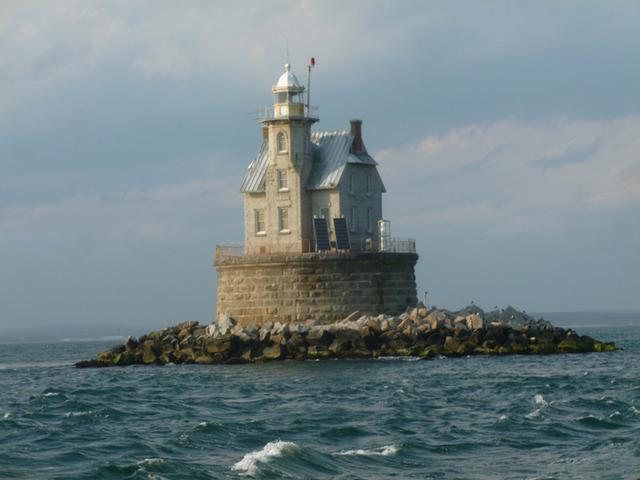
Race Rock Lighthouse

Background & History
Historical context and known paranormal claims surrounding Race Rock Lighthouse.
There is a point in the eastern reaches of Long Island Sound where three bodies of water — the Sound itself, Block Island Sound, and Fishers Island Sound — converge in a narrow channel four miles wide and choked with opposing tidal forces. Mariners have called it The Race for centuries, a name that captures the speed and turbulence of currents that can push six knots and reverse direction entirely with the tide. At the center of this convergence sits Race Rock, a submerged ledge rising only three feet above mean low water, decorated with shipwreck after shipwreck and surrounded by water that behaves like a living thing with bad intentions. The lighthouse that stands on that reef — granite, square at the base, octagonal at the top, its fourth-order Fresnel beam visible fourteen miles at sea — is one of the most consequential feats of American marine engineering, and one of the most persistently reported haunted sites along the Eastern Seaboard.
By 1837, eight vessels had been lost on Race Rock Reef in eight years. Congress appropriated funds for a lighthouse as early as 1838, but the money was never spent, the engineering problem seemingly unsolvable. Buoys couldn't hold in the current. Iron spindles driven eighteen inches into the reef disappeared with the spring ice. The Lighthouse Board reported in 1852 that every conventional approach had been tried and failed. The danger was well-documented; the solution was not. It would take another two decades and a total of $278,716 — and nearly eight years of continuous effort — before the light was finally activated on January 1, 1879.
The man who solved it was Francis Hopkinson Smith, a structural engineer contracted in 1871 who was also, improbably, a painter and novelist — a descendant of Francis Hopkinson, signer of the Declaration of Independence, and later famous for fiction drawn from his own experiences on this reef. Smith had previously built the Block Island breakwater and a seawall on Staten Island; he would later build the foundation for the Statue of Liberty. Race Rock would be his most demanding project. He and his crew — led by master diver Captain Thomas A. Scott — lived on the construction site during working months, erecting a shanty on the partial foundation while the water moved around them. When the initial riprap foundation of 10,000 tons of granite began to shift, Smith donned diving gear himself and went down to examine it. He came up certain the design had to change. The Lighthouse Board resisted; he convinced them. The concrete foundation — a stepped, concentric platform sixty-nine feet in diameter — was poured beginning in 1873. The pier rose from it in fourteen courses of heavy masonry, and the lighthouse itself went up in a single working season in 1878.
The construction was not without its casualties. A boat carrying two hundred pounds of gunpowder exploded at the site, killing workers. The isolated conditions, the violence of the water, and the years of unrelenting labor extracted their price in lives and in men's minds. Smith later transformed those experiences into the novel Caleb West, Master Diver, thinly disguising Race Rock as its setting. The story had already written itself.
Thomas A. Carroll was appointed keeper in 1880. He rowed regularly from Race Rock to Noank for supplies and to visit his family on shore. In January 1885, a severe storm caught him on the mainland and kept him there for several days. When he finally decided he could no longer neglect his post, he pushed his small boat out into the waves alone. He was never seen again. His body was never recovered. Coast Guard crews who later worked maintenance shifts at the lighthouse reported hearing whispers, laughter, and unexplained footsteps moving through the structure. Some reported physical contact — being touched, poked, or pushed — by no visible source. Wet footprints were found leading from the former shower area after the water supply had been disconnected and the fixture removed. Boaters passing at night have reported a shadowy figure visible in the lantern tower when no one is assigned there, illuminated briefly by the rotating beam. Whether the figure belongs to Carroll or to one of the earlier dead — workers from the construction, sailors from the reef's long list of wrecks — has never been resolved.
The lighthouse was automated in 1978, ending any permanent human presence on the rock. In 2004, reportedly at the request of Coast Guard maintenance personnel who continued to report unsettling experiences during equipment checks, The Atlantic Paranormal Society conducted a formal overnight investigation, documented in the fourth episode of the first season of Ghost Hunters on Syfy. The investigation was conducted without electricity or facilities, in harsh weather and rough water. The team reported a chair moving across a room without assistance and an electromagnetic field that tracked consistently up and down the spiral staircase. At the conclusion of the twelve-hour session, investigators stated that Race Rock appeared to be genuinely haunted — an outcome the Coast Guard had hoped to disprove.
Skeptics point to the obvious: Race Rock is exactly the kind of place where the imagination does what it is built to do. Isolated, unlit, accessible only by boat and only in favorable conditions, surrounded by the sound of water that has killed for centuries, the lighthouse sits in the kind of environment that produces reports almost automatically. The spiral staircase creates drafts; the granite structure amplifies sound; the current generates low-frequency vibration detectable in the bones but not in conscious hearing. All of that is probably true. It doesn't account for the consistency of the reports across unrelated witnesses over more than eighty years, or for the specificity of a keeper last seen rowing into a January storm, still attributed by those who work the light as not entirely gone.
Race Rock Lighthouse was added to the National Register of Historic Places in 2005 and transferred to the New London Maritime Society in 2013 under the National Historic Lighthouse Preservation Act. The light remains operational, maintained by the Society and the Coast Guard jointly. Tours are offered occasionally in summer through New London's Custom House Maritime Museum, weather and tidal conditions permitting — the latter qualifier a reminder that the water around Race Rock still sets the terms of everything that happens there.
lighthouse
Suffolk County, New York
New London County
February 26, 2026
Open
People Also Searched For
You Might Also Like

Fort Stanwix stands as one of the most heavily fortified and historically significant military installations in the Mohawk Valley region of New York, a position that earned it status as a crucial defensive position during the colonial period and the Revolutionary War, and subsequently a location of… read more
Rome, New York · fort
The Morris-Jumel Mansion stands as one of the most historically significant structures in New York City, commanding a prominent position in the upper reaches of Manhattan with views across the surrounding urban landscape. Constructed during the colonial period, the mansion represents an exceptional… read more
New York, New York · house
Albany Rural Cemetery occupies a historic burial ground established in 1841 in Albany, New York, where it has served for nearly two centuries as a final resting place for deceased community members and as a significant cultural institution within the regional landscape. The cemetery was founded duri… read more
Albany, New York · cemetery
Have you visited Race Rock Lighthouse?
Share your paranormal experience and help other investigators decide if it's worth exploring.
Activity Breakdown
Types of documented activity recorded at Race Rock Lighthouse, organized by category.
Visual Activity
Audio Activity
Sensory & Environmental
Instrumental Anomalies
Reported Areas
Specific areas within Race Rock Lighthouse where activity has been documented.
Tower
Attic
Shore Leave Area
Known Entities
Entities, spirits, and figures that have been identified or reported at Race Rock Lighthouse.
Shipwreck victims
Thomas Carroll lighthouse keeper
Photos
Images sourced from across the web and linked directly to the original host. Ghouler does not download or host these images, nor do we claim them as our own.
Investigator Reviews
Your trust is our priority, so no location can pay to alter or remove their reviews.
No reviews yet.
Be the first to share your experience at Race Rock Lighthouse.
Find reviews useful? Help others by sharing your experience.
Documented Experiences
Paranormal reports and documented occurrences compiled for Race Rock Lighthouse from archived sources and community investigators.
No documented experiences for Race Rock Lighthouse yet.
Best Times to Visit
Equipment & Methods
Equipment and investigation methods reported by community investigators at Race Rock Lighthouse.
Know Before You Go
Important details to help plan your visit or investigation of Race Rock Lighthouse.
Restricted
Open
Not specified
Sources & References
Referenced materials and documentation supporting the Race Rock Lighthouse case file.
Experience Glossary
Detailed descriptions of each type of activity documented at Race Rock Lighthouse.
Apparitions
Definition
A reported visual sighting of a human-like or shadow-like figure without a physical source.
What People Report
Witnesses describe full-body figures, partial forms, or fleeting silhouettes appearing in hallways, doorways, or peripheral vision. These sightings are typically brief and may vanish when directly observed.
Disembodied Voices
Definition
Audible speech heard without a visible speaker present.
What People Report
Witnesses report whispers, direct responses, conversations, or voices calling their name in otherwise quiet environments. These events may occur during investigations or spontaneously in residential settings.
Shadow Figures
Definition
A dark, human-shaped silhouette seen in peripheral vision or dim lighting.
What People Report
Typically described as featureless and quickly vanishing when directly observed, shadow figures are among the most commonly reported visual phenomena.
Electronic Disturbances
Definition
Malfunctions or unusual behavior in electronic devices without clear technical cause.
What People Report
Lights may flicker, radios activate, batteries drain rapidly, or cameras fail during active investigation periods. These disturbances are often reported in clusters rather than isolated events.
Unexplained Footsteps / Knockings
Definition
Clear sounds of footsteps, pacing, or knocking without a visible source.
What People Report
Often reported in empty upper floors, hallways, or sealed rooms, these sounds may follow distinct rhythms or patterns.
Unexplained Sounds
Definition
Unidentifiable noises such as bangs, growls, music, or movement occurring without environmental explanation.
What People Report
These sounds may be isolated or recurring and are frequently reported during periods of heightened activity.
Tactile Phenomena
Definition
Physical sensations such as being touched, pushed, or brushed with no visible source.
What People Report
Witnesses report sudden pressure on shoulders, hair pulling, cold contact, or the sensation of someone standing close behind them.
Important Notices
Information in this case file is compiled from public sources and community reports. Accuracy cannot be guaranteed. Always verify details before visiting, and check with property owners and local or state authorities to confirm access is permitted.
Access to this location is restricted. Unauthorized entry may result in legal consequences.
Nearby Case Files
Explore New York
- Most haunted places in New York
- Haunted Lighthouses in New York
- Paranormal locations near Suffolk County
- New London County hauntings
- Haunted Asylums in New York
- Haunted Bar / Restaurants in New York
- Haunted Battlefields in New York
- Haunted Bridges in New York
- Haunted Buildings in New York
- Haunted Cemeteries in New York
Browse by Haunt Type
Phenomena & Experiences
- Apparition reports
- Full-Body Apparition reports
- Shadow Figure reports
- EVP reports
- Disembodied Voice reports
- Unexplained Footsteps / Knockings reports
- Poltergeist reports
- Object Manipulation reports
- Cold Spot reports
- EMF Anomaly reports
- Intelligent Haunting reports
- Residual Haunting reports
- Sense of Presence reports
- Phantom Smell reports
- Electronic Disturbance reports