
Full-Body Apparition Sightings
847 haunted locations
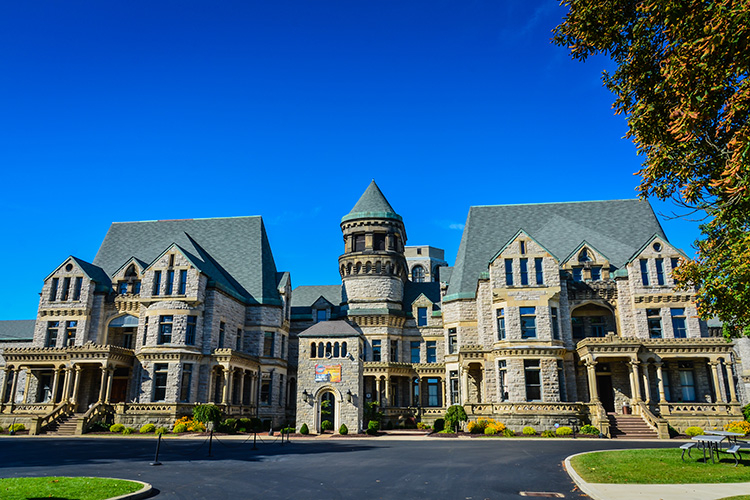
Ohio State Reformatory
Rising from the edge of Mansfield, Ohio, the Ohio State Reformatory looks exactly like what most people picture when they think of a haunted prison—a towering limestone fortress with Gothic turrets, arched windows, and a scale that seems impossible for a building that was never meant to be a maximum-security facility at all. But the Reformatory's origins weren't built on punishment. They were built on the belief that young men could be saved. The land itself carries history before the first stone was laid. The field where the Reformatory stands once served as Camp Mordecai Bartley, a Civil War training ground for Ohio soldiers. In 1867, Mansfield was selected as the site for a new state prison intended to fill the gap between juvenile corrections and the full Ohio State Penitentiary in Columbus. The city raised $10,000 to purchase the land. Construction began in 1886 under Cleveland architect Levi T. Scofield, who blended Victorian Gothic, Richardsonian Romanesque, and Queen Anne styles into a structure specifically designed to inspire moral renewal—its grandeur meant to encourage inmates toward repentance rather than despair. The first 150 prisoners arrived by train in 1896, and construction wouldn't be completed until 1910. Unlike locations shaped by a single catastrophe, the Reformatory's weight comes from a century of drift. The original mission was genuinely rehabilitative—inmates received religion, education, and a trade, with 18-month sentences that could end early for good behavior. By most accounts, the model worked. But as Ohio's criminal population grew and the facility became overcrowded, the state began sending more serious offenders to Mansfield. By the mid-twentieth century, rooms designed for one inmate held two or three. Violence became routine. Guards were killed. Inmates were murdered, drove themselves to suicide, or died from disease. Over 154,000 men passed through the gates before the building was ordered closed in 1990 following a federal class-action suit over inhumane conditions. Just outside the walls, 215 numbered graves mark the ones who never left. The building itself demands attention. The six-tier East Cell Block is widely cited as the largest freestanding steel cell block in the world—a canyon of iron that rises through the interior like something industrial and medieval at once. The warden's quarters, the chapel, the solitary confinement wing, and the basement all carry their own atmosphere. The Hole—a row of pitch-black isolation cells in the basement—is described by visitors as one of the most oppressive physical spaces they have ever entered. Natural light barely reaches the lower levels. The upper tiers stretch upward in iron rows until they disappear into shadow. Paranormal claims at the Reformatory are among the most extensively reported of any site in the Midwest. Visitors and investigators describe shadow figures moving across the upper tiers, unexplained voices in the cellblocks, and the sensation of being followed through otherwise empty corridors. EVP sessions regularly produce what investigators describe as direct, responsive communication. Some guests report being physically touched, grabbed, or scratched with no one nearby. Specific areas generate consistent accounts across unrelated visitors. The Hole produces reports of sudden nausea, cold air, and the feeling of being crowded in a space barely large enough to stand in. The basement is associated with two distinct presences—one described as a young boy, light and flickering, the other heavier and threatening. The warden's quarters carry stories of Helen Glattke, wife of longtime superintendent Arthur Glattke, who died in 1950 from an accidental gunshot wound inside the residence. Investigators report the scent of roses—her signature perfume—in rooms where no one has been. The chapel brings reports of whispered voices and phantom organ tones. Skeptics note that a century-old limestone structure of this scale naturally generates sounds, temperature swings, and optical oddities. The documented history of violence, suffering, and death embedded in this place is powerful enough to shape what any visitor expects to find before they step inside. That suggestion cannot be discounted. Still, the consistency of independent reports across decades, and across visitors with no prior knowledge of specific locations, gives even skeptical investigators reason to pause. Today the Reformatory is operated by the Mansfield Reformatory Preservation Society, which purchased the building from the state of Ohio for one dollar in the mid-1990s and has worked to restore it ever since. It is listed on the National Register of Historic Places, welcomes over 120,000 visitors annually, and is recognized worldwide as the primary filming location for The Shawshank Redemption. But the movie connection is only part of what draws people here. Some come for the architecture. Some come for the film history. Many come for the chance to spend a night in the East Cell Block, lights off, listening. Almost all of them leave with something they didn't have when they arrived—a story they struggle to explain, and a quiet conviction that the Ohio State Reformatory is far from empty.
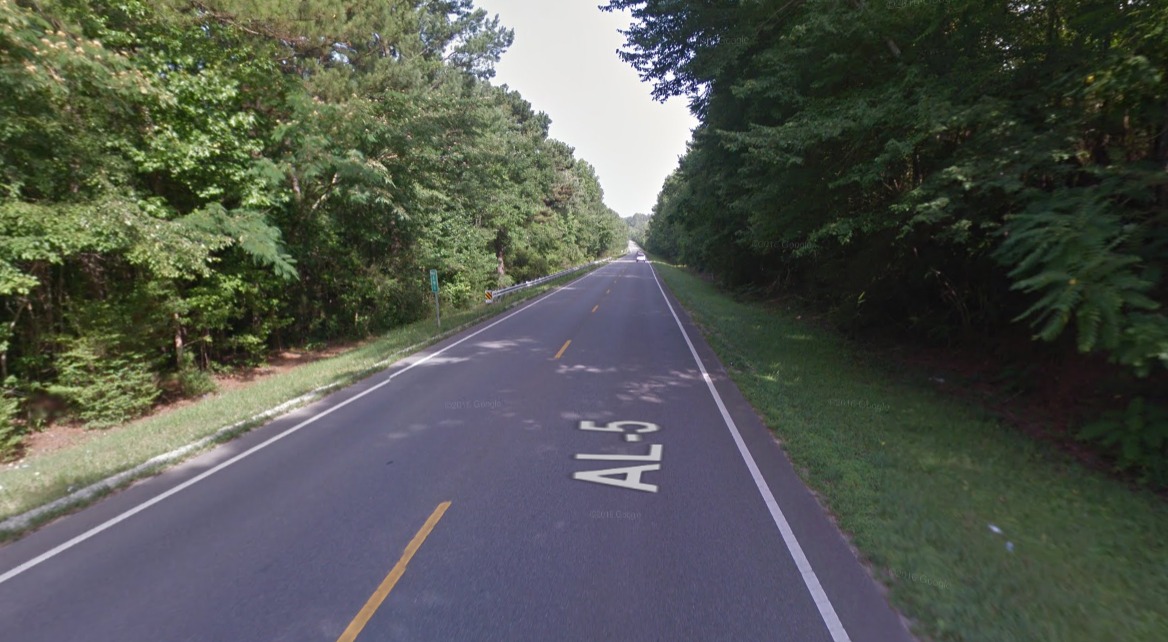
Highway 5 Ghost
Running through the piney hills of northwest Alabama, Highway 5 cuts a quiet and largely unremarkable path through Winston County, connecting communities like Natural Bridge to the north and Jasper to the south. The road passes directly through Lynn, a small town that today holds a population of just over 800 people and barely registers on most maps of the state. But among truck drivers who haul freight through this stretch of Alabama backroad, Lynn carries a reputation that has circulated for generations — and that reputation has nothing to do with farming, lumber mills, or the Northern Alabama Railroad that first gave the town its name. The area around what is now Lynn began to be settled as early as 1814, five years before Alabama achieved statehood. In 1888, a local landowner named John White Lynn donated land for a railroad right-of-way with the condition that the surrounding community bear his name. A post office followed that same year, and the lumber industry arrived behind the railroad, briefly expanding the population before the mills shuttered and the town settled into the quiet it has kept ever since. Lynn was not formally incorporated until 1952, a vote held largely to legitimize a local pool room under state law. By any measure, this is not a place built around drama or notoriety. Winston County itself was forged in isolation — its craggy hills and rocky terrain leaving settlers outside the mainstream geographically, economically, and politically. During the Civil War, residents famously resisted joining the Confederacy, having no large plantations and virtually no enslaved labor, and at one point attempted to declare themselves the independent Free State of Winston. It is the kind of place where independence runs deep, where stories are passed down through families rather than written into official records, and where a legend can take root on a rural highway and outlast every person who first told it. The ghost of Highway 5 belongs to that tradition. The story holds that many years ago, on a rainy night in Lynn, a teenage girl was traveling home from prom with her boyfriend when an argument broke out. She asked to be let out, he complied, and she walked the rest of the way alone. While making her way along the side of the highway, she was struck by an 18-wheeler. The driver fled the scene, and her body was found the next morning in a ditch. The details shift depending on who is telling it — some versions place the argument at a local dragstrip, others at a prom, and some name a coal truck rather than a semi. One researcher who spent years combing through county and state records reported finding no documentation of a girl killed on that road at all, leaving the origin story unverifiable and the legend untethered to any confirmed event. What cannot be dismissed as easily are the accounts themselves. The central claim is consistent across dozens of reports: if an 18-wheeler travels Highway 5 on a rainy night, the girl will climb onto the side of the truck and peer in through the cab window, searching for the face of the man who killed her. Many truckers, rather than risk the encounter, chose to reroute entirely onto Highway 13 — a significantly longer detour — rather than pass through that stretch after dark. Some accounts describe her appearing in a long white dress, standing clean and dry at the road's edge despite rain and mud, then vanishing completely from the side mirrors of passing trucks. Others describe a knock on the cab door, a face at the glass, a figure that simply disappears. One account from 1999 describes a trucker so convinced he had struck someone that he stopped, called 911, searched the entire undercarriage of his vehicle, and found nothing — no body, no damage, no sign of impact. Another driver described pulling alongside a young woman and offering her a ride, only to have her exit near the drag strip and dissolve into the dark. Some versions of the legend include a resolution: the driver who struck the girl eventually confessed his crime, and after that, the activity along the highway diminished noticeably. Whether that detail was added to give the story a clean ending it never had, or whether it reflects something that actually quieted a restless presence, depends entirely on what you believe is happening on that road. Skeptics have reasonable ground to stand on. A narrow, poorly lit rural highway in rainy conditions produces exactly the kinds of visual distortions and psychological pressure that generate sightings. The legend is old enough and well-traveled enough that any driver who knows it arrives already primed to see something. And without a verifiable death to anchor the story, the whole structure floats on folklore alone. But the accounts keep coming — from truckers who had never heard the legend before stopping, from locals who grew up miles from the spot and still won't drive it alone at night, from people whose experience of that road defies easy explanation. Highway 5 doesn't have a ruined building or a documented death toll. It has something simpler and in some ways harder to shake — a stretch of open road in a small Alabama town where the darkness feels occupied, and where the rain, when it comes, still makes certain drivers choose a longer way home.

Gettysburg Battlefield
Spread across more than six thousand acres of rolling Pennsylvania farmland, the Gettysburg Battlefield does not look like a place where over fifty thousand men were killed, wounded, or went missing in three days. It looks like what it was before the armies arrived—a patchwork of wheat fields, orchards, low stone walls, and gentle ridges converging on a small crossroads town in Adams County. That ordinariness is part of what makes it so unsettling. In the summer of 1863, Confederate General Robert E. Lee launched his second invasion of the North, hoping to win a decisive battle on Union soil that might break Northern morale and force a negotiated end to the war. The armies collided at Gettysburg almost by accident on July 1, and over three days more than 165,000 soldiers fought across farms, hills, and streets in engagements that became legend—the defense of Little Round Top, the carnage at Devil's Den and the Wheatfield, and the doomed Confederate assault known as Pickett's Charge. The estimated 51,000 casualties included over 7,000 dead left on the field. It was the bloodiest single battle in American military history and the turning point of the Civil War. What followed was nearly as harrowing. Gettysburg's 2,400 residents were left with roughly 21,000 wounded, thousands of dead horses rotting in the July heat, and bodies everywhere. Homes, churches, and barns became hospitals. Burial parties worked by lantern light, digging trenches sometimes only ten inches deep, leaving hands and feet exposed. Rain on July 4 unearthed shallow graves. The stench hung over the town for months. One family left for nine years because the smell made their home uninhabitable. Of the 3,354 Union dead eventually interred in the Soldiers' National Cemetery—dedicated by Lincoln that November—979 remain unknown. The paranormal reputation of Gettysburg is as vast as the battlefield itself. Devil's Den produces some of the most consistent accounts—cameras and electronics malfunctioning, mysterious figures appearing in photographs, distant gunfire echoing off the rocks, and encounters with a barefoot man in ragged clothing who speaks briefly before vanishing. At Little Round Top, visitors report apparitions and phantom drumbeats. Across the Pickett's Charge fields, witnesses describe formations of soldiers still marching toward the ridge. Iverson's Pits—the site of a mass grave—has long been associated with apparitions and impressions of bodies in the grass. At Sachs Covered Bridge, visitors report phantom cigar smoke, distant cannon fire, and the sensation of being tapped on the shoulder by no one. Inside Gettysburg College's Pennsylvania Hall, which served as a Confederate field hospital, reports describe an elevator bypassing the first floor to open on a basement scene of Civil War-era surgical operations. Park rangers have privately described hearing crying, footsteps, and the smell of tobacco in battlefield structures, though the National Park Service issues no official statements on the subject. Skeptics rightly note that a landscape this saturated with historical narrative will prime visitors to interpret ordinary stimuli as extraordinary. But the sheer volume and consistency of reports—from tourists, historians, park employees, and investigators with no particular agenda—gives the place a reputation that resists easy dismissal. Today, Gettysburg National Military Park includes over 1,300 monuments and memorials. The Soldiers' National Cemetery holds over 6,000 burials spanning six American conflicts. The fields are walkable. The stone walls still stand. And for a place where the dead were once measured not in names but in trenches, the quiet has never entirely settled.

Sanger Mansion – Sangerfield House
Rising from the crest of West Hill between the villages of Waterville and Oriskany Falls, the Sanger Mansion commands the kind of view that was never accidental. The main entrance overlooks Waterville to the east. The terrace faces Madison to the south. The stone walls, quarried from Oxford, give the structure the appearance of something closer to a castle than a country home—a 52-room estate spread across 61 acres of wooded hills, pastures, and farmed fields, with grounds designed by the Olmsted firm, the same landscape architects responsible for Central Park. It is one of the grandest private residences ever built in central New York, and for more than a century it has carried a reputation that extends well beyond its architecture. The man who built it came from a family already woven into the region's history. Colonel William Cary Sanger was born in Brooklyn in 1853 and descended from Richard Sanger, who arrived in Hingham, Massachusetts, around 1636. His great-great-grandfather was a member of the Provincial Congress that convened at Cambridge in 1775. His great-uncle, Jedediah Sanger, was the first settler of the town of New Hartford and the first judge of Oneida County—the township of Sangerfield itself bears the family name. After graduating from Harvard in 1874 and earning a law degree from Columbia in 1878, Sanger built a distinguished career in law, politics, and military service. He served as a colonel in the New York State National Guard, represented Oneida County in the State Assembly from 1895 to 1897, and was appointed United States Assistant Secretary of War under Theodore Roosevelt from 1901 to 1903. He later chaired the National Guard Commission, served on the New York State Lunacy Commission, and led the American delegation to the International Red Cross Conference in Geneva. In 1892 Sanger married Mary Ethel Cleveland Dodge and moved to Sangerfield, initially building a home called "The Maples" on nearby land. By 1906, construction had begun on the mansion itself, with a contractor and thirty to forty men raising the stone walls on the hilltop. The interior held between thirty and forty rooms, including servant's quarters in the north wing. The house was filled with life-size family portraits, antique furnishings, clocks from around the world, battle weapons dating to the age of the lance, and a suit of armor. Sanger died in New York City in December 1921 after contracting pneumonia following surgery. The estate passed to his son, William Cary Sanger Jr., a writer and World War I veteran who had served in military intelligence and with the American Embassy in Paris. The mansion's trajectory after the family's stewardship is where the story begins to shift. Around 1960, the property was sold to the Stigmatine Fathers and converted into a monastery. Monks lived and worked in the building through the early 1970s, and local craftsmen were brought in for restoration—one carpenter's daughter later recalled her father enjoying lunches with the monks while working to return the house to its original condition. After the monastery closed, the property's history grows murky. It was donated to a camp organization around 1990 and later sat on the market for years. In the 1970s, the Hall family purchased the house from the Stigmatine Fathers and raised Clydesdale horses on the property—the Budweiser horses were reportedly kept in the large horse barn. The family raised four daughters there before selling to a Boston buyer who never occupied the house. After a period of abandonment, subsequent owners invested heavily in restoration. The paranormal claims at Sangerfield House center on the monastery period and its aftermath. Visitors and residents have long reported seeing the ghosts of monks wandering both the house and the surrounding grounds—robed figures moving through hallways and appearing near windows. The most frequently cited modern account comes from a caretaker who witnessed the apparition of a woman standing in a second-floor window. Several paranormal investigation teams have explored the mansion over the years, reporting EVP captures and anomalous photographs. But the most compelling testimony comes from someone who actually lived there. A member of the Hall family, who resided in the house for a decade during the 1970s and 1980s, confirmed plainly that the house is haunted—but described the presence as friendly and loving, an entity the family came to call Henry. In their telling, Henry was not something to fear but something to coexist with, a presence that inhabited the house alongside them without malice. The mansion has been a private residence since 2006, and the current owners do not welcome trespassers or unauthorized visitors. The stone walls still hold. The Olmsted-designed grounds still frame the hilltop. And whether the monks who once walked those halls left something of themselves behind, or whether Henry predates them all, remains a question the house keeps to itself.
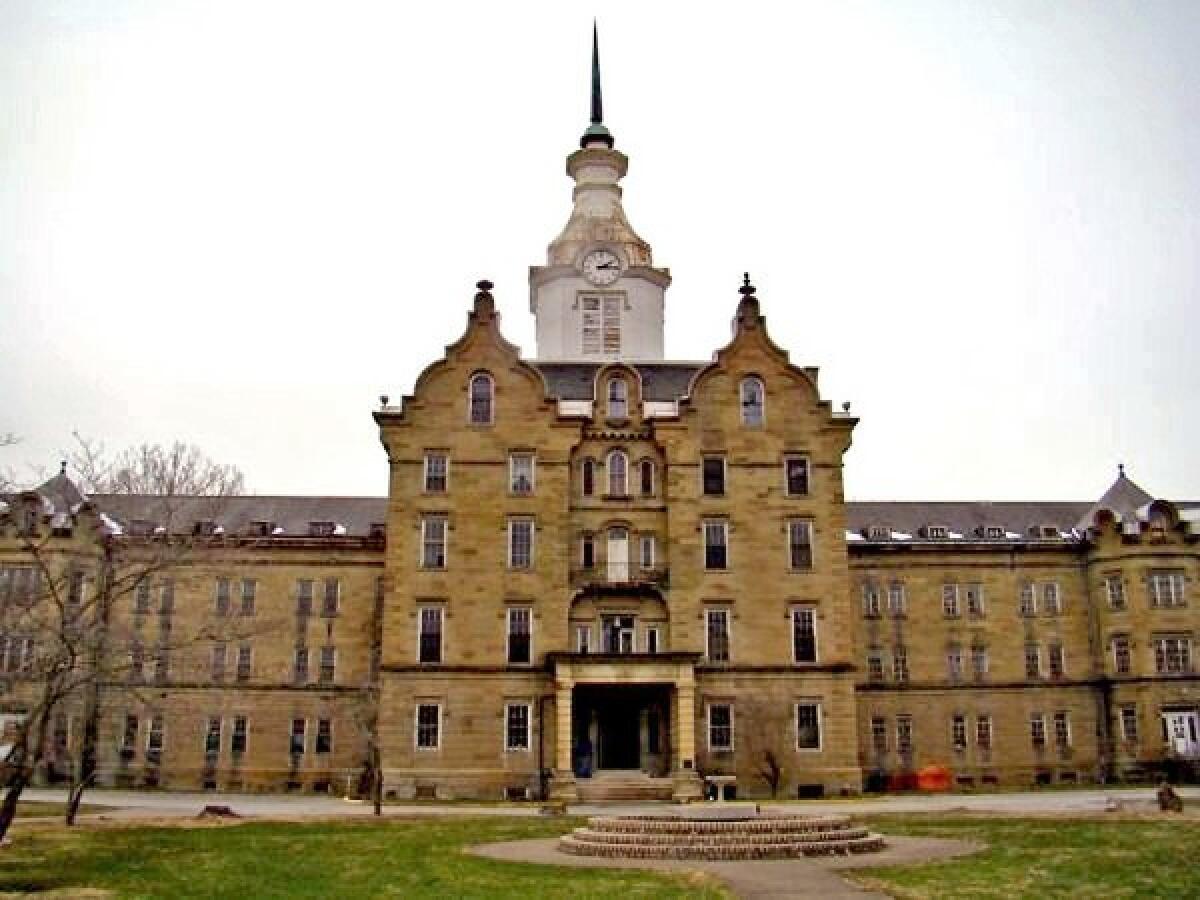
Trans-Allegheny Lunatic Asylum
Stretching nearly 1,300 feet across a hillside above the West Fork River in Weston, West Virginia, the Trans-Allegheny Lunatic Asylum is a building that defies casual description. Its staggered Gothic and Tudor Revival wings fan outward from a 200-foot central clock tower in a formation so massive it reads more like a fortified compound than a hospital. The walls are two and a half feet of hand-cut sandstone. There are over 900 windows and 900 doors across four floors and 242,000 square feet of interior space. It is reportedly the largest hand-cut stone masonry building in North America, second in the world only to the Kremlin. And for 130 years, it held some of the most vulnerable people in Appalachia behind those walls — first with the intention of healing them, and eventually with little intention at all. The Virginia General Assembly authorized the asylum in the early 1850s, part of a national wave of mental health reform driven by activist Dorothea Dix. The building was designed by Baltimore architect Richard Snowden Andrews following the Kirkbride Plan, a progressive model that emphasized fresh air, natural light, and the therapeutic power of environment. Each wing was staggered so that every room received sunlight and cross-ventilation. The capacity was set at 250 patients, reflecting the belief that a superintendent could only manage so many individuals while maintaining quality of care. Construction began in 1858, but the Civil War intervened almost immediately. The partially built structure was seized by Union forces and converted into Camp Tyler, and control of the site changed hands multiple times during the conflict. Confederate raids in 1862 and 1863 disrupted operations, and a final raid in 1864 stripped the building of food and clothing intended for its first patients. Despite all of this, the asylum opened that same year under the name West Virginia Hospital for the Insane. In its early decades, the facility functioned roughly as intended. Patients worked on a self-sustaining farm spread across more than 600 acres, learned trades like sewing and furniture-making, and lived in conditions that — by the standards of the era — represented genuine progress. But the population grew relentlessly. By 1880, the asylum held over 700 patients. By the 1930s, nearly 1,700. At its peak in the 1950s, more than 2,400 people were crammed into a building designed for a tenth of that number. The reasons for admission had long since expanded beyond what any modern definition of mental illness would recognize — patients were committed for conditions including epilepsy, alcoholism, domestic troubles, and even laziness. The overcrowding brought conditions that were nothing short of catastrophic. A series of investigative reports by the Charleston Gazette documented the deterioration in vivid terms, describing wards without adequate furniture, heating, or sanitation. Patients slept on floors. Some were locked in cages. Isolation cells still bear the rusted iron rings once used to restrain the most violent. The asylum also became a site for Walter Freeman's lobotomy project in the early 1950s, an effort by the state to reduce patient populations through surgical intervention. Thousands of procedures were performed using Freeman's transorbital method. The results were often devastating — patients left without affect or personality, their neural connections severed by a tool inserted through the eye socket. Combined with insulin shock therapy and electroconvulsive treatment, the facility's medical legacy is one of experimentation carried out on a population with no ability to refuse. A patient named Dean was murdered by two fellow inmates in a back room at the end of a wing, past the solitary confinement cells, where staff had no awareness of what was happening. The building's sheer scale made oversight impossible. The asylum finally closed in 1994 after decades of decline. The property sat abandoned until 2007, when Joe Jordan purchased the 242,000-square-foot main building at auction for $1.5 million. It reopened in 2008 as a historical and paranormal tourism destination, and it has since appeared on Ghost Hunters, Ghost Adventures, Paranormal Lockdown, and numerous other programs. Paranormal claims at Trans-Allegheny are extensive and tied closely to specific individuals whose stories are part of the building's documented history. The most widely reported spirit is Lily, a child believed to have been born inside the asylum to a patient and to have died of pneumonia at age nine, never having lived outside its walls. Her room in Ward Four on the first floor has been converted into a small shrine filled with toys and gifts left by visitors. Staff and guests report hearing a child's laughter, feeling small hands tug at clothing, and watching balls roll across the floor without visible cause. On the same floor, a spirit known as Ruth — described in life as a female patient with an intense hostility toward men — is said to throw objects at male visitors near her former holding cell. The third floor produces reports associated with a patient called Big Jim and a nurse named Elizabeth. The fourth floor generates accounts of a spectral Civil War soldier named Jacob. In the back rooms of one wing, investigators describe a dual energy in the space where Dean was killed — a childlike gentleness when encountered alone, and an oppressive coldness when the presence of his killers seems to enter the space alongside him. A figure known as Slewfoot, a patient who was slashed to death in a bathroom, is reported throughout the building. Beyond the named spirits, the asylum generates the kind of broad, ambient reports common to buildings of this scale and history — disembodied voices, shadows moving through empty corridors, cold spots, unexplained sounds of breaking glass, and the sensation of being watched or physically touched. The underground tunnel system used by staff to move unseen between buildings has its own claims, including the smell of baked goods attributed to a former chef. Skeptics have no shortage of material to work with. A building this old, this enormous, and this deteriorated will produce sounds, temperature shifts, and visual anomalies entirely on its own. The cultural expectation visitors carry into any asylum-turned-attraction shapes perception before a single door opens. But the consistency of reports across decades — from staff, casual tourists, television crews, and seasoned investigators — and the specificity with which encounters map onto documented residents and events, makes the Trans-Allegheny file difficult to set aside entirely. Today the asylum operates year-round, offering historical day tours, nighttime paranormal tours, and overnight ghost hunts that run from 9 p.m. to 5 a.m. The first-floor museum preserves patient artwork, medical equipment, restraints, and a restored ward. The remaining twenty-three wards are largely untouched — endless decayed hallways, vacant rooms, and isolation cells open to anyone willing to walk them. The clock tower still rises above Weston. The wings still stretch outward. And the building, for all its emptiness, does not feel empty at all.

Belleview-Biltmore Hotel
For more than a century, the Belleview-Biltmore Hotel commanded one of the highest points along Florida's Gulf Coast, its white clapboard exterior and green-shingled roofline visible for miles across Clearwater Bay. Known as the "White Queen of the Gulf," the massive Queen Anne–style structure was one of the largest occupied wooden buildings in the United States—a sprawling 350,000-square-foot monument to the Gilded Age ambition that transformed Florida from frontier into winter playground. Its story is one of opulence, slow decline, and a demolition that erased most of the original structure but could not, according to decades of witness accounts, erase everything that happened inside it. The hotel was the creation of Henry B. Plant, a railroad and shipping magnate who spent the late nineteenth century building a transportation empire along Florida's western coast. Plant purchased the Orange Belt Railway in 1895 and recognized that the rail line alone would not generate sufficient tourist traffic without significant accommodations. He commissioned a massive resort on a bluff overlooking the bay between Clearwater and St. Petersburg. Construction began in 1896, and the Hotel Belleview opened January 15, 1897. Built primarily of native Florida heart pine, it featured peaked gables, deep verandas, steam-generated electricity, Tiffany glass, and a resident orchestra. Three long wings fanned from a central core, creating an interior of seemingly endless corridors, stairwells, and hidden service passages. The hotel drew America's industrial aristocracy immediately. The Vanderbilts, DuPonts, and Studebakers were regular guests. Railroad presidents arrived in private cars on the hotel's own siding. Among the more colorful figures in the hotel's history was Maisie Plant, who married Henry Plant's son Morton after Morton reportedly offered her existing husband eight million dollars to step aside. Maisie later traded the Plant family mansion on Fifth Avenue to the jeweler Cartier in exchange for a double strand of Oriental pearls valued at over a million dollars. According to persistent local legend, she lost those pearls somewhere inside the Belleview—a story that has become inseparable from the hotel's paranormal lore. During World War II, the hotel was requisitioned to house servicemen stationed at MacDill Air Force Base, adding another layer of transience to the building's dense history. Through the decades, the guest list included Presidents Ford, Carter, George H. W. Bush, and Obama, along with Margaret Thatcher, the Duke of Windsor, Thomas Edison, Babe Ruth, and Bob Dylan, who rehearsed for his 1976 Rolling Thunder Revue tour in the hotel's Starlight Ballroom. Decline set in during the 1970s as newer beachfront properties drew tourists elsewhere. The hotel was added to the National Register of Historic Places in 1979 but closed in 2009. Despite efforts by preservation organizations, demolition began in 2015. A portion of the 1897 structure was saved, relocated, and restored as the Belleview Inn, a boutique hotel that opened in 2018. The paranormal reputation of the Belleview-Biltmore was among the most widely reported of any hotel in Florida, drawing national attention through a Travel Channel Weird Travels episode filmed in 2004 and regular ghost tours in its final years. The most iconic claim involves Maisie Plant herself—guests and staff reported an apparition in a white dress and hat drifting through corridors and ballrooms, seemingly searching for her lost pearls. At least one investigator described seeing a full-bodied apparition matching this description. Other recurring reports included transparent elevator operators who vanished before reaching their floor, poltergeist activity involving doors banging and lights switching on unprompted, and dresser drawers opening on their own in occupied rooms. Guests on the first floor frequently heard children running through hallways at night, consistent with the fourth floor's historical use as quarters for servants and children kept out of sight during the Gilded Age. Room 4336 carried a specific legend involving a bride who allegedly leapt from its balcony after her husband was killed. The sealed fifth floor was described by paranormal teams as the most active area in the building, home to an aggressive presence investigators called "the angry man," alongside equipment anomalies, cold spots, and unexplained footsteps. A couple photographed at the base of a stairway during a 2004 holiday party discovered, upon developing their film, a misty white figure hovering above them that had not been visible to the naked eye. Today the Belleview Inn preserves a fragment of the original building, restored with heart-pine flooring, wainscoting, and original Tiffany glass. Most of the hotel's immense footprint is gone—the sealed fifth floor, the service tunnels, the rooms where guests heard running children and felt unseen hands. Whether the spirits that reportedly inhabited the White Queen survived demolition is a question no one can answer. But for over a century, the Belleview-Biltmore carried the kind of accumulated presence—grief, glamour, war, and loss—that tends to leave traces deeper than any wrecking crew can reach.
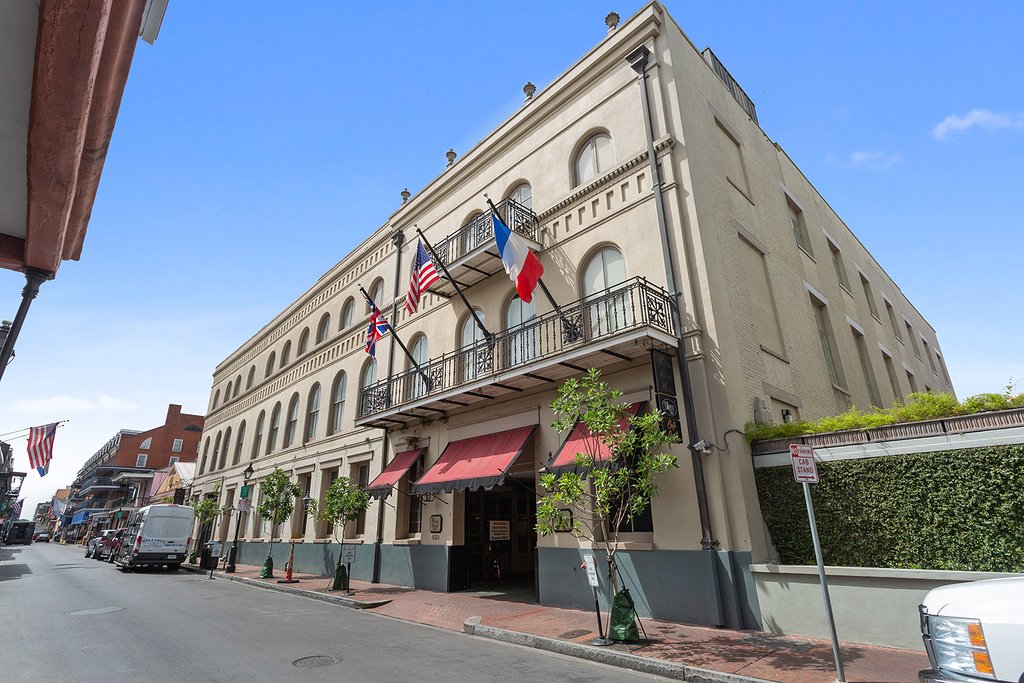
Prince Conti Hotel
At 830 Conti Street in the French Quarter of New Orleans, the Prince Conti Hotel occupies a building dating to the early 1900s, sitting on a block that has cycled through nearly every identity the Quarter has to offer—residence, commerce, vice, hospitality, and, if the accounts are to be believed, something that refuses to vacate regardless of what the current management has planned. The hotel is a small property by New Orleans standards, with just over fifty rooms tucked into a historic townhouse structure steps from Bourbon Street. It is operated by the Valentino family, who have run hotels in the French Quarter for over sixty years. The ground floor houses the Bombay Club, an upscale bar known for its martini list, Creole cuisine, and a resident spirit the staff has been dealing with for decades. Conti Street is named for the Princess Conti—originally the name given to what is now Bourbon Street before an early colonial renaming shuffled the designations. The street runs deep into French Quarter history. At 1026 Conti, just two blocks away, the infamous Norma Wallace operated the last major brothel in New Orleans from the late 1920s through the mid-1960s, entertaining governors, gangsters, and celebrities in a parlor house that ran nearly four decades before District Attorney Jim Garrison shut it down. Wallace's story ended in 1974 when she shot herself after learning of her husband's infidelity. Her building, an 1830s townhouse, is now condominiums—and reportedly still haunted. Farther up the block, the site of what is now the Williams Research Center once housed the Rising Sun Hotel in the 1820s, a property whose archaeological remains have yielded artifacts suggestive of early commercial sex work and whose name may have inspired one of the most famous folk songs in the English language. Conti Street has never been quiet. The Prince Conti Hotel's primary haunting centers on a figure the staff has named Sophie. According to paranormal researchers, Sophie is believed to be the spirit of a madam who operated on the premises before the building became a hotel. Her identity has never been established, but staff members have encountered her in the kitchen, the bar, and at Booth 3 of the Bombay Club. She is described as a presence rather than a full apparition—felt more often than seen, though some accounts describe a spectral woman visible in the bar during quiet hours. Guest accounts extend well beyond Sophie. Visitors on the upper floors—particularly the third floor—report a striking range of experiences. Multiple guests describe being nudged or physically shaken while asleep, only to find the room empty. One guest reported their mattress bouncing as though someone had sat down hard at six in the morning. Another described the full weight of a body pressing down on them during the night. Showers have turned on by themselves. Doors securely locked have been found standing wide open. A concierge reportedly confirmed that doors had been known to fly open on their own, accompanied on at least one occasion by a visible apparition. Objects have fallen from surfaces without explanation. Curtains have swung open untouched. In Room 361, a couple watching television reported their shower turning on for several seconds, followed by a bag of chips falling off the nightstand—and in the morning, a plugged-in diffuser was found unplugged from the wall. What makes these accounts notable is not their dramatic quality—by New Orleans haunted hotel standards, they are restrained—but their consistency across unrelated guests over many years, and the physical nature of the interactions. The nudging, the pressure, the bed-shaking describe contact, not atmosphere. Skeptics will note that old French Quarter buildings settle, plumbing acts unpredictably, and doors in century-old structures don't always stay shut. New Orleans humidity warps wood and metal alike. Guests arriving after a night on Bourbon Street are not always reliable witnesses. But the Prince Conti's accounts carry a specificity—particular rooms, particular times, particular physical sensations—that environmental explanations don't fully cover. Today the Prince Conti Hotel continues to operate at 830 Conti Street, offering the Bombay Club downstairs, Cafe Conti in the mornings, and a location at the center of one of the most historically layered streets in the most historically layered neighborhood in America. Sophie, if that is her name, appears to have no intention of checking out. And on the third floor, something still seems to think the beds could use one more occupant.
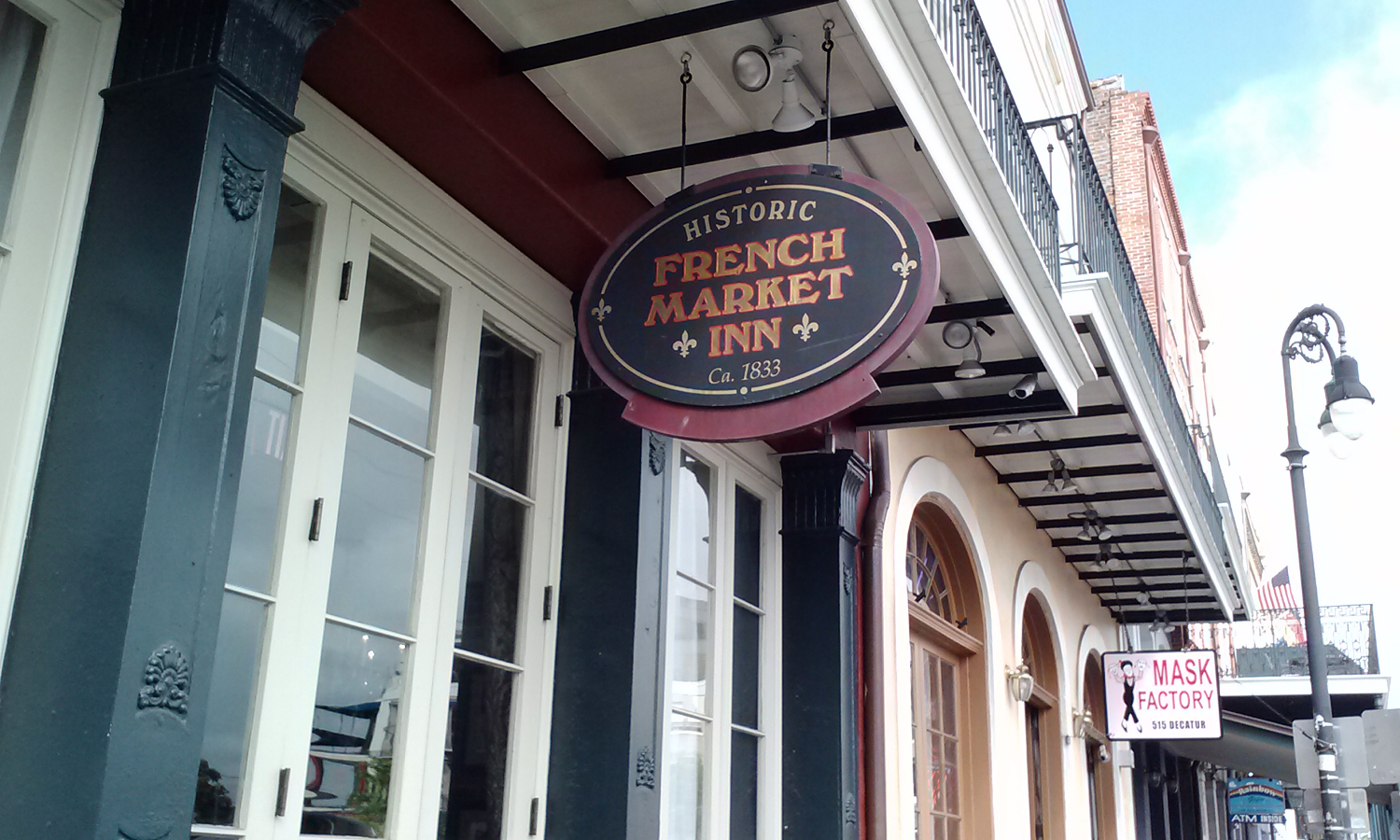
French Market Inn
The French Market Inn sits at 509 Decatur Street in the heart of the French Quarter, a few steps from Jackson Square and within earshot of the Mississippi River. Its antique brick façade opens onto a lobby of period paintings, chandeliers, and marble, and a stone-paved courtyard shaded by greenery—the kind of place that looks exactly like what visitors expect from historic New Orleans. What most of them do not expect is what has been reported inside its rooms for nearly two centuries. The property dates to 1722, when the original deed was issued to a baker named Dreux, whose family operated a bakery on the site throughout the eighteenth century, using a pulley system to hoist goods between floors. The building was later acquired by Baron Joseph Xavier de Pontalba, husband of the formidable Baroness Micaela Almonester de Pontalba, whose business empire still marks the French Quarter landscape in the form of the iconic Pontalba Buildings flanking Jackson Square. By the 1830s, the property had been converted into an inn, and it has operated as one in various forms ever since. The current French Market Inn, run by the Valentino family for over sixty years, maintains more than a hundred guest rooms, many still showcasing the original exposed beams and brick walls of the centuries-old structure. The hauntings were first recorded in 1832, shortly after the building began receiving guests. Visitors reported misty shapes entering their rooms after dark and loud metallic clanging echoing through the halls—sounds consistent with the old pulley system from the Dreux bakery era, operating in a building where no such equipment had functioned for decades. Those two phenomena—shadow figures and phantom mechanical sounds—have persisted without interruption for almost two hundred years. But the claim that has defined the French Market Inn's paranormal reputation is far more visceral. Guests have reported waking in the night to find their pillowcases, sheets, and sometimes their own skin marked with bloody handprints. The accounts are not limited to a single era or a handful of visitors. They span decades and continue to the present day, with guests who had no prior knowledge of the inn's reputation describing nearly identical experiences. One guest recounted waking drenched in what appeared to be blood, covering both occupants of the bed and the headboard, with neither person bearing any wound. The prevailing legend attributes the blood to the spirit of a prostitute who was murdered by a client on the property—a cry for help that manifests in the most startling way possible. No historical record has confirmed the specific murder, but the reports have proven remarkably resistant to debunking by their sheer volume and consistency. Beyond the handprints, guests describe beds shaking violently in the middle of the night with no seismic explanation, lamps clicking on and off in pitch-dark interior rooms, showers activating on their own, cold spots appearing without cause in the humid New Orleans air, shadow figures passing through walls, and the unmistakable sensation of being watched or physically touched. Room 218 has drawn particular attention from investigators. One paranormal researcher who stayed there reported being kept awake all night by unseen presences and an alarm clock that triggered repeatedly without being set. A guest on the third floor described waking to find her pillow being tugged beneath her head, and her daughter woke to a black figure standing between her bed and the windows. When they reported the incident to the front desk, the night clerk asked which room, then said simply that they did not get many reports from that floor. The French Market Inn does not hide from its reputation—the hotel's own website acknowledges the hauntings as part of its history. It remains one of the most popular and consistently booked properties in the French Quarter, operated with the warmth and professionalism the Valentino family is known for. The courtyard is still beautiful. The rooms are still charming. And the walls are still the same centuries-old brick that has absorbed whatever it is that keeps making itself known after dark.

Stevenson House
The Stevenson House stands at 530 Houston Street in Monterey, California, a two-story Spanish Colonial adobe set back from the road behind trees and gardens in the heart of the old town. It is a quiet building on a quiet street, operated by the California Department of Parks and Recreation as part of Monterey State Historic Park, and best known as the place where a young, unknown, gravely ill Scottish writer named Robert Louis Stevenson spent the autumn of 1879 recovering from tuberculosis and courting the woman who would become his wife. The house bears his name and holds one of the world's most important collections of his personal belongings. But the ghost that has occupied the building for nearly eight decades is not Stevenson's. It belongs to the woman who ran the place before he ever arrived—and who died there trying to save her grandchildren from a disease she could not outrun. The original adobe was built around 1836 by Don Rafael Gonzalez, the customs administrator at the Port of Monterey during the Mexican era. The walls are a mixture of chalk rock laid in mud mortar and wood frame, plastered in limestone, with a bracketed shingled roof. After California passed to the United States, the building changed hands and purposes. In the late 1860s, a Swiss immigrant of French descent named Juan Girardin purchased the property with his second wife, a local Mexican woman named Manuela Perez. The Girardin family renovated the structure and opened it as the French Hotel, which became one of Monterey's primary boarding houses, serving sailors, tradesmen, artists, and travelers. The year 1879 destroyed them. A typhoid fever epidemic swept through Monterey, and Juan Girardin was among its first victims, dying on July 1. Months later, the couple's two grandchildren fell ill with the same disease. Manuela threw herself into nursing them, barely sleeping, refusing to leave their bedsides in the upstairs nursery. She contracted typhoid herself and died on December 21, 1879. The children, miraculously, survived—but Manuela never knew it. She died believing she had failed them. After so much death, no one wanted to buy the French Hotel. It was eventually purchased at a steep discount by a man named Jules Simoneau, who continued operating it as a boarding house. When his friend Robert Louis Stevenson arrived in Monterey that same autumn—penniless, tubercular, chasing Fanny Osbourne across a continent—Simoneau let him stay for free. Stevenson spent roughly three and a half months there, writing prolifically despite his illness, producing essays, stories, and gathering the impressions that would later inform his most famous work. In 1937, the building was purchased by Edith van Antwerp and Celia Tobin Clark to preserve it as a Stevenson memorial. They donated it to the state in 1941 along with a significant collection of the author's manuscripts, first editions, and personal effects. The house was restored to reflect both the Stevenson period and the Girardin family's era, with the upstairs rooms displaying the furnishings and domestic life of the French Hotel. It is in those upstairs rooms—particularly the nursery where Manuela nursed her grandchildren—that the haunting centers. For nearly eighty years, visitors and staff have reported encountering the spirit known as the Lady in Black. She appears as a woman in a black dress with a high lace collar, solid and lifelike enough that witnesses have mistaken her for a costumed docent—until she vanishes. The activity concentrates in December, the month of Manuela's death. The nursery rocking chair has been observed rocking on its own, propelled by no visible force. Visitors report the sudden, unmistakable smell of carbolic acid—the sickroom disinfectant used in the nineteenth century—filling the room without any source. One visitor described feeling a calming hand placed on her shoulder that began gently rubbing her back. Trunks have been found dragged across the floor. Books are pulled from shelves. The scent of roses appears and dissipates without explanation. During a lecture to the California Historical Society, a speaker reportedly noticed an unfamiliar woman in period dress sitting in the audience, listening with apparent interest from a rocking chair, before disappearing. Other visitors have reported seeing a blurry-faced man in a robe and a small child running through the halls. The museum does not permit paranormal investigators, preferring to maintain its identity as a literary and historical site rather than a haunted attraction. That restraint is itself notable—the lack of organized investigation means the reports that exist are almost entirely spontaneous, offered by visitors and staff who came for Stevenson and encountered something older. Today the Stevenson House operates by reservation, open for guided tours within Monterey State Historic Park. It is listed on the National Register of Historic Places and designated California Historical Landmark No. 352. The gardens are peaceful, the rooms carefully preserved, and the collection of Stevenson memorabilia is irreplaceable. But the building's most persistent presence is not the famous author who passed through for a season. It is the woman who lived and died there—who gave everything she had to keep two children alive and never learned that she succeeded. Manuela Girardin remains, by all accounts, exactly where she was needed most.
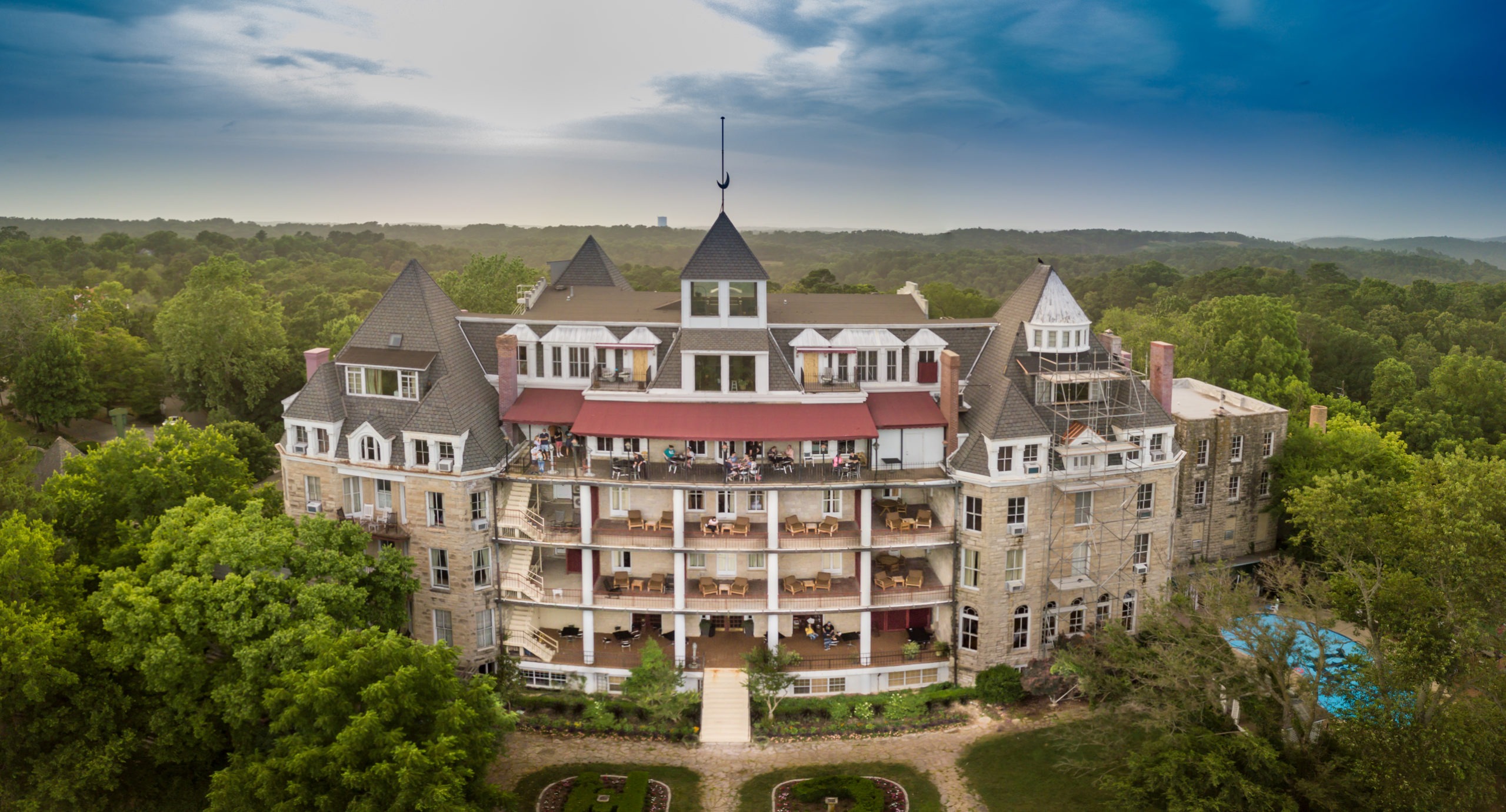
The Crescent Hotel
Perched on the crest of a limestone mountain overlooking the Victorian village of Eureka Springs, Arkansas, the 1886 Crescent Hotel commands the Ozark skyline like something lifted from a Gothic novel and dropped into the middle of the Bible Belt. Built from hand-cut limestone blocks so precisely fitted they required no mortar, the hotel rises in a blend of Richardsonian Romanesque and French Renaissance styling—arched windows, turrets, broad verandas, and a presence that can be seen from nearly anywhere in town. It was designed by architect Isaac S. Taylor, who would later design buildings for the 1904 St. Louis World's Fair, and funded by the Eureka Springs Improvement Company under former Arkansas governor Powell Clayton. When its doors opened on May 20, 1886, six hundred guests arrived from six states, greeted by a band stationed at the train depot. Eureka Springs had boomed almost overnight after its founding in 1879, drawn by sixty natural mineral springs that Native Americans had long known and that white settlers began marketing as miracle cures. By 1880, over fifteen thousand people had descended on the area. The Crescent was built to serve that wave—a luxury resort at nearly $300,000, the equivalent of roughly eight million dollars today. For its first two decades it operated as an exclusive destination, but interest in the springs faded, and the hotel couldn't sustain itself through the off-seasons. By 1902 it had been leased to the Frisco Railway. In 1908, it was converted into the Crescent College and Conservatory for Young Women, reportedly one of the finest women's seminaries in the country. That institution closed in 1924 for lack of funding, and a successor junior college folded during the Depression. By the mid-1930s, the grand hotel sat vacant and deteriorating. Then came Norman Baker. A former vaudeville performer and radio showman from Muscatine, Iowa, Baker had no medical training whatsoever but had already operated a fraudulent cancer clinic in his home state before being driven out. In 1937 he purchased the Crescent for $40,000 and transformed it into Baker's Cancer Curing Hospital, painting the interior in garish lavender and broadcasting his claims over the airwaves. His so-called treatments centered on injections of a concoction he called Formula 5—a mix of alcohol, carbolic acid, watermelon seed, corn silk, and clover leaves—administered up to seven times daily. Patients arrived from across the country, many spending their life savings on the promise of a painless cure. What they received was theater. At least forty-four patients died during the twenty months the hospital operated, their bodies moved to a basement morgue fashioned from the hotel's original kitchen, stored in the walk-in freezer. In 1940, federal authorities arrested Baker for mail fraud. He served four years in prison and died in Florida in 1958—of liver cancer. The hotel sat empty again until 1946, when new owners restored it to its original purpose. The paranormal reputation of the Crescent begins not with Baker but with the building itself. During construction in the 1880s, an Irish stonemason reportedly fell to his death from the upper framework into what is now Room 218. Staff have long referred to his spirit as Michael, and the room remains the most consistently active in the hotel. Guests report doors opening and slamming shut, pounding in the walls, the sound of a man falling through the ceiling, and, most disturbingly, hands emerging from the bathroom mirror. Room 419—known as Theodora's room—is associated with a former Baker patient who also worked as a hospital assistant. Guests find her straightening furniture or fumbling at the door as though searching for her key. On the third floor, witnesses describe the sound of squeaking wheels and the apparition of a nurse pushing a gurney down the corridor, only to watch it vanish. A young boy called Breckie, believed to have died from complications of appendicitis, has been seen bouncing a red ball on the second floor. In the hotel kitchen, a former chef reported pots and pans flying from their hooks, and another staff member witnessed a boy in old-fashioned knickers skipping through the room. Even Baker himself has reportedly been seen, appearing in his trademark white linen suit near the basement morgue. The morgue itself—still containing Baker's original autopsy table and walk-in cold storage—produces some of the most intense reports. Visitors describe oppressive atmosphere, sudden temperature drops, shadowy figures near the examination area, and the sensation of being touched by unseen hands. In 2019, groundskeepers digging near the hotel unearthed hundreds of glass bottles—remnants of Baker's operation—some containing preserved human tissue later confirmed by pathologists at the University of Arkansas for Medical Sciences. The discovery seemed to intensify reported activity, particularly in and around the morgue. Today the Crescent Hotel is owned by Elise Roenigk, who along with her late husband Marty purchased the property in 1997 for $1.3 million and undertook a six-year restoration. The hotel was listed on the National Register of Historic Places in 2016 and operates as a full-service resort and spa. It runs nightly ghost tours that draw over thirty-five thousand visitors annually, and hosts the Eureka Springs Paranormal Weekend each January. The morgue is open for public viewing. Room 218 books months in advance. The Crescent doesn't hide from what it is. It sets a place at the table for it.
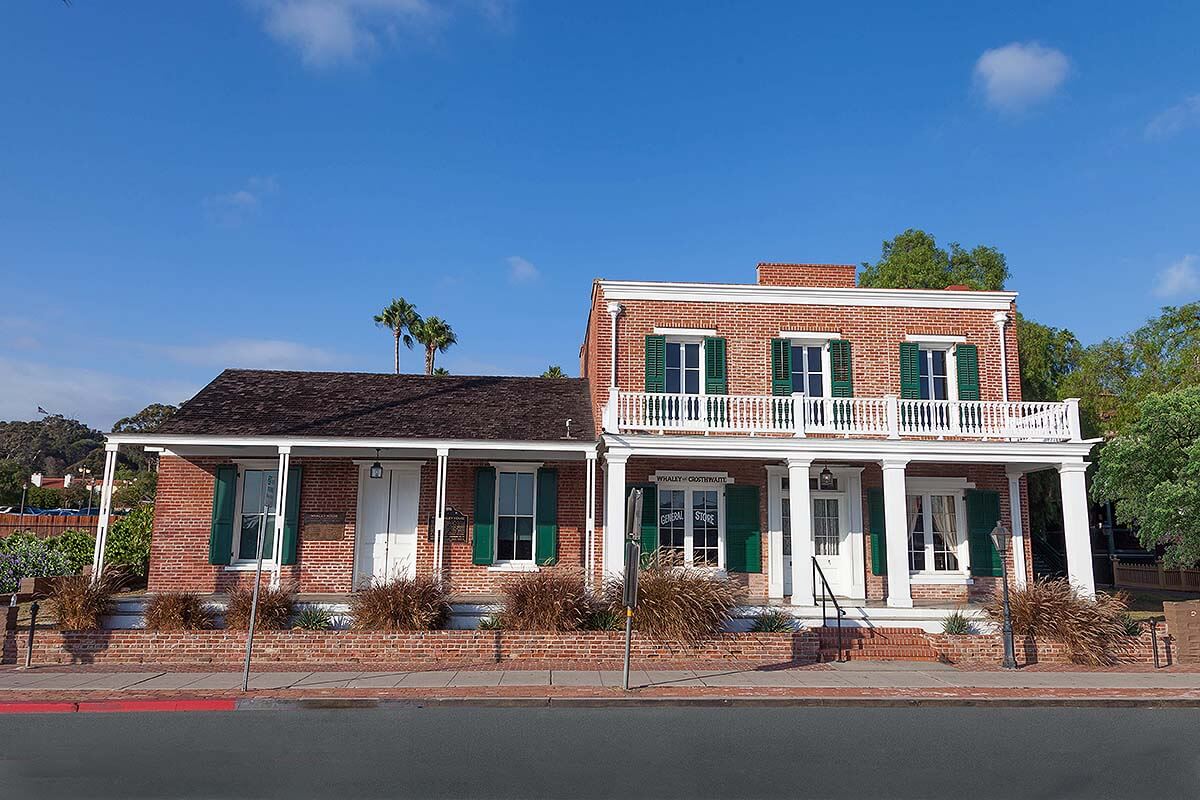
Whaley House
The Whaley House sits on San Diego Avenue in the Old Town neighborhood, a two-story Greek Revival brick home that looks, at first glance, like the kind of place a prosperous merchant would build to announce that he had arrived. And that is exactly what Thomas Whaley intended when he began construction in 1856. The house was the oldest brick structure in Southern California, built from clay bricks fired in Whaley's own kiln on Conde Street, with cedar woodwork and hardware shipped from New York. It cost over ten thousand dollars—a significant sum for a dusty frontier town that had only recently become part of the United States. What Whaley built on, however, was not ordinary ground. The property had served as San Diego's public gallows, and Thomas Whaley had personally witnessed the site's most notorious execution. In September 1852, a man named James Robinson—known locally as Yankee Jim—was hanged there for stealing a rowboat from San Diego Harbor. The trial had been swift and dubious: the jury included two men who owned the stolen boat, and the judge was reportedly drunk for much of the proceedings. Yankee Jim, a towering figure at six-foot-three, did not believe the sentence was real until he saw the rope. The gallows were too short for his frame. When the mule cart was pulled away, his feet grazed the ground, and he strangled slowly rather than dying from a broken neck. Thomas Whaley stood in the crowd and watched the entire thing. Three years later, he bought the land and built his family home directly over the spot. The archway between what became the music room and the parlor stands precisely where the gallows once were. The Whaley family moved in in 1857, and the house quickly became a civic centerpiece—it served at various times as a general store, San Diego's first commercial theater, and the county courthouse. But tragedy followed the family through its walls. Their eighteen-month-old son Thomas Jr. died of scarlet fever in the house. In 1871, armed men held Anna Whaley at gunpoint while seizing courthouse records during a bitter dispute between Old Town and the rising New Town. In 1885, their daughter Violet—devastated after discovering her new husband was a con artist who had married her for the family's money—shot herself in the chest with her father's revolver at the age of twenty-two. Thomas Whaley died in the house in 1890. Anna followed in 1913. Their son Francis died there in 1914, and their daughter Corinne lived in the home until her death in 1953, the last of the family to occupy the residence. Thomas Whaley himself was the first to report something wrong. He wrote in his journal of heavy footsteps moving through the upstairs rooms when no one was there—footsteps he attributed to Yankee Jim. That claim has persisted for over 160 years. Visitors today report a choking sensation when passing through the archway where the gallows stood. Staff and guests describe the sound of tiny footsteps and a child's crying attributed to baby Thomas. A young woman believed to be Violet is seen on the second floor. The scent of perfume associated with Anna drifts through rooms with no apparent source. Disembodied voices, cold spots, doors opening and closing on their own, and full-bodied apparitions have been reported by tourists and investigators alike. The house has been featured on numerous paranormal television programs, and EVP sessions have reportedly captured direct responses. The U.S. Department of Commerce has officially designated the Whaley House as haunted—one of only two homes in California to receive that recognition. Skeptics note that the house trades heavily on its reputation, and that the combination of dim lighting, period atmosphere, and primed expectation accounts for much of what visitors experience. That is a fair observation. But the reports predate the tourism industry by over a century—Thomas Whaley was documenting disturbances in the 1860s, long before anyone was selling tickets. Today the Whaley House operates as a museum maintained by Historic Tours of America. It is a California Historical Landmark and draws thousands of visitors annually for both historical and evening paranormal tours. The archway still stands. The parlor is still furnished. And the ground beneath the house has never forgotten what happened on it.

Spitzer House Bed and Breakfast
Four blocks west of the historic Medina Square in northeastern Ohio, the Spitzer House sits on West Liberty Street like a Victorian postcard brought to life—painted trim, stained glass windows, twin cherry staircases, and the kind of ornamental woodwork that announces both the wealth and the aspirations of the family that built it. Constructed in 1890 for Ceilan Milo Spitzer, the house was a monument to one of Ohio's most ambitious financial careers. Spitzer was born in 1849 in Batavia, New York, and raised in Medina County after his family relocated in 1851. He entered business young, moving into banking with his father Aaron. An early Cleveland venture—the German-American Bank—collapsed in 1880 amid a national financial panic, and Spitzer liquidated his personal assets to pay every creditor, a move that cost him dearly but cemented his reputation. He rebuilt from the ground up. By the late 1880s, he and his cousin Adelbert had established Spitzer & Company in Toledo, becoming the first firm west of New York City to deal in municipal bonds. They were widely credited as founders of the municipal bond industry in the American Midwest. In January 1900, Ohio Governor George Nash appointed Ceilan Quartermaster General of the state with the rank of Brigadier General—a title he carried for life. It was at the height of this ascent that Spitzer commissioned the Medina house, overseeing construction remotely while expanding operations in Boston. His return to inspect the nearly completed residence made the front page of the Medina County Gazette in December 1890. He granted his parents a lifelong lease the following year, and the Spitzer family would occupy the house for the next seventy years. The house is a German Renaissance design with Queen Anne and Stick-Style elements, executed with particular refinement. Cherry and oak woodwork run throughout. The guest rooms, now named for family members, retain the proportions and character of the original layout. After the family's long tenure ended, the home was converted into a bed and breakfast in 1994 and has earned recognition for its restoration. It sits within walking distance of downtown Medina—a quiet residential stretch that belies the building's increasingly well-known reputation. That reputation extends beyond architecture. The Spitzer House has been featured in Chris Woodyard's Haunted Ohio book series, Brandon Massullo's Haunted Medina County, Ohio, and appears on multiple paranormal databases. The claims are specific, recurring, and tied to distinct areas of the house. In Ceilan's Room, guests have reported the apparition of a stern-looking man—sometimes watching from the corner, sometimes near the bed. The figure is widely interpreted as Spitzer himself, and at least one account describes the apparition physically nudging a guest. In Anna's Room, named for Ceilan's stepmother, the presence is different: a young servant girl, appearing at the foot of the bed or at the top of the staircase. Guests have heard her laughter. Some accounts describe her as short and stout, wearing an Edwardian-era housedress, firing questions at startled witnesses before vanishing. In the dining room, the voices of two men have been heard conversing when the room is empty. The parlor piano has been reported playing on its own. Throughout the house, guests describe flickering lights, slamming doors, cold spots, and light touches from an unseen source. One guest reported being scratched. Another described a spirit whispering their name. What gives these accounts weight is their consistency across decades and unrelated witnesses, and the absence of any anchoring tragedy. There is no murder, no suicide, no fire. The Spitzer family's occupancy was long and unremarkable in terms of darkness. Ceilan himself died in 1919 in Toledo, not in the Medina house. The servant girl's identity remains unknown—no documented death connects a specific individual to the claims. The hauntings seem to belong to the house itself rather than to any story imposed upon it. Skeptics will note that Victorian homes are acoustically rich—old wood settles, radiators clang, drafts move through invisible gaps. A bed and breakfast trades on atmosphere, and guests who know the reputation are primed to interpret ambiguity as evidence. But the reports carry a specificity—particular rooms, particular figures, particular behaviors—that resists dismissal as environmental noise alone. Today the Spitzer House continues to operate at 504 West Liberty Street, offering four guest rooms with private baths, period furnishings, and breakfast served in the dining room where two invisible men still occasionally hold court. The cherry staircases are original. The stained glass catches the light the same way it did in 1890. And whether a young woman in a housedress is waiting at the top of the stairs depends on when you visit—and how much of the house's long memory you're prepared to meet.
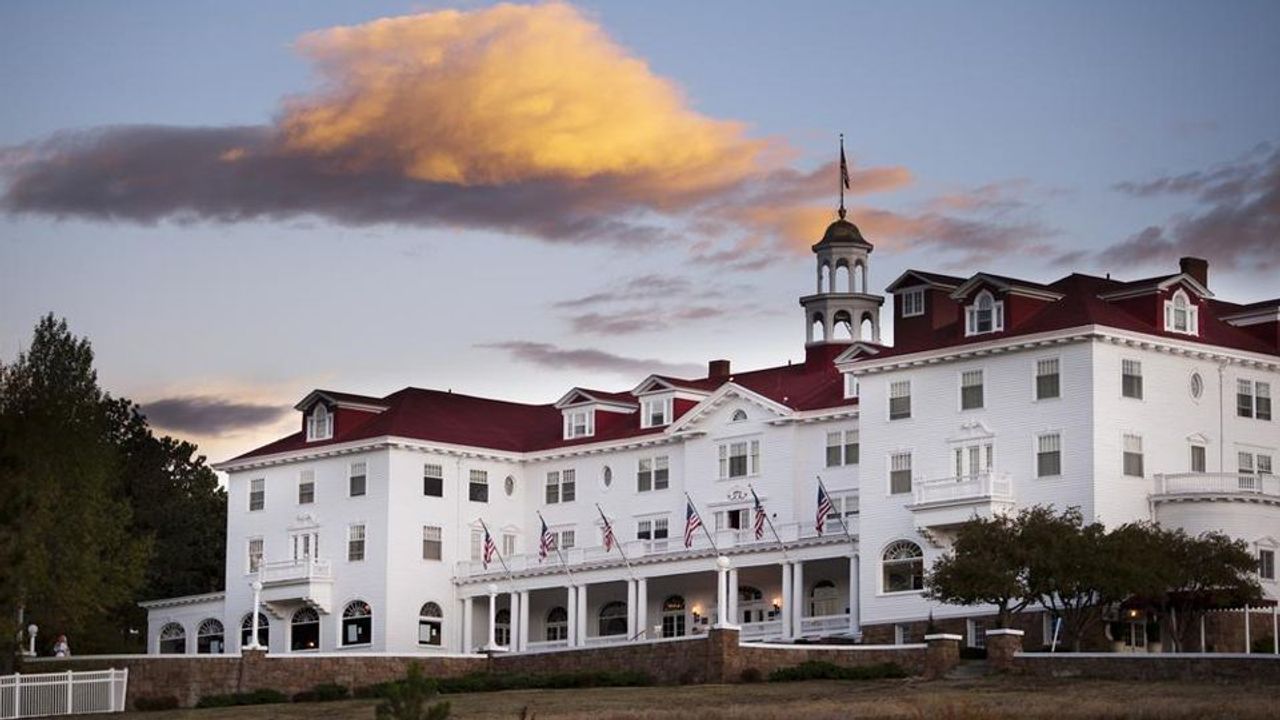
The Stanley Hotel
Perched on a hillside at the edge of Estes Park with the full sweep of the Rocky Mountains behind it, the Stanley Hotel looks less like a haunted building than a misplaced New England estate — white clapboard siding, Georgian columns, and a formal symmetry that has no business sitting at 7,500 feet in the Colorado high country. That contrast is entirely deliberate. The man who built it was an inventor from Maine who came west to save his own life, and what he left behind has refused to stay quiet for more than a century. Freelan Oscar Stanley arrived in the Estes Valley in 1903 suffering from tuberculosis, weak enough that his doctors had told him not to plan beyond six months. The mountain air reversed his decline so dramatically that by summer's end he resolved to return every year. But the tiny settlement of Estes Park offered nothing for a man of his means and temperament. Stanley had made his fortune co-inventing the Stanley Steamer automobile and manufacturing photographic dry plates, and he and his wife Flora were accustomed to the social fabric of the East Coast. So Stanley decided to bring that world to the Rockies. He purchased land from the holdings of the 4th Earl of Dunraven — an Anglo-Irish nobleman who had tried and failed to turn the valley into a private hunting preserve — and broke ground on his hotel in 1906. On July 4, 1909, the Stanley Hotel opened with 140 rooms, running water, telephones, electricity from a hydroplant Stanley himself had built on the Fall River, and a concert hall designed to echo the acoustics of Boston Symphony Hall. Flora, an accomplished pianist, christened the space with a 1904 Steinway grand that remains in the hotel today. Among the early guests were Teddy Roosevelt, Unsinkable Molly Brown, John Philip Sousa, and the Emperor of Japan. The hotel operated as a summer resort for decades, closing each winter and cycling through owners after Stanley sold it in 1926. By the 1970s it had deteriorated badly — neglected, half-empty, and close to demolition. Then, on the last night of the 1974 season, a young writer from Boulder checked in with his wife. Stephen King and Tabitha King were the only guests in the building. They ate dinner alone in the empty dining room, accompanied by recorded orchestral music, then retired to Room 217. That night King had a vivid nightmare of his three-year-old son being chased through the hotel's corridors by a living fire hose. He woke in a sweat, walked to the balcony, lit a cigarette, and by the time he finished it the framework of The Shining had taken shape in his mind. The novel, published in 1977, became his first hardcover bestseller and cemented the Stanley Hotel in the American imagination as the real-world counterpart to the fictional Overlook Hotel. But the paranormal claims at the Stanley predate King by decades and extend well beyond literary inspiration. Room 217 carries the longest recorded history. In June 1911, head housekeeper Elizabeth Wilson entered the room to light acetylene lanterns during a power outage. An undetected gas leak had filled the wing, and the match she struck triggered an explosion that destroyed the room and dropped her through the floor into the dining room below. She survived with broken bones, continued working at the hotel for years, and eventually died peacefully in the 1950s. Guests in Room 217 now report luggage being unpacked, clothing folded, lights switched on and off, and an unseen presence settling onto the bed — as though Wilson never stopped tending to her duties. Room 401 draws a different kind of attention. Attributed by legend to the spirit of Lord Dunraven — who never actually stayed at the hotel but once controlled the land beneath it — the room has produced accounts of a closet door opening on its own, women reporting being touched by an invisible presence, and personal items displaced without explanation. During a visit by the television program Ghost Hunters, an investigator reported the locked closet opening by itself while he slept. Room 407 generates reports of lights operating independently and indentations appearing on beds in otherwise empty rooms. The entire fourth floor, which originally served as servant quarters and storage, is the most consistently active area of the hotel, with guests describing the sounds of children running and laughing in the hallways when no children are present. The concert hall produces its own category of reports. Guests and staff describe hearing classical piano music emanating from the empty hall, and some claim to have seen piano keys depressing on their own. The spirit attributed to these performances is Flora Stanley, who died of a stroke in 1930 but whose love of music — and the Steinway she played — appears, according to believers, to have survived her. F.O. Stanley, who died in 1940 at ninety-one, is said to appear in the lobby and billiard room, sometimes visible in reflections. Beneath the hotel, a tunnel system once used by staff to move unseen has its own lore — including the reported smell of baked goods attributed to a deceased chef and sightings of a spectral grey cat. The skeptical framework here is worth noting. The hotel sits on heavy concentrations of quartz and granite, which some researchers have linked to elevated electromagnetic fields capable of producing disorientation. The building's age, its creaking wooden frame, and the low-frequency vibrations generated by mountain winds at high elevation all offer plausible explanations for sounds and sensations that visitors interpret as supernatural. The sheer cultural weight of The Shining guarantees that nearly every guest arrives primed for something eerie. Expectation and atmosphere do real work in a place like this. Still, the volume and consistency of reports across more than a hundred years — from staff, casual visitors, seasoned investigators, and celebrity guests alike — give the Stanley a paranormal file that few American hotels can rival. The property is listed on the National Register of Historic Places and was acquired in 2025 by The Stanley Partnership for Art, Culture, and Education. It remains fully operational, offering historical day tours, night tours focused on paranormal claims, and designated "spirited rooms" for guests who want to sleep where the activity is most frequently reported. Room 217 is just up the stairs. The concert hall is just across the grounds. And the piano, as always, is waiting.
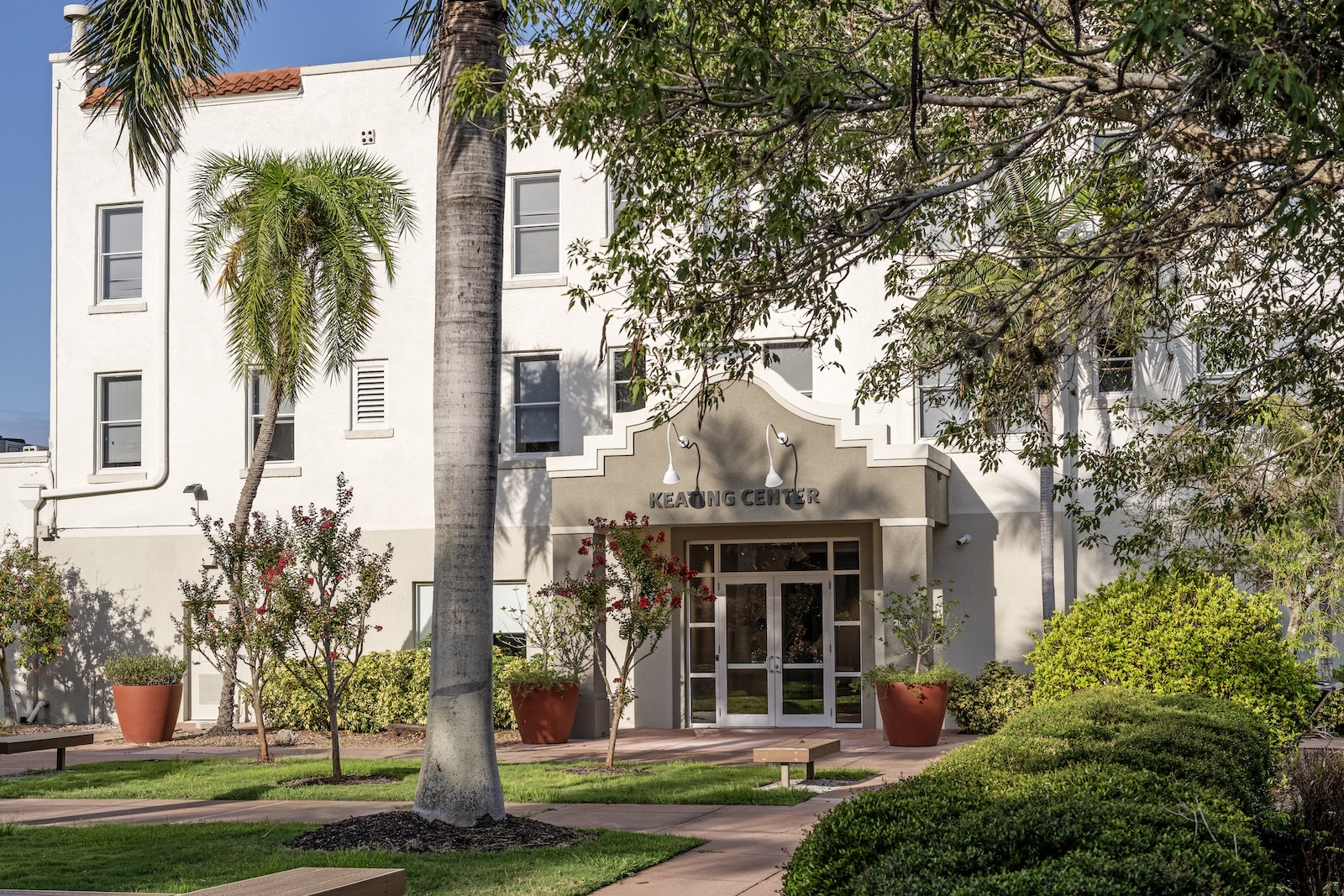
Ringling School of Art and Design
Along North Tamiami Trail in Sarasota, a short distance from the Ringling Museum estate and the circus money that shaped this stretch of Florida coastline, Ringling College of Art and Design sits on a campus that blends contemporary studio buildings with a handful of older structures carrying far heavier histories. At its center stands the Keating Center — a Spanish Mission Revival building constructed in 1925, listed on the National Register of Historic Places since 1984. Before it was an art school, it was a hotel. And before it was merely a hotel, it was something darker than that. The Bay Haven Hotel opened in the mid-1920s during the Florida land boom, a period when Sarasota was exploding with speculative wealth and circus-empire prestige. The Bay Haven was built to attract the traveling businessman and seasonal wealthy visitor. It was moderately successful for a few years. Then the boom crashed. By 1928, the man who developed the Bay Haven subdivision was killed in a car wreck near Arcadia, and his wife struggled to keep the hotel afloat. By 1930 the banks were closing, insurance payments lapsed, and the hotel fell into receivership. What replaced the original clientele, according to accounts passed through generations of students and staff, was a considerably different population: gamblers, Prohibition-era bootleggers, and women working in prostitution on the second floor. Into this compromised building, Dr. Ludd M. Spivey — president of Southern College in Lakeland — brought his plan for a Florida art school. He courted John Ringling, who was nearly bankrupt but agreed to lend his name and fund the $45,000 renovation. On October 2, 1931, the School of Fine and Applied Art of the John and Mable Ringling Art Museum opened with 75 students and 13 faculty. Students attended chapel daily and needed written permission to leave town. The school became independent in 1933 and eventually grew into Ringling College of Art and Design. The Keating Center has served as the campus heart ever since, housing administration below and student dormitory rooms above. The ghost came with the building. She is called Mary, and her legend is among the most consistently reported haunting accounts in Sarasota. The story holds that Mary was one of the women living and working on the second floor of the Bay Haven during its decline — a live-in prostitute who fell in love with a client who didn't return her feelings and took her life by hanging in the stairwell at the end of the second-floor corridor. Hotel management concealed the death. Alumni accounts from as far back as the 1960s reference a locked room off that hallway near the stairwell that was left unused. The manifestations are specific and consistent across decades. Students have described a young woman in her late teens or early twenties gazing down from a second-floor window at students below — sometimes smiling, sometimes not — wearing a cream-colored dress with ruffled armlets or a lavender flapper-style dress, a tight skull cap from the 1920s, with one foot bare and the other in a small blue shoe. Others report anguished sobbing from the stairwell at night with no visible source. Those who investigated described an overpowering smell of stale perfume and a crushing wave of sadness — shortness of breath, racing heart, an uncontrollable urge to weep. Former students from the 1970s and early 1980s described certain rooms on the haunted side as persistently thick and dark, prompting room transfers. A local priest reportedly performed an exorcism at the Keating Center in the 1990s — an event that those who claim ongoing encounters with Mary generally describe as unsuccessful. The Travel Channel featured the legend in 2004. Ringling College today is a thriving institution and the Keating Center is fully restored, its upper floors still active as student housing. Students still report seeing her at the window. The perfume still turns up where no one is wearing any.

Seven Sisters Inn
On East Fort King Street in Ocala's Historic District, surrounded by live oak canopies and a neighborhood of Victorian-era homes added to the National Register of Historic Places in 1984, the Seven Sisters Inn rises from the landscape exactly as it was meant to — ornate, commanding, and unapologetically excessive. The Gothic Queen Anne Victorian was built around 1890 by Linda B. and Joseph Lancaster and was known locally in its early years as the Painted Purple Lady, a nod to its distinctive original color. But the house's identity was defined by its second owners, and it bears their name in local memory to this day. Charles Rheinauer was born in Germany in 1846, the son of a Jewish cantor, and arrived in America with ambitions that proved more than adequate to the frontier city of Ocala. After marrying Emma Hohenberg in Alabama in 1890, he migrated to Florida and established a dry goods and clothing business with his brother Maurice under the name Rheinauer and Brothers. The enterprise grew into one of the finest clothier operations in the state, their flagship building on Ocala's town square so prominent it became known as the Rheinauer Block. Charles served as vice president of the Ocala Iron and Machine Works, founder of the Board of Trade — the forerunner of the Chamber of Commerce — and founder and director of the first bank in the city, the Merchants National Bank. He helped introduce Thomas Edison's incandescent electric lamp to the community. He served as presiding officer of the Hebrew Society of Ocala. In 1906, he became the second Jewish mayor in the city's history. And in a chapter that links the house to wider hemispheric history, Rheinauer collaborated with Cuban revolutionary José Martí to co-found La Criolla Cigar Company, which became one of the largest cigar factories in Florida and drew thousands of Cuban immigrants to the section of Ocala that became known as Marti City before the factory eventually relocated to Tampa's Ybor City. Charles and Emma moved into the Fort King Street house in 1895 and remained there for the rest of their lives. Charles died in the home on May 18, 1925, at age 79. Emma outlived him by nearly seventeen years, dying on May 7, 1942, at age 74. Both are buried in the Temple Beth Shalom Cemetery, the only Jewish cemetery in Ocala. After Emma's death, the property passed through various hands over the following decades, serving at different points as a private residence and office space before being purchased and restored as a bed and breakfast. Later owners — former international cargo airline pilots — filled the house with antiques and artifacts gathered from decades of travel: temple doors from Bali over four hundred years old, pieces from Egypt, India, China, Indonesia, and South America. The inn now offers suites themed by destination, including Madrid, Casablanca, Beijing, Paris, and Cairo, each one a densely layered room that feels more like a cabinet of curiosities than a hotel accommodation. The paranormal reputation is substantial and has attracted serious outside attention. In October 2008, The Atlantic Paranormal Society — TAPS, the group behind the SyFy Channel's Ghost Hunters — spent four days at the inn filming what aired as "The Ghosts of the Sunshine State." Their K2 meters registered unexplained electromagnetic spikes. Investigators reported seeing a shadow moving between rooms during nighttime sessions. A shoe left on the stairs turned up in a room no one had entered. Co-owner Bonnie Morehardt, who ran the inn with her husband Ken Oden for nearly twenty years, described the presence as consistently playful rather than threatening, and noted that a book had been found placed on a table and opened as though someone was in the middle of reading it. She said, pointedly, that she believed it was not the house itself that was haunted but the property underneath it — speculating about what may have occupied the land before the Victorian was built, possibly connected to the nearby site of Fort King. In the years following the Ghost Hunters episode, the inn hosted additional investigations by Chip Coffey, John Zaffis and Brian Cano of Haunted Collector, Scott Tepperman of Ghost Hunters International, and Steve DiShiavi of The Dead Files. The haunting is described around a cast of seven identified spirits. Charles and Emma Rheinauer are said to appear occasionally in Victorian dress, and guests have reported seeing the couple together in what was once a ballroom. Three children of unknown identity are associated with playful, disruptive activity — moving small objects, producing sounds, generating unexplained responses during EVP sessions. A well-dressed man identified only as George, said to project a 1950s sensibility, has reportedly made his presence known to female guests specifically. A seventh figure, an older man whose identity has never been determined, is sometimes connected to the sound of phantom piano music. A woman in white has been reported passing through bathroom walls. Staff and guests across different eras have described footsteps in empty hallways, whispers, the rustle of long period clothing, furniture relocated without explanation, knocks from the walls, and the persistent feeling of being watched from somewhere inside the rooms. The inn has changed hands more than once in the years since its peak ghost-hunting notoriety and has gone through additional restoration. It operates today as a boutique accommodation. The antiques are still there. The architecture is intact. The seven rooms in the guest registry that were never formally checked out appear to still be occupied.

The Springville Inn
The Springville Inn sits along California State Route 190 in the small foothill town of Springville, Tulare County, nestled against the western slope of the Sierra Nevada just minutes from the Giant Sequoia National Monument. The town has been here since 1849, when pioneers settled the area, and the inn has been at its center since 1911, when it was built as the Wilkinson Hotel to serve travelers arriving with the railroad. The original owners went broke during construction and were forced to sell before they ever saw it finished. A 1972 addition brought the motel rooms that extend behind the original structure, but the bones of the place—the restaurant on the ground floor, the bar and dance hall on the second—remain housed in the 1911 building. For over a century, the Springville Inn has served as the social hub of a town that goes quiet by six in the evening. It is also, by most accounts from those who have worked and stayed there, thoroughly haunted. Four distinct entities have been identified by staff over the decades, each given a plainspoken name by employees who encountered them often enough to stop being surprised. The Old Man is the most frequently reported, an observant presence concentrated around the kitchen and the old dumbwaiter that connects the lower kitchen to the upper service area. Former employees describe him not as a passive residual haunting but as an active and hostile personality—hiding the lock to the walk-in cooler, shoving barstools, breaking glassware, knocking from inside the walk-in as though someone had been locked in, and on more than one occasion physically attempting to push workers down the stairs. The Young Man is said to be the ghost of a logger who was shot and carried into the inn to die. His energy is described as friendly, even charming—he frequents the bar area and has a reported affinity for female guests and staff. The Little Girl, estimated by witnesses at seven or eight years old, appears in turn-of-the-century dress at various locations throughout the building, though sightings have grown less frequent in recent years. The Woman is the rarest and most unsettling of the four. She has been seen on the upstairs balcony in white, and one former restaurant employee described an encounter in which the figure appeared standing inverted on the ceiling of the dining room, staring down with a dark substance dripping from her mouth. That employee ran screaming into the kitchen. The reports extend beyond the original building. Guests in the motel rooms have described cabinet doors swinging open on working hinges, unexplained sparkling lights on ceilings that persisted even after curtains were drawn, and personal belongings rearranged overnight—dress socks neatly folded into pant legs in ways the guest swore they never would have done. Staff members have reported whispers, physical touches on the staircase, and self-propelled kitchen utensils. One visitor captured a voice on a phone recording that appeared to say "help me" over background noise. A man from Sacramento who stayed at the inn for a work trip reportedly refused to return, driving an extra forty-five minutes to stay in Tulare on all subsequent visits rather than spend another night. Former employees note the activity is markedly stronger during mornings and afternoons than at night.
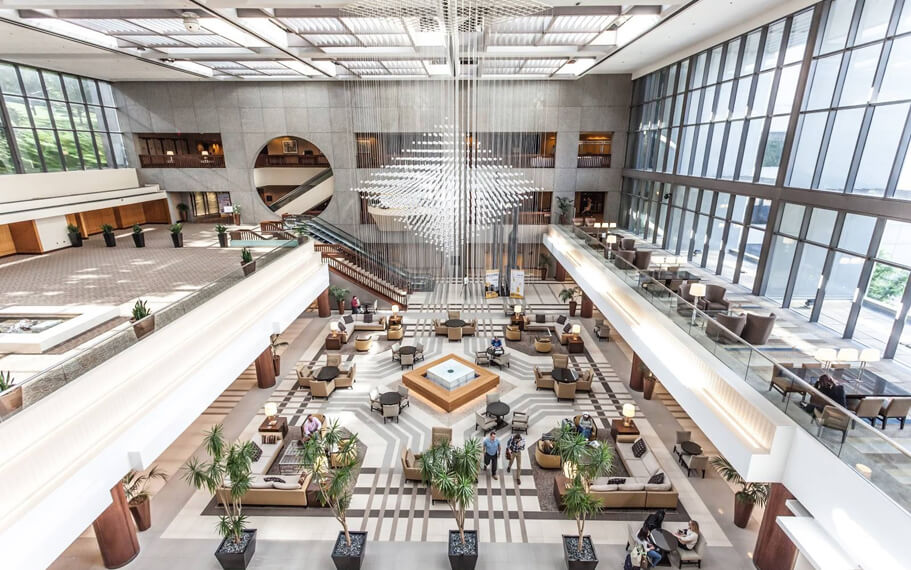
Sheraton Kansas City Hotel at Crown Center
The lobby of the Sheraton Kansas City Hotel at Crown Center is bright, modern, and busy—a soaring atrium with polished floors, a silver sculpture suspended from the ceiling, and sunlight streaming through walls of glass. Guests move through it on their way to conventions, shopping, and meetings at the adjacent Hallmark Cards headquarters. Nothing about the space announces what happened here. There is no plaque on the wall, no marker on the floor, no indication that on the evening of July 17, 1981, this lobby became the site of the deadliest structural failure in American history. The building opened July 1, 1980, as the Hyatt Regency Kansas City, a forty-story, 733-room tower developed by Don Hall of Hallmark Cards as the centerpiece of the Crown Center complex. At the time it was the tallest building in Missouri. The atrium was its showpiece—a cavernous open space crossed by suspended pedestrian walkways on the second and fourth floors, connected by steel rods. The hotel hosted weekly tea dances in the lobby, events that drew hundreds for big-band music and dancing beneath the soaring ceiling. On the evening of July 17, 1981, more than 1,600 people were gathered for one of those dances. At approximately 7:05 p.m., the fourth-floor walkway broke free from its suspension rods and collapsed onto the second-floor walkway below. Both structures crashed to the lobby floor, carrying dozens of people and crushing dozens more standing beneath. The cause was a design change made during construction: the original engineering called for continuous steel rods supporting both walkways, but the design was altered to use shorter rods each supporting only one level. The connection points bore twice the intended load. The National Bureau of Standards later determined the walkways could barely support their own weight. The rods tore through the box beams. One hundred and fourteen people were killed. Two hundred and sixteen were injured. Rescuers worked through the night, pulling the last survivor from the wreckage at four in the morning. The aftermath reshaped American engineering standards. The engineers who approved the design lost their licenses. The Crown Center Redevelopment Corporation paid over $140 million in claims. The hotel underwent reconstruction, replacing the skywalks with a single balcony supported by ground columns. The tea dances ended permanently. The hotel changed hands—becoming the Sheraton Kansas City in 2011 after Starwood assumed management. A memorial was not dedicated until 2015, when the Skywalk Memorial Plaza opened in Hospital Hill Park with a sculpture of dancers and the engraved names of all 114 victims. The paranormal accounts carry a weight distinct from most haunted hotel stories because the event that produced them is not legend—it is documented, investigated, and seared into the memory of a city. Guests who know nothing of the history report an oppressive heaviness in the lobby, particularly a downward pressure on the head and shoulders. One flight attendant described the sensation as feeling like her head was being physically pushed down from the moment she entered the atrium. Visitors have heard screaming echoing through the mezzanine—loud, hysterical, unmistakable—with no source found. The most commonly identified apparition is a woman in a tea gown, believed to be victim Kathryn Sullivan, seen in guest rooms, reflected in windows, and standing in the lobby. A young man in a black tuxedo with a blue bow tie has been reported disappearing through elevator doors. Figures in period attire have been observed in the atrium. A local paranormal investigator named Jim Schwalm, who had reportedly experienced premonitory dreams before the collapse, photographed the lobby shortly after the disaster and claimed to have captured an image of several couples dancing. Today the Sheraton Kansas City operates as a major convention hotel with over 42,000 square feet of function space and the largest ballroom in the city. The lobby is open, bright, and full of life. The skywalks are gone. The architecture has been redesigned to ensure nothing like the collapse could recur. But the space remembers what the building cannot say, and some who pass through it feel something no renovation has removed—a gravity in the air, a sound just below hearing, the sense that not everyone who came to dance that night has left the floor.
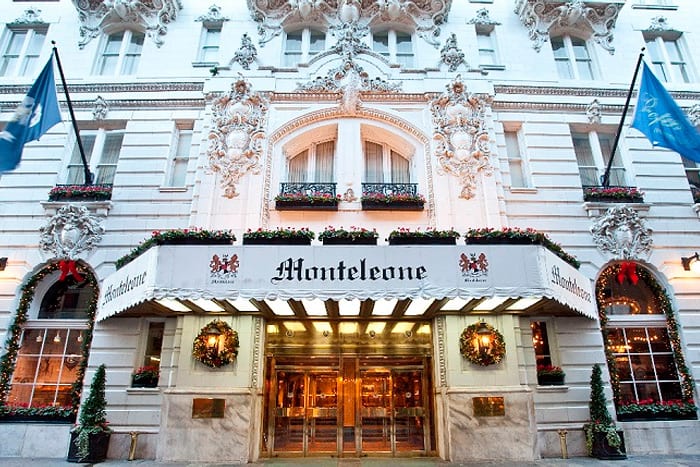
Hotel Monteleone
It has been said that the French Quarter begins in the lobby of the Hotel Monteleone. The claim is not merely geographic. Standing at the corner of Royal and Iberville streets since 1886, the Monteleone is the only high-rise building in the interior of the Quarter, a Beaux-Arts landmark that has anchored the cultural life of the neighborhood for well over a century. It is one of the last great family-owned hotels in America, and it is, by nearly every account, one of the most actively haunted buildings in New Orleans. The hotel's origins trace to Antonio Monteleone, a Sicilian nobleman who had operated a successful shoe factory before immigrating to New Orleans around 1880. Setting up a cobbler's shop on Royal Street, then the commercial and banking heart of the city, Monteleone prospered quickly enough to purchase a small sixty-four-room hotel on the corner of Royal and Iberville. He renamed it the Hotel Monteleone, and the property grew rapidly. A major expansion in 1903 added thirty rooms, and a sweeping 1908 renovation added three hundred more. Antonio died in 1913, and the hotel passed to his son Frank, who oversaw the addition of the Queen Anne Ballroom and two hundred more rooms in 1928—one year before the Depression. The Monteleone was one of the rare family-owned hotels to survive those lean years intact. In 1949, Frank introduced the hotel's most famous feature: the Carousel Piano Bar and Lounge, a twenty-five-seat revolving bar turning on two thousand steel rollers at a rate of one revolution every fifteen minutes. The original building was demolished and rebuilt in 1954, and a final expansion in 1964 added the upper floors, a Sky Terrace, rooftop pool, and the Presidential Suite. The hotel today holds 570 guest rooms across its towering frame. The Monteleone's literary associations alone would secure its place in American cultural history. Ernest Hemingway, William Faulkner, Tennessee Williams, Eudora Welty, and Truman Capote were all frequent guests. Hemingway referenced the hotel in his short story "Night Before Battle." Williams used it as a symbol in The Rose Tattoo. Capote famously claimed on The Tonight Show that he was born in the hotel—his mother lived there during her pregnancy but made it to the hospital in time. In 1999, the Friends of the Library Association designated the Monteleone an official literary landmark, one of only three hotels in the country to receive that distinction. In 1942, New Orleans author Innis Patterson Truman jumped to her death from the hotel's twelfth floor, an event documented in letters by the writer Lyle Saxon—one of the building's darker episodes and one that adds genuine tragedy to the property's layered past. The paranormal reputation of the Hotel Monteleone is extensive and has been the subject of formal investigation. In March 2003, the International Society for Paranormal Research conducted a multi-day investigation and reported making contact with more than a dozen earthbound entities. Among them were two former employees—a chef and a busboy or waiter—whom investigators linked to a recurring phenomenon involving the hotel restaurant's door, which opens and closes on its own despite being locked and operated by a push-button mechanism. The investigators concluded the two spirits were engaged in an ongoing disagreement about whether the door should remain open or shut. The most widely reported spirit is that of a toddler named Maurice Begere. According to the legend, Maurice's parents, Jacques and Josephine, were frequent guests in the late nineteenth century who would leave their young son with a nanny while they attended performances at the French Opera House on Bourbon Street. One evening, Maurice developed a high fever and died in his room on what is now the fourteenth floor. His grief-stricken mother returned to the hotel repeatedly, and eventually, the story holds, Maurice's spirit appeared before her, saying words to the effect of not to cry, that he was fine. Guests to this day report seeing a small boy wandering the fourteenth-floor hallway, sometimes standing at the foot of their bed, sometimes heard laughing. The fourteenth floor—which is actually the thirteenth, as the hotel skipped that number in its floor plan—has become the most requested floor among guests seeking a paranormal experience. Other reported entities include a man named William "Red" Wildemere, who died of natural causes in the hotel, a ghostly figure in nineteenth-century clothing believed by some to be Antonio Monteleone himself still watching over his creation, a phantom child who takes visitors' hands and then vanishes, and a spirit identified as "Solemn John," a Tennessee businessman said to have committed suicide after failed investments. Guests report shadows gliding through corridors, unexplained cold spots, elevators that stop on the fourteenth floor without being called, and the sounds of children playing in hallways where none are present. Today the Hotel Monteleone continues to operate under the fifth generation of the Monteleone family. The grandfather clock still chimes in the lobby. The Carousel Bar still turns. The doormen still stand at the entrance on Royal Street. And somewhere on the fourteenth floor, a small boy may still be looking for his parents—or simply making sure he is remembered.

Sunland Hospital Site – Orlando
Sunland Hospital no longer stands. The main building was demolished in 1999, the last administration building torn down in 2006, and the site in the Pine Hills neighborhood of Orlando now holds a children's playground. But the ground remembers what was built on it, and so does everyone who lived near it, explored it, or worked to shut it down. The facility began in 1938 as the Florida State Tuberculosis Sanitarium, part of a statewide chain of hospitals funded by benefactor W.T. Edwards. The building was constructed in the style common to TB hospitals of the era—long, thin, five stories tall, lined with enormous windows that could be cranked open to let in the fresh air believed to aid recovery. By 1960, antibiotics had conquered tuberculosis, and the State of Florida converted the Orlando facility into the Sunland Training Center, a residential institution for children and adults with profound mental and physical disabilities. The patients—most of them children, many of them wards of the state whose parents had surrendered custody on the advice of physicians—were supposed to receive expert care. What they received was something else entirely. Over two decades, conditions deteriorated into documented atrocity. Wards were severely overcrowded. Patients were bathed on bare concrete slabs. Staff and residents were bitten by rats. Gastric feeding tubes were surgically implanted in over four hundred patients, delivering a cereal-like gruel three times daily—a procedure performed here at rates far exceeding the national average. Investigators documented rampant infections, skin breakdown, and nutritional deficiencies. In 1979, the Association for Retarded Citizens filed a class-action lawsuit on behalf of the "Sunland Six," alleging gross neglect and abuse. The lawsuit succeeded. The hospital closed in 1983. One hundred and six Sunland patients are buried in Section Q of Orlando's Greenwood Cemetery. The building sat vacant for over fifteen years, and during that time it became the most infamous destination for urban explorers in Orlando. What they found inside was a decaying monument to institutional cruelty—wheelchairs left in corridors, medical equipment scattered across floors, old Disney characters painted on the walls of the children's ward, and an atmosphere that visitors described less as spooky and more as deeply, physically wrong. The reports were consistent and disturbing. Visitors heard screams and moaning, some distinctly childlike. Shadow figures moved through corridors and appeared in upper-story windows. Apparitions of small children were seen wandering the halls. A shadow resembling a figure hanging from the ceiling was reported more than once. In 1997, a twenty-three-year-old man exploring the building with friends fell three stories down an elevator shaft and was critically injured. When police arrived, an officer reported seeing a child peering through a window. The child was never found. The incident galvanized the Pine Hills community, and residents successfully lobbied for demolition. Today the site is a playground and open field where neighborhood children come to play in daylight. But visitors to the grounds after dark still report the presence of children who are not living ones—small figures seen at the edges of the field, the sound of laughter with no source, the unmistakable feeling of being watched by someone too short to see over the fence. The spirits attributed to Sunland are not vengeful or aggressive. They are small. And they are still there, playing on the ground where no one played when they were alive.
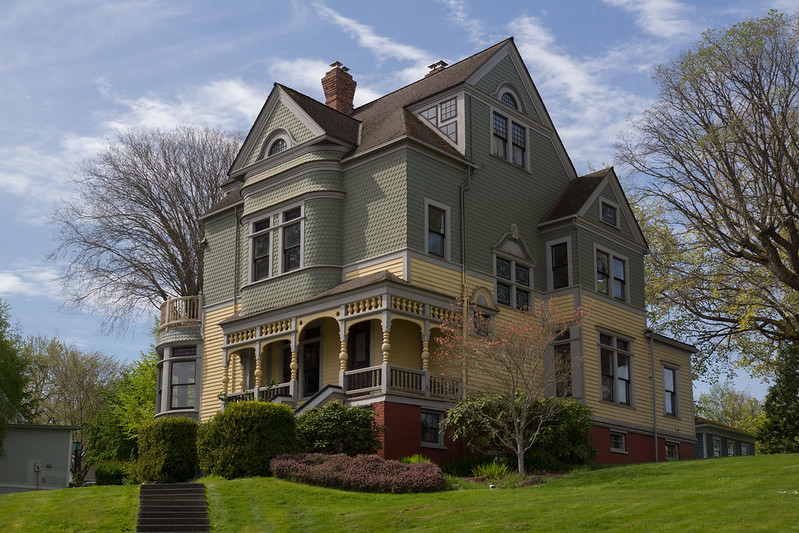
Walker-Ames House
The Walker-Ames House rises from a wooded hillside on Rainier Avenue in Port Gamble, Washington, a Victorian-era residence overlooking one of the most remarkably preserved company towns in the Pacific Northwest. The house is empty. It has been empty since the sawmill that built the town shut down in 1995. No one lives there, no one has lived there for decades, and yet by nearly every account available—from casual passersby to seasoned paranormal investigators—it is anything but unoccupied. Widely regarded as the most haunted house in Washington State, and possibly the entire West Coast, the Walker-Ames House sits at the center of a town where the dead, by persistent report, have simply chosen not to leave. Port Gamble was founded in 1853 when William Talbot and Andrew Pope established a sawmill on the shores of Hood Canal on the Kitsap Peninsula. The mill operated continuously for 142 years—the longest-running sawmill in the United States at the time of its closure in December 1995. Around the mill, the Puget Mill Company built a town modeled on the New England villages its founders had known, with tidy clapboard houses, a white-steepled church, a general store, and tree-lined streets arranged along the waterfront. Port Gamble was a company town in the fullest sense: the mill provided the livelihood, the company owned the homes, and the families who lived there were bound to the rhythms of timber, tide, and the company's fortunes. The original Walker-Ames House was destroyed in a fire in 1885. The current structure was built in 1888 for William Walker, the mill's master mechanic—a position of significant standing in a community organized entirely around the operation of the saw. Walker's daughter Maude married Edwin G. Ames, who served as the mill's resident manager and later its general manager. The house thus became the Walker-Ames, the most prominent and expensive residence in town, occupied by two generations of the family that ran the operation. After the mill closed, the house sat vacant, used occasionally for weddings, events, and eventually as a setting for films and fiction. Paranormal reports at the Walker-Ames House date back to at least the 1950s, well before the property gained any organized attention from investigators. Former town manager Shana Smith began actively collecting accounts from current and former tenants in 2006, after a paranormal group called Evergreen Paranormal requested permission to investigate. What struck Smith was the consistency across accounts separated by years and offered by people with no knowledge of one another's experiences. The house produces a range of reported phenomena. Pedestrians walking past have looked up to see the faces of small children peering from the upper-story windows of a house they know to be locked and empty. Attic lights flicker on and off with no one inside. Footsteps are heard running across floors above visitors standing in lower rooms. Disembodied voices have been recorded on electronic equipment. Visitors report being physically touched—one investigator emerged from the basement with a dusty handprint on her leg, claiming she had been grabbed. The basement generates the most intense reactions, with sensitives and casual visitors alike reporting feelings of sadness, heaviness, and an oppressive presence that several have described as darker in character than the rest of the house. The attic produces its own distinct atmosphere, with investigators reporting contact through electronic devices and the sense of a childlike energy. The most frequently described apparition is a female figure in a long dark dress with her hair pulled back in a bun—identified by some psychics as a nanny, though her name and specific history remain unknown. Paranormal investigator Pete Orbea, who has led guided tours and investigations of the house since 2012, described an encounter in which he heard a scuffle in a hallway, turned around, and found the woman standing expressionless behind him. She vanished the moment others in his group saw her, but not before someone captured a photograph of a form in the doorway. A male figure believed by some to be Edwin Ames has also been described, along with a boy with curly light brown hair in period clothing. The Walker-Ames House has been featured on A&E's "My Ghost Story" and serves as the centerpiece of the annual Port Gamble Ghost Conference, launched in 2010. Organized investigations are available by reservation, led by Orbea and visiting paranormal teams. One investigator's summary captures the paradox of the house well: despite having no dramatic history of violence or tragedy, the Walker-Ames produces an abundance of unexplainable activity—physical contact, electronic responses, apparitions, and EVP recordings that have left even skeptical visitors unsettled. Today, Port Gamble itself is a quiet tourist village of galleries, shops, and cafes housed in the old company buildings. The Buena Vista Cemetery on the hill above town holds its own reputation for activity. The Walker-Ames House stands on Rainier Avenue, locked and unrestored, its Victorian facade watching over a town that outlived its industry but not, apparently, all of its inhabitants. Whatever draws the spirits to this particular house—whether it is love of place, unfinished duty, or something less easily named—the Walker-Ames remains what it has been for over a century: a family home, still occupied by a family that no longer needs the door.