
Haunted Cemeteries in America
577 haunted locations
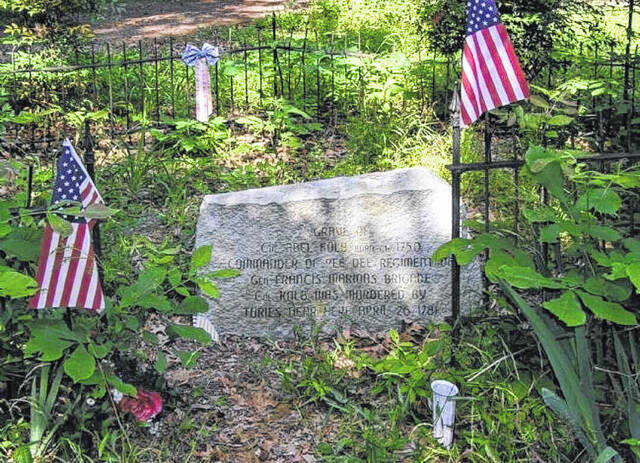
Colonel Kolb’s Tomb
The Great Pee Dee River moves through the coastal plain of South Carolina the way all rivers move through that kind of country — brown and wide and slow, flanked by bottomland that floods in spring and holds the heat in summer, lined with cypress and oak and the particular stillness of a landscape that has not changed its character in three hundred years. On its eastern bank, near the old Marlboro-Darlington county line, a small clearing holds what remains of the Old Welsh Neck Baptist Church cemetery — a few stone markers, several river rocks, and a modest obelisk that marks the grave of Colonel Abel Kolb, commander of the Pee Dee Regiment of General Francis Marion's Brigade. It is one of the more remote historic sites in South Carolina, sitting at the end of a county road in a place that the Darlington County Historical Commission's director has described, simply, as not having the peaceful, easy feeling you normally get from being on the banks of the Pee Dee River. The community that produced Abel Kolb was among the oldest in the Carolina interior. Welsh Baptist settlers from Pennsylvania and Delaware had been establishing homesteads on the eastern bank of the Pee Dee River as early as 1737, building Welsh Neck Church in 1738 — one of the foundational Baptist congregations in the American South — and creating a tight-knit community of farmers, planters, and dissenting Protestants who would, by the time of the Revolution, furnish a disproportionate number of committed patriots to the cause. Abel Kolb was born into this world around 1750, the son of Peter Kolb and Ann James, daughter of the Reverend Philip James, an early minister of Welsh Neck Church. His family's roots ran back to German Mennonite immigrants who had arrived in Pennsylvania in 1707; by the time Abel was born, the Kolbs were part of the established planter community on the Pee Dee. He was a gentleman farmer, a politician, a founding member of St. David's Episcopal Church in Cheraw, and, when the Revolution came, a soldier of considerable consequence in his region. Under General Francis Marion — the Swamp Fox, whose partisan warfare among the rivers and marshes of South Carolina has become one of the defining stories of the Revolutionary War in the South — Kolb served as commander of the Pee Dee Regiment, operating in the borderland between what is now Marlboro and Darlington counties. Marion's men fought without uniforms and without regular pay, relying on mobility and local knowledge to harry British forces and their Loyalist allies across the Carolina lowcountry. By 1781, Kolb and his regiment had contributed meaningfully to re-securing Patriot control of the Pee Dee region. That success made him a target. On the night of April 27–28, 1781, approximately fifty North Carolina Loyalist irregulars under Captain Joseph Jones — believed to have been operating under the command of the notorious Major Micajah Gainey — surrounded Kolb's home on the Pee Dee. His family was inside. Kolb came to the door and agreed to surrender himself as a prisoner of war at the urging of his wife and children. He stepped onto the porch. One of Jones's men shot him on the spot, in front of his family. The home was plundered and burned. His wife and children, along with other women and children present on the property, were spared. The historical marker erected in 1973 by the Marlboro County Historic Preservation Commission records the event without elaboration: he was shot while surrendering himself as a prisoner of war and his home was burned. The stone at his grave reads: "Col. Kolb was murdered by Tories near here April 26, 1781." Kolb was buried in the Welsh Neck cemetery a mile north of his home site, at the foot of the same eastern riverbank on which his community had built its first church forty years earlier. The obelisk that originally marked the grave was moved to the Marlboro County Historical Museum in Bennettsville for preservation after the site suffered repeated vandalism; a replacement marker now stands at the gravesite. The cemetery itself is old and largely abandoned — when the Welsh Neck congregation relocated to Society Hill in the nineteenth century, the graveyard was left behind. What remains are two stone monuments, several river rocks, scattered remnants of Kolb, Marshall, and Wilds family burials, and the accumulated presence of a site that has been undisturbed for close to two centuries except by those who come looking for something. The paranormal tradition attached to Kolb's tomb is specific and consistent. Visitors who come to the gravesite after dark report hearing the sound of someone walking in the woods around the clearing — footsteps without a visible source, movement in the tree line that does not correspond to any identifiable animal. Several witnesses have reported the apparition of a man appearing suddenly beside them at the grave, present for a moment and then gone. The site sits on the same ground where Kolb was shot, close enough to his home site that the killing and the burial are effectively collocated — the tomb is not a distant memorial but a marker placed within yards of the porch where he died. Paranormal investigators have conducted sessions at the site with EVP equipment and spirit communication devices, receiving responses including the words "commanded," "troops," "brass," and "shot" — the last considered by investigators to be consistent with the actual circumstances of the murder rather than the popular legend, which in some versions holds that Kolb and his family were burned alive together. The popular legend diverges from the historical record in its details but not in its emotional weight. The documented facts — a soldier who agreed to surrender to protect his family, shot the moment he stepped through his own front door, his house torched while his children watched — carry enough of their own gravity to sustain a haunting tradition without embellishment. The site sits in a region so saturated with Revolutionary War violence that artifacts turn up routinely in the surrounding fields and woods, alongside remnants of the Welsh Neck settlement that preceded the war by a generation. The Darlington County Historical Commission's director put it directly: if there is any indication of ghostly spirits in the area, Col. Kolb would be a likely candidate.

Boone-Hutcheson Cemetery
Set on a high hilltop overlooking Big Walnut Creek and the picturesque Houck Covered Bridge, Boone-Hutcheson Cemetery occupies one of the most striking pieces of ground in Putnam County, Indiana. The view stretches across open farmland in every direction—soybean fields, cornrows, and the kind of rolling central Indiana terrain that looks peaceful enough in daylight but takes on a different character entirely after dark. The cemetery was established in 1812, a full nine years before Putnam County itself was officially founded, making it one of the oldest burial grounds in the region and a direct artifact of the earliest American settlement in what was then unbroken wilderness. The names on the stones tell the story of who came first. Susan Boone Rissler, buried here, was the great-niece of Daniel Boone. Three children of Squire Boone—Daniel's brother—are also interred on the grounds. A monument to Phoebe Rissler Boone, Squire's wife, stands in the cemetery as well, though some records suggest the stone was erected by the family when she and Squire left Putnam County for Iowa in 1852, and debate persists over whether she is actually buried beneath it. The Hutcheson family arrived soon after—Dr. Walter Hutcheson reached the area in 1827, and his descendants have maintained a presence ever since. Civil War veterans, War of 1812 soldiers, and pioneer families fill the rows, their stones dating back to the 1820s and forward through the present day. But it is the landscape beneath the cemetery, as much as the one above it, that has given Boone-Hutcheson its particular hold on local imagination. A cave opening sits on or near the grounds, and the lore surrounding it has been accumulating for nearly two centuries. Legend holds that this cave connects to Sellers Cave near the DePauw University campus in Greencastle, roughly five miles northeast, through a tunnel system running beneath much of the town. One persistent story claims enslaved people escaping via the Underground Railroad used the passages, and that some who entered never emerged—their remains occasionally surfacing in macabre fashion. Another tale links the cave to John Dillinger's escape after his Greencastle robbery, though records confirm he left by automobile. Geologists have been considerably less impressed. The president of the Indiana University Caving Club has stated that caves in the Greencastle area are very small due to thin limestone, and that a five-mile underground passage is unlikely in the extreme. Visitors who have entered the opening confirm it is barely large enough to crawl into. None of that has done much to quiet the paranormal reports. The most distinctive claim involves a spectral police officer from the 1950s who sits inside the cemetery accompanied by a floating blue light. Multiple witnesses over multiple decades have described this figure independently. One longtime Greencastle resident recalled seeing the blue lantern drifting across the grounds as a teenager. Another visitor described finding an older-model police cruiser parked at the hilltop in broad daylight, the officer waving from the driver's seat—a vehicle consistent with no currently active patrol car. Others have reported seeing a car driving up the narrow road toward the cemetery only for it to vanish before arriving, with no turnoff that could explain its disappearance. Then there are the dogs. Phantom canines with glowing red eyes are among the most frequently reported phenomena here, and the accounts carry unusual consistency. Visitors describe aggressive growling directly outside car doors without any visible animal. Others have seen a black dog with red eyes running alongside their vehicle as they fled. The sounds are described as unlike anything recognizable—a moaning that grows louder and closer without resolving into a visible source. A woman in white has been spotted on the road leading to the cemetery. Investigators using spirit boxes report responsive communication and repeated warnings to stay away from the surrounding woods. The persistent sensation of being watched and the sound of footsteps mirroring a visitor's movement from the opposite side of the gravel loop appear in account after account. Skeptics can fairly point to the power of atmosphere—a hilltop cemetery at night, surrounded by open farmland and backed by woods, with a cave and generations of legend practically demanding a fear response. Real cows graze the adjacent field and have startled more than one visitor who mistook them for something worse. But the blue light reports predate the internet. The dog encounters come from people who arrived expecting to debunk them. And the cemetery itself, with two centuries of burials rooted in the earliest days of Indiana statehood, carries a weight that has nothing to do with legend. Boone-Hutcheson remains active, maintained through donations with no government funding. The covered bridge is visible from the hilltop. The Boone family section sits near the front. Whether you come for genealogy, the view, or the things that move between headstones after dark, the cemetery asks only that you respect the ground—because the people beneath it have been there a very long time.
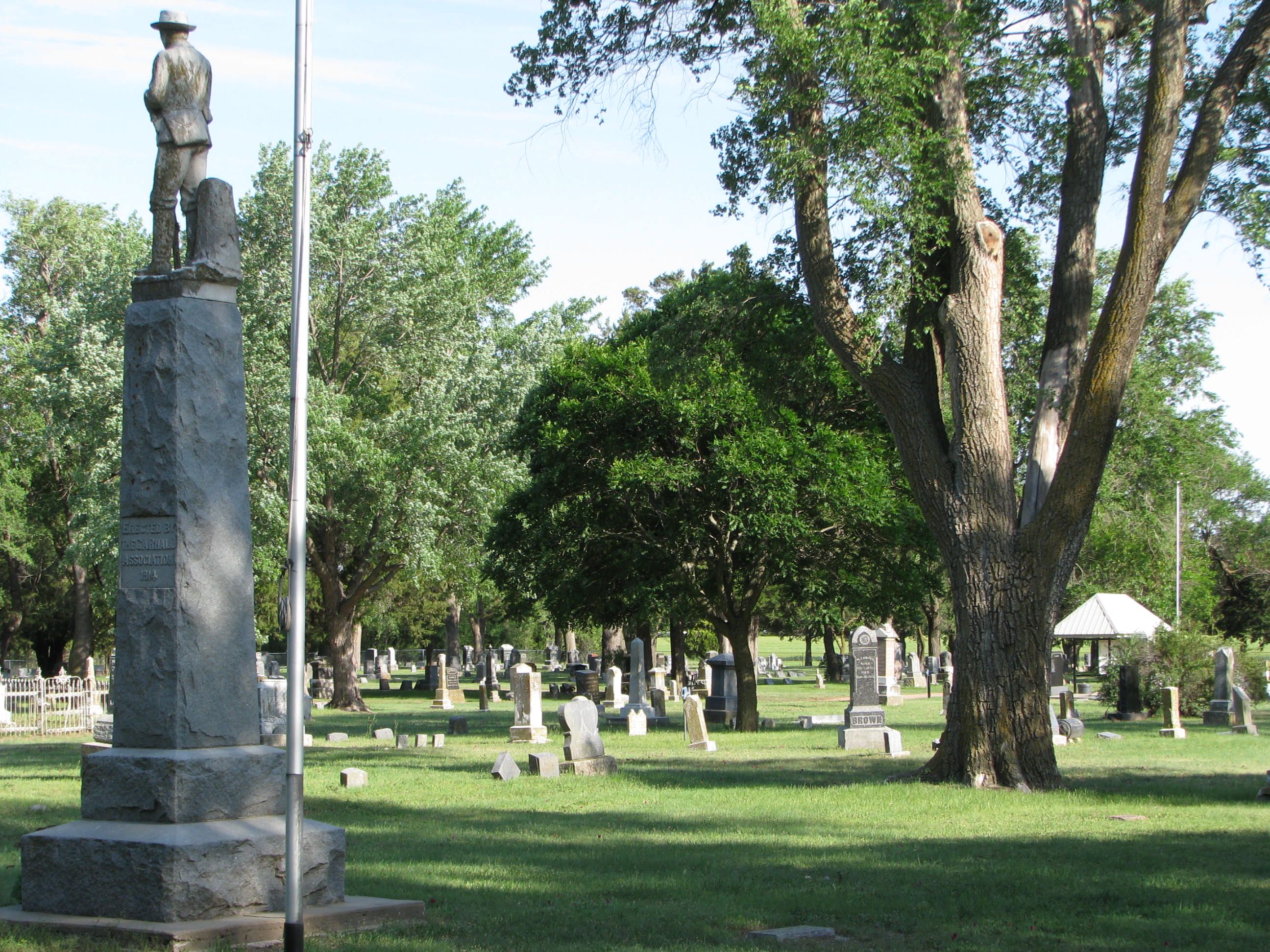
Wildmead Cemetery
Out on the flat central Kansas prairie, roughly a dozen miles northwest of Hutchinson along the Arkansas River lowlands, the small town of Nickerson came into being the way most of this part of the country did — by rail. The Atchison, Topeka and Santa Fe Railway laid its line through Reno County in 1872, and the town platted along that corridor was named in honor of Thomas Nickerson, then president of the railroad. First houses followed in 1875, incorporation came in 1879, and by the turn of the century Nickerson had banks, mills, a newspaper, an opera house, and Nickerson College. It was a proper little prairie city, built by homesteaders and Mennonite farmers working some of the richest wheat land in the country. Wildmead Cemetery sits just outside the town as a record of that community — nearly two thousand documented burials accumulated across generations of Reno County life. The headstones range from weathered frontier-era markers to mid-century monuments, and the grounds are shaded by old trees that give the place a stillness rare in the treeless Kansas landscape. Burials span the full arc of regional history, including at least one veteran of the Spanish-American War of 1898 whose grave has been noted by visitors as a point of quiet reflection. The paranormal reputation of Wildmead is anchored to a single dominant figure known locally as the White Lady — a female apparition said to move through the cemetery, particularly at night. Regional legend frames her not merely as a ghost but as something closer to a guardian, a presence that distinguishes between those who visit out of grief or genuine curiosity and those who come only to cause trouble or disrespect the grounds. The distinction matters in local telling: families and respectful visitors are said to fall under her protection, while those who arrive with bad intentions are not extended the same courtesy. Whether she is connected to a specific grave has never been established. The cemetery gate has its own piece of local lore. Multiple accounts describe the entrance as bent from the inside, and the gate itself is said to resist visitors — closing on those inside and refusing to open when it shouldn't. In one widely circulated account from around 1980, two carloads of teenagers drove into Wildmead late at night specifically hoping to catch a glimpse of the White Lady. During a slow loop through the grounds, both vehicles experienced headlights cutting out simultaneously with no mechanical explanation. One car stalled partway through the gate, blocking the exit. The group pushed it nearly half a mile down the road before both vehicles resumed normal function on their own. No apparition was seen that night, but the account circulated in Nickerson for decades afterward. More recent accounts have concentrated on the cemetery's maintenance building. Investigators reported hearing a generator inside the structure power on while they were nearby. When they approached, it shut off. One member of the group asked aloud for it to start again. It did, and the moment was captured on a recording device. Other visitors have described unexplained knocking sounds coming from trees within the grounds, temperature fluctuations on hot summer days, and an intermittent feeling of being observed from somewhere within the tree line. A self-described psychic sensitive who visited on a July afternoon in 2017 reported sudden, intense goosebumps near the grave of a Spanish-American War veteran — an experience she noted specifically because of the triple-digit heat that day. Wildmead is an active cemetery, open and accessible to the public. The headstones are readable, the trees still stand, and the gate is still there. Whether you arrive in daylight to trace family names or after dark looking for something harder to explain, the grounds have a weight to them that most visitors remark on before they leave.

Myrtle Grove Cemetery
Myrtle Grove Cemetery sits at the end of Lost John Road south of the community of Baxterville in Lamar County, Mississippi, a small rural burial ground tucked into the longleaf pine flatlands of the state's Pine Belt region. There are no grand gates, no historical plaques, no visitor centers. Just a fenced plot of graves surrounded by woods, oil pump jacks, and the low, rhythmic hum of machinery pulling crude from the earth below. It is the kind of place you have to mean to find—and the kind of place that, according to a steady accumulation of visitor accounts, finds a way to follow you back out. Lamar County was carved from Marion County in 1904, during the peak of the southern Mississippi timber boom. The region had been Choctaw land before European settlement, and by the mid-nineteenth century it was populated by subsistence herder-farmers from the Carolinas and Georgia, drawn to the open pine country that discouraged dense settlement. The longleaf forests were stripped by northern lumber companies in less than thirty years. Lumberton, the nearest town, took its name directly from the industry that built it. By the time the timber played out, Baxterville had shifted to another extractive economy. In 1944, Gulf Oil discovered the Baxterville Field on the border of Lamar and Marion Counties, and the area became one of Mississippi's most productive petroleum zones—a field that has yielded over 250 million barrels of crude since discovery. The cemetery predates the oil boom, serving families who settled this stretch of piney woods in the late nineteenth and early twentieth centuries. Approximately 55 documented memorials exist on site, though the actual number of burials is likely higher—rural Mississippi cemeteries of this era frequently contain unmarked graves. The headstones trace the contours of a hardscrabble community: short lives, family clusters, weathered markers half-swallowed by sandy soil. The land has also borne unusual history. In 1964, the Atomic Energy Commission detonated a nuclear device inside the Tatum Salt Dome just miles away as part of Project Salmon—one of only two underground nuclear tests ever conducted east of the Rockies. The blast shook homes and cracked walls two miles out. A second nuclear detonation followed in 1966. The cemetery exists in a landscape that has been quite literally shaken to its foundations. Paranormal reports at Myrtle Grove are remarkably consistent for a site with no organized investigation history. Visitors describe an overwhelming and immediate sense of dread upon approach, sometimes before exiting their vehicles. Multiple accounts reference hair rising on arms, sudden panic attacks, and a visceral urge to leave. One visitor reported the panic was so severe upon turning onto Myrtle Grove Cemetery Road that her husband reversed the truck and left without reaching the gate. Shadow figures are the most commonly reported visual phenomenon, seen among headstones and at the tree line. At least one visitor described a full-bodied apparition standing beside a gravestone—a female figure who, upon being noticed, appeared to transform into a ball of light and vanish at speed. Others reported a strange iron rod topped with a doll's head at the center of the cemetery, surrounded by a perfectly dry circle roughly six feet wide despite recent rain soaking the surrounding grass. Not every visitor leaves convinced. Some find nothing unusual and describe the cemetery as quiet and well kept. One recurring skeptical observation is that the constant hum of surrounding oil pump jacks may produce ambient unease that visitors misattribute to something supernatural. Infrasound generated by industrial machinery is a documented cause of discomfort and even visual disturbances, and the oil field provides a plausible environmental trigger. The isolation amplifies everything else—the road is dark, the woods are thick, and arriving at a rural cemetery at night in deep southern Mississippi is its own psychological experience. But the sheer repetition of the panic response, described independently by people with no prior knowledge of others' accounts, is difficult to attribute entirely to atmosphere. Today, Myrtle Grove remains an active burial ground with no formal historical or tourism infrastructure. It sits off Mississippi Highway 13, reachable only by a narrow rural route that GPS systems occasionally fail to resolve. Visitors should note the cemetery is on private land and exercise appropriate respect. Whether the source of the unease is geological, mechanical, psychological, or something not yet categorized, Myrtle Grove occupies a strange intersection of Mississippi's extractive past—timber, oil, nuclear energy—and the quieter, older work of laying the dead to rest in ground that, by many accounts, does not rest easily itself.
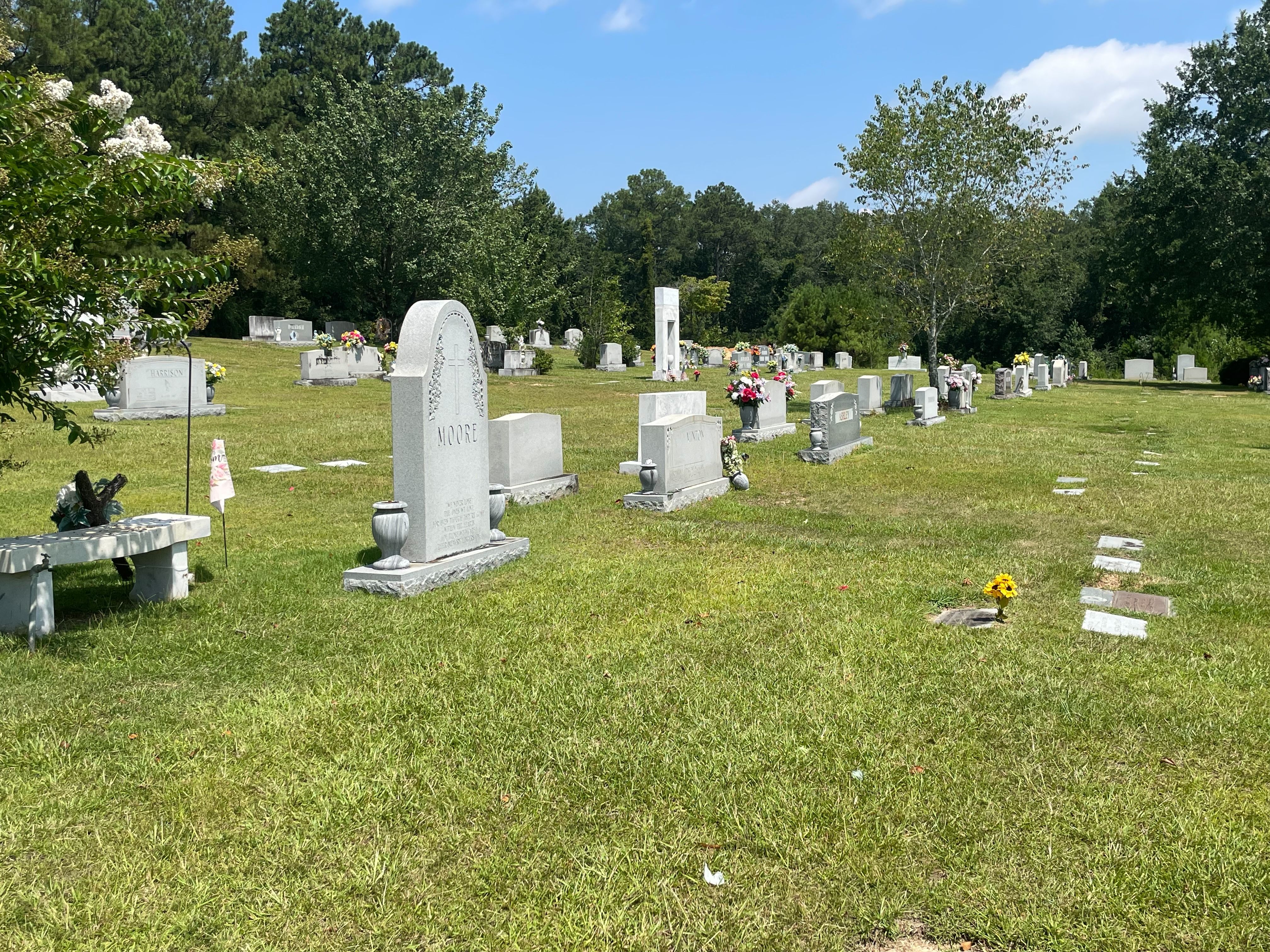
Crestwood Cemetery
Settled into a quiet stretch of East Broad Street in Gadsden, Alabama, Crestwood Cemetery occupies land that sits near the banks of the Coosa River in Etowah County — a region with deep and often troubled roots stretching back through the Civil War era and beyond. Established in 1940 and operated in connection with the Crestwood Funeral Home on the same grounds, the cemetery has served the East Gadsden community for generations, its plots home to veterans, longtime residents, and ordinary families whose lives were woven into the fabric of a city built on river commerce and heavy industry. Gadsden itself grew from a steamboat landing in the 1840s into one of Alabama's most significant industrial centers, second only to Mobile in commercial importance through much of the 19th century. The east side of town, where Crestwood sits, was a site of active movement during the Civil War — Confederate forces encamped along the Coosa River's east bank, and the area saw both skirmishes and the passage of large troop movements as Hood's Army of Tennessee crossed through in October 1864. The broader Etowah County landscape was shaped by plantation agriculture before the war, with enslaved labor woven into the region's economy, and with those histories largely undocumented and unmarked in the historical record. It is that older, harder history that forms the core of Crestwood's paranormal reputation. The cemetery is rumored to sit on the grounds of a former slave plantation, with accounts suggesting that the land carries the unresolved weight of that history. The most specific and persistently repeated claim is the apparition of a hanged enslaved man appearing in the trees on the property — a figure glimpsed at the edge of visibility, present in the branches and then gone. Whether rooted in documented history or passed down through neighborhood legend, the image is a stark one, and it endures in local accounts with a consistency that separates it from vague general unease. Beyond that central figure, visitors have reported shadowy movement along the cemetery's perimeter and the feeling of being watched from the tree line after dark. The cemetery borders a long-established Black neighborhood on its east and south sides, and some observers have noted that reported figures near the fence line could have rational explanations — though accounts of the hanged apparition in the trees don't yield as easily to those interpretations. Crestwood is a functioning cemetery, still accepting burials and maintained as an active place of rest for the Gadsden community. It is not a tourist destination, and no organized paranormal investigation access exists. What lingers around the property is less the structured mythology of a famous haunted location and more the quiet, unsettled weight of land that may carry histories older and darker than the headstones placed upon it. In a county where Cherokee removal, plantation slavery, Civil War encampments, and Jim Crow all left marks on the same soil within decades of each other, the idea that certain ground holds something unresolved is not difficult to understand.

Riverside Cemetery
Beechwood Mansion rises majestically from Newport, Rhode Island's Cliff Walk district, an opulent testament to the Gilded Age excess and aristocratic ambition that defined America's wealthiest enclave during the late nineteenth century. Designed in the Italianate Renaissance Revival style and completed in 1858, the mansion served as a summer residence for the Astor family, one of America's oldest and most prominent dynasties whose wealth derived from the fur trade and vast real estate holdings accumulated across generations. The building encompasses approximately five thousand square feet of meticulously crafted interior space, featuring marble fireplaces imported from Italy, ornate plasterwork created by master artisans, soaring ceilings adorned with gilded details and frescoes, and collections of European art and furnishings that reflected the cosmopolitan tastes of international high society. The mansion's construction represented the pinnacle of residential architecture available to American wealth during its era, incorporating the latest technological innovations for heating, lighting, and plumbing. The mansion hosted elaborate parties and social gatherings that became legendary in American society, drawing celebrities, dignitaries, and foreign nobility who came to experience the pinnacle of American luxury and sophisticated entertaining. The guest lists included political figures of national importance, cultural luminaries, and wealthy industrialists whose associations with the Astor family enhanced their social standing. Beechwood's gardens and terraces overlooked the Atlantic Ocean, providing a dramatic seaside setting that enhanced its reputation as one of the most desirable addresses in America. The outdoor spaces served as venues for garden parties, lawn concerts, and social functions that extended the entertainment and hospitality offered within the mansion itself. The mansion absorbed decades of privilege and pageantry, its rooms filled with laughter, music, and the conversations of influential figures who shaped American culture and politics. The visual impressions of countless glittering events imprinted themselves upon the physical spaces, creating an atmosphere saturated with memories of sophisticated pleasure and social achievement. However, amid this gilded grandeur, stories emerged of a persistent and melancholic phantom, a spirit whose sorrow seemed incompatible with the joyful atmosphere the mansion generally embodied. Staff members and visitors reported consistently sighting a woman dressed entirely in black, visible in the third-floor windows overlooking the property. Witnesses described her as a sad figure, standing eternally at those windows as though gazing out at the ocean or waiting for a return that would never come. Her positioning suggested a watcher monitoring arrivals or departures, suggesting possible romantic sorrow or bereavement. Some identified her as a woman of deep sorrow whose emotional anguish became so profound that it transcended death itself, binding her spirit to the house where her heartbreak occurred. The identity of the lady in black remains speculative, with various theories linking her to servants, family members, or guests who experienced tragedy within the mansion's walls. Paranormal investigators documented the apparition extensively, with multiple independent witnesses describing identical details: a slender feminine figure, dark clothing appropriate to formal mourning, a posture of grief, and an overwhelming sense of melancholy that washed over observers who encountered her. The ghost became so well-documented that paranormal television crews, including the acclaimed Ghost Hunters team, conducted formal investigations of the phenomenon. Their equipment registered temperature fluctuations and unusual electromagnetic readings concentrated around the third-floor windows where the lady in black had been sighted. Today, Beechwood Mansion stands as a documented example of how wealth and grandeur cannot shield the living from profound sorrow, nor can death fully deliver the dead from their emotional burdens.
Charlene Richard – St. Edwards Church Cemetery
Charlene Richard St. Edwards Church Cemetery, located in Louisiana, represents a unique convergence of religious devotion, modern spiritual seeking, and documented paranormal phenomena centered on the burial site of a remarkable young individual whose life and death have generated interest extending far beyond typical local historical significance. Charlene Richard was a girl of exceptional character who died at the age of twelve after battling terminal cancer, an illness that subjected her to extreme suffering yet apparently did not diminish her spiritual faith or her reported concern for the well-being of others even as she faced her own mortality. Her family, her community, and ultimately the Roman Catholic Church recognized something exceptional in her life, leading to an ongoing investigation into her potential sainthood and the possibility of official canonization. The Vatican has formally accepted and approved an investigation into the life of Charlene Richard, evaluating claims and phenomena associated with her, lending official ecclesiastical attention to a location that might otherwise be dismissed as merely another cemetery gravesite. Her identity as the possible saint has led to her being affectionately known as the "Little Cajun Saint," a designation that reflects both her Cajun heritage and her youth at the time of her death. The gravesite of Charlene Richard has become a pilgrimage destination, with more than ten thousand visitors annually traveling to the cemetery to pay respects at her grave, to seek spiritual healing and intervention, and to petition her intercession in matters of health and personal crisis. This high volume of consistent visitation and spiritual engagement with the gravesite has created an environment of deep emotional and spiritual intensity that appears to facilitate paranormal phenomena. The spiritual dimensions of the location appear to operate somewhat differently from typical haunting phenomena, with manifestations less centered on fear-based experiences and more oriented toward healing and spiritual intervention. Strange noises have been documented emanating from the gravesite area during visits and investigations, sounds that appear to carry intentional qualities rather than being merely ambient environmental phenomena. These auditory phenomena have been reported consistently across multiple decades and multiple visitors, suggesting reliable and reproducible manifestations rather than isolated incidents. The manifestations at the location appear to correlate with the spiritual intentions of visitors, with those seeking healing or divine intervention reporting phenomena interpreted as responses to their prayers and petitions. Miraculous healing has been reported by some visitors to the gravesite, phenomena that supporters of Charlene Richard's canonization cite as evidence of her spiritual intercession on behalf of the living. These reports of spiritual healing represent a form of paranormal phenomena distinct from typical haunting manifestations, suggesting that the spiritual presence at the location operates according to benevolent principles and healing intentions rather than psychological disturbance or unresolved trauma. The combination of the Vatican's investigation, the high volume of pilgrimage visitation, the documented phenomena, and the reports of spiritual healing suggest that the Charlene Richard gravesite represents a location of genuine spiritual significance that transcends simple paranormal classification.
Nunica Cemetery
Nunica Cemetery stretches across a rural landscape in Nunica, Michigan, serving as a burial ground and final resting place for generations of individuals from the surrounding communities. Like countless cemeteries throughout North America, Nunica Cemetery represents centuries of history, loss, and commemoration, containing graves dating back to the early settlement periods and extending through modern times. The cemetery is maintained with varying degrees of attention, with some sections showing careful upkeep while others contain aging monuments and weathered markers that testify to the passage of decades and centuries since the burials. The quiet setting, natural landscaping, and atmospheric qualities typical of cemeteries have traditionally made the location peaceful and serene, a place for reflection and remembrance. However, Nunica Cemetery has become recognized as one of Michigan's most actively haunted cemeteries, a location where paranormal phenomena manifest with unusual intensity and frequency. The paranormal reputation of Nunica Cemetery is anchored by specific entities that have been identified through investigation and eyewitness accounts, most prominently a child spirit identified as a little girl who has become particularly active in her interactions with living visitors. The child spirit is reported to hold hands with investigators and visitors, her touch distinctly cold despite the ambient temperature and despite the impossibility of physical contact with a non-corporeal entity. The sensation of the child's hand grasping the hands of living individuals is described as unmistakably real and intentional, suggesting an entity with sufficient energy and focus to create prolonged physical contact with the living. The child spirit appears to seek interaction and connection rather than to frighten or harm, though her presence inevitably creates profound emotional reactions in those who experience the encounter. Additionally, the cemetery is home to Joel A. Bond, identified as an intelligent spirit who demonstrates awareness of his surroundings, recognition of living visitors, and the capacity to communicate through various paranormal phenomena. A mysterious lady in white has been observed throughout the cemetery, her apparition appearing in multiple locations and her intentions and identity remaining unknown despite extensive investigation. The paranormal phenomena documented at Nunica Cemetery extend beyond apparitions to include a comprehensive array of manifestations suggesting active and varied spiritual presences. Visitors and investigators report unexplained lights that float through the cemetery without apparent source or mechanism of movement, described as ranging from dim glows to bright illuminations that appear and vanish inexplicably. Ghostly sounds and whispers have been recorded and witnessed, with investigators capturing audible phenomena that cannot be attributed to natural sources such as wind or animal activity. The smell of cigar smoke materializes in specific locations despite no living person smoking, and the odor appears concentrated as though a specific individual is producing the smoke. Odd electromagnetic readings have been documented through sensitive instrumentation, and orbs captured in photographs suggest the presence of residual energy or manifesting entities. Uneasiness and anxiety are commonly reported by nighttime visitors, with many individuals describing overwhelming feelings of being watched and a sense that they are unwelcome in the space. Paranormal activity is distributed throughout the cemetery but concentrates in specific areas and around particular features. A small shack located within the cemetery grounds appears to be a focal point of paranormal activity, with investigators reporting that ghosts bang on the structure and produce sounds suggesting agitation or distress. Figures materialize and disappear throughout the cemetery, suggesting either multiple entities with distinct manifestation patterns or a limited number of spirits with the capacity to move rapidly between locations. The phenomena appear most intense during evening and nighttime hours, with paranormal activity beginning at sunset and extending through the predawn hours. The child spirit appears particularly active in specific areas, often approaching visitors who display signs of sensitivity or emotional receptivity. The intelligent spirit of Joel A. Bond appears capable of deliberate communication, possibly responding to questions posed by investigators through electronic voice phenomena or other means of paranormal interaction. Numica Cemetery continues to function as an active burial ground and site of commemoration, with the paranormal phenomena acknowledged by local paranormal investigation groups and included in regional haunted location registers. The cemetery has attracted paranormal researchers who conduct formal investigations documenting the phenomena through various methodologies and technologies. The mixture of childlike manifestations, intelligent interactions, and diffuse paranormal activity suggests that Nunica Cemetery may serve as a haven for spirits of varying levels of consciousness and intentionality, a location where the veil between living and dead appears unusually thin. Whether the phenomena result from genuinely supernatural activity or from psychogeographic and environmental factors triggering human perception of the paranormal remains a matter of debate, though the consistency and specificity of reported phenomena across multiple independent witnesses and investigation teams support the conclusion that Nunica Cemetery is a location of active and well-documented haunting.
Koreshan State Historic Site
Koreshan State Historic Site, situated in the subtropical landscape of southwestern Florida, preserves the remains of one of nineteenth-century America's most unusual religious communities. Founded in 1894 by the charismatic spiritual leader Cyrus Teed, the Koreshan Unity established itself in this remote region with the conviction that the Earth itself was hollow and that its inhabitants lived within a concave interior shell. Teed, who had experienced what he described as a divine revelation, developed a complex theological system combining mysticism, communalism, and radical reinterpretation of scripture. The settlement grew to include hundreds of followers who built an ordered community with specific geometric layouts intended to reflect spiritual principles, complete with ornate buildings, dormitories, gardens, and communal workspaces. The architectural legacy reflects the community's distinct vision, with structures featuring Queen Anne and Victorian design elements that stand in stark contrast to the surrounding Florida wetlands. At its height in the early twentieth century, the Koreshan settlement functioned as a self-contained society where members adhered to strict communal living arrangements and the guidance of Teed's increasingly absolute authority. The community maintained publishing operations, educational institutions, and agricultural enterprises intended to support their withdrawal from mainstream American society. Teed promoted celibacy among members and claimed that the community would experience collective spiritual ascension rather than traditional death. His teachings were meticulously documented in journals, pamphlets, and a communal newspaper. However, despite initial promise and rapid growth, the movement began to fracture following Teed's death in 1908, though the site itself continued to operate under diminished circumstances for decades. The remaining members gradually aged, and the community's unique vision faded into obscurity as the twentieth century progressed. Paranormal reports from Koreshan State Historic Site suggest an unusual persistence of spiritual activity across the grounds and structures. Visitors and caretakers have documented encounters with shadowy figures moving through the historic buildings and along the trails, apparitions that witnesses describe as wearing period-appropriate clothing from the late nineteenth century. Unexplained voices have been recorded at various locations, including whispers that seem to emanate from empty spaces within the former dormitory buildings and the mausoleum where Cyrus Teed and several followers were interred. Floating orbs and luminescent phenomena have been photographed with unusual frequency near the burial grounds and the central buildings of the settlement. The most compelling reports suggest that these manifestations intensify during twilight hours and appear to be concentrated in areas where the Koreshan community once gathered for spiritual ceremonies. Witnesses describe an overwhelming sense of presence throughout the site, as if the land itself retains an imprint of the fervent religious conviction that saturated it for generations. The phenomena have been attributed by some researchers to the intense emotional and spiritual investment of the community members who dedicated their lives to this unusual utopian vision. Unexplained movements of objects within the visitor areas and ghostly encounters near the mausoleum have contributed to the site's reputation among paranormal investigators. The most notable reports involve apparitions with an unmistakable quality of watchfulness, as though the spirits of former community members remain vigilant over their legacy. Today, Koreshan State Historic Site operates as a public park and museum, attracting both historical enthusiasts and those interested in paranormal phenomena, making it one of Florida's most enigmatic locations where documented history and spiritual mystery converge.
The Mine Shaft Tavern
Evergreen Cemetery in Gettysburg, Pennsylvania stands as one of America's most profoundly haunted cemeteries, distinguished by its historical significance as a burial ground for Civil War casualties and civilian populations and its extraordinary paranormal reputation spanning decades of consistent and well-documented supernatural phenomena. The cemetery was established reflecting mid-nineteenth century design principles emphasizing natural aesthetics, peaceful contemplative spaces, and integrated burial landscapes throughout the property grounds. Evergreen Cemetery received profound historical significance following the Battle of Gettysburg in July 1863, with the institution transforming immediately into a repository for thousands of casualties from the devastating three-day conflict. The cemetery was expanded substantially and continuously following the battle to accommodate the overwhelming number of burials required to respectfully inter the casualties. The cemetery represents American commemoration of Civil War sacrifice, with numerous monuments, markers, and memorials documenting the names and service records of the deceased soldiers and civilians buried within its sacred grounds. The paranormal reputation of Evergreen Cemetery reflects the cemetery's profound historical associations with mass death, battlefield casualties, and the emotional devastation experienced by families throughout the nation following the Civil War conflict. The spiritual entities haunting the cemetery include Civil War soldiers representing multiple military branches and regiments, the Lady in White appearing throughout the grounds, and numerous unmarked spirits lacking specific identification and history. The concentration of paranormal phenomena at Evergreen Cemetery substantially exceeds most American cemetery hauntings, suggesting particular spiritual intensity resulting from the specific historical circumstances of the burial grounds and the mass casualties interred there. The paranormal manifestations concentrate throughout the cemetery grounds and at specific grave sites associated with prominent casualties or historically significant burials and military units. Apparitions of soldiers materializing across the cemetery landscape represent the most frequently reported paranormal phenomena documented across decades, with witnesses describing uniformed figures appearing briefly and vanishing when approached directly by investigators and visitors. These soldier apparitions manifest in various seasons and temporal conditions, suggesting residual energy recordings rather than intelligent spirit interaction, though some appearances exhibit characteristics suggesting conscious manifestation and awareness of living observers. The Lady in White, one of the cemetery's most recognized and thoroughly documented paranormal entities, has been observed by numerous witnesses across many decades, described consistently as a female apparition wearing period-appropriate white or light-colored clothing consistent with nineteenth-century fashion conventions. Cold spots—sudden temperature drops without meteorological explanation—have been documented throughout the cemetery grounds, typically concentrated in areas where apparitions have been observed with greatest frequency by investigators. Electronic voice phenomena captured on recording equipment articulate intelligible words, fragmented phrases, and emotional vocalizations suggesting spirit communication or expression of unresolved emotions from the deceased. Today, Evergreen Cemetery remains an active burial ground while simultaneously serving as one of America's most visited paranormal investigation sites and primary destinations for Civil War historical tourism and educational programs attracting visitors from across the nation. The cemetery's paranormal reputation has been extensively documented in paranormal research literature, paranormal television programs, and paranormal media productions focusing on American haunted locations and Civil War history. Cemetery management has accommodated paranormal research conducted respectfully within the property, recognizing the historical significance of the site and the research value of documenting the paranormal phenomena occurring continuously. The spirits of Civil War soldiers and the Lady in White show no indication of diminished activity or spiritual departure despite the passage of more than 150 years since the battle and continuing evolution of American society and historical interpretation.
Mulkey Cemetery
Mulkey Cemetery represents one of America's most extensively documented paranormally active burial grounds, a distinction that has emerged through consistent reports from multiple visitors and investigators spanning decades. Cemeteries occupy a unique position in paranormal research, serving simultaneously as repositories of human remains and as locations where the boundary between the living and the deceased appears demonstrably permeable. Mulkey Cemetery's reputation among paranormal researchers and ghost hunting communities has elevated it to prominence among the nation's most haunted cemeteries, a status supported by documentation of unusual phenomena that defies conventional explanation. The cemetery's physical characteristics include traditional headstones and grave markers distributed across open ground studded with bushes and vegetation, creating an environment where visibility remains limited even in daylight hours. This landscape of partial concealment and natural obstructions provides ideal conditions for the manifestation of entities capable of moving rapidly and concealing themselves from observer detection. The cultural significance of cemeteries as places where the dead are honored and remembered may create psychological and emotional conditions that heighten perceptual sensitivity to paranormal phenomena, yet the consistency of reports at Mulkey Cemetery suggests something beyond merely elevated psychological suggestibility. The paranormal phenomena most characteristically reported at Mulkey Cemetery center on a shadow figure of remarkable specificity, described with consistent precision across multiple independent accounts. This entity manifests as a humanoid form approximately five feet in height, composed of or appearing to consist of shadow or darkness rather than conventional matter. The shadow figure has been observed darting with unusual speed and agility around bushes and headstones, moving in patterns suggesting intentional navigation of the cemetery's terrain rather than random displacement. Witnesses report observing this figure moving with a rapidity that seems to exceed normal human capacity, suggesting paranormal origin rather than a misidentified living person. In addition to the shadow figure's physical manifestations, visitors have reported encountering what can only be described as an ominous entity, an undefined presence conveying threat or malevolence without necessarily taking visible form. This ominous presence has been associated with what witnesses describe as attacks, paranormal encounters of sufficient intensity and apparent hostility to create genuine fear in observers. Among the phenomena most poignant to those who encounter them are the reports of child-related paranormal activity, particularly voices of a child crying out for maternal comfort. Visitors have documented hearing a child's voice articulating the word "mommy" in tones conveying distress, desperation, or confusion. This phenomenon concentrates particularly near children's graves within the cemetery, suggesting that the child spirit's manifestation remains connected to the location of their physical remains. The appearance of a child entity, combined with the emotional context of hearing a child's voice expressing loss and abandonment, creates a profoundly affecting paranormal experience that transcends the sensationalism often associated with ghost hunting. Researchers have proposed that traumatic death, including deaths occurring in childhood before completion of psychological development, may create conditions particularly conducive to spirit manifestation and persistence within locations of physical burial. The shadow figure, the ominous entity, and the child's voice represent distinct phenomena potentially originating from separate discarnate individuals or intelligences, creating a complex paranormal environment rather than a location haunted by a single spirit. Mulkey Cemetery continues to attract paranormal investigators, ghost hunters, and those interested in unexplained phenomena despite the documented hostility and danger associated with certain manifestations. The cemetery's accessibility and the consistency of reported paranormal activity make it a primary destination for those seeking documented, verifiable paranormal phenomena. Local residents possess long-standing awareness of the cemetery's unusual properties, with knowledge of the shadow figure and other entities passing through community memory and conversation. Paranormal research organizations have conducted formal investigations utilizing electronic detection equipment, thermal imaging, and other technological approaches in attempts to document and understand the phenomena empirically. Whether viewed through the lens of traditional ghost narratives, through psychological explanations emphasizing observer expectation and emotional engagement, or through alternative paranormal frameworks, Mulkey Cemetery remains a location where conventional explanation proves demonstrably inadequate to account for the full range of documented phenomena. The cemetery stands as a reminder that places where the dead are interred may host manifestations and entities that challenge fundamental assumptions about the boundaries between life and death, consciousness and non-consciousness, the material and the metaphysical.
Death Masks of Mt. Nebo Cemetery
Mount Nebo Cemetery, located in Carlton, Alabama, represents a unique archaeological and folkloristic phenomenon within American burial practice, distinguished by its collection of life-sized death mask sculptures that serve as grave markers for the deceased individuals interred within its grounds. The cemetery itself is registered on the National Register of Historic Places, acknowledging its significance as a cultural and historical resource worthy of preservation and scholarly study. The burial ground dates to the nineteenth century and contains graves spanning multiple generations, with the surrounding landscape reflecting the natural topography of central Alabama's rolling terrain. The cemetery has been maintained as an active burial ground for generations of families, continuing to serve the local community's need for respectful interment of deceased individuals. The physical landscape of Mount Nebo combines natural elements of forest and open ground with the constructed human elements of grave markers, paths, and commemorative structures that individuals and families have added to mark and remember their deceased. The cemetery retains an atmosphere that many visitors describe as peaceful yet somehow suspended in time, as though the accumulated presence of the dead has created a quality of stillness and historical weight that penetrates the contemporary experience of individuals moving through the grounds. The distinctive feature of Mount Nebo Cemetery that has attracted scholarly attention and contributed to its reputation is the presence of plaster or ceramic death mask sculptures that serve as grave markers for selected burials. These masks appear to have been created by Issac "Ike" Nettles, an artist and craftsman who worked in the late nineteenth or early twentieth century, producing life-sized representations of deceased individuals's faces based on death-related sculptural traditions and folk art practices. The masks are positioned upright at grave sites, creating an uncanny visual experience in which the cemetery becomes populated by stone or ceramic faces of the deceased gazing outward from their burial locations. Each mask preserves the distinctive facial characteristics of the individual it represents, with variations in age, expression, and individual features creating a gallery of death representations. Some masks display serene or peaceful expressions, while others appear to preserve evidence of illness, age, or the ravages of time upon physical features. The creation of these masks by Ike Nettles represented a significant artistic and cultural undertaking, with the artist apparently working with families to create commemorative sculptures that served both aesthetic and memorial functions. The death masks represent folk art of considerable sophistication, preserving artistic traditions from earlier centuries while adapting them to the specific cultural and social contexts of nineteenth-century Alabama communities. The death masks of Mount Nebo Cemetery have generated scholarly interest from multiple disciplinary perspectives including art history, folklore studies, archaeology, and cultural anthropology. Researchers have studied the masks as examples of folk art production and as evidence of cultural practices surrounding memorialization and representation of the deceased. The masks preserve individual identities through their distinctive facial representations, creating a permanent visual record of how specific individuals appeared at or near the time of death. Archaeological investigations have examined the masks' construction methods, materials, and artistic techniques, determining that they reflect skilled craftsmanship and artistic sophistication beyond simple folk production. The masks have been photographed and documented extensively, with these records serving to preserve the artistic and cultural significance of the cemetery for future generations. Academic publications have examined the masks within broader contexts of American folk art traditions, memorial practices, and nineteenth-century cultural beliefs regarding death and commemoration. The cemetery has attracted the attention of students of unusual burial practices and American graveyards, with the death masks establishing Mount Nebo as a distinctive and archaeologically significant location. Paranormal reports associated with Mount Nebo Cemetery remain limited in documentation compared to more actively haunted locations, yet the cemetery's unique character and the presence of the uncanny death mask sculptures have generated speculation regarding supernatural phenomena. Visitors to the cemetery have occasionally reported encounters with what they describe as spiritual presences or unexplained phenomena, though these accounts remain anecdotal and lack the consistency and documentation associated with more actively paranormal locations. The psychological impact of encountering the death masks creates conditions in which it becomes difficult to distinguish between genuine paranormal experience and the effects of the masks' visual strangeness and psychological resonance. Local folklore includes references to the cemetery as a location of spiritual significance, with traditional narratives suggesting that the spirits of the deceased remain unusually present within the cemetery grounds, their awareness somehow preserved or intensified by the presence of the masks that bear their likenesses. Some investigators have speculated that the artistic representation of the deceased through the masks might create a focal point for spiritual manifestation or communication, though such theories remain speculative and unsupported by systematic investigation. Mount Nebo Cemetery remains primarily significant for its historical, artistic, and cultural value as an example of folk art memorial practice, while its paranormal character remains secondary and uncertain. The death masks themselves represent a profound meditation on mortality, memory, and the human impulse to preserve representation of the deceased against the inexorable erasure of time, creating a location where the living confront the reality of death through artistic representation and where the distinction between aesthetic experience and supernatural encounter becomes productively ambiguous.
The Vanderbilt Tomb – Moravian Cemetery
The Moravian Cemetery sprawls across 113 acres in the New Dorp neighborhood of Staten Island, New York, occupying a verdant hilltop that has served as a sacred burial ground for centuries. Among its rows of weathered headstones and sculpted monuments stands one of the most iconic structures in American sepulchral architecture: the Vanderbilt mausoleum, an imposing edifice constructed in 1886 by renowned architect Richard Morris Hunt. This distinguished structure was deliberately designed to replicate the architectural grandeur of a Romanesque church in Arles, France, evoking a sense of permanence and ecclesiastical dignity befitting the final resting place of one of America's wealthiest industrial magnates. The Vanderbilt family's prominence in American commerce and society made this cemetery plot a place of pilgrimage for those fascinated by the intersection of wealth, power, and mortality. The carefully manicured grounds surrounding the mausoleum reflect the meticulous standards expected of one of the nation's most distinguished burial sites, with elaborate ironwork gates and manicured landscaping creating an atmosphere of solemn grandeur. The cemetery itself dates to the colonial period, but the arrival of the Vanderbilt family elevated it to national prominence. Throughout the nineteenth and twentieth centuries, the cemetery became not merely a repository of remains but a destination for those seeking to pay respects to generations of American industrial leadership. The location gained additional historical significance as a gathering place where the intersection of family legacy and cultural memory could be contemplated among the stones. The architectural and botanical elements of the cemetery were carefully maintained to reflect the standards of upper-class burial practice, with attention paid to sight lines, monument placement, and the creation of solemn processional routes. Tragedy struck the cemetery grounds in 1967 when a 24-year-old woman was crushed to death by a massive fifteen-foot-tall ironwork gate at the entrance to Cornelius Vanderbilt's tomb. The incident sent shockwaves through the community, raising questions about safety standards at historic monuments and the hidden dangers lurking within seemingly benign public spaces. This fatal accident would later become intertwined with the location's paranormal narrative, creating a persistent shadow of tragedy that seemingly refuses to dissipate. The death transformed the cemetery from a mere historical site into a place marked by sudden, violent loss. Since the 1967 incident, visitors and cemetery staff have reported extraordinary photographic phenomena concentrated around the Vanderbilt tomb entrance. Individuals who have posed for photographs in front of the mausoleum consistently report seeing ghostly figures materialize in their images that were not visible to the naked eye at the time of capture. In other documented cases, subjects appear completely absent from photographs despite having been physically present. These manifestations have sparked theories among paranormal investigators that the location has become imprinted with supernatural presences. Most notably, visitors report witnessing apparitions of a distinguished gentleman clad in a gray suit, believed by many to be Cornelius Vanderbilt himself, materialized to oversee his eternal domain. Additional reports describe sightings of a luminescent woman with long flowing hair and an ethereal glow, sometimes referred to as the Glowing Woman. These spectral encounters, combined with the location's architectural grandeur and tragic history, have positioned the Vanderbilt tomb as one of the most actively haunted cemeteries in the northeastern United States, attracting paranormal researchers and curious visitors who seek to capture evidence of these mysterious phenomena on film.
Vicksburg Cemetery
Vicksburg Cemetery in southern Minnesota represents a typical rural American burial ground established during the nineteenth century to serve the funerary and memorial needs of a small frontier community. The cemetery's physical layout, including organized sections for different family groups and chronological periods, reflects standard nineteenth and early twentieth-century American cemetery design principles. The gravesites themselves contain markers, headstones, and monuments that document the individuals interred within the cemetery, creating a tangible record of community members whose lives became part of Vicksburg's historical narrative. The cemetery's landscape, featuring mature trees, maintained grass areas, and pathways facilitating visitor movement, creates an aesthetically appealing environment despite its fundamental function as a location dedicated to honoring the deceased. The cemetery's particular distinctiveness derives not from architectural elaboration but rather from consistent reports of paranormal phenomena accumulated across multiple decades, establishing Vicksburg Cemetery as one of Minnesota's most authentically haunted burial grounds. The paranormal phenomena documented within Vicksburg Cemetery center on distinctive manifestations concentrated in specific areas, most notably the cemetery's children's section where young individuals were interred following premature deaths. The apparition of a woman has been documented and reported by multiple independent witnesses, a female ghost whose manifestations concentrate in specific areas and whose identity remains historically obscure. Laughter seemingly emanating from nowhere has been reported with sufficient frequency to establish itself as a reliable paranormal indicator, particularly concentrated in the children's burial area where such manifestations seem especially poignant. A glowing tombstone represents perhaps the most visually distinctive paranormal phenomenon within the cemetery, a grave marker that apparently emanates luminescence or appears to glow with internally generated light. Bleeding flowers appearing on specific graves have been reported with sufficient consistency to warrant special notation among regional paranormal researchers. The children's area generally demonstrates heightened paranormal activity intensity compared to other burial sections. Eerie silence descends periodically across portions of the cemetery. Orb sightings appear in photographic documentation and visual observation. The combination of paranormal phenomena occurring within Vicksburg Cemetery creates a distinctive haunting profile characterized by manifestations distributed across multiple phenomenon categories. The female apparition stands as the most clearly defined singular entity, a ghost whose presence seems tied to specific emotional narratives and whose manifestations generate interest from paranormal investigators. The glowing tombstone represents the cemetery's most visually distinctive paranormal feature, a manifestation appearing particularly impressive during evening and nighttime hours when luminescence contrasts sharply with surrounding darkness. The children's burial section functions as a paranormal hotspot within the larger cemetery environment, demonstrating consistently higher levels of documented paranormal activity. The auditory phenomena including laughter and cries contribute to the sensory dimension of paranormal experience at Vicksburg Cemetery. The bleeding flowers phenomenon remains among the cemetery's more enigmatic paranormal manifestations. These varied phenomena collectively create a comprehensive paranormal profile distinguishing Vicksburg Cemetery. Vicksburg Cemetery has achieved recognition as one of Minnesota's most substantially haunted burial grounds, a designation that has generated increased paranormal research interest and visitation. The cemetery's documented paranormal activity has been featured in paranormal investigation television programs and paranormal research documentation. Multiple paranormal investigation teams have conducted research within Vicksburg Cemetery, utilizing electronic investigation equipment and spiritually sensitive methodologies designed to document paranormal phenomena and facilitate communication with cemetery spirits. The combination of authentic historical significance as a burial ground serving an actual community across generations and thoroughly documented paranormal phenomena creates a compelling destination where death, memory, historical tradition, and supernatural manifestation intersect, establishing Vicksburg Cemetery as a location where the boundary between living and deceased communities appears particularly thin and accessible.
Montrepose Cemetery
Montrepose Cemetery in Kingston, New York represents one of the significant burial grounds in the Hudson Valley region, a landscape historically associated with distinctive folklore traditions and cultural narratives that extend back centuries. The cemetery itself occupies terrain typical of nineteenth-century burial grounds, with varied topography, mature trees, and established grave sites representing multiple generations of community interment. The cemetery's location within a historic region of New York state contributes to its cultural resonance, situated within a landscape bearing witness to Native American heritage, colonial settlement, and subsequent American development. The establishment of Montrepose as a formal burial ground reflects the expansion of organized cemetery design during the period when American attitudes toward death, remembrance, and public burial spaces were undergoing transformation. The cemetery remains an active burial site serving contemporary community needs while simultaneously maintaining historical significance as a landscape of accumulated memory and loss. The distinctive paranormal manifestation most prominently associated with Montrepose Cemetery involves the apparition of a long-haired woman dressed in flowing garments consistent with nineteenth-century women's clothing. This apparition has been observed moving among the gravesites with apparent purposefulness and awareness, leading to speculation regarding her historical identity and potential connection to specific burials within the cemetery. The figure's appearance and observed behavior have led some researchers to hypothesize connections to tragic events, untimely deaths, or significant loss within specific family plots. The female voice that has allegedly been captured in audio recordings and reported by multiple witnesses represents a complementary manifestation suggesting a responsive paranormal presence capable of both visual appearance and auditory communication. The consistency of reports describing a woman in flowing dress across multiple time periods and numerous independent witnesses lends a particular credibility to the narrative construct surrounding this specific apparition. Paranormal investigation teams and visitors to Montrepose Cemetery have documented several distinctive phenomena associated with the reported female apparition and more generalized paranormal activity. Knocking sounds have allegedly occurred in response to requests and verbal inquiries, suggesting a responsive paranormal entity capable of interaction with living individuals. Objects have been observed moving without apparent physical agency, with witnesses describing witnessed displacement of cemetery flowers, wreaths, and other objects positioned at grave sites. The reported woman's voice has been documented in audio recordings, with investigators interpreting captured sounds as coherent responses to posed questions and statements. The pattern of responsiveness characterizing Montrepose Cemetery's reported paranormal phenomena suggests interaction rather than passive haunting, with the alleged female presence displaying apparent awareness of and reaction to living visitors. Montrepose Cemetery has been featured in documentary tours focused specifically on paranormal history and has achieved recognition among regional haunted location databases and paranormal tourism guides. The location has been documented through historical research into cemetery records and archival materials exploring the lives and deaths of individuals buried within its grounds. Visitors and paranormal enthusiasts access the cemetery regularly to conduct personal investigations, photography documentation, and direct experience with reported phenomena. Local historical societies and preservation organizations maintain records and documentation regarding the cemetery's historical significance and the identities of significant individuals interred within its boundaries. The combination of documented historical depth, consistent paranormal reports, and the distinctive characteristics of the reported female apparition have established Montrepose Cemetery as a notable location within the broader landscape of New York state's paranormally active sites, representing the intersection of regional history, documented community loss, and contemporary supernatural narrative.
Tucker Cemetery
Tucker Cemetery in Comanche County, Oklahoma, represents one of the American Southwest's most extensively documented burial grounds where paranormal phenomena manifest with remarkable frequency and intensity across multiple seasons and weather conditions, establishing its widespread reputation as one of the region's most actively haunted locations despite—or perhaps because of—its primary function as a place of final rest and spiritual transition. The cemetery's sprawling grounds encompass numerous grave sites arranged across landscaped terrain, elaborate stone monuments commemorating the deceased, weathered headstones bearing the names and dates of departed residents, and the accumulated spiritual weight of generations of interred individuals whose remains rest beneath the Oklahoma soil, creating an environment uniquely susceptible to paranormal manifestation according to paranormal research methodologies and investigative frameworks. The entity believed to be the primary consciousness directing and orchestrating paranormal activity at Tucker Cemetery identifies as Old Man Tucker, whose historical connection to the burial ground's founding, early stewardship, or significant occupation established his spiritual attachment to the location with sufficient force to maintain his presence and influence across decades or possibly centuries following his biological death. The phenomenon of apparitions manifesting throughout the cemetery grounds has been documented with striking regularity and consistency by visitors, professional investigators, and cemetery personnel, with descriptions consistently mentioning humanoid figures appearing translucent and ethereal against the cemetery's stone monuments and landscaped features, moving with apparent purpose. Light orbs—spheres of luminescence without obvious natural explanation—have been successfully photographed and observed through direct visual testimony with sufficient frequency at Tucker Cemetery to establish optical phenomena as a consistent component of the location's paranormal signature, with orbs sometimes appearing to move with apparent intelligence and demonstrable responsiveness to investigator presence and activity. Shadow figures, distinct from full-bodied apparitions through their characteristically dark silhouettes and greater opacity, move through the cemetery grounds with deliberate purpose and apparent intention, sometimes interacting directly with specific grave sites or lingering near particular monuments, suggesting territorial awareness and selective emotional attachment to particular burial locations. Disembodied voices have been successfully captured through audio recording equipment deployed during investigations and documented through direct auditory experience by multiple independent witnesses, sometimes responding to investigator inquiries and demonstrating apparent comprehension of conversational context and emotional tenor. Moving headstones—reports accumulated from multiple witnesses describe monuments appearing to shift position inexplicably, topple without visible cause, or right themselves after falling—suggest either poltergeist activity demonstrating substantial physical force or paranormal manipulation of material structures by entities possessed of significant energy manifestation capabilities. The sounds of children laughing and crying, described consistently as emanating from specific grave areas without corresponding visible children present at the location, create particularly disturbing paranormal phenomena at Tucker Cemetery, suggesting the presence of juvenile entities whose emotional expression manifests through auditory means distinct from adult voices. The combination of diverse paranormal phenomena concentrated within a single geographic location, the consistency of documented reports across multiple investigation teams and decades of continuous observation, and the particular intensity and frequency of activity all establish Tucker Cemetery as a premier location for paranormal research and serious investigation within Oklahoma and the broader regional network of documented haunted cemeteries.
Peace Church Cemetery
Peace Church Cemetery, located near Joplin, Missouri, occupies a rural setting among rolling hills and open farmland with considerable elevation changes, its grounds containing graves dating back to the nineteenth century and the earliest periods of European settlement in the region. The cemetery was established formally as a burial ground associated with a small Protestant church community that served the spiritual needs of pioneers and settlers, evolving to serve multiple generations of local families and becoming the final resting place for residents who shaped the development of the rural Missouri landscape through their labors and sacrifice. The grounds contain numerous graves from the Civil War era of soldiers who died in the region's conflicts during the war or were laid to rest by grieving family members during and immediately after the conflict, with many graves remaining deliberately unmarked due to the administrative chaos of the period and the widespread loss of burial records in the upheaval of warfare. The most imposing and threatening paranormal presence in the cemetery is the manifestation locally known as the shadow man, a dark and seemingly malevolent figure that materializes against the tree line at the cemetery's entrance and moves along its perimeter with apparent awareness and intention. The shadow man has been observed by multiple independent witnesses across different time periods as moving deliberately through the cemetery grounds with what witnesses describe as apparent purpose and direction, disappearing and reappearing in different locations in ways that completely defy rational explanation and strongly suggest non-corporeal existence. Billy Cook, a historically documented serial killer and spree killer who was executed for his violent crimes in the region, appears to manifest at the cemetery despite unclear historical connection to the location through burial or documented presence, his violent and disturbed spirit creating a distinctly palpable and oppressive atmosphere of danger and menace that frightens visitors. The cemetery grounds, particularly concentrated in the vicinity of the unmarked Civil War graves and the nearby Rader farm property, produce unexplained sounds that witnesses consistently describe as moaning, screaming, and phenomena acoustically consistent with military combat, cannon fire, and gunfire from the Civil War period. Disembodied voices echo persistently throughout the burial grounds, with some voices appearing to plead desperately for help or cry out in profound anguish, while others seem deliberately to issue warnings to living visitors to avoid certain locations or turn back. Eerie luminescent phenomena have been extensively documented by paranormal researchers moving across the cemetery grounds without any apparent physical source, appearing variously as orbs of light, wisps of ethereal luminescence, and what some experienced witnesses describe as the torches or oil lanterns characteristic of the Civil War era. Shadows dart rapidly and unpredictably through the tree line in patterns that suggest deliberate sentient movement rather than tricks of light or natural phenomena, with witnesses consistently reporting the deeply unsettling sensation of being closely watched and followed throughout cemetery visits. The overall paranormal atmosphere of the cemetery intensifies noticeably during twilight and evening hours and appears particularly active during the anniversary periods of Civil War battles and significant historical conflicts when emotional energy peaks. Civil War soldier apparitions have been reported in military formation near the unmarked graves, suggesting strongly that the spirits of those who died far from home continue seeking proper recognition, formal burial rites, and acknowledgment of their sacrifice. The paranormal investigation society has extensively documented the cemetery's phenomena through scientific investigation, including detailed audio recordings of the disembodied voices and electromagnetic mapping of the concentrated hotspots of paranormal activity. The cemetery remains simultaneously an active burial ground for modern families while functioning as one of Missouri's most actively and intensely haunted locations, a profound duality that speaks eloquently to the complex and troubled nature of the spirits inhabiting its hallowed grounds.
Benson Road Cemetery
Benson Road Cemetery occupies a rural location in Richmond, New Hampshire, representing a specific category of burial ground that has accumulated significant paranormal attention despite lacking the architectural grandeur or historical prominence of larger institutional cemeteries. The burial ground itself reflects patterns typical of rural American cemeteries from the nineteenth and twentieth centuries, serving the practical function of providing interment space for community members across generations. The cemetery's setting within forested terrain contributes to its atmospheric qualities, with natural features including open woodland areas, overgrown sections, and environmental conditions that create distinctive sensory experiences for visitors. The road itself represents a major thorough-fare, creating an unusual urban-rural interface where a public cemetery exists in close proximity to significant traffic patterns and contemporary development. This intersection of modern infrastructure with historical burial grounds creates distinctive conditions that may contribute to the reported phenomena and visitor experiences. The documented history of Benson Road Cemetery includes burial of members of the Ballou family, a prominent local lineage whose family plots remain visible throughout the cemetery grounds. The Ballou family narrative, extending across multiple generations and centuries of American history, provides documented historical context distinct from the paranormal accounts that have subsequently developed around the location. Among the reported phenomena most distinctive to Benson Road Cemetery is the manifestation associated with a young boy whose specific identity and historical details remain partially obscured in contemporary accounts. This spirit has allegedly been observed attempting to flag down passing automobiles along the adjacent road, a manifestation reflecting the intersection of historical burial ground and contemporary transportation corridors. Shadow figures have also been reported throughout the cemetery, appearing and disappearing in ways that defy conventional explanation and suggesting paranormal presences not clearly identifiable with specific historical individuals. Paranormal investigation teams have conducted systematic documentation at Benson Road Cemetery, employing electronic voice phenomenon recording equipment and thermal imaging cameras. These investigations have yielded audio recordings interpreted as disembodied voices, referred to as EVP evidence by paranormal research communities. Unusual light anomalies have been documented in photographs taken within the cemetery, with investigators reporting unexplained photographic artifacts and luminous phenomena not readily attributable to natural light sources. The most striking documented phenomenon involves a full-body apparition captured on trail camera equipment, providing visual evidence interpreted by believers as confirmation of paranormal activity at the location. Additional reported phenomena include the unexplained cracking of a specific tombstone when the name of the deceased individual is spoken aloud, suggesting a responsive paranormal presence directly linked to specific graves and identifiable individuals. Benson Road Cemetery remains an active burial ground serving its original practical function while simultaneously functioning as a paranormal investigation destination. Researchers and paranormal enthusiasts visit regularly to conduct investigations, photograph unusual phenomena, and document reported experiences. The cemetery's accessibility and location along a major public road make it a convenient paranormal investigation site for regional researchers and enthusiasts. The combination of documented paranormal evidence, distinctive historical associations, and ongoing reports of unusual phenomena has secured Benson Road Cemetery's position among recognized paranormally active locations in New England. The location exemplifies how rural cemeteries, traditionally understood as spaces of solemn remembrance, can become focal points for contemporary paranormal investigation and supernatural narrative when paired with accumulated accounts of unusual phenomena and compelling documentary evidence.
St Mary’s Cemetery
Saint Mary's Cemetery in Salem, Massachusetts, constitutes one of the most historically significant burial grounds in New England, containing graves dating to the colonial period and representing multiple centuries of religious, social, and cultural history embedded in the landscape. The cemetery is administered by the Roman Catholic Church and is associated with a historic church structure that has served the parish community since the early nineteenth century, though the burial ground extends farther back in temporal origin. The site encompasses multiple acres of forested ground interspersed with gravestones, monuments, and commemorative structures of varying architectural elaboration and material composition. The landscape combines cultivated gardening with naturally occurring forest vegetation, creating an environment that transitions between ordered human intention and organic ecological process. The physical setting, on elevated terrain with views across surrounding areas, was deliberately selected to provide appropriate dignity and prominence to the function of permanent rest and memorial commemoration. Numerous grave markers bear names and dates legible to contemporary visitors, documenting generational continuity, family relationships, and the migration and settlement patterns of communities that have established themselves in the Salem region across centuries. The historical significance of Saint Mary's Cemetery extends beyond its function as a burial ground to encompass its role in shaping community identity and social memory for generations of families who have placed loved ones within its boundaries. The cemetery represents the intersection of religious devotion, family obligation, cultural tradition, and the universal human confrontation with mortality. The monuments and grave markers themselves constitute a form of material culture that documents aesthetic preferences, economic status, and the theological convictions of successive historical periods. The church grounds that adjoin the cemetery include pathways, landscaping, and religious structures that create a comprehensive sacred landscape intended to facilitate both mourning and spiritual contemplation. The forest areas near the hill and the regions in proximity to statuary representing the Virgin Mary have acquired particular significance in paranormal documentation, suggesting that these specifically sanctified or aesthetically prominent locations may concentrate spiritual manifestations. Paranormal phenomena reported at Saint Mary's Cemetery demonstrate unusual consistency and corroboration across multiple independent observers and paranormal investigation groups. Shadowy figures have been extensively reported roaming the church grounds and throughout the cemetery pathways, with witnesses consistently describing these apparitions as appearing with human form and movement patterns but lacking the visual clarity or solidity of living individuals. A ghostly gray figure, distinct from the shadowy apparitions, has been described by multiple witnesses as walking directly beside visitors to the cemetery, apparently accompanying them through the grounds despite remaining unmistakably incorporeal. Luminescent phenomena have been documented through photography and eyewitness accounts, including greenish light appearing near gravestones without electrical or obvious natural source, white figures and orbs captured in photographic documentation, and wailing sounds emanating from indeterminate locations within the cemetery boundaries. The phenomena are particularly notable for their apparent intentionality and responsiveness to human presence, suggesting what paranormal researchers term "interactive hauntings." The most distinctive paranormal manifestation at Saint Mary's Cemetery involves a mysterious female spirit observed kneeling in postures of devotion or prayer at the feet of three specific Virgin Mary statues distributed throughout the cemetery grounds. Multiple witnesses have independently described encountering this apparition at different times and locations, all consistently reporting a female figure in period clothing engaged in what appears to be prayer or spiritual contemplation. The statuary itself, representing the Virgin Mary in various artistic expressions, appears to serve as a locus for spiritual concentration, suggesting that the religious iconography and its devotional significance may facilitate or concentrate paranormal manifestations. Paranormal investigation groups have documented that the most intense electromagnetic anomalies and photographic anomalies cluster around these specific statues. Sounds of claws or other undefined scratching on pathways have been reported, along with a waist-high light that appeared near the top of the hill and demonstrated characteristics inconsistent with conventional light sources. Official paranormal documentation emphasizes that despite the abundance of reported phenomena, encounters with these spirits have not been hostile or threatening, suggesting entities that remain spiritually engaged with the sacred space rather than antagonistic toward the living. Saint Mary's Cemetery today functions simultaneously as an active burial ground, a site of religious pilgrimage and devotion, and one of Massachusetts' most extensively documented paranormal investigation locations.
Rock Point Cemetery
Rock Point Pioneer Cemetery, situated in the remote Gold Hill region of southern Oregon, represents one of the most historically significant burial grounds in the Rogue Valley, preserving the remains of settlers, miners, and community members who established themselves in this challenging landscape during the nineteenth century. The cemetery was established during the period of gold mining expansion and frontier settlement that transformed the Oregon Territory from indigenous lands into American colonial space, with burials occurring throughout the latter half of the nineteenth century and into the twentieth century. The physical setting is characterized by high elevation, dramatic topography, and dense forest vegetation that creates an atmosphere of isolation and timelessness often described by visitors as profoundly moving or unsettling. The cemetery contains numerous graves marked by headstones of varying quality, materials, and conditions, some bearing legible inscriptions documenting the names and dates of the deceased, while others have deteriorated into anonymity. The structures include traditional ground-level graves, family plots demarcated by fencing or stone markers, and crypts or vault-like burial structures that represent more elaborate funerary practices and presumably greater financial investment by surviving family members. The historical context of Rock Point Cemetery includes the documented deaths of pioneers, miners, settlers, and those who perished under frontier conditions that contemporary observers would have found brutal and unforgiving. The Gold Hill region experienced significant population fluctuations related to mining cycles, with periods of intensive development followed by decline and abandonment as mineral deposits were exhausted or as economic conditions rendered mining unprofitable. The burial records and surviving headstones document families who established roots in the region, children who died of diseases now largely eliminated, miners who succumbed to occupational hazards or simple accident, and individuals whose names and stories have been largely forgotten by contemporary society. The cemetery represents the physical manifestation of community aspiration, loss, and the human determination to establish permanence in a landscape that perpetually threatens to return to wilderness and obscurity. The graves themselves stand as monuments to mortality and the human desire for commemoration and remembrance in the face of inevitable death. Paranormal reports from Rock Point Cemetery describe phenomena with unusual vividness and consistency across multiple independent witnesses and paranormal investigation groups. The most prominent manifestations involve the apparition of a hooded figure carrying a lantern, described by multiple witnesses as moving between grave sites as though conducting some form of eternal duty or ritual observance. This entity, clad in dark robes or heavy clothing that obscures physical details, has been observed during both daylight and darkness hours, manifesting with particular frequency during fog or heavy mist conditions that reduce visibility and create an atmosphere of heightened strangeness. Additional paranormal phenomena include green fog or mist that appears without meteorological cause and does not behave according to normal fog patterns, eerie lights and sounds of indeterminate origin moving through the cemetery grounds, and flames or fire emanating from the crypts without apparent combustible material. Victorian-era figures dressed in period clothing have been observed moving through the cemetery, appearing particularly focused on graveside visitation and mourning behaviors. A mysterious and persistent fragrance of lilac has been reported by multiple witnesses in specific locations throughout the cemetery, an olfactory phenomenon particularly compelling because it suggests a benign or even affectionate spiritual presence. Paranormal investigators documenting phenomena at Rock Point Cemetery have recorded electromagnetic anomalies, thermal variations, and photographic evidence of apparitions and unexplained light phenomena. One particularly disturbing report involves the mysterious cracking of car windows parked near the cemetery, with the damage occurring while vehicles were unoccupied and unattended, leaving investigators puzzled regarding the cause of these incidents. The accumulated evidence suggests that Rock Point Cemetery exists as a location where the boundary between material and spiritual existence appears unusually permeable, possibly because of the concentration of human remains, the emotional weight of loss and commemoration, or because of some unknown factor specific to the location's geological or electromagnetic characteristics. Today, Rock Point Pioneer Cemetery continues to function as an active burial ground while simultaneously serving as one of Oregon's most extensively documented paranormal sites, attracting researchers, historians, and those interested in frontier cemetery lore and spiritual phenomena associated with locations of interment.