
Electronic Disturbances at Haunted Sites
357 haunted locations

Farrar Schoolhouse
Just northeast of the Des Moines metro, surrounded by quiet farmland and gravel roads, sits the tiny unincorporated community of Farrar, Iowa. The town itself is small—just a church, a handful of homes, and one enormous brick building that seems strangely oversized for the countryside around it. That structure is the Farrar Schoolhouse, a former rural school that educated generations of local children before eventually becoming one of the Midwest’s most recognized paranormal investigation locations. The community of Farrar formed in the early 1900s after a railroad line was built through the area. As farms developed across the surrounding countryside, the need for a centralized school became clear. At the time, many children in rural Iowa attended scattered one-room schoolhouses. Local leaders decided to consolidate those small schools into a single modern facility that could serve the wider farming community. Land for the new school was donated by local farmer C.G. Geddes, and construction began in the early 1920s. When the Farrar School officially opened in 1922, it was considered remarkably modern for rural Iowa. The two-story brick building spanned roughly 17,000 square feet and included amenities many country schools lacked at the time: electric lighting, boiler heat, indoor plumbing, and multiple classrooms under one roof. The project came with a steep price tag—nearly $100,000—which sparked debate among local residents who believed the building was too extravagant for such a small community. Despite the controversy, the school quickly became the educational and social center for the surrounding farmland. Generations of students attended classes, played basketball in the gymnasium, and gathered for community events inside its large halls. For roughly eighty years, the school served families throughout the region. Like many rural schools in the Midwest, however, declining populations and district consolidations eventually made it difficult to maintain such a large aging facility. In 2002, the Farrar Schoolhouse officially closed when students were absorbed into newer schools within the Bondurant–Farrar district. After the final class graduated, the building sat empty for several years. In 2006 it was purchased by Jim and Nancy Oliver, who began restoring the property and living inside the former school. It was during this period that stories of unusual activity began gaining wider attention. Visitors and investigators reported unexplained footsteps in empty hallways, doors closing on their own, children’s voices echoing through classrooms, and shadowy figures moving between rooms. Over time, Farrar Schoolhouse developed a reputation as one of Iowa’s most active paranormal locations. The building attracted numerous investigative teams and media coverage, including appearances on television programs such as My Ghost Story, Ghost Stalkers, and Kindred Spirits. Independent investigators and YouTube creators also began documenting their experiences inside the school, further expanding its reputation among paranormal enthusiasts. In 2024, the property gained even wider attention when it was purchased by paranormal YouTubers Sam Golbach and Colby Brock—better known online as Sam & Colby. The pair, whose channel reaches millions of viewers, bought the school after learning it might be demolished. Their goal was to preserve the building and continue investigating its claims while opening it to other paranormal researchers. Their multi-episode investigation series filmed inside the school brought a new wave of global interest to the location. During their time at the property, they collaborated with several well-known figures in the paranormal community, including Exploring With Josh, Dakota Laden from Project Fear, and creators such as CelinaSpookyBoo and KallMeKris. These investigations introduced Farrar Schoolhouse to a massive online audience and helped cement its status as one of the most recognizable haunted schools in the United States. Today the building remains largely intact from its days as a rural school. Classrooms, staircases, chalkboards, and administrative offices still stand much as they did decades ago. For historians, the structure represents a rare surviving example of early 20th-century rural school consolidation. For paranormal investigators, it has become a place where history, folklore, and modern digital storytelling intersect. Whether the strange reports inside Farrar Schoolhouse stem from paranormal forces, the psychology of expectation, or simply the acoustics of a century-old building is still debated. What is certain is that this once-quiet rural school now sits at the center of one of Iowa’s most widely discussed paranormal case files.
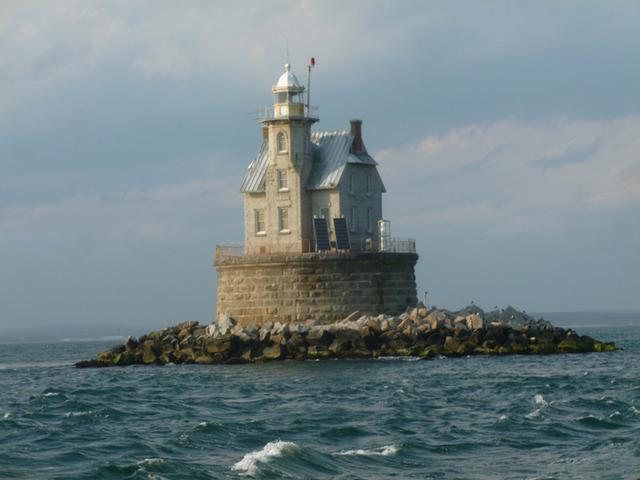
Race Rock Lighthouse
There is a point in the eastern reaches of Long Island Sound where three bodies of water — the Sound itself, Block Island Sound, and Fishers Island Sound — converge in a narrow channel four miles wide and choked with opposing tidal forces. Mariners have called it The Race for centuries, a name that captures the speed and turbulence of currents that can push six knots and reverse direction entirely with the tide. At the center of this convergence sits Race Rock, a submerged ledge rising only three feet above mean low water, decorated with shipwreck after shipwreck and surrounded by water that behaves like a living thing with bad intentions. The lighthouse that stands on that reef — granite, square at the base, octagonal at the top, its fourth-order Fresnel beam visible fourteen miles at sea — is one of the most consequential feats of American marine engineering, and one of the most persistently reported haunted sites along the Eastern Seaboard. By 1837, eight vessels had been lost on Race Rock Reef in eight years. Congress appropriated funds for a lighthouse as early as 1838, but the money was never spent, the engineering problem seemingly unsolvable. Buoys couldn't hold in the current. Iron spindles driven eighteen inches into the reef disappeared with the spring ice. The Lighthouse Board reported in 1852 that every conventional approach had been tried and failed. The danger was well-documented; the solution was not. It would take another two decades and a total of $278,716 — and nearly eight years of continuous effort — before the light was finally activated on January 1, 1879. The man who solved it was Francis Hopkinson Smith, a structural engineer contracted in 1871 who was also, improbably, a painter and novelist — a descendant of Francis Hopkinson, signer of the Declaration of Independence, and later famous for fiction drawn from his own experiences on this reef. Smith had previously built the Block Island breakwater and a seawall on Staten Island; he would later build the foundation for the Statue of Liberty. Race Rock would be his most demanding project. He and his crew — led by master diver Captain Thomas A. Scott — lived on the construction site during working months, erecting a shanty on the partial foundation while the water moved around them. When the initial riprap foundation of 10,000 tons of granite began to shift, Smith donned diving gear himself and went down to examine it. He came up certain the design had to change. The Lighthouse Board resisted; he convinced them. The concrete foundation — a stepped, concentric platform sixty-nine feet in diameter — was poured beginning in 1873. The pier rose from it in fourteen courses of heavy masonry, and the lighthouse itself went up in a single working season in 1878. The construction was not without its casualties. A boat carrying two hundred pounds of gunpowder exploded at the site, killing workers. The isolated conditions, the violence of the water, and the years of unrelenting labor extracted their price in lives and in men's minds. Smith later transformed those experiences into the novel Caleb West, Master Diver, thinly disguising Race Rock as its setting. The story had already written itself. Thomas A. Carroll was appointed keeper in 1880. He rowed regularly from Race Rock to Noank for supplies and to visit his family on shore. In January 1885, a severe storm caught him on the mainland and kept him there for several days. When he finally decided he could no longer neglect his post, he pushed his small boat out into the waves alone. He was never seen again. His body was never recovered. Coast Guard crews who later worked maintenance shifts at the lighthouse reported hearing whispers, laughter, and unexplained footsteps moving through the structure. Some reported physical contact — being touched, poked, or pushed — by no visible source. Wet footprints were found leading from the former shower area after the water supply had been disconnected and the fixture removed. Boaters passing at night have reported a shadowy figure visible in the lantern tower when no one is assigned there, illuminated briefly by the rotating beam. Whether the figure belongs to Carroll or to one of the earlier dead — workers from the construction, sailors from the reef's long list of wrecks — has never been resolved. The lighthouse was automated in 1978, ending any permanent human presence on the rock. In 2004, reportedly at the request of Coast Guard maintenance personnel who continued to report unsettling experiences during equipment checks, The Atlantic Paranormal Society conducted a formal overnight investigation, documented in the fourth episode of the first season of Ghost Hunters on Syfy. The investigation was conducted without electricity or facilities, in harsh weather and rough water. The team reported a chair moving across a room without assistance and an electromagnetic field that tracked consistently up and down the spiral staircase. At the conclusion of the twelve-hour session, investigators stated that Race Rock appeared to be genuinely haunted — an outcome the Coast Guard had hoped to disprove. Skeptics point to the obvious: Race Rock is exactly the kind of place where the imagination does what it is built to do. Isolated, unlit, accessible only by boat and only in favorable conditions, surrounded by the sound of water that has killed for centuries, the lighthouse sits in the kind of environment that produces reports almost automatically. The spiral staircase creates drafts; the granite structure amplifies sound; the current generates low-frequency vibration detectable in the bones but not in conscious hearing. All of that is probably true. It doesn't account for the consistency of the reports across unrelated witnesses over more than eighty years, or for the specificity of a keeper last seen rowing into a January storm, still attributed by those who work the light as not entirely gone. Race Rock Lighthouse was added to the National Register of Historic Places in 2005 and transferred to the New London Maritime Society in 2013 under the National Historic Lighthouse Preservation Act. The light remains operational, maintained by the Society and the Coast Guard jointly. Tours are offered occasionally in summer through New London's Custom House Maritime Museum, weather and tidal conditions permitting — the latter qualifier a reminder that the water around Race Rock still sets the terms of everything that happens there.

Belleview-Biltmore Hotel
For more than a century, the Belleview-Biltmore Hotel commanded one of the highest points along Florida's Gulf Coast, its white clapboard exterior and green-shingled roofline visible for miles across Clearwater Bay. Known as the "White Queen of the Gulf," the massive Queen Anne–style structure was one of the largest occupied wooden buildings in the United States—a sprawling 350,000-square-foot monument to the Gilded Age ambition that transformed Florida from frontier into winter playground. Its story is one of opulence, slow decline, and a demolition that erased most of the original structure but could not, according to decades of witness accounts, erase everything that happened inside it. The hotel was the creation of Henry B. Plant, a railroad and shipping magnate who spent the late nineteenth century building a transportation empire along Florida's western coast. Plant purchased the Orange Belt Railway in 1895 and recognized that the rail line alone would not generate sufficient tourist traffic without significant accommodations. He commissioned a massive resort on a bluff overlooking the bay between Clearwater and St. Petersburg. Construction began in 1896, and the Hotel Belleview opened January 15, 1897. Built primarily of native Florida heart pine, it featured peaked gables, deep verandas, steam-generated electricity, Tiffany glass, and a resident orchestra. Three long wings fanned from a central core, creating an interior of seemingly endless corridors, stairwells, and hidden service passages. The hotel drew America's industrial aristocracy immediately. The Vanderbilts, DuPonts, and Studebakers were regular guests. Railroad presidents arrived in private cars on the hotel's own siding. Among the more colorful figures in the hotel's history was Maisie Plant, who married Henry Plant's son Morton after Morton reportedly offered her existing husband eight million dollars to step aside. Maisie later traded the Plant family mansion on Fifth Avenue to the jeweler Cartier in exchange for a double strand of Oriental pearls valued at over a million dollars. According to persistent local legend, she lost those pearls somewhere inside the Belleview—a story that has become inseparable from the hotel's paranormal lore. During World War II, the hotel was requisitioned to house servicemen stationed at MacDill Air Force Base, adding another layer of transience to the building's dense history. Through the decades, the guest list included Presidents Ford, Carter, George H. W. Bush, and Obama, along with Margaret Thatcher, the Duke of Windsor, Thomas Edison, Babe Ruth, and Bob Dylan, who rehearsed for his 1976 Rolling Thunder Revue tour in the hotel's Starlight Ballroom. Decline set in during the 1970s as newer beachfront properties drew tourists elsewhere. The hotel was added to the National Register of Historic Places in 1979 but closed in 2009. Despite efforts by preservation organizations, demolition began in 2015. A portion of the 1897 structure was saved, relocated, and restored as the Belleview Inn, a boutique hotel that opened in 2018. The paranormal reputation of the Belleview-Biltmore was among the most widely reported of any hotel in Florida, drawing national attention through a Travel Channel Weird Travels episode filmed in 2004 and regular ghost tours in its final years. The most iconic claim involves Maisie Plant herself—guests and staff reported an apparition in a white dress and hat drifting through corridors and ballrooms, seemingly searching for her lost pearls. At least one investigator described seeing a full-bodied apparition matching this description. Other recurring reports included transparent elevator operators who vanished before reaching their floor, poltergeist activity involving doors banging and lights switching on unprompted, and dresser drawers opening on their own in occupied rooms. Guests on the first floor frequently heard children running through hallways at night, consistent with the fourth floor's historical use as quarters for servants and children kept out of sight during the Gilded Age. Room 4336 carried a specific legend involving a bride who allegedly leapt from its balcony after her husband was killed. The sealed fifth floor was described by paranormal teams as the most active area in the building, home to an aggressive presence investigators called "the angry man," alongside equipment anomalies, cold spots, and unexplained footsteps. A couple photographed at the base of a stairway during a 2004 holiday party discovered, upon developing their film, a misty white figure hovering above them that had not been visible to the naked eye. Today the Belleview Inn preserves a fragment of the original building, restored with heart-pine flooring, wainscoting, and original Tiffany glass. Most of the hotel's immense footprint is gone—the sealed fifth floor, the service tunnels, the rooms where guests heard running children and felt unseen hands. Whether the spirits that reportedly inhabited the White Queen survived demolition is a question no one can answer. But for over a century, the Belleview-Biltmore carried the kind of accumulated presence—grief, glamour, war, and loss—that tends to leave traces deeper than any wrecking crew can reach.
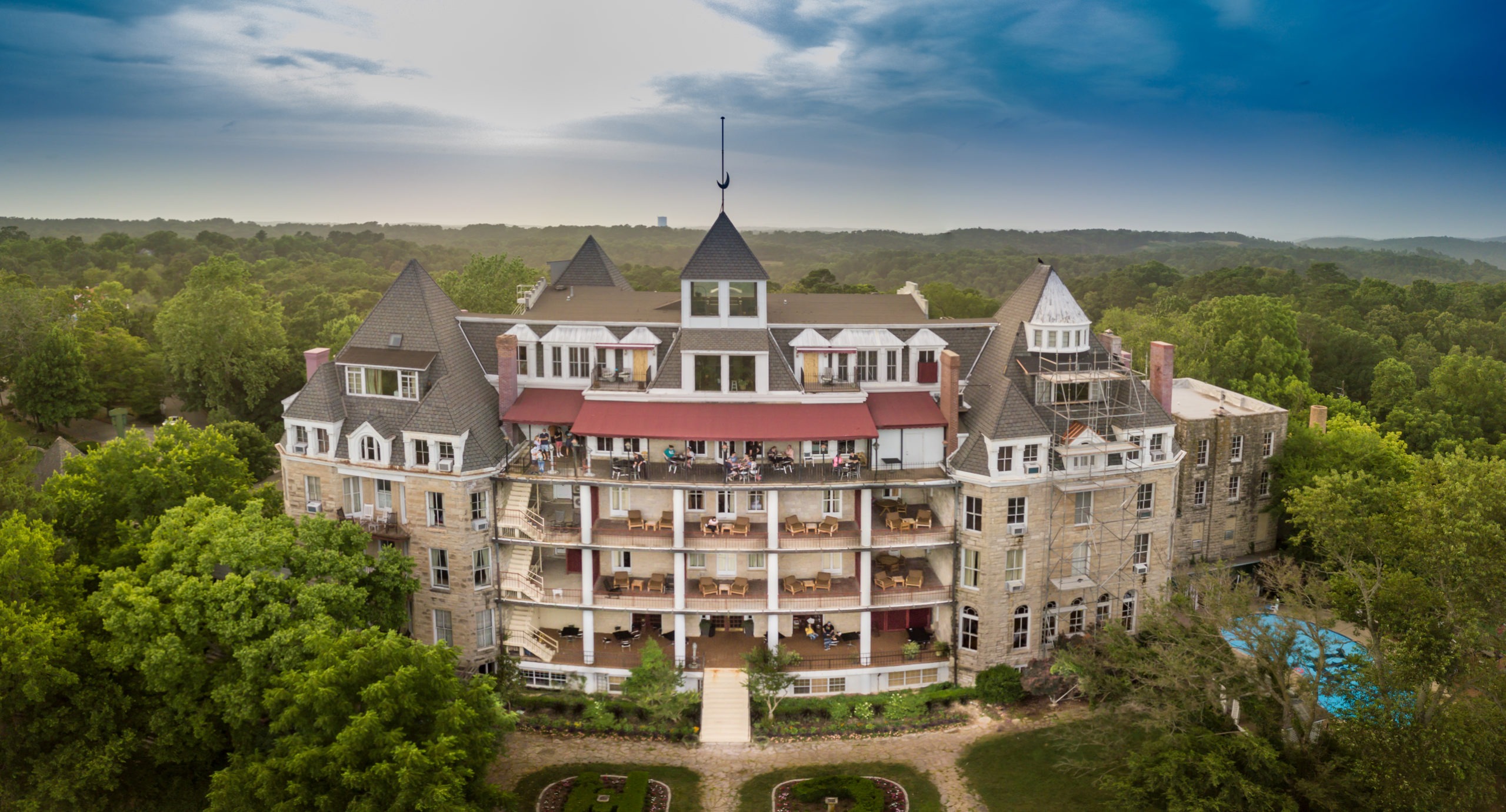
The Crescent Hotel
Perched on the crest of a limestone mountain overlooking the Victorian village of Eureka Springs, Arkansas, the 1886 Crescent Hotel commands the Ozark skyline like something lifted from a Gothic novel and dropped into the middle of the Bible Belt. Built from hand-cut limestone blocks so precisely fitted they required no mortar, the hotel rises in a blend of Richardsonian Romanesque and French Renaissance styling—arched windows, turrets, broad verandas, and a presence that can be seen from nearly anywhere in town. It was designed by architect Isaac S. Taylor, who would later design buildings for the 1904 St. Louis World's Fair, and funded by the Eureka Springs Improvement Company under former Arkansas governor Powell Clayton. When its doors opened on May 20, 1886, six hundred guests arrived from six states, greeted by a band stationed at the train depot. Eureka Springs had boomed almost overnight after its founding in 1879, drawn by sixty natural mineral springs that Native Americans had long known and that white settlers began marketing as miracle cures. By 1880, over fifteen thousand people had descended on the area. The Crescent was built to serve that wave—a luxury resort at nearly $300,000, the equivalent of roughly eight million dollars today. For its first two decades it operated as an exclusive destination, but interest in the springs faded, and the hotel couldn't sustain itself through the off-seasons. By 1902 it had been leased to the Frisco Railway. In 1908, it was converted into the Crescent College and Conservatory for Young Women, reportedly one of the finest women's seminaries in the country. That institution closed in 1924 for lack of funding, and a successor junior college folded during the Depression. By the mid-1930s, the grand hotel sat vacant and deteriorating. Then came Norman Baker. A former vaudeville performer and radio showman from Muscatine, Iowa, Baker had no medical training whatsoever but had already operated a fraudulent cancer clinic in his home state before being driven out. In 1937 he purchased the Crescent for $40,000 and transformed it into Baker's Cancer Curing Hospital, painting the interior in garish lavender and broadcasting his claims over the airwaves. His so-called treatments centered on injections of a concoction he called Formula 5—a mix of alcohol, carbolic acid, watermelon seed, corn silk, and clover leaves—administered up to seven times daily. Patients arrived from across the country, many spending their life savings on the promise of a painless cure. What they received was theater. At least forty-four patients died during the twenty months the hospital operated, their bodies moved to a basement morgue fashioned from the hotel's original kitchen, stored in the walk-in freezer. In 1940, federal authorities arrested Baker for mail fraud. He served four years in prison and died in Florida in 1958—of liver cancer. The hotel sat empty again until 1946, when new owners restored it to its original purpose. The paranormal reputation of the Crescent begins not with Baker but with the building itself. During construction in the 1880s, an Irish stonemason reportedly fell to his death from the upper framework into what is now Room 218. Staff have long referred to his spirit as Michael, and the room remains the most consistently active in the hotel. Guests report doors opening and slamming shut, pounding in the walls, the sound of a man falling through the ceiling, and, most disturbingly, hands emerging from the bathroom mirror. Room 419—known as Theodora's room—is associated with a former Baker patient who also worked as a hospital assistant. Guests find her straightening furniture or fumbling at the door as though searching for her key. On the third floor, witnesses describe the sound of squeaking wheels and the apparition of a nurse pushing a gurney down the corridor, only to watch it vanish. A young boy called Breckie, believed to have died from complications of appendicitis, has been seen bouncing a red ball on the second floor. In the hotel kitchen, a former chef reported pots and pans flying from their hooks, and another staff member witnessed a boy in old-fashioned knickers skipping through the room. Even Baker himself has reportedly been seen, appearing in his trademark white linen suit near the basement morgue. The morgue itself—still containing Baker's original autopsy table and walk-in cold storage—produces some of the most intense reports. Visitors describe oppressive atmosphere, sudden temperature drops, shadowy figures near the examination area, and the sensation of being touched by unseen hands. In 2019, groundskeepers digging near the hotel unearthed hundreds of glass bottles—remnants of Baker's operation—some containing preserved human tissue later confirmed by pathologists at the University of Arkansas for Medical Sciences. The discovery seemed to intensify reported activity, particularly in and around the morgue. Today the Crescent Hotel is owned by Elise Roenigk, who along with her late husband Marty purchased the property in 1997 for $1.3 million and undertook a six-year restoration. The hotel was listed on the National Register of Historic Places in 2016 and operates as a full-service resort and spa. It runs nightly ghost tours that draw over thirty-five thousand visitors annually, and hosts the Eureka Springs Paranormal Weekend each January. The morgue is open for public viewing. Room 218 books months in advance. The Crescent doesn't hide from what it is. It sets a place at the table for it.
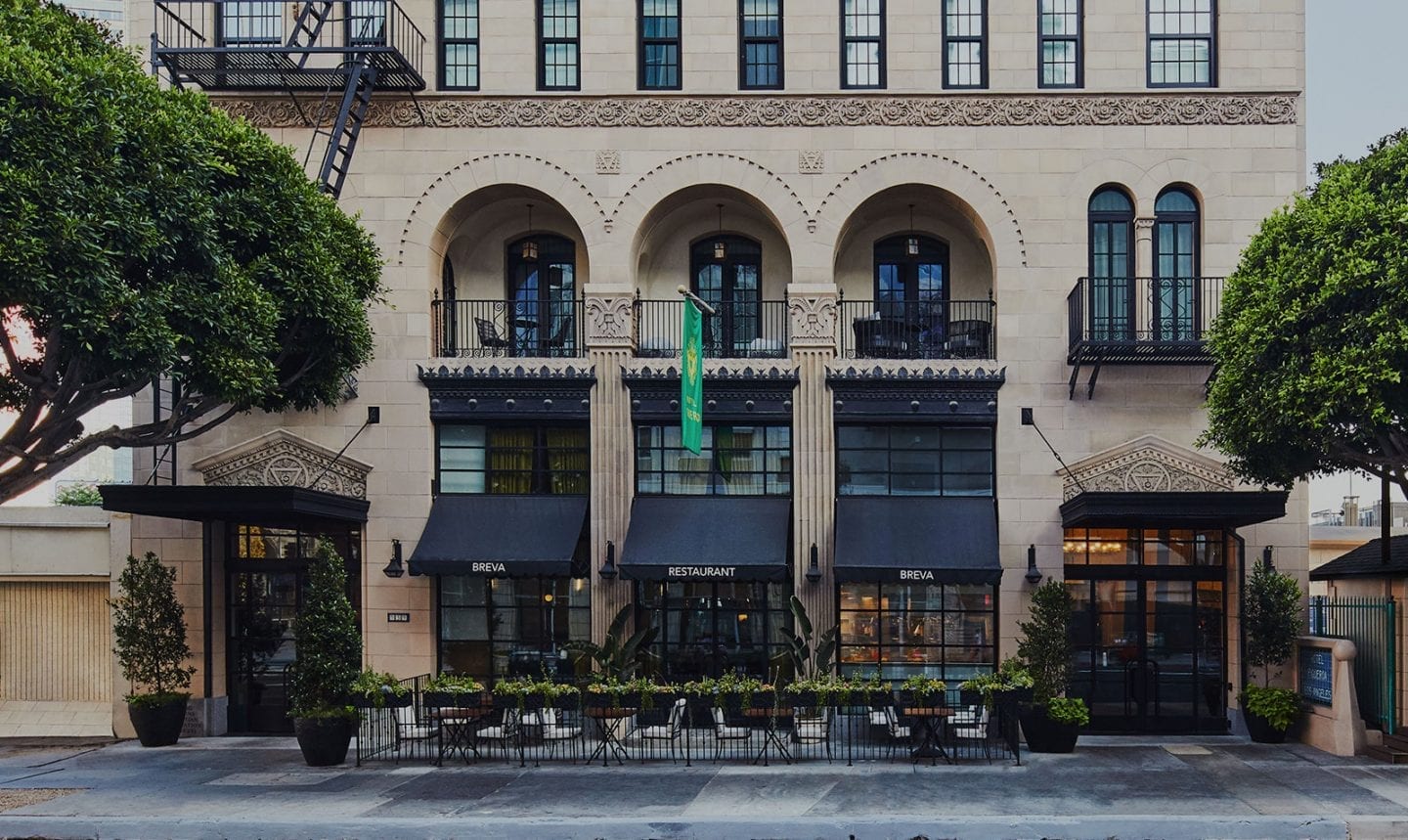
Figueroa Hotel
Rising thirteen stories above South Figueroa Street in the South Park district of Downtown Los Angeles, Hotel Figueroa occupies a building that was never meant to simply house travelers. It was built as a statement—the largest commercial structure in the United States financed, owned, and operated by women at the time of its completion in 1926. Its origins belong to the YWCA of Los Angeles, and its paranormal reputation belongs to nearly a century of human drama that unfolded within walls designed to shelter women at a time when most hotels in America would not admit them without a male escort. The project was spearheaded by the Los Angeles YWCA under the leadership of Mrs. Chester C. Ashley, who recognized that the growing number of women entering the white-collar workforce needed safe, respectable accommodations while traveling on business. The organization purchased the land at 939 South Figueroa Street and financed the 409-room concrete and steel structure through supporter donations and two mortgage bonds. The architecture firm Stanton, Reed and Hibbard designed the building in a Spanish Colonial Revival style, and construction began in 1925. The hotel was finished ahead of schedule and dedicated on August 14, 1926, with a night of dancing and entertainment attended by more than three hundred guests, including representatives of nearly every women's club in Los Angeles. The interior was appointed with wrought iron finishes, goldenrod satin draperies with black patent leather trim, Spanish tapestries on loan from prominent local women, and public spaces given Spanish names—the lobby was the sala de recepcion, the main corridor the el corredor. Maude Bouldin, a motorcycle-riding, plane-flying feminist, served as the hotel's first managing director, believed to be the first woman in the country to hold such a position at a major hotel. For its first two years, the hotel served women exclusively, with men granted only limited access. By 1928, the policy was relaxed to include men in order to sustain business. Through the 1930s, 1940s, and 1950s, the Figueroa functioned as a hub for political organizations, social clubs, and the creative community of downtown Los Angeles. The hotel held press conferences and rallies against sexism and racism, cultivating a reputation as a progressive gathering place. By the late 1950s and 1960s, as downtown Los Angeles experienced a westward migration of offices and residents, the Figueroa declined into a semi-permanent residential hotel with guests paying by the week. In 1976, Swedish entrepreneur Uno Thimansson purchased the property and converted it into a Moroccan-themed budget hotel, introducing the Tangier Room and Club Fes. For decades the Figueroa operated in this eclectic incarnation, known for its affordability and its distinctive coffin-shaped swimming pool but increasingly criticized for aging infrastructure and the absence of modern amenities. In 2014, a joint venture purchased the hotel for sixty-five million dollars and undertook a three-year restoration that stripped away the Moroccan layers and returned the building to its original Spanish Colonial splendor. The hotel reopened in 2018 with 268 rooms and 63 suites, an art program featuring works exclusively by women, and multiple dining and bar concepts. The darker chapters of the Figueroa's history provide the framework for its haunting claims. In 1929, radio operator William L. Tallman murdered his girlfriend Virginia Patty in the hotel and was never captured. A separate killing involved a woman named Cecilia Oswald, whose body was discovered in one of the rooms after her partner confessed, claiming he killed her because he loved her. At least one suicide has also been documented on the premises. These violent deaths, layered over decades of dense human occupancy—hundreds of rooms filled night after night with transient guests, long-term residents, and the steady churn of a building that has never stopped operating—have given the Figueroa a paranormal reputation that persists through its various renovations. Guests over the years have reported televisions and lights turning on in the middle of the night without explanation, air conditioning and heating systems cycling on and off in patterns that suggest deliberate manipulation, and elevator doors opening on empty floors unprompted. Some visitors have described an oppressive or unsettling energy in certain hallways, particularly near the old elevator shafts. The apparition of a former maid who was murdered in the hotel has been reported by multiple sources, and at least one valet parking attendant has acknowledged off the record that staff are aware of the haunting but are discouraged from discussing it with guests. Some visitors have described experiences intense enough to cause them to leave in the middle of the night. Others have noted that the energy in the building, while unmistakable, does not feel uniformly hostile—more restless than aggressive, as though the spirits occupying the Figueroa are as varied in temperament as the living guests who have passed through its doors over the past century. Today Hotel Figueroa operates as part of the Unbound Collection by Hyatt, fully restored and positioned as a boutique luxury destination steps from Crypto.com Arena, the Los Angeles Convention Center, and the LA Live entertainment complex. The Gran Sala lobby displays a black-and-white photograph of the founding women in their flapper dresses, and a large-scale painting of Maude Bouldin greets visitors near the entrance. The coffin-shaped pool remains. The art on the walls is still by women. And the building itself, approaching its centennial, continues to hold whatever it has accumulated across a hundred years of sheltering the living—and, perhaps, some who no longer are.
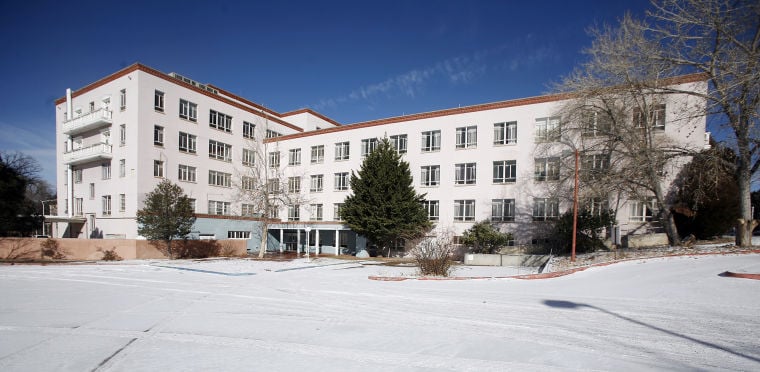
Old St. Vincent’s Hospital (Drury Inn)
The corner of Palace Avenue and Paseo de Peralta in downtown Santa Fe is one of the most historically saturated pieces of ground in the American Southwest. Before European contact, it sat within the territory of ancestral Pueblo peoples. After Spanish colonization established Santa Fe as a capital in 1610, it cycled through two centuries of colonial administration, conflict, and change. By the time Archbishop Jean Baptiste Lamy arrived in the mid-1800s to transform the church's presence in New Mexico, this corner was already ancient by American standards. The building that now operates as the Drury Plaza Hotel carries that entire weight — plus decades of hospital death, a nursing home, state offices, film sets, and years of abandonment — inside a structure that still looks, to many guests, like it remembers everything. The hospital's origin traces directly to Lamy. After his arrival, he invited the Sisters of Charity to New Mexico to help care for the sick. In 1865, Lamy sold them a building originally constructed as a rectory adjacent to what would become St. Francis Cathedral, and the Sisters opened Santa Fe's first hospital inside it. That original structure and the 1911 Craftsman-style Marian Hall built next door served the community for nearly a century before the Sisters outgrew them entirely. In 1953, renowned architect John Gaw Meem — known for the Zimmerman Library at the University of New Mexico and the Cristo Rey Church in Santa Fe — was commissioned to design a proper city hospital on the site. The resulting building was notably austere for Meem: yellow brick, sharp corners, large windows, only a faint nod to Territorial style. It opened as the new St. Vincent Hospital and served Santa Fe for roughly two decades before the hospital relocated to St. Michael's Drive in 1977. The state of New Mexico then took over the buildings for use as offices for the Department of Cultural Affairs and, eventually, a nursing home. That nursing home, which locals called La Residencia, occupied the old hospital until the early 1980s. The building then sat largely empty for years — used occasionally as a film location, including Jeff Bridges' 2009 film Crazy Heart — before Drury Hotels purchased it in 2007 and began a years-long adaptive reuse project. Archaeologists working the site in 2008 uncovered what appeared to be an underground vault of unknown origin before the economic collapse shut the project down. The Drury Plaza Hotel finally opened in 2014. The paranormal reputation of the building predates the hotel by decades and is concentrated in two areas: the basement and the third floor. During the La Residencia years, the basement became so unsettling to staff that sending new employees down there alone at night became a formal initiation ritual — a rite of passage that the longtime employees themselves refused to repeat solo under any circumstances. Multiple accounts describe the basement walls appearing to ooze blood, particularly near a storage room that had once been used to incinerate amputated limbs and surgical remains. A nurse coordinator investigating a disturbance in that room reported finding what looked like fresh blood on a wall surface. A former candy striper who worked at the original St. Vincent Hospital in the 1970s recalled that the area near the basement incinerator produced intense cold, a sense of presence, and disembodied voices — and that hospital staff uniformly avoided it after dark. During the Drury renovation, a security guard working nights described refusing to enter an adjacent structure called Marian Hall, reporting consistent unease throughout the basement level. The state museum's use of the building added another layer: Native American artifacts, and reportedly skeletal remains in cardboard boxes, were stored in the basement hallways during the state offices era. That detail appears in documented interviews with former employees and has fed persistent theories about the nature of the activity. Room 311 — or the fourth floor, depending on the account — carries its own specific legend. A young boy brought into the hospital on Christmas Eve after a severe car crash is said to have died crying for his deceased father throughout the night. Long after the hospital years, nurses at La Residencia reported hearing a baby crying in that room with no source, eventually keeping it vacant unless the census demanded otherwise. The sound has been reported by visitors as recently as the hotel era. A nurse who worked the top floor during the hospital years described a short Hispanic man in old-fashioned clothing appearing alongside a woman in a black mantilla — both seeming confused and in need of something they couldn't name. A worker who accidentally rode the elevator to the basement described the doors refusing to close until he stepped out, then ascending without him while a shadowy presence moved nearby. The Drury Plaza Hotel operates today as a functioning boutique hotel in one of Santa Fe's most storied locations. The basement is there. Room 311 is numbered. The history goes back further than the building — and, by most accounts, it hasn't stopped moving.
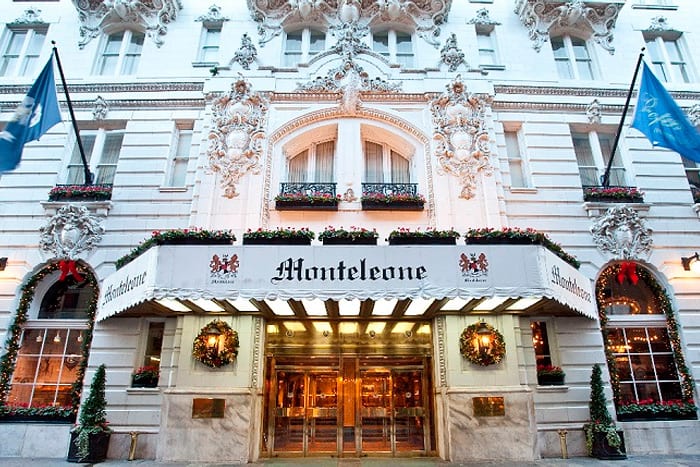
Hotel Monteleone
It has been said that the French Quarter begins in the lobby of the Hotel Monteleone. The claim is not merely geographic. Standing at the corner of Royal and Iberville streets since 1886, the Monteleone is the only high-rise building in the interior of the Quarter, a Beaux-Arts landmark that has anchored the cultural life of the neighborhood for well over a century. It is one of the last great family-owned hotels in America, and it is, by nearly every account, one of the most actively haunted buildings in New Orleans. The hotel's origins trace to Antonio Monteleone, a Sicilian nobleman who had operated a successful shoe factory before immigrating to New Orleans around 1880. Setting up a cobbler's shop on Royal Street, then the commercial and banking heart of the city, Monteleone prospered quickly enough to purchase a small sixty-four-room hotel on the corner of Royal and Iberville. He renamed it the Hotel Monteleone, and the property grew rapidly. A major expansion in 1903 added thirty rooms, and a sweeping 1908 renovation added three hundred more. Antonio died in 1913, and the hotel passed to his son Frank, who oversaw the addition of the Queen Anne Ballroom and two hundred more rooms in 1928—one year before the Depression. The Monteleone was one of the rare family-owned hotels to survive those lean years intact. In 1949, Frank introduced the hotel's most famous feature: the Carousel Piano Bar and Lounge, a twenty-five-seat revolving bar turning on two thousand steel rollers at a rate of one revolution every fifteen minutes. The original building was demolished and rebuilt in 1954, and a final expansion in 1964 added the upper floors, a Sky Terrace, rooftop pool, and the Presidential Suite. The hotel today holds 570 guest rooms across its towering frame. The Monteleone's literary associations alone would secure its place in American cultural history. Ernest Hemingway, William Faulkner, Tennessee Williams, Eudora Welty, and Truman Capote were all frequent guests. Hemingway referenced the hotel in his short story "Night Before Battle." Williams used it as a symbol in The Rose Tattoo. Capote famously claimed on The Tonight Show that he was born in the hotel—his mother lived there during her pregnancy but made it to the hospital in time. In 1999, the Friends of the Library Association designated the Monteleone an official literary landmark, one of only three hotels in the country to receive that distinction. In 1942, New Orleans author Innis Patterson Truman jumped to her death from the hotel's twelfth floor, an event documented in letters by the writer Lyle Saxon—one of the building's darker episodes and one that adds genuine tragedy to the property's layered past. The paranormal reputation of the Hotel Monteleone is extensive and has been the subject of formal investigation. In March 2003, the International Society for Paranormal Research conducted a multi-day investigation and reported making contact with more than a dozen earthbound entities. Among them were two former employees—a chef and a busboy or waiter—whom investigators linked to a recurring phenomenon involving the hotel restaurant's door, which opens and closes on its own despite being locked and operated by a push-button mechanism. The investigators concluded the two spirits were engaged in an ongoing disagreement about whether the door should remain open or shut. The most widely reported spirit is that of a toddler named Maurice Begere. According to the legend, Maurice's parents, Jacques and Josephine, were frequent guests in the late nineteenth century who would leave their young son with a nanny while they attended performances at the French Opera House on Bourbon Street. One evening, Maurice developed a high fever and died in his room on what is now the fourteenth floor. His grief-stricken mother returned to the hotel repeatedly, and eventually, the story holds, Maurice's spirit appeared before her, saying words to the effect of not to cry, that he was fine. Guests to this day report seeing a small boy wandering the fourteenth-floor hallway, sometimes standing at the foot of their bed, sometimes heard laughing. The fourteenth floor—which is actually the thirteenth, as the hotel skipped that number in its floor plan—has become the most requested floor among guests seeking a paranormal experience. Other reported entities include a man named William "Red" Wildemere, who died of natural causes in the hotel, a ghostly figure in nineteenth-century clothing believed by some to be Antonio Monteleone himself still watching over his creation, a phantom child who takes visitors' hands and then vanishes, and a spirit identified as "Solemn John," a Tennessee businessman said to have committed suicide after failed investments. Guests report shadows gliding through corridors, unexplained cold spots, elevators that stop on the fourteenth floor without being called, and the sounds of children playing in hallways where none are present. Today the Hotel Monteleone continues to operate under the fifth generation of the Monteleone family. The grandfather clock still chimes in the lobby. The Carousel Bar still turns. The doormen still stand at the entrance on Royal Street. And somewhere on the fourteenth floor, a small boy may still be looking for his parents—or simply making sure he is remembered.

Brunswick Heritage Museum
Sitting in the heart of downtown Brunswick, Maryland, just steps from four active CSX mainline tracks and the Potomac River, the Brunswick Heritage Museum occupies a three-story brick building that has housed more history than its modest Main Street footprint would suggest. The 1904 structure — with its five tall narrow arches, Flemish bond brickwork, and dentelle cornice — was not built as a museum. It was built as a lodge, and the town it stands in was not always called Brunswick. It has been Eel Town, Berlin, Barry, and half a dozen other names across three centuries of continuous human settlement, each identity layered onto the one before it. The land along this stretch of the Potomac was home to the Susquehanna Indians when European settlement began in the early eighteenth century. The area was known as Eel Town because Native Americans fished for eel from the riverbank. A 1753 land grant from King George II planted the area firmly in colonial hands, and German immigrants followed in enough numbers through the 1780s that the settlement took the name Berlin. It remained a modest river trading post until the Baltimore and Ohio Railroad arrived and changed everything. In 1883, the B&O selected Berlin as the site for a massive new freight classification yard — the terrain was ideal, riverside bottomland was cheap, and the railroad was exempt from Maryland property taxes. The town was incorporated as Brunswick in 1890, and by 1907 the yard was complete: five miles of track, the largest and most modern classification yard in the country to serve a single railroad. A population of roughly 200 in 1890 swelled to an estimated 5,000 by 1910. Brunswick was, briefly, a boomtown. The building at 40 West Potomac Street was constructed in 1904 at the height of that boom, commissioned for the Delaware Tribe No. 43 of the Improved Order of Red Men — a fraternal organization whose roots traced to secret patriotic societies of the pre-Revolutionary era. The upper two floors served the lodge; the ground floor housed separate commercial tenants. A Native American statue stood at the building's entrance. The Improved Order of Red Men occupied the building until 1945, when the Fraternal Order of Eagles Brunswick Aerie No. 1136 purchased it, removed the statue from the entrance — it now stands on the museum's second floor — and operated there until 1969. The Brunswick Potomac Foundation purchased the building in 1974 for $30,000, paying off the mortgage through dollar donations and baked goods sales. The museum opened in 1980, focused initially on the railroad, and expanded its scope in 2013 to encompass the full arc of Brunswick's history. During the Civil War, Confederate forces used the area as a staging ground for raids into Maryland, and Union soldiers camped nearby after both Antietam and Gettysburg. Before the building became a museum, its third floor served as a dance hall where Patsy Cline performed for the Lions Club in the 1960s. The building itself carries three stories of accumulated human use across more than a century — fraternal lodge, dance hall, civic meeting space, and now museum. The architecture is straightforward brick commercial, but the interior has absorbed decades of different functions and different communities. The 1,700-square-foot HO scale model railroad on the third floor depicts the B&O Metropolitan Subdivision in meticulous detail. Elsewhere in the building, exhibits trace the town from its Indigenous roots through the canal era, the railroad boom, and into the present. The whole structure sits less than a block from active tracks, and the sound and vibration of passing trains are a constant undercurrent. Paranormal activity at the museum was described as occasional from the time it opened in 1980, but reports appeared to escalate in 2010 during construction on an elevator. The most consistent account across multiple independent sources is the apparition of a woman in a white dress — long-sleeved, ankle-length, described by at least one former resident as appearing to be from the Civil War era or earlier. She has been seen on the second floor and moving through exhibit spaces in rooms that should be empty. A former child resident of an apartment above the museum reported seeing the apparition repeatedly at night over the course of years, an account that surfaced only after adult investigators began documenting the building's activity. A second presence is described as a spirit who rearranges exhibits and interacts with the museum's collection — sometimes referred to as a ghostly curator. A third is associated specifically with the model railroad on the third floor, where the trains are said to start moving on their own and track switches reported to flip with no one near them. Skeptics will point to the building's age and constant low-level vibration from nearby rail traffic as natural sources for unexplained sounds and movement. A structure that has served as a fraternal lodge, dance hall, and community gathering space for over a century has absorbed a great deal of human energy, and the suggestion embedded in a location marketed as haunted is never insignificant. Investigators from multiple paranormal organizations have conducted formal sessions at the museum, with one 2017 expedition capturing what researchers described as statistically significant results from a random event generator and apparent direct radio voice responses to control questions using local and historical names. Today the Brunswick Heritage Museum is open to the public, free of charge, and operated as a nonprofit. It has been featured on regional ghost tours and included in guided haunted history routes through western Maryland. Whether visitors come for the model railroad, the Civil War history, the layers of fraternal lodge lore, or the woman in white reportedly still moving through the second-floor exhibits, the building at 40 West Potomac Street has more stories running through it than most places twice its size. Brunswick built itself around a railroad, and the museum built itself around Brunswick — and something in the building, apparently, has declined to leave.
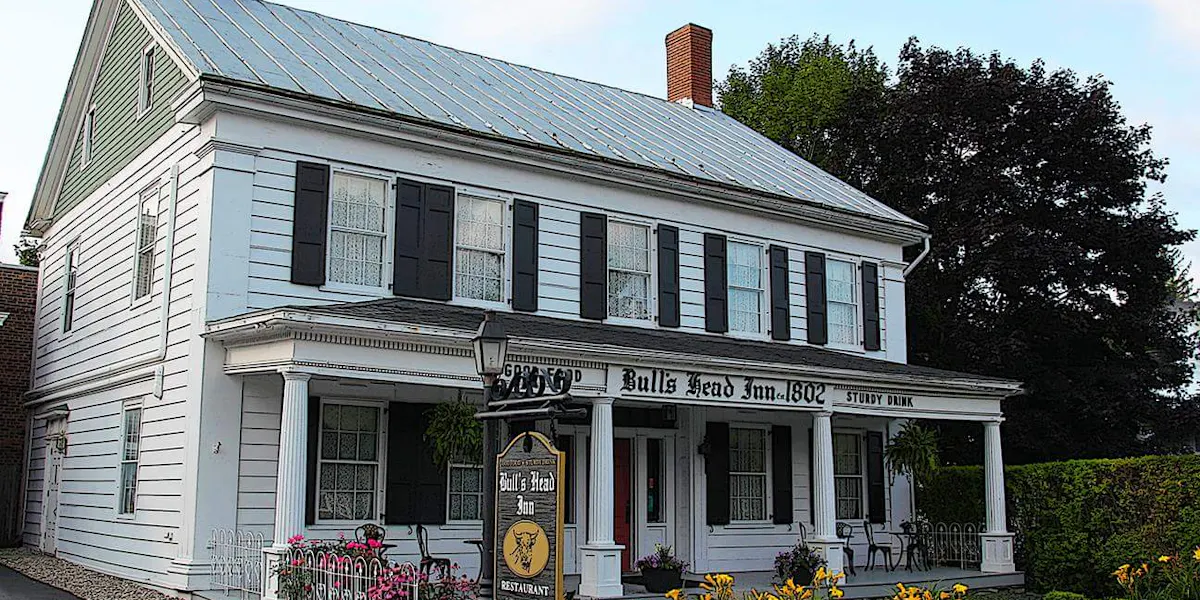
Bull’s Head Inn
Standing at the corner of Park Place in the heart of Cobleskill, New York, the Bull's Head Inn is the oldest building in the village — a Federal-style structure built in 1802 that has served, across more than two centuries, as tavern, town hall, Masonic temple, courthouse, meeting hall, private residence, and restaurant. It carries that layered institutional history the way old buildings do in small upstate New York towns — quietly, in the woodwork, in the reoriented staircase, in the central fireplace that has warmed a rotating cast of merchants, soldiers, politicians, and neighbors across generations. A portrait of Thomas Jefferson hangs in the foyer, a reminder that he was President when the building was new. But the site itself is older than the building by half a century. George Ferster constructed one of the first structures in Cobleskill here in 1752, and what followed was a sequence of catastrophes that left a mark the land has apparently not forgotten. On May 30, 1778, during the Battle of Cobleskill, Mohawk forces under the command of Joseph Brant — fighting alongside Tories and British — burned the settlement nearly to the ground. Retreating patriots were killed, and the structure on this site was destroyed. The two buildings that followed met the same fate, each burned in subsequent enemy raids on Cobleskill in the spring and fall of 1781. Local tradition holds that occupants perished in one or more of these fires — including, in one account, a young girl in an upstairs bedroom who froze in terror and could not escape the blaze. Another story maintains that a Native American was killed inside the building during one of the conflicts. Three buildings destroyed on the same ground, within a single generation, each one carrying its dead. The current structure was built in 1802 by Seth Wakeman — the same builder responsible for the Beekman Mansion in Sharon Springs — and established as an inn and tavern to serve merchant traffic along the newly charted Loonenburg Turnpike, which ran commerce between Central New York and New York City. The inn thrived until the Erie Canal redirected that traffic north through Albany, bypassing Cobleskill and draining the commercial foot traffic that had kept it busy. By 1839, the building had transitioned into a private residence, and it remained one for well over a century. In 1810, when Cobleskill's Main Street was developed, the building was physically reoriented — its staircase repositioned, its front entrance redesigned to face the new brick-lined street. The building adapted, as it always had. The architecture reflects its early Federal character — three floors, a central staircase, original wide-plank floors, and stone cellar walls that the current owners exposed and incorporated into the lower tavern space using reclaimed brick from Cobleskill's own Main Street. The building is divided across three distinct atmospheres: a ground floor dining room anchored by a classic brick fireplace, an upper floor with vintage glass windows suited for private gatherings, and a lower tavern built from the bones of the old cellar. It is a building that wears its age honestly, without staging. The last private residents of the Bull's Head were John and Grace Steacy, whose opposing natures apparently outlasted them both. John drank; Grace was a dedicated member of the Women's Christian Temperance Union. When the building was sold after their deaths and former Cobleskill mayor Monte Allen reopened it as a restaurant and bar in 1966, he placed the bar in the room that had served as Grace Steacy's bedroom. What followed, according to staff, guests, and ownership across multiple decades, has been consistent and specific. A woman in a white gown — long-sleeved, floor-length — has been seen moving around the central staircase, along the upper and lower landings, and through the first-floor dining room by guests and staff working late. Silverware and napkins have been knocked to the floor or sent across the room. Plates and utensils have been disrupted mid-service. Doors slam on their own. Faucets turn themselves on. The current ownership reports these occurrences as ongoing. The paranormal activity at the Bull's Head is notable for its consistency across unrelated witnesses spanning more than fifty years of restaurant operation. The apparition of the woman in white has been described in nearly identical terms by guests who had no prior knowledge of the building's story. Paranormal investigators have conducted formal sessions at the property, and the inn is an established stop on New York State's official Haunted History Trail. The figure most commonly associated with the activity is Grace Steacy — a teetotaler whose bedroom became a bar — though older stories from local family tradition point toward the Revolutionary-era fires and the girl reportedly trapped in the upstairs room as an earlier and perhaps deeper source. Skeptics will note that a two-hundred-year-old building with three destroyed predecessors on the same site is exactly the kind of place where stories accumulate and feed on each other. The convergence of documented historical violence, a colorful final resident with a grudge against alcohol, and decades of reported encounters makes the Bull's Head something of a perfect storm for haunted reputation. None of that makes the firsthand accounts less consistent or less specific. The woman in white keeps appearing near the staircase. The silverware keeps moving. And the bar, to Grace Steacy's apparent displeasure, remains open.

Gratz Park Inn
Tucked into the corner of Second and Upper streets in downtown Lexington, Kentucky, just steps from the green canopy of Gratz Park, the building now known as the Sire Hotel—but remembered by most locals as the Gratz Park Inn—sits quietly among some of the oldest and most storied ground in the Bluegrass. The surrounding historic district occupies land first laid out in 1781 by order of the Virginia Assembly, and by the late eighteenth century the neighborhood had already begun its long accumulation of wealth, ambition, tragedy, and memory. Transylvania University, one of the oldest institutions of higher learning west of the Alleghenies, established its campus here in 1793. The park itself served as a Civil War bivouac for both Union and Confederate troops, and the Federal and Greek Revival homes lining its edges housed some of Lexington's most prominent—and most troubled—families. The building at 120 West Second Street was constructed around 1916 and opened in 1920 as the Lexington Clinic, a group medical practice modeled after the Mayo Clinic. What began as a modest venture among three physicians eventually grew to house nine doctors and expanded facilities, including surgical suites and, notably, a basement morgue complete with drainage scuppers that remain in the building to this day. The clinic served central Kentucky for decades before outgrowing its original home and relocating to Harrodsburg Road in the late 1950s. After the physicians departed, the Fuller Engineering firm occupied the structure through the mid-1970s, and the building sat largely underused until the 1980s, when developers converted it into the Gratz Park Inn—a boutique hotel that opened in 1988 and quickly became Lexington's only historic lodging property. The conversion from medical facility to intimate hotel preserved much of the building's original architecture, but it also appears to have preserved something less tangible. Staff and guests began reporting unusual encounters not long after the inn opened, and over the years a small but remarkably consistent cast of recurring figures emerged from the accounts. The most frequently described are three entities said to be linked to the building's years as a clinic—former patients, according to local tradition, who died within its walls and never fully departed. The spirit known as John is described as a mischievous older man with a sense of humor, known for switching televisions on and off in guest rooms and occasionally manifesting as a melancholy figure on the lower level. Little Annie, as she has come to be called, is reported as a young girl seen playing with a doll or jacks in the third-floor hallway, her footsteps sometimes heard running and then abruptly stopping outside occupied rooms. One guest, staying in what they believed was room 207, described waking to the sound of small footsteps approaching the bed—slow, deliberate, as if trying not to be noticed—before the steps broke into a child's sprint back toward the hallway when the guest removed their sleep mask. The front desk staff reportedly logged the encounter in a ledger kept for such reports. The third recurring presence is the Lady in White, an apparition of a woman in a white dress and matching hat who has been seen drifting through the halls and the atrium, described by witnesses as appearing to search for someone or something. Guests have also reported the sound of a woman walking in high heels through the atrium area, unexplained laughter emanating from room 216, levitating objects, and the apparitions of what appear to be rowdy, intoxicated partygoers from another era materializing briefly before vanishing. The building's medical past lends a particular gravity to these claims. The basement morgue, though no longer in active use, still bears the physical evidence of its original purpose, and the knowledge that patients lived, suffered, and died in the very rooms now occupied by hotel guests gives the reported activity a plausibility that pure legend would struggle to achieve. The Blue Grass Trust for Historic Preservation once conducted its Gratz Park Ghost Tails and Tours through the surrounding neighborhood, and the inn featured prominently in the route. Today, MK Paranormal leads ghost walks through the district, and the Gratz Park Inn remains a regular stop on haunted Lexington itineraries. The building was sold in the late 2010s and underwent a full renovation, reopening as the Sire Hotel under the Hilton Tapestry Collection. The 42 rooms were gutted and redesigned with modern finishes and equestrian-themed touches befitting Lexington's thoroughbred culture. The structural bones remain, though—the same hallways, the same third floor, the same basement. Whether the renovation disturbed or displaced whatever had settled into the old clinic is a question the new ownership has not publicly addressed. But the reports that preceded the transformation were consistent enough, and came from enough unrelated sources, that the building's reputation is unlikely to be stripped away as easily as the wallpaper. The Gratz Park district remains one of the most concentrated clusters of reported paranormal activity in the Commonwealth, and the old clinic at its eastern edge remains one of its anchors.
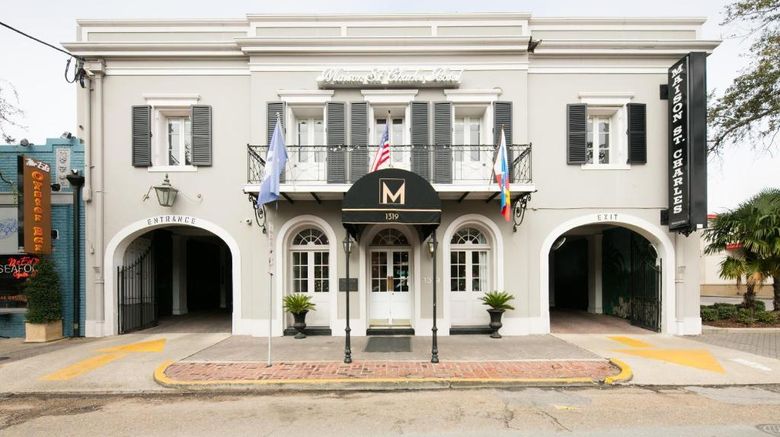
Maison St. Charles
Maison St. Charles sits at 1319 St. Charles Avenue in the Lower Garden District of New Orleans, a boutique hotel assembled from five antebellum townhouses arranged around brick courtyards and wrought-iron patios, directly on the route of the St. Charles streetcar line. The property operates today as a 128-room hotel with exposed brick walls, crystal chandeliers, and murals by local artist Robert Dafford depicting scenes of southern Louisiana life. It is charming, accessible, and laced with the particular brand of theatrical history that New Orleans produces better than any other American city. Because long before there was a hotel at 1319 St. Charles Avenue, there was—according to one of the city's most enduring legends—a mansion built by the Devil himself. The story, recorded in Jeanne deLavigne's 1946 collection of New Orleans folklore and retold in numerous subsequent accounts, holds that sometime in the 1820s, the Devil took up residence in New Orleans, drawn by the city's decadence and its hospitality toward the damned. Around 1840, he took a woman named Madeleine Frenau as his mistress and erected a mansion for her at the 1300 block of St. Charles Avenue. Some versions claim the house appeared overnight; others allow seven days. The structure was said to be architecturally disorienting, with rooms stacked on separate floors connected by stairways that seemed to lead only downward. The Devil entered not through the front door but through the upper gable, and at dusk could be seen peering down at the avenue, horns silhouetted against the fading light. The household was reportedly staffed by small red demons who cooked, cleaned, and dressed Madeleine in jewels. Madeleine, however, grew bored with infernal luxury and began an affair with a Creole gentleman named Alcide Cancienne. The Devil discovered the betrayal and offered Alcide a sum of money to leave town, on the condition the couple adopt the name Monsieur and Madame L. Alcide, having already tired of the affair, told Madeleine over dinner that he intended to leave. When she realized he meant to go without her, she flew into a rage and strangled him with a dinner napkin, severing a blood vessel in his neck and drenching herself and the table in blood. The Devil returned at that moment, gathered both Madeleine and her dead lover, and devoured them on an upstairs balcony. He left town the next day. For decades afterward, occupants of the mansion reported that each evening the murder scene replayed itself—a spectral dining table appearing at sunset, the figures of Madeleine and Alcide reenacting the fatal dinner, followed by the bloodied ghost of Madeleine moving from room to room wiping her hands on the linens. In 1878, Laure Beauregard, daughter of Confederate General P.G.T. Beauregard, moved into the mansion with her husband Charles Larendon. Rather than flee, the couple accepted the nightly apparitions as grim housemates. Charles documented the events for two decades, continuing even after Laure died in childbirth on July 4, 1884. He finally left around 1909. In the years that followed, passersby reported seeing the face of the Devil imprinted high on the crumbling facade. The mansion was torn down in the summer of 1930. The legend is almost certainly fiction—a gothic Creole folktale built from the same cultural soil that produced the stories of the LaLaurie Mansion, the Sultan's Palace, and Marie Laveau. No historical records confirm the existence of Madeleine Frenau or Alcide Cancienne. But the story's persistence says something real about the site and the city's relationship with its own mythology. New Orleans does not distinguish sharply between history and legend; both are treated as forms of truth, and both leave residue. The modern hotel at 1319 St. Charles Avenue carries its own set of claims, separate from the Devil's Mansion folklore. Room 126, located in the older portion of the property, has attracted the most attention. According to local accounts, a young woman was murdered in that room on her wedding day—stabbed repeatedly and found still in her blood-soaked dress after she failed to appear at the church. Guests and staff have reported seeing a woman in white or a hazy luminous figure looking out the window of Room 126. The room is said to go inexplicably cold in summer with the air conditioning off. Electronics behave erratically—televisions turning on after being unplugged, remote controls hurling across the room. Brightly colored socks have a documented tendency to vanish from guest luggage and reappear elsewhere on the property days later. Other guests have reported footsteps outside their doors in otherwise empty hallways, unexplained breezes in sealed rooms, sounds of arguments from unoccupied adjacent rooms, piano music at four in the morning, and the sensation of something pressing down on them while they sleep. A paranormal group reportedly captured EVP recordings on the property. Today, Maison St. Charles operates as a gated courtyard hotel on one of America's most storied avenues, with the streetcar rattling past the front entrance and the French Quarter a short ride away. It is a working hotel, not a haunted attraction, and the management does not trade on the property's darker reputation. But the site at 1319 St. Charles Avenue has been generating stories for nearly two centuries now—stories of appetite, betrayal, and things that refuse to leave when the lights go out. In New Orleans, that is less an anomaly than a qualification for residency.
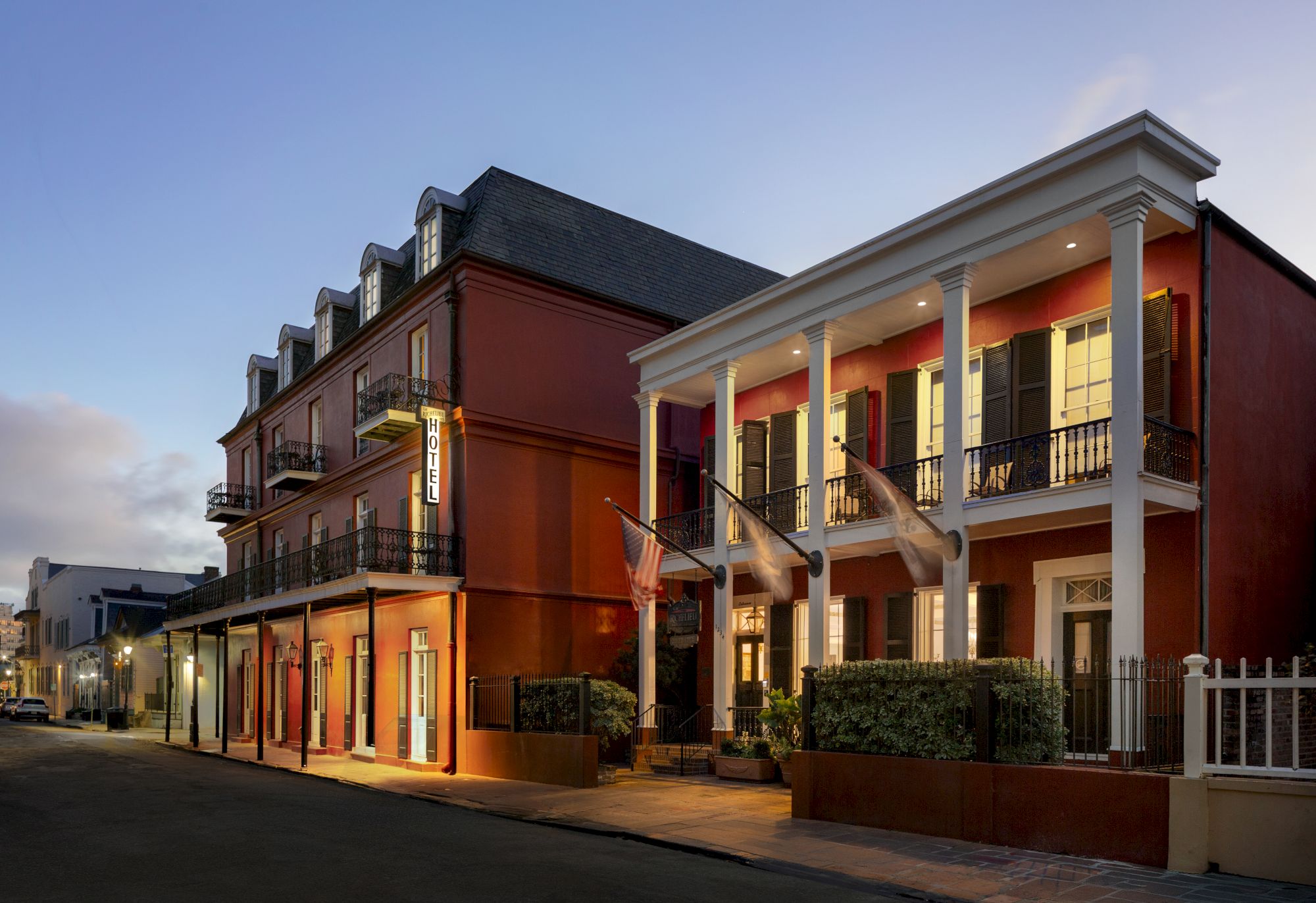
Le Richelieu Hotel
The land at 1234 Chartres Street sits at the quieter, residential end of the French Quarter, a few blocks downriver from Jackson Square where the tourist energy thins and the neighborhood begins to feel like a place where people actually live. It is a corner of the Vieux Carré that has been inhabited, built upon, burned, rebuilt, and reinvented so many times that the ground itself carries the compressed weight of more than two centuries of New Orleans history. Before any structure stood here, the site bore witness to one of the darker chapters of the city's colonial past. During the late eighteenth century, when control of Louisiana passed violently between French and Spanish hands, public executions were carried out across New Orleans as a tool of colonial authority. The land now occupied by Le Richelieu Hotel is reputed to have served as one such execution ground. According to local historians, five French patriots were put to death here during the period of Spanish rule, and a separate account holds that a group of mutinous Spanish soldiers met the same fate on the same soil. The precise details have been softened by time, but the association between the property and state-sanctioned killing has never been forgotten. By the mid-nineteenth century, the block had been developed with a row of townhouses in the Vieux Carré style, with an initial structure dating to around 1845. A second building was added or substantially expanded in 1902, and the complex of structures at the corner of Chartres and Barracks streets cycled through a succession of uses that mirrors the restless reinvention of the French Quarter itself—private residences, apartments, a hospital, a school, a furniture factory. Perhaps most memorably, the property housed a macaroni factory operated by Jacob Cusimano, a Sicilian immigrant who became a prominent figure in the city's turn-of-the-century Italian community. Cusimano's factory produced pasta on a scale significant enough to ship across the country during the First World War, and it remained in operation until 1939. The factory burned in 1916 but was rebuilt, and the solid burgundy wing where hotel guests now sleep was originally part of that industrial operation. In 1969, the property was purchased by Frank Rochefort, who converted the aging complex into the roughly ninety-room Le Richelieu Hotel and took up residence inside it. Under Rochefort's long stewardship, the hotel became a French Quarter institution—a quieter, more personal alternative to the grand hotels on Canal and Royal streets. Paul McCartney stayed for two months in the 1970s while recording with Wings, and the hotel named its presidential suite in his honor. Over the years the guest book accumulated names ranging from Carlos Marcello to Patti LaBelle to Billy Joel, drawn by the combination of location, discretion, and a staff whose tenure was measured in decades. Paranormal claims at Le Richelieu are rooted primarily in the site's pre-hotel history, and the most persistent accounts center on the execution ground that preceded everything else. Staff and guests have reported seeing apparitions of men in old Spanish military uniforms moving through the hotel's courtyard and near the pool and bar area. The figures are described as appearing suddenly and without apparent awareness of the living—walking their routes as though replaying a moment rather than inhabiting the present. Investigators who have studied the claims have suggested these may represent residual energy rather than interactive spirits, impressions left in the fabric of the location by events of extreme violence. But the soldiers are not the only presences reported. A spirit known as Ellen, believed to be a former hotel employee, is said to interact with guests in a more purposeful manner—adjusting bed sheets, tidying rooms, and rearranging personal belongings before vanishing when noticed. One guest in room 404 described televisions switching on repeatedly in the middle of the night and motion sensors activating in empty bathrooms. Another reported waking to the sound of piano music at two-thirty in the morning; the front desk confirmed there was no piano on the premises. A visitor in 2016 described seeing a small Creole woman in period clothing standing in the foyer, gazing up at a painting of a man in a rowboat before disappearing entirely. A guest in room 119 returned from the pool to find small handprints covering the lower portion of a floor-to-ceiling mirror that had been immaculate when they left. One account describes being pinned to the bed by a dark grey apparition that pressed weight onto the guest's legs and chest, returning a second time within minutes. Le Richelieu continues to operate as a boutique hotel in the French Quarter, now part of the J Collection of New Orleans properties. The courtyard pool remains, the wrought-iron balconies still overlook Chartres Street, and the Terrace Café still serves guests beneath the same canopy where Spanish soldiers are said to walk. The building's layered history—colonial execution ground, Creole townhouses, immigrant factory, celebrity hideaway—gives it a density of memory that few French Quarter properties can match, and the reports that accumulate in its guest logs suggest that not all of that memory has consented to stay in the past.
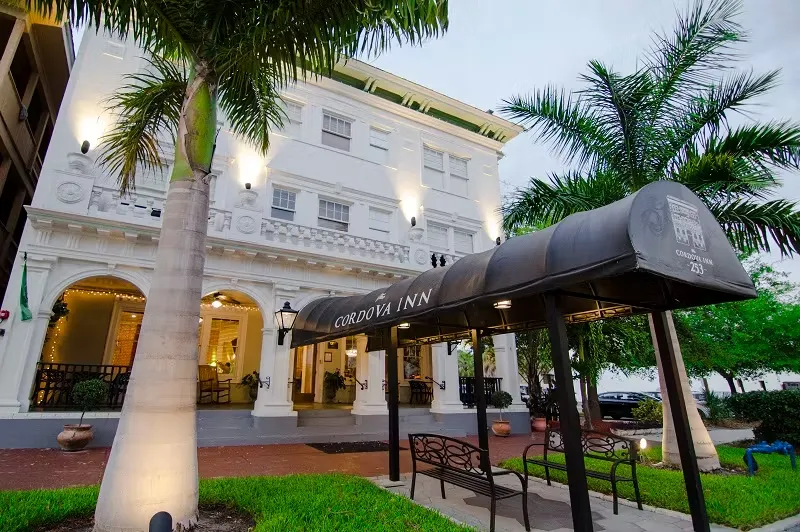
The Cordova Inn
At 253 Second Avenue North in downtown St. Petersburg, Florida, a three-story Renaissance Revival building sits half a block from the Sundial shopping district, looking much the way it did when it first opened in 1921. The Cordova Inn is not the grandest of St. Petersburg's boom-era hotels—it never competed with the Vinoy or the Don CeSar for celebrity guests—but it is among the oldest, and its quieter history carries a weight those larger landmarks don't always match. Built by Francis Scott during the opening surge of the Florida Land Boom, the hotel originally operated as The Hotel Scott. It arrived at the moment when rising postwar prosperity and the spread of the automobile turned Florida's Gulf Coast into one of the most frenzied real estate markets the country had ever seen. St. Petersburg's population exploded in the early 1920s, and small hotels like The Scott sprang up to house the tourists, speculators, and seasonal residents flooding the area. The building was constructed of masonry with scored stucco designed to resemble stone, its facade detailed with five keyed arches, a balustrade topped with decorative urns, and a projecting cornice along the roofline. Inside, thirty-two rooms were fitted with clawfoot soaking tubs—many of which survive today. By 1923, the hotel had changed hands and been renamed the Hotel Cordova, after the family that would operate it for three decades. The Cordovas sold in the early 1950s, and for the next half century the property passed through multiple owners. As downtown St. Petersburg declined through the 1970s and 1980s, the hotel declined with it. By the late 1990s the surrounding blocks were considered undesirable after dark, and the Cordova closed in 1999, sitting empty on a street it had anchored for nearly eighty years. A local investor completed a full restoration, reopening it as The Pier Hotel in 2001—earning the St. Petersburg Preservation Society's Restoration of the Year Award. In 2014 the property reclaimed its historic name. It is a contributing property to the Downtown St. Petersburg Historic District on the National Register of Historic Places. The central figure in the hotel's haunting is not a guest or an owner but a member of the staff—the Major-domo, the building's head butler. According to the hotel's own published history, this man devoted twenty years to the Cordova's guests before dying inside the building he had served. The circumstances of his death are not widely detailed, but the hotel does not shy from acknowledging the story. During the years the building sat vacant before restoration, schoolboys who broke in at night reportedly heard howling in the empty hallways—sounds attributed to the displaced Major-domo protesting the abandonment of his post. Ghost tours in St. Petersburg have included the Cordova on their routes for years, and local paranormal investigator Brandy Stark has featured the hotel in her downtown walking tours. Guest accounts have accumulated steadily since reopening. Visitors describe the apparition of a well-dressed man in an old-fashioned suit, widely believed to be the Major-domo. Some employees have concluded this figure has helped protect the building from neglect—a guardian rather than a threat. But overnight experiences suggest something more complicated. Multiple visitors describe being woken by a sharp burst of air or a whispered word in their ear. Others report sleep paralysis accompanied by sensations of being touched or held down. One guest described hearing two women standing over them discussing a man who would be displeased with their belongings. The second and third floors generate the most reports. The staircase between them is a recurring point of interest—visitors describe sudden heaviness or a feeling of presence while ascending. Cold spots appear without explanation. A sulfurous smell has been noted near Room 208. The building's age explains some of this. A century-old masonry structure without elevators, with original plumbing and narrow corridors, will produce sounds modern buildings do not. Guests primed by the hotel's openly acknowledged reputation may interpret ambiguous input accordingly. But the specificity of many accounts—the whispered names, the paralysis, the smell—pushes beyond what settling wood and old pipes typically produce. Today the Cordova Inn operates as a boutique hotel with its original thirty-two rooms, a lobby bar called The Scott, a fireplace, a small library, and a veranda. There is no elevator—guests climb the original staircases, just as they did in 1921. Whether the Major-domo is still making his rounds depends on who you ask and what floor you're sleeping on. But the building remains what it has been for over a century: a place built to welcome strangers, where at least one longtime resident appears unwilling to stop doing exactly that.
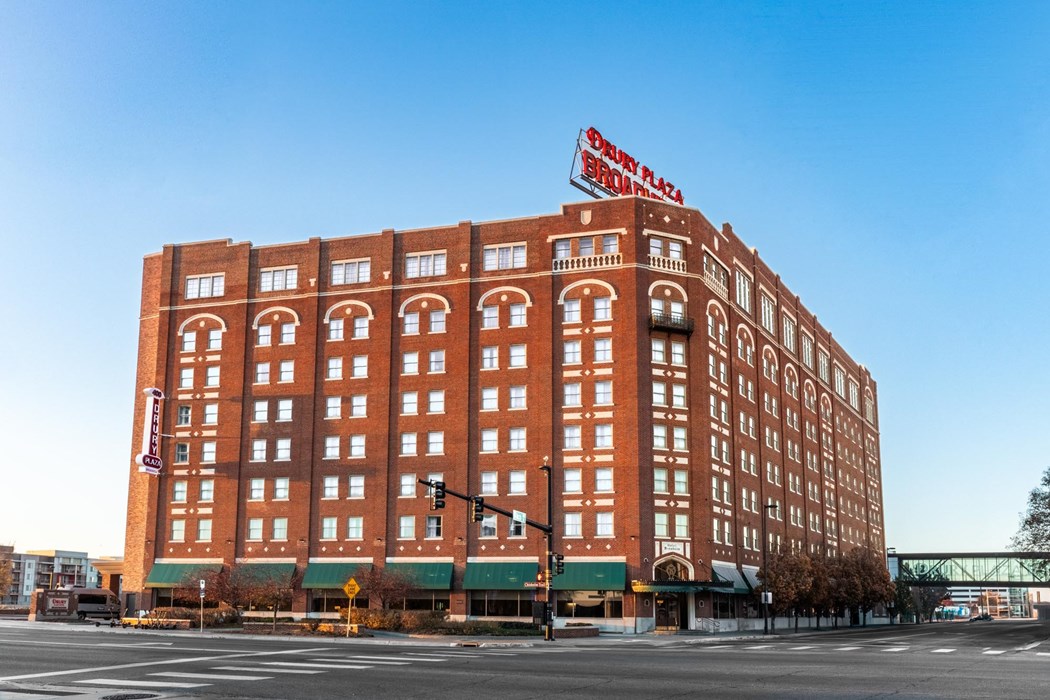
Drury Plaza Hotel Broadview
The Drury Plaza Hotel Broadview stands eight stories above the banks of the Arkansas River at the corner of West Douglas Avenue and North Waco Street in downtown Wichita, Kansas—a massive brick landmark that has anchored the city's skyline since the early days of the oil boom and the aviation industry that would come to define it. Built in 1922 by George H. Siedhoff, one of Wichita's most prolific contractors, the hotel was conceived as a first-class destination for railroad passengers and travelers moving through the central Plains. Its name came from Siedhoff's wife, who stood in the rooftop garden shortly before the grand opening on May 15, 1922, looked out over the city and the river below, and suggested it simply be called the Broadview. The name fit. The building sat at the intersection of two major avenues, and its unusual placement on an angled lot meant that passersby could see two full sides of the facade at once—a broad view in both directions. The Broadview opened during Prohibition, and like many grand hotels of the era, it adapted quietly. The basement housed what was reportedly Wichita's only speakeasy, where liquor and gambling ran uninterrupted behind closed doors. Upstairs, the rooftop promenade offered dining, dancing, and a 360-degree panorama of the prairie horizon. A restaurant on the main floor seated six hundred. The guest list over the decades read like a cross-section of American ambition: Charles Lindbergh, aviation pioneer Clyde Cessna, and Al Capone all passed through the Broadview's doors. A north wing was added in 1929, and in 1948, the Crystal Ballroom was constructed on the ground floor, featuring a 1,500-square-foot mosaic mural by renowned Kiowa-Comanche artist Blackbear Bosin—the same artist responsible for Wichita's iconic Keeper of the Plains sculpture. The mosaic depicts the settlement of Kansas, with panels showing Native Americans, early pioneers, wildlife, and the railroad that brought them all together. The hotel's most persistent ghost story centers on a man known only as Clarence. According to accounts passed down through decades of staff and guests, Clarence checked into the Broadview with his wife for an evening event. At some point during their stay, he discovered she was having an affair with another guest. In a fit of rage, Clarence shot and killed his wife, then threw himself from an eighth-floor balcony. The story has never been independently verified through historical records, and the details shift depending on who tells it—sometimes the affair is discovered in a hallway, sometimes in the room itself, sometimes the fall is from a window rather than a balcony. But the name Clarence has attached itself to the building with a permanence that suggests either a real event or a remarkably durable piece of hotel folklore. Paranormal reports at the Broadview are varied and have been consistent across decades. Guests report lights flickering in their rooms with no electrical explanation, telephones ringing repeatedly with no caller on the line, and doors shaking violently as though someone is trying to force entry. Furniture has reportedly been rearranged within seconds of a guest stepping out of a room. Cold spots appear without warning in otherwise climate-controlled spaces. Former employees from the 1960s and 1970s recall long, dark hallways and abandoned rooms in the basement—remnants of the old speakeasy era—where the atmosphere was dense and unsettling. One former bellboy described tunnels in the basement whose purpose no one could explain. A particular room was known among staff for a lamp that perpetually blew its bulbs and delivered an electric shock to anyone who replaced them. In the Crystal Ballroom, guests have reported seeing figures dressed in 1920s attire dancing when the room is otherwise empty. One of the stranger recurring reports involves the sound of wings flapping down a long, vacant hallway—a phenomenon no one has been able to attribute to birds, bats, or ventilation. Kitchen staff have reported equipment activating on its own, including a disused soap dispenser that began clicking rhythmically with no one near it. Ghost hunters who have investigated the property report capturing EVP recordings throughout the building. Skeptics will note that a century-old building with a complicated electrical history, a basement full of disused infrastructure, and a rooftop exposed to Kansas wind will produce its share of odd noises and mechanical quirks. The Clarence story, lacking firm documentation, may be an invention that calcified into local fact through repetition. But the range of the reports—from visual apparitions in period clothing to physical disturbances with furniture and electronics—extends well beyond what aging wiring and drafty hallways typically explain. Today the Broadview operates as a Drury Plaza Hotel, having been renovated in 2011 with careful attention to preserving its historic character. The original lobby tile, hand-crafted moldings, and Bosin mosaic remain intact. The building earned LEED Green certification during the renovation, and the surrounding riverfront park hosts community events throughout the year. The hotel is listed on the National Register of Historic Places. It sits within walking distance of Wichita's Old Town entertainment district and the Douglas Avenue corridor, and the St. Charles streetcar archway from the original rail depot is still visible on the building's east side. Whether you come for the architecture, the history, or the chance to meet Clarence, the Broadview remains what it has been for over a century—a building that holds on to everything, including, by many accounts, the people who never checked out.

Birchwood Saloon
Twenty miles northeast of downtown Anchorage, where the Glenn Highway begins to ease away from the Chugach Mountains toward the flatter plateau country along the Knik Arm, sits the small community of Birchwood — forested lots, private wells, log cabins and ranch homes set back among the birch trees that gave the area its name. This is a corner of Alaska where the land itself still carries the character of the frontier: scenic, isolated in feeling even when suburbia is close, and shaped by the particular culture of people who came north to build something from raw ground. The Denai'ina Athabascans had lived along this stretch of Cook Inlet watershed for thousands of years before white settlers arrived, and the name Chugiak — formally adopted by the handful of homesteaders who gathered to name their settlement on February 17, 1947 — is derived from a Denai'ina word said to mean "place of many places." The community that grew up around them in the 1950s was built largely by former military personnel who had served in Alaska during the war and decided to stay, homesteading 160 acres at a time along what was then called the Palmer Highway. Into this world of homesteads and volunteer fire departments and dogsled telephone lines came the particular institution of the Alaskan roadhouse bar — not merely a place to drink but a genuine community anchor, a warm room set against the cold, a location where neighbors gathered because in a place this large and this sparse, gathering places matter. The Birchwood Saloon on Pilots Road has functioned in this tradition for well over twenty-five years, operating as a neighborhood bar and restaurant — cheesesteaks and pool tables and cold beer — against a backdrop of Chugach Mountains and birch forest that makes the drive to the next nearest option feel theoretical rather than practical. Local guidebooks describe the saloon as an essential casual stop for the area, the kind of establishment that becomes part of the texture of a community rather than simply a business. The building sits on Pilots Road in the South Birchwood area, close to Badarka Road — a narrow gravel road not listed on most maps, a stretch of territory with its own folklore about the things that happen in its surrounding woods. This corner of South Birchwood carries, for people familiar with the area, a particular atmospheric weight. The forested land just off the road is the setting for one of the area's most persistent local stories: a father and young daughter who went into the woods to collect firewood, the girl killed when she pulled an axe from a tree and the tree fell, the father sitting in the snow cradling her body until he froze. Whether true or embellishment, the story has attached itself to the landscape and to Badarka Road in the way that such stories do in places where the wilderness still feels genuinely close. The Birchwood Saloon itself has accumulated a different kind of story. Staff and patrons over the years have reported experiences that resist ordinary explanation — voices heard clearly when the room is nearly empty, the kind of sound that makes a person turn and find no one there. The jukebox has reportedly played on its own, music starting without any coin, without any hand on the machine. Apparitions have been described moving through the bar area, figures that appear and then do not. Objects have vanished from one location and turned up in another part of the saloon with no accounting for how they got there. Footsteps have been heard on the roof — a specific, persistent detail that appears in multiple accounts and was cited by investigators in the book Ghosts of Alaska by Jody Ellis-Knapp, whose research into the saloon contributed to its regional reputation as one of the more reliably reported haunted locations in southcentral Alaska. The name most often attached to the presence is that of a young man who died nearby — electrocuted, the story goes, while shoveling snow from the roof of an adjacent building, his shovel contacting a power line. The accounts vary slightly in the telling: some say he was a neighbor, some describe him as a young local man, and the exact circumstances have blurred over years of retelling. The footsteps on the roof are the detail that people return to — as if something is still up there doing the job that ended badly, still moving across the surface in the cold Alaskan air above the warm room below. The physical proximity of that death to the saloon, and the specificity of the roof as a location of reported activity, have made the electrocution story the dominant explanation among those who believe the building is genuinely occupied. Whether a poltergeist, a residual haunting, or simply the accumulated effect of decades of community memory pressing against the walls of an old bar, the Birchwood Saloon has earned its place on lists of Alaska's most active paranormal locations. The 2021 ghost hunt events hosted at the address drew investigators from around the region, bringing equipment and methodology to bear on a building that had, by that point, spent years generating anecdotes. The saloon appears in published accounts of Alaskan haunted places alongside properties with considerably more dramatic histories — historic hotels, Gold Rush-era sites, remote wilderness locations — which speaks to the density of reported activity relative to the building's modest profile. Skeptics will note, reasonably, that the anchor stories are thin on documentation — no newspaper record of the electrocution has been widely cited, no name attached to the young man on the roof. The jukebox malfunction, the disembodied voices, the moving objects: these are the standard vocabulary of haunted bar folklore, easy to generate and impossible to disprove. What remains harder to account for is the consistency of the reports across years and across different people, the way the same specific details recur — the roof, the jukebox, the voices in the empty room — in accounts given by people who had no particular reason to tell the same story.
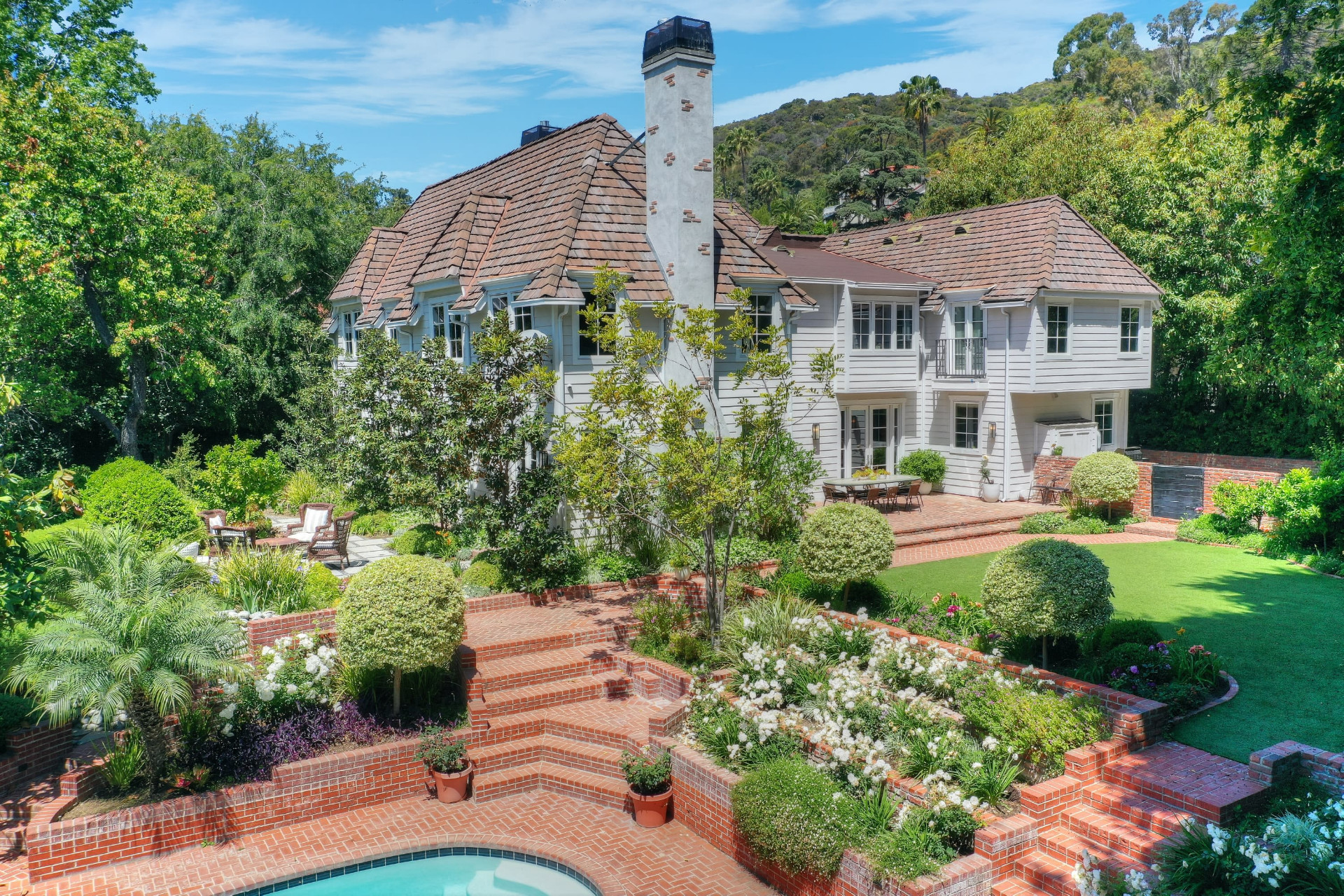
Nelson House
Nestled at the base of the Hollywood Hills near Franklin Avenue, the Colonial Revival house at 1822 Camino Palmero is one of the most quietly famous addresses in American entertainment history — a two-story clapboard home with dark green shutters that millions of television viewers came to know as intimately as their own living rooms, without ever being told its real name. The house was built in 1916 by architect Frank T. Kegley and H. Scott Gerity for Harold G. Feraud, a prominent Los Angeles businessman, on a sloping half-acre parcel in the exclusive Las Colinas Heights subdivision. Designed in the Colonial Revival style with traditional clapboard siding and a classic staircase entry, it was at the time one of the more distinguished residences in that part of western Hollywood. It sat quietly for decades before the family that would make it famous arrived. Ozzie Nelson — bandleader, attorney, Eagle Scout, and one of the most driven men in American entertainment — and his wife Harriet Hilliard moved in during the 1940s. Ozzie had built a career in big band music during the 1930s before pivoting to radio, where he created The Adventures of Ozzie and Harriet in 1944 as a domestic comedy featuring himself, his wife, and their two sons David and Ricky. When the show transitioned to ABC television in 1952, the house on Camino Palmero became a co-star. Establishing exterior shots were filmed directly in front of it, and the interior sets at Hollywood General Studios were modeled room by room after the real house, down to the Early American furniture Harriet had chosen. The kitchen viewers watched Harriet work in every week was a near-perfect recreation of the kitchen she actually cooked in at home. For 14 years and 435 episodes — still the record for total episodes produced in American live-action sitcom history — the Nelson family played themselves on national television, and this house was the stage for that illusion. Ricky Nelson wrote some of his early songs here. His name is reportedly still scratched into a door frame inside his old bedroom. The family became the definitive image of mid-century American domestic life, and the house absorbed every frame of it. Ozzie was the engine behind all of it — producer, director, co-writer, and perfectionist. He was also, by his own cheerful admission, someone who took meticulous care of his health: no smoking, no drinking, daily two-mile ocean swims. When he was diagnosed with liver cancer in 1974, he reportedly called it "odd for a guy who never drank or smoked." He died on June 3, 1975, at 69, surrounded by Harriet, David, and Ricky. The family sold the house shortly after. Ricky died in a plane crash on New Year's Eve 1985. Harriet died in 1994. David in 2011. The whole family is gone now, and the trajectory of their losses was steep. The paranormal claims at the house began almost immediately after Ozzie's death. Family members reported seeing his apparition walking through the rooms, lingering near his favorite spots — particularly the wood-paneled pub room he'd loved. New owners who purchased the house in 1975 reported mysterious footsteps in empty rooms, lights and faucets operating on their own, and doors opening despite being locked. One woman living in the house described feeling, on multiple occasions, a strong and unmistakably loving presence beside her in bed. Years later, in 1994, a painter working in the house heard unexplained footsteps while alone in the building and observed a white misty form drifting nearby, appearing to inspect his work. Ozzie's old model train set in the pub room reportedly began running on its own in the middle of the night. The accounts were consistent enough that when the house went to market, the listing agent felt obligated to disclose the rumored haunting to prospective buyers. The house remains a private residence. It later appeared as Ari Gold's home in HBO's Entourage, adding another layer of on-screen identity to a building that has rarely been just a building. Whatever is still inside, it keeps itself to walls that know the difference between a set and a home.

Ancestor’s Inn at the Bassett House
Standing along Sycamore Street in the village of Liverpool just north of Syracuse, the historic Bassett House has long been one of the older surviving structures connected to the early development of the community. The building at 215 Sycamore Street traces its roots to the early nineteenth century, a period when the region surrounding Onondaga Lake was transforming from scattered frontier settlements into an active corridor of commerce tied to salt production and canal travel. Liverpool in particular grew rapidly after the opening of the Erie Canal in 1825, which turned the nearby waterways and roads into important transportation routes linking central New York to markets across the state. Inns and taverns quickly followed the movement of travelers and laborers, and the Bassett House developed within this environment as a place of lodging and social activity. The structure is believed to date to the early 1800s and is commonly associated with the Bassett family, whose name became permanently attached to the property. Buildings like this served a variety of roles during the canal era. Travelers arriving by boat or carriage needed places to stay overnight, while canal workers, merchants, and farmers used taverns as informal meeting places where business was conducted and news from other towns circulated. The Bassett House functioned as both a residence and a hospitality property during different periods of its history, reflecting the changing character of Liverpool as the canal economy expanded and later declined. Throughout the nineteenth century the surrounding community remained closely tied to transportation and industry. The nearby salt works at Onondaga Lake drew workers and traders, while canal traffic brought a steady flow of strangers through the village. Buildings like the Bassett House witnessed decades of everyday life associated with this movement—meals served to passing travelers, rooms rented to overnight guests, and local residents gathering in common spaces that doubled as community hubs. Over time the property passed through multiple owners and uses, but the core structure remained intact, preserving elements of early nineteenth-century construction within a town that gradually modernized around it. In the twentieth century the building took on a new identity as Ancestor’s Inn, a restaurant and gathering place that embraced the property’s historic atmosphere. The name itself reflected the owners’ intention to connect the dining experience with the deep past of the house and the generations of people who had lived, worked, or stayed within its walls. Visitors often remarked on the building’s aged interior features—low ceilings, thick wooden beams, narrow stairways, and rooms whose shapes reflected centuries of additions and alterations. The sense of stepping into an earlier era became part of the appeal, particularly for diners interested in local history. It was during these later years that stories of unexplained activity began to circulate among staff and guests. Reports most often centered on strange sounds heard after closing, including footsteps on the staircases or movement in rooms that had already been locked for the night. Employees occasionally described objects being shifted or found out of place between shifts, while others spoke of doors opening or closing without an obvious cause in the quieter parts of the building. Some witnesses claimed to have seen shadowy figures moving through hallways or glimpsed the brief outline of a person standing in doorways before disappearing. Accounts varied, but the apparitions were often described as resembling individuals dressed in clothing from an earlier century, leading many to associate the sightings with the building’s canal-era past. Guests dining in the restaurant sometimes reported sudden cold drafts or the uneasy sensation of being watched when seated in the older dining rooms. Paranormal investigators who visited the site during the years the restaurant operated occasionally reported capturing unexplained audio responses during electronic voice recording sessions or experiencing sudden malfunctions in investigative equipment. As with many historic structures, skeptics have suggested that the building’s age and layered construction could easily produce creaking timbers, shifting floorboards, and air movement that mimic footsteps or other sounds. The powerful atmosphere created by an old house filled with local stories can also shape how ordinary events are interpreted. Despite these explanations, the Bassett House developed a modest reputation in regional ghost lore. The combination of its canal-era origins, its long service as an inn and gathering place, and the number of travelers who passed through its rooms over nearly two centuries created the sense that the building held echoes of the past. Today the property remains one of the older historic sites associated with Liverpool’s early development. Even as ownership and use have changed over the years, stories of unexplained encounters continue to circulate among locals, maintaining the quiet belief that some of the house’s earliest occupants—or perhaps former guests—may never have fully left the Bassett House behind.

Snuffer’s Restaurant
Snuffers Restaurant occupies a building with a complex and layered history in the Dallas-Fort Worth metropolitan area, earning a reputation as the most intensely haunted dining establishment in the region. The structure itself contains physical and spiritual remnants of multiple eras, with paranormal activity concentrated throughout the restaurant's dining and service areas. The property's history includes occupation as a pool hall during earlier decades, a social space where men gathered to play billiards, socialize, and occasionally engage in disputes. The transition from pool hall to restaurant did not erase the energy imprinted upon the location by previous activities and tragic events that unfolded within its walls. Beneath the restaurant's foundations lie the remains of what was once a cemetery, a graveyard displaced during urban development as the Dallas-Fort Worth area underwent rapid expansion and redevelopment. The disturbance of burial grounds and removal of human remains, even through officially sanctioned processes, often results in significant paranormal consequences. Many cultures and spiritual traditions recognize that displacing the dead creates unrest in the spiritual realm, and this location bears testament to that principle. The cemetery's former occupants, including children whose small bodies were laid to rest in this now-vanished burial ground, appear to have remained attached to the location despite the transformation of the surface landscape. Multiple spirit entities inhabit Snuffers Restaurant, their presence documented through consistent witness testimony and paranormal investigation records. A murdered man from the pool hall era roams the restaurant, his violent death creating a restless spirit unable to find peace. Numerous children, possibly cemetery remains disturbed during construction, are believed to occupy various areas of the establishment. These juvenile spirits appear to interact playfully and mischievously with the living environment, creating phenomena distinct from the darker energy of the murdered adult entity. The paranormal manifestations at Snuffers represent some of the most dramatic and varied encountered in commercial establishments. Electronic equipment throughout the restaurant malfunctions inexplicably, with computers, lighting systems, and kitchen equipment experiencing failures without mechanical explanation. Dramatic temperature fluctuations create localized cold spots in dining areas, with patrons and staff experiencing sudden chills despite climate controls operating normally. Lights sway and swing despite absence of air movement or physical contact. Disembodied footsteps echo through dining areas and kitchen spaces during periods when no humans are moving through those locations. Children's voices speak, laugh, and call out, their youthful tones unmistakable to adult listeners who encounter these sounds. Objects levitate or move independently, with glasses, utensils, and other items shifting positions or falling without natural causation. Shadowy figures manifest throughout the restaurant, appearing as dark humanoid shapes that dissipate before close examination. Strange, unidentifiable voices produce sounds that bear no relation to normal human speech or the ambient restaurant noise. The intensity of paranormal activity at Snuffers has made it a destination for paranormal investigators, ghost hunters, and curiosity seekers from throughout the United States, solidifying its status as a location of exceptional and documented supernatural significance.
Holiday Inn
The Holiday Inn in Martinsburg, West Virginia, appears to an ordinary modern hotel serving the transportation and hospitality needs of travelers passing through the eastern panhandle region. However, the establishment has become notorious in paranormal circles due to a death so unusual and mysterious that it continues to generate investigation, speculation, and reported paranormal activity decades after the initial incident. On August 10, 1991, journalist and writer Joseph Daniel Casolaro was found dead in the bathtub of room 517, his wrists bearing multiple deep lacerations. Local authorities ruled the death a suicide almost immediately, attributing it to self-inflicted wounds delivered in what would have been an act of self-harm. However, the circumstances surrounding Casolaro's death have never fully convinced many observers, including fellow researchers, journalists, and paranormal investigators who view the case with considerable skepticism. Casolaro had been investigating what he referred to as the Octopus, an elaborate conspiracy theory that allegedly linked the Iran-Contra affair, the Inslaw case, and numerous other high-profile political and governmental scandals of the era. He had accumulated thousands of documents and notes related to his investigation and had been expecting a potentially significant meeting in Martinsburg at the time of his death. Casolaro's death immediately assumed tragic historical significance, becoming one of the most controversial and suspicious deaths in American journalism. The journalist had been intensely focused on uncovering what he believed was an extensive web of governmental and corporate malfeasance, and his sudden demise in a hotel bathtub struck many observers as suspiciously convenient. The official suicide ruling did little to satisfy the curiosity of those who knew him or understood the scope of his investigations. The death also occurred under circumstances that many found unusual: the manner of the wounds, the location, and the apparent lack of struggle or resistance that one might expect from someone attempting such an act. As the years passed, the official explanation of his death would be questioned repeatedly by researchers, investigators, and family members who felt unsatisfied with the conclusions drawn by law enforcement. The tragedy of Casolaro's death appears to have left an indelible mark upon room 517 and the surrounding hotel spaces, manifesting as persistent paranormal phenomena that guests and staff continue to document. Room 517 has become a focal point for supernatural activity, with numerous visitors reporting unexplained knocking sounds on the walls and doors, followed by complete silence when the door is opened. Footsteps have been heard at night from empty hallways adjacent to the room, suggesting the presence of invisible occupants moving through the hotel corridors. Temperature drops occur suddenly and without meteorological explanation, creating patches of intense cold within specific areas of the room. Guests have reported hearing the distinct sound of running water emanating from the bathroom despite no one using the facilities and no apparent cause for the noise. Some visitors have described seeing shadowy apparitions resembling descriptions of Casolaro himself, often positioned near the bathroom or standing at the window as if looking out at the parking lot. Electrical disturbances are common, with lights flickering unpredictably and televisions turning on and off spontaneously without remote or switch activation. The Martinsburg Holiday Inn has become a destination for ghost hunters and paranormal enthusiasts seeking to document what many believe are the manifestations of Casolaro's restless spirit, unable to rest given the unresolved questions surrounding his mysterious death.
Concordia University Wisconsin
Halls refers to multiple residence halls at Concordia University located in the Milwaukee, Wisconsin area, a campus steeped in religious heritage and decades of academic tradition and institutional history. The university grounds and buildings embody the institution's core mission to provide Christian education within an environment deliberately designed to nurture intellectual growth and spiritual development in students. The various residence halls including Katharine Hall, Augsburg Hall, and Coburg Hall serve as home to countless generations of students across the decades, spaces where formative and transformative college experiences occur and where students transition profoundly from adolescence to young adulthood. The dormitory buildings showcase architectural styles reflecting different distinct periods of the university's long development, with some structures dating to the institution's earliest decades and others representing more contemporary additions to the campus infrastructure. The halls have served not only as practical student housing but as significant community spaces where meaningful relationships form, important academic collaborations develop, and the shared experience of collegiate life binds successive cohorts of students together in common memory. Within this distinctive academic community, one particular spirit entity has established a remarkable and documented presence spanning multiple decades of consistent documentation and student reporting. Sister Sixtoes, identified through careful historical records as a devoted nun whose commitment to the religious community knew virtually no bounds and influenced her entire existence, has demonstrated through her posthumous manifestations a profound dedication to remaining present at the location she served so faithfully during her earthly life. The name Sixtoes itself suggests her distinctive and memorable identity and her particular place within the community's collective memory and institutional history. Sister Sixtoes's apparent refusal to depart from the property, whether through spiritual choice or through spiritual entrapment beyond her control, has created a documented hauntings phenomenon consistent and recognizable across multiple decades of student reports and witness accounts. The paranormal phenomena associated with Sister Sixtoes concentrates specifically in particular campus locations, with Katharine Hall, Augsburg Hall, and Coburg Hall serving as the primary paranormal manifestation sites. A phantom figure is consistently reported on the stairs connecting different levels of the residence halls, appearing as a robed humanoid form that moves deliberately with apparent purpose before vanishing suddenly when approached by living witnesses. This figure is widely believed among students and staff to represent Sister Sixtoes conducting some eternal spiritual task or religious obligation that she cannot abandon despite her transition from life. Objects throughout the dormitory spaces move without explanation or mechanical cause, with students reporting books, decorations, and personal items shifting position overnight or disappearing entirely before reappearing mysteriously in unexpected locations. Electrical malfunctions plague certain areas of the halls with unusual frequency and consistency, with lights failing inexplicably despite recent professional maintenance, electrical outlets ceasing to function without identifiable electrical problems, and electronic devices experiencing interference or complete failure. Apparition sightings occur sporadically within the building's interior spaces, with students and staff encountering the ghostly form of a woman wearing religious habit, her presence acknowledged and verified by multiple independent witnesses across different time periods spanning decades. The proximity of Coburg Hall to the chapel area suggests that Sister Sixtoes's spiritual remaining within the residence halls may directly relate to her religious duties, her consciousness perhaps remaining singularly focused on the sacred responsibilities she maintained faithfully in her earthly life. The documented hauntings have become an accepted and normalized part of campus folklore and student experience, with Sister Sixtoes regarded affectionately as a benevolent, if decidedly mysterious, presence within the residential community.