
Haunted Forts in America
89 haunted locations
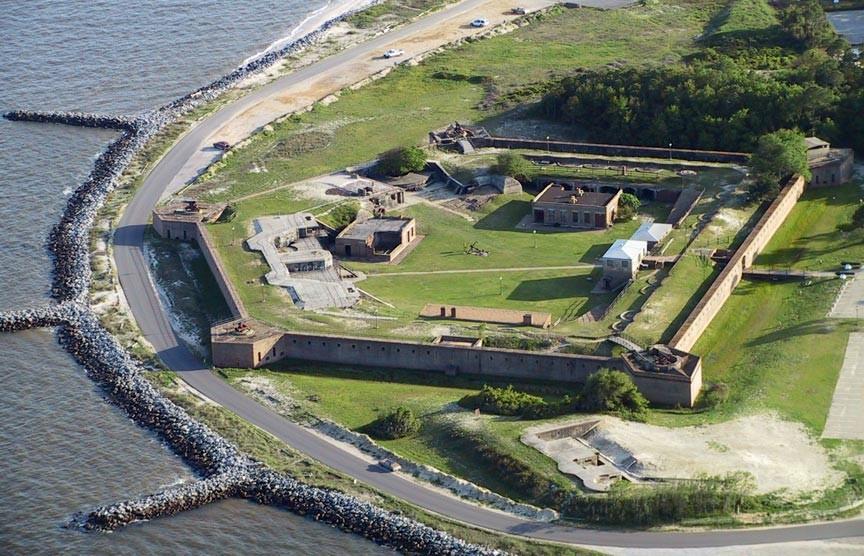
Fort Gaines
Sitting at the eastern tip of Dauphin Island where Mobile Bay meets the Gulf of Mexico, Fort Gaines occupies one of the most strategically loaded pieces of ground on the Alabama coast. The island itself carries death in its name. When French explorer Pierre Le Moyne d'Iberville arrived in 1699, he found so many sun-bleached human bones scattered across the shell mounds that he named the place Massacre Island. The name eventually softened to Dauphin Island, but the bones remained — remnants of Native American burial sites eroded and exposed by the sea. France, Spain, and Britain all used the island as a military platform at various points, each recognizing what the geography made obvious: whoever controlled this narrow strip of land controlled the entrance to Mobile Bay. The United States recognized it too. Following the War of 1812, Congress authorized a network of coastal fortifications along the southern shoreline, and Dauphin Island was identified as a critical position. Construction began in 1821 but lurched along for decades — plagued by poor engineering, flooded foundations, and funding gaps. A new design was ordered in the 1850s under chief engineer Joseph G. Totten, who drew up a five-sided masonry fort with 22.5-foot walls built to absorb artillery rather than shatter under it. Every one of the more than three million bricks had to be transported across the bay, since the island had no suitable clay. The fort was still incomplete when Alabama state militia seized it on January 5, 1861, six days before the state formally voted to leave the Union. Confederate engineers finished the work. Fort Gaines and Fort Morgan, sitting on opposite shores of the channel, formed a pair meant to strangle any naval approach to Mobile. By 1864, Mobile was one of the last Confederate ports open on the Gulf, and the Union was determined to close it. On August 5, Rear Admiral David Farragut led eighteen ships directly into the channel under the guns of both forts. When the ironclad USS Tecumseh struck a Confederate mine and sank almost instantly, Farragut reportedly shouted the order that has echoed through American history: "Damn the torpedoes — full speed ahead." The fleet punched through. Fort Gaines, pounded from sea and besieged from land, surrendered on August 8 with roughly 800 men taken prisoner — including a battalion of military cadets between twelve and sixteen years old from the Pelham Military Academy in Mobile. The fall of both forts sealed Mobile from the outside world and helped secure Abraham Lincoln's reelection that November. The fort remained in military use through both World Wars, serving as a coastal artillery installation and anti-aircraft gunnery school. It was sold to the City of Mobile in 1926, passed to the State of Alabama, and is now considered one of the best-preserved Civil War masonry forts in the country. The paranormal reputation of Fort Gaines draws from every layer of that long history. Visitors and investigators report a Confederate soldier seen standing at one of the cannons facing the water — motionless, as though still at his post. The old officers' quarters are cited as particularly active, with accounts of furniture moving, unexplained whispers filling empty rooms, and the persistent feeling of being watched. Cold spots appear without explanation in the tunnels connecting the bastions to the main courtyard. A dark shadowy figure has been reported following visitors through the inner buildings, vanishing when confronted. Paranormal researchers scouting for MTV's Fear series documented shadowy figures in photographs taken inside the walls, and the Mobile-based group SAPI has held annual ghost hunts at the fort for years. Beyond the fort itself, the ancient shell mounds on the island's eastern end — actual Native American burial sites used for centuries before European displacement — generate their own reports. Visitors describe faint drumming and chanting heard near the mounds after dark, and a blood-covered Native American apparition has been reported in the area. An older island legend speaks of a chief named Double Head who walked the beaches at night, leaving glowing phosphorescent footprints in the sand. Fort Gaines is open to the public. The guns still face the water. The brick walls still absorb the Gulf wind. And according to those who have spent time inside after the crowds leave, something in there hasn't fully stood down.

Fort Riley
Fort Riley, established in Kansas during the nineteenth century, stands as one of the most historically significant military installations in the United States, a sprawling facility that has housed countless soldiers, witnessed military innovation, and absorbed the emotional energy of generations of military personnel. The fort represents a critical intersection between westward expansion, Native American displacement, and American military development. As one of the nation's most important cavalry training centers, Fort Riley prepared officers and enlisted men for decades of conflict, from frontier operations against indigenous populations through both World Wars and into modern military engagements. The fort's 155-year history encompasses triumph and tragedy, sacrifice and loss, creating conditions that paranormal researchers suggest facilitate spiritual manifestation. The combination of military authority, human suffering, and deaths occurring under extraordinary circumstances apparently created resonances that persist despite the passage of time and the turnover of personnel. The Historical and Archaeological Society of Fort Riley acknowledges the location's paranormal reputation sufficiently to provide official Ghost Tours to visitors interested in the fort's haunted history. Among the numerous reported spirits inhabiting Fort Riley, General Lewis Armistead stands out as a particularly prominent entity. Armistead's death during the American Civil War created unresolved questions and emotional turbulence that apparently prevented his spirit from achieving complete spiritual rest. Other reported entities include the apparition of a drowned woman whose circumstances and identity remain partially obscure in paranormal documentation, an old nurse who apparently served within the fort's medical facilities, and a lone rider whose ghostly form has become iconic within Fort Riley's paranormal folklore. Soldiers from various eras apparently remained bound to the location, their spirits continuing to maintain presence on grounds where they served, trained, or suffered injury. The fort's cemetery contains graves of numerous individuals, many of whom may have lacked strong connections to families or communities outside military service, potentially facilitating spiritual attachment to the fort rather than spiritual movement toward other realms. The paranormal phenomena at Fort Riley manifest with particular intensity in specific locations throughout the sprawling military complex. The Lower Parade Field emerged as a focal point for paranormal activity, with witnesses reporting the distinct apparition of a lone rider on horseback, moving across the field in patterns suggesting military drill or patrol. This ghostly rider would appear solid and three-dimensional before vanishing when approached, leaving witnesses stunned by the apparent solidity of the manifestation. The Custer House, a historic structure bearing the name of the famous cavalry officer, developed a reputation for intense paranormal activity. Doors would open spontaneously when no human hand touched them, voices echoed through empty rooms, and apparitions of uniformed soldiers appeared and vanished without warning. Quarters 124 became another significant location, with reports of physical phenomena including objects moving without visible cause and the appearance of spectral figures. The fort's NCO Club and Main Post areas also generated consistent paranormal reports. The specific phenomena documented at Fort Riley include apparitions of weeping women, ghostly figures appearing in doorways and hallways, and a nurse apparition in medical clothing moving through spaces as though performing duties from an earlier era. Witnesses described a palpable sense of unease and melancholy in certain locations, accompanied by cold spots and unexplained temperature fluctuations. The fort's military history of conflict, training accidents, illness, and injury apparently created sufficient emotional resonance that spirits of deceased military personnel became unable to transition completely from the physical realm. The location attracted paranormal researchers and investigation teams who documented electromagnetic anomalies consistent with spiritual manifestation. Fort Riley stands as a compelling example of how locations steeped in military history and human suffering can develop robust paranormal activity, becoming historical sites where visitors encounter not only artifacts and structures from past eras but also the apparent spiritual presence of those whose lives defined those periods.
Drum Barracks
Drum Barracks stands as a preserved military structure in Wilmington, California, representing a significant chapter in American Civil War history and the military infrastructure that supported Union operations in the southwestern United States during the 1860s. The building was constructed to house military personnel and serve as a command center for operations, representing the federal government's commitment to maintaining military control over the region even as the nation was divided by civil conflict. The structure features multiple rooms and spaces designed to accommodate officers, enlisted personnel, supply storage, and administrative functions necessary for military operations. The barracks is now maintained as a historical museum, preserving the building and its artifacts as a educational resource for understanding the Civil War period and the role of southwestern military installations in the broader conflict. The museum attracts visitors interested in history, military operations, and the everyday life of soldiers during the Civil War era. However, the building's historical significance is matched by its paranormal reputation, as multiple spirits appear to maintain an active presence within the structure. The paranormal presences at Drum Barracks are most prominently represented by two distinct entities who appear to have maintained a long-term presence within the building. Maria is identified as a woman who manifests in a hoop skirt, the garment suggesting either that she lived during the Civil War era or that her appearance is anchored to that period of history. Her apparition appears solid and clearly visible to observers, described as dressed in period-appropriate clothing that suggests her life spanned the era when the barracks was actively in use as a military installation. Maria's presence is often preceded or accompanied by the distinctive scent of lavender or violet perfume, a sensory manifestation suggesting the entity maintains sufficient energy and intention to create olfactory impressions in the physical world. The second entity is a uniformed officer from the 1800s who appears as a solid apparition wearing military dress and apparently smoking a pipe. His manifestations similarly include sensory components, with the smell of tobacco preceding or accompanying his appearances. The two entities appear to coexist peacefully within the building, though whether they interact with each other remains undocumented. Paranormal phenomena at Drum Barracks include both visual apparitions and phenomena affecting the other senses. The Model Room, located within the building, appears to be the most active location, with more frequent and intense manifestations concentrated in that specific space. Unexplained noises are common throughout the building, including sounds of dragging chains and footsteps that suggest movement through the corridors despite no visible source. The odors of perfume and tobacco are reported frequently and appear to be reliable indicators of the presence of Maria and the officer respectively. Items within the museum are sometimes moved from their expected locations, suggesting an active poltergeist phenomenon that may represent an entity other than Maria and the uniformed officer, or that may indicate these entities are capable of manipulating physical objects. Visitors to the museum frequently report emotional impressions and sensory perceptions that suggest the presence of conscious entities observing them as they move through the exhibits. The paranormal phenomena at Drum Barracks appear to be concentrated in the Model Room, where the manifestations are most frequent and intense, though apparitions and other phenomena have been documented throughout the building. The entities appear peaceful and non-threatening in their interactions with living individuals, suggesting they may be trapped spirits content to exist as eternal observers of the building they once inhabited. Maria's manifestations suggest she may have been associated with the barracks as a resident or visitor who maintained emotional connections to the location extending beyond her mortal life. The uniformed officer's continued presence similarly suggests emotional attachment to military service or to specific relationships or experiences that occurred within the structure. The phenomena are consistent across multiple visitor reports and investigations, suggesting genuine paranormal activity rather than isolated incidents or misinterpretation of normal phenomena. Paranormal investigation programs have documented the phenomena, contributing additional evidence to support the haunting claims. Drum Barracks continues to operate as a historical museum, preserving the paranormal phenomena as an integral component of the visitor experience alongside the historical artifacts and educational programming. The museum has incorporated the haunting into its promotional materials and historical interpretation, acknowledging the paranormal reputation while maintaining focus on the historical significance of the location. Visitors to the museum frequently report experiences consistent with the documented paranormal phenomena, including sightings of apparitions, unusual odors, and emotional impressions. The combination of historical preservation and active paranormal phenomena creates a unique location where past and present coexist, where Civil War era military history remains vividly present not only in artifacts and structures but in the apparently continuing presence of the spirits of those who lived and worked within the building. Drum Barracks represents a compelling example of how locations of historical significance may also become locations of paranormal activity, where trauma, loss, and profound emotional events may anchor spirits to the physical locations where their lives and deaths occurred.
Illinois State University – Atkin-Colby Hall
Atkin Colby Hall stands as a dormitory facility at Illinois State University in Bloomington-Normal, Illinois, serving as residence for hundreds of undergraduate and graduate students throughout its years of operation. The building represents typical late twentieth-century dormitory architecture, designed to maximize efficient housing of student populations while providing basic amenities and common spaces for community building. The structure includes multiple floors, with the eleventh floor apparently serving as a particular focus of paranormal activity. Like other university residence halls, Atkin Colby Hall has experienced the full spectrum of human experience, witnessing academic development, social formation, romantic entanglements, mental health crises, and the complex personal challenges that characterize the college experience. The dormitory also appears to have become the residence of at least one spirit who maintains an active and apparently hostile presence within the building, particularly concentrated on the upper floors. The nature of the death or tragic event that resulted in the haunting of Atkin Colby Hall remains unclear from available documentation, though the aggressive and protective behavior of the entity suggests the event was traumatic and occurred directly within the building. No specific death is commonly attributed to the haunting in readily available accounts, suggesting that either the original incident has been forgotten or obscured by time, or that the entity predates the construction of the modern dormitory building. The spirit manifesting in Atkin Colby Hall demonstrates characteristics of an intelligent haunting rather than residual phenomena, suggesting an entity with continuing awareness, intention, and the capacity for deliberate action. The entity does not appear content to remain a passive apparition but instead actively interacts with living inhabitants of the building, making its presence known through physical actions and emotional impressions that communicate displeasure or aggression. The most dramatic and well-documented paranormal manifestation at Atkin Colby Hall involves a witness who reported being actively pushed down a flight of stairs by the ghost, a physical assault that represents one of the most direct and violent paranormal interactions documented within a university dormitory setting. The victim of this assault reported that the push occurred without warning, with no visible entity visible to have caused the impact, though the force of the assault was sufficient to send the person tumbling down the stairs. The experience was traumatic and resulted in physical injuries in addition to profound psychological shock. Beyond this singular dramatic incident, students and staff have reported ongoing paranormal phenomena including doors that open spontaneously without human action, disembodied whispers that convey no intelligible content but communicate presence through sound, and strange noises that appear to originate within the walls or from empty spaces. An overwhelming feeling of discomfort pervades certain areas of the building, with individuals experiencing a psychological sense that they are unwanted and unwelcome in the space. The paranormal activity at Atkin Colby Hall is most concentrated on the eleventh floor, where the most severe manifestations have been documented and where the entity appears to maintain its primary operational base. The aggressive nature of the haunting suggests that the spirit may be defending its territory against the living residents, or that it is acting out unresolved trauma through physical aggression directed at the dormitory's inhabitants. The entity appears to demonstrate awareness of the dormitory's function and the presence of students, suggesting that the spirit has adapted to the modern uses of the building even if the original haunting event predates contemporary occupancy. Students who have experienced or witnessed the phenomena report significant emotional distress and anxiety related to their continued residence in the building, leading some individuals to request room transfers or to withdraw from the university entirely. The aggressive nature of the manifestations distinguishes Atkin Colby Hall from many other university haunted locations, where paranormal activity typically remains more passive or playful in character. Illinois State University has acknowledged the paranormal reputation of Atkin Colby Hall and other dormitory buildings through student forums and official university communications, though the administration has maintained a cautious stance regarding formal recognition of the hauntings. The dormitory continues to house students despite its notorious reputation, with students often unaware of the location's paranormal history until they encounter phenomena personally or through discussions with peers. Paranormal investigation groups have reportedly conducted investigations within the building, documenting phenomena consistent with active haunting. The combination of an apparent poltergeist presence, hostile interactions with living residents, and a focused concentration of activity on the eleventh floor distinguishes Atkin Colby Hall as one of the more actively dangerous haunted locations in Illinois. Whether future research will reveal the identity of the haunting entity or the circumstances of the original traumatic event remains uncertain, but the ongoing phenomena firmly establish the dormitory as a location where the paranormal intrudes measurably upon the normal activities and safety of living occupants.
Jackson Barracks
Jackson Barracks in New Orleans stands as a sprawling military installation whose long history of service to the United States Armed Forces is intertwined with a persistent undercurrent of paranormal activity and tragic loss that extends across multiple centuries. Established in the nineteenth century to serve as a primary garrison and training facility for troops stationed throughout Louisiana and the Gulf region, the barracks complex expanded substantially over subsequent decades to accommodate growing military needs and strategic importance. The installation encompasses numerous structures including residential quarters, administrative buildings, parade grounds, mess halls, and training facilities spread across a significant geographical expanse that encompasses dozens of buildings and outdoor training areas. Throughout the twentieth century, Jackson Barracks served as home to countless soldiers and military families, each generation contributing their own experiences and memories to the accumulated history of the complex and its institutional character. The facility became particularly notable during the Civil War era as a strategic military position and continued operating through both World Wars and subsequent conflicts, making it a living archive of American military evolution and wartime service. The physical environment of the barracks reflects its long military history, with architectural elements from multiple periods coexisting within the installation boundaries. The paranormal phenomena at Jackson Barracks is fundamentally connected to the tragedy surrounding Sergeant Henry Brunig, whose 1937 suicide within the barracks marked a turning point in the location's supernatural activity and documented paranormal manifestations. Brunig, a career military man whose service records reflected dedication to his duties and responsibilities, fell into severe psychological distress and took his own life while stationed at the facility during a period of relative peace. The circumstances of his death created a psychic wound within the barracks' physical infrastructure that manifests through persistent paranormal phenomena appearing to intensify during particular times and seasons. Throughout the barracks complex, soldiers and staff have reported encounters with spectral apparitions of armed servicemen dressed in military uniforms from various eras, suggesting that Brunig's presence may not be alone in haunting the installation and that other military traumas are also encoded in its structure. Water runs mysteriously from faucets without visible activation or mechanical cause, doors slam with tremendous force in the absence of wind or physical cause, and toilets flush autonomously without human interaction or proximity sensors. These phenomena occur with such regularity that long-term residents of the barracks consider them normal aspects of the environment rather than aberrations requiring investigation. Most disturbingly, paranormal investigators have recorded disembodied voices emanating from empty barracks rooms, some giving orders in military terminology and protocol, others expressing anguish and despair consistent with psychological crisis. The phenomena intensifies during night hours when the barracks fall silent and appears concentrated around the residential quarters and common areas where soldiers spend their off-duty time and social interactions. Despite the persistent paranormal activity documented by multiple researchers and investigators, Jackson Barracks continues to function as an active military facility, with military personnel adapting to the unusual circumstances that define their working and living environment.
Litchfield Villa
Litchfield Villa occupies a commanding and architecturally distinguished position within the landscape of Prospect Park in Brooklyn, New York, representing one of the most prominent and historically significant structures within the park system and standing as a testament to mid-nineteenth-century institutional architecture and landscape design. The villa was constructed during the 1860s as a residence for officials affiliated with the Prospect Park administration and serves as a focal point within the park's visual geography and spatial organization, visible from multiple vantage points and drawing attention through its distinctive architectural character and elevated positioning overlooking the park's central landscape features. The building exhibits architectural elements characteristic of the Victorian era's aesthetic preferences, incorporating elements of classical design tradition while expressing the particular grandiosity and ornamentation favored by wealthy and institutional patrons of the mid-nineteenth century. The structure occupies a threshold position between the park's natural landscape and the urban environment of Brooklyn, creating a liminal space that may have particular significance to paranormal phenomena and spiritual manifestation. The paranormal reputation of Litchfield Villa derives substantially from an incident documented as occurring in 1864, when a seance conducted within the building allegedly opened channels of communication with the spirit world, resulting in paranormal manifestations that contemporary accounts interpreted as evidence of demonic presence and influence within the structure's walls. The practice of spiritualism and seance-conducted spirit communication achieved significant popularity among educated and elite social circles during the mid-nineteenth century, with numerous accounts documenting supposed contact with deceased individuals and communication with entities from the spiritual realm, creating an institutional framework through which unusual psychological or environmental phenomena could be interpreted as evidence of supernatural agency and intelligence. The specific claims associated with the 1864 seance at Litchfield Villa maintain that entities contacted during the seance possessed fundamentally malevolent character and demonstrable power to influence physical reality and manifest apparent supernatural phenomena, establishing the location's paranormal reputation as connected specifically to demonic rather than benevolent or neutral spiritual presence. The contemporary paranormal phenomena reported at Litchfield Villa center upon the manifestation of entities described as distinctly demonic in character, with witnesses employing language and metaphor suggesting entities of grotesque or supernatural appearance, often likened to gargoyle figures or other iconography of evil and demonic representation within Western cultural tradition. The most visually distinctive paranormal phenomena at the location consist of apparitions of demonic figures accompanied by manifestations of red flowing lights visible in the upper windows and top floors of the building, phenomena that have achieved considerable prominence within Brooklyn paranormal folklore and attracted the attention of paranormal research organizations investigating the location's supernatural phenomena. The combination of demonic apparitions and the distinctive red luminous phenomena creates a particularly striking and memorable paranormal experience for observers, likely contributing to the location's continuing prominence within New York paranormal documentation and research communities. The visual distinctiveness of the red light phenomena, unusual in comparison to other documented ghost light manifestations that typically appear as white or multihued luminescence, suggests particular characteristics of the spiritual forces or energy manifestations occurring at the location. The contemporary status of Litchfield Villa remains under the administrative control of Prospect Park management, with the building maintained as a historically and architecturally significant structure within the park system that is preserved for its cultural heritage value and potential future adaptive use accommodating contemporary community needs while respecting its historical character and significance. The paranormal reputation of the location has not prevented its continued preservation and maintenance, with park management and local preservation advocates balancing acknowledgment of the building's supernatural history with the importance of documenting and preserving structures of architectural and historical significance regardless of paranormal associations. Litchfield Villa thus stands as a location where architectural preservation, historical significance, and documented paranormal phenomena converge, creating a complex site within Brooklyn's cultural landscape that attracts paranormal researchers, architectural historians, and cultural enthusiasts seeking to understand the intersection between physical structures, historical events, and apparent supernatural manifestation that transcends conventional boundaries of rational explanation.
Fort Hall Bottoms
Fort Hall Bottoms occupies a geographically and historically significant location within the Fort Hall Indian Reservation in southeastern Idaho, representing a river valley landscape saturated with indigenous history, tragedy, and spiritual significance accumulated across generations of Native American occupation. The location's topography features wetland and riparian habitats formed by the Snake River and its associated waterways, creating an ecosystem of considerable biological productivity and archaeological significance. The Fort Hall Reservation was established as homeland for multiple Shoshone and Bannock bands following dispossession from traditional territories and forced relocation through federal Indian policy, representing one location among countless sites where indigenous peoples were concentrated on restricted reservations. The river bottomlands contain evidence of continuous indigenous occupation spanning centuries, with archaeological sites, traditional gathering areas, and locations associated with significant tribal history. The waters themselves carried profound spiritual significance within indigenous cosmologies and cultural practices, representing sacred relationships connecting human communities with natural and spiritual forces. The tragic history concentrated at Fort Hall Bottoms includes documented deaths of Native American children in or near the Snake River, incidents embedded in local Native American cultural memory and paranormal folklore as the Water Babies legend. The term Water Babies references spirits of drowned children, particularly young children who died in drowning accidents in the river, whose deaths occurred suddenly and traumatically. Such sudden deaths of children generate profound emotional impact within Native American communities already experiencing dispossession, poverty, and systemic marginalization creating conditions conducive to accidental deaths. The psychological trauma accompanying loss of children, combined with spiritual frameworks within indigenous traditions incorporating belief in continuing relationships with the deceased, creates cultural and spiritual context for paranormal phenomena interpretation. The location's association with deaths—children dying in water—creates a landscape layer of tragedy and loss particularly salient within indigenous cultural memory. The paranormal phenomena documented at Fort Hall Bottoms include apparitional sightings of a faceless woman attired in a white dress, manifestations occurring primarily in areas adjacent to trails and river environments. The apparition's facelessness creates an unsettling quality and suggests possible representation of collective trauma or loss rather than a specific identified individual. More prominent among documented phenomena are auditory manifestations consisting of sounds of children crying, distressed vocalizations suggesting fear or suffering, and accompanying sounds of water movement described as ebbing or flowing water sounds. These auditory phenomena concentrate particularly during evening and night hours along trail areas adjacent to the river, with the crying sounds intensifying during seasons of high water when the river's volume and flow increase significantly. The combination of auditory phenomena and identification of the entity with drowned children creates a cohesive narrative linking paranormal manifestations with the documented historical event. The Water Babies legend operates within multiple cultural frameworks—indigenous spiritual tradition incorporating relationships with the deceased, contemporary paranormal investigation paradigms explaining phenomena through residual haunting and psychic imprint theory, and psychological elements involving collective trauma and grief manifesting in cultural memory and landscape perception. Within indigenous Shoshone and Bannock spiritual traditions, the continued presence of spirits of the deceased, particularly those who died traumatically or were not appropriately mourned, represents a concept consistent with water spirit traditions. The particular association of these spirits with water reflects both the geographic location of deaths and potential spiritual significance of water within indigenous cosmologies. Fort Hall Bottoms continues to operate within contested frameworks of land use, cultural significance, and paranormal tourism. The location remains within the Fort Hall Indian Reservation, subject to tribal jurisdiction and governed by indigenous leadership committed to preservation of culturally and spiritually significant sites. Paranormal investigations occur with appropriate tribal consultation and permission.
Fort William Henry Museum
Fort William Henry stands as one of the most historically significant military installations in colonial American history, positioned strategically at the southern terminus of Lake George in upstate New York where the waterway narrows and provides natural defensive advantages for a fortified position. The original fort was established in the mid-eighteenth century during a period of intense conflict between European colonial powers competing for dominance over North America and its strategic resources. The physical structure was designed as a star fort with bastions and defensive works intended to command the surrounding terrain and waterways, constructed from earth, wood, and stone to provide adequate protection for soldiers and supplies while serving as a base for military operations throughout the region. The fort changed hands multiple times during the colonial conflicts, and its architectural modifications and reconstruction reflect the various occupying forces' differing defensive philosophies and engineering approaches. By the conclusion of the revolutionary conflicts that established American independence, the fort had experienced multiple assaults, sieges, and reconstructions, each leaving physical and metaphysical imprints upon the location. The most significant and traumatic event associated with Fort William Henry occurred in 1757 when the garrison, composed primarily of British forces and colonial militia, came under siege by a substantially larger French force supported by indigenous allies from the region. During the siege, the fort's defenders engaged in sustained resistance despite limited supplies and the overwhelming numerical advantage possessed by the attacking forces. The bombardment and direct assault continued with intensity for several days, resulting in significant casualties among the defending garrison. The eventual capitulation of the fort resulted in the agreement for the safe passage of the surviving defenders, yet this agreement was violated in a manner that resulted in what contemporary accounts describe as a massacre of the evacuating soldiers and civilian dependents. The exact circumstances and scale of the violence remain subject to historical debate and interpretation, yet the brutality of the event and the violation of established military protocols ensured that the incident would be remembered as a significant atrocity and a turning point in the colonial conflict. The paranormal phenomena documented at Fort William Henry are among the most extensively researched and well-documented instances of spiritual manifestation at any American historical site. Investigators and visitors have repeatedly reported the appearance of a uniformed figure mounted on horseback, described as a man dressed in the distinctive red uniform characteristic of eighteenth-century British military personnel, who appears in various locations throughout the fort complex and in the surrounding parking areas. The apparition is often observed for brief periods before vanishing, suggesting a residual manifestation rather than an interactive intelligent haunting. Additional phenomena include the documentation of cold spots that persist independent of ambient temperature, appearing suddenly in specific locations and dissipating with equal inexplicability. Disembodied voices have been recorded in audio investigations, speaking in manner consistent with the period and language patterns of the eighteenth century, often expressing statements of distress or commands consistent with military operations. Shadowy figures have been observed moving through the fort's interior and exterior spaces, maintaining humanoid form yet lacking the substantiality and clear definition of living individuals. One particularly distinctive and consistently reported phenomenon involves the manifestation of an entity referred to as The Limper, characterized by uneven and irregular footsteps that echo through the fort's interior passages and across the grounds. The sound patterns suggest a person walking with a significant physical impediment, with pronounced asymmetry between left and right footfalls that create a distinctive rhythmic pattern unmistakable once heard by witnesses. Paranormal investigators equipped with sensitive audio recording equipment have successfully documented these footsteps in locations where no living individuals were present, with the sounds consistently disappearing when investigators attempted to locate their source. Photographic documentation has captured unexplained colored light streaks, luminescent phenomena, and spherical objects appearing in images captured in the fort's interior spaces, phenomena documented across multiple photographic sessions and investigation periods. The manifestations at Fort William Henry appear to originate from the cumulative traumatic energy generated by the siege and the violent aftermath, with the site serving as a focal point for the spiritual presence of those who experienced violent death or profound psychological trauma during the historical events. The fort continues to operate as a museum and historical site, offering both conventional historical tours and dedicated paranormal investigation programs that allow interested researchers to document the ongoing manifestations and contribute to the growing body of knowledge concerning the site's spiritual activity.
Lafitte’s Blacksmith Shop
Lafitte's Blacksmith Shop stands as one of the oldest surviving structures in New Orleans, its brick walls and period architecture representing a tangible connection to the city's colonial and early American history. The building was originally constructed as a residential dwelling during the 1770s, when the region remained under Spanish colonial administration and the future city of New Orleans was developing its distinctive architectural and cultural character. The structure reflects the building practices and design preferences of the late eighteenth century, incorporating thick masonry walls, period-appropriate fenestration, and spatial configurations adapted to the practical and social needs of colonial residents. The property subsequently transitioned through multiple functions and ownerships, eventually becoming associated with commercial operations and, ultimately, with the legendary figure of Jean Lafitte, the privateer and smuggler whose activities in the Gulf of Mexico and New Orleans region generated considerable historical attention and folklore. The building's enduring physical presence despite centuries of environmental exposure and social change has contributed to its designation as a significant historical landmark within New Orleans's French Quarter district. The historical connection between Lafitte's Blacksmith Shop and the figure of Jean Lafitte represents a complex intersection of documented historical fact and romanticized legend. Jean Lafitte emerged as a significant figure in early nineteenth-century Gulf Coast history, commanding a network of privateers and smugglers who conducted maritime operations against Spanish colonial interests and American merchant vessels. Historical documentation confirms that Lafitte maintained operations in the New Orleans region and maintained connections to various properties and criminal enterprises throughout the area. The specific nature of Lafitte's connection to the structure now known as Lafitte's Blacksmith Shop remains subject to historical debate, with various sources attributing different functions and meanings to the building within Lafitte's operational network. Some historical accounts suggest the structure served as a front for smuggling operations, while others propose alternative functions or connections. The building's historical association with Lafitte has become firmly embedded within New Orleans culture and tourism, regardless of the precise historical accuracy of specific claims regarding Lafitte's direct ownership or operational control of the property. The romanticization of Lafitte as a folk hero and legendary figure has elevated the building's cultural significance far beyond what might be justified by strictly documented historical evidence. Lafitte's Blacksmith Shop has developed an extensive reputation as an actively haunted location, with the spectral presence of Jean Lafitte himself representing the primary paranormal entity associated with the property. Witnesses and paranormal investigators have documented the appearance of a full-bodied apparition identified as Lafitte, manifesting with sufficient solidity and clarity to generate genuine terror among observers unprepared for such an encounter. The apparition appears clothed in period costume consistent with early nineteenth-century maritime dress, suggesting either a habitual manifestation reflecting Lafitte's appearance during life or a psychological projection incorporating historical associations. Particularly striking paranormal phenomena involve the appearance of glowing red eyes staring outward from the building's fireplace grate, a manifestation that suggests either a concentrated point of paranormal energy or the literal appearance of Lafitte's spectral face within the chimney structure. The psychological impact of witnessing a disembodied face with glowing eyes constitutes one of the more disturbing paranormal phenomena documented at the location. Additional paranormal activity includes phantom sounds emanating from within the building, cold spots representing localized temperature anomalies, and the distinctive smell of tobacco smoke appearing without any visible source of combustion. These sensory phenomena combine to create an environment rich with paranormal manifestations that extend beyond visual sightings to encompass multiple forms of spectral communication and presence. The presence of a female ghost has also been reported by some investigators, though less extensively documented than the apparition of Jean Lafitte himself, suggesting multiple entities may inhabit the location.
Fort Mackinac
Fort Mackinac stands as one of the oldest and most strategically significant military installations in the Great Lakes region, perched on a limestone bluff overlooking Mackinac Island and the Straits of Mackinac. The fort was originally constructed as a British military fortification during the French and Indian War and subsequent conflicts, occupying a position of immense strategic importance due to its control of passage through the straits. The structure was subsequently captured, reclaimed, and modified multiple times through various military conflicts, including the American Revolutionary War and the War of 1812. The fort's construction reflects military engineering principles of the eighteenth and nineteenth centuries, incorporating stone fortifications, defensive positions, and structures designed to house troops and supplies. The oldest building within the fort complex dates to the earliest period of construction, making it the oldest standing structure in the state of Michigan. Over its centuries of operation as a military post, Fort Mackinac served as barracks for soldiers, a supply depot, a hospital facility, and the seat of military authority for the region. The physical layout of the fort, with its walls, buildings, and defensive positions, has been substantially preserved and restored to reflect various periods of its history. During the War of 1812, Fort Mackinac became the site of intense military conflict between American forces and a combined British and Native American force. The strategic importance of the fort made control of it a priority for both sides of the conflict. The battle that ensued resulted in the death of soldiers from both the American and British forces, with casualties accumulating in the fighting and from subsequent occupation and military operations. Soldiers from various military units were stationed at the fort throughout its operational history, some serving in peacetime, others experiencing combat operations and siege conditions. The Hospital building, constructed to serve medical needs of the garrison, treated sick and wounded soldiers, with some dying from wounds or diseases contracted during service. The Guard House, another significant structure within the fort, served administrative and detention functions, housing soldiers under discipline or investigation. The daily operations of maintaining a military post involved routine activities of military life: drills, watch duties, maintenance work, and the mundane interactions of military personnel confined together in close quarters. However, these routine operations occurred against a backdrop of violence, death, and intense human experience that marked the fort's history. The paranormal phenomena at Fort Mackinac appear concentrated among the areas where military activity, death, and tragedy were most prevalent. Visitors and paranormal investigators have documented apparitions of soldiers in military uniform, some identified as British soldiers and others as American soldiers from the War of 1812 era. These apparitions, appearing in various locations throughout the fort, sometimes move with purpose as if conducting military duties or responding to perceived threats. Particularly striking reports describe three soldiers engaged in conversation, visible to observers as transparent or translucent figures, communicating with each other before abruptly disappearing. The soldiers appear to be in their historical military uniforms and positions, enacting routines or interactions from their service period. Within the Guard House and Hospital buildings, additional paranormal phenomena have been documented, including cold spots, unexplained sounds, and manifestations of distress. In the children's areas and living quarters of the fort, visitors have reported toys being moved and rearranged without visible cause, suggesting the presence of spirits maintaining habits from their living years. The footsteps of unseen soldiers have been heard within buildings and along the fort's passages, with the sound of military marching or individual movement patterns. Photographic evidence documenting the paranormal activity at Fort Mackinac has contributed significantly to the location's reputation as a paranormal hotspot. Visitors and paranormal investigators using standard photographic equipment have documented unexplained orbs of light appearing in photographs taken within the fort, often concentrated in areas associated with death or military activity. Cold spot detection equipment has recorded anomalous temperature variations in specific locations, suggesting the presence of entities drawing energy from the environment. Most strikingly, some investigators have documented what appear to be phantom limbs or appendages visible in photographs or perceived in person, suggesting the incomplete or fragmented manifestation of human forms. Disembodied sounds of musket fire, characteristic of the firearms used during the War of 1812 era, have been recorded during investigations, along with the sounds of men shouting, commotion, and the sounds of military conflict or emergency response. These auditory phenomena occur within the fort's defensive positions and structures, suggesting a residual replay or intelligent haunting of soldiers responding to perceived threats. Furniture in the officer's quarters and other buildings has been reported to move unexpectedly, with objects being rearranged despite the buildings being secured and empty of visitors. In the present day, Fort Mackinac operates as a historical museum and popular tourist attraction, drawing thousands of visitors annually to experience the region's military history and paranormal reputation. The fort has been extensively preserved and restored, with buildings maintained to reflect various periods of its operational history. Professional paranormal investigation groups regularly conduct investigations at the location, documenting evidence of the persistent spiritual presence of the soldiers and personnel who served there. Visitors engaging in ghost tours of the fort encounter both the historical narrative of military service and conflict, as well as accounts of paranormal phenomena that suggest continued spiritual presence. The fort's reputation as a haunted location has made it a significant destination for paranormal tourism, attracting investigators seeking to document the phenomena and casual visitors seeking historical experience combined with paranormal investigation. Fort Mackinac stands as one of the most comprehensively documented paranormal locations in the Great Lakes region, with a continuous record of reported phenomena spanning decades, making it a remarkable example of the persistence of spirits within locations marked by violence, death, and intense human experience during periods of historical significance.
Fort Davis National Historic Site
Fort Davis National Historic Site occupies a significant position within the historical and cultural landscape of west Texas, representing the military institution constructed to establish federal authority and provide security for American settlements expanding into indigenous territories. The fort was established during the period of American expansion in the mid-nineteenth century, serving strategic functions in the assertion of territorial control and protection of traveling merchants and settlers from resistance by indigenous populations. The establishment of the military installation represented a concentration of federal military resources deployed to enforce colonial expansion and secure transportation corridors serving American commercial interests. The fort's construction involved substantial capital investment and human effort, with numerous military personnel stationed within its walls throughout its operational history. The physical structures composing the fort, including barracks, administrative buildings, storage facilities, and defensive works, created a complex of spaces where soldiers conducted daily routines. During the fort's operational period, numerous civilians, including women and children, occupied the military installation either as family members of stationed soldiers or as temporary residents engaged in commercial or administrative functions. The presence of civilian populations within the military space created a distinctive social environment combining military hierarchy with domestic relationships. Alice Walpole occupied a position within the fort's civilian population, establishing residence and engaging in daily activities within the protective walls. Her existence within the fort created personal memories and emotional attachments to specific locations and relationships. The military installation provided what was perceived as a protective environment, with the fortress walls and stationed military personnel offering security against the external dangers characterizing the frontier region of west Texas. The traumatic event that defined Alice Walpole's relationship to Fort Davis occurred when she was abducted by Native Americans from the grounds of the fort, suggesting a breach of the security the military installation was ostensibly providing. Her abduction represented a violent rupture in ordinary existence, a sudden forced removal from familiar surroundings into circumstances of captivity and displacement. The fate of Alice Walpole following her abduction remained unknown, with her body never recovered despite presumably extensive searching. The absence of closure regarding her ultimate fate, combined with the violent and traumatic nature of her abduction, created profound psychological and emotional disturbance affecting her family and the broader fort community. Paranormal phenomena at Fort Davis have been attributed to the spirit of Alice Walpole, suggesting that the trauma and violent disruption associated with her abduction created spiritual disturbance persisting across the intervening centuries. The apparition of a woman matching descriptions of Walpole has been reported within the grounds of the fort, with witnesses describing encounters suggesting the presence of her spectral form. The manifestations concentrate on the open ground areas of the fort rather than within specific structures, suggesting that her apparition appears in locations associated with outdoor movement and daily activity. The persistence of her spiritual presence apparently represents a continuation of her attempt to occupy the space from which she was violently removed, or a manifestation of the trauma and loss associated with her abduction. The haunting of Fort Davis National Historic Site illustrates how violent abduction and unexplained disappearance can generate paranormal phenomena persisting across generations. Alice Walpole's spectral presence suggests that sudden violent removal from familiar surroundings and absence of resolution regarding ultimate fate may create psychological and spiritual impressions resistant to temporal dissolution. The fort continues to operate as a historical site accessible to public visitation, with paranormal phenomena occurring within a location simultaneously dedicated to military history. Contemporary visitors and investigators continue documenting encounters with Alice Walpole's apparition, adding testimony to the historical narrative of her abduction and the apparent supernatural consequences of her violent removal from the fort.
Fort Constitution
Fort Constitution stands as a military fortification located on Wentworth Road in New Castle, New Hampshire, occupying a strategic position overlooking Portsmouth Harbor and the approaches to Portsmouth from the Atlantic Ocean. Established during the early history of the American colonies, the fort served as a military installation charged with defense of the harbor and protection of Portsmouth's commercial interests and maritime activities. The fortification represents centuries of military occupation and function, with its construction and modifications reflecting evolving technologies and strategies of military defense across the seventeenth, eighteenth, and nineteenth centuries. The physical structure includes barracks, powder magazines, walls, and defensive installations designed to mount artillery pieces and maintain military readiness. Adjacent to the main fortification stands the Portsmouth Harbor Lighthouse, a navigational beacon constructed to guide maritime traffic entering the harbor, serving dual functions of both maritime navigation and military observation. The paranormal history of Fort Constitution dates to a catastrophic explosion occurring during the early nineteenth century, an incident resulting in the deaths of multiple soldiers and military personnel stationed at the fort. The explosion is believed to have involved the detonation of powder stores or ammunition magazines, though specific details regarding the exact cause and precise circumstances remain incompletely documented in available historical records. The explosion resulted in casualties numbering in the dozens according to some accounts, though the exact death toll remains ambiguous. The violence of the explosion, the nature of deaths by violent blast injury, and the traumatic circumstances surrounding the incident appear to have created the conditions for paranormal manifestation. The spirits believed responsible for ongoing paranormal activity are identified as victims of the explosion, multiple soldiers and military personnel who died as a result. The paranormal phenomena documented at Fort Constitution encompass multiple distinct categories of supernatural activity, with investigations establishing the location as possessing a firm reputation for paranormal manifestation. The apparition of dark figures has been documented by paranormal investigators and visitors, described as humanoid shapes of unknown origin appearing and vanishing within the fort grounds and surrounding areas. These dark figures lack the clarity and detail of fully formed apparitions, instead appearing as shadowy or translucent shapes suggesting partial manifestation of spiritual entities. Oily footprints have been reported appearing spontaneously on surfaces throughout the fort, linear patterns of residue suggesting the passage of invisible entities. Disembodied voices have been recorded by paranormal investigators, audio evidence of disembodied communication captured through electronic recording devices, with some voices appearing to respond to investigative questions. Paranormal investigators have documented photographic evidence of apparitions and anomalous visual phenomena not perceptible to the naked eye. Paranormal investigations conducted at Fort Constitution have been conducted by paranormal investigation teams and individual researchers. The fort has become a destination for paranormal tourism, with regular haunted tours offered to the public by paranormal investigation organizations. The lighthouse area appears particularly active paranormally, with investigators reporting concentrated paranormal phenomena within and around the lighthouse structure. The consistent documentation of paranormal phenomena across multiple investigations has established Fort Constitution as one of the most verified haunted military fortifications in New England. Fort Constitution continues functioning as a historical site and paranormal investigation location, with contemporary access available to visitors and paranormal investigators seeking to document or experience the paranormal phenomena at the location. The fort maintains its historical function as a military installation of historical significance while simultaneously serving as a destination for paranormal tourism and paranormal investigation. The spirits of soldiers who died in the explosion appear to have become permanently bound to the location, their continued manifestation suggesting that the violent and unexpected nature of their deaths created an enduring supernatural attachment. The paranormal phenomena at Fort Constitution demonstrate that military installations, like other locations associated with human tragedy and violent death, can become focal points for paranormal activity and manifestation.
Fort De Soto State Park
Fort De Soto State Park occupies Mullet Key, a barrier island off the coast of St. Petersburg, Florida, where the Confederacy constructed a substantial military fortification during the American Civil War in the 1860s. The fort was built as a five-sided masonry structure designed to defend Tampa Bay and the surrounding coastal region against Union naval operations. Fort De Soto represented a significant engineering achievement for its era, with walls constructed from massive quantities of brick and mortar capable of withstanding cannon fire and naval assault. The fort was garrisoned by Confederate troops throughout much of the Civil War, though it saw limited direct military action compared to other coastal fortifications. The park infrastructure developed in the twentieth century converted the historic military site into a recreational destination featuring camping facilities, beaches, and historical interpretation. Beyond its role as a Civil War fortification, Fort De Soto and Mullet Key have a more significant history related to public health crises. During the nineteenth century, the fort served as a quarantine station for individuals suspected of carrying infectious diseases, particularly yellow fever, a mosquito-borne viral illness that periodically swept through Florida and the Gulf Coast region. Yellow fever caused acute febrile illness with high mortality rates reaching seventy percent or higher among those infected. The quarantine station was designed to isolate infected individuals from the general population, attempting to prevent disease spread to the broader Tampa Bay region. Individuals who arrived at the quarantine station often did so already seriously ill, with minimal hope of recovery. Many of those quarantined at Fort De Soto died of yellow fever, their bodies buried in graves that remain on the island. The paranormal phenomena documented at Fort De Soto State Park are numerous and multifaceted, suggesting multiple spiritual entities inhabiting the location and manifesting distinct characteristics. A male apparition has been reported by numerous visitors and park staff. Disembodied voices have been documented in various locations throughout the park. Phantom footsteps have been reported by multiple witnesses, particularly in the fort structure, suggesting entities engaged in repetitive movement patterns. Paranormal activity intensifies notably during night hours. A particularly disturbing apparition involves the manifestation of a soaking wet man, appearing as though recently emerged from the water. Another documented entity manifests as a phantom fisherman, complete with fishing activities. Most poignantly, witnesses have reported the presence of a grieving mother spirit, appearing to search desperately for her deceased children, suggesting the loss of family members during yellow fever epidemics. Fort De Soto State Park remains an active recreational facility, functioning as a campground and historical site where visitors can explore the Civil War era fortification and enjoy the Gulf Coast. The park service has preserved the fort structure and maintained interpretive materials explaining the historical significance. Paranormal researchers and ghost enthusiasts have conducted investigations and documentation, adding to the growing body of evidence regarding the supernatural phenomena. The park administration acknowledges the paranormal heritage, recognizing its significance for paranormal tourism while continuing to serve broader recreational needs. The spirits inhabiting Fort De Soto appear bound to the location through the trauma of their deaths, whether through military conflict, epidemic disease, or the despair of quarantine and separation from loved ones. The continuing manifestations suggest that the emotional suffering associated with the fort's history has created a spiritual atmosphere dense with unresolved trauma and longing, making the location one of Florida's most significantly haunted sites.
Fort Conde Inn
Fort Conde Inn represents one of the most historically significant and reputedly haunted structures within the city of Mobile, Alabama, embodying significant cultural and architectural development. The inn was constructed in 1836 by a prominent member of Mobile's merchant and plantation class, erected as a residence befitting the wealth and social standing of a prosperous landowner whose economic position derived from agricultural and commercial activities dominating the regional economy. The Gothic and antebellum architectural style of the structure reflects the aesthetic preferences and building techniques prevalent among affluent classes of the American South during the antebellum period, with design elements emphasizing permanence, elegance, and architectural conventions marking status and wealth. Mobile itself carries a uniquely layered historical character, having existed continuously as a populated settlement for more than three centuries under Spanish, French, and American administration and control. The city's geographic position on Mobile Bay and proximity to the Gulf of Mexico made it a strategic location for maritime commerce, military fortification, and colonial settlement, resulting in the accumulation of historical events, conflicts, and tragedies within its boundaries. Fort Conde Inn, built during a period when Mobile was consolidating its position as a major American port city and commercial center, occupies space within this densely historical urban landscape. The property underwent multiple transformations in function and use, transitioning through various ownership structures while maintaining its essential architectural identity and physical presence within Mobile's downtown district. The paranormal reputation of Fort Conde Inn derives from the convergence of multiple distinct spiritual presences reportedly manifesting throughout the property, each associated with particular historical circumstances or tragic events occurring within the building during its long history. The most frequently reported apparition involves a woman dressed entirely in black garments, an ethereal form appearing within the building and observed by guests and staff throughout various rooms and corridors. The identity and historical origin of this woman in black remain subjects of ongoing investigation among paranormal researchers. An additional distinct presence involves the apparition or manifestation of a young child named Emily, whose presence has been reported by multiple witnesses and documented during paranormal investigations. A Civil War soldier has been reported by guests and investigators as appearing within specific areas of the inn, suggesting a historical connection to the American Civil War and events that profoundly affected Mobile and the broader Southern region. Beyond the apparitional manifestations, the inn is known for diverse physical phenomena and disturbances suggesting active poltergeist activity. Guests and staff report experiencing heavy footsteps traversing hallways when the building is unoccupied. Distinctive clawing sounds occurring near floor level, doors slamming unexpectedly with considerable force, and beds experiencing unexplained shaking and movement have been reported. Electrical phenomena including flickering lights and unexpected illumination have been extensively documented, along with instances of furniture moving or shifting without human agency. The historical associations of the building, including its connection to periods of American history marked by conflict and tragedy, are believed to create conditions conducive to persistent spiritual manifestations. Today, Fort Conde Inn operates as a bed and breakfast establishment and event venue within downtown Mobile, prominently featured on paranormal ghost tours and attracting paranormal enthusiasts and historical travelers. The property has developed a distinctive brand identity partially based on its haunted reputation while maintaining operations as a functioning hospitality business. Guests choose to stay with awareness of the property's paranormal reputation, and many report experiences consistent with documented phenomena, contributing to the inn's status as one of Alabama's most paranormally active hospitality properties.
Fort Ontario
Fort Ontario stands as a distinctive military installation constructed in 1839 on the shoreline of Lake Ontario near Oswego, New York, positioned strategically to defend against potential British incursion from the north during the decades following American independence when international tensions and territorial disputes remained unresolved between the United States and the British Empire. The fortification represented a significant investment of federal military resources, encompassing elaborate star-shaped defensive architecture characteristic of nineteenth-century American coastal defense construction, with multiple bastions, magazine facilities, and barracks structures designed to accommodate substantial military garrisons and enable sustained defensive operations. The fort's location on the Oswego waterfront provided direct control over lake commerce and access routes into the interior of New York and surrounding regions. The construction site selected for the fort occupied the ruins of three earlier fortifications that had served defensive purposes during the French and Indian Wars and the American Revolution, making Fort Ontario the fourth major military installation built in that location over a span of more than a century. The documented military history of Fort Ontario encompasses decades of service as an active military installation, with numerous personnel stationed within the fortification during various periods of American military operations. The fort changed hands between military functions and civilian administration multiple times throughout its existence, serving variously as active military facility, prisoner of war detention center, refugee reception facility, and other institutional functions as governmental requirements dictated. The paranormal identity of Fort Ontario centers on multiple documented spirit entities whose presence at the location has been reported consistently across decades of observation and investigation by both casual visitors and systematic paranormal researchers. Among the most prominent reported entities is the spirit of British Lieutenant Basil Dunbar, identified through historical records as a military officer whose presence has been reported in various locations within the fort's interior spaces. George Fikes represents another significant spirit entity associated with the location, with the grave of Fikes located in the fort's Post Cemetery and serving as a focal point for reports of grave curses and paranormal manifestation allegedly extending from his burial site. Additional spirits reported at the location include a ghostly child calling for a cat, a woman observed in the upstairs windows of the fortification, and a dazed male apparition allegedly representing a duel loser from the fort's earlier history. Paranormal activity at Fort Ontario manifests in multiple distinct categories of reported phenomena distributed across the fort's extensive grounds and interior spaces. Strange lights and unexplained musical sounds have been reported emanating from various locations within the fortification with no identifiable source. Visitors have reported observing a woman in upstairs windows of the fort's main structure, appearing in period-appropriate clothing and visible only briefly before vanishing or becoming inaccessible upon investigation. The ghostly child entity has been reported calling out for a cat within the fort's grounds. The Post Cemetery location has become particularly notable for paranormal activity, with numerous reports of manifestation associated with graves and burial locations. Visitors commonly report sensations of sudden temperature changes, electromagnetic anomalies detectable with electronic instruments, and overwhelming emotional responses to specific locations within the fort.
Fort Reno
Fort Reno stands as a military installation with roots extending deep into American frontier history, having been established in 1874 during the era of intensive American military presence in Oklahoma Territory. The fort was constructed as a military post designed to house troops, maintain supplies, and project American military power across the sparsely settled regions of Indian Territory, a landscape designated for the forced relocation of indigenous peoples displaced from their ancestral territories. El Reno, Oklahoma, the contemporary city surrounding the fort's remnants, developed directly from the military post's establishment, growing from a supply depot into a permanent settlement. The fort's physical structures, including the cemetery, chapel, and commissary buildings, represent an archaeological record of American military occupation and the establishment of federal authority across territories previously inhabited by indigenous nations whose political autonomy was systematically dismantled through military force and policy. The historical trajectory of Fort Reno encompasses decades of American military presence, spanning the era of Indian Wars, the transition toward reservation policies, military technological evolution, and the eventual decline of the fort as military necessity diminished. Throughout its operational period, the fort's physical spaces witnessed the routines of military life, soldiers serving far from home, births of children born to military families, deaths from disease and accident, and accumulated human experiences that transformed the landscape into an emotionally charged environment saturated with loss and suffering caused by military conflict, occupation, and the displacement of indigenous peoples. The paranormal phenomena documented at Fort Reno are extensive and well-documented by paranormal researchers and military historians. Apparitions of soldiers in uniform manifest throughout the fort, particularly near the cemetery where numerous military personnel were interred. A mysterious female figure appears as a misty, ethereal form at the tree line near the cemetery, her identity unknown but her presence consistent with female experience during military occupation and frontier settlement. Children's apparitions suggest spirits born at the fort or perished during occupation. Phenomena include mysterious footsteps throughout the compound, doors opening by themselves, cold spots, phantom noises, and an overwhelming sense of being watched by unseen presences. These manifestations accumulate into a powerful sense that Fort Reno remains inhabited by spiritual entities unable or unwilling to depart the location that shaped their lived experiences. Fort Reno has developed official programming around paranormal investigation and ghost tours, positioning itself as a destination for exploring American military history through paranormal phenomena. Paranormal researchers have conducted extensive investigations utilizing modern ghost-hunting technology and traditional methodologies to document phenomena occurring within the fort's boundaries. The fort's status as a historically tragic location marked by military conflict, disease, death, and indigenous displacement provides context for understanding the intensity and persistence of paranormal activity. The spirits manifesting at Fort Reno represent multiple categories of human experience and historical tragedy, from military personnel to indigenous individuals to children, creating a complex spiritual landscape that continues to intrigue researchers investigating the apparent persistence of consciousness tied to places of suffering and violence.
Carleton House – Fort Huachuca
Carleton House stands within Fort Huachuca, a United States Army installation located in the Arizona territory, serving historically as officers' quarters and military housing throughout its existence as part of the fort's residential architecture and administrative structures. The fort itself was established during the nineteenth century as a military outpost on the American frontier, functioning as a base for cavalry and infantry operations against Native American tribes during the era of western expansion and territorial consolidation in the American Southwest. Carleton House gained its name to commemorate military service and presumably represents the residence of an officer or prominent figure associated with the fort's history, though the specific namesake has become secondary to the location's contemporary reputation as one of Fort Huachuca's most actively haunted structures among military installations. The house functioned as military quarters for numerous military families throughout the late nineteenth and twentieth centuries, and it was during one of these occupancies that a tragic event occurred that apparently altered the spiritual nature of the location forever through the dramatic circumstances of death and loss. According to historical accounts and paranormal records, a woman named Charlotte, who was either the wife of an officer stationed at the fort or another female resident of the household, became pregnant while residing in Carleton House during her time as part of the military community. Complications during childbirth led to Charlotte's death within the residence, a tragedy that occurred before modern medical interventions could have potentially saved her life and prevented the spiritual attachment that followed. Charlotte's death, and possibly the death of her infant child as well, apparently created spiritual attachments so powerful that her presence has remained bound to Carleton House for generations of subsequent residents. Military personnel and family members have reported extraordinarily consistent paranormal phenomena throughout the residence, with the sound of an infant crying echoing through rooms and hallways despite the absence of any living child or plausible explanation. The crying appears particularly strong in certain rooms and at specific times, suggesting locations and times associated with Charlotte's presence or the circumstances of the tragedy that created the haunting. Witnesses describe a rocking chair moving on its own, rocking back and forth without physical agency, as if an invisible mother holds an invisible child while attempting to comfort the infant through spectral motion. Items appear mysteriously strewn about rooms in patterns suggesting agitation or search, with objects moved from their normal positions without explanation or apparent agency by any living person. Paintings and wall hangings fall inexplicably from secured mounting points, and witnesses have reported encountering the full-bodied apparition of a woman in nineteenth-century clothing moving through the house with apparent purpose. Mists and shadows appear and disappear within rooms, and unexplained rumblings and stomping sounds emanate from various areas of the structure, particularly during nighttime hours when paranormal activity intensifies. The phenomena appear to intensify during the anniversary of Charlotte's death or during periods when pregnancies or childbirth-related discussions occur in the residence, suggesting a connection between the haunting and the tragic event that initiated it decades ago. Fort Huachuca continues to operate as an active Army installation, and Carleton House, while occasionally inhabited by military families, remains one of the fort's most documented paranormally active locations with extensive investigation records.
Fort Pickens
Fort Pickens stands as one of the oldest and most strategically important military fortifications in the continental United States, occupying a commanding position on Santa Rosa Island near Pensacola, Florida, overlooking the entrance to Pensacola Bay. The fortress was constructed beginning in 1829 and completed in 1834, representing the apex of American coastal defense architecture during the pre-Civil War era, with massive pentagonal bastions designed to withstand naval assault and powerful cannon batteries positioned to control the shipping lanes leading into one of the nation's most strategically valuable harbors. The fort's construction required the labor of countless workers, soldiers, and enslaved individuals, each contributing to this massive undertaking. Fort Pickens has remained continuously garrisoned and maintained as a military installation throughout American history, making it not merely a historical artifact but a living institutional presence spanning generations. The fort's historical significance extends far beyond its role as a coastal defense installation when it became a location of profound tragedy and traumatic imprisonment during the latter decades of the nineteenth century. Following the conclusion of the Indian Wars in the American Southwest, the fort was utilized as a military prison for captured Native American warriors and leaders, particularly serving as the primary detention facility for Apache prisoners of war, including Geronimo and approximately 500 Apache warriors, women, and children. Beginning in 1887, these prisoners were held in deplorable conditions that contrasted starkly with the temperate climate and open spaces of their native territories. The fort also served as a repository for Choctaw warriors and prisoners from various other tribal nations displaced by federal expansionist policies. The environmental conditions proved catastrophically unsuitable for the Apache prisoners, who had evolved biologically and culturally within arid southwestern deserts. Yellow fever, malaria, dysentery, pneumonia, tuberculosis, and other tropical diseases devastated the imprisoned population, claiming lives at rates far exceeding combat casualties and creating a humanitarian crisis within the fort's bastions. Historical records document that captive Native Americans died from disease at rates that far exceeded casualties from actual military combat. Geronimo himself, while imprisoned at Fort Pickens between 1887 and 1894, allegedly pronounced a curse upon the location, declaring with prophetic or vengeful intent that anyone who left Fort Pickens would inevitably return to it, either in life or in death. This declaration has been integrated into the fort's cultural and paranormal history, representing the spiritual resistance of a conquered people and the alleged supernatural consequences of their subjugation and imprisonment. The curse represents the lingering trauma of indigenous displacement and colonization and the alleged persistence of indigenous spiritual presence. Beginning in the late twentieth and early twenty-first centuries, Fort Pickens developed a pronounced reputation for paranormal activity and haunting phenomena. Paranormal investigators utilizing specialized audio recording equipment have captured what they interpret as auditory evidence, including faint drumbeats resembling traditional Native American percussion instruments that cannot be attributed to conventional sources. Most dramatically, these recordings have allegedly captured disembodied voices speaking in Apache and Choctaw dialects. Witnesses have reported encountering translucent or semi-transparent apparitions within the fort's interior spaces and grounds, manifestations attributed to Apache warriors and other imprisoned indigenous peoples. Visitors and staff have reported experiencing sudden emotional transitions, including profound sadness, anger, and melancholy. In contemporary times, Fort Pickens functions simultaneously as a historical military monument and a component of Gulf Islands National Seashore administered by the National Park Service, attracting both historical tourism and paranormal investigation. The documented historical tragedy of Native American imprisonment and the consistent paranormal reports have established Fort Pickens as a location where historical documentation and paranormal phenomena converge. The alleged curse of Geronimo has become integral to the site's contemporary cultural meaning, connecting modern paranormal experiences directly to documented historical atrocities. Fort Pickens represents a location where American colonial history, military institution-building, indigenous displacement, and alleged supernatural phenomena intersect.
Fort Phantom Hill
Fort Phantom Hill near Abilene, Texas stands as a historic military installation established during the American frontier era to project federal authority and protect settlement and transportation routes across the Texas plains. The fort was constructed in the nineteenth century as part of a network of military outposts designed to control indigenous populations and secure the expanding frontier. The strategic location relative to important transportation routes and population centers made it a significant node in military and civilian infrastructure. Fort Phantom Hill encompasses multiple structures including barracks, officer quarters, storage facilities, and fortifications arranged to serve military functions and accommodate stationed soldiers. The fort grounds extend across significant acreage including parade grounds and training areas, while nearby water features including a lake become central to the location's geography and paranormal phenomena. The history of Fort Phantom Hill encompasses periods of active military occupation, abandonment, and transformation into a historical site and tourist destination. The garrison included soldiers from various backgrounds creating a complex social environment typical of frontier military installations. The spatial organization reflected military hierarchies in the arrangement of officers' quarters, enlisted barracks, and facilities, creating distinct communities within the institutional structure. A cemetery within the fort grounds served as burial place for soldiers who died during the facility's operation. The transformation from active facility to abandoned structure and eventually preserved historical site involved extended periods where buildings stood empty and deteriorating, creating an atmosphere of abandonment and loss. Paranormal phenomena at Fort Phantom Hill suggest a complex spiritual landscape involving multiple distinct entities associated with the location's tragic history. Restless Native American spirits have been identified among paranormal presences haunting the fort grounds, their manifestations suggesting continued anguish related to the fort's role in indigenous dispossession and frontier era conflicts. These entities represent indigenous peoples whose lands and lives were disrupted by the military installation and American expansion it enabled. A male figure identified as a wrongfully hanged man represents another significant paranormal entity, his manifestation suggesting either judicial execution or lynching resulting in death and continued spiritual unrest. The specific circumstances surrounding this hanging remain partially obscured in historical records. Among documented spirits, the entity known as the Lady of the Lake or Mona Bell represents a particularly poignant paranormal presence. This female spirit is associated with drowning within the lake situated near the fort, her death representing tragic loss connected to the location's water features. Witness accounts describe manifestations of this entity searching the shoreline, suggesting either confusion following death or spiritual search for resolution related to her drowning. The appearances near the water feature create an eerie connection between location and haunt, with the site of death becoming the location of continued spiritual activity. The combination of multiple distinct entities suggests a location carrying accumulated trauma and spiritual residue from diverse historical incidents. Fort Phantom Hill continues to exist as a historical site and tourist destination, with the fort grounds open to visitors interested in frontier military history and paranormal phenomena. The cemetery and surrounding grounds remain accessible for those seeking to photograph and document paranormal phenomena reported across decades. The eerie feelings reported by visitors combine with documented apparitions to create an atmosphere saturated with historical tragedy and spiritual presence. The innocence and injustice associated with the site's hauntings add emotional resonance to paranormal phenomena. Fort Phantom Hill stands where American frontier history, military operations, indigenous dispossession, and paranormal presence converge, creating an environment where historical consciousness and supernatural experience become inseparable aspects of a troubled past.
Tribble Farm
Tribble Farm, situated in Blackstone, Virginia, represents a classic example of rural American agricultural property that has become the focus of paranormal phenomena centered on multiple spirits apparently associated with the property's historical development and lives of individuals who perished or experienced significant events within the farm's boundaries. The farmhouse structure and surrounding acreage have accumulated documented reports of paranormal activity spanning multiple generations of property ownership, with contemporary residents and visiting paranormal investigators confirming ongoing manifestation of spectral phenomena consistent with multiple earthbound spirits. The rural Virginia setting provides an appropriate backdrop for paranormal phenomena that appears concentrated within the primary dwelling while extending to associated barn facilities and property grounds. The paranormal phenomena at Tribble Farm appear to originate from at least three distinct spectral entities, each characterized by distinctive visual presentations and apparent historical time periods. A female spirit, consistently described as presenting in turn-of-the-century clothing styles appropriate to the early twentieth century, has been observed repeatedly moving through farmhouse interior spaces and across exterior property grounds in patterns suggesting familiarity and possible historical connection to the property during an earlier era. Equally notable is a male spirit dressed in military clothing, though the specific historical period and military affiliation remain unclear, suggesting possible military connection or wartime experience. A third entity, characterized as a child spirit, rounds out the collection of apparitions, with witnesses describing a young entity occasionally observed peeking around corners, playing with objects, or manifesting in ways suggesting younger age and more playful behavioral characteristics. The paranormal phenomena at the farm take several distinctive forms documented by multiple independent witnesses and paranormal investigation teams. Visible light orbs, characterized as spheres of unexplained luminescence, have been observed both within the farmhouse interior and across exterior property grounds, appearing and disappearing in patterns suggesting either energetic manifestation of spiritual presences or unknown atmospheric phenomena concentrated at the location. Auditory phenomena including unexplained noises throughout the primary dwelling represent another significant category, with witnesses describing sounds ranging from indistinct ambient noise to recognizable footsteps and voice-like sounds that cannot be attributed to conventional sources. Physical phenomena including apparent movement of objects without visible causation have been reported by residents and investigators, with items occasionally displaced or found in unusual positions suggesting deliberate placement rather than accidental movement. Tribble Farm continues to operate as a residential property while accommodating ongoing presence of multiple spectral entities whose manifestations persist despite current human occupancy and periodic paranormal investigation activities. The convergence of three distinct apparitions within a single rural farm environment suggests a location of significant historical trauma, loss, or spiritual significance that has created unusual paranormal circumstances. The peaceful rural setting provides stark contrast to persistent manifestations of death, loss, and spiritual attachment documented at the property, with phenomena appearing stable and consistent across multiple investigation periods, suggesting entrenched spiritual presences that may persist indefinitely within the location's physical and energetic environment.