
Shadow Figure Sightings in America
1,049 haunted locations
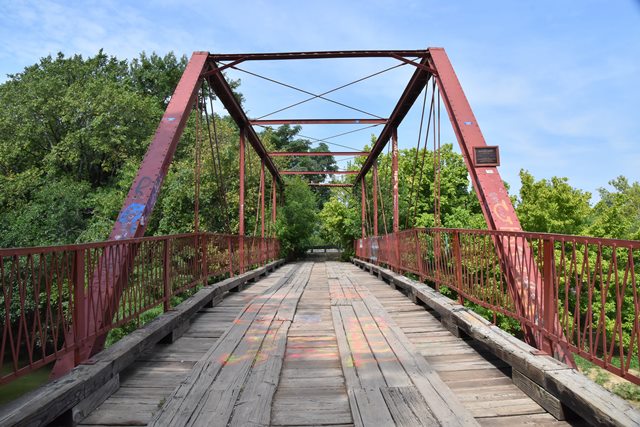
Goatman’s Bridge
Just outside Denton, Texas, tucked between trees and hovering over Hickory Creek, stands the Old Alton Bridge—better known today as Goatman’s Bridge. What looks like a quiet iron truss bridge from the late 1800s has become one of the most infamous legend-laden locations in the state. Part history, part folklore, part modern paranormal hotspot, Goatman’s Bridge sits at the crossroads of documented past and deeply rooted local myth. The bridge was built in 1884 to connect the towns of Denton and Copper Canyon, replacing an earlier wooden structure. For decades, it served farmers, travelers, and livestock drivers moving through the area. The surrounding woods and creek bottom were rural, isolated, and—especially at night—pitch black. Even without a legend attached, it’s the kind of place that feels removed from the modern world once the sun goes down. The haunting reputation largely centers around the story of a Black goat farmer named Oscar Washburn. According to the legend, Washburn successfully raised goats near the bridge and even hung a sign reading “This way to the Goatman.” As the story goes, members of a local Ku Klux Klan group resented his success and presence in the area. One night, they allegedly dragged him onto the bridge and hanged him from the iron supports. When they looked over the edge to see his body, it was gone. In retaliation, the legend claims the mob murdered his wife and children at their cabin nearby. The problem is that historians have found little concrete evidence confirming the Washburn story as it’s commonly told. While racial violence was tragically common in Texas during that era, records directly tying this specific lynching to the bridge remain debated. Like many American ghost stories, the narrative appears to have evolved over time, blending fragments of possible history with escalating folklore. Beyond the Goatman legend, the surrounding woods have their own dark reputation. Some accounts claim the area was once a gathering site for the KKK. Others say occult rituals took place in the forest clearing near the bridge. Stories circulate of satanic symbols, animal remains, and strange ceremonies—though many of these reports are difficult to verify and may stem from trespassing, vandalism, or modern thrill-seekers attempting to add fuel to the myth. Paranormal claims at Goatman’s Bridge are intense and varied. Visitors report hearing growls or heavy footsteps pacing along the bridge at night. Some claim to see a tall, shadowy figure with glowing eyes moving between the trees. Others describe feeling sudden dread or being pushed, scratched, or followed. Electronic voice phenomena sessions allegedly capture aggressive responses. There are even reports of car malfunctions and battery drain near the bridge—common claims at high-profile paranormal sites. One of the most persistent experiences reported is a feeling of being watched from the treeline. Investigators often describe the woods as more active than the bridge itself. Disembodied voices, distant chanting, and unexplained knocks are frequently cited. Skeptics argue that the area’s wildlife—deer, coyotes, wild hogs—and the acoustics of the creek valley can easily account for many of the sounds. The power of suggestion also plays a significant role; when people walk into a place expecting a demonic goat creature, adrenaline tends to do the rest. Despite the debate over its historical accuracy, Goatman’s Bridge has cemented itself in Texas paranormal culture. It has been featured in documentaries, YouTube investigations, podcasts, and television ghost-hunting shows. The combination of racial tragedy, alleged occult activity, and a creature-based legend gives it a uniquely layered mythology compared to traditional “haunted house” locations. Today, the Old Alton Bridge is part of a public trail system, and visitors can legally walk the bridge during park hours. By day, it’s a scenic historic structure surrounded by greenbelt trails. By night, it transforms into something entirely different in the public imagination—a place where history, fear, and folklore blur together. Whether the Goatman is a vengeful spirit, a demon born from rumor, or simply a campfire story that grew too large to contain, the bridge remains one of Texas’ most talked-about haunted locations. It’s a reminder that sometimes the most powerful hauntings aren’t built on documented facts alone—but on the stories communities tell, retell, and refuse to let die.
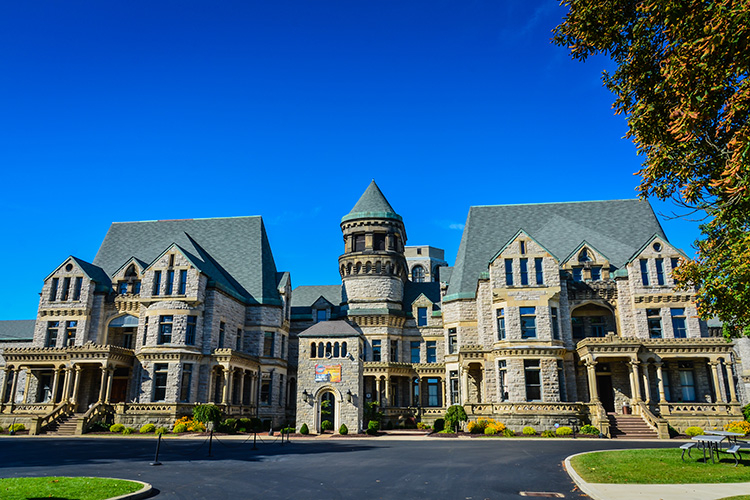
Ohio State Reformatory
Rising from the edge of Mansfield, Ohio, the Ohio State Reformatory looks exactly like what most people picture when they think of a haunted prison—a towering limestone fortress with Gothic turrets, arched windows, and a scale that seems impossible for a building that was never meant to be a maximum-security facility at all. But the Reformatory's origins weren't built on punishment. They were built on the belief that young men could be saved. The land itself carries history before the first stone was laid. The field where the Reformatory stands once served as Camp Mordecai Bartley, a Civil War training ground for Ohio soldiers. In 1867, Mansfield was selected as the site for a new state prison intended to fill the gap between juvenile corrections and the full Ohio State Penitentiary in Columbus. The city raised $10,000 to purchase the land. Construction began in 1886 under Cleveland architect Levi T. Scofield, who blended Victorian Gothic, Richardsonian Romanesque, and Queen Anne styles into a structure specifically designed to inspire moral renewal—its grandeur meant to encourage inmates toward repentance rather than despair. The first 150 prisoners arrived by train in 1896, and construction wouldn't be completed until 1910. Unlike locations shaped by a single catastrophe, the Reformatory's weight comes from a century of drift. The original mission was genuinely rehabilitative—inmates received religion, education, and a trade, with 18-month sentences that could end early for good behavior. By most accounts, the model worked. But as Ohio's criminal population grew and the facility became overcrowded, the state began sending more serious offenders to Mansfield. By the mid-twentieth century, rooms designed for one inmate held two or three. Violence became routine. Guards were killed. Inmates were murdered, drove themselves to suicide, or died from disease. Over 154,000 men passed through the gates before the building was ordered closed in 1990 following a federal class-action suit over inhumane conditions. Just outside the walls, 215 numbered graves mark the ones who never left. The building itself demands attention. The six-tier East Cell Block is widely cited as the largest freestanding steel cell block in the world—a canyon of iron that rises through the interior like something industrial and medieval at once. The warden's quarters, the chapel, the solitary confinement wing, and the basement all carry their own atmosphere. The Hole—a row of pitch-black isolation cells in the basement—is described by visitors as one of the most oppressive physical spaces they have ever entered. Natural light barely reaches the lower levels. The upper tiers stretch upward in iron rows until they disappear into shadow. Paranormal claims at the Reformatory are among the most extensively reported of any site in the Midwest. Visitors and investigators describe shadow figures moving across the upper tiers, unexplained voices in the cellblocks, and the sensation of being followed through otherwise empty corridors. EVP sessions regularly produce what investigators describe as direct, responsive communication. Some guests report being physically touched, grabbed, or scratched with no one nearby. Specific areas generate consistent accounts across unrelated visitors. The Hole produces reports of sudden nausea, cold air, and the feeling of being crowded in a space barely large enough to stand in. The basement is associated with two distinct presences—one described as a young boy, light and flickering, the other heavier and threatening. The warden's quarters carry stories of Helen Glattke, wife of longtime superintendent Arthur Glattke, who died in 1950 from an accidental gunshot wound inside the residence. Investigators report the scent of roses—her signature perfume—in rooms where no one has been. The chapel brings reports of whispered voices and phantom organ tones. Skeptics note that a century-old limestone structure of this scale naturally generates sounds, temperature swings, and optical oddities. The documented history of violence, suffering, and death embedded in this place is powerful enough to shape what any visitor expects to find before they step inside. That suggestion cannot be discounted. Still, the consistency of independent reports across decades, and across visitors with no prior knowledge of specific locations, gives even skeptical investigators reason to pause. Today the Reformatory is operated by the Mansfield Reformatory Preservation Society, which purchased the building from the state of Ohio for one dollar in the mid-1990s and has worked to restore it ever since. It is listed on the National Register of Historic Places, welcomes over 120,000 visitors annually, and is recognized worldwide as the primary filming location for The Shawshank Redemption. But the movie connection is only part of what draws people here. Some come for the architecture. Some come for the film history. Many come for the chance to spend a night in the East Cell Block, lights off, listening. Almost all of them leave with something they didn't have when they arrived—a story they struggle to explain, and a quiet conviction that the Ohio State Reformatory is far from empty.
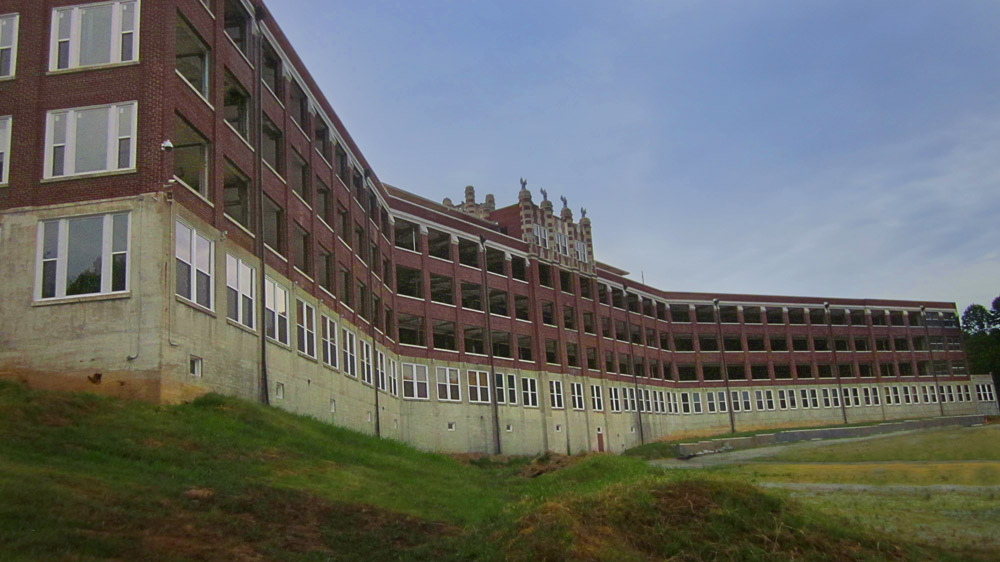
Waverly Hills Sanatorium
Rising from a windswept hill on the south side of Louisville, Kentucky, Waverly Hills Sanatorium looks exactly like what most people picture when they think of a haunted hospital—a massive Tudor Gothic structure with long sun-bleached corridors, cavernous open wards, and an elevation that keeps it visible and isolated all at once. But Waverly Hills wasn't built with darkness in mind. It was built out of desperation, as a response to one of the deadliest disease outbreaks an American city had ever faced. In the early 1900s, Louisville had the highest tuberculosis death rate in the entire country. Nestled in the Ohio Valley along the wetlands of the Ohio River, the city was a near-perfect environment for the disease to spread. To try to contain it, a Board of Tuberculosis Hospital was established in 1906, and a two-story wooden facility opened on the hill in 1910, capable of holding around 40 to 50 patients. As the epidemic worsened, that structure proved woefully inadequate. Construction on a permanent five-story building began in 1924, and the new Waverly Hills opened in 1926—considered at the time to be the most advanced tuberculosis sanatorium in the country. Unlike locations tied to a single act of violence, Waverly Hills carries the weight of prolonged suffering. Patients arrived knowing they might not leave. Treatments of the era were brutal by any measure—surgical procedures to collapse and expand the lungs, removal of ribs and chest muscles, experimental interventions that killed as often as they cured. Fresh air was considered therapeutic, so patients were positioned on open porches in all weather, including winter. Old photographs show men and women bundled in chairs, dusted in snow, staring out over Louisville. Many of them died there. When antibiotic streptomycin finally brought tuberculosis under control, Waverly Hills closed in 1961 with its work done but its halls saturated with decades of illness and death. The building itself is disorienting in scale. Five floors of open corridors stretch across the hilltop, with patient rooms branching off in long rows. The solarium porches jut from the exterior, still open to the sky. Deep in the building's lower section runs what staff called the body chute—an enclosed tunnel leading down the hillside to the railroad tracks below, used to transport the dead away from the facility without demoralizing the living patients above. It remains one of the most viscerally unsettling features of any historic building in the country. Peeling paint, rusted hardware, and collapsing plaster fill the interior, while the structural bones remain largely intact. Paranormal claims at Waverly Hills are among the most extensively documented of any location in the United States. Investigators and visitors report shadow figures moving through doorways, disembodied voices in the stairwells, and the sounds of footsteps trailing through otherwise empty wards. EVP sessions frequently yield responses that investigators describe as intelligent and direct. Some guests report being physically touched or experiencing sudden waves of dread in certain rooms without any obvious explanation. Room 502 on the top floor draws particular attention—the site of an alleged nurse suicide that has circulated in local legend for decades. The body chute produces some of the most consistent reports of any area, with visitors describing feelings of being followed, cold spots, and shadows moving along the tunnel walls. On the upper floors, investigators commonly report equipment failures, sudden battery drains, and apparitions near the open solarium windows. The reports span casual tourists and seasoned paranormal teams alike, and the consistency across unrelated accounts is difficult to dismiss. Skeptics reasonably point out that a massive deteriorating structure will generate sounds, pressure shifts, and visual anomalies on its own. The history of suffering embedded in Waverly Hills is well documented and powerful enough to shape perception before a visitor ever sets foot inside. Suggestion and atmosphere account for much. But even investigators who arrive with clinical skepticism tend to leave describing something harder to categorize than building noise and expectation. Today Waverly Hills is operated by owners Tina and Charlie Mattingly, who purchased the property in 2001 and have dedicated themselves to its restoration. It is listed on the National Register of Historic Places and draws thousands of visitors each year for historical tours, paranormal investigations, and overnight stays. The body chute is accessible. The corridors are walkable. Room 502 is just up the stairs. Whether you come for the architecture, the medical history, or the unexplained, Waverly Hills offers something few historic sites can match—a place where the past doesn't feel past at all, and where the silence between footsteps has a weight all its own.
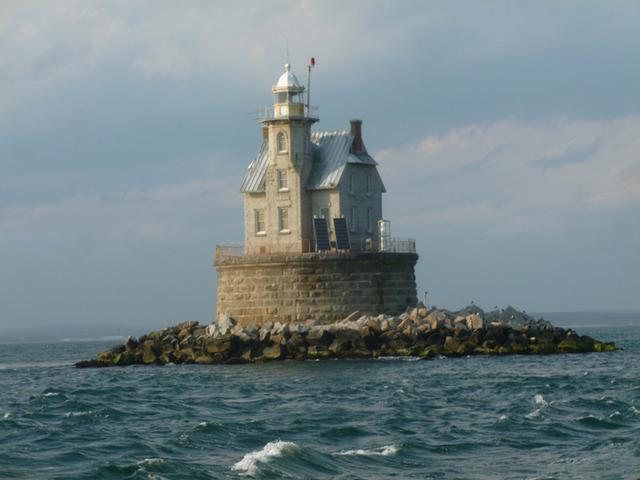
Race Rock Lighthouse
There is a point in the eastern reaches of Long Island Sound where three bodies of water — the Sound itself, Block Island Sound, and Fishers Island Sound — converge in a narrow channel four miles wide and choked with opposing tidal forces. Mariners have called it The Race for centuries, a name that captures the speed and turbulence of currents that can push six knots and reverse direction entirely with the tide. At the center of this convergence sits Race Rock, a submerged ledge rising only three feet above mean low water, decorated with shipwreck after shipwreck and surrounded by water that behaves like a living thing with bad intentions. The lighthouse that stands on that reef — granite, square at the base, octagonal at the top, its fourth-order Fresnel beam visible fourteen miles at sea — is one of the most consequential feats of American marine engineering, and one of the most persistently reported haunted sites along the Eastern Seaboard. By 1837, eight vessels had been lost on Race Rock Reef in eight years. Congress appropriated funds for a lighthouse as early as 1838, but the money was never spent, the engineering problem seemingly unsolvable. Buoys couldn't hold in the current. Iron spindles driven eighteen inches into the reef disappeared with the spring ice. The Lighthouse Board reported in 1852 that every conventional approach had been tried and failed. The danger was well-documented; the solution was not. It would take another two decades and a total of $278,716 — and nearly eight years of continuous effort — before the light was finally activated on January 1, 1879. The man who solved it was Francis Hopkinson Smith, a structural engineer contracted in 1871 who was also, improbably, a painter and novelist — a descendant of Francis Hopkinson, signer of the Declaration of Independence, and later famous for fiction drawn from his own experiences on this reef. Smith had previously built the Block Island breakwater and a seawall on Staten Island; he would later build the foundation for the Statue of Liberty. Race Rock would be his most demanding project. He and his crew — led by master diver Captain Thomas A. Scott — lived on the construction site during working months, erecting a shanty on the partial foundation while the water moved around them. When the initial riprap foundation of 10,000 tons of granite began to shift, Smith donned diving gear himself and went down to examine it. He came up certain the design had to change. The Lighthouse Board resisted; he convinced them. The concrete foundation — a stepped, concentric platform sixty-nine feet in diameter — was poured beginning in 1873. The pier rose from it in fourteen courses of heavy masonry, and the lighthouse itself went up in a single working season in 1878. The construction was not without its casualties. A boat carrying two hundred pounds of gunpowder exploded at the site, killing workers. The isolated conditions, the violence of the water, and the years of unrelenting labor extracted their price in lives and in men's minds. Smith later transformed those experiences into the novel Caleb West, Master Diver, thinly disguising Race Rock as its setting. The story had already written itself. Thomas A. Carroll was appointed keeper in 1880. He rowed regularly from Race Rock to Noank for supplies and to visit his family on shore. In January 1885, a severe storm caught him on the mainland and kept him there for several days. When he finally decided he could no longer neglect his post, he pushed his small boat out into the waves alone. He was never seen again. His body was never recovered. Coast Guard crews who later worked maintenance shifts at the lighthouse reported hearing whispers, laughter, and unexplained footsteps moving through the structure. Some reported physical contact — being touched, poked, or pushed — by no visible source. Wet footprints were found leading from the former shower area after the water supply had been disconnected and the fixture removed. Boaters passing at night have reported a shadowy figure visible in the lantern tower when no one is assigned there, illuminated briefly by the rotating beam. Whether the figure belongs to Carroll or to one of the earlier dead — workers from the construction, sailors from the reef's long list of wrecks — has never been resolved. The lighthouse was automated in 1978, ending any permanent human presence on the rock. In 2004, reportedly at the request of Coast Guard maintenance personnel who continued to report unsettling experiences during equipment checks, The Atlantic Paranormal Society conducted a formal overnight investigation, documented in the fourth episode of the first season of Ghost Hunters on Syfy. The investigation was conducted without electricity or facilities, in harsh weather and rough water. The team reported a chair moving across a room without assistance and an electromagnetic field that tracked consistently up and down the spiral staircase. At the conclusion of the twelve-hour session, investigators stated that Race Rock appeared to be genuinely haunted — an outcome the Coast Guard had hoped to disprove. Skeptics point to the obvious: Race Rock is exactly the kind of place where the imagination does what it is built to do. Isolated, unlit, accessible only by boat and only in favorable conditions, surrounded by the sound of water that has killed for centuries, the lighthouse sits in the kind of environment that produces reports almost automatically. The spiral staircase creates drafts; the granite structure amplifies sound; the current generates low-frequency vibration detectable in the bones but not in conscious hearing. All of that is probably true. It doesn't account for the consistency of the reports across unrelated witnesses over more than eighty years, or for the specificity of a keeper last seen rowing into a January storm, still attributed by those who work the light as not entirely gone. Race Rock Lighthouse was added to the National Register of Historic Places in 2005 and transferred to the New London Maritime Society in 2013 under the National Historic Lighthouse Preservation Act. The light remains operational, maintained by the Society and the Coast Guard jointly. Tours are offered occasionally in summer through New London's Custom House Maritime Museum, weather and tidal conditions permitting — the latter qualifier a reminder that the water around Race Rock still sets the terms of everything that happens there.

Gettysburg Battlefield
Spread across more than six thousand acres of rolling Pennsylvania farmland, the Gettysburg Battlefield does not look like a place where over fifty thousand men were killed, wounded, or went missing in three days. It looks like what it was before the armies arrived—a patchwork of wheat fields, orchards, low stone walls, and gentle ridges converging on a small crossroads town in Adams County. That ordinariness is part of what makes it so unsettling. In the summer of 1863, Confederate General Robert E. Lee launched his second invasion of the North, hoping to win a decisive battle on Union soil that might break Northern morale and force a negotiated end to the war. The armies collided at Gettysburg almost by accident on July 1, and over three days more than 165,000 soldiers fought across farms, hills, and streets in engagements that became legend—the defense of Little Round Top, the carnage at Devil's Den and the Wheatfield, and the doomed Confederate assault known as Pickett's Charge. The estimated 51,000 casualties included over 7,000 dead left on the field. It was the bloodiest single battle in American military history and the turning point of the Civil War. What followed was nearly as harrowing. Gettysburg's 2,400 residents were left with roughly 21,000 wounded, thousands of dead horses rotting in the July heat, and bodies everywhere. Homes, churches, and barns became hospitals. Burial parties worked by lantern light, digging trenches sometimes only ten inches deep, leaving hands and feet exposed. Rain on July 4 unearthed shallow graves. The stench hung over the town for months. One family left for nine years because the smell made their home uninhabitable. Of the 3,354 Union dead eventually interred in the Soldiers' National Cemetery—dedicated by Lincoln that November—979 remain unknown. The paranormal reputation of Gettysburg is as vast as the battlefield itself. Devil's Den produces some of the most consistent accounts—cameras and electronics malfunctioning, mysterious figures appearing in photographs, distant gunfire echoing off the rocks, and encounters with a barefoot man in ragged clothing who speaks briefly before vanishing. At Little Round Top, visitors report apparitions and phantom drumbeats. Across the Pickett's Charge fields, witnesses describe formations of soldiers still marching toward the ridge. Iverson's Pits—the site of a mass grave—has long been associated with apparitions and impressions of bodies in the grass. At Sachs Covered Bridge, visitors report phantom cigar smoke, distant cannon fire, and the sensation of being tapped on the shoulder by no one. Inside Gettysburg College's Pennsylvania Hall, which served as a Confederate field hospital, reports describe an elevator bypassing the first floor to open on a basement scene of Civil War-era surgical operations. Park rangers have privately described hearing crying, footsteps, and the smell of tobacco in battlefield structures, though the National Park Service issues no official statements on the subject. Skeptics rightly note that a landscape this saturated with historical narrative will prime visitors to interpret ordinary stimuli as extraordinary. But the sheer volume and consistency of reports—from tourists, historians, park employees, and investigators with no particular agenda—gives the place a reputation that resists easy dismissal. Today, Gettysburg National Military Park includes over 1,300 monuments and memorials. The Soldiers' National Cemetery holds over 6,000 burials spanning six American conflicts. The fields are walkable. The stone walls still stand. And for a place where the dead were once measured not in names but in trenches, the quiet has never entirely settled.
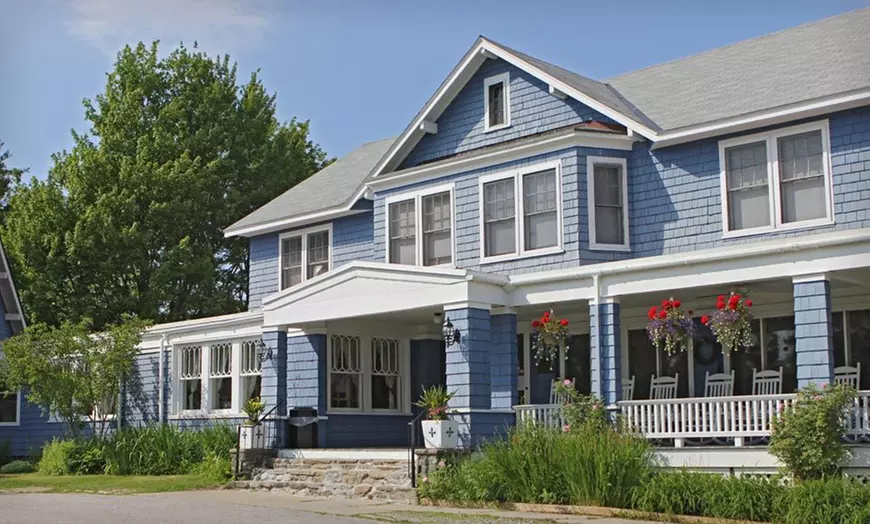
The Spalding Inn
Set on nearly eight acres of rolling land along Mountain View Road in Whitefield, New Hampshire, the Spalding Inn looks out across orchards and perennial gardens toward the smoky ridgeline of the Presidential Range. It is the kind of White Mountains property that seems to have always been there—a sprawling, white-columned Victorian structure flanked by a carriage house and framed by the kind of landscape that drew Bostonians and New Yorkers north by rail during the Gilded Age, when the region's grand resort hotels were at the peak of their influence. The building dates to the 1860s, when it was known as the Cherry Hill House—a modest structure with an attic that was later expanded by lifting the roof and adding a full second floor. It began its life as a private residence, and like many properties in northern New Hampshire's hotel corridor, it eventually transitioned into lodging as the White Mountains tourism trade grew. By 1926, the property had been formally established as the Spalding Inn, operating as a seasonal resort that welcomed guests for the spring and summer months, with some visitors staying the entire season. For a time it functioned as a private members-only establishment, a country club of sorts, offering tennis, a heated pool, golf, and formal dining against a backdrop of mountain scenery. Brochures from the mid-twentieth century advertise it as a gracious retreat—the kind of place where guests dressed for dinner and rocked on the veranda in the long northern twilight. Over the decades the property changed hands several times, and like many of the grand old lodging houses of the White Mountains, it experienced cycles of prosperity and decline. By the early 2000s the building was aging and in need of significant attention, its long history beginning to show in the bones of the structure. Reports of unusual activity inside the inn, however, had been circulating for far longer than anyone could precisely date. Guests and staff described shadow figures drifting through hallways, doors opening and closing without explanation, and a pervasive sense of unease in certain parts of the building—particularly the carriage house and the basement bar area. The stories were persistent enough that the inn had acquired a reputation for being haunted well before it attracted national attention. Local tradition holds that a former owner took his own life in the carriage house, and that a woman and a child also died on the property under circumstances that have blurred with time into the kind of half-documented, half-whispered accounts that cling to old New England buildings like woodsmoke. In 2008, the property was purchased by Jason Hawes and Grant Wilson, the co-founders of The Atlantic Paranormal Society and stars of Syfy's Ghost Hunters. The purchase was not incidental to the inn's reputation—both men were drawn to it precisely because of the paranormal claims that predated their ownership. They invested heavily in restoring the building, reopening it as a working inn with 36 rooms across the main house and carriage house, a main dining room, and a basement pub called 2 Kings. The inn debuted on Ghost Hunters in April 2009, in a Season 5 episode titled "Crossing Over," in which Hawes and Wilson brought in the Ghost Hunters International team to conduct an independent investigation. The results were striking. Digital recorders in the carriage house captured what investigators described as the sound of a door opening and closing on its own and a male voice saying a single word. In the bar area, a female voice with what was described as an English accent was captured—a detail investigators noted as significant given the inn's long history of hosting British guests. In the kitchen, where a dark shadow had been observed moving through the room, a recorder picked up a voice speaking the word "cherry," an apparent reference to the building's original name. The team's conclusion was unequivocal: they deemed the inn haunted. Subsequent investigations by other paranormal groups and by visitors attending the TAPS ghost-hunting events held at the property produced additional accounts. The carriage house consistently generated the most activity. Rooms 15, 16, and 17 on the upper floor were identified as hotspots, with Room 16 reportedly carrying a heavy male energy and Room 17 producing sightings of a shadowy female figure wearing what appeared to be a pearl necklace. One investigator who observed the figure from outside later learned that a former owner of the inn had been known for always wearing pearls. Room 33 in the main house drew reports from guests who described being awakened by unexplained disturbances in the night. In the main building, a hunched figure was reportedly observed moving slowly across the first floor, and investigators noted that nearly every room in the inn seemed to carry its own distinct energy. A massive dark mass was repeatedly witnessed in the bar and kitchen areas by both staff and guests. One visitor reported being tapped on the shoulder three times while sitting with his back to an empty room. Hawes's wife described an occasion when she and her son looked out a window of the main house and saw a woman standing in an upstairs carriage house window, staring back at them before vanishing. The inn also appeared in Ghost Hunters Season 8, in an episode titled "Sign the Ghostbook," which served as Grant Wilson's final investigation before departing the show. Hawes and Wilson listed the property for sale in 2013 at $795,000, noting that while they loved the building, they no longer had the time to operate it. The inn changed hands again and continued to operate on a limited basis in subsequent years, though its status has remained uncertain. As of recent reports, the Spalding Inn is not currently open to guests, and its future remains unclear. The building still stands on its hillside, the carriage house still flanks the main structure, and the view of the Presidential Range from the front porch has not changed. Whether the property will be restored again or allowed to continue its slow drift toward silence is an open question. What is less open to debate is the volume and consistency of the accounts that have accumulated within its walls—reports spanning casual visitors, seasoned investigators, and the families of the men who made their careers studying exactly this kind of thing, and who chose this particular building to call their own.
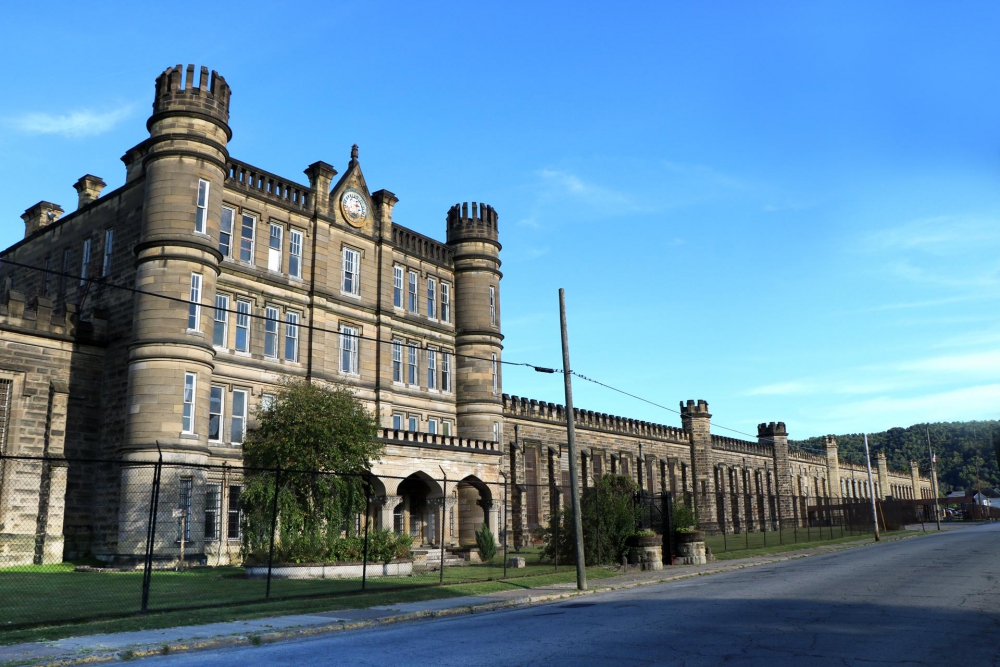
West Virginia State Penitentiary
Rising from a flat stretch along Jefferson Avenue in Moundsville, West Virginia, the West Virginia State Penitentiary looks exactly like what most people picture when they think of a haunted prison—massive sandstone walls adorned with battlements and turrets, a fortress silhouette that feels pulled from a darker century. But the Penitentiary's origins weren't born from cruelty by design. When West Virginia became a state in 1863, it had no state prison at all. Prisoners were held in county jails, an arrangement that quickly proved inadequate for a young state trying to establish its own institutions. Governor Boreman lobbied the legislature for funds to construct a state penitentiary, and in 1866 the legislature appropriated $50,000 to acquire land in Moundsville for construction. The prison at Joliet, Illinois provided the architectural prototype—an imposing stone structure fashioned in the castellated Gothic style, complete with turrets and battlements, though West Virginia's version would be approximately half the size. The Gothic structure officially opened in 1876 and would remain in continuous operation for nearly 130 years. Unlike locations defined by a single dramatic event, the Penitentiary's weight comes from accumulation. It witnessed riots, fires, and the execution of nearly 100 prisoners through either hanging or electrocution over its lifetime. Deadly riots in 1973 and 1979 prompted judicial oversight, and despite efforts to improve conditions, another riot on New Year's Day 1986 led the state Supreme Court to order the facility's eventual closing. A 1986 ruling determined that confinement to the 5-by-7-foot cells constituted cruel and unusual punishment, and the last prisoners were transferred out in 1995. The building itself amplifies everything. The sandstone facade rises with attached buttresses, circular turrets, and lancet windows—one of the finest examples of high Gothic Revival architecture in West Virginia. Long cellblock corridors stretch in either direction from the central administrative tower. The former North Hall, the shower room, and the solitary confinement area known as the Sugar Shack each carry their own particular atmosphere. Natural light barely penetrates the deeper interior. The original hardware, bars, and cell fixtures remain largely intact throughout. Paranormal claims at the Penitentiary are among the most documented in the country. Reports of supernatural phenomena include sightings of phantom inmates by former guards and legends of a shadowy figure that wanders the premises. Visitors frequently report cold spots and unexplained noises, including voices. EVP sessions in the cellblocks often yield results that investigators describe as direct responses rather than ambient noise. Some guests report being touched or physically pushed in areas where no one else is standing. Visitors have reported seeing the "Shadow Man," a static silhouette that roams the grounds. The former execution chamber draws particular attention, as does the Sugar Shack, where inmates were reportedly subjected to extreme punishment. Shadow figures, equipment malfunctions, and sudden drops in temperature are consistently reported across multiple independent investigations. Some claim to hear screaming from empty cellblocks, while others report doors moving on their own in the upper tiers. Skeptics note that any century-old stone structure will settle, creak, and breathe in ways that feel unexplainable. Large facilities amplify sound unpredictably. The history of violence and suffering embedded in this place—by design, by circumstance, and by record—gives visitors a psychological framework that can color every sound and shadow. Still, seasoned investigators routinely describe the Penitentiary as producing some of the most compelling evidence they've encountered anywhere. Today the site is maintained as a tourist attraction, museum, training facility, and filming location, operated by the Moundsville Economic Development Council. It sits directly across from the Grave Creek Mound, the largest prehistoric burial mound in eastern North America, a detail that adds another layer of historical unease to an already loaded site. There are no costumed actors on the standard tours. Just iron bars, cold stone floors, and the long institutional silence of a building that processed more than a century of human suffering. Whether visitors arrive as history buffs or paranormal investigators, most leave with the same feeling: that the West Virginia State Penitentiary has not finished telling its story.
Stage Coach Inn
Half a mile west of Ida Grove, Iowa, tucked into the timber of Moorehead Pioneer Park, a one-and-a-half-story frame building sits on land that was occupied long before any European settlers arrived in Ida County. The Moorehead Stagecoach Inn is the first structure ever built in Ida Grove, the oldest surviving building in the county, and a place where the layers of human use run so deep—and in some cases so grim—that the paranormal activity reported within its walls has drawn investigators for years and inspired a book-length account of what happens inside after dark. The Western Stage Line began operating stagecoaches from Lizzard Point at Fort Dodge to Sergeant Bluff near Sioux City in 1855, and the route needed way stations roughly every thirty miles where horses could be changed and riders could rest. The following year, John H. Moorehead began constructing an inn along the route on a site that, according to local accounts, sat directly over a Native American burial ground. A Sioux burial tree still stands approximately forty feet from the front door of the building. Moorehead completed the inn in 1863, creating a twelve-room, L-shaped frame structure that would serve the community in nearly every capacity a frontier settlement could require. In the years that followed, the inn functioned simultaneously as a stagecoach depot, the first Ida County courthouse—a role it held until 1871—the county post office, the community's first church, its first schoolroom, and its first hospital, where surgical procedures including amputations were performed on a table that reportedly remains inside the building to this day. The sheer density of function compressed into one small wooden structure meant that the inn absorbed births, deaths, legal proceedings, worship, education, and frontier medicine all under a single roof during the most volatile decades of Iowa's settlement period. John and Martha Moorehead raised their family in the building while operating it, and the inn passed through the decades as Ida Grove grew around it. The original stagecoach barn still stands nearby. By the twentieth century, the inn had outlived its practical usefulness but retained its historical significance. It was listed on the National Register of Historic Places in 1974. A historical architect was brought in during the 1970s to assess the building, and a restoration effort preserved the structure with its original character intact. Today the inn is part of Moorehead Pioneer Park, under the direction of the Ida County Conservation Board, and is open to the public on Sundays during summer months, with tours available by appointment year-round. The interior features period antiques and memorabilia from the stagecoach era, along with artifacts from the building's many institutional roles. The paranormal reputation of the Stagecoach Inn has been documented most extensively by Allen Cornelison, a veteran paranormal investigator who moved to Ida Grove around 2011 and, after discovering the building during a walk through the park, conducted an intensive six-year investigation of the site with permission from the Ida County Historical Society. Cornelison published his findings in Ghosts and Legends of the Stage Coach Inn, describing the inn as one of the most active locations he had encountered in two decades of investigative work. The phenomena reported at the inn span a wide range. Disembodied voices and whistling are heard regularly inside the building, along with phantom footsteps that sound through the rooms when no one is present. On one documented occasion, a spinning wheel displayed in the schoolroom area was captured on video turning rapidly on its own before abruptly stopping. The staircase has been identified by investigators as a particular focal point of activity, described as a kind of energy portal, with the top landing producing the most concentrated phenomena. Cornelison himself reported being physically tugged on the back of his coat during an early investigation, an experience he captured on video though the source of the pull was not visible. Audio recordings made during his sessions captured what investigators believe is a child's voice responding to direct questions. Outside the inn, the proximity of the Sioux burial tree adds another dimension to the site's reputation. Shadowy figures have been reported near the tree and around the burial ground, particularly after dark. Paranormal teams that have investigated the exterior have noted unusual occurrences near the tree, including sudden barrages of falling acorns that intensify when people approach and cease when they withdraw. The convergence of Indigenous sacred ground, frontier-era suffering, and the sheer volume of human activity that passed through the building during its working life creates a setting that investigators and visitors describe as unmistakably charged. Today the Moorehead Stagecoach Inn stands quietly in its park setting, surrounded by hiking trails, a stocked lake, and the other preserved structures of the Ida County Historical Society. The burial tree still rises near the front door. The amputation table, if the accounts are accurate, still sits inside. The building is the kind of place that looks unremarkable from the outside—a modest wooden house in a county park—but carries within its twelve rooms the compressed weight of an entire community's origins, from the sacred ground it was built upon to the stagecoach travelers who slept under its roof to whatever remains of the voices that investigators continue to record in the silence between visits.

Sunland Hospital Site – Orlando
Sunland Hospital no longer stands. The main building was demolished in 1999, the last administration building torn down in 2006, and the site in the Pine Hills neighborhood of Orlando now holds a children's playground. But the ground remembers what was built on it, and so does everyone who lived near it, explored it, or worked to shut it down. The facility began in 1938 as the Florida State Tuberculosis Sanitarium, part of a statewide chain of hospitals funded by benefactor W.T. Edwards. The building was constructed in the style common to TB hospitals of the era—long, thin, five stories tall, lined with enormous windows that could be cranked open to let in the fresh air believed to aid recovery. By 1960, antibiotics had conquered tuberculosis, and the State of Florida converted the Orlando facility into the Sunland Training Center, a residential institution for children and adults with profound mental and physical disabilities. The patients—most of them children, many of them wards of the state whose parents had surrendered custody on the advice of physicians—were supposed to receive expert care. What they received was something else entirely. Over two decades, conditions deteriorated into documented atrocity. Wards were severely overcrowded. Patients were bathed on bare concrete slabs. Staff and residents were bitten by rats. Gastric feeding tubes were surgically implanted in over four hundred patients, delivering a cereal-like gruel three times daily—a procedure performed here at rates far exceeding the national average. Investigators documented rampant infections, skin breakdown, and nutritional deficiencies. In 1979, the Association for Retarded Citizens filed a class-action lawsuit on behalf of the "Sunland Six," alleging gross neglect and abuse. The lawsuit succeeded. The hospital closed in 1983. One hundred and six Sunland patients are buried in Section Q of Orlando's Greenwood Cemetery. The building sat vacant for over fifteen years, and during that time it became the most infamous destination for urban explorers in Orlando. What they found inside was a decaying monument to institutional cruelty—wheelchairs left in corridors, medical equipment scattered across floors, old Disney characters painted on the walls of the children's ward, and an atmosphere that visitors described less as spooky and more as deeply, physically wrong. The reports were consistent and disturbing. Visitors heard screams and moaning, some distinctly childlike. Shadow figures moved through corridors and appeared in upper-story windows. Apparitions of small children were seen wandering the halls. A shadow resembling a figure hanging from the ceiling was reported more than once. In 1997, a twenty-three-year-old man exploring the building with friends fell three stories down an elevator shaft and was critically injured. When police arrived, an officer reported seeing a child peering through a window. The child was never found. The incident galvanized the Pine Hills community, and residents successfully lobbied for demolition. Today the site is a playground and open field where neighborhood children come to play in daylight. But visitors to the grounds after dark still report the presence of children who are not living ones—small figures seen at the edges of the field, the sound of laughter with no source, the unmistakable feeling of being watched by someone too short to see over the fence. The spirits attributed to Sunland are not vengeful or aggressive. They are small. And they are still there, playing on the ground where no one played when they were alive.
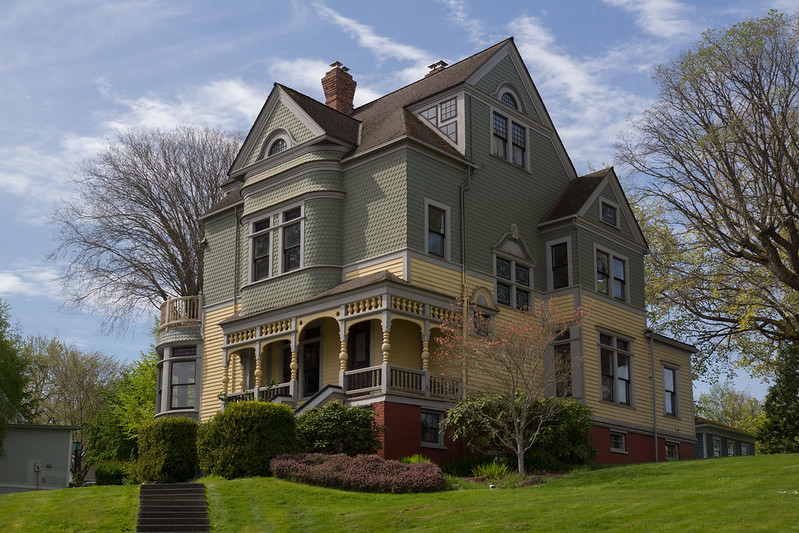
Walker-Ames House
The Walker-Ames House rises from a wooded hillside on Rainier Avenue in Port Gamble, Washington, a Victorian-era residence overlooking one of the most remarkably preserved company towns in the Pacific Northwest. The house is empty. It has been empty since the sawmill that built the town shut down in 1995. No one lives there, no one has lived there for decades, and yet by nearly every account available—from casual passersby to seasoned paranormal investigators—it is anything but unoccupied. Widely regarded as the most haunted house in Washington State, and possibly the entire West Coast, the Walker-Ames House sits at the center of a town where the dead, by persistent report, have simply chosen not to leave. Port Gamble was founded in 1853 when William Talbot and Andrew Pope established a sawmill on the shores of Hood Canal on the Kitsap Peninsula. The mill operated continuously for 142 years—the longest-running sawmill in the United States at the time of its closure in December 1995. Around the mill, the Puget Mill Company built a town modeled on the New England villages its founders had known, with tidy clapboard houses, a white-steepled church, a general store, and tree-lined streets arranged along the waterfront. Port Gamble was a company town in the fullest sense: the mill provided the livelihood, the company owned the homes, and the families who lived there were bound to the rhythms of timber, tide, and the company's fortunes. The original Walker-Ames House was destroyed in a fire in 1885. The current structure was built in 1888 for William Walker, the mill's master mechanic—a position of significant standing in a community organized entirely around the operation of the saw. Walker's daughter Maude married Edwin G. Ames, who served as the mill's resident manager and later its general manager. The house thus became the Walker-Ames, the most prominent and expensive residence in town, occupied by two generations of the family that ran the operation. After the mill closed, the house sat vacant, used occasionally for weddings, events, and eventually as a setting for films and fiction. Paranormal reports at the Walker-Ames House date back to at least the 1950s, well before the property gained any organized attention from investigators. Former town manager Shana Smith began actively collecting accounts from current and former tenants in 2006, after a paranormal group called Evergreen Paranormal requested permission to investigate. What struck Smith was the consistency across accounts separated by years and offered by people with no knowledge of one another's experiences. The house produces a range of reported phenomena. Pedestrians walking past have looked up to see the faces of small children peering from the upper-story windows of a house they know to be locked and empty. Attic lights flicker on and off with no one inside. Footsteps are heard running across floors above visitors standing in lower rooms. Disembodied voices have been recorded on electronic equipment. Visitors report being physically touched—one investigator emerged from the basement with a dusty handprint on her leg, claiming she had been grabbed. The basement generates the most intense reactions, with sensitives and casual visitors alike reporting feelings of sadness, heaviness, and an oppressive presence that several have described as darker in character than the rest of the house. The attic produces its own distinct atmosphere, with investigators reporting contact through electronic devices and the sense of a childlike energy. The most frequently described apparition is a female figure in a long dark dress with her hair pulled back in a bun—identified by some psychics as a nanny, though her name and specific history remain unknown. Paranormal investigator Pete Orbea, who has led guided tours and investigations of the house since 2012, described an encounter in which he heard a scuffle in a hallway, turned around, and found the woman standing expressionless behind him. She vanished the moment others in his group saw her, but not before someone captured a photograph of a form in the doorway. A male figure believed by some to be Edwin Ames has also been described, along with a boy with curly light brown hair in period clothing. The Walker-Ames House has been featured on A&E's "My Ghost Story" and serves as the centerpiece of the annual Port Gamble Ghost Conference, launched in 2010. Organized investigations are available by reservation, led by Orbea and visiting paranormal teams. One investigator's summary captures the paradox of the house well: despite having no dramatic history of violence or tragedy, the Walker-Ames produces an abundance of unexplainable activity—physical contact, electronic responses, apparitions, and EVP recordings that have left even skeptical visitors unsettled. Today, Port Gamble itself is a quiet tourist village of galleries, shops, and cafes housed in the old company buildings. The Buena Vista Cemetery on the hill above town holds its own reputation for activity. The Walker-Ames House stands on Rainier Avenue, locked and unrestored, its Victorian facade watching over a town that outlived its industry but not, apparently, all of its inhabitants. Whatever draws the spirits to this particular house—whether it is love of place, unfinished duty, or something less easily named—the Walker-Ames remains what it has been for over a century: a family home, still occupied by a family that no longer needs the door.
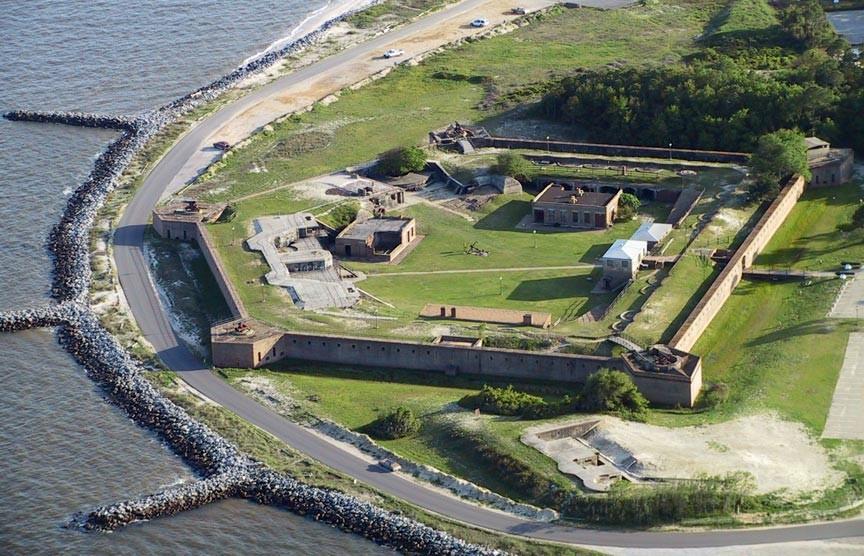
Fort Gaines
Sitting at the eastern tip of Dauphin Island where Mobile Bay meets the Gulf of Mexico, Fort Gaines occupies one of the most strategically loaded pieces of ground on the Alabama coast. The island itself carries death in its name. When French explorer Pierre Le Moyne d'Iberville arrived in 1699, he found so many sun-bleached human bones scattered across the shell mounds that he named the place Massacre Island. The name eventually softened to Dauphin Island, but the bones remained — remnants of Native American burial sites eroded and exposed by the sea. France, Spain, and Britain all used the island as a military platform at various points, each recognizing what the geography made obvious: whoever controlled this narrow strip of land controlled the entrance to Mobile Bay. The United States recognized it too. Following the War of 1812, Congress authorized a network of coastal fortifications along the southern shoreline, and Dauphin Island was identified as a critical position. Construction began in 1821 but lurched along for decades — plagued by poor engineering, flooded foundations, and funding gaps. A new design was ordered in the 1850s under chief engineer Joseph G. Totten, who drew up a five-sided masonry fort with 22.5-foot walls built to absorb artillery rather than shatter under it. Every one of the more than three million bricks had to be transported across the bay, since the island had no suitable clay. The fort was still incomplete when Alabama state militia seized it on January 5, 1861, six days before the state formally voted to leave the Union. Confederate engineers finished the work. Fort Gaines and Fort Morgan, sitting on opposite shores of the channel, formed a pair meant to strangle any naval approach to Mobile. By 1864, Mobile was one of the last Confederate ports open on the Gulf, and the Union was determined to close it. On August 5, Rear Admiral David Farragut led eighteen ships directly into the channel under the guns of both forts. When the ironclad USS Tecumseh struck a Confederate mine and sank almost instantly, Farragut reportedly shouted the order that has echoed through American history: "Damn the torpedoes — full speed ahead." The fleet punched through. Fort Gaines, pounded from sea and besieged from land, surrendered on August 8 with roughly 800 men taken prisoner — including a battalion of military cadets between twelve and sixteen years old from the Pelham Military Academy in Mobile. The fall of both forts sealed Mobile from the outside world and helped secure Abraham Lincoln's reelection that November. The fort remained in military use through both World Wars, serving as a coastal artillery installation and anti-aircraft gunnery school. It was sold to the City of Mobile in 1926, passed to the State of Alabama, and is now considered one of the best-preserved Civil War masonry forts in the country. The paranormal reputation of Fort Gaines draws from every layer of that long history. Visitors and investigators report a Confederate soldier seen standing at one of the cannons facing the water — motionless, as though still at his post. The old officers' quarters are cited as particularly active, with accounts of furniture moving, unexplained whispers filling empty rooms, and the persistent feeling of being watched. Cold spots appear without explanation in the tunnels connecting the bastions to the main courtyard. A dark shadowy figure has been reported following visitors through the inner buildings, vanishing when confronted. Paranormal researchers scouting for MTV's Fear series documented shadowy figures in photographs taken inside the walls, and the Mobile-based group SAPI has held annual ghost hunts at the fort for years. Beyond the fort itself, the ancient shell mounds on the island's eastern end — actual Native American burial sites used for centuries before European displacement — generate their own reports. Visitors describe faint drumming and chanting heard near the mounds after dark, and a blood-covered Native American apparition has been reported in the area. An older island legend speaks of a chief named Double Head who walked the beaches at night, leaving glowing phosphorescent footprints in the sand. Fort Gaines is open to the public. The guns still face the water. The brick walls still absorb the Gulf wind. And according to those who have spent time inside after the crowds leave, something in there hasn't fully stood down.
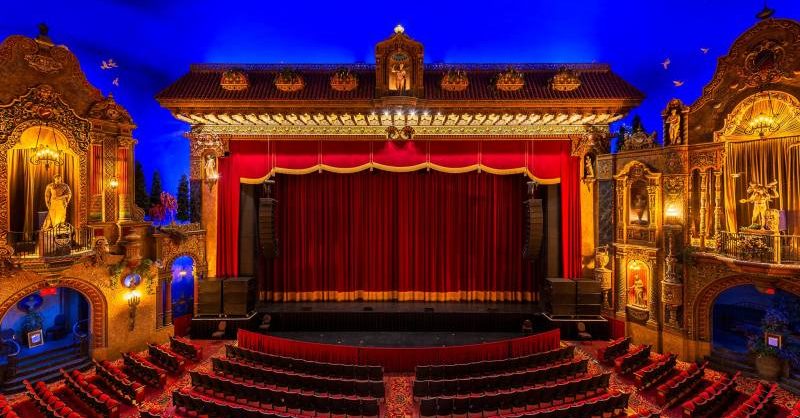
Louisville Palace Theater
Standing on the east side of South Fourth Street in downtown Louisville, the Louisville Palace announces itself before you ever reach the door. Castle-like towers flank a copper-domed marquee blazing the word PALACE in synchronized light. Terra-cotta niches, cartouches, and finials crawl across the Churrigueresque facade in a riot of Spanish Baroque ornamentation that feels closer to a fever dream of old Madrid than a Kentucky movie house. That disorienting grandeur is entirely intentional. It was designed that way from the beginning to pull you out of your life the moment you arrived. Architect John Eberson — an Austrian immigrant trained in electrical engineering who found his calling building fantastical movie palaces across America — designed the building in 1928 for Loew's and United Artists as a first-run cinema seating 3,300. Eberson called his style "atmospheric theater." His theory was that audiences should feel transported before the film even started, and the Louisville building delivers on that completely. Step through the front doors and you enter what reads as an elaborate Spanish courtyard open to the night sky. The barrel-vaulted ceiling overhead is painted midnight blue and studded with lights positioned after a photograph in National Geographic to approximate actual stars. Over 500 plaster statues and reliefs populate the walls and alcoves. The mezzanine Faces Lobby is lined with 139 sculpted busts of historical figures — composers, philosophers, writers — gazing down from every surface. The original 1,000-pipe Wurlitzer organ was still in place at opening night on September 1, 1928, when Eberson himself attended, accompanied by a live macaw, the Loew's company mascot. It was immediately heralded by the Louisville Courier-Journal as an architectural marvel. For decades the Palace was the premier entertainment destination on Fourth Street, which the locals called Theater Square. Frank Sinatra performed there in 1941 during his early career. Ray Charles appeared in 1959. Al Capone, legend holds, frequented the theater during Prohibition, traveling there from the Seelbach Hotel through underground steam tunnels beneath the city. The building carried Louisville's glamour through the post-war era before the familiar forces of suburban flight and multiplex competition hollowed out downtown entertainment districts everywhere. The Palace went dark in the 1970s, was briefly reborn in 1981 under local businessman John Siegel's ambitious $4.4 million restoration, then closed again in 1985 when the costs of maintaining a century-old atmospheric theater outran the revenue. Siegel eventually declared bankruptcy. The building sat in fragile limbo until Sunshine Theater Inc. brought it back in 1994. Live Nation has owned it since 2005, and it operates today as a 2,800-seat concert and event venue — the only surviving movie palace of its era in the city, listed on the National Register of Historic Places since 1978. The paranormal claims here are numerous, specific, and consistently reported by staff, workers, and visitors across multiple decades. The most documented figure is Ferdinand Frisch, a theater employee who died in the building in 1965. During the 1990s restoration, workers began encountering an older man in work clothes, flat-top haircut, and outdated eyeglasses appearing at various points throughout the building — sitting in the balcony watching workers on stage, standing in corners, observed by multiple unrelated crew members. Tools were moved. Voices were heard in empty spaces. One painter who fell asleep on scaffolding near a high ceiling was woken by a voice speaking directly in his ear, and found himself dangerously close to the edge. His name has reportedly been found scratched into the dust in the basement. Current staff refer to him as Bernie, and the projection booth — where a separate apparition, believed to be a projectionist who suffered a fatal heart attack on the job, is also reported — remains one of the most consistently active areas in the building. The Grand Staircase leading to the mezzanine lobby has its own persistent figure: a faceless woman in 1940s clothing, seen climbing the stairs, who vanishes before she reaches the top. A man in 1930s attire has been spotted repeatedly in the balcony by ushers; when approached, he disappears. The Ladies' Parlor bathroom has generated reports of a child giggling, and a production manager arriving to lock up alone one night reported hearing running footsteps, searching the building and finding it empty, then being physically shoved from behind as he headed for the exit — followed by the sound of two children laughing and running away. The theater's marketing manager has publicly described seeing the Grey Lady: a translucent female figure walking four or five paces in the lobby before simply ceasing to exist mid-step. She noted that nearly every member of the facilities staff has had their own encounter with the same figure. The Louisville Palace is open for performances year-round. The stars on the ceiling still burn. The faces in the lobby still watch. And the people who work there after the crowds leave have stopped being surprised by what shares the building with them.
Heartbeat Bridge
Somewhere south of Whiteville, in the flat, swampy lowlands of Columbus County, North Carolina, Chair Factory Road cuts through a stretch of coastal plain that feels older than anything built on it. The road is narrow, rural, and unlit—bordered by pine forest, drainage ditches, and the kind of dense Carolina swamp that swallows sound and light in equal measure. Partway along it, a small bridge crosses a dark waterway. There is no historical marker. There is no signage. But for decades, locals have called it Heartbeat Bridge, and what they claim to hear there has made it one of the most persistent pieces of paranormal folklore in southeastern North Carolina. Columbus County was carved from parts of Bladen and Brunswick Counties in 1808. The land had been home to the Waccamaw people for centuries before English settlers pushed into the region. The Waccamaw eventually retreated into the swamps around their namesake river and Lake Waccamaw, where roughly 1,800 members of the Waccamaw-Siouan tribe still live. The county seat, Whiteville, was incorporated in 1832 on land donated by state senator James B. White. The area developed slowly, driven by agriculture, naval stores, and timber. Chair Factory Road takes its name from one of these old timber-related enterprises—a chair manufacturing operation that once stood along the route, now long gone, leaving only the road name behind. The landscape is defined by water. The Waccamaw, Lumber, and Cape Fear Rivers all flow through or border the county. The Green Swamp, a vast pine savanna ecosystem, lies to the east. Carolina bays—thousands of shallow, oval depressions of uncertain geological origin—dot the terrain. The bridge spans one of the area's many dark, slow-moving creeks, the kind that barely moves in summer and rises without warning after rain. It is a profoundly quiet place at night—no traffic, no ambient noise, just insects, frogs, and the occasional movement of water beneath the road. The legend centers on a murder. A young woman was reportedly killed on or near the bridge by a masked assailant, who cut out her heart and threw it into the water below. The tale has circulated in Columbus County for generations, passed along at bonfires, church hayrides, and late-night drives through the countryside. There are no verifiable records of such a crime. No newspaper accounts, no police reports, no named victim. The story exists entirely in the oral tradition—which, in a rural Southern county with deep roots and long memories, is not the same as saying it is baseless, only that it cannot be confirmed. What draws people to the bridge is what they claim to experience there. Visitors report that if you park on the bridge at night and cut your engine, you can hear the sound of a heartbeat rising from the water—faint at first, then growing louder, sometimes to the point of discomfort. The sound is described as rhythmic and unmistakable, not easily confused with frogs or the settling of a vehicle. Some visitors report shadowy figures in the tree line. Others describe orbs of light in photographs. One account describes a bottle placed on the hood of a car, the bag beneath it yanked away by an unseen force without the bottle moving—witnessed by multiple people on a windless night. Another longtime local describes sitting on his car hood listening to what he calls the soothing sound of the swamp, suggesting the bridge's atmosphere carries a quality not everyone interprets as threatening. The bridge sits near another Columbus County haunt—Old Tram Road, a long straight stretch associated with its own legend of a ghostly racing light. The two locations share a geographic and folkloric ecosystem, connected by the same back roads, and locals frequently visit both in the same night. The concentration of paranormal claims in this corridor of rural Columbus County has drawn amateur investigators and regional paranormal groups, though no formal investigation has produced conclusive findings. Skeptics will note that swamp environments produce a wide range of sounds—gas escaping from decomposing matter, water moving through submerged structures, the amplified acoustics of a flat landscape at night. A bridge surface acts as a resonating chamber. The human ear, primed by a frightening story and surrounded by darkness, is good at finding patterns in ambient noise. But the sheer number of independent accounts describing the same rhythmic sound at the same location, spanning decades, gives the claims a consistency that acoustics and suggestion don't fully explain. Heartbeat Bridge remains an unmarked, publicly accessible bridge on a rural county road. There is no admission, no tour guide, no gift shop. It is simply a place where the road crosses the water, the trees close in, and something beneath the surface—whether memory, geology, or something harder to name—keeps beating.
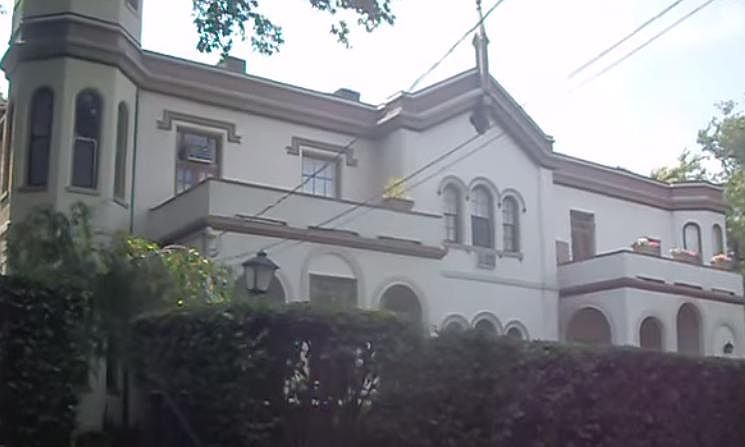
Stenton House – Cornell Place Apartments
On a quiet cul-de-sac in Cincinnati's Clifton neighborhood, one of the city's most prestigious old-money districts built on the rolling hills that give the Queen City its classical silhouette, a Victorian mansion stands at 3517 Cornell Place that has been absorbing tragedy since before the Civil War ended. Now subdivided into apartments and known as Cornell Place Apartments, the building is more commonly referred to in paranormal circles as Stenton House—a name drawn not from a builder or an original owner but from a family who moved into one of its units decades later and discovered that the dead had not moved out. The Clifton haunted walking tour regularly features the property as one of its signature stops, and some accounts describe it as one of the most haunted residences in the United States. It is a private building. Tours of the interior are not publicly offered. The privacy of the occupants, both living and otherwise, is expected to be respected. The mansion was built in 1850 as a private dwelling during the period when Dutch and German families were establishing Clifton as a refined residential enclave above the bustle of downtown Cincinnati. Property records identify it as part of the Ruben Resor tract, and rental listings for the building describe it as historically the second oldest home in Clifton, featuring an octagonal tower base, thirteen-foot ceilings, ten-foot walnut doors, marble entries and mantels, ornate plaster molding, and ceiling medallions—the bones of a house built for prominence. The first documented tragedy occurred in 1880, when a young man committed suicide inside the house. After his death, his family departed and the mansion sat vacant for years, the kind of prolonged emptiness that tends to compound whatever energy a violent death leaves behind. Around 1900, the building was converted into the Ealy School, an institution for girls. The school's tenure in the house produced its own dark chapter. According to local legend, a young schoolgirl hanged herself in one of the upstairs rooms. In a separate incident, another girl—described in some accounts as the daughter of a doctor—was found murdered on the stairway. The details of these deaths are sparse in the historical record, and the line between documented fact and accumulated neighborhood legend is difficult to draw with precision at this distance. What is consistent across accounts is that the building's years as a girls' school ended with at least two more deaths layered onto the suicide of 1880, creating a concentration of young, violent death within a single structure that few residential buildings in Cincinnati can match. After World War II, the mansion was subdivided into apartments, and it was during this era that the building acquired the name by which it is most commonly known. The Stenton family moved into one of the units, and almost immediately, odd incidents began. Phantom footsteps were heard walking the hallway when no one was visible. Two weeks after their arrival, at precisely 2:10 in the morning, the Stentons heard a heavy thump from the floor above them—the sound of something or someone hitting the ground with force. The thump repeated itself on subsequent nights, always at exactly 2:10 AM. When the family investigated, they learned that the young man who committed suicide in 1880 had killed himself in the room directly above their apartment. The regularity of the sound suggested not a conscious haunting but a residual one—an event so traumatic that its echo had embedded itself into the fabric of the building, replaying at the same hour like a recording that no one had asked to hear. Other tenants over the years have reported experiences consistent with what the Stentons described. Disembodied footsteps follow residents through the halls, keeping pace as they walk. Voices are heard in corridors and rooms when no living person is present. The sounds of phantom objects striking the floor continue to be reported. At least one tenant's dog refused to enter rooms where spiritual presences were manifesting, baying in alarm at thresholds the animal would not cross. The shadowy figure of a woman has been seen standing at the top of the staircase leading to the attic apartment, motionless, watching the space below her before disappearing. Whether she is one of the schoolgirls, a former resident, or something else entirely has never been established. Today the building at 3517 Cornell Place continues to operate as private rental apartments. The units feature the grand architectural details of the original mansion—the chandeliers, the woodwork, the veranda with sunset views overlooking acres of trees. It sits on a cul-de-sac within walking distance of Ludlow Avenue. The rent reflects the neighborhood. Nothing about the listing mentions what comes with the thirteen-foot ceilings and the walnut doors. But the residents know, and the tour guides know, and at 2:10 in the morning the building itself apparently still remembers.

Waltz Inn
At the intersection of Waltz Road and Mineral Springs Road in the unincorporated community of Waltz, Michigan—about twenty-five miles southwest of Detroit in Huron Charter Township—a modest two-story building has stood since the early 1900s, carrying within its walls more than a century of small-town history and a haunting story rooted in love, loss, and an owner who apparently never left. The Waltz Inn began its life not as a restaurant but as a German bier garten and hall, established by Joseph Waltz Jr., the man for whom the surrounding community is named. The elder Joseph Waltz had moved his family from Detroit to a 160-acre plot of farmland along Territorial Road in 1857, settling what would become one of Wayne County's quieter rural communities. When he died in 1865, the land passed to his widow and eventually to his son, who platted the area in 1872 and became a prominent local figure, serving as Huron Township Clerk and Supervisor, Wayne County Superintendent of the Poor, and a Michigan State Representative. Joseph Jr. operated a general store on Territorial Road and opened the bier garten on Mineral Springs Avenue, establishing the building that would eventually become the Waltz Inn. Property records date the current structure to approximately 1912, and it has operated in various capacities—as an inn with upstairs lodging, a tavern, a gathering hall, and eventually a full restaurant—across the generations that followed. The building retains the sturdy, unpretentious character of early twentieth-century rural Michigan commercial architecture, with two rental apartments still occupying the upper floor above the restaurant space. The Waltz Inn's modern identity was shaped most directly by Tom Monastersky, who owned and operated the business until the early 1980s. Tom and his wife Olga lived upstairs in the building, running the inn as both their livelihood and their home. According to accounts preserved in the restaurant's own menu and passed down through subsequent owners, Olga died in the upstairs bedroom, and Tom followed her just two weeks later, passing away in the same room. The proximity of their deaths—two people who had shared the building as both home and business, dying within days of each other in the same space—forms the core of the haunting narrative that has followed the Waltz Inn ever since. The paranormal activity reportedly began shortly after the Monasterskys' deaths and has continued through every subsequent ownership. The current owners, who took over the restaurant in 1984, have acknowledged that strange occurrences are a regular part of life in the building. The most common reports involve classic poltergeist-style phenomena: objects moved from one location to another without explanation, doors opening on their own, furniture rearranged when no one has been upstairs, and lights turning on and off throughout the building at hours when the restaurant is closed and empty. Staff members over the years have described the activity as mischievous rather than menacing, as though someone were playing small pranks—nudging a glass, relocating a utensil, flipping a switch. The ghost is widely identified as Tom, still tending to the business he ran in life, unwilling or unable to leave the building where he and Olga spent their final years together. Some employees and visitors have reported the sense that the upper floor, particularly in the evening hours, carries a feeling of occupation—as if unseen guests were moving through the rooms above the dining area, footsteps and ambient sounds suggesting a building that is never quite as empty as it appears. The haunting at the Waltz Inn also exists within a broader neighborhood of reported paranormal activity. Roughly a block away on Waltz Road, a house that once stood on a lot next to the Waltz Feed Store was considered haunted by its former residents, who described being physically thrown, seeing shadowy figures in bedrooms, and encountering an apparition of a man outside on the street who vanished when looked at directly. That house eventually burned to the ground. Whether there is any genuine connection between the two locations or whether the proximity is coincidental remains a matter of speculation, but the clustering of claims in such a small community has added to the Waltz Inn's reputation as a paranormally active site. The Waltz Inn closed as a restaurant during the COVID-19 pandemic and has not reopened. As of 2025, the property is listed for sale, fully intact with its inventory, kitchen equipment, and carryout liquor license. The building's roof was replaced in 2024. The two upstairs apartments—including the bedroom where Tom and Olga Monastersky died—continue to generate rental income. Whether a new owner will reopen the restaurant and inherit its resident ghost remains to be seen, but the building still stands at its quiet crossroads in Waltz, holding onto a history that stretches back to the German immigrants who settled this corner of Michigan and to the couple who loved the place enough, it seems, to never entirely leave it behind.
Devil’s Bridge
On the south side of San Antonio, where the city thins out into scrubby ranchland and the San Antonio River bends through old mission territory, a small bridge on East Ashley Road crosses a ravine deep enough that locals say if you drop a rock from the railing, you'll never hear it land. The bridge sits near 2454 East Ashley Road, not far from Mission San Juan Capistrano—one of the chain of eighteenth-century Spanish missions that line the river and now form a UNESCO World Heritage Site. The area has been continuously inhabited for thousands of years. Native Americans camped along this stretch of river long before the Spanish arrived. The missions themselves, established in the 1730s, were built with Indigenous labor and sustained by an elaborate acequia system that still carries water through the surrounding farmland today. The ground here is layered with centuries of human presence, conflict, disease, conversion, and death. It is old land, even by Texas standards. Devil's Bridge is not an ancient structure. It is a modest roadway bridge, unremarkable in engineering, crossing a steep ravine in an area that goes very dark after sundown. The name belongs to a global tradition—there are dozens of Devil's Bridges across Europe, most of them medieval, each carrying its own legend about a pact with Satan in exchange for construction. San Antonio's version doesn't have a clear origin story for the name itself. Some say it refers to supernatural happenings at the site. Others suggest it simply describes the danger of crossing the ravine at night on an unlit road, in an era before guardrails and headlights made such crossings routine. The bridge did claim at least one documented life: on March 7, 1965, shortly after midnight, a forty-one-year-old woman named Victoria Ann Broussard was fatally injured when the car her husband was driving struck the bridge's guardrail head-on. He told the responding patrolman he hadn't seen the bridge. She was pronounced dead at Baptist Memorial Hospital and buried at San Fernando Cemetery No. 2. The paranormal claims at Devil's Bridge draw from multiple threads, none of them cleanly verifiable but all of them persistent. One account ties the haunting to the Spanish colonial period, claiming a priest whose parishioners were killed during the Inquisition hanged himself from a tree near the bridge. Visitors have reported hearing the sound of a creaking rope in the surrounding trees—rhythmic, deliberate, like a body swinging from a noose. A priest at the nearby San Juan Church reportedly warned a young man in the early 1970s to be careful exploring the riverbank near the bridge, telling him he had personally seen spirits walking the grounds where Native Americans once camped. The young man had found pottery shards and square nails in the area, artifacts consistent with centuries of habitation along the river. A paranormal investigator named Joe recorded EVP sessions at the bridge and claimed to capture a voice responding to the question "Who are you?" with the name "Melvin," along with a separate recording of a voice saying "I'm here." No historical records have been found for anyone named Melvin connected to the site. Visitors have also reported the apparition of a headless woman who approaches from behind, white smoke-like figures, and the smell of sulfur—rotten eggs—hanging in the air around the bridge at night. The claim about the impenetrable darkness is among the most frequently repeated: that after sundown, the area around the ravine becomes so dark that headlights and flashlights seem to penetrate only a few feet, as if the light itself is being absorbed. The most unsettling recurring detail involves the ravine itself. Multiple accounts describe throwing rocks off the bridge and never hearing them hit water or ground—as though something catches them, or the ravine simply has no bottom. One version of the legend attributes this to the spirit of a little girl. The depth of the ravine is real and measurable, but the acoustic effect in a steep, vegetation-choked gully at night, combined with ambient insect noise and the psychology of expectation, could plausibly account for the phenomenon. Or it couldn't. The people who've stood on that bridge in the dark tend to find the explanation less comforting than the mystery. Today Devil's Bridge remains a functioning road bridge on East Ashley Road, accessible by car, with no signage or formal acknowledgment of its reputation. Mission San Juan sits nearby, its stone walls and flowing acequias drawing tourists and pilgrims. The San Antonio Food Bank farms the old mission fields just down the road. It is a landscape where the sacred, the agricultural, and the spectral exist in close proximity—where a UNESCO site and a haunted bridge share the same stretch of river, and where the oldest water rights in Texas still flow through ditches dug by hands that have been gone for three hundred years.
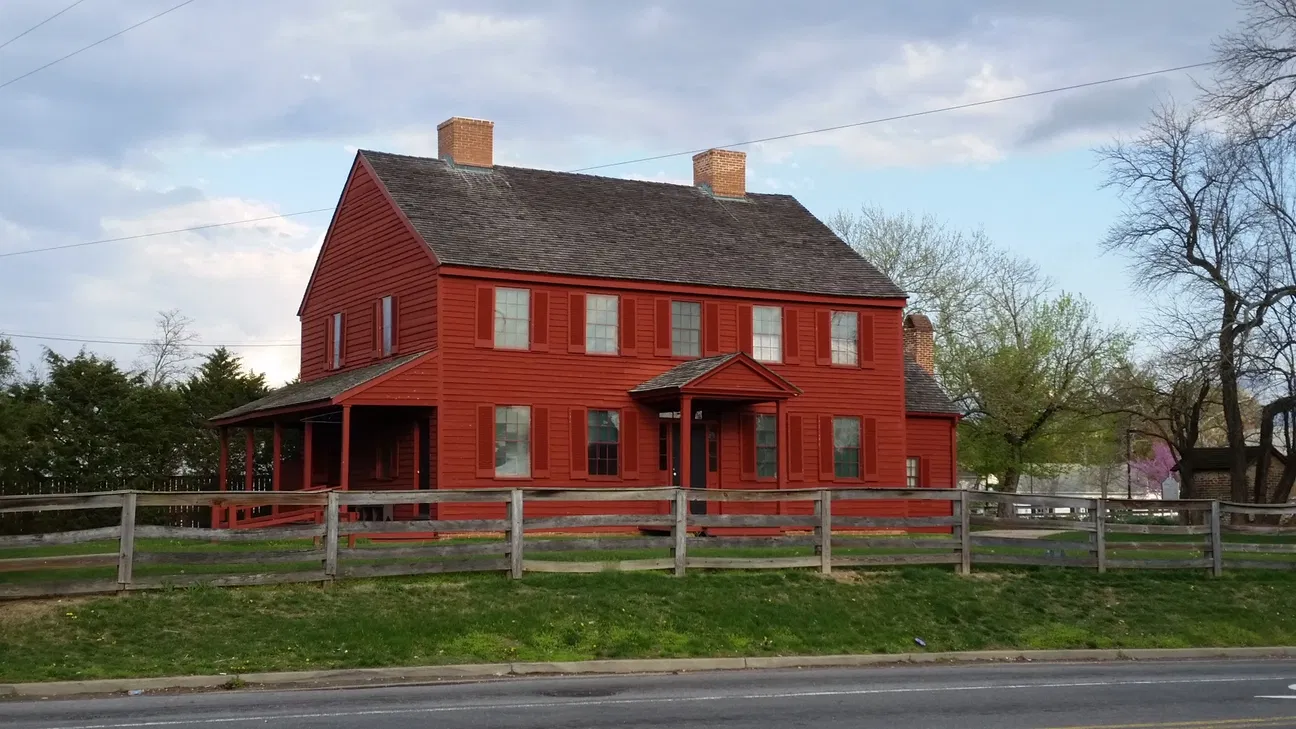
Surratt House Museum
The two-story red clapboard farmhouse on Brandywine Road in what is now Clinton, Maryland sits less than fifteen miles from Ford's Theatre and looks, from the outside, like any number of modest mid-century plantation homes that once dotted Southern Maryland. It does not announce what it was. But the Surratt House is one of the few surviving physical waypoints in the most consequential crime of the nineteenth century — the assassination of Abraham Lincoln — and the story that runs through it is as tangled and tragic as anything the Civil War produced. John and Mary Surratt built the house in 1852 on 200 acres of Prince George's County farmland, and from the beginning it served multiple purposes. It was a family home and a working plantation, but also a tavern, a public dining room, a hotel for traveling gentlemen, a post office, and a polling place. The surrounding community took the family name: the area became known officially as Surrattsville in 1853. When the Civil War began, the character of the place shifted. Southern Maryland was Confederate country in sympathy if not in official allegiance, and the Surratt tavern became a clandestine stop on the Confederate underground — a safe house for couriers and communications moving between Richmond and Washington. John Surratt Sr. died suddenly of a stroke in August 1862, leaving Mary with his debts, the farm, and three children. Facing financial collapse and unable to manage the property alone, she rented the Surrattsville tavern to a man named John Lloyd in the fall of 1864 and moved with her children to a rowhouse she owned at 541 H Street in Washington, where she ran it as a boarding house. She would never live in Surrattsville again. It was at the H Street boarding house that the conspiracy took shape. Mary's son John Jr., already an active Confederate courier, was introduced to actor John Wilkes Booth by Dr. Samuel Mudd in December 1864. Booth's original plan was kidnapping — seize Lincoln, use him as leverage to force the resumption of prisoner exchanges with the Confederacy. The Surratt boarders became his inner circle: Lewis Powell, George Atzerodt, David Herold. As part of the plot, weapons and supplies — two Spencer carbines, ammunition, field glasses — were cached at the Surrattsville tavern ahead of time, hidden there for retrieval during the planned escape through Southern Maryland. The kidnapping scheme collapsed, and Booth turned to assassination. On April 14, 1865, the same day he shot Lincoln at Ford's Theatre, Mary made one of her regular trips to Surrattsville — ostensibly to collect a debt from a neighbor. Her tenant John Lloyd would later testify that she told him to have the shooting irons ready. She delivered a package from Booth, later found to contain binoculars. Hours after Lincoln was shot, Booth and conspirator David Herold arrived at the Surratt tavern in the early morning hours. Booth had broken his leg leaping from the presidential box. He needed whiskey for the pain and the weapons that were waiting. The stop lasted only minutes. Twelve days later, Booth was dead in a Virginia barn. Mary Surratt was arrested, tried by a military tribunal, and convicted of conspiracy. On July 7, 1865, she was hanged at the Old Arsenal Penitentiary in Washington — the first woman executed by the United States federal government. Her guilt, and specifically the depth of her knowledge of Booth's plans, has been argued by historians ever since. The house was confiscated by the federal government after her conviction. Between 1868 and 1965, five separate families owned and lived in the former Surratt tavern, making ordinary modifications that gradually obscured its original character. In 1965 the property was donated to the Maryland-National Capital Park and Planning Commission, listed on the National Register of Historic Places in 1973, and restored to its 1865 appearance before opening as the first public historic house museum in Prince George's County on May 1, 1976. The Surratt Society, formed in 1975 by citizens interested in Mary's case — many of whom lean toward her exoneration — now supports the museum with more than 1,500 members worldwide. The paranormal claims attached to the house are modest but consistent, and notably some of the most credible come from the museum's own staff. The longtime director of the museum, Laurie Verge, described the experience plainly in multiple accounts: though she never saw anything, she repeatedly felt the sensation of a man stepping out of one of the upstairs bedrooms and looking directly at her, enough to raise the hair on the back of her neck. On one occasion, she and five or six employees sitting in her office — which was then located inside the house — all stopped mid-conversation and listened together as footsteps crossed the first floor below them, sounding exactly as though someone had walked in the front door, down the hall, and out the back. When they checked, no one was there. Verge noted that the paranormal attention directed at the house grew significantly after ghost investigator Hans Holzer visited in the 1950s with a spiritual medium — she was skeptical of his conclusions but could not explain what she had personally heard. She theorized, if any spirit was present, it was more likely John Lloyd — the tenant whose testimony condemned Mary — than Mary herself. Visitors have reported the figure of a bearded man seated in a rocking chair, visible only in a mirror's reflection. Others describe male apparitions on the back staircase, muffled voices of men, and the apparition of a woman believed to be Mary near the main staircase or on the porch. The museum declines paranormal investigation requests — staff receive them at roughly the rate of once a month — out of a deliberate choice to keep the documented history at the center rather than the ghost stories. The house still holds original furnishings, including Mary Surratt's own writing desk. The tavern room is intact. The staircase is there. Whether or not anything remains in residence, the weight of what happened inside is present in every room.

Old Santa Fe Depot of Guthrie
Sitting along the railroad tracks on Guthrie's west side, the Old Santa Fe Depot of Guthrie is one of the most historically layered buildings in a city that was itself born in a single afternoon. The two-story red brick station exists because of a land run, a railroad, and the ambition of a territorial capital that believed it would remain the center of power in Oklahoma forever. The Santa Fe Railroad completed its line through what was then Indian Territory in 1887, and the first depot at Guthrie was a modest red frame building serving as a watering station with rudimentary rail yards. That changed permanently on April 22, 1889, when President Benjamin Harrison's proclamation opened the Unassigned Lands to settlement and launched the first great Oklahoma land run. Twenty trains carrying over a thousand passengers each were scheduled out of Arkansas City, Kansas, and Purcell to the south. Guthrie, designated as a Federal Land Office where settlers would file their claims, was the target destination for most of them. By nightfall, a place with virtually no population that morning had become a tent city of ten thousand. Within a few years, Guthrie had transformed into a city of elegant redbrick and sandstone buildings, electric streetlights, and a mass-transit system. It was named the capital of Oklahoma Territory under the Organic Act of 1890 and remained the seat of government through statehood in 1907 until a contentious 1910 election moved the capital to Oklahoma City. The original frame depot could not keep pace. A flood destroyed it, and in 1903 the present structure was completed—a striking two-story red brick station roughly 185 feet long by 85 feet wide, with a central section flanked by one-story wings. It housed passenger service, mail service, a newsstand, employee living quarters, offices, and a Harvey House restaurant. Fred Harvey had revolutionized rail travel dining beginning in the 1870s, establishing a chain of restaurants along the Atchison, Topeka and Santa Fe line that replaced the notoriously wretched food available to travelers with immaculate table service, imported linens, and meals that rivaled fine restaurants back east. The Harvey Houses were staffed by the famous Harvey Girls—young, unmarried women between eighteen and thirty, recruited from across the country, who lived in quarters above the depot and were held to exacting standards of deportment and service. By 1904, the Guthrie depot oversaw nine lines of railroad and as many as thirty-six passenger trains daily. Guthrie's decline as a political center after 1910 did not immediately kill the depot. Passenger service continued for decades, but as automobile travel expanded and rail shrank, the building's role diminished. The last regular service ended in 1979, when Amtrak dropped its Lone Star route from the timetable. The building sat largely dormant until 1998, when restoration began on the northern portion. Subsequent work continued through the rest of the structure, though the upstairs rooms on the southern end—where Harvey Girls once lived—remained unfinished for years. The depot is a contributing resource within the Guthrie Historic District, a National Historic Landmark encompassing more than two thousand buildings. The most widely reported haunting centers on the upper floors. A woman in Victorian-era dress has been seen at one of the upstairs windows, gazing toward the tracks as trains pass. Some accounts identify her as a Harvey Girl who lived in the depot's upper rooms while working in the restaurant below. Others attribute the figure to Pearl Harvey, wife of Fred Harvey, though this reflects a misunderstanding—the Harvey family did not live in individual depot restaurants, and the chain was a commercial operation. The conflation likely arose from the building's long association with the Harvey name and the intimacy of the quarters where young women spent years of their lives. Regardless of the identity assigned to her, the apparition has been reported consistently enough to anchor the depot's haunted reputation. Visitors have also reported unexplained footsteps on upper floors when no one is present, and what some describe as the distant sound of a train pulling into the platform when no train is approaching. The MidAmerica Paranormal Science Team investigated the depot in 2008 and reported capturing video they believe shows an apparition, though the evidence remains anecdotal. The depot is a regular stop on the Guthrie Ghost Tour, alongside the Blue Belle Saloon, the Pollard Theatre, and the Stone Lion Inn. Today the Old Santa Fe Depot of Guthrie operates as a wedding and private event venue under the ownership of Adam and Abigail Ropp, who have continued restoring the building. The rail line alongside remains active. The upstairs windows still face the same long, flat stretch of Oklahoma where trains once arrived by the dozens, and where at least one presence, by all accounts, has never departed.

Silver King Hotel
Perched at the top of a steep flight of stairs on Brewery Avenue in the canyon district known as Brewery Gulch, the Silver King Hotel is one of the oldest remaining structures associated with Bisbee's copper mining boom. Built around 1900, it was constructed to house the men who worked the Copper Queen Mine — not the investors and dignitaries who stayed at the nearby Copper Queen Hotel, but the laborers themselves. The building is European boarding house style, seven rooms sharing common baths, and it still operates that way today. The front rooms look directly out over the Gulch, the narrow canyon corridor that during Bisbee's peak held more than fifty saloons, brothels, gambling dens, and dance halls packed into a stretch of red-brick buildings carved into the hillside. The Silver King sat at the center of all of it. Bisbee itself came out of nothing fast. Copper was discovered in the Mule Mountains of southeastern Arizona in 1877 by a U.S. Army patrol. Within a generation the town had grown to a population approaching 25,000, making it for a time the largest city in Arizona and one of the most productive mineral sites on earth — eventually yielding nearly 3 million ounces of gold, over 100 million ounces of silver, and more than 8 billion pounds of copper. German-Swiss immigrants founded the first breweries in Brewery Gulch as early as 1881. The Silver King Hotel was built when the Gulch was at its rowdiest and most populated, its lower floors allegedly housing a brothel and gambling operation serving the same rough demographic that filled the boarding rooms above. An Asian laundress is said to have operated a laundry on one of the middle floors — common in mining towns of the era, where immigrant labor filled service roles across the district. The broader context of the building's era is inseparable from violence and upheaval. In July 1917, the Phelps Dodge Corporation, with the cooperation of Cochise County Sheriff Harry Wheeler, rounded up over 1,000 striking miners at gunpoint — many of them the same class of men who had lived in places like the Silver King — loaded them into cattle cars, and sent them sixteen hours through the desert without food or water to Hermanas, New Mexico. The Bisbee Deportation, as it became known, was later declared wholly illegal. Two years later, in July 1919, Brewery Gulch was the site of the Battle of Brewery Gulch — a violent street riot between Black Buffalo Soldiers of the 10th Cavalry and local police, part of the broader Red Summer of that year. The Silver King Hotel stood through all of it. The building has reportedly been the site of at least two murders. Paranormal accounts center on two recurring apparitions. The first is an Asian woman believed to be the laundress who operated on the middle floor — described as present throughout that section of the building. The second is a distressed miner, seen and heard on the upper floors in what is described as an agitated or injured state. Both accounts have circulated among staff and guests for years and are consistent enough that the location was featured on an episode of the Travel Channel's Ghost Adventures. Mining operations under the hotel actually resumed in 2013, and the low vibration of the drills beneath the structure is reportedly noticeable when they pause between shifts. Owner Danielle Martinez, a Philadelphia-raised artist who took over the property and converted the hotel's smallest and least-rentable room into Room 4 Bar — now widely billed as the smallest bar in Arizona at just 100 square feet and four stools — has noted that the property may or may not be haunted, with the two reported murders acknowledged. The hotel remains open, welcoming guests who don't mind steep stairs, shared baths, and the possibility of company they didn't book.
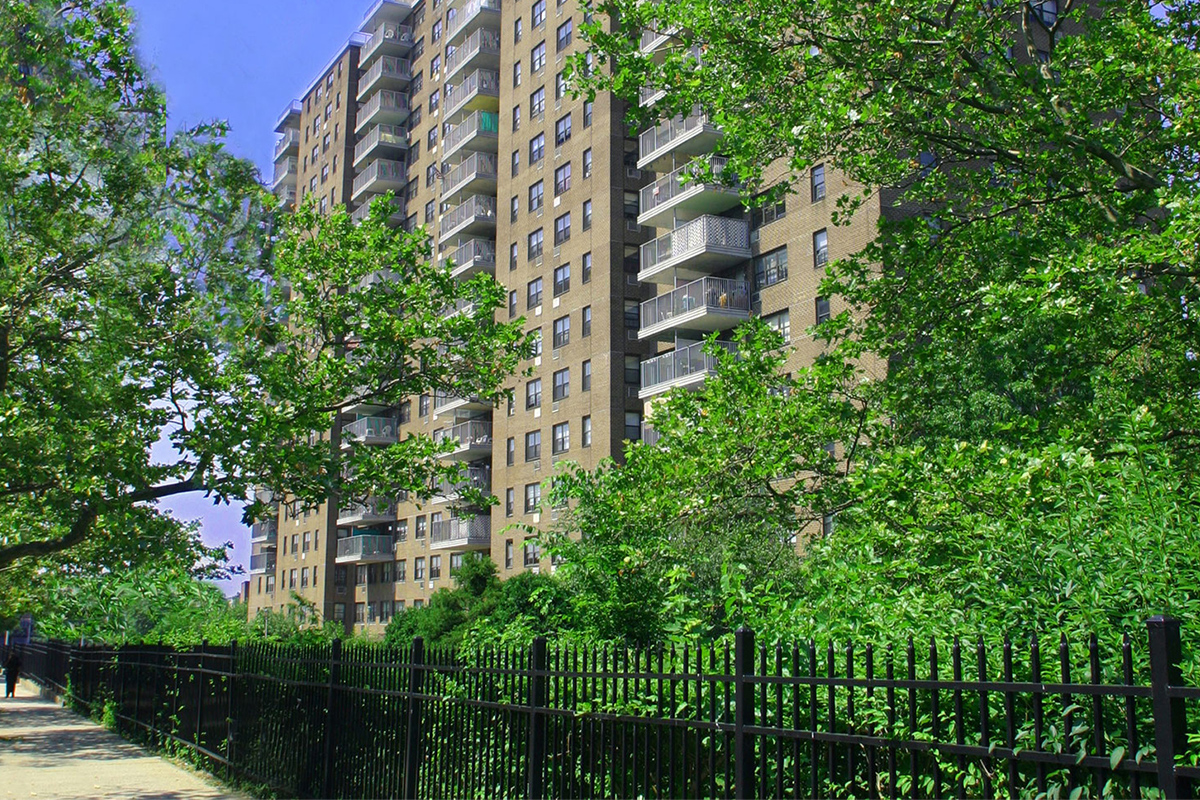
Hazel Towers
Standing eighteen stories over the Pelham Bay section of the Bronx, Hazel Towers is the kind of building that doesn't announce itself as haunted. There are no crumbling facades or Gothic embellishments—just a postwar residential high-rise at 1730 Mulford Avenue, brick and concrete, squared off against the sky like dozens of other mid-century towers that define New York City's outer borough skyline. It was built in 1968, designed by the architectural firm Pomerance & Breines, whose portfolio included hospitals and large-scale residential projects across the city. It went up during the great wave of high-rise construction that reshaped the Bronx in the 1960s, part of a broader effort to house the borough's growing working- and middle-class population in modern, elevator-serviced towers with balconies and amenities that older walkup tenements could never offer. The land beneath Hazel Towers carries a longer history than the building itself. The Pelham Bay neighborhood sits on ground originally purchased by Englishman Thomas Pell from the Siwanoy people in 1654—a vast tract that would eventually lend its name to the park, the parkway, and the surrounding streets. For centuries the area remained agricultural. It wasn't until the extension of the IRT Pelham Line in 1920 that the eastern Bronx opened to dense residential development, drawing Italian, Irish, and Jewish families outward from Manhattan. The postwar decades brought larger structures—towers like Hazel Towers—rising above a neighborhood that still retained the feel of a quiet enclave just two blocks from the 6 train. The building contains roughly 286 units with one-, two-, and three-bedroom apartments. Nelson Management Group acquired the property in 1999 and has since invested over four million dollars in upgrades including new elevators, windows, lobbies, and a security system. A tenants' association has been active since at least 1991. By all outward measures, Hazel Towers is a functioning, well-maintained residential building in one of the Bronx's more desirable neighborhoods. And yet the building appears on multiple databases of allegedly haunted locations, and the accounts from residents are remarkably consistent. Tenants across various apartments—not concentrated on any single floor—report shadow figures in hallways and rooms, particularly during late-night hours. Some describe orbs of light moving through darkened spaces. Objects reportedly fall or shift without explanation. Cold spots appear and dissipate with no apparent cause. Disembodied voices have been reported in apartments and common areas. Several residents describe an oppressive feeling of sadness or paranoia that lifts the moment they step outside, a phenomenon difficult to attribute to ordinary environmental factors. The basement and boiler room draw particular attention. At least one former resident has described seeing shadow figures near the boiler room during routine laundry trips—a detail that recurs independently in other accounts. One resident recounted a sleepover during which multiple people experienced panic attacks between three and four in the morning, accompanied by shadows, orbs, and objects falling. A follow-up Ouija board session in another apartment reportedly produced additional sightings—notable for involving multiple witnesses across two units on consecutive days. What makes Hazel Towers unusual is the absence of any known originating event. There is no documented tragedy, no publicized death, no fire or crime the narratives attach themselves to. The spirits, according to those who claim encounters, are simply present—and unwelcoming. Multiple sources describe the entities as hostile in demeanor, though no accounts describe physical harm. Most haunted locations build mythology around a specific incident. Hazel Towers offers no such anchor, which either undermines the claims or makes them harder to explain as narrative projection. Skeptics would rightly note that an eighteen-story concrete tower from the late 1960s will produce unexplained sounds—elevator machinery, water pressure shifts, air in aging ductwork. The basement of any large building is inherently atmospheric. And suggestion, once a building acquires a reputation, is powerful. But the consistency across unrelated residents over decades, and the emphasis on emotional effects rather than spectacle, gives the accounts a texture that environmental explanation doesn't fully resolve. Today Hazel Towers remains fully occupied in a neighborhood that continues to attract families. Pelham Bay Park sprawls to the north. The lobby is staffed around the clock. Nothing about the building suggests anything other than ordinary urban life. But behind certain doors, at certain hours, some residents insist the building holds something no renovation has managed to address—and something that does not seem glad to have company.