
Haunted Bridges in America
126 haunted locations
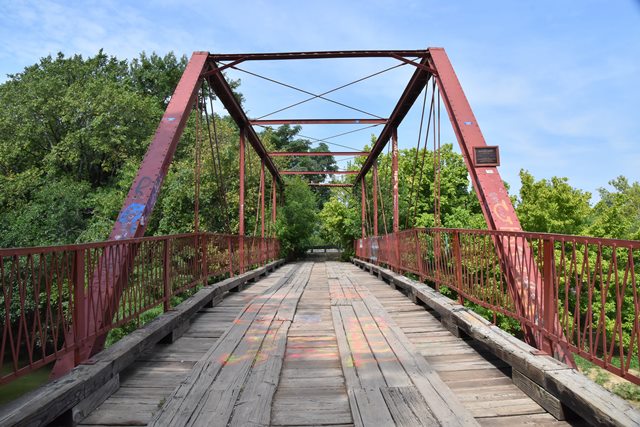
Goatman’s Bridge
Just outside Denton, Texas, tucked between trees and hovering over Hickory Creek, stands the Old Alton Bridge—better known today as Goatman’s Bridge. What looks like a quiet iron truss bridge from the late 1800s has become one of the most infamous legend-laden locations in the state. Part history, part folklore, part modern paranormal hotspot, Goatman’s Bridge sits at the crossroads of documented past and deeply rooted local myth. The bridge was built in 1884 to connect the towns of Denton and Copper Canyon, replacing an earlier wooden structure. For decades, it served farmers, travelers, and livestock drivers moving through the area. The surrounding woods and creek bottom were rural, isolated, and—especially at night—pitch black. Even without a legend attached, it’s the kind of place that feels removed from the modern world once the sun goes down. The haunting reputation largely centers around the story of a Black goat farmer named Oscar Washburn. According to the legend, Washburn successfully raised goats near the bridge and even hung a sign reading “This way to the Goatman.” As the story goes, members of a local Ku Klux Klan group resented his success and presence in the area. One night, they allegedly dragged him onto the bridge and hanged him from the iron supports. When they looked over the edge to see his body, it was gone. In retaliation, the legend claims the mob murdered his wife and children at their cabin nearby. The problem is that historians have found little concrete evidence confirming the Washburn story as it’s commonly told. While racial violence was tragically common in Texas during that era, records directly tying this specific lynching to the bridge remain debated. Like many American ghost stories, the narrative appears to have evolved over time, blending fragments of possible history with escalating folklore. Beyond the Goatman legend, the surrounding woods have their own dark reputation. Some accounts claim the area was once a gathering site for the KKK. Others say occult rituals took place in the forest clearing near the bridge. Stories circulate of satanic symbols, animal remains, and strange ceremonies—though many of these reports are difficult to verify and may stem from trespassing, vandalism, or modern thrill-seekers attempting to add fuel to the myth. Paranormal claims at Goatman’s Bridge are intense and varied. Visitors report hearing growls or heavy footsteps pacing along the bridge at night. Some claim to see a tall, shadowy figure with glowing eyes moving between the trees. Others describe feeling sudden dread or being pushed, scratched, or followed. Electronic voice phenomena sessions allegedly capture aggressive responses. There are even reports of car malfunctions and battery drain near the bridge—common claims at high-profile paranormal sites. One of the most persistent experiences reported is a feeling of being watched from the treeline. Investigators often describe the woods as more active than the bridge itself. Disembodied voices, distant chanting, and unexplained knocks are frequently cited. Skeptics argue that the area’s wildlife—deer, coyotes, wild hogs—and the acoustics of the creek valley can easily account for many of the sounds. The power of suggestion also plays a significant role; when people walk into a place expecting a demonic goat creature, adrenaline tends to do the rest. Despite the debate over its historical accuracy, Goatman’s Bridge has cemented itself in Texas paranormal culture. It has been featured in documentaries, YouTube investigations, podcasts, and television ghost-hunting shows. The combination of racial tragedy, alleged occult activity, and a creature-based legend gives it a uniquely layered mythology compared to traditional “haunted house” locations. Today, the Old Alton Bridge is part of a public trail system, and visitors can legally walk the bridge during park hours. By day, it’s a scenic historic structure surrounded by greenbelt trails. By night, it transforms into something entirely different in the public imagination—a place where history, fear, and folklore blur together. Whether the Goatman is a vengeful spirit, a demon born from rumor, or simply a campfire story that grew too large to contain, the bridge remains one of Texas’ most talked-about haunted locations. It’s a reminder that sometimes the most powerful hauntings aren’t built on documented facts alone—but on the stories communities tell, retell, and refuse to let die.
Heartbeat Bridge
Somewhere south of Whiteville, in the flat, swampy lowlands of Columbus County, North Carolina, Chair Factory Road cuts through a stretch of coastal plain that feels older than anything built on it. The road is narrow, rural, and unlit—bordered by pine forest, drainage ditches, and the kind of dense Carolina swamp that swallows sound and light in equal measure. Partway along it, a small bridge crosses a dark waterway. There is no historical marker. There is no signage. But for decades, locals have called it Heartbeat Bridge, and what they claim to hear there has made it one of the most persistent pieces of paranormal folklore in southeastern North Carolina. Columbus County was carved from parts of Bladen and Brunswick Counties in 1808. The land had been home to the Waccamaw people for centuries before English settlers pushed into the region. The Waccamaw eventually retreated into the swamps around their namesake river and Lake Waccamaw, where roughly 1,800 members of the Waccamaw-Siouan tribe still live. The county seat, Whiteville, was incorporated in 1832 on land donated by state senator James B. White. The area developed slowly, driven by agriculture, naval stores, and timber. Chair Factory Road takes its name from one of these old timber-related enterprises—a chair manufacturing operation that once stood along the route, now long gone, leaving only the road name behind. The landscape is defined by water. The Waccamaw, Lumber, and Cape Fear Rivers all flow through or border the county. The Green Swamp, a vast pine savanna ecosystem, lies to the east. Carolina bays—thousands of shallow, oval depressions of uncertain geological origin—dot the terrain. The bridge spans one of the area's many dark, slow-moving creeks, the kind that barely moves in summer and rises without warning after rain. It is a profoundly quiet place at night—no traffic, no ambient noise, just insects, frogs, and the occasional movement of water beneath the road. The legend centers on a murder. A young woman was reportedly killed on or near the bridge by a masked assailant, who cut out her heart and threw it into the water below. The tale has circulated in Columbus County for generations, passed along at bonfires, church hayrides, and late-night drives through the countryside. There are no verifiable records of such a crime. No newspaper accounts, no police reports, no named victim. The story exists entirely in the oral tradition—which, in a rural Southern county with deep roots and long memories, is not the same as saying it is baseless, only that it cannot be confirmed. What draws people to the bridge is what they claim to experience there. Visitors report that if you park on the bridge at night and cut your engine, you can hear the sound of a heartbeat rising from the water—faint at first, then growing louder, sometimes to the point of discomfort. The sound is described as rhythmic and unmistakable, not easily confused with frogs or the settling of a vehicle. Some visitors report shadowy figures in the tree line. Others describe orbs of light in photographs. One account describes a bottle placed on the hood of a car, the bag beneath it yanked away by an unseen force without the bottle moving—witnessed by multiple people on a windless night. Another longtime local describes sitting on his car hood listening to what he calls the soothing sound of the swamp, suggesting the bridge's atmosphere carries a quality not everyone interprets as threatening. The bridge sits near another Columbus County haunt—Old Tram Road, a long straight stretch associated with its own legend of a ghostly racing light. The two locations share a geographic and folkloric ecosystem, connected by the same back roads, and locals frequently visit both in the same night. The concentration of paranormal claims in this corridor of rural Columbus County has drawn amateur investigators and regional paranormal groups, though no formal investigation has produced conclusive findings. Skeptics will note that swamp environments produce a wide range of sounds—gas escaping from decomposing matter, water moving through submerged structures, the amplified acoustics of a flat landscape at night. A bridge surface acts as a resonating chamber. The human ear, primed by a frightening story and surrounded by darkness, is good at finding patterns in ambient noise. But the sheer number of independent accounts describing the same rhythmic sound at the same location, spanning decades, gives the claims a consistency that acoustics and suggestion don't fully explain. Heartbeat Bridge remains an unmarked, publicly accessible bridge on a rural county road. There is no admission, no tour guide, no gift shop. It is simply a place where the road crosses the water, the trees close in, and something beneath the surface—whether memory, geology, or something harder to name—keeps beating.
Devil’s Bridge
On the south side of San Antonio, where the city thins out into scrubby ranchland and the San Antonio River bends through old mission territory, a small bridge on East Ashley Road crosses a ravine deep enough that locals say if you drop a rock from the railing, you'll never hear it land. The bridge sits near 2454 East Ashley Road, not far from Mission San Juan Capistrano—one of the chain of eighteenth-century Spanish missions that line the river and now form a UNESCO World Heritage Site. The area has been continuously inhabited for thousands of years. Native Americans camped along this stretch of river long before the Spanish arrived. The missions themselves, established in the 1730s, were built with Indigenous labor and sustained by an elaborate acequia system that still carries water through the surrounding farmland today. The ground here is layered with centuries of human presence, conflict, disease, conversion, and death. It is old land, even by Texas standards. Devil's Bridge is not an ancient structure. It is a modest roadway bridge, unremarkable in engineering, crossing a steep ravine in an area that goes very dark after sundown. The name belongs to a global tradition—there are dozens of Devil's Bridges across Europe, most of them medieval, each carrying its own legend about a pact with Satan in exchange for construction. San Antonio's version doesn't have a clear origin story for the name itself. Some say it refers to supernatural happenings at the site. Others suggest it simply describes the danger of crossing the ravine at night on an unlit road, in an era before guardrails and headlights made such crossings routine. The bridge did claim at least one documented life: on March 7, 1965, shortly after midnight, a forty-one-year-old woman named Victoria Ann Broussard was fatally injured when the car her husband was driving struck the bridge's guardrail head-on. He told the responding patrolman he hadn't seen the bridge. She was pronounced dead at Baptist Memorial Hospital and buried at San Fernando Cemetery No. 2. The paranormal claims at Devil's Bridge draw from multiple threads, none of them cleanly verifiable but all of them persistent. One account ties the haunting to the Spanish colonial period, claiming a priest whose parishioners were killed during the Inquisition hanged himself from a tree near the bridge. Visitors have reported hearing the sound of a creaking rope in the surrounding trees—rhythmic, deliberate, like a body swinging from a noose. A priest at the nearby San Juan Church reportedly warned a young man in the early 1970s to be careful exploring the riverbank near the bridge, telling him he had personally seen spirits walking the grounds where Native Americans once camped. The young man had found pottery shards and square nails in the area, artifacts consistent with centuries of habitation along the river. A paranormal investigator named Joe recorded EVP sessions at the bridge and claimed to capture a voice responding to the question "Who are you?" with the name "Melvin," along with a separate recording of a voice saying "I'm here." No historical records have been found for anyone named Melvin connected to the site. Visitors have also reported the apparition of a headless woman who approaches from behind, white smoke-like figures, and the smell of sulfur—rotten eggs—hanging in the air around the bridge at night. The claim about the impenetrable darkness is among the most frequently repeated: that after sundown, the area around the ravine becomes so dark that headlights and flashlights seem to penetrate only a few feet, as if the light itself is being absorbed. The most unsettling recurring detail involves the ravine itself. Multiple accounts describe throwing rocks off the bridge and never hearing them hit water or ground—as though something catches them, or the ravine simply has no bottom. One version of the legend attributes this to the spirit of a little girl. The depth of the ravine is real and measurable, but the acoustic effect in a steep, vegetation-choked gully at night, combined with ambient insect noise and the psychology of expectation, could plausibly account for the phenomenon. Or it couldn't. The people who've stood on that bridge in the dark tend to find the explanation less comforting than the mystery. Today Devil's Bridge remains a functioning road bridge on East Ashley Road, accessible by car, with no signage or formal acknowledgment of its reputation. Mission San Juan sits nearby, its stone walls and flowing acequias drawing tourists and pilgrims. The San Antonio Food Bank farms the old mission fields just down the road. It is a landscape where the sacred, the agricultural, and the spectral exist in close proximity—where a UNESCO site and a haunted bridge share the same stretch of river, and where the oldest water rights in Texas still flow through ditches dug by hands that have been gone for three hundred years.

Veterans Memorial Bridge – Orange Avenue Bridge
The Veterans Memorial Bridge, also known as the Orange Avenue Bridge, spans a waterway in the Daytona Beach and Port Orange area of Florida, serving as a functional transportation corridor while simultaneously hosting paranormal phenomena that have attracted attention from ghost hunters and local paranormal researchers. Bridges, as liminal spaces between geographic regions and as sites of transportation and transition, have long occupied prominent positions in paranormal folklore and documented hauntings across multiple cultures and historical periods. The bridge's structural engineering reflects twentieth-century transportation design, incorporating materials and construction techniques consistent with infrastructure development during the mid-twentieth century. The gazebo on the grounds adjacent to the bridge represents an additional architectural feature that contributes to the overall atmospheric and paranormal character of the location. The northeastern side of the bridge has been identified as the primary location of paranormal phenomena, with this specific geographic orientation apparently concentrating or facilitating supernatural manifestations. Paranormal investigation and eyewitness testimony document the presence of at least two distinct spirits associated with the Veterans Memorial Bridge and its immediate surroundings. A dark-haired woman wearing a robe appears as an apparition on the northeastern side of the bridge, her manifestation characterized by sufficient clarity that observers have noted specific details regarding her clothing and physical appearance. A man positioned within the gazebo on the bridge grounds represents a second spectral presence, apparently maintaining what might be characterized as a permanent vigil or habitual position within this outdoor structure. The circumstances of death and reasons for spiritual attachment for both entities remain historically unclear, though the bridge's proximity to water and the gazebo's liminal character as an outdoor shelter suggest circumstances potentially involving accidents, tragedy, or deliberate acts of self-harm. Paranormal phenomena at the Veterans Memorial Bridge encompass a relatively focused range of manifestations concentrated on the northeastern side of the structure. Objects mysteriously get thrown about in the area where the dark-haired woman in the robe manifests, suggesting that this particular spirit retains the capacity to interact with and manipulate physical matter in the material world. Disembodied voices materialize audibly, creating an acoustic environment that indicates the presence of intelligent paranormal entities capable of communication and expression. Shadows, distinct from the apparitional manifestations of the identifiable spirits, appear and disappear without logical explanation related to light sources or physical obstruction, suggesting either residual psychic energy impressed upon the location or additional paranormal entities whose presence does not rise to the level of full visual apparition. The Veterans Memorial Bridge has been documented among haunted locations in both the Port Orange and Edgewater areas, indicating that paranormal phenomena may extend along the bridge structure and into the surrounding geographic region rather than being confined to a single point of manifestation. Bridge hauntings documented across the eastern United States suggest that these transportation structures may inherently accumulate or amplify paranormal phenomena, perhaps because of their position as liminal spaces between geographic regions, the frequency of human movement and transit across them, and the historical tendency for bridges to become sites of accident, suicide, and tragic death. The Veterans Memorial Bridge continues to function as both a necessary transportation corridor and a destination for paranormal investigation, with the structure serving dual purposes as infrastructure and as a nexus of supernatural phenomena. Local paranormal research organizations and ghost tour operations have incorporated the bridge into their offerings, bringing attention to this location for those interested in documenting and understanding paranormal manifestations in liminal geographic spaces.
Heritage House
Heritage Park in Corpus Christi, Texas, represents a carefully preserved collection of historic structures serving as a living museum of the region's architectural and cultural heritage. The park encompasses multiple historic buildings and homes, each contributing to the overall narrative of how families and communities developed throughout the nineteenth and early twentieth centuries. These structures display period-appropriate furnishings, artifacts, and design elements offering visitors tangible connections to the lives of people from previous eras. The park operates as both an educational institution and a tourist destination, welcoming visitors who wish to understand the material culture and daily experiences of residents from the area's historical periods. The grounds are carefully maintained to reflect historical accuracy, with landscaping and outdoor features designed to approximate the appearance of the original properties during their periods of primary occupation. Within the historic structures, paranormal investigators have documented substantial evidence of supernatural activity concentrated particularly in upstairs areas, staircases, and attic spaces. The most prominent entity is the spirit of Charlotte Sidbury, a woman whose attachment to the property manifests through multiple forms of paranormal phenomena. The apparition of a ghostly woman has been frequently observed gazing from upstairs windows, a manifestation occurring with sufficient regularity to suggest a genuine haunting. Visitors and staff have reported the distinctive experience of witnessing this spectral figure at windows, only to find the actual interior spaces completely empty. Beyond Charlotte's presence, the park hosts a broader range of paranormal phenomena suggesting multiple entities inhabiting the historic structures. Tapping sensations have been experienced by visitors and researchers, occurring on walls and furniture without apparent source. These unexplained auditory phenomena often appear in response to questioning or as apparent attempts at communication from spectral inhabitants. Footsteps have been documented in staircases and upper hallways, suggesting movement of spirit entities through spaces where no living person is present. Electronic voice phenomena recorded during paranormal investigations have captured disembodied voices and fragmentary speech that cannot be attributed to ordinary sources. The apparitions appearing within Heritage Park display distinctive period clothing, suggesting these entities were residents or significant visitors during the era when the structures were actively occupied. A woman in blue, characterized by her distinctive appearance including hair arranged in a bun style consistent with earlier historical periods, has been reported with sufficient frequency to suggest a specific entity. These sightings suggest the spirits maintaining presence in Heritage Park may be connected to specific individuals with biographical and historical significance. The fact that multiple spirits appear to maintain simultaneous existence suggests either multiple entities with individual attachments or a complex psychogeographical phenomenon anchoring multiple supernatural manifestations. Heritage Park continues functioning as a museum and educational center while acknowledging its significant paranormal reputation. Paranormal investigation groups regularly visit to conduct research and document evidence of the entities inhabiting the structures.
Dog Face Bridge
Dog Face Bridge near San Pierre, Indiana represents one of the most disturbing and intensely paranormally active haunted locations in the entire Midwest region, distinguished by paranormal reports of unprecedented grotesqueness and supernatural manifestations of extraordinary intensity and disturbing character. The bridge spans a swamp area characterized by dense vegetation, murky water conditions, and profound isolation from major population centers, creating an appropriately ominous physical setting for the documented tragedy and paranormal phenomena. The origin narratives surrounding the bridge's paranormal reputation involve unsolved murders, missing persons cases, and mysterious disappearances that have accumulated over extended time periods, though precise historical documentation of specific incidents remains fragmentary and dispersed. The tragic circumstances allegedly involved murder victims whose bodies were disposed within the surrounding swamp and creek areas, their remains never properly discovered or formally accounted for through official investigation or law enforcement activities. The bridge's dark reputation has attracted negative spiritual activity and residual energy from multiple traumatic death events, creating a location of extraordinary paranormal intensity that exceeds most haunted American sites in documented phenomena severity. The most distinctive and unsettling paranormal manifestation at Dog Face Bridge involves apparitions of a woman-dog hybrid creature, described consistently by multiple independent witnesses across decades as a chimeric entity combining humanoid and canine characteristics in deeply disturbing and grotesque ways. These hybrid apparitions materialize suddenly within the bridge area and surrounding swamp terrain, appearing in twilight and nighttime conditions when visibility is reduced and perception becomes vulnerable to subjective interpretation. Witnesses describe overwhelming terror and psychological distress upon encountering these apparitions, reporting visceral disgust and existential dread beyond typical fear responses associated with conventional ghost encounters and paranormal manifestations. Paranormal researchers propose multiple interpretative frameworks—some suggest the entity represents a spiritual creation resulting from murder victim suffering and trauma, while others propose the phenomenon reflects folkloric or mythological elements incorporated into the location's paranormal reputation through accumulated storytelling traditions. Apparitions of bodies and dogs have been separately reported, suggesting human victims and animal deaths represent distinct paranormal manifestations that became conflated into the hybrid creature. The auditory phenomena at Dog Face Bridge matches the intensity and deeply disturbing character of the visual apparitions, with phantom screaming emanating from the bridge and surrounding swamp without identifiable source. Witnesses describe agonized human screams suggesting torture, suffering, or dying in extreme distress, often accompanied by disembodied voices articulating unintelligible sounds or fragmented words. Dog howling of unusual intensity and particularly disturbing quality has been reported, described as sounds that inspire unusual levels of fear and dread compared to natural canine vocalizations. These auditory phenomena suggest that both human and animal spirits maintain paranormal presence within the location, with their acoustic manifestations creating a soundscape of supernatural horror and anguish. The combination of visual apparitions including the horrifying woman-dog hybrid creature and auditory manifestations creates a paranormal environment of extraordinary psychological and emotional intensity. Today, Dog Face Bridge remains accessible to visitors willing to venture into the remote swamp area surrounding San Pierre, Indiana, though its reputation as one of America's most intensely haunted locations attracts primarily dedicated paranormal researchers and experienced ghost hunters rather than casual tourists. The bridge continues to generate paranormal investigation reports and documentation efforts, with researchers utilizing modern equipment to detect and record electromagnetic phenomena, temperature anomalies, and electronic voice phenomena. The paranormal activity shows no indication of diminishing despite passing decades, suggesting traumatic events maintain permanent manifestation within the location. The swamp environment surrounding the bridge contributes to isolation and inaccessibility, protecting the paranormal site from casual disturbance. Dog Face Bridge represents an extreme example of American paranormal phenomena combining multiple categories of spiritual manifestations with tragic circumstances.
Egypt Road Bridge
Egypt Road Bridge near Salem, Ohio has become one of the most infamous crybaby bridges in the Midwest, distinguished by decades of consistent paranormal reports and dark local folklore that continues to attract paranormal researchers and ghost hunters. The bridge spans a creek in a rural area that has witnessed numerous tragedies since its construction, with documented accounts stretching back generations through oral tradition and scattered historical records. The most prominent legend involves the drowning of an infant in the creek waters below, though historical records of the exact incident remain fragmented and difficult to verify through official documentation. Various versions of the tragic story circulate within the community—some describe a desperate mother throwing her newborn from the bridge during economically difficult times, while others reference accidental drowning during informal water crossings or baptismal ceremonies. Beyond the singular infant narrative, suicide victims are believed to have met their deaths at this location, adding substantial layers of tragedy to the site's dark and disturbing history. The paranormal experiences reported at Egypt Road Bridge have remained remarkably consistent over decades, with multiple independent witnesses describing nearly identical phenomena despite lacking prior knowledge of previous accounts. Visitors have documented persistent phantom baby cries emanating from beneath the bridge, particularly during nighttime hours, described as sudden wailing sounds without any identifiable source or explanation. Electronic voice phenomena captured on recording equipment by paranormal researchers conducting investigations has provided additional documentation of the haunting. Witnesses frequently report unseen entities attempting to push visitors from the bridge surface or railings with forceful pressure, with multiple documented accounts describing sudden, forceful contact against their bodies from invisible sources. These physical interactions represent one of the most unsettling and disturbing aspects of the bridge's reputation. The supernatural activity concentrates in two primary zones: the bridge structure itself and the creek area immediately below the bridge. Paranormal researchers have identified unusual electromagnetic fluctuations and unexplained temperature variations during nighttime investigations, suggesting spiritual energy manifestations. The creek area reportedly exhibits particular paranormal intensity during autumn and winter months, possibly correlating with seasonal changes. Sensory experiences beyond auditory phenomena include overwhelming feelings of dread, unexplained cold sensations, and sudden emotional shifts upon crossing the bridge. Some paranormal investigators suggest these experiences relate to residual energy from traumatic events, with spirits potentially reliving their final moments in a continuous paranormal loop. Today, Egypt Road Bridge remains accessible to the public, though the rural location limits traffic primarily to local residents and paranormal enthusiasts conducting investigations. The bridge has been featured in regional paranormal documentaries and investigation programs, attracting paranormal researchers from considerable distances who conduct investigations with recording equipment. Local law enforcement occasionally receives reports of unusual incidents, though the remote location and dark hours when phenomena reportedly peak have limited official documentation of these events. Egypt Road Bridge continues to warrant serious paranormal research attention as one of the most thoroughly documented crybaby bridges in American folklore and paranormal history.
Van Cortlandt Park
Van Cortlandt Park occupies a prominent position within the urban landscape of the Bronx, New York City, representing one of the largest parks in the city's park system and encompassing extensive natural areas, historical structures, and landscapes that have accumulated layers of historical significance and documented paranormal phenomena across multiple centuries of occupation. Originally developed from indigenous Lenape territories, the area witnessed the establishment of European settlements, including the construction of the Van Cortlandt House, a historic structure dating to the colonial period preserving architectural artifacts from the seventeenth and eighteenth centuries. The park encompasses wooded areas, open meadows, bodies of water, hiking trails, and the Vault Hill area, a location of particular paranormal significance where stone structures and archaeological remains preserve evidence of earlier occupation. The park's transformation into a public park system occurred during the nineteenth century, reflecting changing attitudes toward urban green space and natural area preservation. Throughout its complex history, Van Cortlandt Park has served multiple functions as recreational space, historical preservation site, and location of sustained paranormal manifestations reflecting the area's long history of human occupation and violence. The paranormal phenomena documented within Van Cortlandt Park are associated with multiple historical traumas and spiritual entities whose presences have created sustained paranormal activity throughout the park's natural and built environments. One of the most significant documented entities is associated with Captain Rau, identified as a Hessian soldier who participated in military conflicts during the American Revolutionary War period, whose death may have occurred within the park's geographical area. The manifestations associated with Captain Rau include strange whispers without discernible source, auditory phenomena suggesting vocal utterances of unclear meaning or communicative intent. A second major category of paranormal phenomena is associated with victims of the Stockbridge massacre, a historical incident resulting in multiple deaths, whose spiritual aftermath appears to persist within the park. These spirits manifest through sensations of spirits walking through solid walls, violating physical boundaries suggesting non-material nature of spiritual entities. Dolls and other objects have been documented moving of their own accord, a telekinetic phenomenon suggesting active spiritual agency. Doors repeatedly close of their own volition, creating repeated cycles of the same seemingly purposeful action without human agency. Additional paranormal phenomena include sensations of people feeling physically touched by invisible presences. Whispering voices traverse the wooded areas and near the Van Cortlandt House, creating auditory manifestations suggesting multiple communicating entities. Most distinctively, paranormal investigators have documented repetitive melodic chants in unknown language or intelligible utterances, vocalizations suggesting ritualistic or linguistic communication from entities whose origins may predate contemporary New York City, possibly deriving from indigenous populations whose presence and displacement preceded European settlement. The combination of Revolutionary War-era military spirits, trauma victims from historical violence, and possibly pre-contact indigenous spiritual presences creates a palimpsest of spiritual density throughout Van Cortlandt Park. The Van Cortlandt House and Vault Hill serve as particular loci of paranormal concentration. Contemporary visitors to the park, particularly those venturing into wooded areas and around historical structures, frequently report experiences of paranormal phenomena that collectively establish the park as one of the most significantly haunted locations within New York City.
O’Neal Bridge – Holiday Drive Bridge
The O'Neal Bridge, colloquially known as Holiday Drive Bridge, spans across a rural waterway in the outskirts of Zionsville, Indiana, representing more than a century and a half of local history woven into its aged timber and stone foundations. Constructed in 1892 during an era when covered bridges served as critical transportation arteries for rural communities, the structure initially functioned as a straightforward crossing point for farmers, merchants, and travelers moving between the scattered settlements of northwestern Indiana. The bridge emerged from the same epoch that saw rapid industrialization beginning to reshape the American landscape, yet this particular crossing would remain largely unchanged even as the twentieth century brought dramatic transformations to nearly every aspect of regional life. Over its long existence, the bridge developed a reputation among locals as one of the most actively haunted structures in the state, with paranormal reports accumulating steadily across multiple decades and attracting the attention of paranormal investigators and ghost enthusiasts from across the Midwest and beyond. The bridge's notoriety has grown particularly pronounced in recent decades as paranormal investigation has become an increasingly mainstream cultural phenomenon. The darker chapters of the bridge's history are intertwined with multiple tragedies that have left psychological imprints upon the location and created a concentrated field of spiritual disturbance. The most frequently documented haunting involves a young man who hanged himself from the bridge structure, reportedly during autumn months when the surrounding foliage displays its most vivid colors, creating a stark contrast between natural beauty and human despair. The youth's act of self-termination at this location has apparently left an indelible spiritual mark, with his anguished final moments seemingly unable to conclude even after his physical death. Additionally, the bridge became associated with a tragic incident involving a scout troop who drowned in the waters below, their young voices silenced in a devastating accident that echoed through the community and seemingly left permanent spiritual residue at the site. Perhaps most troublingly, the bridge's history is marked by its use as a lynching site, where members of the Ku Klux Klan carried out acts of racial violence, claiming multiple victims whose deaths represented some of the darkest moments in Indiana's forgotten history and American racial violence generally. These cumulative tragedies—suicide, drowning, and murder—seem to have created a concentrated nexus of spiritual anguish that continues to manifest across the present day with remarkable intensity. People who have visited the O'Neal Bridge, particularly during the late evening and early morning hours when living activity is minimal and the veil between worlds appears most permeable, consistently report experiencing disembodied screams that seemingly emanate from the bridge structure itself, with witnesses describing the sounds as carrying undeniable emotional weight and anguish. Visitors and paranormal investigators have documented apparitions matching the description of the young man who hanged himself, often appearing during autumn months when his suicide is believed to have occurred, wearing period-appropriate clothing and occasionally reenacting his final moments with disturbing precision and emotional intensity. In addition to these more dramatic manifestations, witnesses frequently report hearing the cries and laughter of children, presumably belonging to members of the scout troop, creating a haunting auditory experience that alternates between joyful sounds and manifestations of terror and confusion suggesting the victims' emotional states during their drowning. Phantom sounds of all varieties continue to be reported, including unexplained footsteps, disembodied voices calling out across the water, and inexplicable noises that seem to belong to no identifiable source, sometimes accompanied by what witnesses describe as the sounds of distressed people. Visitors have reported experiencing sudden drops in temperature, feelings of overwhelming dread and sadness, and the sense of unseen presences watching them as they cross the structure, with some investigators noting that these experiences intensify during autumn months and evening hours. The cumulative paranormal experiences reported at O'Neal Bridge suggest a location where multiple traumatic deaths have created enduring spiritual consequences.
Old Bridge Inn
The Old Bridge Inn in Jeffersonville, Indiana, represents one of the region's most enduring examples of hospitality architecture from the nineteenth century, positioned strategically along the Ohio River's northwestern tributaries. Built during an era when riverfront lodging establishments served as vital commerce centers and social hubs for travelers, the inn developed a reputation for exceptional service and attention to guest comfort. The structure displays characteristic architectural elements of its period, with carefully maintained details preserved through restoration efforts spanning multiple decades. The property has hosted countless visitors across its long operational history, from merchants conducting business to weary riverboat captains seeking respite. Throughout the late nineteenth and early twentieth centuries, the Old Bridge Inn evolved into a refined establishment, with successive owners making improvements to accommodate changing guest expectations and modern amenities. The property's management maintained detailed guest ledgers and correspondence providing valuable insights into the daily operations and social fabric of riverfront life during this transformative historical period. A notable figure associated with the inn's history is Mrs. Duffy, whose tenure at the property left an indelible mark on its character and legacy. Her dedicated service to guests and meticulous attention to household management established her as a cherished member of the inn's staff, known for creating an atmosphere of warmth and care that made visitors feel genuinely welcome. The paranormal phenomena reported at the Old Bridge Inn have drawn considerable attention from researchers investigating unexplained activity at historical properties. Guests and staff members have reported a recurring pattern of experiences suggesting the continued presence of Mrs. Duffy's benevolent influence within the structure, including documented accounts of visitors being tucked into bed by an unseen caretaker during night hours. Witnesses describe discovering household objects in unexpected locations, including candleholders that reappear despite being stored away, and canes that have been observed standing upright and being twirled within rooms occupied only by sleeping guests. Additional reports document the apparition of a bearded gentleman of distinguished appearance materializing within the dining room area. The property's resident animal companions appear to demonstrate unusual awareness of unseen presences, with the family dog Buttons exhibiting behaviors suggesting interaction with a ghostly cat. In contemporary times, the Old Bridge Inn maintains its operational status as both a residential and hospitality space, welcoming guests drawn to its historical significance and paranormal reputation. The property has been featured in multiple paranormal documentation efforts and regional hauntings surveys, establishing its credentials as a genuine location of persistent supernatural phenomena. Visitors and long-term residents continue to report experiences consistent with previous accounts, suggesting that the beneficent presence associated with Mrs. Duffy and other entities inhabiting the space remain actively engaged with the living world. The inn stands as a testament to the possibility that bonds of care and dedication forged during life may transcend the boundaries of mortality, creating a space where the past remains intimately connected with the present.
Crybaby Bridge
Crybaby Bridge in Saraland, Alabama represents a regional manifestation of one of the most geographically dispersed paranormal phenomena in North America, a legend and documented haunting spanning virtually every continental state. The phenomenon of crybaby bridges has established itself as one of the most recognizable categories of American folklore and paranormal tradition, with basic narrative structure remaining consistent across geographical regions despite variations in specific circumstances and local details. The Alabama location occupies a significant position within this broader paranormal pattern, representing both a unique local manifestation and a node in a continental network of comparable hauntings. The bridge itself likely dates to the nineteenth or early twentieth century, constructed as a conventional infrastructure element to facilitate transportation. The paranormal reputation acquired through decades of documented phenomena has transformed the bridge into a location of substantial paranormal significance and cultural meaning. The core narrative underlying the Crybaby Bridge legend involves tragedy centered upon a vulnerable infant, creating an emotional foundation of loss, abandonment, and death that generates psychologically profound responses from contemporary visitors. Variations of the legend propose different specific circumstances accounting for the infant's death, including scenarios involving accidental drowning, deliberate infanticide, and abandonment in severe weather. The consistency of the legend's basic structure across the continent suggests either cultural transmission of a single narrative or independent parallel development of similar psychological and paranormal patterns across diverse geographical contexts. The specifics of Crybaby Bridge in Saraland align with the generalized legend pattern while potentially embodying unique local elements warranting investigation and documentation. The bridge location appears to have become a focal point for spectral manifestations related to infantile death and maternal loss. The primary paranormal manifestations at Crybaby Bridge involve disembodied sounds of infants crying with such clarity and emotional intensity that listeners initially question whether an actual abandoned child might be present. Numerous documented instances exist of visitors responding to the apparent cries by searching the bridge vicinity for a living infant, with subsequent realization that no physical child could account for the auditory phenomenon. The cries have been recorded by paranormal investigators using digital audio equipment, with captured sounds displaying acoustic characteristics consistent with infant vocalizations despite the absence of any conventional source. The phenomenon appears activated particularly during nighttime hours and under conditions of reduced visibility, suggesting potential sensitivity to ambient light levels. Apparitions of unidentified women have been documented at the location, with witness descriptions suggesting individuals dressed in period clothing consistent with nineteenth-century styles. The haunting at Crybaby Bridge has expanded beyond purely paranormal manifestations to encompass phenomena involving mechanical malfunction and vehicle anomalies. Multiple documented instances exist of vehicles experiencing electrical failures, engine problems, or other mechanical disruptions while crossing or in proximity to the bridge, with repairs revealing no mechanical cause. These incidents have generated folklore suggesting that the paranormal presence actively interacts with contemporary technology, though alternative explanations involving perceptual errors or confirmation bias cannot be entirely excluded. Summoning rituals developed by paranormal enthusiasts propose specific actions believed to activate or intensify the paranormal phenomena, including particular incantations or behaviors performed on the bridge. The legend of Crybaby Bridge has established itself as a central narrative in American paranormal folklore and youth popular culture, with the Saraland location becoming a destination for paranormal enthusiasts, folklore collectors, and verification-seeking individuals. The combination of accessible location, documented paranormal activity, and powerful emotional narrative foundation makes the site particularly compelling for contemporary visitors. The bridge remains functional for its original transportation purpose while simultaneously operating as an informal paranormal attraction accessible to the public. The paranormal activity at Crybaby Bridge appears to persist with notable consistency despite the passage of time and changes to surrounding infrastructure and development patterns.
Burnt Bridge
Burnt Bridge, located near Hattiesburg in southeastern Mississippi, represents a location steeped in regional folklore and documented paranormal phenomena extending back generations within local collective memory. The bridge itself, now no longer standing in its original form, was constructed during the late nineteenth century as a vital transportation link connecting rural communities across a significant waterway. The structure served as an essential infrastructure element for surrounding agricultural communities, facilitating commerce, communication, and social interaction between populations separated by the water barrier. The name "Burnt Bridge" derives from a historical incident involving fire that damaged or destroyed the original structure, creating a memorable event that became embedded within regional oral tradition and contributing substantially to the location's paranormal reputation. The area surrounding Burnt Bridge developed a reputation over multiple decades as a location where unusual phenomena occurred with sufficient frequency to merit documented investigation and establish itself firmly within regional paranormal databases and folklore collections. The specific road leading to and passing by the bridge location has been the subject of numerous paranormal reports submitted by travelers and residents who have experienced unexplained activity during visits. Descriptions in documentation reference encounters with apparitional figures, unusual atmospheric conditions, and sensory experiences that witnesses could not readily explain through conventional physical mechanisms. The consistency of reports across multiple decades and from independent witnesses lacking apparent connection to one another suggests that something genuinely unusual occurs within this specific geographic location. A particularly compelling aspect of the Burnt Bridge location involves the repeated apparition of a young girl dressed in formal prom attire, suggesting a connection to a specific tragic event or loss involving a young female individual associated with the location. The apparition has been documented by multiple independent witnesses over extended time periods, each describing a figure consistent with previous accounts in terms of appearance, clothing, and apparent emotional state. The prom dress worn by the apparition suggests a connection to a significant life event, possibly an occasion of great anticipation and importance to the individual whose spirit remains present. Speculation regarding the circumstances that bound this spirit to the bridge location has generated numerous theories within regional paranormal communities. Additional paranormal phenomena reported at Burnt Bridge include encounters with a figure commonly described within regional folklore as the "deer woman" or similar designations that reference an entity combining characteristics of human and animal forms. Witnesses have reported encounters with this figure that induced extreme fear and a sense of profound dread, suggesting an entity of considerably different character from the sorrowful apparition of the young girl. These accounts represent a distinct category of paranormal experience at the location that defies conventional explanation and contributes substantially to the location's reputation as a site of particularly intense supernatural activity. The reasons for the manifestation and persistence of such varied entities at a single geographic location remain subjects of ongoing speculation and investigation. In contemporary times, the original Burnt Bridge no longer exists in its historical form, having been replaced as road infrastructure evolved and modern engineering superseded nineteenth-century construction methods. However, the location and its immediate surroundings continue to generate reports of paranormal activity from visitors and residents who travel through the area. The absence of the physical structure itself has not diminished the phenomena associated with the location, suggesting that the paranormal activity may be fundamentally connected to geographic circumstances or historical events rather than being anchored exclusively to the material presence of the bridge structure. The continued documentation of experiences maintains Burnt Bridge's position as a significant point of interest within Mississippi's paranormal landscape.
Caroleen Broad River Bridge
Caroleen Broad River Bridge spans the Broad River in North Carolina, serving as a critical transportation infrastructure connecting communities separated by the river's waterway and spanning a landscape characterized by dense vegetation and significant topographical variation typical of the Piedmont region of the Carolinas. The bridge represents typical American infrastructure construction of the mid-twentieth century, engineered to provide reliable crossing of the river under varying conditions and designed according to the practical specifications necessary to accommodate vehicular traffic and support the economic and social interchange dependent upon reliable road networks in rural regions. The immediate environment surrounding the bridge encompasses natural landscape featuring steep embankments, dense forest vegetation, and water features whose characteristics change with seasonal variation and precipitation patterns, creating environmental conditions that may isolate travelers and create psychological experiences characterized by solitude and disconnection from populated areas. The river itself possesses characteristics typical of Piedmont waterways, with variable water depth, current flow influenced by rainfall and seasonal patterns, and rocky substrate creating conditions that have historically contributed to accidental drowning and other water-related deaths. The paranormal history of Caroleen Broad River Bridge extends back across multiple decades and encompasses manifestations connected to a complex narrative involving tragic deaths occurring at or near the bridge location, with historical records documenting multiple incidents of drowning and apparent suicide involving individuals attempting to cross the bridge or access the water beneath it. The most consistently documented apparitions at the bridge manifest as two elderly ladies appearing together and moving through the bridge area and along the walkway adjacent to the water, with witnesses describing these apparitions as particularly vivid and affecting in their apparent emotional distress and purposeful movement patterns. Local historical accounts and folklore maintain that these two elderly sisters met their deaths at the bridge location under circumstances involving either accidental drowning or deliberate suicide, establishing the narrative foundation through which contemporary paranormal manifestations are interpreted and understood. The apparitions of the elderly sisters demonstrate particular intensity during periods of precipitation and rainy weather, with multiple independent witnesses reporting that the manifestations become more frequent and visible when atmospheric conditions feature active rainfall, a correlation that may suggest connection between environmental conditions and the spiritual phenomena occurring at the location. Beyond the primary manifestations of the two elderly sisters, the Caroleen Broad River Bridge also exhibits paranormal phenomena associated with additional apparitions described as a red-haired woman of undetermined historical period, and separately, the disturbing apparition of a woman whose appearance includes evidence of strangulation or violent trauma to the neck region, manifestations that suggest additional tragic deaths occurring at the location beyond the documented drownings associated with the elderly sisters. The paranormal phenomena at the bridge also encompass the classic manifestation of vanishing hitchhiker phenomena, in which travelers report encountering individuals requesting rides or assistance while crossing the bridge, only to discover upon conversation or arrival at the stated destination that the individuals have inexplicably vanished from the vehicle, suggesting the spectral rather than material nature of the apparent human interactions. These encounters typically occur during nighttime hours and in conditions of reduced visibility, with travelers reporting profound psychological disturbance following realization that they have apparently encountered and interacted with apparitional entities rather than living human beings. The consistency of these manifestations across multiple decades and independent observers suggests genuine paranormal phenomena rather than collective delusion or culturally transmitted folklore lacking grounding in actual supernatural occurrences. The contemporary status of Caroleen Broad River Bridge as a functioning transportation infrastructure crossing remains unchanged despite the extensive documentation of paranormal activity at and immediately surrounding the location, with regular vehicular traffic continuing to cross the bridge while occasional reports of paranormal encounters continue to emerge from travelers and local residents familiar with the location's supernatural history. The bridge has achieved recognition within paranormal research communities throughout North Carolina and neighboring states, with investigative organizations documenting witness accounts and collecting photographic and other evidence of paranormal phenomena at the location. The accessibility of the bridge location to paranormal researchers and curious visitors seeking paranormal experiences has established it as a destination within the informal network of paranormal tourism centered upon documented haunted locations throughout the southeastern United States. Caroleen Broad River Bridge thus exemplifies the intersection between practical transportation infrastructure, tragic historical events, and persistent paranormal manifestation, creating a location where the functional necessity of bridge crossing coexists with the psychological impact of awareness regarding the apparent spiritual presences of those whose deaths at the location appear to have left lasting impressions upon the spatial and temporal reality characterizing the bridge and its surrounding environment.
Bono Bridge
Bono Bridge crosses rail infrastructure in Arkansas as a location that has accumulated one of the most disturbing sets of paranormal legends associated with any bridge structure in the American south, carrying within its physical form and the surrounding rail lines evidence of a tragedy centered on a young victim. The bridge itself is relatively unremarkable in its architecture and construction, a functional structure designed to carry vehicular traffic across railroad tracks in a location that would otherwise appear entirely ordinary to the casual observer passing through. The area surrounding the bridge, particularly the railroad tracks below and the bridge's railings, has become the focal point of paranormal investigation activity and the collection of witness testimonies documenting manifestations of particular intensity and specificity. The geographical isolation of Bono Bridge and its positioning within Arkansas's network of paranormal hotspots has made it a regular destination for both amateur and professional paranormal research teams seeking to document the activity that accumulates at this specific location. The historical catalyst for Bono Bridge's notoriety stems from a tragedy involving a young girl whose death and the circumstances surrounding it remain officially unclear or undocumented within mainstream historical records, existing instead within the collective memory of local communities and the extensive documentation maintained by paranormal investigators. Historical accounts, pieced together from fragmentary local sources and paranormal databases, suggest the girl's death may have been connected to ritualistic practices of a nature that defies conventional explanation and suggests circumstances far more disturbing than accidental death. The positioning of the victim's body at or near the rail lines, combined with evidence of ritual artifacts discovered in the vicinity, has led paranormal researchers to classify this as a location marked by intentional spiritual trauma rather than accident or natural death. The presence of multiple independent accounts describing similar phenomena across different time periods suggests a pattern of haunting that has persisted for decades, with the intensity and nature of the manifestations remaining remarkably consistent despite the passage of years. Paranormal activity at Bono Bridge has been documented with remarkable consistency by multiple independent investigation teams and casual witnesses reporting spontaneous experiences during visits to the location. The most frequently reported phenomenon involves the apparition of a young girl, typically described as transparent or semi-corporeal, appearing on or near the railroad tracks in the vicinity of the bridge structure itself. Witnesses consistently describe the apparition as wearing period clothing of indeterminate age, though the style suggests origins sometime in the historical past rather than recent decades. The apparition is frequently accompanied by unexplained screams of considerable distress and intensity, with multiple witnesses describing the sound as emanating from a child's voice experiencing acute terror or pain. The phenomenon most dramatically manifests at midnight hours, with consistent reports of the apparition appearing directly on the rail tracks in apparent reenactment of the final moments before an oncoming train, leading some witnesses to describe the experience as the manifestation of a traumatic moment preserved in the location's spiritual resonance. The ritualistic dimensions of the events associated with Bono Bridge have been emphasized by paranormal investigators who have discovered artifacts and documentation suggesting the girl's death may have been preceded or accompanied by ritual activity designed to bind her spirit to the location. Satanic ritual artifacts have been recovered in the area surrounding the bridge, leading investigators to hypothesize a connection between organized ritual activity and the intense paranormal manifestations reported at the site. The combination of a young victim, traumatic death circumstances, and evidence of intentional ritual practices has led paranormal researchers to classify Bono Bridge among the locations with the most severe and spiritually damaging histories in American paranormal documentation. The present-day paranormal activity, characterized by consistent apparitional manifestations and repeated screaming phenomena, appears to represent an echo of the trauma and ritual abuse that terminated in the girl's death at this location. The bridge continues to attract paranormal investigation teams from throughout the region seeking to document the haunting activity and potentially offer assistance or closure to the trapped spirit whose presence continues to manifest with distressing regularity at midnight hours.
Hanging Grounds in Senoia
The Hanging Grounds in Senoia, Georgia represents a historical location of profound tragedy and injustice, marking the site where a man identified as Old Man Padgett met his death through judicial execution via hanging. Senoia, a small community in the Coweta County region of Georgia, developed during the nineteenth century as settlement patterns expanded throughout the state's rural areas. The railroad arrived in the community during the post-Civil War period, bringing economic activity and transformation to the previously isolated settlement. The railroad tracks and the prominent bridge structure spanning the rails became central geographical features of the community, and it is from this railroad bridge that Old Man Padgett was hanged, creating a focal point for historical trauma and subsequent paranormal manifestations. The circumstances surrounding Padgett's execution, the alleged crimes he was accused of, and the identity of those who administered the death penalty remain embedded within local historical memory and regional lore. Old Man Padgett's execution appears to have resulted from judicial processes rather than vigilante mob justice, though the exact charges and the nature of the trial proceedings lack complete documentation in readily accessible historical records. Some accounts suggest that Padgett protested his innocence strenuously, potentially claiming that he had been falsely accused or unjustly condemned by witnesses who provided perjured testimony. Whether Padgett was in fact innocent or guilty of the crimes attributed to him remains unclear, but the intensity of his spiritual manifestation and the nature of the paranormal phenomena associated with the hanging site suggest considerable emotional turbulence, psychological trauma, and unresolved justice surrounding the execution. The hanging itself would have created a profound traumatic event marked by physical violence, terror, and the abrupt severance of life, circumstances known to produce particularly strong spiritual impressions and paranormal manifestations. The most distinctive paranormal signature of the Hanging Grounds involves auditory phenomena, particularly the report of phantom train whistles that manifest in the vicinity of the railroad bridge where Padgett was executed. Witnesses describe hearing the sound of approaching trains, complete with the distinctive whistle sounds that locomotives produce, yet investigation reveals no active trains in the area at the time of the auditory phenomena. These phantom sounds appear particularly during evening hours or at times when rail traffic would have been minimal during the historical period. The quality and characteristics of the phantom train sounds suggest either residual haunting activity replaying sounds from the period when the railroad operated regularly in the community, or intelligent spiritual activity through which Padgett communicates the traumatic circumstances of his death through the auditory medium that dominated his final moments of consciousness. Padgett's ghost has been reported manifesting in visible form at the hanging site and in the immediate vicinity of the railroad bridge, typically appearing as a translucent or semi-transparent humanoid figure identifiable as a male of advanced age or mature years. Multiple sighting reports describe Padgett's apparition as appearing restless or agitated, moving about the bridge area and the railroad tracks as though searching for something or someone. Some investigators interpret this behavior as evidence that Padgett's spirit seeks the individual or individuals responsible for his wrongful hanging, suggesting that he views his execution as a miscarriage of justice for which accountability remains outstanding. The persistent nature of Padgett's manifestations, spanning what appears to be well over a century from the time of his execution to the contemporary period, indicates profound spiritual connection to the location and unresolved emotional turmoil regarding the circumstances of his death. The Hanging Grounds in Senoia has attracted paranormal researchers and investigators interested in documenting Civil War era and post-Civil War period hauntings associated with tragic and violent deaths, making it a recognized location within Georgia's paranormal investigation community.
Eunice Williams Covered Bridge – Pumping Station Bridge
The Eunice Williams Covered Bridge, also known colloquially as the Pumping Station Bridge, stands as a historic covered bridge spanning the Green River in Massachusetts, representing an important architectural and engineering achievement of the covered bridge era that dominated bridge construction throughout New England during the nineteenth century. The bridge's construction incorporated characteristic design elements of covered bridges from this period, including wooden structural framework, a covered passage providing shelter, and necessary engineering sophistication to support vehicular and pedestrian traffic safely. The bridge connects communities separated by the Green River, facilitating commerce, transportation, and social interaction while serving as a focal point for recreational activities. The riverbanks along the Green River create a natural setting of considerable scenic beauty, with mature trees and vegetation combining to produce an environment characterized by quiet beauty of New England wilderness. The historical narrative extends back to its construction during an era when covered bridge construction represented the cutting edge of infrastructure development in New England. The bridge was named after Eunice Williams, a colonial-era figure whose life and death became intertwined with the historical identity of the location and whose cultural significance intensified following the emergence of paranormal phenomena. The bridge's role as a transportation corridor established it as an important regional feature, connecting communities and facilitating economic and social activities constituting ordinary life during the colonial and early American periods. The accumulation of decades of human traffic created an environment saturated with human significance and accumulated emotional resonance. The bridge's physical continuity ended dramatically in nineteen sixty-nine, when a Halloween fire destroyed the original covered bridge structure. The loss represented a significant community tragedy, destroying an important architectural landmark and severing the physical link connecting the present to the historical past. The determined community response resulted in reconstruction in nineteen seventy-two, creating a replacement structure approximating the original design while incorporating modern materials and engineering practices. The rebuilt bridge, though lacking authenticity and historical continuity of the original, restored crossing function and attempted to preserve historical significance. Paranormal phenomena associated with the Eunice Williams Covered Bridge appear centered on the ghost of Eunice Williams herself, whose spirit maintains a persistent attachment despite the destruction and reconstruction of the physical structure. The apparition of a ghostly female figure, identified as Eunice Williams through historical research and accumulated paranormal accounts, has been observed materializing on or near the bridge deck, particularly during moonless nights. The ghost's appearance is frequently preceded or accompanied by the distinctive sound of a car horn being honked. Witnesses describe the apparition as appearing distinctly Colonial in appearance, dressed in period-appropriate attire, her appearance varying depending upon lighting conditions. One distinctive and consistently documented phenomenon involves the sound of screaming, an auditory manifestation leading to the bridge's designation as a "Screaming Bridge" in paranormal literature. The screams, reported by multiple witnesses across several decades, carry distinctive emotional content consistent with expressions of fear, pain, or extreme distress, appearing to emanate from locations along the riverbank. These screams have been interpreted as manifestations representing not only Eunice Williams' distressed state but also the apparent presence of other colonial-era victims. The Eunice Williams Covered Bridge continues to serve contemporary transportation function while simultaneously functioning as a destination for paranormal enthusiasts and researchers interested in documenting manifestations of Eunice Williams' spirit and investigating historical circumstances that may have led to her death and subsequent attachment.
Graceville Bridge
Graceville Bridge represents a significant transportation infrastructure element within its geographic region, constructed during a historical period when bridge construction required substantial engineering expertise and community investment to span water barriers and facilitate commerce and communication between separated populations. The bridge's specific location and design reflected the practical transportation needs of surrounding communities while incorporating engineering standards and construction practices characteristic of its historical construction period. The structure itself has served multiple generations of users, accumulating extensive historical documentation through its primary function as a vital transportation link connecting communities. The surrounding landscape and geographic features contribute distinctive environmental qualities to the location, creating particular atmospheric and visual conditions that may influence both conventional perception and paranormal sensitivity of visitors. The historical development of the Graceville Bridge area involved substantial human activity and settlement patterns that created complex social dynamics and human interactions within surrounding communities. The bridge's location ensured its centrality to regional commerce and transportation networks, making it a frequent focal point for diverse human experiences ranging from routine commute journeys to emergencies, significant life transitions, and consequential personal moments. The accumulated weight of human experience at this particular location over multiple generations may have contributed to the development of unusual phenomena, suggesting that paranormal activity may emerge from the convergence of repeated human presence and emotionally significant experiences concentrated at a single geographic point. The most distinctive paranormal phenomenon documented at Graceville Bridge involves the manifestation of a girl spirit whose apparent purpose revolves around intervention in potentially dangerous circumstances affecting vehicle operators and occupants crossing the bridge structure. Multiple independent witnesses have reported encountering apparitions of this girl, described as appearing in prom dress attire or alternatively as a young girl dressed in pajamas displaying clear signs of fear and emotional distress. The apparition's behavioral patterns suggest agency and intentional protective action directed toward living persons, with documented accounts describing the spirit apparently pushing vehicles away from dangerous circumstances or directing drivers toward safety. The benevolent character of these reported interactions stands in marked contrast to malevolent paranormal phenomena documented at other locations. Additional paranormal phenomena reported at Graceville Bridge include mechanical difficulties affecting vehicles crossing the structure, with particular emphasis placed upon vehicles that refuse to start despite mechanical functioning immediately prior to and subsequent to the bridge crossing. Witnesses have reported instances of vehicle ignition systems failing to activate while on or immediately adjacent to the bridge structure, with the vehicles subsequently starting normally once moved away from the immediate area. These mechanical phenomena, interpreted by some as evidence of electrical or energetic disturbances associated with paranormal activity, have accumulated sufficient documentation through independent reports to establish a pattern of consistent anomalous activity at the location. Graceville Bridge continues to function as an active transportation infrastructure element within its region, serving daily the vehicle operators and passengers who require passage across its span. The bridge has achieved recognition within paranormal research communities as a location of documented supernatural phenomena and benevolent spirit presence, attracting investigators and enthusiasts interested in examining protective paranormal phenomena. The continued documentation of experiences at the location by contemporary visitors and regular users suggests that the protective spirit remains actively engaged with the bridge and its crossing population, potentially preventing accidents and maintaining a guardian presence. The benevolent nature of the manifestations contributes substantially to the location's distinctive reputation.
Poinsett Bridge
Poinsett Bridge stands as a remarkable example of early American stone masonry, rising from the waters of the Little Reedy River in the Piedmont region of South Carolina as a testament to nineteenth-century engineering achievement and historical resilience. Constructed in the early 1800s as a critical transportation artery, the bridge served vital commercial and personal travel routes through the countryside, connecting distant communities and enabling the flow of goods and people across what would have otherwise been an impassable waterway. The structure's distinctive single elliptical arch and precisely cut limestone blocks represent the craftsmanship and determination of its builders, who created a monument to progress in a region experiencing rapid expansion and development. Over its two centuries of existence, the bridge witnessed countless journeys, from commerce-laden wagons to families traveling to new settlements, establishing itself as a fixture of local culture and memory. Historical records indicate the bridge endured various periods of repair and maintenance, testament to the devotion of successive generations to preserving this vital crossing. The surrounding landscape transformed from wilderness to settled farmland to modern preserve, yet the bridge itself remained constant, a physical anchor to the region's past and a gathering place for those drawn to its distinctive architecture and tranquil setting. Accompanying the bridge's physical history is a darker narrative woven into local folklore and documented accounts of tragedy that befell those who traveled its length. Historical accounts suggest multiple incidents of violence, accidents, and unexplained deaths occurred at or near the crossing, with some sources referencing conflicts during periods of civil unrest and other accounts describing accidental drowning in the river below. Local tradition speaks of an older woman with long black hair who appears in conjunction with the most persistent hauntings, her appearance forever frozen in time by the violence or tragedy that took her life. Military-era figures, identified through witness accounts as uniformed soldiers, are reported alongside this primary apparition, suggesting a possible connection to wartime violence or militaristic activity centered at the bridge location. The exact circumstances surrounding these deaths remain partially obscured by time and the selective nature of historical record-keeping, creating an enduring mystery that continues to provoke speculation and historical inquiry among researchers and local historians. The paranormal phenomena reported at Poinsett Bridge have accumulated substantial documentation through multiple decades of witness accounts and investigative efforts. Visitors and investigators have consistently reported that vehicles lose their ability to start and operate near the bridge, with engines refusing to turn over despite mechanical soundness, subsequently resuming normal function once distance is achieved from the location. Bizarre and piercing screams emanate from the bridge structure and surrounding preserve area without identifiable human or animal sources, occurring at unpredictable intervals and causing significant psychological distress to witnesses unfamiliar with the location's reputation. Mysterious lights manifest in the darkness, moving through the air and across the bridge structure in patterns inconsistent with traffic, flashlights, or conventional light sources, suggesting some form of non-physical luminescence. Photographic documentation frequently captures unexplained spherical orbs of light within the image frame, appearing without visible light source and clustering in areas of greatest paranormal intensity. Multiple witnesses have reported tactile experiences of ghostly hands touching their bodies, pulling at clothing, and initiating physical contact despite the absence of visible entities. White-robed or white-dressed figures have been observed moving across the bridge structure and through the surrounding preserve area, appearing and disappearing in manner inconsistent with ordinary human movement and visibility constraints. Despite its prominence in paranormal literature and its considerable reputation among ghost enthusiasts and paranormal investigators, Poinsett Bridge remains accessible to the public as a historical site and scenic destination managed as part of a South Carolina preserve area. The structure continues to serve as a crossing point and photographic subject, though the psychological weight of its haunted reputation influences visitor expectations and experiences. Modern investigations employing paranormal detection equipment have documented anomalies consistent with electromagnetic and thermal disturbances localized to specific areas of the bridge and surrounding lands, lending quantifiable dimension to anecdotal reports. Preservation efforts maintain the bridge's structural integrity while acknowledging its status as a significant paranormal landmark, balancing historical conservation with the complex legacy of the supernatural phenomena attributed to this location. The bridge remains in place today, its stone arch still spanning the Little Reedy River, simultaneously serving as an architectural monument to nineteenth-century achievement and as a portal to the dark events embedded within its historical narrative.
Arbuckle Creek Bridge
Arbuckle Creek Bridge, located near Lorida in central Florida, stands as one of the state's most enigmatic paranormal locations, associated with a legend of an old woman whose mysterious death transformed the bridge into a focal point for supernatural manifestation. The bridge itself, constructed to facilitate passage across Arbuckle Creek, represents a common infrastructure element in the region's landscape, yet the specific circumstances and history associated with this particular crossing have endowed it with cultural and paranormal significance that extends far beyond its utilitarian function. The bridge's location in the swampy terrain of central Florida, surrounded by water, wetland vegetation, and geographic isolation, creates environmental conditions conducive to the manifestation and persistence of paranormal phenomena. The historical record of the location traces back to the early twentieth century, with accounts of unusual events and mysterious occurrences accumulating over the subsequent decades until the bridge became recognized as a paranormal hotspot distinguished by consistent and well-documented phenomena. Accounts surrounding the original haunting entity focus upon an old woman who lived in proximity to the bridge and who possessed extensive knowledge of herbal medicine, potion-making, and traditional healing practices that were common in rural Florida communities of that era. This woman, whose name has been obscured or lost to historical record, served her community as a healer and advisor, relying upon her accumulated knowledge of plants and natural remedies to treat ailments and address the medical needs of those who sought her assistance. Her reputation as a knowledgeable healer earned her respect within her immediate community, yet also subjected her to suspicion and misunderstanding from those less familiar with traditional healing practices. The woman's life came to a violent and apparently untimely end, with accounts suggesting she was killed or died under traumatic circumstances that established the psychological and emotional foundation for her posthumous manifestation. The violent nature of her death, combined with the apparent injustice of her demise, appears to have anchored her spirit to the location where she spent much of her life and where her death ultimately occurred. The primary manifestation associated with Arbuckle Creek Bridge involves the recurring appearance of an elderly woman's apparition, particularly during full moon phases when paranormal activity throughout many locations demonstrates increased intensity. Visitors and local residents have reported repeated encounters with this spectral figure, who appears in various locations around the bridge and surrounding area. The apparition is not merely visually observed but accompanied by additional paranormal phenomena including mysterious lights and ghostly voices that suggest intelligent communication attempts on the part of the entity. These flickering lights have been documented by multiple independent observers across different time periods, lending credibility to the accounts and establishing a consistent pattern of paranormal phenomena. Visitors have shared detailed accounts of encountering the lights and hearing voices, with some reporting attempts to communicate with the entity and understanding that the spirit is attempting to convey information or express some form of distress. The characterization of the spirit haunting Arbuckle Creek Bridge emphasizes the apparent emotional turbulence associated with her manifestation, with accounts describing her as an uneasy spirit whose agitation persists despite the passage of decades or centuries since her death. This restless quality distinguishes her haunting from more passive or neutral manifestations, suggesting that significant emotional distress or unresolved circumstances drive her continued presence at the location. The precise nature of her grievance remains unclear from available accounts, though the violent manner of her death and the apparent injustice surrounding her circumstances suggest substantial trauma that has not been adequately resolved or processed through conventional mechanisms of grief and closure. Her presence at the bridge is not benign or welcoming but rather characterized by anxiety and turbulence, manifesting through the eerie lights and mysterious voices that startle and disturb those who encounter them. The ongoing nature of her manifestation suggests that until such time as the fundamental injustice or trauma underlying her death is acknowledged or somehow rectified, her spirit may continue its restless haunting of this isolated location. Arbuckle Creek Bridge remains among Florida's most recognized paranormal locations, attracting paranormal enthusiasts and researchers who travel to the site specifically hoping to document the phenomena firsthand. The bridge has become a pilgrimage destination for those interested in exploring legendary witch locations and understanding the intersection of historical healing practices and paranormal phenomena. Local accounts continue to accumulate, with contemporary visitors reporting encounters consistent with historical documentation, establishing the haunting as a persistent and ongoing phenomenon rather than a isolated historical event. The mysterious lights and ghostly voices that characterize the location represent some of the most commonly documented paranormal phenomena in Florida, making the bridge a focal point for understanding how violent death and unresolved injustice can transform geographic locations into focal points for sustained paranormal manifestation. The swampy terrain and geographic isolation of the location contribute to its atmosphere of mystery and otherworldliness, making Arbuckle Creek Bridge an ideal destination for paranormal investigation and exploration.
Rogue’s Hollow Bridge
Rogue's Hollow Bridge spans a creek in the rural landscape surrounding Doylestown, Ohio, representing a typical rural crossing structure of the nineteenth and early twentieth centuries that connected isolated communities and farmlands across difficult terrain. The bridge and its surrounding environment encompass both the creek bottom and the densely wooded areas adjacent to the waterway, accumulating a substantial body of paranormal lore and documented supernatural phenomena that have established the location as one of Ohio's most famous haunted sites. The hollow itself, the natural depression formed by millennia of water erosion and geological activity, creates an isolated and somewhat eerie environment distinct from the surrounding landscape, with dense vegetation, limited visibility, and acoustic properties that amplify and distort sounds traveling through the space. This distinctive geographic setting has become the focal point for numerous paranormal legends and contemporary reports of unusual activity. The paranormal entities associated with Rogue's Hollow Bridge encompass a remarkable diversity of apparitions and phenomena suggesting multiple historical traumas and deaths concentrated in this relatively small geographic area. The most distinctive is the crybaby ghost, manifesting as an apparition of an infant producing sounds of human weeping and distress audible to visitors and investigators approaching the bridge. The nature of this entity and the circumstances of the child's death remain subjects of historical speculation. In addition to the infant ghost, the location is home to the apparition of a woman dressed in frontier-era clothing, representing a historical period earlier than contemporary times. The bridge also manifests apparitional phenomena associated with a headless horse, a classic paranormal entity that appears and moves through the landscape with apparent intentionality. Reports document the presence of phantom train sounds, though no active railroad presently operates in proximity to the location. Paranormal phenomena at Rogue's Hollow Bridge concentrate primarily along the bridge structure itself and throughout the surrounding woodlands that encompass the hollow. The distinctive cry of a baby echoes through the landscape, most frequently heard by those who venture to the bridge during hours of darkness, a phenomenon known as the crybaby bridge legend. The apparition of the woman in frontier dress manifests in the wooded areas surrounding the bridge, her spectral form seemingly condemned to wander perpetually. The headless horse apparition has been reported by multiple witnesses over extended periods. The phantom sounds of a train moving through the landscape, complete with distinctive auditory signatures of nineteenth-century rail transport, periodically manifest despite the absence of any functional railroad. Rogue's Hollow Bridge remains one of Ohio's most notorious and extensively documented paranormal locations, attracting paranormal investigators, folklore enthusiasts, and paranormal tourists throughout the year. The crybaby phenomenon continues to manifest with distressing consistency, the sounds of an infant in profound distress echoing through the hollow particularly during late evening and nocturnal hours. The apparition of the frontier woman persists in her wandering through the wooded areas, representing a connection to an earlier period of the region's history. The combination of these diverse paranormal phenomena has established Rogue's Hollow Bridge as one of the most complex and extensively documented haunted locations in Ohio.