
Haunted Churches in the U.S.
134 haunted locations

Sedamsville Rectory
On a narrow street in one of Cincinnati's smallest and most overlooked neighborhoods, a four-level rectory sits on a hillside above the Ohio River, holding inside its six thousand square feet of space a concentration of dark history that has made it one of the most investigated paranormal locations in the state. The Sedamsville Rectory at 639 Steiner Avenue has been featured on the Travel Channel's Ghost Adventures, the SyFy Channel's Haunted Collector, and the Biography Channel's My Ghost Story, and was voted the number one fan favorite episode during the Travel Channel's 2015 Halloween marathon. The attention is not accidental. The building's history involves violent death, alleged abuse, and a period of abandonment during which the basement reportedly housed something far worse than neglect. Sedamsville itself was established in 1795 by Colonel Cornelius Sedam, a Revolutionary War veteran who moved to the area to help build Fort Washington. The neighborhood grew along the banks of the Ohio River and the railroad line, becoming a hub for manufacturing and river commerce. By the late nineteenth century, the community's booming German Catholic population led to the founding of Our Lady of Perpetual Help parish in 1878. The Gothic Revival church was dedicated on May 5, 1889, perched high on a hill overlooking the neighborhood. According to a booklet published by the parish for its centennial, the rectory was built in 1891 to house the priests serving the growing congregation. The building is a substantial structure with a parlor, living room, library, formal dining room, kitchen, and bathroom on the first floor, servant's quarters accessible by a back staircase on the second floor, additional rooms on the third floor, and a basement that would later take on its own grim reputation. Sedamsville prospered into the early twentieth century, with over a hundred businesses operating along River Road. Residents could take the streetcar into Cincinnati or the ferry across to Kentucky. But the catastrophic Ohio River flood of 1937, combined with the ongoing Depression, devastated the commercial district. Many businesses never rebuilt. The widening of River Road further isolated the neighborhood. Our Lady of Perpetual Help's school closed in 1976 and merged with Holy Family parish in East Price Hill. When the church itself closed in 1989, the remaining parishioners joined Holy Family as well. The church was stripped of its sacred items and the properties were sold. In 1995, John Klosterman purchased the church and rectory from the Archdiocese of Cincinnati. The rectory's paranormal reputation is anchored by several distinct threads of history. The most widely identified spirit is Father Donald MacLeod, who authored The History of Roman Catholicism in North America and resided at the rectory in the late 1800s. Father MacLeod was struck and killed by a train in Sedamsville while on his way to provide comfort to a seriously ill woman. Since his death, locals and parishioners have reported seeing his apparition walking along the street near the building or beside the railroad tracks. Inside the rectory, visitors have reported seeing the figure of a clergyman in the hallways. Adding to the building's burden are two separate deaths documented on the street directly in front of the rectory—a man found dead at one time, and a child found with a noose around its neck at another. The circumstances of these deaths are not well documented, but the proximity to the building has drawn them into its haunting narrative. The darkest chapter of the rectory's history involves two distinct periods of alleged abuse. The building is rumored to have housed a priest who abused and molested children during its years of church operation. Separately, during a period in the 1980s when the rectory sat vacant after the church closed, the basement was reportedly used to operate a dog fighting ring. The convergence of these two forms of cruelty—against children and against animals—has led investigators and visitors to describe the energy inside the building as not merely haunted but aggressively malevolent. The sounds of dogs growling and barking have been reported in the basement when no animals are present. Visitors have described being scratched, bitten, pushed, and shoved by unseen forces. A child-like entity has been encountered in the building, but when approached, it reportedly growls rather than speaks, leading some investigators to suspect it may not be what it appears. A shadowy figure described as a dark monk has been reported moving through the halls. The smell of sulfur—commonly associated in paranormal research with demonic or deeply negative presences—has been noted by former tenants. One ghost hunter received a scratch down his back in the shape of a cross during an investigation. When the current owners brought salvaged books and a Monet reproduction into the building from a vandalized neighboring house, the rectory reportedly erupted with growling, whispering, a slamming door upstairs, the sound of a woman crying, and a sudden darkening of the interior light. The Midwest Preservation Society began renovations of the rectory in March 2011, and it was during this restoration work that the building gained its widest attention. Workers reported eerie mists and shadows visible under the doors of empty rooms. The Ghost Adventures investigation in 2012 captured evidence that deepened the rectory's reputation as one of the most aggressive haunts in the Midwest. Paranormal teams that have investigated the site report shadow figures, intelligent responses to questions during EVP sessions, physical contact from unseen entities, and doors that open and close without explanation. Today the Sedamsville Rectory remains privately owned and continues to undergo restoration. The neighborhood around it is small and quiet—known primarily as the birthplace of Pete Rose and for the rectory itself. The church still stands on the hill above. The railroad tracks still run nearby. And the building at 639 Steiner Avenue continues to draw investigators and visitors who describe it in terms that most haunted locations never earn—not just active, not just unsettling, but a place where the accumulated weight of suffering seems to push back against anyone who enters.

Bethlehem United Methodist Church
Sitting on McElderry Road in the rural northeast corner of Talladega County, Bethlehem United Methodist Church is the kind of small-town Alabama congregation that holds the bones of a community. Its attached cemetery has served the surrounding area for generations, and its burial records reach back into the 1800s, when the first settlers were still arriving in the region and the land was young enough that families lived and died within a few miles of where they were born. The church is still active, still holding Sunday services, still tending its grounds — which makes its quiet reputation for strange happenings at night feel more intimate than the usual deserted-ruin ghost story. Munford itself carries a particular weight in American history. First settled in the early 1830s, the town sits in northeastern Talladega County against the backdrop of Cheaha Mountain, the highest point in Alabama. It grew slowly through the antebellum period as a small farming community, surrounded by the kind of Appalachian foothills landscape that kept large plantation agriculture limited but did not insulate it from the broader cruelties of the era. What Munford is best known for historically is an event that happened fourteen days after the Civil War should have already been over. On April 23, 1865 — two weeks after Robert E. Lee's surrender at Appomattox — roughly 150 exhausted Confederate soldiers, described in accounts as convalescents, home guards, and pardoned deserters, faced off against 1,500 veteran Union cavalrymen under General John T. Croxton, armed with repeating carbines. The skirmish lasted only minutes before the Confederate position collapsed. One soldier died on each side, and Lieutenant Andrew Jackson Buttram became what many historians consider the last Confederate soldier killed in battle east of the Mississippi River. The fight at Munford is widely regarded as the final engagement of the Civil War in the Eastern Theater — a war that ended, in part, right here on this ground. That history hangs over the entire area. A community that absorbed the last shots of the Civil War and carried forward its dead through Reconstruction, through the mill era, through the industrial decline of the 20th century, accumulates a particular kind of layered grief. Church cemeteries like Bethlehem's are repositories for all of it — the marked graves and the unmarked ones alike. A regular churchgoer noted in one account that the cemetery contains unmarked graves of families whose descendants still remember them, tracing names like Nabors back to the 1800s through Decoration Day visits, the Southern tradition of gathering at church graveyards each spring to clean and decorate the graves of the dead. The paranormal claims at Bethlehem are modest but consistent. Visitors and passersby report seeing orbs rising over the cemetery after dark — soft, hovering lights that lift above the headstones and dissipate. The accounts come from multiple unrelated sources over time, spanning casual visitors and people who know the property well. One regular churchgoer offered a rational interpretation, suggesting the lights result from moonlight or passing headlights reflecting off certain headstones at specific angles, visible only at the right position. Others who visited on Halloween captured balls of light in photographs that were invisible to the naked eye at the time of shooting, a detail they described as disorienting. Whether the orbs at Bethlehem reflect something genuinely unexplained or are a product of old reflective stone and the human tendency to see meaning in light and shadow, the cemetery has earned its quiet local reputation. It is a functioning sacred space, maintained and attended by a congregation that has gathered here across generations, and the dead buried within it are not strangers — they are neighbors, relatives, and the people who built this community. The church remains open to its members. The cemetery asks for respect.
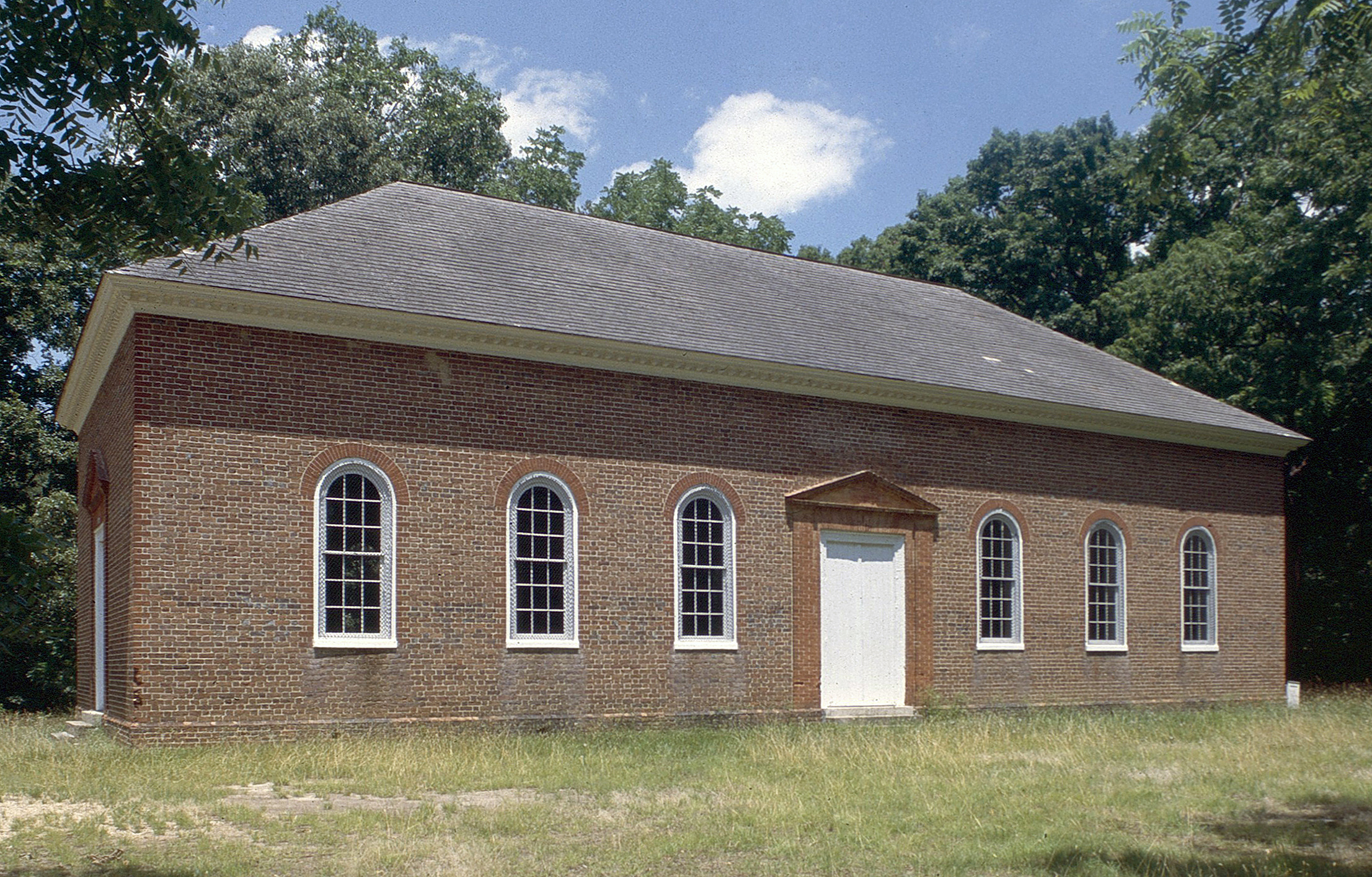
Lamb's Creek Church
Lamb's Creek Church stands off a quiet rural road in King George County, Virginia, half a mile north of the old King's Highway—a small, elegant brick rectangle with a hipped roof, seven bays of round-headed windows, and gauged brick doorways that represent some of the finest colonial craftsmanship in the Virginia Tidewater. It was built between 1769 and 1770 to serve Brunswick Parish, attributed to architect John Ariss, and it achieved a level of sophistication with almost no ornamentation at all. The brickwork alone tells you everything about what the builders intended—precise, restrained, and built to last centuries. It has. The parish traces its origins to the early 1700s, when Brunswick Parish was carved from older parishes along the Rappahannock River. Its first house of worship, known as Muddy Creek Church, was likely a log chapel near the boundary of King George and Stafford Counties. As the population shifted eastward, the congregation needed a larger, more centrally located building, and Lamb's Creek Church was the result. The design closely resembles Payne's Church in Fairfax County, also attributed to Ariss, which was demolished by Union troops during the Civil War. Lamb's Creek survived the war, but not without scars. The church still possesses two rare treasures from its colonial past—a 1716 Vinegar Bible, so named for a famous misprint in Luke 20 that reads "the parable of the vinegar" instead of "the vineyard," and a 1662 missal—but the interior tells a harder story. During the Civil War, Union cavalry used Lamb's Creek Church as a stable. Soldiers of the 1st Pennsylvania Cavalry tore out the pews, scattered the floor with straw and pistol cartridges, hitched horses to the headstones in the surrounding burial ground, and built fires on the graves. A wartime account from the Harris Light Cavalry described the scene with disgust, noting the church was 122 years old, built of three brick walls, and contained two pulpits, paintings, and inscriptions—all of it desecrated. The account concluded that every officer of the 1st Pennsylvania Cavalry should be dismissed from service for what had transpired there. After the war, the church fell into disuse and neglect. It was not restored to active Episcopal service until 1908. Today it stands as part of the Hanover-with-Brunswick Parish of the Diocese of Virginia, largely inactive, used primarily for an annual homecoming service held on the last Sunday of August. The haunting associated with Lamb's Creek Church is a single, vivid legend that has persisted since the Civil War era. Two Confederate soldiers, the story goes, entered the church during the conflict and encountered the apparition of a woman in white kneeling at the chancel rail in prayer. She was not a living person. The figure appeared and then was gone, and the soldiers carried the account with them. The Lady in White has been the church's signature ghost ever since—a spectral worshipper still attending a service that ended long ago, in a building that had been emptied of its congregation and filled with horses and men who had no use for what the space was built to hold. It is a restrained claim, almost genteel in its simplicity, and it fits the character of the building. Lamb's Creek Church is not a place that invites sensationalism. It is a place where the brickwork is still tight after 250 years, where the proportions still hold, and where the silence inside carries the weight of everything that has passed through it—colonial worship, revolutionary upheaval, wartime violation, decades of abandonment, and a slow, quiet return. The church was added to the National Register of Historic Places in 1972. It is available for weddings and events. The Lady in White, if she is still there, has the chancel to herself.
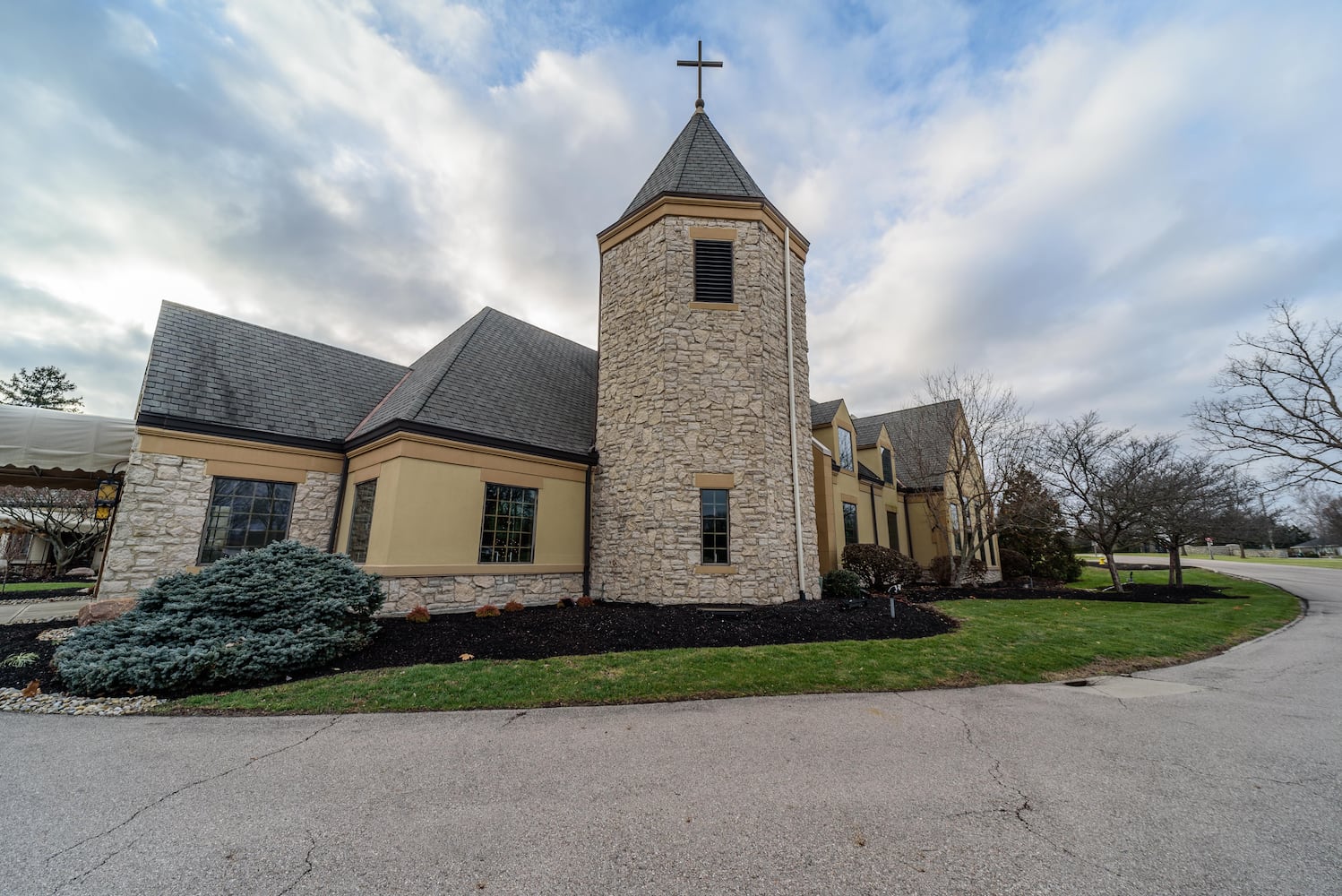
Normandy United Methodist Church
Normandy United Methodist Church sits at 450 West Alex Bell Road in Washington Township near Dayton, Ohio, but the building at its heart is not a church at all—it is a million-dollar English Manor estate built in the late 1920s by one of the most powerful automobile executives in the country. The mansion, known as Normandy Farms, was the home of Richard Hallam Grant Sr., a Harvard-educated industrialist who rose from a clerk's position at National Cash Register in 1904 to Vice President and General Sales Manager of Chevrolet and eventually a member of the General Motors Board of Directors. The Grants had traveled extensively in Europe and were particularly taken with the Normandy region of France, so in 1924 they hired a New York architectural firm to design a residence worthy of the name. Construction began in 1927 and was completed in 1930 at a reported cost of one million dollars—a staggering sum at the height of the Depression. The house was remarkable not just for its scale but for its innovation. It was reportedly the first fully air-conditioned private residence in the United States. Grant, an inventor by temperament, outfitted the home with automatic closet lights that activated when doors were opened—a concept he later carried over to the Chevrolet automobile. The estate featured dual furnaces and water systems, concealed closets, a private gymnasium, a two-story pewter chandelier, nickel-silver stair railings, four built-in safes, one of the first push-button radios, and an automatic push-button garage door opener. A swimming pool and diving platform graced the grounds. The rooftop promenade overlooked the rolling farmland of Montgomery County. It was a house built by a man accustomed to thinking on an industrial scale, applied to domestic life. Grant lived at Normandy Farms until 1955. In 1938, he had acquired controlling interest in the Reynolds & Reynolds Company, which he headed until his death in 1957. His wife Laura Williams Grant, whom he had married in 1906, was by all accounts deeply attached to the estate. When the Grants decided to leave, they sold or gifted the property to form the Normandy United Methodist Church. Services were originally held in the Grant living room, which became the chapel. A 1963 addition provided a sanctuary, education space, and kitchen—now known as Fellowship Hall. The church's present-day sanctuary was built in 1997. The mansion itself remains the architectural centerpiece of the campus, listed on the National Register of Historic Places since 1983. It is Laura Grant, by most accounts, who never left. Custodians and cleaning crews working late at night in the mansion have reported the unmistakable scent of perfume drifting through empty rooms when no one else is in the building. The fragrance appears without source, lingers briefly, and dissipates. Mysterious noises have accompanied the scent—sounds without clear origin in the old residence and staff quarters. One account from a person who grew up around the church in the 1980s describes seeing a woman in white watching from an attic window of the mansion during a snow day while children sledded on the hill behind the property. The figure was visible and distinct enough to send the witness running home. The same person reported multiple unexplained experiences over several years, spanning both the main residence and the staff quarters. Other accounts describe the family who once owned the estate haunting the grounds and buildings more broadly, though the perfume and the woman in white remain the most consistently reported phenomena. The claims are modest in number but striking in their domestic quality. There are no reports of malevolence, no violent history to anchor the haunting to a specific trauma. What people describe is the presence of someone who loved the house and apparently has no intention of leaving it—a woman whose perfume still fills rooms she furnished, whose silhouette still appears in windows she once looked through. If suggestion plays a role, the mansion itself provides ample material. The original architecture is extraordinarily well preserved, and the transition from private estate to church left much of the interior character intact. Walking through the Grant mansion is walking through a space that still feels owned—not by a congregation, but by the people who built it. Today Normandy United Methodist Church is an active congregation with roughly 490 in weekly attendance. The historic mansion hosts a popular annual Christmas open house featuring decorated trees, carolers, and tours of the original rooms. The property is surrounded by what is now Grant Park, where the farmland that once belonged to the estate is open to the public. The church does not trade on its haunted reputation, and the building's primary identity remains firmly rooted in community worship and service. But the perfume still comes, and the woman in white still watches from the attic, and the house that Richard Grant built for a million dollars and filled with every innovation of the modern age remains, by quiet account, occupied by someone who was there before any of the congregants arrived.
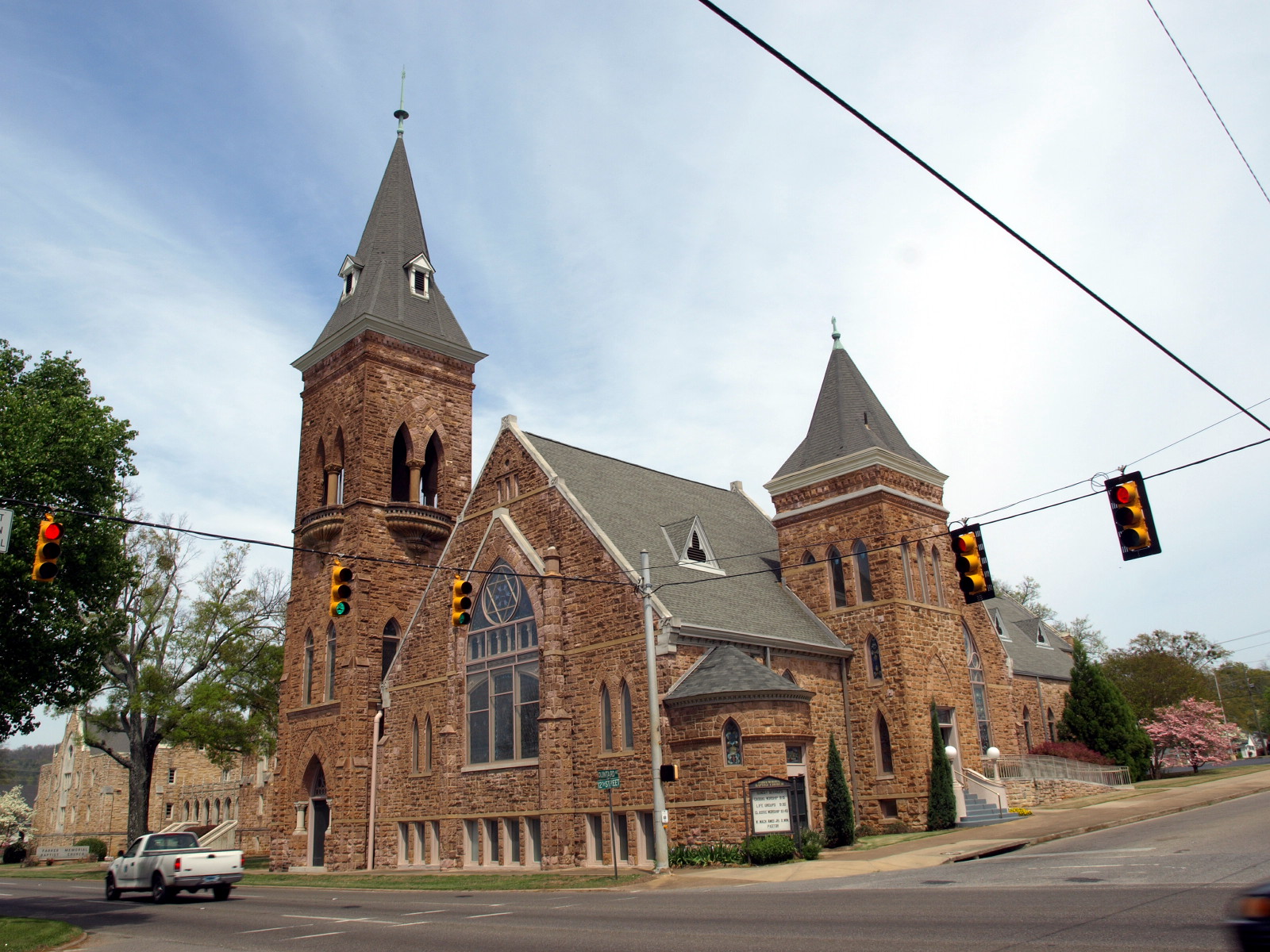
Parker Memorial Baptist Church
Standing along Quintard Avenue in Anniston, Alabama, Parker Memorial Baptist Church cuts a striking silhouette against the Calhoun County sky—a massive Victorian Gothic structure built of native pink sandstone, its corner tower and arched entryway pulling the eye upward in the tradition of grand 19th-century ecclesiastical architecture. It is a building that was never meant to project fear. It was built out of grief, funded by a man who lost everything he loved in the span of a few devastating months, and the weight of that origin has never fully left its walls. The congregation that would eventually call this building home first gathered on July 3, 1887, when 45 people met at the Opera House on Noble Street to organize a new church, originally called Second Baptist Church, before being renamed Twelfth Street Baptist when its location changed. The story of how it became Parker Memorial is one of the most quietly tragic founding narratives of any church in the state. Duncan T. Parker, founder and first president of First National Bank in Anniston, suffered a catastrophic personal loss in 1889. His young son died of pneumonia, and his wife Cornelia—who had served as the church's first organist—died of the same disease shortly after, her resistance already worn down from nursing a sick daughter through her own illness. Parker, devastated, offered to fund the construction of a new sanctuary as a memorial to his wife. The stained glass windows on the north and south sides of the sanctuary were his personal gifts to the congregation. Parker died shortly after construction began, but left instructions with his three daughters for the building's completion. The new building was dedicated in March of 1891. The result is a large masonry structure built in a late Victorian Gothic style, its exterior of randomly coursed native pink sandstone with belt courses, sills, coping, and steps of Kentucky blue stone. The arched main entrance is found in the northwest corner tower. Inside, the sanctuary retains the proportions and atmosphere of its era—soaring ceilings, rich woodwork, and the pipe organ that has become, over more than a century, one of the building's most persistently discussed features. The church was added to the Alabama Register of Landmarks and Heritage in 1981 and to the National Register of Historic Places in 1985. The paranormal claims surrounding Parker Memorial are modest by the standards of more widely documented haunted locations, but they carry an internal logic that connects directly to the building's founding story. The church has been described as reportedly haunted by a ghostly organ player who plays the chapel organ in the wee hours of the morning. Given that Cornelia Parker was herself the congregation's first organist—and that the church was built in her memory by a husband who died before seeing it completed—the specificity of that particular claim is difficult to dismiss entirely as random legend-making. Whether or not music actually drifts through the sanctuary after midnight, the image of a Victorian organist who never lived to see the church dedicated, tied forever to an instrument in a building raised in her honor, carries its own peculiar emotional resonance. The other claim in circulation is considerably less credible. At least one ghost website has proclaimed that the church is haunted by a nun who took her own life in the main hallway—a detail that doesn't survive even casual scrutiny given that this is a Southern Baptist congregation with no historic connection to Catholic religious life whatsoever. It is the kind of story that accumulates around old buildings the way moss does around stone, indifferent to whether it makes any sense. What gives Parker Memorial its genuine atmosphere isn't the folklore. It's the circumstances of its creation. A man who helped build a city lost his son and his wife to the same disease within weeks of each other, and responded by commissioning an $85,000 sandstone church he would never live to enter. His daughters completed it. His wife's organ was placed inside. The stained glass he paid for still filters the Alabama light. There is something melancholy and unresolved embedded in that sequence of events that no amount of skepticism can fully dispel. Buildings built to memorialize the dead have a different quality than buildings built for the living, and Parker Memorial Baptist Church has been, in a very literal sense, a monument to grief from the day its cornerstone was laid. Today the church remains an active Southern Baptist congregation and a legitimate piece of Anniston's architectural and civic heritage. The pink sandstone tower still anchors the Quintard Avenue streetscape. The stained glass still holds. Whether the organ plays on its own in the small hours is a question the congregation leaves largely unanswered. But for a building whose very name was spoken first in mourning, a little unresolved mystery seems entirely appropriate.

St. Joseph of the Lakes Catholic Church
St. Joseph of the Lakes Catholic Church in Lino Lakes, Minnesota represents a significant religious structure within the Upper Midwest Catholic community, serving as a sanctuary for spiritual practice and communal worship across generations of parishioners. The church building itself embodies architectural tradition and religious purpose, with design elements consistent with early-to-mid twentieth-century Catholic ecclesiastical architecture. The structure has served as a center for baptisms, marriages, funerals, and daily religious practice, absorbing the emotional energy of countless life transitions and moments of spiritual significance. The location's designation as a Catholic church endowed it with spiritual properties intended to sanctify the space and elevate consciousness toward transcendent realm. Yet despite these sanctifying intentions, the building apparently became subject to spiritual phenomena that defied conventional religious explanation, creating tension between the church's formal religious purpose and the paranormal manifestations documented within its spaces. The most prominent entity identified at St. Joseph of the Lakes is a ghost nun, a female apparition dressed in religious habit whose identity and historical connection to the church remain uncertain. The nun's apparition has been observed moving through the church's interior spaces with apparent familiarity, suggesting she may have served within the institution or resided in attached convent facilities. Her behavior proved non-threatening and purposeful, consistent with someone conducting assigned duties or familiar with the building's layout. The apparition has been glimpsed walking through walls and solid barriers, a phenomenon that suggests her spiritual form transcends physical limitations. Additionally, the spirits of a young girl have been identified within the church, whose presence generated different emotional qualities than the nun apparition. The young girl spirit apparently lacked the purposeful demeanor of the nun, instead suggesting confusion or distress more consistent with traumatic circumstances surrounding her death. The paranormal phenomena documented at St. Joseph of the Lakes manifest through diverse categories of activity. Doors within the church building slam shut with forceful violence when no human hand manipulates them, a phenomenon occurring repeatedly across independent observations. Witnesses have reported hearing music from the church piano playing melodies when the instrument remains untouched and no human organist occupies the bench. A Bible placed on a shelf was knocked forcefully to the ground without visible cause, suggesting aggressive spiritual intervention. Footsteps echo through empty church spaces, the sounds of feet moving across floor and through hallways conveying purposeful movement despite absence of physical presence. Ghosts have been observed walking directly through walls and solid barriers, their translucent forms defying architectural impediments. Lights within the church turn off spontaneously, plunging areas into darkness despite no human intervention at electrical switches. The combination of these phenomena created an atmosphere suggesting active spiritual presence, yet the church's sanctifying purpose created confusion regarding the nature and intent of these apparitions. The paranormal activity at St. Joseph of the Lakes became sufficiently documented that the location achieved recognition within Minnesota's paranormal research communities. The incongruity between the church's religious purpose and its apparent haunting created theological and psychological tension for parishioners and church officials. Some individuals interpreted the phenomena as evidence of suffering souls trapped in spiritual purgatory, requiring spiritual intervention or prayer to facilitate their passage to transcendent realms. Others questioned whether the phenomena represented genuine spiritual manifestation or misinterpretation of building sounds and environmental factors. The location became included in compilations of Minnesota haunted sites, achieving status as a verified paranormal location alongside secular haunted establishments. St. Joseph of the Lakes stands as an example of how paranormal phenomena may manifest in any location regardless of religious designation or sanctification intent, suggesting that spiritual imprints transcend boundaries between sacred and secular spaces.
Berry’s Chapel
Berry's Chapel occupies a distinctive position within the spiritual and paranormal landscape of southern New Jersey, situated in the vicinity of Quinton and bridging the boundaries between the developed areas of Bridgeton and the more rural, wooded regions that characterize the Pine Barrens ecosystem and surrounding terrain. The chapel itself represents a small ecclesiastical structure dedicated to Christian worship and spiritual gathering, constructed during the nineteenth century as part of the religious infrastructure that served scattered communities in the sparsely populated regions of this area of New Jersey. The building and the surrounding property reflect the modest scale and humble aesthetic typical of rural Protestant chapels constructed to serve dispersed populations whose religious practice and community cohesion depended upon dedicated spaces for gathering and collective worship. The setting of Berry's Chapel within wooded terrain, surrounded by pine forests and natural landscape features of the Pine Barrens region, creates a distinctive environmental context that contrasts sharply with the developed urban and suburban spaces that characterize much of the New Jersey landscape. The natural isolation of the chapel and its surroundings, combined with the region's cultural associations with mystery and unusual phenomena, has contributed to the chapel's significance as a location where paranormal manifestations have achieved notable intensity and recognition. The paranormal phenomena documented within and around Berry's Chapel manifest in forms distinctly different from the anthropomorphic apparitions and human-associated hauntings that characterize many other haunted locations in North America. Most prominently, multiple independent witness accounts, paranormal investigators, and casual visitors have documented sightings of a phantom white wolf, a spectral animal entity whose appearance, behavior, and manifestation patterns suggest the presence of a non-human spiritual force persisting within the natural landscape surrounding the chapel. The phantom white wolf appears with particular frequency in the pine woods areas adjacent to the chapel property, manifesting as a visible form distinctly white in coloration and possessing characteristics of wolf-like animals despite the biological impossibility of wolf populations in contemporary New Jersey. These sightings have generated considerable interest among paranormal researchers and cryptozoological investigators seeking to understand the nature of animal apparitions and the mechanisms by which non-human spiritual entities might achieve manifestation within physical space. Beyond the distinctive phenomenon of the phantom white wolf, visitors and paranormal investigators have reported creepy sounds emanating from throughout the property and surrounding wooded areas, sounds whose origins resist conventional explanation based on known animal vocalizations or environmental phenomena. Paranormal investigation teams conducting systematic research within Berry's Chapel have employed electronic voice phenomena recording techniques, a methodology through which investigators document and capture disembodied voices and unexplained auditory manifestations through audio recording equipment. The electronic voice phenomena recordings conducted at Berry's Chapel have yielded evidence of vocal utterances and communicative attempts by unknown entities, spoken through mechanisms that bypass conventional human vocal apparatus yet register clearly upon audio recording equipment. These recorded voices and the intelligible utterances captured through electronic voice phenomena documentation suggest the presence of communicative intelligence persisting within the location, entities capable of expressing meaning and intent through audio manifestation despite their non-physical nature. The combination of the phantom white wolf sightings, the creepy sounds, and the electronic voice phenomena recordings collectively establish Berry's Chapel as a location of sustained and multifaceted paranormal activity that defies simple categorization or explanation based upon conventional paranormal models centered upon human spirits and anthropomorphic apparitions. The chapel and its surrounding property remain actively haunted, with paranormal investigators and paranormal tourists continuing to visit and document the persistent manifestations that characterize this unusual location situated within the unique environmental and cultural context of southern New Jersey.
St. Mary’s Episcopal Church
St. Mary's Episcopal Church in Kansas City, Missouri stands as a significant religious institution representing the Anglican ecclesiastical tradition within the Kansas City community, serving as a place of worship and spiritual practice for congregants throughout its long operational history. The church building itself reflects architectural and design principles characteristic of Episcopal church construction, with interior spaces dedicated to worship activities, prayer, religious instruction, and sacramental practices central to Episcopal tradition. The church's position within Kansas City reflects its importance within the local religious and community landscape, with the building serving multiple functions beyond merely providing space for worship services, including hosting community gatherings, educational activities, and various social functions that reinforce the church's role as a community institution. The physical structure of St. Mary's Episcopal Church incorporates architectural details and design elements that reflect the aesthetic and spiritual values of Episcopal tradition, with religious iconography and spatial organization designed to facilitate contemplation and worship. Throughout its operational history, the church has served generations of parishioners, with individuals marking significant life events including baptisms, confirmations, marriages, and funerals within its walls. The paranormal reputation of St. Mary's Episcopal Church became particularly associated with Father Henry D. Jardine, a controversial priest who served at the church at some point in its history and whose tenure appears to have been marked by significant conflict, mystery, or scandal that generated lasting spiritual consequences. Father Jardine's controversial nature and the circumstances surrounding his time at St. Mary's remain somewhat veiled in available historical accounts, with detailed biographical and professional information about this particular clergy member being limited in readily accessible sources. However, the strength of the paranormal association between Father Jardine and St. Mary's Episcopal Church suggests that his presence at the church and the circumstances of his departure or death created sufficient spiritual or emotional impact to generate ongoing paranormal manifestations within the church building. The controversy surrounding Father Jardine may have involved theological disputes, personal misconduct, interpersonal conflicts with congregants or other clergy members, or circumstances related to his death that created spiritual turbulence at the location. His apparent reluctance or inability to find peaceful rest after death has resulted in his spirit remaining bound to St. Mary's Episcopal Church, continuing to assert his presence through various paranormal phenomena that visitors and staff members have documented. Visitors to St. Mary's Episcopal Church have reported experiencing paranormal phenomena particularly concentrated on the church's second floor, though manifestations occur throughout the building as well. Individuals present at the church, particularly during late evening hours and nighttime when fewer people are present and the building is more quiet, report feeling a distinct sense of being watched by an unseen presence, with this sensation appearing to intensify late at night. An apparition matching the description of Father Jardine has been reported multiple times, with witnesses describing a spectral figure holding a candle, creating a visually striking and distinctive paranormal manifestation that has been documented by multiple independent observers. Unexplained sounds echo throughout the church building at irregular intervals, including disembodied voices and vocalizations that seem to emanate from the church structure itself rather than from any identifiable source. The voices appear to communicate or express emotion, though the specific content and meaning of these disembodied vocalizations remain difficult to interpret with certainty. The paranormal activity at St. Mary's Episcopal Church has become sufficiently documented and notable that the church community itself has embraced acknowledgment of the building's haunted status, with the church recognizing its paranormal history as a component of its cultural identity. This unusual situation, in which a religious institution publicly acknowledges and discusses its haunted status, has contributed to St. Mary's Episcopal Church becoming a recognized paranormal destination within Kansas City, attracting the attention of ghost tour companies, paranormal investigators, and curious visitors interested in experiencing the church's acknowledged supernatural phenomena.
Platypus Pub
Platypus Pub, situated in Bend, Oregon, occupies a distinctive position within the urban landscape as a commercial establishment located beneath an older building designated as the Old Church, creating a spatial arrangement in which the pub operates in the basement levels of a structure with deeper historical connections to the community. The pub itself operates as a contemporary bar and restaurant, serving the local population and visiting tourists seeking dining and entertainment in a casual atmosphere. However, the location's historical layers and the spiritual impressions apparently retained within the basement spaces create a paranormal environment markedly distinct from the surface-level commercial character of the establishment. The juxtaposition of the old church structure above with the modern pub below creates a complex physical and spiritual geography in which contemporary commerce coexists with historical religious significance and attendant paranormal phenomena. Paranormal investigators and pub patrons have documented multiple categories of phenomena occurring within Platypus Pub that distinguish it from typical bar and restaurant locations. The most consistent paranormal manifestation involves electromagnetic anomalies, with lights flickering erratically throughout various areas of the establishment despite proper functioning of electrical systems. The flickering lights appear particularly in the hallway accessing the restroom facilities and in various corners and enclosed spaces within the pub's interior. The pattern of electrical anomalies suggests either residual spiritual energy interfering with conventional electrical systems, or active intelligent manifestations through which a paranormal entity deliberately manipulates lighting conditions to communicate with or to provoke reaction from living observers. Patrons and staff members report the distinctly abnormal pattern of light fluctuations as generating feelings of unease or heightened awareness of supernatural presence. The most disturbing and distinctive paranormal phenomenon occurring at Platypus Pub involves the manifestation of a dark apparition, described by multiple witnesses as a shadowy humanoid figure appearing in unexpected locations throughout the establishment. The dark apparition exhibits characteristics that provoke fear in observers, suggesting either genuinely threatening spiritual intention or the appearance of threat through the apparition's physical characteristics and behavior patterns. Witnesses describe encountering the dark figure in the hallway connecting the bar area to the restroom facilities, a location where the dimensional constraints and lack of alternative exit routes create a sense of vulnerability and potential entrapment in close proximity to the paranormal entity. The dark apparition appears particularly in peripheral vision, suggesting that direct observation of the figure may prove impossible or result in the apparition's disappearance or transformation. Investigations conducted throughout Platypus Pub have identified a distinctive heavy presence, a sensation characterized by witnesses as an oppressive atmospheric weight or density that manifests particularly in specific areas of the basement bar establishment. This heavy presence creates an environment in which sensitive observers experience discomfort, anxiety, or heightened awareness of supernatural activity without necessarily perceiving any discrete paranormal phenomenon. The heaviness appears concentrated in certain areas while remaining absent in others, suggesting that the spiritual entity or energy manifestation occupies particular spatial zones within the pub's interior. The combination of flickering lights, dark apparition sightings, and the overwhelming heavy presence creates a paranormal environment distinctive within Oregon's documented haunted locations. Platypus Pub continues to operate as a functional bar and restaurant while maintaining awareness of its paranormal reputation, and paranormal enthusiasts and researchers continue to document activity within this basement establishment located beneath the historically significant Old Church structure.
Canyon Ferry Mansion Bed and Breakfast
Canyon Ferry Mansion stands as a historic manor house situated in the mountainous region of central Montana, commanding a prominent position within its surrounding landscape and representing a significant achievement in residential architecture and construction during its original period of development. The structure exemplifies early twentieth-century mansion architecture, incorporating elements of refined design including ornamental details, multiple stories, period-appropriate fenestration, and spatial configurations reflecting the aspirations and social position of its original owners. The building's construction materials and structural design were intended to provide durability and lasting presence, allowing the structure to persist through multiple generations of ownership and changing uses. The mansion's location within Montana's natural landscape positions it to offer views and connections to the distinctive terrain of the northern Rocky Mountain region. The property subsequently underwent transformation from private residential use to operation as a bed and breakfast establishment, adapting its original function to serve contemporary travelers and guests seeking accommodation and hospitality services. This conversion required interior modifications to create guest accommodations while preserving the historical architectural character and distinguished appearance of the structure. The historical narrative of Canyon Ferry Mansion encompasses both the documented residential history of the property and the tragic circumstances that appear to have established its reputation as one of Montana's most actively haunted locations. The mansion was the site of a murder, an incident that involved loss of life under traumatic and violent circumstances. The specific details of the murder, including the identity of the victim, the perpetrator, and the precise circumstances, remain somewhat obscured in available historical documentation, though the occurrence is well-established within paranormal investigation literature. The violent nature of the death and the emotional and psychological content associated with such an occurrence generated conditions conducive to paranormal manifestation and residual haunting phenomena. The property's conversion to bed and breakfast operations introduced contemporary residents and guests into an environment profoundly marked by historical tragedy. The mansion accumulated layers of historical significance encompassing both its period as a private residence and its subsequent transformation into a hospitality establishment. The combination of refined architectural achievement, intimate domestic history, and violent tragedy created a complex environment rich in psychological and emotional content conducive to paranormal phenomena. Canyon Ferry Mansion has developed an extensive reputation as an actively haunted location, with paranormal investigators and bed and breakfast guests documenting numerous distinct spectral entities and paranormal phenomena throughout the building. The mansion is reportedly home to eight distinct ghosts, each representing a separate entity with characteristic manifestations and behavioral patterns. A weeping woman apparition manifests at specific locations within the mansion, her emotions expressed through audible weeping sounds and visual sightings of a female figure displaying signs of profound emotional distress. A shadowy lawyer figure appears in the office areas of the mansion, reportedly capable of moving objects and interacting with the physical environment despite his deceased status. A floating woman apparition has been observed on the mansion's porch, her spectral form appearing to hover or glide above ground level. A phantom piano player manifests through the audible sounds of piano music emanating from the chapel areas, the music appearing without any visible source or musician. A cigar-smoking specter generates the distinctive smell of tobacco smoke in various locations throughout the mansion, the aroma appearing without any visible source of combustion. Most disturbingly, witnesses have documented encounters with a terrifying apparition characterized by intense glaring eyes and an expression of extreme menace, an entity that generates profound fear and psychological distress in observers. The diversity of distinct spectral entities suggests that the murder may have claimed multiple victims, or that the traumatic historical circumstances attracted spirits from earlier periods of the mansion's history. Canyon Ferry Mansion continues to operate as a bed and breakfast establishment, welcoming guests seeking overnight accommodations and hospitality services within Montana's mountainous environment.
Piney Grove Church
Piney Grove Church, located in Concord, North Carolina, stands as a historic religious institution situated within a region of substantial historical and paranormal significance, representing centuries of Baptist worship, community gathering, and the spiritual life of individuals and families throughout the surrounding area. The church building itself reflects the architectural traditions of rural Baptist churches in the American South, embodying design elements and construction methods consistent with the period of the church's establishment and the resources available to the congregation during its construction and expansion. The church occupies a setting within the natural landscape of the North Carolina Piedmont, surrounded by the vegetation and geological features characteristic of the region, with the physical building and surrounding cemetery creating a sacred space distinct from ordinary secular landscape. The church has served continuously as a center of religious practice and community identity, hosting worship services, religious ceremonies, pastoral care, and the social gatherings through which rural communities maintain cohesion and connection across generations. The cemetery adjacent to the church building contains grave markers documenting centuries of community members who have been laid to rest within this consecrated ground, creating a visual and spiritual landscape where religious community extends simultaneously across the living and the deceased. The history of Piney Grove Church extends deeply into the religious traditions of the American South, with the Baptist denomination establishing strong roots in rural North Carolina communities and the church representing decades or potentially centuries of uninterrupted religious practice and community significance. The church has witnessed significant events in the lives of its congregation members, including baptisms, weddings, funerals, and spiritual crises that mark the boundaries and transitions within human existence. The accumulated spiritual practice, genuine religious conviction, and emotional intensity associated with such events creates an atmosphere of profound religious significance within the church building and surrounding cemetery. The graves within the adjacent cemetery represent individuals of varying ages, circumstances, and historical periods, with some grave markers bearing dates from the eighteenth or nineteenth centuries and others representing more recent burials. The cemetery itself constitutes a genealogical record of community lineages and family connections, with family plot groupings demonstrating the continuation of particular family lines across multiple generations of burial and remembrance. The paranormal phenomena documented at Piney Grove Church present as a multiplicity of distinct manifestations suggesting the presence of four separate spiritual entities or presence configurations throughout the church building and cemetery grounds. Strange lights have been observed appearing within and around the church building, particularly during evening and night hours when darkness would otherwise render the location completely unilluminated by conventional light sources. These lights manifest in various forms, including diffuse glowing phenomena, distinct point sources of illumination, and luminescence that appears to originate from no explicable technological or natural source. Misty or foggy apparitions have been reported throughout the church and cemetery, manifesting as whitish or grayish humanoid forms that appear and dissipate without conforming to the behavior of ordinary atmospheric moisture. Shadowy figures have been witnessed moving through the church building and cemetery grounds, appearing as dark silhouettes that seem to possess purposeful movement and human-like form while remaining distinct from the ordinary shadows created by light and physical obstruction. Photographic anomalies captured during investigative visits include unexplained objects appearing in photographs taken at the location, with orbs being particularly common, appearing as spherical luminous phenomena in digital photographs despite their absence in direct perception during the photograph's capture. Young boy figures have been reported, appearing as child-like apparitions or shadowy forms suggesting youthful human shape, with multiple independent reports suggesting the presence of a specific deceased child spirit or spirits of multiple children. The paranormal phenomena occurring at Piney Grove Church are characterized by witnesses as creating a palpable sense of presence and heavy spiritual atmosphere within the church building and cemetery, with sensitivity to paranormal phenomena reporting subjective experiences of being observed, followed, or contacted by non-physical entities inhabiting the location. This sensation of presence is not uniformly associated with fear or negative emotional response, with some accounts describing a quality of peaceful or benign presence, while others describe more unsettling or oppressive spiritual atmospheres. The heavy presence reported at the location suggests consciousness, intention, or at least persistent attachment to the location by the entities responsible for the paranormal phenomena. Investigation of the location utilizing both electronic paranormal detection equipment and investigator intuition has documented electromagnetic anomalies, temperature variations, and apparent responses to investigator inquiries suggesting some form of communication between living researchers and the spiritual entities inhabiting the location. The identification of four distinct ghosts represents the outcome of paranormal investigation and spiritual communication methodologies, though the specific identities of these individuals and the circumstances binding them to the church location remain partially mysterious. Today, Piney Grove Church continues to function as an active religious institution, maintaining its worship traditions and community role while simultaneously acknowledging its identity as a haunted location with substantial paranormal phenomena. The church has incorporated its paranormal reputation into its identity and public presentation, recognizing that the documented supernatural activity represents an integral aspect of the location's character and significance. Paranormal investigation teams and ghost hunters have been granted access to the property to conduct investigations, with the understanding that such research may contribute to broader understanding of paranormal phenomena while respecting the sacred nature of the location as a church building and burial ground. The combination of deep religious history, active ongoing community practice, and well-documented paranormal activity creates a unique location where the sacred and the paranormal exist in apparent coexistence. Piney Grove Church exemplifies how American religious institutions can simultaneously serve as centers of living religious practice and as locations inhabited by spiritual entities seemingly bound by emotional attachment or unresolved business to the place where they are buried or where significant events occurred during their lifetime.
Old Stone Fort
Old Stone Fort, located near Manchester in Coffee County, Tennessee, stands as an archaeological and historical site of considerable antiquity and cultural significance, representing a substantial pre-Columbian structure whose original purpose and construction date have been subjects of extensive scholarly investigation and debate. The fort itself consists of earthen embankments and stone walls forming distinctive defensive or ceremonial structures whose geometric precision indicates intentional planning and sophisticated construction techniques. Estimates suggest the fort was constructed by indigenous peoples sometime during the prehistoric period, though the exact dating of the construction and the specific culture responsible remain subjects of ongoing archaeological research. The site's historical importance was recognized early in the European settlement of Tennessee, leading to its designation as a historic site and its integration into regional tourism and cultural heritage programming. The fort's distinctive presence in the Tennessee landscape made it an inevitable destination for early settlers and travelers, accumulating historical narratives and cultural associations that would eventually become inextricably linked with paranormal phenomena. The paranormal history associated with Old Stone Fort emerged during the early nineteenth century, when reports of ghostly manifestations and unexplained phenomena began circulating among local residents and visitors to the site. The earliest documented accounts described mysterious voices, apparitions of unknown origin, and manifestations suggestive of spiritual presence or supernatural activity persisting within the fort's boundaries. These initial reports accumulated throughout the nineteenth century, becoming increasingly elaborate and gaining wider recognition among paranormal enthusiasts and historical researchers. The phenomena were attributed to the spirits of indigenous peoples associated with the fort's original construction and use, or to historical figures from the American frontier period who died at or were buried near the location. Stories circulated regarding mysterious lights, disembodied footsteps, and other classic paranormal manifestations that contributed to Old Stone Fort's reputation as one of Tennessee's most actively haunted historical sites. However, the paranormal history associated with Old Stone Fort experienced a significant transformation in the late nineteenth century when one of the individuals involved in perpetrating an elaborate hoax came forward with a confession detailing the mechanical means by which the reported phenomena had been artificially created. According to this confession, provided by a former reporter for the Nashville American in May eighteen eighty-seven, a local man named Latimer had constructed an elaborate contraption or mechanical device specifically designed to produce frightening sounds intended to drive away hunters and other individuals who frequented the fort. This mechanical apparatus generated the mysterious growls, eerie noises, and other phenomena that terrified visitors and accumulated in the local folklore as genuine paranormal manifestations. The confession revealed that the haunting of Old Stone Fort was actually an elaborate prank, constructed with mechanical ingenuity by an individual seeking to exclude others from his preferred hunting grounds. Six initial hunters had been sufficiently frightened by the contraption's output to abandon their activities at the location, and subsequent reports of paranormal phenomena at the fort were apparently based upon misinterpretation of the mechanical sounds or elaborations upon the original hoax. The revelation that the most famous paranormal phenomena at Old Stone Fort were products of deliberate human deception significantly altered the site's paranormal status and contributed to historical discussions regarding the reliability of eyewitness accounts and the human tendency toward credulity in matters concerning the supernatural. The confession detailed the construction date and mechanics of the hoax, providing documentary evidence of how a carefully orchestrated deception could generate numerous reports of paranormal activity that accumulated credibility and cultural resonance over time. This case demonstrated how paranormal folklore can be constructed from non-supernatural origins and how initial misinterpretations can be reinforced through social transmission and embellishment. However, the debunking of the most prominent phenomena did not entirely eliminate the fort's paranormal reputation, with occasional reports of unusual experiences continuing to emerge from visitors and researchers who suggested that some genuine paranormal activity might persist independent of Latimer's mechanical hoax. Today, Old Stone Fort functions as both an archaeological site and a historical narrative demonstrating the complex relationship between paranormal folklore, human psychology, and historical documentation. In nineteen sixty-six, archaeologists from the University of Tennessee conducted extensive excavations at the site, employing modern archaeological techniques and methodologies to investigate the fort's origins and construction. The archaeological research provided valuable insights into the site's genuine historical significance, documenting the sophistication of the structure's design and construction while simultaneously establishing a more reliable historical timeline independent of paranormal narratives or hoaxes. The revelation of Latimer's mechanical hoax transformed Old Stone Fort into a case study in paranormal skepticism and the importance of rigorous investigation in distinguishing genuine phenomena from human-generated deceptions. Yet the site retains its place in Tennessee's paranormal folklore and remains a destination for those interested in exploring the boundary between genuine unexplained phenomena and elaborate hoaxes that generate widespread belief and cultural impact.
Calvary Episcopal Church
Calvary Episcopal Church, located in Fletcher, North Carolina, represents a significant religious institution with deep historical roots within the region, embodying architectural and theological traditions consistent with the Episcopal Church's presence within the American South and the development of organized religious communities within the North Carolina Piedmont. The church building itself reflects the construction methods and architectural sensibilities characteristic of its historical period, with design elements that communicate both the practical requirements of ecclesiastical assembly and the symbolic expressions of theological commitment characteristic of the Episcopal tradition. The church stands within a historical and geographical context shaped by colonial-era settlement patterns, Revolutionary War conflicts, and the subsequent development of religious and community institutions within the region. The churchyard adjacent to the main building contains grave markers and burial monuments documenting centuries of community members interred within this consecrated ground, creating a visible record of genealogies, family connections, and the mortality of individuals whose lives have been connected to the religious community. An old well located behind the church building constitutes a physical artifact from earlier periods of the church's history, serving as a tangible connection to the practical necessities and daily life of previous generations of church members and community residents. The history of Calvary Episcopal Church extends across centuries of religious practice, pastoral leadership, congregational participation, and the accumulation of spiritual life and community experience within the institutional framework of organized religion. The church has served as a site where significant religious and life events have transpired, including baptisms, confirmations, marriages, funerals, and the pastoral care that marks the lives of individuals within a religious community. The building has absorbed the genuine spiritual conviction, emotional intensity, and human connection associated with religious practice conducted with sincerity and authentic faith. The cemetery and churchyard have accumulated the graves of individuals from various historical periods, with some grave markers bearing dates from colonial-era settlement and others representing more contemporary burials. The continuity of the church's function as a religious institution and burial location has created an accumulation of spiritual and emotional significance that transcends the material characteristics of the building and grounds. The most distinctive and consistently documented paranormal phenomenon associated with Calvary Episcopal Church involves the manifestations of the Phantom Rider of the Confederacy, a female apparition mounted upon a palomino horse, widely regarded as representing the spirit of a woman executed during the American Civil War era for her role as a Confederate spy. The Phantom Rider has been reported appearing on roads in the vicinity of Calvary Episcopal Church, typically manifesting during twilight hours or evening periods when natural illumination is diminishing and shadows lengthen across the landscape. The apparition is described consistently across multiple reports as presenting a feminine form with long blonde hair, dressed in period-appropriate attire, mounted upon a distinctive palomino-colored horse. The Phantom Rider is reported as appearing briefly before vanishing rapidly from sight, suggesting movement at speeds inconsistent with conventional equestrian travel and indicating the spectral rather than corporeal nature of the manifestation. Multiple independent reports from different witnesses across extended time periods corroborate the basic characteristics of the apparition, creating a reliable description of the phantom entity despite variations in specific details and viewing circumstances. The historical research surrounding the Phantom Rider apparition has yielded contextual information suggesting that the spirit may represent a woman executed as a Confederate spy during the American Civil War, with her death connected to intelligence activities and military secrets associated with the conflict between Union and Confederate forces. The execution of a female spy would constitute a traumatic and unusual death, involving legal judgment, military authority, and the violation of conventional protections extended to women within Victorian-era societies. The circumstances of such a death might plausibly generate the type of emotional disturbance and spiritual attachment theorized to underlie persistent hauntings. The proximity of the Phantom Rider's manifestations to Calvary Episcopal Church suggests either that the woman was interred within the churchyard or that the church building or location possessed significance in her life, creating a spiritual anchor binding her manifestation to the geographical area. The connection between a decapitated Confederate spy and the church location remains historically ambiguous, with some sources suggesting definitively that such an execution occurred at or near the church, while other sources remain uncertain regarding the precise historical facts. Paranormal investigation of the Phantom Rider apparition has proceeded within a framework of acknowledging the substantial historical and paranormal documentation while recognizing that the precise historical identity and circumstances of the spirit remain partially unresolved. Paranormal research teams investigating the location have documented electromagnetic anomalies in the vicinity of the church and bell tower, temperature variations suggesting concentrated spiritual presence, and audio recordings that some investigators interpret as capturing equestrian sounds or period-appropriate vocalizations. The bell tower area and the old well behind the church building have been identified as locations of concentrated paranormal activity, suggesting that these areas may be particularly associated with the circumstances of the woman's death or with spiritually significant events within the church's history. Contemporary investigators working with historical records, genealogical documentation, and paranormal research methodologies have attempted to identify the specific individual comprising the Phantom Rider spirit and to document the historical circumstances of her death and execution. The ongoing presence of the apparition across extended time periods suggests persistent emotional disturbance or unfinished spiritual business binding the entity to the location. Today, Calvary Episcopal Church continues to function as an active religious institution while openly acknowledging the paranormal phenomena occurring in the vicinity of the property, incorporating the Phantom Rider legend and paranormal investigation opportunities into the church's identity and historical narratives. The apparition remains one of North Carolina's most famous paranormal manifestations, recognized throughout regional paranormal circles and documented in numerous paranormal reference materials and ghost story collections. The combination of historical mystery, Civil War-era connections, documented paranormal phenomena, and ongoing religious function creates a unique location where American military history, individual tragedy, religious significance, and paranormal manifestation intersect. Visitors to the church area continue to report encounters with the Phantom Rider, maintaining the tradition of witnessing and documenting the apparition's periodic manifestations. The unresolved questions surrounding the spirit's identity and the precise historical circumstances of her execution add to the intrigue and mystery associated with the location, establishing Calvary Episcopal Church as a significant site where paranormal tradition, regional history, and the possibility of spiritual survival after death converge.
Rancho Guajome Adobe
Rancho Guajome Adobe represents one of the finest surviving examples of Spanish colonial adobe architecture in Southern California, constructed during the Mexican era in what is now Vista, California. The ranch, established as a substantial landholding under Mexican territorial law, served as both a residence and an agricultural enterprise. The adobe structure itself, built with thick walls characteristic of nineteenth-century Spanish colonial construction, has survived fires, earthquakes, and the passage of more than a century and a half with remarkable integrity. The architecture reflects the design principles of the period, with rooms arranged around a central courtyard to provide protection from the elements and create a defensible layout. The chapel, an integral part of the compound, served the spiritual needs of the residents and their workers, featuring religious iconography and furnishings consistent with Catholic practice during the Mexican territorial period. The grounds surrounding the main residence included agricultural areas, worker housing, and structures supporting the ranch's economic operations. The ranch property was developed during the early nineteenth century as part of the broader Spanish colonial landholding system that characterized Alta California before American conquest and settlement. Ownership of the property transferred between various Mexican landholders throughout the territorial period, with the Guajome family eventually giving the property its lasting name. The ranch operated as a functional agricultural enterprise, relying on the labor of indigenous workers and enslaved persons whose lives formed the foundation of the property's economic production. The family who occupied the main residence lived within the context of the hierarchical Spanish colonial social structure, enjoying privileges and comforts provided by their land ownership while participating in the exploitation of labor that characterized the era. Among the residents of the ranch was a woman named Ysidora Bandini, whose presence at the property would eventually become associated with persistent paranormal phenomena that continue to this day. Ysidora Bandini's connection to the property and circumstances of her association with the ranch remain somewhat obscured by the passage of time and limited historical documentation. What is known is that her spirit appears to remain bound to the location, manifesting through audible phenomena that have been consistently reported by visitors and investigators. The most distinctive paranormal manifestation involves the sound of a woman crying, sometimes described as inconsolable sobbing, emanating from the chapel area of the adobe compound. Visitors have reported hearing the distinctive sound of female weeping coming from within or near the chapel despite the building being empty of living occupants at the time of the phenomena. The crying is often described as deeply sorrowful, carrying emotional weight that affects those who hear it. In addition to the auditory phenomena associated with Ysidora, visitors have reported encountering a male figure on the property grounds, an apparition that moves about the ranch area without clear purpose. Skeleton remains discovered within the adobe's walls during renovation work in the 1970s suggest a history of trauma or sudden death within the structure, adding to the sense of tragedy that permeates the location. The combination of multiple documented paranormal phenomena at Rancho Guajome Adobe points to a location deeply troubled by its history. The chapel, traditionally a place of spiritual solace, has instead become a location associated with sorrow and spiritual distress. Paranormal investigators have conducted documented investigations at the site, attempting to understand the nature and origin of the manifesting entities. The consistent nature of the phenomena, particularly the crying sounds in the chapel, suggests an intelligent haunting rather than mere residual energy replay. Research into the property's history has revealed layers of complex human experience, tragedy, and loss that may explain the persistence of spiritual phenomena at the location. The indigenous labor upon which the ranch's prosperity was built, the inequitable social structure of the colonial period, and the individual tragedies of residents like Ysidora Bandini may all contribute to the haunted nature of the property. Today, Rancho Guajome Adobe operates as a historical park and museum, allowing public access to visitors interested in California's Spanish colonial heritage and paranormal investigation. The site has been carefully restored and maintained to preserve its architectural and historical significance, while its paranormal reputation has made it a destination for paranormal researchers and enthusiasts. The chapel continues to be a focus of paranormal activity reports, with visitors regularly documenting their experiences of the persistent crying sounds. The presence of the male apparition on the grounds and the documented discovery of skeletal remains add layers of mystery to the location's spiritual landscape. Rancho Guajome Adobe stands as a location where historical significance and paranormal phenomena coexist, offering researchers the opportunity to explore both the colonial history of California and the mysterious spiritual forces that appear to inhabit the property.
Cristo Rey Catholic Church
Cristo Rey Catholic Church stands as a significant religious institution serving the faith community and representing the architectural and spiritual traditions of Roman Catholic practice in the region. The church building itself reflects the architectural styles and construction standards characteristic of Catholic institutional structures, featuring distinctive design elements that convey the sacred purpose of the space and the religious traditions it represents. The location has served as a site of religious practice, sacramental activity, and spiritual community gathering for many decades, functioning as a center of worship and pastoral care for the local Catholic population. The transition of the church into a recognized paranormal location has occurred through the documented appearance of a spectral nun who manifests within the sacred spaces of the church, suggesting a spiritual entity with deep religious significance and apparent continued commitment to religious devotion even beyond physical death. The primary paranormal phenomenon documented at Cristo Rey Catholic Church involves the appearance of a nun in traditional religious habit, manifesting at the communion rail during periods of religious significance, most notably during Holy Week when the Christian calendar observes the passion, crucifixion, and resurrection of Jesus Christ. The apparition appears to be actively engaged in prayer at the communion rail, demonstrating the posture and apparent devotion associated with religious contemplation and spiritual practice. The identity of this spectral nun remains unknown, though her presence suggests either a former member of a religious community who served at or visited the church, or a spiritual entity with profound commitment to Catholic religious practice who has remained spiritually attached to the location. The timing of her manifestations during Holy Week suggests a connection to significant moments in the Catholic liturgical calendar and an ongoing observance of religious practices characteristic of her earthly spiritual practice. The paranormal manifestation of the nun follows a consistent and well-documented pattern in which witnesses observe the apparition engaged in prayer at the communion rail, with the figure remaining visible for varying lengths of time before gradually fading from sight as observers approach or make attempts to interact with the manifestation. This pattern suggests an intelligent or purposeful spiritual entity who is aware of the physical world and responsive to the presence of living individuals, yet chooses to maintain a separation between the earthly realm and the spiritual domain she inhabits. The apparition's continued devotional practice, manifest in her persistent prayer at the communion rail, suggests that the deeply held religious convictions and spiritual practices of her earthly life may have transcended the boundary between life and death, creating a condition where her spiritual presence remains committed to religious observance within the sacred space of the church. Paranormal research and theological analysis of the apparition at Cristo Rey Catholic Church have approached the phenomena from perspectives that acknowledge both the paranormal research tradition and the Catholic theological framework within which the church operates. Catholic perspectives on paranormal phenomena recognize the possibility of genuine spiritual manifestations while maintaining the church's established doctrinal positions regarding the nature of the afterlife, divine will, and the nature of human souls. The consistent documentation of the nun's apparition during Holy Week and her sustained devotional practice have led researchers and theologians to recognize the manifestation as a potentially significant example of spiritual attachment to sacred spaces and the continuation of religious commitment beyond physical death. The integration of paranormal research methodology with theological reflection has created a unique analytical framework for understanding the phenomena at this location. Cristo Rey Catholic Church continues to serve its primary function as a Roman Catholic worship space while acknowledging the documented paranormal phenomena that occur within its walls. The church community and leadership have incorporated awareness of the nun's apparition into the broader spiritual and cultural identity of the location, recognizing it as evidence of profound spiritual commitment and the possibility of continued prayer and devotion beyond the boundary of physical death. The ongoing documentation of the apparition's manifestations contributes to the broader understanding of religious paranormal phenomena and the ways in which spiritual commitments and sacred spaces may create conditions favorable for sustained supernatural manifestations. The presence of the nun's apparition at Cristo Rey Catholic Church demonstrates that paranormal phenomena are not limited to secular locations or tragic deaths, but may also manifest in sacred religious spaces where spiritual devotion has been particularly profound.
Heritage Baptist Church
Heritage Baptist Church stands as a significant religious institution within its community, representing decades of spiritual practice, community gathering, theological instruction, and the formation of individual and collective religious identity among its congregation members and their families. The church building itself embodies the architectural and aesthetic traditions of Baptist ecclesiastical design, with features and elements that reflect both practical requirements for religious assembly and symbolic expressions of theological commitments and denominational identity. Like many Baptist churches established in American communities, Heritage Baptist Church has served as more than merely a site of formal religious worship, instead functioning as a community center where social bonds are formed, life transitions are marked and celebrated, and individuals and families navigate the spiritual dimensions of their existence within a framework of religious community and theological guidance. The building's construction period and architectural style connect the church to particular historical contexts and construction traditions, situating it within the broader history of American religious architecture and denominational development across the nineteenth and twentieth centuries. The history of Heritage Baptist Church extends across generations of pastoral leadership, congregational participation, and the accumulation of religious practice and community life that characterizes established religious institutions. The church has weathered periods of growth and contraction, denominational changes and theological developments, and the broader social and cultural transformations that have affected American religious life across the span of the institution's existence. Church records document baptisms, marriages, memorial services, and other significant life events of congregation members, creating an archival record of human experience and spiritual commitment across multiple generations. The church building has been site to countless moments of genuine spiritual experience, theological conviction, pastoral care, and community support that have marked the lives of individuals and families within its orbit. The accumulated weight of sincere religious feeling, theological reflection, and human connection has imbued the building with emotional and spiritual significance beyond its material function as a structure housing an assembly of people. Paranormal phenomena documented at Heritage Baptist Church differ notably from the established haunting patterns associated with many American churches, presenting instead a case of relative paranormal inactivity and absence of the ghostly manifestations and spiritual presence reported at more infamous ecclesiastical haunting locations. Investigation of the location has revealed minimal evidence of autonomous paranormal phenomena, with the absence of apparitions, disembodied voices, inexplicable sounds, or other manifestations commonly associated with haunted locations. No documented cases of poltergeist activity, electromagnetic anomalies, or other paranormal occurrences have been conclusively documented at the church, despite the location possessing characteristics that might theoretically facilitate such phenomena, including age, religious significance, and the emotional weight of accumulated spiritual practice. The absence of paranormal activity at the location is itself noteworthy, suggesting that whatever mechanisms may underlie paranormal manifestation in other locations do not appear to be present or active at Heritage Baptist Church. The location stands in contrast to numerous other churches throughout North America that have developed substantial paranormal reputations and documented evidence of supernatural phenomena. The absence of paranormal activity at Heritage Baptist Church may suggest several interpretative frameworks regarding the relationship between religious practice, spiritual geography, and paranormal manifestation. Some theoretical perspectives propose that genuine religious practice and authentic spiritual connection within a location may actually inhibit or prevent paranormal manifestations, suggesting that the living spiritual practice of a community may create protective conditions that prevent attachment or manifestation by deceased entities. Alternative theoretical frameworks suggest that paranormal phenomena correlate more strongly with sudden, violent, or traumatic death rather than with peaceful passing at the end of natural lifespans, and that the people who have died in association with Heritage Baptist Church may have done so in circumstances of peace and acceptance that do not generate the emotional disturbance or unfinished business theorized to underlie hauntings. Other perspectives propose that paranormal manifestation may be distributed across many locations in subtle and undetectable forms rather than concentrated in the famous locations that comprise the canon of American haunted places, suggesting that the absence of documented phenomena at Heritage Baptist Church may reflect investigative bias toward locations with established paranormal reputations rather than reflecting genuine absence of spiritual presence. Today, Heritage Baptist Church continues its function as an active religious institution, serving the spiritual needs of its congregation while maintaining the building and property in conditions appropriate for ongoing religious assembly and community gathering. The church has not developed a paranormal tourism identity or incorporated ghost tours and paranormal investigation opportunities into its offerings, instead maintaining focus on its religious mission and community role. The location stands as an example of a church that, despite possessing characteristics that might theoretically support paranormal manifestation, has not developed significant documented evidence of supernatural phenomena, presenting a counterpoint to the numerous American churches that have acquired substantial paranormal reputations. The continued religious practice, active pastoral leadership, and vital community engagement at Heritage Baptist Church may create conditions that are fundamentally distinct from those characterizing more famous haunted churches, suggesting that the relationship between religious community, spiritual practice, and paranormal manifestation may be more complex and nuanced than surface-level theorizing might suggest. Heritage Baptist Church exemplifies the possibility that not all locations with deep historical significance, accumulated human emotion, and religious importance necessarily develop paranormal reputations or demonstrate measurable evidence of supernatural phenomena.
Salem Black River Church
Salem Black River Church stands as a historic religious structure in South Carolina, positioned within the landscape of the American South with its particular history, culture, and spiritual traditions developed across centuries of indigenous presence, European settlement, slavery, and reconstruction. The church building embodies architectural styles and construction methods characteristic of nineteenth-century American religious structures, built to serve community spiritual needs while functioning as a center of social activity and cultural identity. The surrounding cemetery contains generations of graves marking the deaths and burials of those connected to the church community, creating a physical repository of local history. The location is situated within a region rich in both natural beauty and profound historical trauma, where the landscape itself carries memories of joy and suffering. The antebellum South created conditions profoundly shaping human experiences and often tragic outcomes. The social hierarchies, power dynamics, and economic systems generated specific suffering often undocumented in official records but persisting in local memory and oral tradition. The apparition of a Southern belle in antebellum dress suggests a specific historical figure from the planter class connected to the church community. The presence of a young boy approximately six to eight years old suggests childhood mortality from disease or accident, tragically common in the nineteenth-century American South where yellow fever and other epidemic diseases periodically devastated communities. The third entity, a priest whose entire family died from plague, represents trauma specific to those serving the church while watching loved ones die from contagious disease. The combined presence of three spirits creates a haunting extending throughout the church building and cemetery grounds, manifesting in paranormal phenomena depicting profound grief, loss, and spiritual anguish. The Southern belle in her elaborate antebellum dress appears as a distinct apparition, her emotional state seemingly frozen in distress or sorrow. The melancholic little boy ghost moves through hallways with presence many describe as heartbreaking, as though searching for comfort or maternal care. The priest's presence seems more diffuse, his haunting perhaps less about aggressive poltergeist activity and more about overwhelming grief and loss bound to the location. Witnesses consistently report experiencing cold spots appearing and disappearing without meteorological explanation, concentrated in specific locations including the cemetery. A feeling of being watched manifests strongly, with visitors describing supernatural observation creating unease despite the location's sacred purpose. Faint crying sounds, identified as a child's weeping or an adult's muted grief, emanate from various locations with no identifiable human source. Battery drains affecting electronic devices occur with unusual frequency, a phenomenon associated with spirit activity as paranormal researchers theorize entities may draw electrical energy from available sources. These phenomena collectively create a clear impression of active supernatural presence. Salem Black River Church continues functioning as a place of worship and community gathering while openly acknowledging its profound paranormal history. The church and cemetery are recognized as significant paranormal locations within South Carolina and the broader American South, attracting paranormal investigators and researchers seeking to document and understand the spirits present. The Southern belle, young boy, and priest represent specific historical experiences and traumas resonating within Southern history's complex legacy. Local historians and paranormal researchers continue investigating the identities and circumstances binding these three spirits to Salem Black River Church, transforming the haunting into documented historical narrative honoring those whose spiritual presence manifests within the sacred space.
Trinity Episcopal Church
Trinity Episcopal Church, situated in Virginia, represents one of the oldest and most historically significant religious institutions in the region, tracing its origins to the colonial period when European settlement and Anglican religious practice became established in North America. The church building itself, constructed during the eighteenth and nineteenth centuries, embodies architectural traditions reflecting the ecclesiastical aesthetics and construction techniques characteristic of its era, featuring the stone or brick work, stained glass windows, and interior furnishings appropriate to a religious institution of considerable importance and resources. The church grounds include a cemetery that serves as the burial place for centuries of parishioners, including prominent community members, clergy, and ordinary believers whose graves form a temporal archive of the region's social and genealogical history. The institution has maintained continuous religious operations throughout centuries of American history, surviving wars, social transformations, and economic disruptions while serving as a constant spiritual anchor for successive generations of the surrounding community. The paranormal phenomena at Trinity Episcopal Church and its cemetery are rooted in two distinct historical traumas that left indelible marks upon the location, creating persistent manifestations that seem inextricably linked to moments of violence and sudden death. The first source of paranormal activity stems from the American Civil War, when the church and its surrounding area became a theater of military conflict, resulting in casualties among soldiers from both the Union and Confederate armies. The proximity of the church to battlefields and military operations meant that wounded and dying soldiers found shelter within and around its buildings, and the violent deaths of these military combatants apparently created spiritual disturbances that have persisted for more than a century and a half following the conclusion of the war. Multiple visitors to the cemetery have reported encountering shadowy figures in military attire, hearing disembodied voices speaking about battles and military operations, and sensing the presence of restless spirits seemingly unable to find peace following their violent deaths in service to their respective causes. The second major source of paranormal activity at Trinity Episcopal Church involves a historical love triangle involving three individuals, the exact identities and temporal period of whom remain partially obscured by the selective preservation and transmission of historical records. This romantic conflict apparently culminated in violence, resulting in deaths of one or more of the individuals involved, whose remains were interred within the church cemetery. The emotional intensity and sense of betrayal surrounding this tragic romantic entanglement apparently created spiritual disturbances that have endured across generations, manifesting as apparitions of the deceased individuals and unexplained phenomena within the church building and cemetery grounds. Witnesses have reported sightings of ghostly figures, including what appears to be the apparition of a woman in period clothing, suggesting that at least one participant in the fatal love triangle remains bound to the location by unresolved emotions and unfinished business. Trinsity Episcopal Church continues to operate as an active religious institution, welcoming congregants for worship services and ceremonies while simultaneously harboring a substantial population of spiritual entities apparently unable or unwilling to depart from the location. Paranormal investigators have documented the coexistence of living and deceased residents within the same sacred space, with the church's spiritual significance as a house of worship apparently creating an environment in which both religious and paranormal phenomena flourish simultaneously. The church grounds have become a destination for paranormal research and investigation, with historical researchers and spiritual seekers coming to document the manifestations and to explore the historical events that gave rise to them. Today, Trinity Episcopal Church stands as a unique location where centuries of history, religious devotion, violent conflict, and romantic tragedy have all become encoded in the very stones and soil, creating a place where the past refuses to remain silent and the dead apparently maintain a persistent presence within the realm of the living.
Vermont College – College Hall
Champlain College's Johnson Hall stands as one of Vermont's most notable examples of paranormal activity concentrated within a single residential structure, occupying a prominent position on the college's main campus in Burlington. The building represents a substantial investment in student housing and academic resources, with Johnson Hall serving as a dormitory that has sheltered hundreds of student residents across multiple generations since its construction in the nineteenth century. The architecture reflects the educational philosophy of the era in which it was built, with emphasis on austere functionality combined with the ornamental elements typical of Victorian-era institutional design. The building's location on the college campus, surrounded by other historic structures and the vibrant student community of Burlington, creates a unique environment where intense emotional energy from countless resident students may have accumulated over decades of continuous occupation. The primary haunting entity at Johnson Hall is identified as the spirit of a woman known simply as Anna, whose tragic history involves a devastating love triangle that reached its traumatic conclusion in 1897. The specifics of this romantic tragedy, which precipitated Anna's death at such a formative moment in her life, remain somewhat obscured by the passage of time and the limited historical documentation available regarding personal scandals of that era. What is clear from multiple witness accounts is that Anna's emotional attachment to the location has transcended death itself, anchoring her consciousness to the place where her most intense and ultimately destructive emotional experiences occurred. The heartbreak and desperation that presumably characterized the final period of Anna's life appear to have imprinted themselves upon the physical structure of Johnson Hall with sufficient force to generate recurring paranormal manifestations across subsequent generations. The primary manifestation of Anna's presence at Johnson Hall occurs through apparition sightings concentrated in the windows and corridors of the building, creating a pattern of hauntings that has remained consistent across decades of documented reports. Multiple students and staff members have reported observing a spectral woman peering out of windows with an expression described as melancholic and searching, as though she awaits someone or searches for something lost in time. The apparition appears most frequently during evening hours and in conditions of reduced ambient light, consistent with patterns observed at other locations where residual spectral energy manifests visually. Witnesses have described seeing her face clearly enough to note details such as period-appropriate hairstyling and clothing consistent with the 1890s era. The specter glides silently through corridors late at night, creating an ethereal quality that distinguishes these sightings from ordinary human movement. The consistency of apparition reports across different time periods and diverse groups of witnesses lends substantial credibility to the accounts of Anna's haunting, suggesting either a genuine manifestation of post-mortem consciousness or a remarkably stable psychic impression impressed upon the location's physical structure. Paranormal investigators have attempted to document these phenomena using standard investigative equipment, with mixed but intriguing results. Some investigations have detected unusual electromagnetic fluctuations in proximity to areas where visual sightings have been most frequently reported. The emotional quality of the haunting appears to intensify during anniversary periods related to the 1897 tragedy, with anecdotal reports suggesting heightened activity during spring months. Johnson Hall remains occupied by student residents who coexist with Anna's presence in a state of uneasy acceptance that has become normalized within the college community. The haunting has become embedded in the campus culture and folklore, with incoming residents receiving informal briefings about the specter from their predecessors. Rather than generating widespread fear or concern, Anna's presence has become something of a campus legend that enhances the building's historical and cultural significance. Paranormal tour companies operating in Burlington have incorporated Johnson Hall into their offerings, recognizing the academic and residential setting as unique for understanding how haunting phenomena integrate into everyday modern environments.
Church Street
Church Street in downtown Asheville, North Carolina represents one of the oldest and most historically significant locations in the Blue Ridge Mountain region, with settlement patterns extending back to the early nineteenth century when the area was established as a frontier trading post and subsequently developed into a regional commercial and cultural center. The street itself reflects Asheville's architectural heritage and served as a primary commercial corridor throughout the nineteenth and twentieth centuries, with building construction reflecting successive waves of development and economic activity. The downtown area experienced significant expansion during the early twentieth century as Asheville became known as a tourist destination and health resort, with the moderate climate and mountain scenery attracting visitors from across the eastern United States. The paranormal significance of Church Street is inextricably linked to its location directly above what historical records confirm was a cemetery serving the community during the eighteenth and nineteenth centuries, a burial ground that predated the modern street development and commercial construction. The cemetery housed remains from multiple generations of community members, including casualties from various epidemics and illnesses that swept through the frontier community during its early development. Most significantly, the cemetery contains graves from the Spanish Flu pandemic that devastated communities across North America in 1918 and 1919, with Asheville experiencing particularly severe mortality rates that resulted in dozens of deaths concentrated in short time periods. Following development of the commercial street directly over the cemetery, residents, business owners, and visitors began reporting recurring paranormal phenomena concentrated on Church Street and in adjacent buildings. The most frequently reported manifestation involved the apparition of a nun in traditional religious habit, appearing to multiple independent witnesses over decades and consistently described as wearing traditional black and white religious garments consistent with nineteenth-century convent dress and religious practice. Additionally, witnesses reported apparitions of a woman dressed in period clothing from an earlier historical era, suggesting manifestations may represent individuals from different time periods in the cemetery's history and burial practices. Paranormal researchers studying Church Street have documented multiple independent accounts from both paranormal enthusiasts and casual witnesses who have experienced encounters with the manifestations. The nun apparition appears to represent a religious individual whose grave was subsequently covered by street and building construction, possibly a member of a Catholic religious order. The period-dressed woman apparition may represent an earlier settler or community member whose identity has been lost to historical documentation but whose spirit remains attached to the location of her burial. The presence of multiple manifestations suggests that violation of the cemetery and desecration of the graves had profound spiritual consequences, creating conditions conducive to haunting phenomena and persistence of restless spirits. Church Street has become a focal point for paranormal tourism in downtown Asheville, with organized ghost tours regularly highlighting the location's haunted history and manifestations. The site represents the historical consequence of prioritizing commercial development over the sanctity of burial grounds and proper respect due to the deceased. The continued presence of manifestations, despite the passage of decades and thorough urbanization, suggests that the disturbance of the graves created persistent spiritual conditions that leave the apparitions as permanent reminders of historical injustices committed in the name of urban progress and commercial expansion.