
Residual Haunting Reports in the U.S.
60 haunted locations
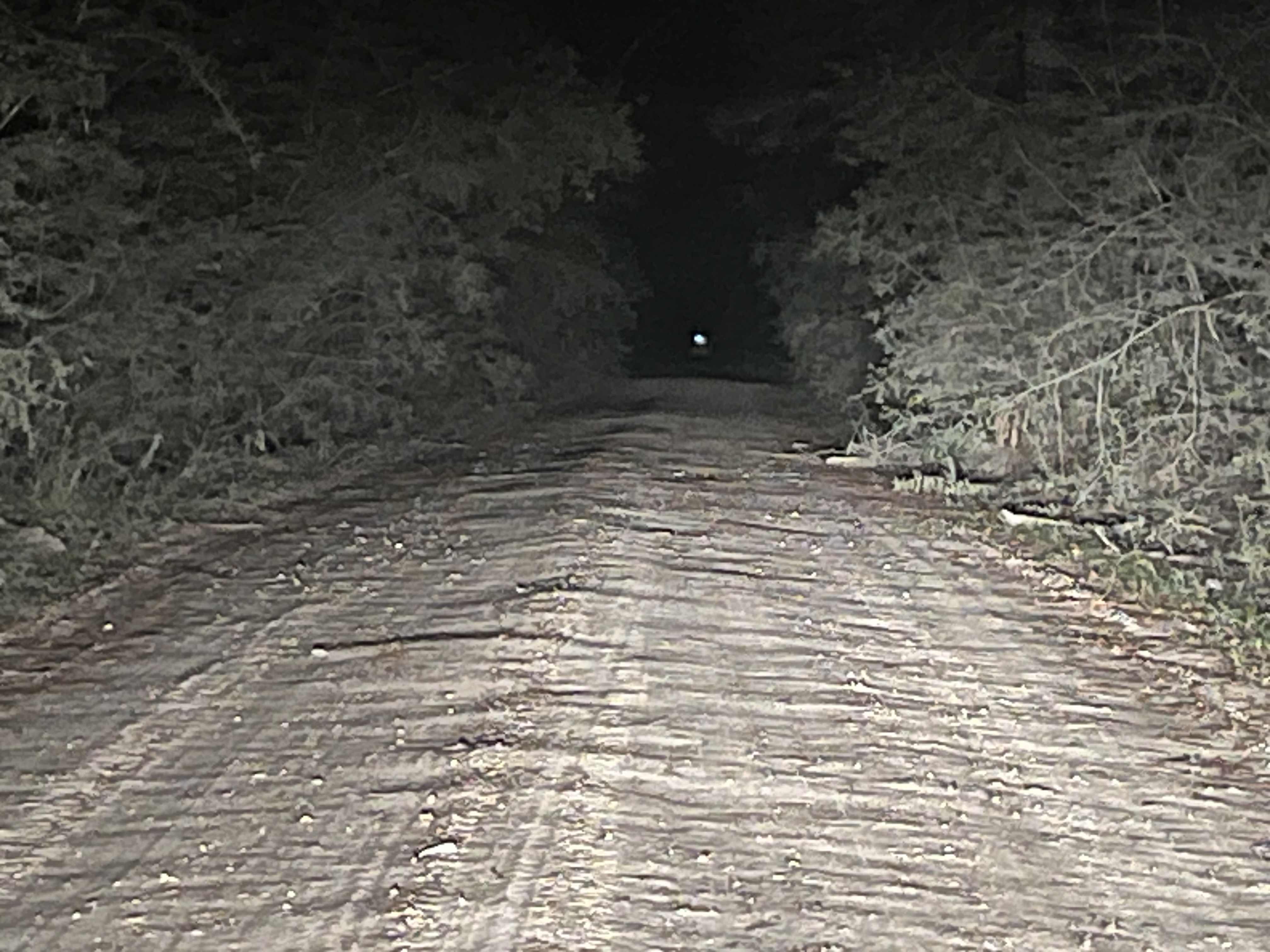
Light of Saratoga – Bragg Road Ghost Lights
Bragg Road cuts eight miles through the Big Thicket of Southeast Texas in a line so straight it looks drawn with a ruler, a dirt track running north-south between Farm-to-Market Road 787 near Saratoga and Farm-to-Market Road 1293 near the ghost town of Bragg Station in Hardin County. During the day it is an unremarkable passage through dense piney woods, the canopy closing overhead in a green tunnel, the sandy road wide enough for two cars with a few small turnouts along its length. At night it becomes something else entirely. The trees block out all ambient light. The darkness is absolute. And somewhere down the road, almost every time someone drives it after dark, a light appears—a single orb, roughly the size of a small pumpkin, hovering at an indeterminate distance, shifting in color from pale yellow to green to blue, bobbing gently, approaching and retreating but never arriving. It is called the Light of Saratoga, and it has been reported for over a century. The road exists because of the railroad. In 1902, the Gulf, Colorado and Santa Fe Railway cut a survey line through the Big Thicket from Bragg Station to Saratoga, bought right-of-way, and laid tracks to serve the booming East Texas oil fields and the timber industry that was stripping the region's longleaf pine. The Saratoga train made daily trips to Beaumont, hauling oil, logs, cattle, and passengers through some of the densest and most inhospitable forest in the American South. The Big Thicket was swamp and wilderness, thick with cypress sloughs, alive with snakes, mosquitoes, and malaria. Railroad crews suffered casualties from accidents and disease, and the work of maintaining the line was brutal. By 1934, the railroad had become obsolete. The rails and ties were pulled up, but the roadbed remained—arrow-straight, flat, and useful enough that it became a link road for local traffic. No one built along it. No one claimed it. The road simply existed, a corridor through darkness that no longer served any industrial purpose. The ghost light was reported while the tracks were still down. The earliest accounts predate automobile traffic in the area, which eliminates the most common skeptical explanation—that the light is a refraction of headlights from a nearby highway. The highway in question, FM 787, can only be seen from the south end of the road, while the light is typically observed facing north. Reports increased after the rails were removed, and in the summer of 1960, Archer Fullingim, the editor of the Kountze News, began running front-page stories about the phenomenon. Metropolitan newspapers across Texas picked up the coverage, and Bragg Road entered the broader public consciousness as one of the most persistently haunted locations in the state. The legends that have attached themselves to the light share a common architecture. The most widely told involves a railroad worker—sometimes a brakeman, sometimes a conductor—who was decapitated in a train accident on the Saratoga line. His body was recovered but his head was never found, and the light is his lantern, still swinging as his headless ghost walks the roadbed searching for what was taken from him. A second story involves a newlywed bride who wandered away from a nearby hotel after her wedding and never returned. Her groom seized a lantern and spent every night of his remaining life walking Bragg Road looking for her, and the light is the residue of that search, carried forward past his death. A third, grimmer tale holds that a Mexican road crew was murdered by their foreman rather than paid their accumulated wages. The workers were buried hastily in the dense woods alongside the road, and their restless spirits haunt the ground that cost them their lives. None of these stories have been historically corroborated. What has been corroborated, by generations of witnesses, is the light itself. Visitors describe it appearing most often in the early evening, hovering at a distance that makes it impossible to judge size or proximity. It shifts color. It moves laterally and vertically in ways inconsistent with a fixed light source. It does not grow larger or brighter as one approaches—a behavior incompatible with oncoming headlights. Some witnesses describe it darting toward their vehicles at startling speed before vanishing. Others watch it bob gently for minutes before winking out. The experience is consistent enough to constitute a rite of passage for East Texans, who have been driving their friends and children out to Bragg Road after dark for as long as anyone can remember. The scientific explanations are plausible but incomplete. Will-o'-the-wisp—the combustion of swamp gases such as methane and phosphine—is a documented phenomenon in wetlands worldwide, but no laboratory has successfully reproduced it under controlled conditions, and some observers note that Bragg Road does not run through active swampland. Atmospheric refraction of distant light sources is possible along a straight, flat corridor, but the light's behavior does not match the predictable characteristics of refracted headlights. The road is maintained as a park by Hardin County, with weathered historical signs at each end describing the railroad era and the oil boom that brought it into being. Four cemeteries sit in the surrounding woods. Today, Bragg Road remains open and drivable, though it is unpaved and can become impassable after heavy rain. The nearest town is Saratoga, birthplace of country legend George Jones, roughly sixteen miles west of Kountze. There is no admission, no gate, no guide. You drive in from one end, kill your headlights if you dare, and wait. The peepers sing. The fireflies drift. And somewhere ahead, more often than not, a light appears in the darkness that has no business being there—steady, shifting, patient, and impossible to reach. Whether it belongs to a headless brakeman, a heartbroken groom, a murdered road crew, or a pocket of burning gas that science cannot quite replicate, the Light of Saratoga has been answering the darkness on Bragg Road for over a hundred years, and it shows no sign of going out.

Cornstalk Hotel
Standing on the 900 block of Royal Street in the French Quarter, the Cornstalk Hotel is among the most photographed buildings in New Orleans—though not for its ghosts. What catches the eye first is the cast-iron fence that gives the hotel its name: an elaborate design of cornstalks rising from a base of pumpkins, with vines, morning glories, and a butterfly adorning the front gate. It is a whimsical feature utterly out of place in the subtropical landscape of southern Louisiana, and it has a story attached to it that has become inseparable from the building itself. The land at 915 Royal Street has been occupied since at least 1730, though all early structures were destroyed during the Great Fires of New Orleans in the 1790s, which leveled vast stretches of the French Quarter. The current brick building was constructed around 1816 for Francois Xavier Martin, a towering figure in Louisiana legal history who served as the state's first attorney general and later as Chief Justice of the Louisiana Supreme Court. Martin presided over some of the most consequential cases of antebellum Louisiana, including the landmark Miller v. Belmonti, which addressed the freedom of a woman unjustly held in slavery. He sold the Royal Street property around 1826 and died in 1846. By 1834, the home had passed to Dr. Joseph Secondo Biamenti, and it was during the Biamenti era that the famous fence appeared. According to the most commonly told version of the story, Dr. Biamenti's wife, who had come from Iowa, grew desperately homesick for the cornfields and open landscapes of her native Midwest. Unable to coax corn from the swampy New Orleans soil, the doctor commissioned the ornamental iron fence from the Philadelphia firm of Wood and Perot, surrounding the property with a permanent reminder of home. Whether the gesture succeeded in curing her homesickness is not recorded. The building passed through numerous owners in the decades that followed. It is claimed that Harriet Beecher Stowe stayed at the residence for a time and witnessed the nearby slave markets firsthand—experiences that may have influenced her writing of Uncle Tom's Cabin. By the twentieth century, the property had been converted into a small hotel, and its guest list grew to include Elvis Presley, who lived at the Cornstalk while filming King Creole in 1958, as well as Bill and Hillary Clinton, Richard Burton, Elizabeth Taylor, and Paul Newman. The hotel's fourteen rooms, each furnished with antiques, canopy beds, stained glass, chandeliers, and rosette scrollwork reminiscent of Louisiana plantation craftsmanship, made it a destination for visitors seeking an intimate alternative to the Quarter's larger establishments. The Cornstalk Hotel was placed on the National Register of Historic Places. The paranormal claims at the Cornstalk are quieter and more elusive than those at many of New Orleans' more aggressively haunted hotels, but they have accumulated steadily over decades. The most frequently reported figure is a woman seen on the upper floors, typically described as wearing a dark or black dress with her hair pulled into a bun. Former hotel manager Ryan Knight, who spoke publicly about the hauntings, described guests reporting this wispy figure moving along the back staircase and hallways, sometimes pausing near a window where observers from across the street have watched her stand motionless before slowly vanishing. Knight himself experienced spectral whispers in empty rooms late at night. The figure does not appear to interact with the living and may represent a residual impression rather than an active presence, though her identity has never been established. Guests have also reported the sounds and sights of ghostly children playing on the hotel's front lawn and running through hallways, though no documented deaths of children at the property have been found. Some visitors have discovered photographs on their cameras taken during the night—images they did not take and could not explain, as their rooms remained locked from the inside. Dresser drawers have been found pulled open or placed on the floor in rooms where guests insist they never touched the furniture. Cold spots have been noted in certain bedrooms. A grandfather clock in the hotel is said to behave erratically, keeping its own time independent of any mechanical explanation. The overall character of the haunting is described by staff and guests alike as nonaggressive—curious rather than threatening, as if whatever lingers in the building is simply unwilling to leave. The Cornstalk Hotel closed in 2020 during the COVID-19 pandemic and has not reopened as of this writing, though the property was listed for sale and management arrangements have been announced. The iconic fence still stands along Royal Street, and ghost tour groups still stop on the sidewalk to point up at the windows. Whether the woman with the bun is still looking back is something only the next guests to walk through the door will be able to say.
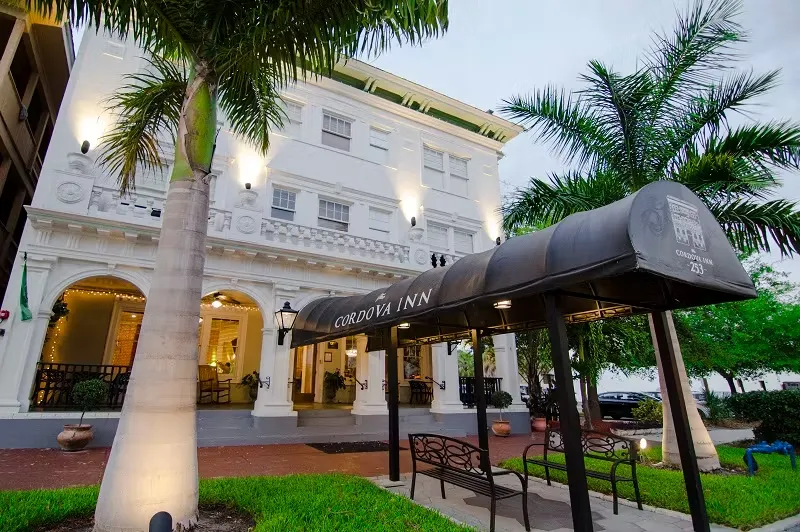
The Cordova Inn
At 253 Second Avenue North in downtown St. Petersburg, Florida, a three-story Renaissance Revival building sits half a block from the Sundial shopping district, looking much the way it did when it first opened in 1921. The Cordova Inn is not the grandest of St. Petersburg's boom-era hotels—it never competed with the Vinoy or the Don CeSar for celebrity guests—but it is among the oldest, and its quieter history carries a weight those larger landmarks don't always match. Built by Francis Scott during the opening surge of the Florida Land Boom, the hotel originally operated as The Hotel Scott. It arrived at the moment when rising postwar prosperity and the spread of the automobile turned Florida's Gulf Coast into one of the most frenzied real estate markets the country had ever seen. St. Petersburg's population exploded in the early 1920s, and small hotels like The Scott sprang up to house the tourists, speculators, and seasonal residents flooding the area. The building was constructed of masonry with scored stucco designed to resemble stone, its facade detailed with five keyed arches, a balustrade topped with decorative urns, and a projecting cornice along the roofline. Inside, thirty-two rooms were fitted with clawfoot soaking tubs—many of which survive today. By 1923, the hotel had changed hands and been renamed the Hotel Cordova, after the family that would operate it for three decades. The Cordovas sold in the early 1950s, and for the next half century the property passed through multiple owners. As downtown St. Petersburg declined through the 1970s and 1980s, the hotel declined with it. By the late 1990s the surrounding blocks were considered undesirable after dark, and the Cordova closed in 1999, sitting empty on a street it had anchored for nearly eighty years. A local investor completed a full restoration, reopening it as The Pier Hotel in 2001—earning the St. Petersburg Preservation Society's Restoration of the Year Award. In 2014 the property reclaimed its historic name. It is a contributing property to the Downtown St. Petersburg Historic District on the National Register of Historic Places. The central figure in the hotel's haunting is not a guest or an owner but a member of the staff—the Major-domo, the building's head butler. According to the hotel's own published history, this man devoted twenty years to the Cordova's guests before dying inside the building he had served. The circumstances of his death are not widely detailed, but the hotel does not shy from acknowledging the story. During the years the building sat vacant before restoration, schoolboys who broke in at night reportedly heard howling in the empty hallways—sounds attributed to the displaced Major-domo protesting the abandonment of his post. Ghost tours in St. Petersburg have included the Cordova on their routes for years, and local paranormal investigator Brandy Stark has featured the hotel in her downtown walking tours. Guest accounts have accumulated steadily since reopening. Visitors describe the apparition of a well-dressed man in an old-fashioned suit, widely believed to be the Major-domo. Some employees have concluded this figure has helped protect the building from neglect—a guardian rather than a threat. But overnight experiences suggest something more complicated. Multiple visitors describe being woken by a sharp burst of air or a whispered word in their ear. Others report sleep paralysis accompanied by sensations of being touched or held down. One guest described hearing two women standing over them discussing a man who would be displeased with their belongings. The second and third floors generate the most reports. The staircase between them is a recurring point of interest—visitors describe sudden heaviness or a feeling of presence while ascending. Cold spots appear without explanation. A sulfurous smell has been noted near Room 208. The building's age explains some of this. A century-old masonry structure without elevators, with original plumbing and narrow corridors, will produce sounds modern buildings do not. Guests primed by the hotel's openly acknowledged reputation may interpret ambiguous input accordingly. But the specificity of many accounts—the whispered names, the paralysis, the smell—pushes beyond what settling wood and old pipes typically produce. Today the Cordova Inn operates as a boutique hotel with its original thirty-two rooms, a lobby bar called The Scott, a fireplace, a small library, and a veranda. There is no elevator—guests climb the original staircases, just as they did in 1921. Whether the Major-domo is still making his rounds depends on who you ask and what floor you're sleeping on. But the building remains what it has been for over a century: a place built to welcome strangers, where at least one longtime resident appears unwilling to stop doing exactly that.

Bottger Mansion of Old Town
The Bottger Mansion sits at 110 San Felipe Street Northwest in Old Town Albuquerque, half a block from the historic plaza where the city's story began in 1706. It is the last of the four original mansions that once anchored this neighborhood—the only one still standing virtually as it was built—and it operates today as Old Town's sole bed and breakfast, an intimate inn surrounded by adobe walls, cottonwood shade, and three centuries of layered New Mexico history. The current owners will tell you plainly that the house is not haunted. Ghost tour operators, paranormal investigators, and a steady procession of overnight guests disagree. The truth, as with most things in Albuquerque, probably lives somewhere in the space between. The property's history predates the mansion itself. In the 1700s, a sprawling 40-room adobe complex occupied this site, serving at various points as a residential compound and, according to some accounts, as the governor's mansion during territorial New Mexico. That structure was long gone by the time Charles Bottger arrived. Bottger was a German-born wool exporter who had made his fortune after immigrating to New Jersey. He relocated to New Mexico to position himself closer to the Native American sheep ranchers who supplied his trade. He acquired the property in the 1890s, and construction on the current American Foursquare-style mansion began in 1905, finishing around 1907. In addition to the house, Bottger owned a saloon just west of the property—now a parking lot—and a toll bridge over the Rio Grande. He was, by the standards of early twentieth-century Old Town, a man of considerable reach. Three generations of the Bottger family lived in the mansion before it was sold and began passing through a series of owners and uses that read like a compressed history of Albuquerque itself. During the 1940s, a small colony of Buddhists occupied the house. Later it housed a restaurant on the ground floor, a boarding house and beauty salon upstairs. The guest list over the decades was improbable. In 1955, a young Elvis Presley, traveling with Bill Black and Scotty Moore, performed two shows in Albuquerque and stayed at the Bottger before heading to Amarillo. In the late 1950s, Frank Sinatra attended a wedding at the mansion and performed in the courtyard after dinner. And in the 1940s, FBI most-wanted fugitive George "Machine Gun" Kelly, along with his girlfriend and gang members, checked in under assumed names while on the run from California to Memphis. They had dyed their hair and bought new clothes as disguises, but the owners grew suspicious when the group refused to leave their rooms, instead sending a neighborhood boy out to fetch all their meals. The owners moved to notify police, but a gang member overheard and the group fled just ahead of the law. They were captured shortly afterward. The paranormal reputation of the Bottger Mansion centers on three reported presences. The first is Charles Bottger himself, whose spirit is said to linger in the halls of the house he built, felt rather than seen—a residual sense of ownership that visitors describe as watchful but not hostile. The second is a female figure known simply as the sighing woman, whose audible sighs have been reported echoing through rooms at odd hours, evoking grief or longing from a period no living person can identify. The third, and most discussed, is an entity referred to as "the Lover"—a figure reported by female guests who describe the sensation of someone sitting on the edge of their bed while they sleep. The identity of this presence has never been established, and the accounts, while consistent in their description, resist easy historical attribution. Other reports include disembodied footsteps, the feeling of being watched in otherwise empty rooms, and a general atmosphere that some visitors describe as heavy or charged, particularly in the older sections of the building. One person who grew up near Old Town in the 1980s reported seeing apparitions and hearing unexplained sounds in and around the mansion over a period of years. Paranormal investigators, including Cody Polston of the Southwest Ghost Hunter's Association, have documented the site extensively, and it features prominently in walking ghost tours of Old Town. The current owners take a measured and somewhat bemused position. Their website states flatly that the Bottger Mansion has had no ghosts since 1912, and they ask that guests refrain from conducting ghost hunts that might disturb other visitors. They also note, with evident frustration, that nearly every published history of the mansion contains factual errors—a 1978 survey of Albuquerque landmarks reportedly got everything wrong except the street address. Practitioners of feng shui who have stayed at the property describe the house as having good energy and a peaceful atmosphere, which either contradicts the haunting claims or suggests that whatever occupies the Bottger has no particular quarrel with the living. Today the Bottger Mansion operates as an award-winning bed and breakfast, offering individually appointed rooms, house-made cookies, and locally inspired breakfasts within steps of Old Town Plaza. The San Felipe de Neri Church, founded in 1706, stands nearby. The Sandia Mountains rise to the east. The house itself remains structurally intact from its original construction, the last of Old Town's great mansions still standing in its original form. Whether its halls hold the residue of Charles Bottger, a sighing woman, a boundary-challenged Lover, or simply the accumulated weight of three centuries of human occupation on a single piece of high-desert ground, the Bottger Mansion remains a place where Albuquerque's past is not abstract—it is the floor beneath your feet and, by some accounts, the presence at the edge of your bed.
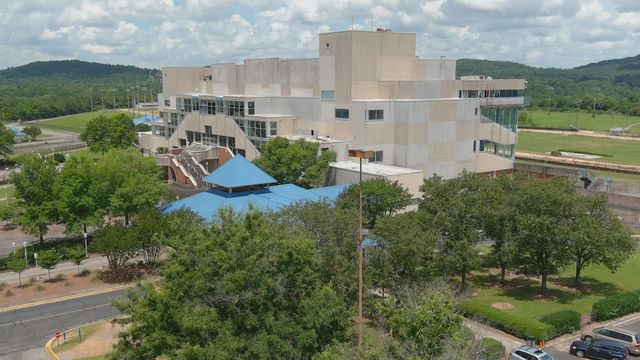
Birmingham Racecourse
Sitting on a sprawling 330-acre parcel just east of downtown Birmingham, the Birmingham Race Course doesn't look like a place that carries much mystery. Its grandstand is utilitarian, its parking lot vast and often half-empty. But the track has a history shaped more by ambition, disappointment, and collapse than by the pageantry of the sport it was built to celebrate — and beneath that history runs a thread of paranormal lore anchored to the land itself. The facility opened on March 4, 1987 under the name the Birmingham Turf Club, conceived as a showcase for thoroughbred horse racing in the Deep South. Backers envisioned a destination drawing gamblers and racing fans from across the region. Legendary jockey Willie Shoemaker recorded TV commercials from the winner's circle. The Birmingham Inaugural Stakes drew more than 13,000 fans on opening night, and the $85 million facility was heralded as a new era for Alabama entertainment. But the momentum collapsed almost immediately. Only a fraction of that opening crowd returned the following night, and the track bled money — reportedly losing up to $100,000 a day in its early weeks. It went bankrupt and shuttered within its first year. Delaware North Companies bought the property and reopened it in 1989, but it closed again by 1991. Greyhound racing magnate Milton McGregor purchased the course the following year and lobbied successfully to bring dog racing to the facility. For a few years, horses and greyhounds ran in alternating races on the same track. The combined betting handle peaked at $163 million in 1993, then began a long, steady decline. Live horse racing was abandoned entirely in 1995. The track reinvented itself multiple times — nightclub, boxing venue, home to the Alabama State Fair, and eventually a facility relying on simulcast wagering and slot-like historical racing machines. McGregor died in 2018. Live greyhound racing ended March 18, 2020. In April 2025, the Poarch Band of Creek Indians completed the purchase through their gaming arm, Wind Creek Hospitality, with plans to redevelop it into a destination resort. The paranormal claims trace back to the facility's very foundation. Accounts circulating for decades hold that the Race Course was constructed over an ancient Native American burial ground. Whether that claim can be formally verified, the land sits in a region deeply marked by Indigenous history — Creek and Cherokee peoples inhabited central Alabama for centuries before European settlement, and the broader Jefferson County area contains numerous known and undocumented ancestral sites. That history has shaped how visitors and staff interpret what they experience there. Employees working late hours have reported shadowy figures standing out on the darkened racecourse — present one moment, gone the next. The stables have drawn particular attention, with accounts of maniacal laughter and disembodied voices coming from areas where no one is present. Phantom hoofbeats have been reported on various parts of the property, a detail that carries specific weight in a place built around the sound of animals running. Visitors describe feeling suddenly and inexplicably watched, an ambient unease with no visible source. What gives the Birmingham Race Course an unusual quality among haunted locations is the layering of its story. The land may predate American settlement by centuries. The facility built upon it was born amid grand promises and failed almost immediately, repeating that cycle several times over three decades. And its new owners are the Poarch Creek Indians — the only federally recognized tribe in Alabama, and the direct descendants of the peoples whose ancestral territory once included this very ground. Whether that represents a closing of a circle is a matter of interpretation. The grandstand still stands, the racing machines still run around the clock, and the long corridors between the old stables sit in the particular silence of places that once held much more life than they do now.

Boone Hall Plantation
Boone Hall Plantation stands as a significant and architecturally distinctive property in Mount Pleasant, South Carolina, representing a complex historical institution encompassing land use, labor systems, architectural achievement, and the cultural dimensions of American slavery. The property features extensive grounds, slave cabin structures, plantation buildings, and landscape elements documenting the material conditions of plantation agriculture during the nineteenth century and earlier colonial period. The avenue of live oak trees characteristic of Boone Hall has become iconic within South Carolina's plantation tourism landscape, representing aesthetic traditions through which plantation owners created environments reflecting wealth and cultural sophistication. The plantation operated as a commercial agricultural enterprise producing export commodities, relying fundamentally upon enslaved labor to generate wealth supporting the planter elite and American capitalist development. Boone Hall Plantation represents a historical institution built upon foundational systems of human slavery, violence, and dispossession that created conditions of extreme suffering for millions of African Americans held in bondage within the American South. The slave cabins, particularly Cabin 11, mark physical spaces where enslaved families were housed, lived, worked, and experienced the profound trauma of human bondage and forced labor. The brickyard area indicates sites of intensive labor production where enslaved individuals manufactured building materials, generating additional wealth through unrecompensated work. The plantation landscape embodies contradictions between aesthetic beauty and historical brutality, with natural elements depending fundamentally upon the suffering and violent exploitation that characterized slavery as an institution of human oppression. The paranormal phenomena at Boone Hall encompass multiple spiritual entities reflecting diverse human experiences within the plantation environment. A little girl in a pale dress manifests in residual haunting patterns since 1956, her spiritual presence suggesting either a child born into slavery or a planter family child whose death occurred on the property. The manifestation features distinctive jerking hand movements possibly referencing labor activity or emotional disturbance. A soldier from the late 1600s has been documented, suggesting potential military history predating the plantation era. Enslaved spirits manifest throughout the property, particularly within slave cabins where they lived and died, their presence representing accumulated spiritual weight of bondage, suffering, and forced labor experienced across generations within specific physical spaces. Boone Hall Plantation has recognized its paranormal reputation and developed programming around paranormal investigation, including "Fright Nights" events positioning the plantation as a destination for paranormal research and ghost hunting. The plantation remains open for public visitation and tourism, with management incorporating awareness of paranormal phenomena into contemporary historical interpretation. Paranormal activity at Boone Hall represents one of the most prominent manifestations at American plantation sites, with multiple research organizations conducting ongoing investigations. The presence of spirits connected to slavery and plantation labor presents contemporary visitors with the spiritual reality of historical trauma and the apparent persistence of human consciousness tied to places of suffering and injustice, exemplifying how paranormal activity represents historical memory—continued spiritual presence giving expression to historical atrocities resisting simple forgetting.
Gilbert’s Bar – House of Refuge Museum
Gilbert's Bar stands as an exceptionally well-preserved historical structure on Hutchinson Island near Stuart, Florida, representing one of the oldest surviving coastal buildings in the state and now functioning as a museum dedicated to maritime rescue history. The building was constructed in 1876 as part of the Life-Saving Service, a precursor organization to the modern United States Coast Guard, during an era when maritime disasters along Florida's treacherous eastern coastline claimed numerous vessels and lives annually. The isolated bar formation that gives the location its name created particular navigational hazards for sailing ships and early steamships attempting to traverse the waters around Stuart, with numerous documented wrecks contributing to a maritime graveyard character. The Life-Saving Service selected this location for installation of a rescue station recognizing its critical position in waters where human intervention could mean the difference between survival and drowning for desperate sailors and shipwreck survivors. The original structure was built to accommodate a station keeper and rescue crew, providing barracks space, storage for rescue equipment, and an observation post monitoring coastal waters for vessels in distress. Historical records document that the first lighthouse keeper assigned to maintain operations at Gilbert's Bar was Joseph Andreu, whose tenure represented one of the early chapters in the facility's operational history. Andreu's duties included maintaining signal lights, documenting maritime traffic, and coordinating rescue operations with available personnel during emergency conditions. The work was dangerous and often monotonous, with long periods of isolation and routine maintenance interrupted occasionally by terrifying maritime disasters. One particularly significant tragedy occurred when a member of the Life-Saving Service staff fell from the upper reaches of the structure while engaged in painting and maintenance work, a fall that proved fatal and left the workers traumatized by the accident. Beyond the documented death of this keeper, historical records reference a daughter of Hezekiah Pity, a significant coastal figure, who also met tragic circumstances associated with the property. The Ais Indian tribe occupied these coastal territories for centuries before European colonization, leaving cultural and spiritual imprints upon the landscape despite their eventual displacement. The convergence of indigenous presence, maritime tragedy, and violent death created a multilayered historical complexity at Gilbert's Bar particularly conducive to paranormal manifestation. Pararormal phenomena reported at Gilbert's Bar consistently emphasize sensory experiences rather than visual apparitions, creating an atmosphere characterized by unusual olfactory and acoustic manifestations. Visitors and staff members frequently report smelling the distinctive aroma of beef stew emanating from the kitchen area, despite no preparation of food occurring in the building at the time of observation. The phantom cooking smell persists for extended periods and recurs on multiple occasions, suggesting either residual haunting energy replaying kitchen activities or the continued presence of spirits engaged in habitual behaviors. Additional phenomena include the mysterious appearance of mirror shards discovered in bedding and sleeping areas despite no mirrors being broken or located in those specific spaces, suggesting paranormal manipulation of objects or displacement from their original locations. Apparitions of human figures dressed in period-appropriate clothing consistent with late nineteenth century garments move through the building, apparently engaged in historical activities or repetitive behaviors associated with their lives at the station. The House of Refuge at Gilbert's Bar now operates as a museum property, with tour guides routinely discussing paranormal phenomena as integral to the site's historical significance and educational mission. Paranormal investigation groups have documented electromagnetic field anomalies corresponding to areas where apparitions are most frequently observed.
Bonaventure Cemetery
Bonaventure Cemetery occupies former Bonaventure Plantation grounds in Savannah, Georgia, with deep historical roots extending into colonial and antebellum American history. The cemetery was established in 1846 when land was sold to Peter Wiltberger, transforming plantation landscape into burial ground serving Savannah community. The land previously functioned as Bonaventure Plantation, originally owned by Colonel John Mullryne within antebellum South plantation economy. The transition from plantation to cemetery marked significant transformation in location's purpose, converting agricultural and residential space into deceased repository. The establishment reflected Savannah's need for burial space as city population expanded and earlier cemeteries became full. The location's elevation and natural beauty with moss-draped live oaks made it attractive for serving as burial ground and contemplative landscape. In 1907, Savannah purchased Evergreen Cemetery Company and renamed facility Bonaventure Cemetery, consolidating operations and establishing current framework. The cemetery expanded over subsequent decades with additional land acquisition and burial sections serving different family groups. The extensive development as major burial facility transformed Bonaventure into Savannah's most significant landscape features. The cemetery developed reputation for natural beauty, with visitors appreciating the dramatic landscape formed by massive live oak trees, ornate monuments, and landscaped sections. The distinctive aesthetic with moss-draped oaks creating cathedral-like spaces contributed to recognition as one of America's most beautiful and distinctive cemeteries. Paranormal phenomena at Bonaventure Cemetery are believed centered on specific individuals and historical narratives. Little Gracie Watson, who lived from 1883 to 1889, died at young age and was buried with distinctive marble monument marking her grave. Gracie's spirit is believed inhabiting the cemetery, with paranormal researchers and visitors reporting child spirit encounters near her grave location. The tragedy of childhood death created strong paranormal manifestations at burial location. The 'Eternal Dinner Party' phenomenon involves spirits apparently reenacting social gatherings, suggesting residual hauntings of historical events. Eighteenth-century plantation guests are believed responsible for these manifestations, their spirits potentially reenacting antebellum formal social gatherings. Paranormal investigations have extensively documented location phenomena, with paranormal research teams recording multiple spirit evidence. Apparitions have been observed throughout cemetery including full-bodied figures appearing near graves. Disembodied voices have been recorded during investigations and reported by visitors. Unexplained sounds including footsteps, musical passages, and social gathering sounds have been documented, supporting eternal dinner party reports. Mysterious mist has been observed forming in specific cemetery areas, creating ethereal phenomena without meteorological cause. Cold spots have been detected throughout, creating temperature differentials consistent with paranormal energy. Paranormal activity is distributed throughout rather than concentrated, suggesting multiple distinct hauntings. Bonaventure Cemetery today remains active burial ground and major Savannah cultural and tourist destination, attracting thousands of visitors annually. The cemetery has been featured extensively in paranormal literature and television programming. Ghost tours have become cultural offerings associated with cemetery, with professional companies offering guided paranormal exploration. The coexistence of ongoing burials, tourism, and paranormal activity creates unique environment where multiple purpose layers overlap.
Felt Mansion
The Felt Mansion stands as a testament to American industrial prosperity and romantic tragedy, a palatial 25-room estate comprising more than 12,000 square feet of meticulously designed residential space set upon substantial grounds in Holland, Michigan. The mansion was constructed in 1928 by Dorr E. Felt, an innovative inventor and entrepreneur whose mechanical and manufacturing achievements had earned him considerable wealth and social prominence. Felt commissioned the mansion as a romantic gesture for his wife Agnes, intending the elaborate residence to serve as a suitable home for a marriage that appeared to represent the pinnacle of early twentieth-century domestic aspiration and achievement. The construction employed the finest available materials and craftsmanship, with architectural details and interior appointments that reflected contemporary high-society aesthetic standards. The residence featured a grand ballroom designed for hosting the social gatherings that formed the center of the couple's social world, a library stocked with volumes reflecting their intellectual interests, and private chambers appointed in contemporary luxury. The completion of the Felt Mansion represented the fulfillment of a romantic vision that seemed destined for years of joyful occupation and social prominence. However, the trajectory of the residence took an unexpected and tragic turn that would establish its reputation as one of Michigan's most actively haunted properties. Agnes Felt, for whom the magnificent home had been specifically constructed, died unexpectedly only six weeks after moving into the residence she had anticipated occupying for decades. The sudden loss of his wife shortly after the completion of this monumental romantic gesture left Dorr Felt to inhabit the mansion alone, surrounded constantly by reminders of the joy he had anticipated but would never experience. The psychological weight of occupying a home designed specifically to house his marriage, now transformed into a monument to loss and disappointed expectations, would mark the residence indelibly. Following Agnes Felt's unexpected death, paranormal investigators and residential staff have consistently reported encounters with a female presence throughout the mansion, most notably within the library, the grand ballroom, and most intensely within Agnes Felt's personal bedroom chambers. Witnesses describe encountering full-bodied apparitions of a woman in period clothing who moves through the spaces with purposefulness and awareness, occasionally acknowledging the presence of living observers. Shadow figures move independently through the halls, and visitors report feelings of sudden intense emotional experiences including profound sadness, romantic yearning, and resigned acceptance in specific locations associated with Agnes's likely movement through the residence. The Felt Mansion remains standing in Holland, Michigan, preserved and accessible to paranormal researchers and curious visitors who wish to experience directly the presence that many believe represents Agnes Felt's continued occupation of the home. The residence has become a destination for paranormal investigation teams seeking to document evidence of intelligent haunting and residual phenomena, with multiple teams having recorded compelling audio and visual evidence of the mansion's otherworldly inhabitants. The love that motivated Dorr Felt to commission such an elaborate residence appears to have transcended mortality itself, with Agnes's continued presence suggesting that emotional bonds extended beyond the threshold of physical death. The mansion stands as both a monument to romantic aspiration and a reminder of how quickly circumstances can transform paradise into tragedy.
Birch Hill Cemetery
Birch Hill Cemetery in Fairbanks, Alaska stands as one of the northernmost significant burial grounds in the United States, occupying terrain in a frontier town where death rates were historically high due to harsh environmental conditions, industrial accidents, epidemic diseases, and the dangerous circumstances of mining operations and frontier settlement. The cemetery was established during Fairbanks' early development as a gold mining camp in the early 1900s, a period when the Alaska interior was experiencing rapid population expansion driven by gold discoveries and the rush of prospectors seeking fortune in remote northern territory. The burial ground reflects the diverse population and circumstances of frontier Alaska, containing graves of miners, early residents, Indigenous peoples, railroad workers, and other individuals whose deaths occurred in a remote region lacking formal governmental administrative structures. The cemetery occupies elevated terrain in the Fairbanks area, a geographic feature that made it suitable for burial purposes while providing commanding views of the surrounding landscape. During the decades following its establishment, Birch Hill Cemetery accumulated hundreds of graves representing the accumulated deaths of Fairbanks residents across multiple generations. The cemetery evolved into a repository of frontier history, with grave markers and burial records documenting the names, dates, and often brief biographical information about individuals whose lives and deaths contributed to the development of Alaska's interior region. Many graves date to the early twentieth century when mortality rates were substantially higher and causes of death ranged from disease and accidents to violence and suicide. Some burial sites lack clear historical documentation, particularly graves of Indigenous individuals and marginalized populations whose deaths may have been recorded inadequately if at all. The cemetery's appearance reflects the harsh environmental conditions of the Arctic and subarctic climate, with frost-heave and permafrost dynamics causing ground disturbance that require constant maintenance and monitoring. Paranormal phenomena documented at Birch Hill Cemetery center on the apparition of the "White Lady," described as the translucent spirit of a woman dressed in early twentieth-century era clothing and wearing period fashions consistent with the decades following 1900. Sightings of the White Lady have been reported consistently since the 1930s, appearing primarily in the cemetery's pathways and among the grave markers, particularly during twilight hours and under certain atmospheric conditions. Supplementing the White Lady apparition are reports of additional spirits, specifically the apparitions of a small girl and a small boy, suggesting that multiple child deaths are represented among the cemetery's paranormal phenomena. Paranormal investigators have captured electronic voice phenomena recordings and photographic images of orbs that appear consistently in the cemetery, particularly around the grave sites of child burials. The combination of multiple documented entities, consistent historical reports spanning more than eighty years, and contemporary paranormal investigation evidence places Birch Hill Cemetery among Alaska's most significant paranormal locations. Birch Hill Cemetery today remains a functioning burial ground and historical site, continuing to serve the community of Fairbanks while simultaneously maintaining its reputation as one of the city's most actively haunted locations. The cemetery is accessible to the public for visitation and grave maintenance, though the paranormal phenomena and harsh environmental conditions create unique challenges for visitors. Contemporary paranormal investigators have established Birch Hill as a significant research location, with documented investigations producing consistent evidence of multiple entities and residual haunting phenomena. The White Lady and her companion child spirits appear to represent a permanent spiritual presence anchored to the burial ground, unable or unwilling to depart from the location where they were interred. The cemetery stands as both a historical documentation of Fairbanks' frontier era and as a powerful manifestation of how locations saturated with human death may develop persistent paranormal phenomena that endure across generations.
Slater Mill Historic Site
Slater Mill Historic Site stands as the foundational landmark of American industrial manufacturing, its restored buildings preserving the physical legacy of the textile revolution that transformed the United States economy in the early nineteenth century. Located in Pawtucket, Rhode Island, the mill complex originated in 1790 when Samuel Slater, a British-trained mill worker, established the first successful water-powered cotton spinning mill in America, reproducing textile technology that had previously been closely guarded British secrets. The site's historic designation acknowledges its role as the birthplace of American manufacturing, marking the transition from agrarian economy to industrial production. The original mill building, powered by the Blackstone River, operated continuously as a working textile facility for nearly two centuries, processing raw cotton into finished yarn through increasingly complex mechanized processes that demanded both skilled oversight and relentless human labor. By the early nineteenth century, Slater Mill had expanded dramatically across multiple buildings including spinning mills, storage facilities, and the Sylvanus Brown House, which served as company offices and residential quarters. The expansion reflected the mill's economic success and growing prominence as textile production became central to Rhode Island's prosperity. Working conditions were notoriously harsh, particularly for the mill's extensive workforce of children, many as young as seven or eight years old, who operated spinning frames and other machinery for fourteen-hour workdays. The site became emblematic of American child labor practices, with generations of young workers suffering injuries from unguarded equipment, repetitive stress injuries, and the general hazards of nineteenth-century factory work. Adult workers faced equally dangerous conditions, with inadequate safety standards and machinery designed to maximize production efficiency rather than worker protection. The mill's operational history is darkened by numerous fatal accidents involving workers, particularly those crushed, mangled, or decapitated by unguarded textile machinery. Children's voices and disembodied sounds of distress have been reported throughout the complex for generations, with particular activity centered in the machine rooms where the most dangerous equipment operated. Staff members working at the site have documented unexplained footsteps echoing through empty buildings, items mysteriously displaced in the Sylvanus Brown House despite being secured the previous evening, and the apparition of a young girl identified through paranormal investigation as Becca. The paranormal phenomena intensified during the restoration of the historic site in the late twentieth century, as construction work and renewed human activity appeared to stir residual spiritual energy from the building's traumatic past. Paranormal investigations conducted at Slater Mill have documented shadow figures moving through the spinning rooms, apparitions of workers in period clothing, and full-bodied manifestations of what investigators believe are victims of fatal machinery accidents. Cold spots appear suddenly in areas where serious injuries occurred, and poltergeist-type activity has been recorded including objects moving across surfaces and doors opening and closing without explanation. The phenomena suggest residual hauntings tied to traumatic deaths, with spiritual presences seemingly reenacting final moments of industrial accidents. Visitors and staff frequently report sudden overwhelming feelings of sadness or dread in specific locations, accompanied by the sensation of being watched by unseen observers. The Sylvanus Brown House exhibits particularly strong activity, with investigators documenting unexplained noises in upper floors and the recurring displacement of period furnishings. Today, Slater Mill Historic Site operates as a National Historic Landmark and museum, welcoming thousands of visitors annually to learn about American industrial history and the human cost of the textile revolution. The preservation efforts have transformed the facility into an important educational institution, while simultaneously attracting paranormal researchers and ghost hunters drawn to investigate the persistent supernatural phenomena. The site openly acknowledges its haunted reputation, with tour guides trained to discuss both the historical realities of industrial accident victims and the contemporary paranormal experiences reported by visitors and staff.
Thaddeus Clapp House
The Thaddeus Clapp House in Pittsfield, Massachusetts, stands as a monument to nineteenth-century domestic architecture and historical significance, constructed in 1871 as the private residence of Colonel Thaddeus Clapp, a military officer and civic figure of considerable prominence within the Berkshire region. The residence itself reflects the aesthetic standards and architectural conventions of the post-Civil War era, featuring design elements and interior appointments consistent with the domestic aspirations of a man of Clapp's military rank and social standing. The property's substantial construction and refined architectural detailing suggest a family of refined tastes and considerable financial resources, capable of commissioning quality construction and maintaining the residence to standards reflecting their social position. The house occupies a prominent location within Pittsfield, with its position and architectural distinction making it a recognizable landmark within the historic fabric of the community. The paranormal phenomena occupying the Thaddeus Clapp House display characteristics consistent with residual haunting combined with evidence suggesting continued occupation by entities possessing awareness and apparent purpose. The most frequently reported paranormal manifestation involves the apparition of a woman, presumed by most researchers to be Mrs. Clapp, the wife of Colonel Thaddeus Clapp. Her apparition is described as drifting throughout the residence with apparently purposeful movement and specific routes of travel, suggesting either residual imprinting of habitual paths or intelligent direction of her movements through spaces familiar to her from her life. Multiple observers have reported feelings of warmth, protection, and emotional comfort radiating from her presence, suggesting that despite her death, her emotional disposition toward the house and its inhabitants remains fundamentally benevolent and nurturing. The warmth experienced by those who encounter her presence appears both literal and metaphorical, providing emotional reassurance and a sense of maternal protection. Parallel with the apparitions of Mrs. Clapp, the residence has also been the subject of detailed paranormal investigation by established researchers and paranormal investigation professionals. Most notably, playwright Peter Bergman, a writer of substantial reputation and credibility, claimed direct personal encounter with the ghost of Colonel Thaddeus Clapp himself during investigations undertaken at the residence. Bergman's testimony regarding the encounter with the colonel's apparition carries particular weight due to his professional credentials and his public prominence as an artist rather than a professional paranormal investigator, suggesting his account to be motivated by genuine experience rather than commercial promotion of paranormal activity. The residence continues to function as a private property within Pittsfield's historic district, with the paranormal phenomena remaining active and accessible to researchers and interested observers. The coexistence of the warmth and comfort associated with Mrs. Clapp's presence alongside documented paranormal activity suggests a household that has persisted in some form beyond the deaths of its historical occupants. The Thaddeus Clapp House represents one of New England's most extensively documented cases of benevolent haunting, in which the spirits of the historical occupants appear to maintain connection to the residence while demonstrating awareness of and benevolent disposition toward its contemporary inhabitants.
Beth Elohim Cemetery
Beth Elohim Cemetery, established in 1772, stands as the second oldest Jewish cemetery in South Carolina and among the earliest repositories of Jewish burial in the southeastern United States. The cemetery occupies a location in Georgetown, South Carolina, a historic coastal town with deep roots in colonial American history and maritime trade. The establishment of a Jewish burial ground in eighteenth-century South Carolina reflects the presence of a Jewish community in the colonial Southeast, a demographic reality often overlooked in historical narratives that focus upon European Christian settlement patterns. The cemetery represents over two and a half centuries of continuous Jewish burial practice, serving families and individuals across generations who chose or were constrained to establish their eternal rest in this location. The cemetery's architectural and botanical character has evolved across centuries, with graves representing different eras of burial practice, different aesthetic expressions of grief and remembrance, and different cultural traditions associated with Jewish funeral and mourning customs. The physical structures of the cemetery, the headstones and monuments inscribed with names and dates, function as a material record of lives and deaths across time. Yet the cemetery contains more than physical markers: it contains the spirits of those whose deaths created sufficient emotional trauma or unfinished business to transcend the boundary between life and afterlife. Among the graves and spirits of Beth Elohim Cemetery, two figures stand out with particular prominence in the documented paranormal history of the location. Pauline Moses and Eliza Munnerlyn were young women whose lives became intertwined through deep friendship and whose deaths occurred within days of each other in devastating proximity to events of profound personal importance. The two women were best friends, a relationship that bound them together emotionally and socially within the community. Both were engaged to be married, with weddings planned and anticipated in the manner of young women approaching the significant transition to married life. Yellow fever, the devastating disease that periodically swept through coastal American communities during the eighteenth and nineteenth centuries, struck the Georgetown area, creating epidemic conditions that spread rapidly through the population. The disease killed indiscriminately, claiming young and old, wealthy and poor, without regard to social status or apparent health. Pauline Moses and Eliza Munnerlyn both contracted yellow fever and died within days of each other, their deaths occurring just before the weddings they had anticipated. The tragedy of dying at the threshold of new life, separated from marriage by mere days, created profound emotional impact that apparently proved sufficiently powerful to prevent the two women's spirits from departing. Following their burials at Beth Elohim Cemetery, witnesses began reporting paranormal phenomena concentrated at the graves of these two young women. The most consistent paranormal manifestation involves the sound of girls' laughter echoing through the cemetery grounds, a phenomenon that has been reported across many generations and by multiple independent witnesses. The laughter carries a quality of youthful happiness and carefree joy, a sound that creates cognitive dissonance within the context of a cemetery, a location associated with death and mourning. The sound cannot be definitively attributed to birds or other natural sources, carrying instead a distinctly human quality that suggests voices rather than animal calls. Beyond the laughter, visitors and staff report experiencing strong feminine presences within the cemetery, impressions of consciousness and intentionality suggesting the presence of multiple female spirits. The presences appear concentrated at specific locations, particularly at or near the graves of Pauline Moses and Eliza Munnerlyn, suggesting that these two women remain actively present at their burial locations. The paranormal phenomena suggest not torment or distress but rather something closer to a continuation of their friendship beyond death, as if the bond that linked them in life proved sufficiently powerful to transcend mortality. Beth Elohim Cemetery continues to function as an active burial ground and historical landmark, its two and a half century history preserved and its significance recognized by the Jewish Historical Society of South Carolina and by local historical organizations. The paranormal activity at the cemetery has not diminished across the decades, with contemporary reports of laughter and feminine presences continuing to emerge from visitors and cemetery staff. Pauline Moses and Eliza Munnerlyn, buried at the threshold of marriage and separated from their anticipated futures by yellow fever, remain present at Beth Elohim, their spirits apparently determined to maintain the friendship that defined their lives. The laughter that echoes through the cemetery represents not a haunting in the traditional sense of malevolent or distressed spirits but rather the persistence of joy and connection beyond the grave. Their continued presence transforms Beth Elohim from a location of death and finality into a space where youthful friendship transcends the boundaries of mortality, where two women continue to share a bond that neither disease nor death could sever.
The Cooperage
The Cooperage in Townsend, Massachusetts represents a remarkable example of American industrial adaptive reuse and the long evolution of a single historic structure through multiple institutional purposes and community functions spanning nearly three centuries. Originally constructed in 1733, the building was initially designed and operated as a mill facility, taking advantage of the water power available from the local watercourse to drive mechanical equipment for grain processing and other industrial operations essential to colonial New England economic activity. The mill structure reflected the architectural traditions and construction practices of early eighteenth-century New England, employing timber framing and stone foundations designed to withstand the vibrations and stresses associated with operating mill machinery. The building's initial purpose as a grain mill positioned it within the essential economic infrastructure of colonial Massachusetts, providing services necessary for agricultural communities to process their harvests and generate usable products. During the nineteenth century, the building underwent a transformation that would fundamentally alter its purpose and function. The structure was repurposed to serve as a barrel-making establishment, a cooperage facility where skilled craftspeople manufactured barrels, casks, and wooden containers essential for shipping and storing goods throughout the emerging industrial economy. The transformation from mill to cooperage reflected shifting economic patterns and changing demand for different types of manufactured products as Massachusetts developed into an industrial center. The cooperage building became a specialized manufacturing facility where the centuries-old craft of barrel making was practiced, employing skilled artisans who shaped wooden staves and assembled them into functional containers. Throughout the twentieth century, The Cooperage underwent successive transformations reflecting changing community needs. The building served as a changing room and facility for swimming operations, then housed a veterans rehabilitation facility associated with World War I, subsequently became home to a restaurant operation, and an antique shop eventually occupied the building. The Townsend Historical Society ultimately assumed responsibility for The Cooperage, recognizing its importance as a tangible representation of the community's industrial and social history. The Historical Society has managed the building as a historic property, utilizing its spaces for educational programs, community events, and the preservation of artifacts and documentation related to Townsend's past. The structure has become increasingly recognized as a valuable historical resource, featured in regional heritage tourism materials and identified as an important component of Massachusetts historical preservation efforts. The building itself has become an artifact of sorts, with its layered architectural history and evidence of successive transformations documenting the evolution of American community life and industrial practice across nearly three centuries. The Cooperage has been featured in paranormal investigation and ghost hunting media, appearing on the television program Ghost Hunters and attracting paranormal researchers interested in investigating the structure's documented haunting phenomena. Paranormal activity within The Cooperage appears concentrated in areas most intensively used throughout the building's long operational history and associated with the residents and workers who inhabited the space across the centuries. Apparitions have been reported by investigators and researchers exploring the building, with witnesses describing encounters with full-body ghostly forms representing individuals dressed in clothing consistent with historical periods encompassing the building's various operational phases. Disembodied voices have been documented within the structure, ranging from indistinct vocal sounds to more clearly audible words and phrases that may represent spirit communication or residual auditory imprinting from past events. Footsteps have been reported by multiple independent observers, sounds of approaching or receding footfalls in areas where no living person was visible or present. The paranormal phenomena suggest both residual haunting, in which traumatic or emotionally significant events leave an imprint upon the physical location, and intelligent haunting, in which conscious spirits appear to interact with their environment or respond to the presence of living investigators.
Kalamunda Hotel
The Kalamunda Hotel, constructed in 1928 in the Perth hills of Western Australia, stands as a significant example of 1920s Australian hospitality architecture and represents a period of economic expansion and development in Western Australia following the discovery of precious mineral resources in the region's interior. Built during the interwar period, the hotel reflects architectural sensibilities that blended Victorian-era decorative traditions with twentieth-century construction practices and design innovations, creating a structure that balanced historical aesthetic references with contemporary comfort and functionality. The building's location in the Kalamunda region, situated in Perth's eastern hills, positioned it to serve visitors drawn to the area by both leisure pursuits and business interests as Western Australia's economy expanded and developed. The ornate Victorian-era architectural elements incorporated into the building's design, including detailed woodwork, period-appropriate fixtures, and lavish interior decoration, reflected the prosperity of the era and the aspiration to create a hospitality establishment worthy of affluent patrons accustomed to quality accommodations and refined service. Throughout the subsequent decades of the twentieth century, the Kalamunda Hotel continued to serve the Perth hills region as a hospitality and social venue, adapting to evolving travel patterns and accommodation expectations as Australian tourism developed. The building witnessed decades of human habitation and social interaction, its rooms and common spaces hosting celebrations, business gatherings, intimate encounters, and countless individual experiences that accumulated emotional resonance within the physical structure. The hotel's particular architectural character, with its ornate decorative traditions and period furnishings, created an atmosphere distinctive from more modern hospitality establishments, generating considerable appeal among visitors seeking accommodation with historical ambiance and distinctive character. The building's survival through the latter twentieth century and its preservation in contemporary times reflects community recognition of its architectural and historical significance. The Kalamunda Hotel has become established within Australian paranormal research and ghost tour communities as a location of particular interest and significance, known for its reported haunting phenomena and inclusion in regional paranormal investigation programs. The Kalamunda Hotel has acquired a well-documented reputation as one of the most actively haunted buildings in the Perth metropolitan region, with multiple categories of paranormal phenomena reported by guests, staff, paranormal investigators, and tour participants. Room 024 located on the second floor has emerged as the focal point of reported paranormal activity, with visitors and investigators reporting diverse manifestations of supernatural phenomena concentrated within this particular space. The apparitions reported within the hotel include both full-body and partial manifestations, with witnesses describing encountering ghostly forms of individuals who appear to be dressed in clothing consistent with early twentieth-century fashion. Shadow figures have been observed by multiple independent witnesses, entities that appear as dark silhouettes moving through hallways and rooms without apparent physical substance or visible features. Disembodied voices emanate from unoccupied spaces, with reports ranging from whispered conversations to clear audible statements and greetings directed at living witnesses. Visitors and investigators have documented cold spots throughout the building, areas where temperature suddenly drops to uncomfortable levels regardless of ambient temperature or season, suggesting spiritual entities drawing thermal energy from the surrounding environment. Strange lights and luminous phenomena have been reported by guests and investigators, particularly concentrated around the most actively haunted second floor and within Room 024, ranging from faint glowing orbs to unexplained light displays without obvious electrical source. Visitors have reported profound feelings of being watched and scrutinized by unseen entities, sensations that suggest conscious awareness of the living individuals occupying the space. The diverse range of documented phenomena and the consistency of reports across independent witnesses and paranormal investigation teams suggest authentic paranormal activity. The Kalamunda Hotel operates in contemporary times as both a functioning hospitality establishment and an intentional paranormal attraction, with the building's owners and managers explicitly acknowledging and marketing the location's haunted reputation, offering specialized ghost tour experiences for visitors interested in paranormal investigation and apparition sightings.
Crossett Railroad Tracks
The Crossett Railroad Tracks in Ashley County, Arkansas represent a location where the boundary between the physical and paranormal worlds appears unusually permeable, a place where documented paranormal phenomena have persisted for over a century with such consistency and widespread corroboration that the phenomenon has earned scientific attention and historical documentation. The railroad tracks follow a route established during the nineteenth-century expansion of rail transportation through Arkansas, connecting communities and facilitating commerce in a region previously accessible only by water or primitive roads. The specific stretch of track near Crossett gained prominence in local folklore and paranormal databases not through a single documented event but through the recurring manifestation of an unexplained luminous phenomenon that appears with sufficient regularity to be reliably observed and photographed. The Crossett Light, as the phenomenon became known, represents one of many similar spooklight phenomena documented across North America, including comparable phenomena in Joplin, Missouri; Senath, Missouri; and Gurdon, Arkansas, suggesting either a shared natural explanation or a widespread pattern of residual hauntings associated with railroad-related deaths. Historical accounts attribute the origin of the Crossett Light phenomenon to a tragic railroad accident during the early twentieth century involving a railroad brakeman whose identity has been lost to history but whose fate created a legendary ghost. According to accounts passed down through generations of local residents and railroad workers, the brakeman was decapitated by a moving train, his severed head separated from his body and presumably lost or buried in an unmarked location adjacent to the tracks. The traumatic nature of his death, combined with the incompleteness of his physical remains, appears to have created spiritual circumstances conducive to paranormal manifestation. Local tradition holds that the ghostly light represents the brakeman's eternal search for his severed head, wandering the tracks and surrounding landscape in perpetual confusion and distress. This explanation, while impossible to verify through historical records, reflects the folklore interpretation of a death so violent and disorienting that even death itself could not provide finality or resolution. The Crossett Light appears consistently as an inexplicable luminous phenomenon that manifests approximately two to three feet above the ground, displaying colors ranging from pale yellow and orange to blue and green, with the precise color varying between sightings and possibly indicating variations in atmospheric conditions or observer perception. The light exhibits properties that contradict conventional understanding of electrical phenomena or natural bioluminescence, moving with apparent intentionality, responding to observer presence by receding when approached, yet maintaining a consistent distance that prevents close examination. When witnesses advance toward the light, it moves away at comparable speed, maintaining the separation and preventing the investigation that would reveal its nature. When approaching is abandoned, the light reappears in the same general location, suggesting either intelligent response or a mechanism that detects observer intention. The light has been photographed extensively, documented in paranormal databases, and investigated by paranormal researchers who have theorized explanations ranging from residual haunting energy to plasma phenomena to interpretations involving genuine intelligent interaction with living observers. Despite extensive investigation and documentation by paranormal researchers, the true nature of the Crossett Light remains unresolved, existing in the ambiguous territory between explained natural phenomenon and confirmed paranormal manifestation. Scientific investigators have proposed explanations including ball lightning, reflected vehicle headlights, bioluminescent organisms, and electromagnetic phenomena generated by the train tracks themselves, yet none of these explanations satisfactorily account for all observed characteristics of the phenomenon. Paranormal researchers have documented hundreds of sightings spanning generations, with consistent descriptions suggesting a phenomenon that cannot be easily dismissed as misidentification or psychological projection. The persistence of the phenomenon, its apparent responsiveness to observer behavior, and the historical tradition associating it with a decapitated railroad worker create a compelling case for paranormal origin, though absolute proof remains elusive.
Old St. Luke’s Hospital
Old St. Luke's Hospital, constructed in Jacksonville, Florida in 1878, stands as a significant testament to nineteenth-century American medical architecture and represents a critical institution in Florida's public health history during a period when infectious diseases and epidemics posed existential threats to urban populations and communities throughout the southeastern United States. Designed by architect George Hoover, the hospital structure incorporated contemporary principles of medical facility design, organizational layout, and sanitation practices reflecting the best medical knowledge of the era. The building was constructed during a period of rising urbanization in Jacksonville, as the city emerged as a significant commercial and transportation hub in Florida's development. The hospital served the Jacksonville community and surrounding regions during its initial decades of operation, providing medical care to patients suffering from diverse acute and chronic ailments characteristic of the period. The facility remained operational until 1914, when changing medical practices, population redistribution, and evolving standards for hospital facilities rendered the structure obsolete for its original medical purpose. The hospital's most significant and traumatic period of operation coincided with Jacksonville's catastrophic yellow fever epidemic of 1888, a public health crisis that overwhelmed municipal medical resources and transformed Old St. Luke's Hospital into a center of desperate medical intervention and mass suffering. Yellow fever, a mosquito-borne viral disease endemic to tropical and subtropical regions, struck Jacksonville with devastating force. The hospital became overwhelmed with dying patients seeking treatment for a disease against which nineteenth-century medical science possessed no effective therapeutic interventions. Staff members and physicians labored under conditions of extreme stress, witnessing helplessly as patients succumbed to the fever's inexorable progression, watching fellow healthcare workers and community members perish despite desperate medical efforts. The hospital's rooms and wards became chambers of collective human suffering and anguish, spaces saturated with the emotional intensity of mass death and despair. Following the hospital's closure in 1914, the building eventually found new purpose serving different organizational functions. The structure subsequently housed various institutional uses, including operation as a casket factory. Eventually, the building and its historical significance attracted the attention of preservation-minded organizations and community groups interested in maintaining connection to Jacksonville's history. The Jacksonville Historical Society ultimately acquired the property and established permanent archival and research facilities within the structure, transforming the former hospital into a repository for documented history and organizational memory. The Arthritis Foundation has also established office space within the building, creating a contemporary institutional presence within the historically significant structure. Paranormal phenomena documented within Old St. Luke's Hospital appear directly connected to the building's history as a site of mass suffering during the yellow fever epidemic and its subsequent decades as a medical institution where patients confronted illness and mortality. Multiple categories of apparitions have been reported by staff members, researchers, and visitors exploring the facility. Full-body apparitions have been observed, entities that appear as complete ghostly forms of individuals dressed in clothing consistent with late nineteenth-century fashion. Disembodied voices have been documented in various locations throughout the building, sometimes intelligible as words or phrases and sometimes manifesting as indistinct vocal sounds. The voices occasionally appear conversational, as if multiple spectral entities are engaging in dialogue across the boundary between life and death. Visitors and staff have reported profound feelings of being watched by unseen presences, sensations of being scrutinized and observed by invisible entities concentrated within the building's spaces. The paranormal characteristics of Old St. Luke's Hospital reflect the building's intense history as a site of collective human tragedy and medical crisis.
Monticello
Monticello stands as one of the most historically significant and architecturally renowned private residences in American history, the self-designed estate created by Thomas Jefferson near Charlottesville, Virginia, as both a demonstration of his architectural vision and as the primary residence of his household throughout his adult life. Jefferson's design of the residence reflected his extensive study of classical architecture, contemporary European aesthetic principles, and his own distinctive vision of domestic space, resulting in a dwelling that became recognized as a landmark of American architectural innovation and scholarly refinement. The estate was constructed across an extended period during Jefferson's life, with phases of construction, modification, and refinement reflecting his evolving architectural thinking and changing circumstances. The dwelling occupies a prominent hilltop location commanding extensive views across the surrounding landscape, a positioning that reflects both practical considerations and Jefferson's apparent preference for elevated terrain offering visual dominance over the surrounding territory. The rooms and spaces within the residence display the careful organization and proportional relationships that characterized Jefferson's architectural thinking, with every element apparently deliberate in its positioning and relationship to the whole. The darker historical dimensions of Monticello's history cannot be separated from Jefferson's maintenance of an enslaved labor force whose work built and maintained the estate and whose bodies and lives sustained the plantation economy that provided the wealth necessary to construct and maintain the dwelling. The enslaved individuals who endured captivity at Monticello performed agricultural labor, skilled trades, domestic service, and other essential functions that enabled Jefferson's household to operate and his architectural vision to be realized in physical form. The profound suffering, systemic dehumanization, psychological trauma, and brutal violence associated with the enslavement of human beings at Monticello created a moral stain upon the location that cannot be eradicated by its architectural beauty or Jefferson's intellectual achievements. The physical landscape of Monticello is thus saturated with the accumulated pain, anguish, and systematic injustice experienced by the enslaved population whose labor and suffering sustained the estate's operation across generations. Paranormal phenomena at Monticello divide into two distinct categories with notably different characteristics and apparent origins. Thomas Jefferson's presence has been documented through the manifestation of phantom whistling sounds, a phenomenon attributed to his documented historical habit of whistling and his strong emotional attachment to the space that represented his life's work. Two young blonde girls attired in period dress have been observed in apparitional manifestation, appearing to engage in childish play within the sitting room areas of the residence, apparently unaware of contemporary observers. Substantially more disturbing and intensely documented are the paranormal phenomena attributed to enslaved individuals whose captivity and trauma created paranormal presences of pronounced intensity. Witnesses and paranormal investigators have documented overwhelming sensations of dread, oppressive atmosphere, cold spot phenomena of unusual severity, and visceral experiences of depression and despair concentrated in specific areas of the dwelling where enslaved labor was most intensively performed. These phenomena appear distinct from residual haunting and suggestive of active paranormal agency, with the accumulated trauma of systemic injustice apparently generating presences that communicate emotional suffering and psychological distress of profound magnitude.
Sun Inn
The Sun Inn stands as a meticulously preserved example of colonial-era American hospitality, its substantial stone structure rising from Bethlehem, Pennsylvania with architectural distinction. Built in 1758 by the Moravian community that founded Bethlehem, the inn was constructed during prosperity in the Pennsylvania colonies when expanding commercial networks created demand for quality accommodations. The Moravians, known for meticulous craftsmanship and hospitality commitment, designed the inn to reflect both practical requirements and aesthetic principles, with stone walls, multiple stories, well-appointed rooms, and dining facilities reflecting architectural standards of the era. The location at the intersection of important colonial trade routes made it a natural gathering place for merchants, government officials, and military leaders. Throughout the late eighteenth century and into the nineteenth, the Sun Inn became famous for exceptional accommodations and association with prominent historical figures including George Washington, Alexander Hamilton, and Benjamin Franklin. The inn achieved legendary status during the American Revolutionary period when it served as a gathering place for prominent figures conducting important discussions of governance, military strategy, and political philosophy. The combination of superior accommodations, excellent cuisine, and reputation for discretion made the Sun Inn the preferred establishment for prominent visitors. Beyond its Revolutionary history, the inn continued serving as a significant social and commercial hub for Bethlehem, hosting civic events, weddings, and business transactions throughout the nineteenth century. The reputation for exceptional service became so established that its name became synonymous with Bethlehem hospitality and comfort. In 1897, a tragedy occurred that marked the beginning of documented paranormal phenomena. Elizabeth Moore, a nurse employed at the inn, died suddenly within its walls under mysterious circumstances. Her spirit appears bound to the location where she spent much of her working life, manifesting through various paranormal phenomena documented continuously since. A child spirit known as Sarah has also been identified as present, along with Mrs. Bender, suggesting multiple distinct entities occupying the space. The combination of the inn's long history of human activity and emotional residue of significant meetings and farewells created conditions conducive to paranormal manifestation. Paranormal activity at the Sun Inn has been extensively documented through anecdotal reports and systematic investigation. Apparitions of full-bodied human figures have been observed throughout the inn, including period-costumed figures appearing to derive from colonial and early American periods. Disembodied voices have been recorded, sometimes responding intelligently to questions, suggesting intelligent haunting rather than residual impressions. Cold spots create dramatic temperature differentials in specific rooms. Phantom sounds of footsteps, doors opening, and period-appropriate noises have been documented. Electromagnetic phenomena have been detected during investigation sessions. Activity intensifies in kitchen and dining areas where former staff spent considerable time. The Sun Inn was restored as a historical site in 1882, returning the building to colonial-era appearance while maintaining function as a public establishment. Today it operates as a historic inn, museum, and active paranormal investigation location regularly visited by research teams. The property has been extensively documented in paranormal literature and featured on paranormal investigation television. The coexistence of historical significance, ongoing operation, and recognized paranormal activity makes the Sun Inn unique where history, hospitality, and the paranormal intersect.
Lonesome Dove Inn
The Lonesome Dove Inn in Archer City, Texas, represents a particularly intriguing case of a haunted location with dual historical identities and layered paranormal phenomena reflecting its transformation from medical facility to hospitality establishment. The building itself was constructed in 1927, a period during which the development of such structures responded to identified community needs and available financial resources. Originally commissioned and designed to function as a hospital facility, the structure was built with the specific architectural features and internal layouts required to accommodate medical practice, patient care, and the infrastructure necessary for early twentieth-century hospital operations. The hospital operated for a substantial historical period, serving the medical needs of residents in Archer City and the surrounding Texas region, functioning as a repository for human suffering and the complex emotional experiences associated with illness and healing. Following the hospital's closure or transition to alternative uses, the building was subsequently repurposed and adapted for operation as the Lonesome Dove Inn, transforming the structure that had previously functioned as a medical facility into a hospitality establishment intended to provide comfort, rest, and welcoming accommodations for travelers and visitors. The architectural transformation required modifications to internal layouts and utility systems, adaptations that inevitably altered the physical character of spaces while potentially disrupting or intensifying paranormal phenomena embedded within them. The name "Lonesome Dove," drawn from the literary tradition and contemporary associations with the American West, suggested a deliberate aesthetic distancing from the building's hospital heritage. Despite these transformations, the paranormal phenomena inhabiting the structure appear to reflect persistently its medical origins and the intense human experiences that occurred within its walls. Paranormal investigation teams, including professional paranormal researchers operating under the auspices of organized investigation groups, have documented compelling evidence of multiple paranormal entities inhabiting the Lonesome Dove Inn. The most distinctive entity appears to be a female presence interpreted as a nurse from the building's hospital era, an apparition that manifests behaviors consistent with continuation of her professional duties and responsibilities beyond her physical death. This ghostly nurse apparently maintains ongoing concern for the welfare of patients, suggesting her emotional commitment to her profession and those under her care persisted beyond the dissolution of the biological processes that sustained her life. Additional entities present within the facility are believed to represent former patients who died within the hospital, with their continued presence suggesting incomplete resolution or continued attachment to the location. A secondary male presence documented at the location manifests what investigators have characterized as playful behavior, displaying a personality distinct from the grave and nurturing presence of the spectral nurse. The remarkable diversity of personalities and behaviors among the multiple entities at the Lonesome Dove Inn suggests that the building harbors spirits with distinctly different emotional constitutions and responses to their paranormal existence. Electronic Voice Phenomena recordings have captured disembodied voices at the location, including what some researchers interpret as the voice of the spectral nurse continuing to provide patient care instructions and comfort. The inn continues to operate as a functioning hospitality facility, with guests encountering paranormal phenomena alongside traditional inn services.