
Object Manipulation & Moving Objects
1,173 haunted locations

The Scotia Lodge
Deep in the redwood country of Humboldt County, California, where the Eel River bends through a valley of old-growth timber and perpetual fog, the town of Scotia sits like a time capsule from an era most of America has forgotten. Scotia was a company town—one of the last in the country—built and wholly owned by the Pacific Lumber Company from 1863 until the company's bankruptcy in 2008. Every house, every street, every storefront belonged to PALCO. The company provided the school, the hospital, the church, the skating rink, the theater, and the hotel. Workers lived in company housing, shopped at the company store, and were woken each morning by the company steam whistle at 7:30. At its peak, PALCO employed over 1,600 people and shipped more than twenty million board feet of redwood lumber annually. The town was originally called Forestville, renamed Scotia in 1888 after a coin toss—a nod to the Canadian Maritime provinces from which many early workers had emigrated. The Scotia Lodge sits at 100 Main Street, at the heart of this self-contained world. The first inn on the site was built in 1888, serving as the only hub of activity in the area and functioning as a stagecoach stop between San Francisco and Eureka. That structure burned in the early 1900s and was replaced in 1923 by the current building, originally called the Mowatoc Hotel—a name referencing local Native Americans, with a diamond motif on the facade drawn from Indigenous design. The name changed to the Scotia Inn in the late 1940s, and the property has most recently been reimagined as the Scotia Lodge, a boutique hotel positioned as a base camp for the Avenue of the Giants and Humboldt Redwoods State Park. The building has twenty-two rooms, a dining room, a pub, and event spaces. The paranormal reputation is built around a cast of recurring figures, the most prominent of whom the staff has named Frank. Frank is said to occupy the top floor, where reports of footsteps, scraping sounds, disembodied voices, and unexplained noises have accumulated over decades. According to one account, Frank is interactive—bounce a basketball toward the third floor and he will reportedly bounce it back. His identity is unknown. No specific death has been linked to the name. Frank is not alone. Guests and employees describe the apparition of a woman with children, linked to a story in which a little girl playing with a ball on an upper balcony fell to her death trying to retrieve it. The mother and daughter are said to haunt the room from which the child fell. A baby crying has been heard on floors where no infants are staying. A woman has been reported in the kitchen. A visiting executive staying alone—before the lodge was officially open to the public—knocked on the CEO's door in the middle of the night, telling him he had heard a crowd of people talking on his floor when the building was empty. He refused to return and slept elsewhere. Multiple guests describe waking around three in the morning to sounds of a group walking the hallway, or murmuring voices, only to confirm the hotel was nearly vacant. One guest heard a ball bouncing seven times in the hallway near midnight—a detail aligning with the story of the little girl. The building's history provides ample material. A century of lumber workers, traveling businessmen, and stagecoach passengers have passed through these rooms. The town endured catastrophic floods in 1862, 1955, and 1964—the last scattering eighteen million board feet of logs from the mill along the Eel River and out to the Pacific. Three major earthquakes struck in 1992, damaging homes and destroying the shopping center. And the slow collapse of PALCO under corporate raider Charles Hurwitz's leveraged buyout—followed by the timber wars, Julia Butterfly Hill's two-year tree-sit, mass layoffs, and bankruptcy—left Scotia with a grief that doesn't require ghosts to explain but may have produced conditions hospitable to them. Today the Scotia Lodge operates in a town still reinventing itself, its houses sold off one by one for the first time in over a century. The redwoods still tower. The Eel River still runs. The steam whistle, by popular vote, still sounds. And on the third floor, Frank—whoever he was—is apparently still home.
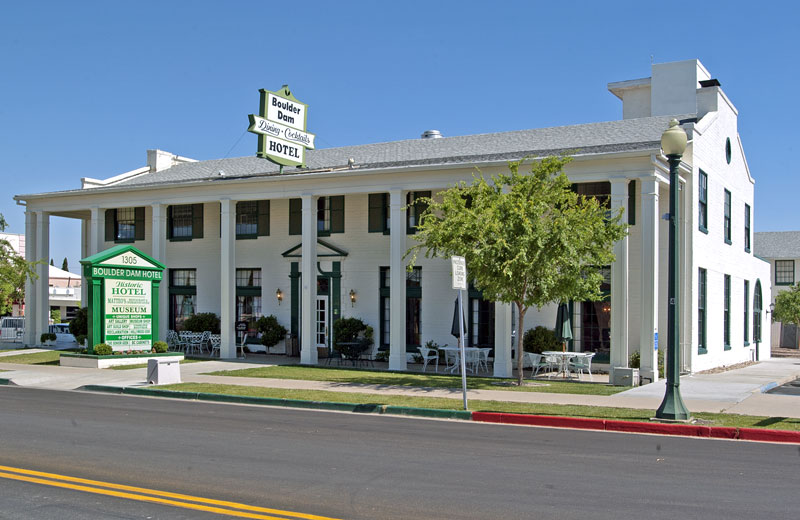
Boulder Dam Hotel
Boulder City, Nevada, is one of the strangest towns in the American West—a place that exists only because the federal government built it from nothing in 1931 to house the thousands of workers constructing what was then called Boulder Dam. In a state defined by gambling, Boulder City was the opposite: a tightly controlled government town with no casinos, no saloons, and strict rules governing daily life. It was engineered for productivity, not pleasure. But it needed a hotel. And the Boulder Dam Hotel, completed in 1933 at 1305 Arizona Street, was built to fill that gap—not for the workers who poured concrete in killing heat down in Black Canyon, but for the dignitaries, officials, and celebrities who came to watch them do it. The hotel was the vision of Paul Stewart Webb, a local businessman who recognized that the thousands of tourists arriving by train from Los Angeles and by car along the Arrowhead Highway would need somewhere to stay. City Manager Sims Ely issued Webb a permit, and the result was a two-story Dutch Colonial Revival structure designed by architect L. Henry Smith—white-columned, with concrete-block walls rising to gable roofs, a wood-paneled lobby, private baths in all thirty-two rooms, and a modern climate system advertised on highway billboards. At its grand opening, the Boulder Dam Hotel had no equal in southern Nevada. Las Vegas, still a small railroad town, had nothing to compare with it. The guest list through the 1930s and 1940s reads like a Hollywood directory crossed with a diplomatic registry. Bette Davis stayed while vacationing after filming in 1934. Mr. and Mrs. Cornelius Vanderbilt Jr. honeymooned there. Will Rogers performed at the nearby Boulder Theatre during a stay in 1935, weeks before his death. Boris Karloff visited while obtaining a divorce. The Maharajah and Maharani of Indore passed through, as did Cardinal Pacelli, who would later become Pope Pius XII. Howard Hughes recuperated at the hotel after crashing his amphibious plane on Lake Mead. Shirley Temple was a regular guest. The hotel also became popular with movie stars establishing Nevada residency for quick divorces, adding a layer of personal upheaval to the building's social history. The hotel's fortunes declined along with passenger rail and shifting tourism patterns. It changed hands over the decades but avoided demolition. In 1982, it became the first hotel in Nevada listed on the National Register of Historic Places. In 2005, the Boulder City Museum and Historical Association acquired the property and renovated it, reducing the room count to twenty-two while expanding public spaces. The Boulder City/Hoover Dam Museum now occupies the first floor, telling the story of the dam workers and the Depression-era community built to house them. Paranormal claims at the Boulder Dam Hotel are varied, persistent, and span decades. The most frequently cited phenomenon involves the sounds of music, conversation, and laughter emanating from the ballroom when it is entirely empty. Staff working alone at night have reported hearing what sounds like a party in full swing—piano music, clinking glasses, voices—only to find the room dark and vacant. The smell of cigar smoke has been reported throughout the hotel despite a no-smoking policy, particularly in the room once occupied by Howard Hughes, who was known to smoke cigars. Some staff believe Hughes himself lingers in the building. The apparition of a former night desk clerk named Tommy Thompson has reportedly been seen in the main lobby, and guests have described an overwhelming sensation of heaviness in the same area. Rooms 209 and 219 are cited as the most active, with reports of faucets turning on in unoccupied rooms, doors opening and closing on their own, and cold spots appearing without drafts. Some guests have described being physically touched or grabbed by unseen hands. Boulder City historian Dennis McBride, who kept offices in the hotel's basement, documented many of these accounts in his book on the property. McBride himself reported seeing an apparition in his basement office. During a reading he arranged with psychic Patsy Welding, she reported sensing strong presences on the upper floors and refused to descend into the basement, describing the energy as overwhelming. The hotel's proximity to Hoover Dam—where at least ninety-six workers died during construction—has led some to speculate that dam workers may account for some of the activity, and figures in old-fashioned work clothes have been glimpsed in restricted areas of the building. Today the Boulder Dam Hotel operates as a boutique historic hotel and museum. The staff generally downplays the haunting reports, and at least one investigator has noted that asking about ghosts can quickly cool an otherwise warm reception. But the accounts continue to accumulate, logged by guests who arrive knowing nothing of the hotel's reputation and leave describing experiences they cannot explain.
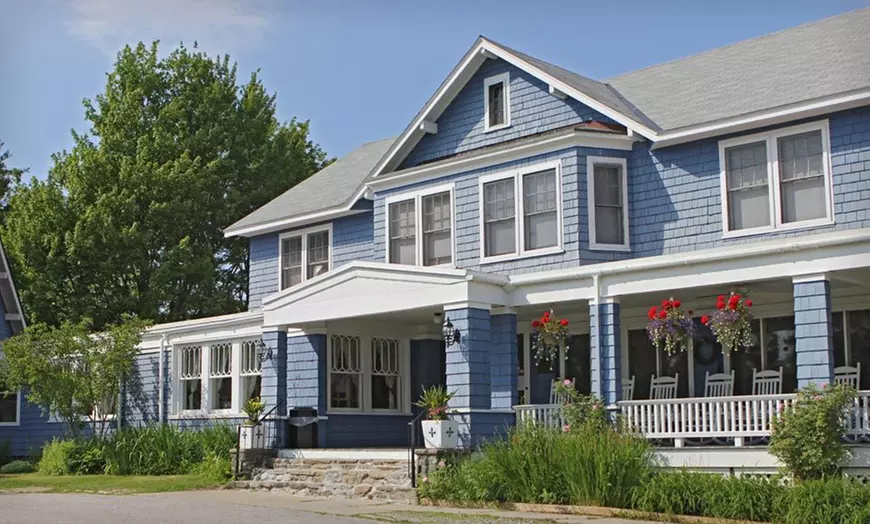
The Spalding Inn
Set on nearly eight acres of rolling land along Mountain View Road in Whitefield, New Hampshire, the Spalding Inn looks out across orchards and perennial gardens toward the smoky ridgeline of the Presidential Range. It is the kind of White Mountains property that seems to have always been there—a sprawling, white-columned Victorian structure flanked by a carriage house and framed by the kind of landscape that drew Bostonians and New Yorkers north by rail during the Gilded Age, when the region's grand resort hotels were at the peak of their influence. The building dates to the 1860s, when it was known as the Cherry Hill House—a modest structure with an attic that was later expanded by lifting the roof and adding a full second floor. It began its life as a private residence, and like many properties in northern New Hampshire's hotel corridor, it eventually transitioned into lodging as the White Mountains tourism trade grew. By 1926, the property had been formally established as the Spalding Inn, operating as a seasonal resort that welcomed guests for the spring and summer months, with some visitors staying the entire season. For a time it functioned as a private members-only establishment, a country club of sorts, offering tennis, a heated pool, golf, and formal dining against a backdrop of mountain scenery. Brochures from the mid-twentieth century advertise it as a gracious retreat—the kind of place where guests dressed for dinner and rocked on the veranda in the long northern twilight. Over the decades the property changed hands several times, and like many of the grand old lodging houses of the White Mountains, it experienced cycles of prosperity and decline. By the early 2000s the building was aging and in need of significant attention, its long history beginning to show in the bones of the structure. Reports of unusual activity inside the inn, however, had been circulating for far longer than anyone could precisely date. Guests and staff described shadow figures drifting through hallways, doors opening and closing without explanation, and a pervasive sense of unease in certain parts of the building—particularly the carriage house and the basement bar area. The stories were persistent enough that the inn had acquired a reputation for being haunted well before it attracted national attention. Local tradition holds that a former owner took his own life in the carriage house, and that a woman and a child also died on the property under circumstances that have blurred with time into the kind of half-documented, half-whispered accounts that cling to old New England buildings like woodsmoke. In 2008, the property was purchased by Jason Hawes and Grant Wilson, the co-founders of The Atlantic Paranormal Society and stars of Syfy's Ghost Hunters. The purchase was not incidental to the inn's reputation—both men were drawn to it precisely because of the paranormal claims that predated their ownership. They invested heavily in restoring the building, reopening it as a working inn with 36 rooms across the main house and carriage house, a main dining room, and a basement pub called 2 Kings. The inn debuted on Ghost Hunters in April 2009, in a Season 5 episode titled "Crossing Over," in which Hawes and Wilson brought in the Ghost Hunters International team to conduct an independent investigation. The results were striking. Digital recorders in the carriage house captured what investigators described as the sound of a door opening and closing on its own and a male voice saying a single word. In the bar area, a female voice with what was described as an English accent was captured—a detail investigators noted as significant given the inn's long history of hosting British guests. In the kitchen, where a dark shadow had been observed moving through the room, a recorder picked up a voice speaking the word "cherry," an apparent reference to the building's original name. The team's conclusion was unequivocal: they deemed the inn haunted. Subsequent investigations by other paranormal groups and by visitors attending the TAPS ghost-hunting events held at the property produced additional accounts. The carriage house consistently generated the most activity. Rooms 15, 16, and 17 on the upper floor were identified as hotspots, with Room 16 reportedly carrying a heavy male energy and Room 17 producing sightings of a shadowy female figure wearing what appeared to be a pearl necklace. One investigator who observed the figure from outside later learned that a former owner of the inn had been known for always wearing pearls. Room 33 in the main house drew reports from guests who described being awakened by unexplained disturbances in the night. In the main building, a hunched figure was reportedly observed moving slowly across the first floor, and investigators noted that nearly every room in the inn seemed to carry its own distinct energy. A massive dark mass was repeatedly witnessed in the bar and kitchen areas by both staff and guests. One visitor reported being tapped on the shoulder three times while sitting with his back to an empty room. Hawes's wife described an occasion when she and her son looked out a window of the main house and saw a woman standing in an upstairs carriage house window, staring back at them before vanishing. The inn also appeared in Ghost Hunters Season 8, in an episode titled "Sign the Ghostbook," which served as Grant Wilson's final investigation before departing the show. Hawes and Wilson listed the property for sale in 2013 at $795,000, noting that while they loved the building, they no longer had the time to operate it. The inn changed hands again and continued to operate on a limited basis in subsequent years, though its status has remained uncertain. As of recent reports, the Spalding Inn is not currently open to guests, and its future remains unclear. The building still stands on its hillside, the carriage house still flanks the main structure, and the view of the Presidential Range from the front porch has not changed. Whether the property will be restored again or allowed to continue its slow drift toward silence is an open question. What is less open to debate is the volume and consistency of the accounts that have accumulated within its walls—reports spanning casual visitors, seasoned investigators, and the families of the men who made their careers studying exactly this kind of thing, and who chose this particular building to call their own.

Belleview-Biltmore Hotel
For more than a century, the Belleview-Biltmore Hotel commanded one of the highest points along Florida's Gulf Coast, its white clapboard exterior and green-shingled roofline visible for miles across Clearwater Bay. Known as the "White Queen of the Gulf," the massive Queen Anne–style structure was one of the largest occupied wooden buildings in the United States—a sprawling 350,000-square-foot monument to the Gilded Age ambition that transformed Florida from frontier into winter playground. Its story is one of opulence, slow decline, and a demolition that erased most of the original structure but could not, according to decades of witness accounts, erase everything that happened inside it. The hotel was the creation of Henry B. Plant, a railroad and shipping magnate who spent the late nineteenth century building a transportation empire along Florida's western coast. Plant purchased the Orange Belt Railway in 1895 and recognized that the rail line alone would not generate sufficient tourist traffic without significant accommodations. He commissioned a massive resort on a bluff overlooking the bay between Clearwater and St. Petersburg. Construction began in 1896, and the Hotel Belleview opened January 15, 1897. Built primarily of native Florida heart pine, it featured peaked gables, deep verandas, steam-generated electricity, Tiffany glass, and a resident orchestra. Three long wings fanned from a central core, creating an interior of seemingly endless corridors, stairwells, and hidden service passages. The hotel drew America's industrial aristocracy immediately. The Vanderbilts, DuPonts, and Studebakers were regular guests. Railroad presidents arrived in private cars on the hotel's own siding. Among the more colorful figures in the hotel's history was Maisie Plant, who married Henry Plant's son Morton after Morton reportedly offered her existing husband eight million dollars to step aside. Maisie later traded the Plant family mansion on Fifth Avenue to the jeweler Cartier in exchange for a double strand of Oriental pearls valued at over a million dollars. According to persistent local legend, she lost those pearls somewhere inside the Belleview—a story that has become inseparable from the hotel's paranormal lore. During World War II, the hotel was requisitioned to house servicemen stationed at MacDill Air Force Base, adding another layer of transience to the building's dense history. Through the decades, the guest list included Presidents Ford, Carter, George H. W. Bush, and Obama, along with Margaret Thatcher, the Duke of Windsor, Thomas Edison, Babe Ruth, and Bob Dylan, who rehearsed for his 1976 Rolling Thunder Revue tour in the hotel's Starlight Ballroom. Decline set in during the 1970s as newer beachfront properties drew tourists elsewhere. The hotel was added to the National Register of Historic Places in 1979 but closed in 2009. Despite efforts by preservation organizations, demolition began in 2015. A portion of the 1897 structure was saved, relocated, and restored as the Belleview Inn, a boutique hotel that opened in 2018. The paranormal reputation of the Belleview-Biltmore was among the most widely reported of any hotel in Florida, drawing national attention through a Travel Channel Weird Travels episode filmed in 2004 and regular ghost tours in its final years. The most iconic claim involves Maisie Plant herself—guests and staff reported an apparition in a white dress and hat drifting through corridors and ballrooms, seemingly searching for her lost pearls. At least one investigator described seeing a full-bodied apparition matching this description. Other recurring reports included transparent elevator operators who vanished before reaching their floor, poltergeist activity involving doors banging and lights switching on unprompted, and dresser drawers opening on their own in occupied rooms. Guests on the first floor frequently heard children running through hallways at night, consistent with the fourth floor's historical use as quarters for servants and children kept out of sight during the Gilded Age. Room 4336 carried a specific legend involving a bride who allegedly leapt from its balcony after her husband was killed. The sealed fifth floor was described by paranormal teams as the most active area in the building, home to an aggressive presence investigators called "the angry man," alongside equipment anomalies, cold spots, and unexplained footsteps. A couple photographed at the base of a stairway during a 2004 holiday party discovered, upon developing their film, a misty white figure hovering above them that had not been visible to the naked eye. Today the Belleview Inn preserves a fragment of the original building, restored with heart-pine flooring, wainscoting, and original Tiffany glass. Most of the hotel's immense footprint is gone—the sealed fifth floor, the service tunnels, the rooms where guests heard running children and felt unseen hands. Whether the spirits that reportedly inhabited the White Queen survived demolition is a question no one can answer. But for over a century, the Belleview-Biltmore carried the kind of accumulated presence—grief, glamour, war, and loss—that tends to leave traces deeper than any wrecking crew can reach.
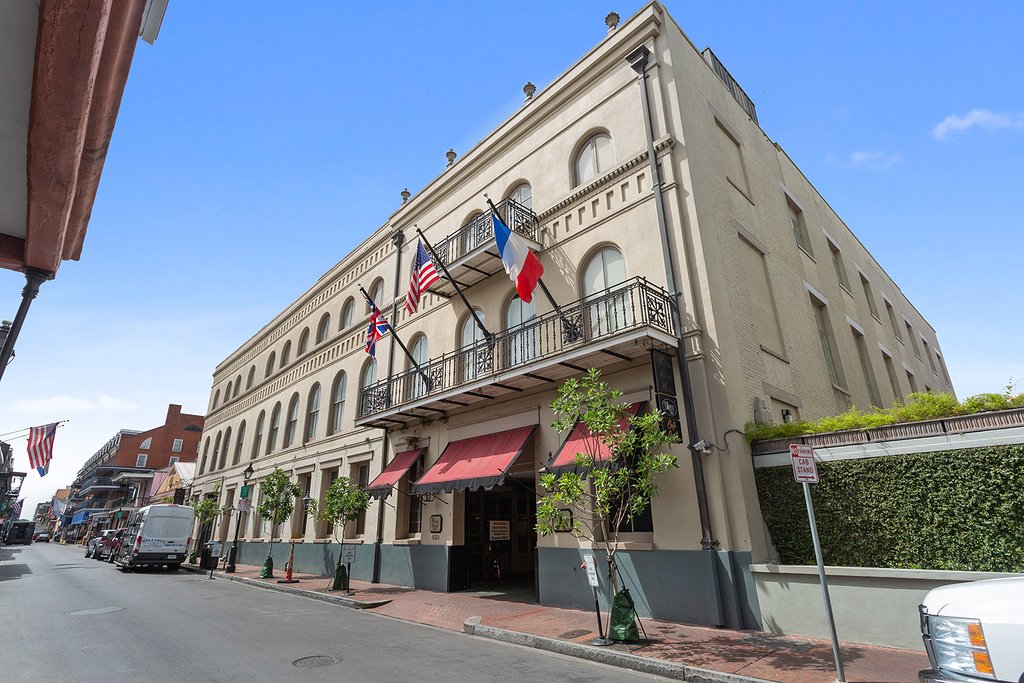
Prince Conti Hotel
At 830 Conti Street in the French Quarter of New Orleans, the Prince Conti Hotel occupies a building dating to the early 1900s, sitting on a block that has cycled through nearly every identity the Quarter has to offer—residence, commerce, vice, hospitality, and, if the accounts are to be believed, something that refuses to vacate regardless of what the current management has planned. The hotel is a small property by New Orleans standards, with just over fifty rooms tucked into a historic townhouse structure steps from Bourbon Street. It is operated by the Valentino family, who have run hotels in the French Quarter for over sixty years. The ground floor houses the Bombay Club, an upscale bar known for its martini list, Creole cuisine, and a resident spirit the staff has been dealing with for decades. Conti Street is named for the Princess Conti—originally the name given to what is now Bourbon Street before an early colonial renaming shuffled the designations. The street runs deep into French Quarter history. At 1026 Conti, just two blocks away, the infamous Norma Wallace operated the last major brothel in New Orleans from the late 1920s through the mid-1960s, entertaining governors, gangsters, and celebrities in a parlor house that ran nearly four decades before District Attorney Jim Garrison shut it down. Wallace's story ended in 1974 when she shot herself after learning of her husband's infidelity. Her building, an 1830s townhouse, is now condominiums—and reportedly still haunted. Farther up the block, the site of what is now the Williams Research Center once housed the Rising Sun Hotel in the 1820s, a property whose archaeological remains have yielded artifacts suggestive of early commercial sex work and whose name may have inspired one of the most famous folk songs in the English language. Conti Street has never been quiet. The Prince Conti Hotel's primary haunting centers on a figure the staff has named Sophie. According to paranormal researchers, Sophie is believed to be the spirit of a madam who operated on the premises before the building became a hotel. Her identity has never been established, but staff members have encountered her in the kitchen, the bar, and at Booth 3 of the Bombay Club. She is described as a presence rather than a full apparition—felt more often than seen, though some accounts describe a spectral woman visible in the bar during quiet hours. Guest accounts extend well beyond Sophie. Visitors on the upper floors—particularly the third floor—report a striking range of experiences. Multiple guests describe being nudged or physically shaken while asleep, only to find the room empty. One guest reported their mattress bouncing as though someone had sat down hard at six in the morning. Another described the full weight of a body pressing down on them during the night. Showers have turned on by themselves. Doors securely locked have been found standing wide open. A concierge reportedly confirmed that doors had been known to fly open on their own, accompanied on at least one occasion by a visible apparition. Objects have fallen from surfaces without explanation. Curtains have swung open untouched. In Room 361, a couple watching television reported their shower turning on for several seconds, followed by a bag of chips falling off the nightstand—and in the morning, a plugged-in diffuser was found unplugged from the wall. What makes these accounts notable is not their dramatic quality—by New Orleans haunted hotel standards, they are restrained—but their consistency across unrelated guests over many years, and the physical nature of the interactions. The nudging, the pressure, the bed-shaking describe contact, not atmosphere. Skeptics will note that old French Quarter buildings settle, plumbing acts unpredictably, and doors in century-old structures don't always stay shut. New Orleans humidity warps wood and metal alike. Guests arriving after a night on Bourbon Street are not always reliable witnesses. But the Prince Conti's accounts carry a specificity—particular rooms, particular times, particular physical sensations—that environmental explanations don't fully cover. Today the Prince Conti Hotel continues to operate at 830 Conti Street, offering the Bombay Club downstairs, Cafe Conti in the mornings, and a location at the center of one of the most historically layered streets in the most historically layered neighborhood in America. Sophie, if that is her name, appears to have no intention of checking out. And on the third floor, something still seems to think the beds could use one more occupant.
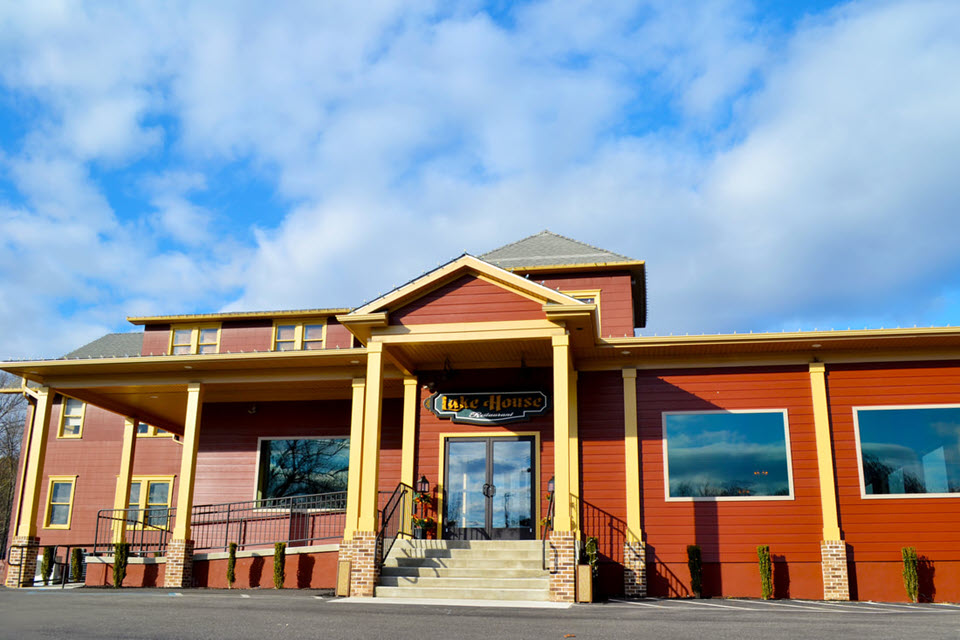
Iona Lake Inn – Lake House Restaurant
Set along the quiet shoreline of Iona Lake in the rural community of Newfield, Gloucester County, the building now associated with the Lake House Restaurant carries a history that stretches back to the nineteenth century, when the lake itself served as a modest resort destination for residents of southern New Jersey and nearby Philadelphia. The property at 611 Taylor Road sits beside the small man-made lake surrounded by woods and farmland, a setting that historically attracted visitors looking for fishing, boating, and seasonal recreation away from the larger cities of the region. Over time the site developed into a gathering place for travelers and locals alike, eventually becoming known as the Iona Lake Inn. During the late 1800s and early 1900s, lakeside inns and taverns were common throughout southern New Jersey, particularly in areas where rail lines or wagon routes made rural retreats accessible for day trips. The inn at Iona Lake operated as one of these establishments, offering food, lodging, and space for social gatherings. The surrounding grounds were used for outdoor recreation, and the lake itself became a focal point for visitors who arrived for fishing excursions, picnics, and small community events. Like many similar properties in the region, the building evolved gradually, expanding and changing hands as the local tourism economy shifted. Through the early twentieth century the inn developed a reputation as both a restaurant and social venue. Community gatherings, private celebrations, and seasonal events were held on the property, while travelers moving through Gloucester County stopped along the quiet rural road to eat or stay overnight. Over decades the structure absorbed numerous renovations and additions, but it retained the feel of an older roadside inn, with dining areas overlooking the water and interior spaces reflecting the layered construction typical of buildings that have been continuously adapted for hospitality use. By the mid-to-late twentieth century the property became more widely known as the Lake House Restaurant, though the historic identity of the Iona Lake Inn remained part of its reputation. Locals continued to treat the lakeside building as a familiar meeting place. The calm setting beside the water, particularly in the evening when the surrounding woods grow quiet, contributed to the atmosphere that later fed into stories surrounding the property. Reports of unusual activity at the site have circulated among employees and visitors for years, making the inn one of the lesser-known haunted locations occasionally discussed in southern New Jersey folklore. Staff members working late shifts have described hearing footsteps moving through empty dining rooms after closing, particularly in sections of the building believed to date to the earliest phases of construction. Others have reported doors opening or closing on their own or lights switching on in areas that had already been shut down for the night. One of the most commonly repeated claims involves the apparition of a woman seen near the stairways or hallways of the older portions of the building. Witnesses typically describe the figure appearing briefly before vanishing, often interpreted as someone dressed in clothing from an earlier period. Other employees have reported fleeting shadows moving across walls, unexplained cold spots, or the sense of someone standing behind them while working alone in the dining rooms. Paranormal investigators who have visited the location over the years have occasionally reported capturing electronic voice phenomena during recording sessions or experiencing sudden fluctuations in equipment readings. As with many historic restaurants, skeptics point out that aging structures frequently produce creaks, drafts, and shifting floorboards that can easily mimic footsteps or movement, particularly late at night when the building is otherwise quiet. The power of suggestion can also play a role once a location becomes known for ghost stories. Even with those explanations, the stories remain part of the building’s identity. The combination of an old lakeside inn, a secluded rural setting, and generations of visitors passing through its doors has given the property a reputation that blends local history with lingering folklore. Today the building continues to operate as a restaurant overlooking Iona Lake, maintaining the long tradition of hospitality on the site. For some visitors, however, the quiet halls and reflective water outside carry the persistent belief that the inn’s past occupants—or perhaps former guests—may still linger within the old lakeside structure.
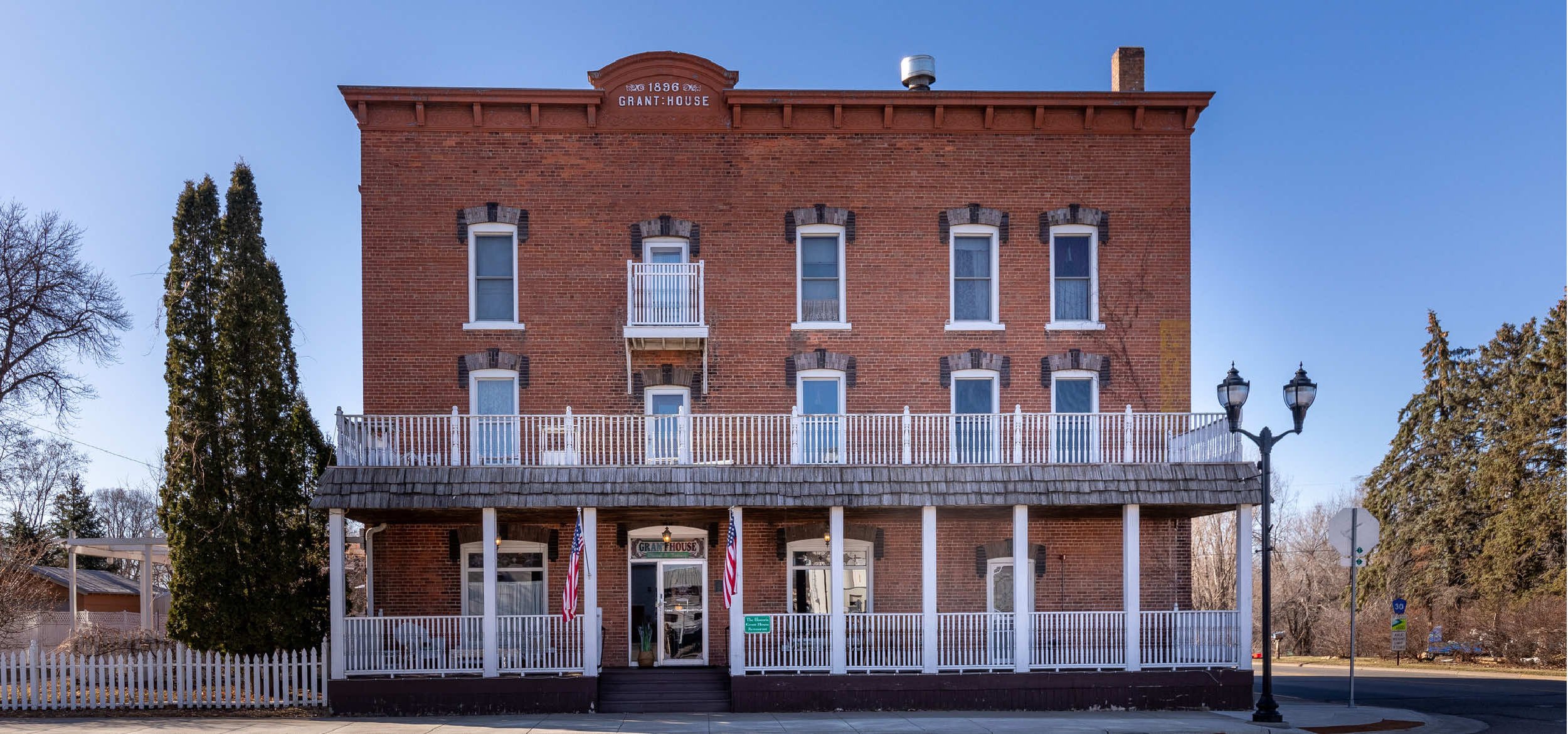
Grant House Hotel and Eatery
At the corner of Fourth Street and Bremer Avenue in downtown Rush City, Minnesota—a small town along Highway 61 roughly sixty miles north of the Twin Cities—a three-story brick hotel has been standing since the last years of the nineteenth century, carrying with it a history of fire, reinvention, and a reputation for paranormal activity that has drawn ghost hunters, television crews, and paranormal authors to a place most travelers on Interstate 35 pass without a second glance. The Grant House was originally built in 1880 by Colonel Russell H. Grant, second cousin to President Ulysses S. Grant. The original structure was a white-board building with an expansive porch, situated to serve the travelers and commerce flowing through Rush City along what was then a stagecoach route connecting St. Paul to Superior, Wisconsin. President Grant himself reportedly stayed at the hotel while visiting family in the area, taking advantage of Minnesota's hunting and fishing. The hotel prospered for just over a decade before fire destroyed the original building in 1895. Colonel Grant rebuilt the following year, this time in brick, and the 1896 structure—listed on the Registry of Historic Places—is the building that stands today, a 7,500-square-foot establishment with eleven rooms spread across its upper floors. The Grant House's history between the fire and the present day is marked by the kinds of uses that tend to leave residual energy in old buildings. During certain periods, the hotel reportedly operated as a bordello, and local accounts connect it to the bootlegging trade that ran through small Minnesota towns during Prohibition. Rush City's location along the railroad made it a natural waypoint for the kind of transient commerce—legal and otherwise—that characterized rural Midwestern towns in the early twentieth century. The Twin Cities Paranormal Society has noted that old railroad hotels in small towns are particularly prone to paranormal activity, citing the combination of constant human turnover, proximity to rail energy, and the fires and violence that frequently accompanied frontier-era hospitality. The paranormal reputation of the Grant House is well established and has been acknowledged by successive owners. Todd Johnston, who owned the hotel in the early 2010s, stated publicly that he, his staff, and guests had experienced numerous unexplained incidents during his tenure. In 2011, Johnston opened the hotel to a formal paranormal investigation, drawing ghost hunters and fans of SyFy Channel's Ghost Hunters International for an evening of organized investigation. The event confirmed what locals and staff had been reporting for years. Paranormal researcher Chad Lewis, author and lecturer for Unexplained Research LLC, has included the Grant House in his presentations on Minnesota's most haunted locations, noting the kinds of subtle evidence—recorded sounds inaudible to the naked ear, unexplained beams of light—that characterize active sites. The Grant House is also featured in The Big Book of Minnesota Ghost Stories by author Andy Weeks, who investigated the property as part of his broader survey of Minnesota hauntings. The reported phenomena at the Grant House span a range consistent with a building carrying multiple layers of occupation and use. Guests have heard ghostly laughter and disembodied voices in the hallways and rooms. Phantom footsteps are heard moving through the building when no one is present. Furniture has been found shifted or rearranged in rooms overnight by unseen hands. The most striking recurring claim involves the apparition of a woman who appears behind guests as they look into mirrors—visible in the reflection but not in the room itself when the guest turns around. The activity has been consistent enough to attract repeated visits from organized paranormal groups, including North Metro Paranormal, whose founder has described the Grant House as one of the locations that first drew him into ghost hunting after experiencing intense activity there on an early visit. Ghost tours have been held at the property, and the building's haunted reputation is embraced rather than concealed—the city of Rush City's own tourism page directs visitors interested in the paranormal to the hotel's website for ghost stories. Today the Grant House continues to operate in downtown Rush City, most recently housing The Fort, an eclectic American restaurant whose owners moved into the historic building in 2024. The new proprietors were aware of the building's reputation before signing the lease and were undeterred. The clawfoot tubs and pedestal sinks remain in the renovated guest rooms. The second-story porch still overlooks Main Street. The railroad tracks that once brought travelers and trouble to Rush City still run nearby. And the woman in the mirror, if she is still there, presumably has new faces to appear behind—and new guests to remind that in a building this old, the reflections do not always belong entirely to the living.

Stevenson House
The Stevenson House stands at 530 Houston Street in Monterey, California, a two-story Spanish Colonial adobe set back from the road behind trees and gardens in the heart of the old town. It is a quiet building on a quiet street, operated by the California Department of Parks and Recreation as part of Monterey State Historic Park, and best known as the place where a young, unknown, gravely ill Scottish writer named Robert Louis Stevenson spent the autumn of 1879 recovering from tuberculosis and courting the woman who would become his wife. The house bears his name and holds one of the world's most important collections of his personal belongings. But the ghost that has occupied the building for nearly eight decades is not Stevenson's. It belongs to the woman who ran the place before he ever arrived—and who died there trying to save her grandchildren from a disease she could not outrun. The original adobe was built around 1836 by Don Rafael Gonzalez, the customs administrator at the Port of Monterey during the Mexican era. The walls are a mixture of chalk rock laid in mud mortar and wood frame, plastered in limestone, with a bracketed shingled roof. After California passed to the United States, the building changed hands and purposes. In the late 1860s, a Swiss immigrant of French descent named Juan Girardin purchased the property with his second wife, a local Mexican woman named Manuela Perez. The Girardin family renovated the structure and opened it as the French Hotel, which became one of Monterey's primary boarding houses, serving sailors, tradesmen, artists, and travelers. The year 1879 destroyed them. A typhoid fever epidemic swept through Monterey, and Juan Girardin was among its first victims, dying on July 1. Months later, the couple's two grandchildren fell ill with the same disease. Manuela threw herself into nursing them, barely sleeping, refusing to leave their bedsides in the upstairs nursery. She contracted typhoid herself and died on December 21, 1879. The children, miraculously, survived—but Manuela never knew it. She died believing she had failed them. After so much death, no one wanted to buy the French Hotel. It was eventually purchased at a steep discount by a man named Jules Simoneau, who continued operating it as a boarding house. When his friend Robert Louis Stevenson arrived in Monterey that same autumn—penniless, tubercular, chasing Fanny Osbourne across a continent—Simoneau let him stay for free. Stevenson spent roughly three and a half months there, writing prolifically despite his illness, producing essays, stories, and gathering the impressions that would later inform his most famous work. In 1937, the building was purchased by Edith van Antwerp and Celia Tobin Clark to preserve it as a Stevenson memorial. They donated it to the state in 1941 along with a significant collection of the author's manuscripts, first editions, and personal effects. The house was restored to reflect both the Stevenson period and the Girardin family's era, with the upstairs rooms displaying the furnishings and domestic life of the French Hotel. It is in those upstairs rooms—particularly the nursery where Manuela nursed her grandchildren—that the haunting centers. For nearly eighty years, visitors and staff have reported encountering the spirit known as the Lady in Black. She appears as a woman in a black dress with a high lace collar, solid and lifelike enough that witnesses have mistaken her for a costumed docent—until she vanishes. The activity concentrates in December, the month of Manuela's death. The nursery rocking chair has been observed rocking on its own, propelled by no visible force. Visitors report the sudden, unmistakable smell of carbolic acid—the sickroom disinfectant used in the nineteenth century—filling the room without any source. One visitor described feeling a calming hand placed on her shoulder that began gently rubbing her back. Trunks have been found dragged across the floor. Books are pulled from shelves. The scent of roses appears and dissipates without explanation. During a lecture to the California Historical Society, a speaker reportedly noticed an unfamiliar woman in period dress sitting in the audience, listening with apparent interest from a rocking chair, before disappearing. Other visitors have reported seeing a blurry-faced man in a robe and a small child running through the halls. The museum does not permit paranormal investigators, preferring to maintain its identity as a literary and historical site rather than a haunted attraction. That restraint is itself notable—the lack of organized investigation means the reports that exist are almost entirely spontaneous, offered by visitors and staff who came for Stevenson and encountered something older. Today the Stevenson House operates by reservation, open for guided tours within Monterey State Historic Park. It is listed on the National Register of Historic Places and designated California Historical Landmark No. 352. The gardens are peaceful, the rooms carefully preserved, and the collection of Stevenson memorabilia is irreplaceable. But the building's most persistent presence is not the famous author who passed through for a season. It is the woman who lived and died there—who gave everything she had to keep two children alive and never learned that she succeeded. Manuela Girardin remains, by all accounts, exactly where she was needed most.

Spitzer House Bed and Breakfast
Four blocks west of the historic Medina Square in northeastern Ohio, the Spitzer House sits on West Liberty Street like a Victorian postcard brought to life—painted trim, stained glass windows, twin cherry staircases, and the kind of ornamental woodwork that announces both the wealth and the aspirations of the family that built it. Constructed in 1890 for Ceilan Milo Spitzer, the house was a monument to one of Ohio's most ambitious financial careers. Spitzer was born in 1849 in Batavia, New York, and raised in Medina County after his family relocated in 1851. He entered business young, moving into banking with his father Aaron. An early Cleveland venture—the German-American Bank—collapsed in 1880 amid a national financial panic, and Spitzer liquidated his personal assets to pay every creditor, a move that cost him dearly but cemented his reputation. He rebuilt from the ground up. By the late 1880s, he and his cousin Adelbert had established Spitzer & Company in Toledo, becoming the first firm west of New York City to deal in municipal bonds. They were widely credited as founders of the municipal bond industry in the American Midwest. In January 1900, Ohio Governor George Nash appointed Ceilan Quartermaster General of the state with the rank of Brigadier General—a title he carried for life. It was at the height of this ascent that Spitzer commissioned the Medina house, overseeing construction remotely while expanding operations in Boston. His return to inspect the nearly completed residence made the front page of the Medina County Gazette in December 1890. He granted his parents a lifelong lease the following year, and the Spitzer family would occupy the house for the next seventy years. The house is a German Renaissance design with Queen Anne and Stick-Style elements, executed with particular refinement. Cherry and oak woodwork run throughout. The guest rooms, now named for family members, retain the proportions and character of the original layout. After the family's long tenure ended, the home was converted into a bed and breakfast in 1994 and has earned recognition for its restoration. It sits within walking distance of downtown Medina—a quiet residential stretch that belies the building's increasingly well-known reputation. That reputation extends beyond architecture. The Spitzer House has been featured in Chris Woodyard's Haunted Ohio book series, Brandon Massullo's Haunted Medina County, Ohio, and appears on multiple paranormal databases. The claims are specific, recurring, and tied to distinct areas of the house. In Ceilan's Room, guests have reported the apparition of a stern-looking man—sometimes watching from the corner, sometimes near the bed. The figure is widely interpreted as Spitzer himself, and at least one account describes the apparition physically nudging a guest. In Anna's Room, named for Ceilan's stepmother, the presence is different: a young servant girl, appearing at the foot of the bed or at the top of the staircase. Guests have heard her laughter. Some accounts describe her as short and stout, wearing an Edwardian-era housedress, firing questions at startled witnesses before vanishing. In the dining room, the voices of two men have been heard conversing when the room is empty. The parlor piano has been reported playing on its own. Throughout the house, guests describe flickering lights, slamming doors, cold spots, and light touches from an unseen source. One guest reported being scratched. Another described a spirit whispering their name. What gives these accounts weight is their consistency across decades and unrelated witnesses, and the absence of any anchoring tragedy. There is no murder, no suicide, no fire. The Spitzer family's occupancy was long and unremarkable in terms of darkness. Ceilan himself died in 1919 in Toledo, not in the Medina house. The servant girl's identity remains unknown—no documented death connects a specific individual to the claims. The hauntings seem to belong to the house itself rather than to any story imposed upon it. Skeptics will note that Victorian homes are acoustically rich—old wood settles, radiators clang, drafts move through invisible gaps. A bed and breakfast trades on atmosphere, and guests who know the reputation are primed to interpret ambiguity as evidence. But the reports carry a specificity—particular rooms, particular figures, particular behaviors—that resists dismissal as environmental noise alone. Today the Spitzer House continues to operate at 504 West Liberty Street, offering four guest rooms with private baths, period furnishings, and breakfast served in the dining room where two invisible men still occasionally hold court. The cherry staircases are original. The stained glass catches the light the same way it did in 1890. And whether a young woman in a housedress is waiting at the top of the stairs depends on when you visit—and how much of the house's long memory you're prepared to meet.
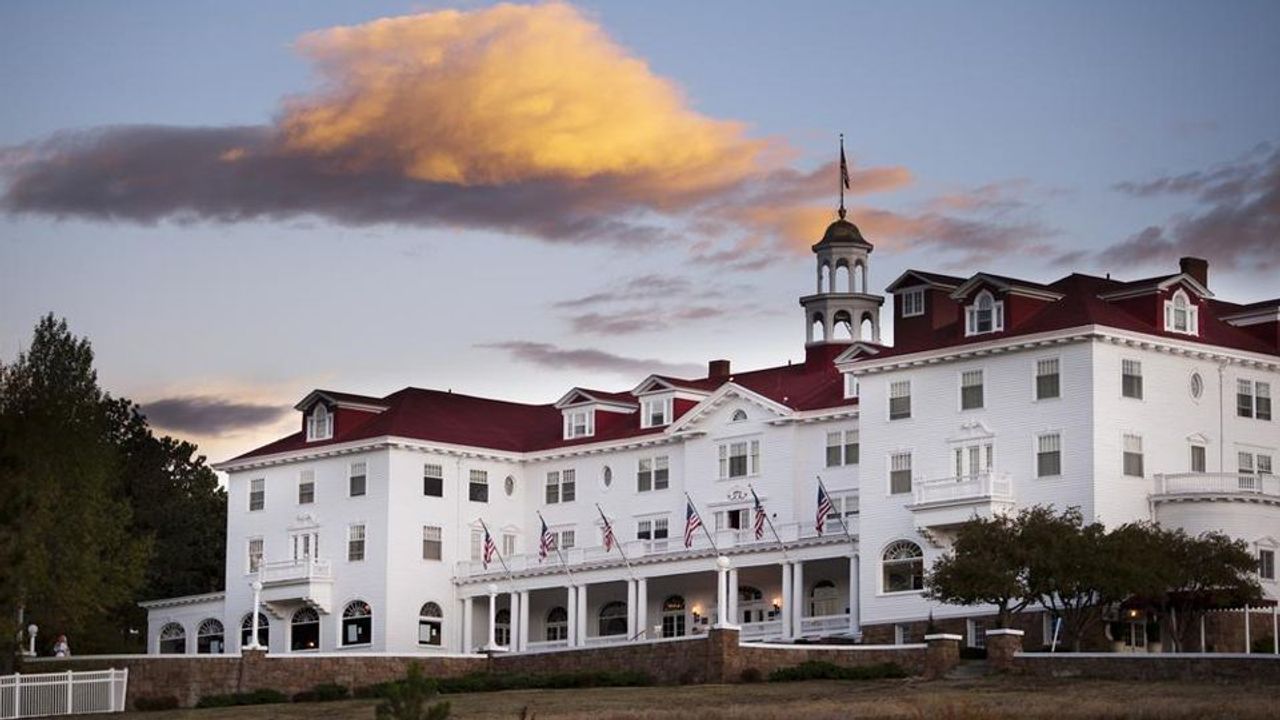
The Stanley Hotel
Perched on a hillside at the edge of Estes Park with the full sweep of the Rocky Mountains behind it, the Stanley Hotel looks less like a haunted building than a misplaced New England estate — white clapboard siding, Georgian columns, and a formal symmetry that has no business sitting at 7,500 feet in the Colorado high country. That contrast is entirely deliberate. The man who built it was an inventor from Maine who came west to save his own life, and what he left behind has refused to stay quiet for more than a century. Freelan Oscar Stanley arrived in the Estes Valley in 1903 suffering from tuberculosis, weak enough that his doctors had told him not to plan beyond six months. The mountain air reversed his decline so dramatically that by summer's end he resolved to return every year. But the tiny settlement of Estes Park offered nothing for a man of his means and temperament. Stanley had made his fortune co-inventing the Stanley Steamer automobile and manufacturing photographic dry plates, and he and his wife Flora were accustomed to the social fabric of the East Coast. So Stanley decided to bring that world to the Rockies. He purchased land from the holdings of the 4th Earl of Dunraven — an Anglo-Irish nobleman who had tried and failed to turn the valley into a private hunting preserve — and broke ground on his hotel in 1906. On July 4, 1909, the Stanley Hotel opened with 140 rooms, running water, telephones, electricity from a hydroplant Stanley himself had built on the Fall River, and a concert hall designed to echo the acoustics of Boston Symphony Hall. Flora, an accomplished pianist, christened the space with a 1904 Steinway grand that remains in the hotel today. Among the early guests were Teddy Roosevelt, Unsinkable Molly Brown, John Philip Sousa, and the Emperor of Japan. The hotel operated as a summer resort for decades, closing each winter and cycling through owners after Stanley sold it in 1926. By the 1970s it had deteriorated badly — neglected, half-empty, and close to demolition. Then, on the last night of the 1974 season, a young writer from Boulder checked in with his wife. Stephen King and Tabitha King were the only guests in the building. They ate dinner alone in the empty dining room, accompanied by recorded orchestral music, then retired to Room 217. That night King had a vivid nightmare of his three-year-old son being chased through the hotel's corridors by a living fire hose. He woke in a sweat, walked to the balcony, lit a cigarette, and by the time he finished it the framework of The Shining had taken shape in his mind. The novel, published in 1977, became his first hardcover bestseller and cemented the Stanley Hotel in the American imagination as the real-world counterpart to the fictional Overlook Hotel. But the paranormal claims at the Stanley predate King by decades and extend well beyond literary inspiration. Room 217 carries the longest recorded history. In June 1911, head housekeeper Elizabeth Wilson entered the room to light acetylene lanterns during a power outage. An undetected gas leak had filled the wing, and the match she struck triggered an explosion that destroyed the room and dropped her through the floor into the dining room below. She survived with broken bones, continued working at the hotel for years, and eventually died peacefully in the 1950s. Guests in Room 217 now report luggage being unpacked, clothing folded, lights switched on and off, and an unseen presence settling onto the bed — as though Wilson never stopped tending to her duties. Room 401 draws a different kind of attention. Attributed by legend to the spirit of Lord Dunraven — who never actually stayed at the hotel but once controlled the land beneath it — the room has produced accounts of a closet door opening on its own, women reporting being touched by an invisible presence, and personal items displaced without explanation. During a visit by the television program Ghost Hunters, an investigator reported the locked closet opening by itself while he slept. Room 407 generates reports of lights operating independently and indentations appearing on beds in otherwise empty rooms. The entire fourth floor, which originally served as servant quarters and storage, is the most consistently active area of the hotel, with guests describing the sounds of children running and laughing in the hallways when no children are present. The concert hall produces its own category of reports. Guests and staff describe hearing classical piano music emanating from the empty hall, and some claim to have seen piano keys depressing on their own. The spirit attributed to these performances is Flora Stanley, who died of a stroke in 1930 but whose love of music — and the Steinway she played — appears, according to believers, to have survived her. F.O. Stanley, who died in 1940 at ninety-one, is said to appear in the lobby and billiard room, sometimes visible in reflections. Beneath the hotel, a tunnel system once used by staff to move unseen has its own lore — including the reported smell of baked goods attributed to a deceased chef and sightings of a spectral grey cat. The skeptical framework here is worth noting. The hotel sits on heavy concentrations of quartz and granite, which some researchers have linked to elevated electromagnetic fields capable of producing disorientation. The building's age, its creaking wooden frame, and the low-frequency vibrations generated by mountain winds at high elevation all offer plausible explanations for sounds and sensations that visitors interpret as supernatural. The sheer cultural weight of The Shining guarantees that nearly every guest arrives primed for something eerie. Expectation and atmosphere do real work in a place like this. Still, the volume and consistency of reports across more than a hundred years — from staff, casual visitors, seasoned investigators, and celebrity guests alike — give the Stanley a paranormal file that few American hotels can rival. The property is listed on the National Register of Historic Places and was acquired in 2025 by The Stanley Partnership for Art, Culture, and Education. It remains fully operational, offering historical day tours, night tours focused on paranormal claims, and designated "spirited rooms" for guests who want to sleep where the activity is most frequently reported. Room 217 is just up the stairs. The concert hall is just across the grounds. And the piano, as always, is waiting.
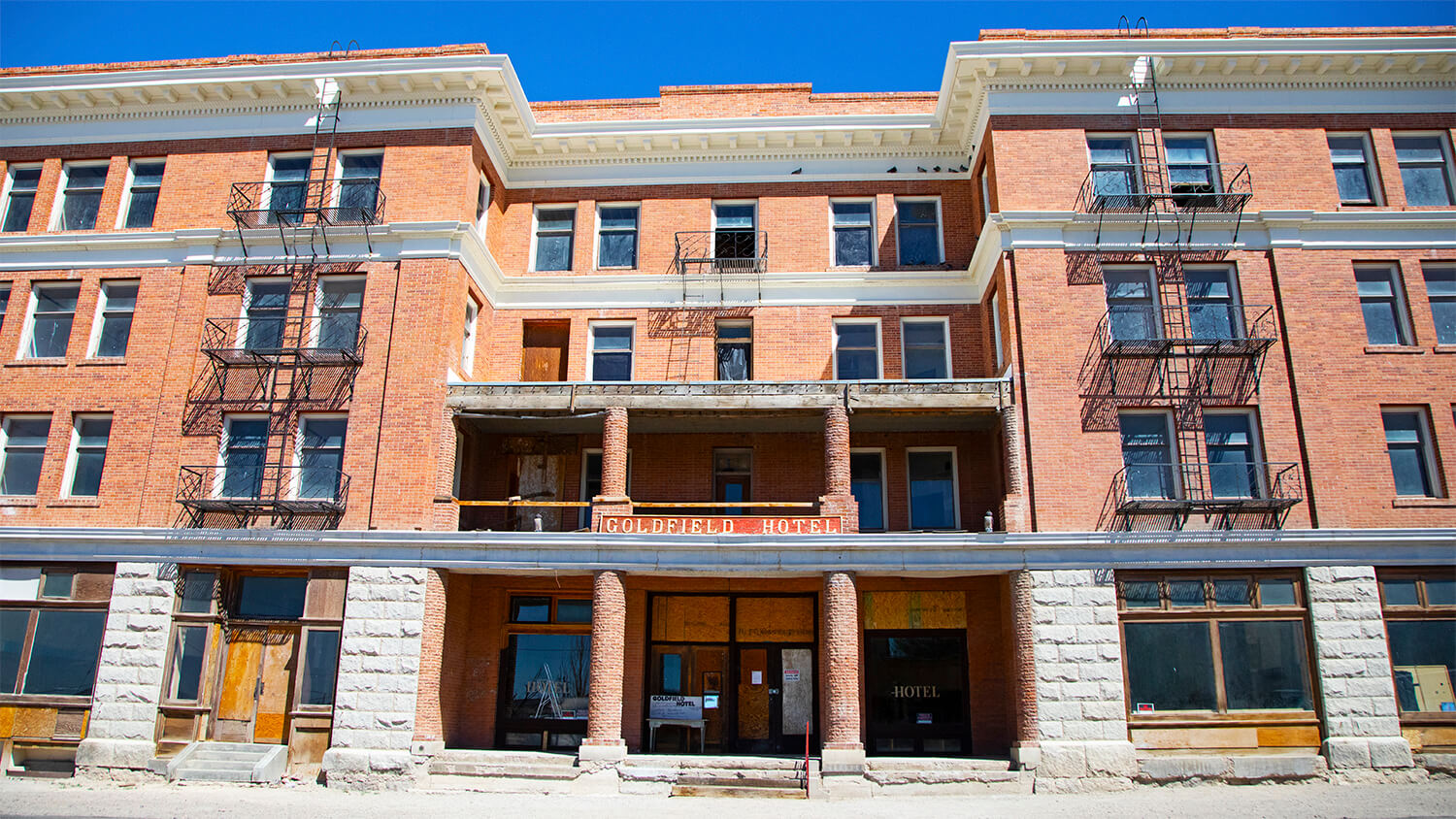
The Goldfield Hotel
The Goldfield Hotel rises four stories above a town that barely exists anymore, its granite-and-brick façade still dominating the main intersection of Goldfield, Nevada—a place that was once the largest city in the state and is now home to roughly 250 people. The hotel was built to match the ambitions of a boomtown drunk on gold, and it stands today as a monument to how quickly all of that can disappear. Gold was discovered near Goldfield in 1902, and within a few years the population surged to 20,000. The town supported three newspapers, five banks, and a mining stock exchange. At the center of it all was George Wingfield, a former cattle driver and card dealer who had grubstaked his way into control of the Goldfield Consolidated Mines Company. The hotel, designed by Reno architects Curtis and Holesworth, opened in 1908 at a cost of over $300,000. Legend holds that champagne was poured down the front steps at the grand opening. The 154-room interior featured mahogany paneling, gilded columns, crystal chandeliers, gold-leaf ceilings, European chefs, and one of the first Otis elevators west of the Mississippi. It was proclaimed the finest hotel between Chicago and San Francisco. But Goldfield was a storm, not a city. Mine output dropped sharply by 1910. A flash flood hit in 1913. In 1923, a moonshine still exploded and ignited a fire that consumed twenty-seven blocks. The hotel survived—stone and brick don't burn easily—but the town was gutted. By the 1930s, the Goldfield Hotel was a flophouse for cowboys. During World War II it housed officers from the nearby Tonopah Army Air Field, and when they checked out in 1945, the hotel closed for good. The hotel's paranormal reputation centers on Room 109 and a legend involving a woman named Elizabeth—said to have been a prostitute and mistress of Wingfield who became pregnant with his child. The story claims he chained her to a radiator in the room, kept her alive until the baby was born, and then either let her die or killed her. The infant was allegedly thrown down a mine shaft beneath the hotel. It is a vivid and horrible story, and it has no verified historical basis. Researchers at the Central Nevada Museum have noted significant inconsistencies—the mine shafts were dug in 1925, years after Wingfield sold the hotel and moved to Reno, and no contemporary records corroborate Elizabeth's existence. The legend appears to trace largely to a book by 1980s owner Shirley Porter, likely crafted to boost interest in the property. However, there is a documented shadow behind the myth: a 1904 lawsuit by a woman named May Baric, who claimed to be Wingfield's common-law wife, accused him of abuse, and was given $400 and forced to leave town with their child. She and the child died in obscurity. The Elizabeth legend may be an embellishment of a real and quieter cruelty. Regardless of origin, the reports attached to Room 109 are persistent. Visitors describe sudden extreme cold, disembodied crying, and an overwhelming sadness that causes some to weep without explanation. Elsewhere, cigar smoke is reported on the first floor—attributed to Wingfield—along with unexplained piles of fresh ash. The lobby staircase is associated with child spirits who tap visitors on the back. The basement became nationally known after a 2004 Ghost Adventures investigation in which a brick appeared to fly across the room on camera. The show returned multiple times. Investigators have reported equipment malfunctions, shadow figures, and physical aggression from an entity known locally as "the Stabber." Today the hotel is privately owned, closed to the public, and mired in renovation efforts that have stalled repeatedly over decades. It is listed on the National Register of Historic Places. You cannot walk in. You can only look through the windows at the mosaic tile floors and the mahogany front desk and the elevator shaft, all of it frozen in place since the last guest left eighty years ago.

Seven Sisters Inn
On East Fort King Street in Ocala's Historic District, surrounded by live oak canopies and a neighborhood of Victorian-era homes added to the National Register of Historic Places in 1984, the Seven Sisters Inn rises from the landscape exactly as it was meant to — ornate, commanding, and unapologetically excessive. The Gothic Queen Anne Victorian was built around 1890 by Linda B. and Joseph Lancaster and was known locally in its early years as the Painted Purple Lady, a nod to its distinctive original color. But the house's identity was defined by its second owners, and it bears their name in local memory to this day. Charles Rheinauer was born in Germany in 1846, the son of a Jewish cantor, and arrived in America with ambitions that proved more than adequate to the frontier city of Ocala. After marrying Emma Hohenberg in Alabama in 1890, he migrated to Florida and established a dry goods and clothing business with his brother Maurice under the name Rheinauer and Brothers. The enterprise grew into one of the finest clothier operations in the state, their flagship building on Ocala's town square so prominent it became known as the Rheinauer Block. Charles served as vice president of the Ocala Iron and Machine Works, founder of the Board of Trade — the forerunner of the Chamber of Commerce — and founder and director of the first bank in the city, the Merchants National Bank. He helped introduce Thomas Edison's incandescent electric lamp to the community. He served as presiding officer of the Hebrew Society of Ocala. In 1906, he became the second Jewish mayor in the city's history. And in a chapter that links the house to wider hemispheric history, Rheinauer collaborated with Cuban revolutionary José Martí to co-found La Criolla Cigar Company, which became one of the largest cigar factories in Florida and drew thousands of Cuban immigrants to the section of Ocala that became known as Marti City before the factory eventually relocated to Tampa's Ybor City. Charles and Emma moved into the Fort King Street house in 1895 and remained there for the rest of their lives. Charles died in the home on May 18, 1925, at age 79. Emma outlived him by nearly seventeen years, dying on May 7, 1942, at age 74. Both are buried in the Temple Beth Shalom Cemetery, the only Jewish cemetery in Ocala. After Emma's death, the property passed through various hands over the following decades, serving at different points as a private residence and office space before being purchased and restored as a bed and breakfast. Later owners — former international cargo airline pilots — filled the house with antiques and artifacts gathered from decades of travel: temple doors from Bali over four hundred years old, pieces from Egypt, India, China, Indonesia, and South America. The inn now offers suites themed by destination, including Madrid, Casablanca, Beijing, Paris, and Cairo, each one a densely layered room that feels more like a cabinet of curiosities than a hotel accommodation. The paranormal reputation is substantial and has attracted serious outside attention. In October 2008, The Atlantic Paranormal Society — TAPS, the group behind the SyFy Channel's Ghost Hunters — spent four days at the inn filming what aired as "The Ghosts of the Sunshine State." Their K2 meters registered unexplained electromagnetic spikes. Investigators reported seeing a shadow moving between rooms during nighttime sessions. A shoe left on the stairs turned up in a room no one had entered. Co-owner Bonnie Morehardt, who ran the inn with her husband Ken Oden for nearly twenty years, described the presence as consistently playful rather than threatening, and noted that a book had been found placed on a table and opened as though someone was in the middle of reading it. She said, pointedly, that she believed it was not the house itself that was haunted but the property underneath it — speculating about what may have occupied the land before the Victorian was built, possibly connected to the nearby site of Fort King. In the years following the Ghost Hunters episode, the inn hosted additional investigations by Chip Coffey, John Zaffis and Brian Cano of Haunted Collector, Scott Tepperman of Ghost Hunters International, and Steve DiShiavi of The Dead Files. The haunting is described around a cast of seven identified spirits. Charles and Emma Rheinauer are said to appear occasionally in Victorian dress, and guests have reported seeing the couple together in what was once a ballroom. Three children of unknown identity are associated with playful, disruptive activity — moving small objects, producing sounds, generating unexplained responses during EVP sessions. A well-dressed man identified only as George, said to project a 1950s sensibility, has reportedly made his presence known to female guests specifically. A seventh figure, an older man whose identity has never been determined, is sometimes connected to the sound of phantom piano music. A woman in white has been reported passing through bathroom walls. Staff and guests across different eras have described footsteps in empty hallways, whispers, the rustle of long period clothing, furniture relocated without explanation, knocks from the walls, and the persistent feeling of being watched from somewhere inside the rooms. The inn has changed hands more than once in the years since its peak ghost-hunting notoriety and has gone through additional restoration. It operates today as a boutique accommodation. The antiques are still there. The architecture is intact. The seven rooms in the guest registry that were never formally checked out appear to still be occupied.
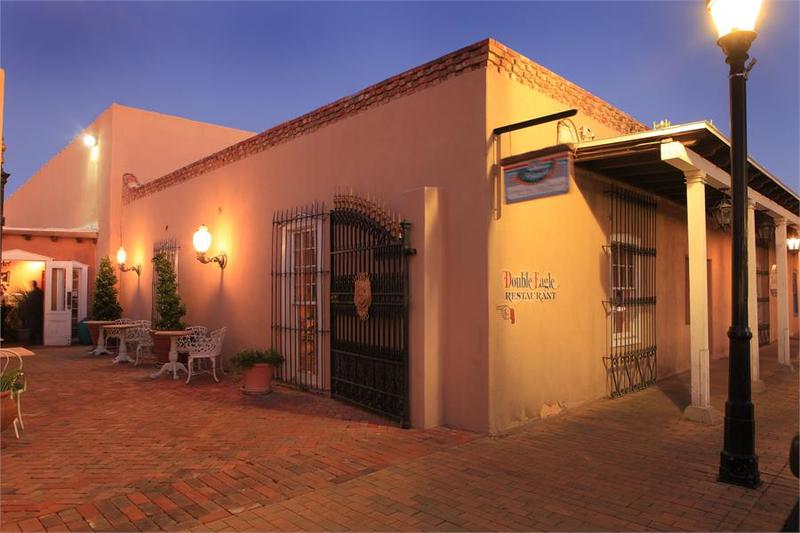
Double Eagle Restaurant
Standing just off the historic plaza in Mesilla, New Mexico, the Double Eagle Restaurant occupies one of the oldest surviving buildings in the region. With thick adobe walls, carved wood beams, chandeliers, and richly decorated dining rooms filled with antiques, the structure feels less like a restaurant and more like a preserved nineteenth-century estate. The original home was constructed in 1849, during a time when Mesilla was emerging as a major settlement along trade routes connecting Mexico, Texas, and the American Southwest. The town itself would soon become the backdrop for several pivotal moments in frontier history. The Gadsden Purchase was confirmed on the Mesilla plaza in 1853, bringing the region formally under United States control. During the Civil War, Mesilla was briefly declared the capital of the Confederate Arizona Territory in 1861. By the late nineteenth century, the town also gained notoriety when Billy the Kid was tried and briefly imprisoned there in 1881. The Double Eagle building stood through all of it, quietly watching the territory around it transform. The haunting legend most closely tied to the property centers on the Maese family, early owners of the home, and a tragic romance that has become one of the most enduring ghost stories in New Mexico. According to local accounts, the family’s teenage son Armando fell deeply in love with Inez, a young servant who worked in the household. Their relationship was forbidden by Armando’s mother, who believed her son should marry into a wealthier and more socially acceptable family. One evening she reportedly discovered the two together in Armando’s bedroom. Enraged, she seized a pair of sewing shears and attacked them. Inez was killed immediately, while Armando was fatally wounded and died days later. The room where the attack is said to have occurred is now known as the Carlotta Room, named after Armando’s mother, and it has become the focal point of nearly every haunting claim connected to the building. Unlike many haunted locations that sit abandoned, the Double Eagle remains active and carefully preserved. Dining rooms branch from one another through narrow passages and archways, still following the layout of the original home. The Carlotta Room in particular carries an atmosphere many visitors describe as unusually heavy or still. In one corner sit two Victorian chairs that have become central to the building’s ghost lore. Reports of paranormal activity at the Double Eagle have circulated for decades among staff and visitors. Many of the experiences center around the Carlotta Room, where Armando and Inez are said to remain. Employees have described chairs and tables shifting slightly, wine glasses breaking without an obvious cause, lights flickering, and unexplained cold spots drifting through the room. Some guests claim to hear whispers or their names spoken when no one else is nearby, while others report seeing shadowy figures near the corner chairs. Those chairs are the most famous detail of the haunting. According to local tradition, the seats show impressions shaped like two people sitting side by side despite rarely being used. Visitors are often warned not to sit in them. Over the years, several people who ignored the warning have reported sudden nausea, overwhelming sadness, or vivid nightmares afterward, reinforcing the belief that the spirits of Armando and Inez still occupy that space. Skeptics note that historic adobe buildings creak, settle, and carry sound in unusual ways, and that powerful stories can shape how visitors interpret ordinary events. But the Double Eagle’s reputation has endured because the reports are remarkably consistent across decades of unrelated visitors. Today the Double Eagle Restaurant operates as both a fine dining destination and one of the most famous haunted locations in the American Southwest. Guests come for the elaborate interior, the preserved frontier architecture, and the deep historical ties to Mesilla’s past. Yet many leave remembering something else entirely—the strange quiet of the Carlotta Room, the chairs in the corner, and the lingering sense that whatever tragedy once unfolded inside the house may not have completely faded with time.

The Springville Inn
The Springville Inn sits along California State Route 190 in the small foothill town of Springville, Tulare County, nestled against the western slope of the Sierra Nevada just minutes from the Giant Sequoia National Monument. The town has been here since 1849, when pioneers settled the area, and the inn has been at its center since 1911, when it was built as the Wilkinson Hotel to serve travelers arriving with the railroad. The original owners went broke during construction and were forced to sell before they ever saw it finished. A 1972 addition brought the motel rooms that extend behind the original structure, but the bones of the place—the restaurant on the ground floor, the bar and dance hall on the second—remain housed in the 1911 building. For over a century, the Springville Inn has served as the social hub of a town that goes quiet by six in the evening. It is also, by most accounts from those who have worked and stayed there, thoroughly haunted. Four distinct entities have been identified by staff over the decades, each given a plainspoken name by employees who encountered them often enough to stop being surprised. The Old Man is the most frequently reported, an observant presence concentrated around the kitchen and the old dumbwaiter that connects the lower kitchen to the upper service area. Former employees describe him not as a passive residual haunting but as an active and hostile personality—hiding the lock to the walk-in cooler, shoving barstools, breaking glassware, knocking from inside the walk-in as though someone had been locked in, and on more than one occasion physically attempting to push workers down the stairs. The Young Man is said to be the ghost of a logger who was shot and carried into the inn to die. His energy is described as friendly, even charming—he frequents the bar area and has a reported affinity for female guests and staff. The Little Girl, estimated by witnesses at seven or eight years old, appears in turn-of-the-century dress at various locations throughout the building, though sightings have grown less frequent in recent years. The Woman is the rarest and most unsettling of the four. She has been seen on the upstairs balcony in white, and one former restaurant employee described an encounter in which the figure appeared standing inverted on the ceiling of the dining room, staring down with a dark substance dripping from her mouth. That employee ran screaming into the kitchen. The reports extend beyond the original building. Guests in the motel rooms have described cabinet doors swinging open on working hinges, unexplained sparkling lights on ceilings that persisted even after curtains were drawn, and personal belongings rearranged overnight—dress socks neatly folded into pant legs in ways the guest swore they never would have done. Staff members have reported whispers, physical touches on the staircase, and self-propelled kitchen utensils. One visitor captured a voice on a phone recording that appeared to say "help me" over background noise. A man from Sacramento who stayed at the inn for a work trip reportedly refused to return, driving an extra forty-five minutes to stay in Tulare on all subsequent visits rather than spend another night. Former employees note the activity is markedly stronger during mornings and afternoons than at night.

Hotel Villa Convento
Standing on Ursulines Avenue in the lower French Quarter, just steps from the Mississippi River and within sight of the Old Ursuline Convent, the Hotel Villa Convento occupies a Creole townhouse that has been absorbing the weight of New Orleans history since the 1830s. The land itself carries an even older provenance. It was originally part of the holdings of the Ursuline nuns, the French Catholic order that arrived in Louisiana during the early colonial period and became one of the most important institutions in the young settlement. In 1805, the nuns partitioned off portions of their property as the growing city pressed in around them, and the lot at what is now 616 Ursulines Avenue passed into private hands. By 1833, the parcel had been purchased by a Frenchman named Jean Baptiste Poeyfarre, who commissioned the construction of the three-story Creole townhouse that remains standing today. Poeyfarre died roughly a decade later, and his widow sold the building to Octave Voorheis, who held the property until the economic collapse that followed the Civil War forced him to let it go around 1872. It is during the difficult years after the war that the building's most enduring and controversial legend takes shape. New Orleans, once one of the wealthiest and most cosmopolitan cities in America, had entered a steep decline. Vice industries flourished as the economy cratered, and the French Quarter became a district where brothels, gambling houses, and saloons operated with varying degrees of openness. Local tradition holds that 616 Ursulines became a brothel during this period, possibly operating as a so-called house of assignation—a place where illicit encounters could take place away from private residences. No definitive documentary proof has surfaced to confirm the building's use as a bordello, but available records suggest that something unsanctioned was happening at the address during these decades, and multiple sources have maintained the claim across generations. The legend has earned the Villa Convento a persistent association with the folk song "House of the Rising Sun," later made internationally famous by the Animals in 1964. Several locations in New Orleans have been put forward as the song's inspiration, and the true origin remains a matter of debate, but the Villa Convento has remained near the top of the list for decades. On March 10, 1902, Pasquale Taromina purchased the property, and his family occupied the building as a private residence until 1946. Following the Taromina family's departure, the structure was converted into a rooming house known as the Old Town Villa, offering inexpensive studio apartments to transient residents and students. Among the more notable tenants was a young Jimmy Buffett, who lived in apartment 305 during his early days in New Orleans and later returned with a video crew to film a documentary about that chapter of his life. The room retains his apartment number to this day and is informally known as the Jimmy Buffett room. In the early 1970s, the rooming house was converted into a hotel, and in September 1981, the Campo family—seventh-generation New Orleanians whose ancestors emigrated from the Canary Islands during the colonial period—purchased the property and have operated it as the Hotel Villa Convento ever since, preserving all twenty-five rooms with their original apartment numbers intact. The paranormal reputation of the Villa Convento is among the most consistently documented of any hotel in a city that has no shortage of haunted accommodations. The activity is not confined to a single room or floor but has been reported across the property, with certain rooms drawing particular attention. The most commonly identified entity is believed to be the ghost of a former madam from the building's rumored brothel era. Guests—overwhelmingly men—report hearing a woman's disembodied voice in Room 301, sometimes speaking in suggestive tones or addressing the guest by name. Male guests in multiple rooms have described rolling over in bed to see the apparition of a woman dressed in black standing at the bedside, gazing at them intently before vanishing. The figure reportedly appears visible only to the man, even when a partner is lying beside him. The connection to the brothel legend extends to another recurring phenomenon: unexplained knocking on guest room doors, which paranormal researchers and tour guides have linked to the old practice of madams making rounds to signal that a client's time was up. Room 302 has produced reports of full-bodied apparitions materializing and disappearing at all hours, including from a longtime annual guest who saw a figure form in the room and never returned to stay there again. Room 305, the Buffett room, generates reports of personal belongings being moved and an oppressive sense of being watched. At least one hotel staff member has described entering 305 to check on a hairdryer and being overcome by a sudden, intense feeling of being observed, strong enough to send her back downstairs immediately. Room 209 carries a grimmer association—local accounts hold that a man took his own life in the room, and guests who stay there have reported hearing voices and finding their possessions displaced. Visitors have also reported the sound of a child's laughter echoing through the building, and some guests have captured unexplained faces in photographs taken inside the hotel. Author James Caskey, who stayed at the Villa Convento while researching his book on New Orleans hauntings, has described it as possibly the most haunted hotel in the city. Paranormal tour groups regularly include the property on their routes, and independent investigators who have conducted overnight sessions at the hotel have reported capturing audio evidence and experiencing physical phenomena consistent with an active location. Today the Hotel Villa Convento operates as a small, family-run guest house with the quiet charm of a building that has never been stripped of its character. The courtyard offers chicory coffee and morning beignets. The wrought-iron balconies look out over Ursulines Avenue, where horse-drawn carriages still pass and the tops of ships on the river are visible in the distance. The Campo family embraces the building's history—its colonial origins, its possible life as a brothel, its tenure as a bohemian rooming house, and its reputation as one of the most paranormally active addresses in New Orleans. Whether the knocking at the door is a former madam making her rounds or just the old bones of an 1833 townhouse settling into another century, the Villa Convento offers the kind of stay where the line between history and haunting is never entirely clear.

Sedamsville Rectory
On a narrow street in one of Cincinnati's smallest and most overlooked neighborhoods, a four-level rectory sits on a hillside above the Ohio River, holding inside its six thousand square feet of space a concentration of dark history that has made it one of the most investigated paranormal locations in the state. The Sedamsville Rectory at 639 Steiner Avenue has been featured on the Travel Channel's Ghost Adventures, the SyFy Channel's Haunted Collector, and the Biography Channel's My Ghost Story, and was voted the number one fan favorite episode during the Travel Channel's 2015 Halloween marathon. The attention is not accidental. The building's history involves violent death, alleged abuse, and a period of abandonment during which the basement reportedly housed something far worse than neglect. Sedamsville itself was established in 1795 by Colonel Cornelius Sedam, a Revolutionary War veteran who moved to the area to help build Fort Washington. The neighborhood grew along the banks of the Ohio River and the railroad line, becoming a hub for manufacturing and river commerce. By the late nineteenth century, the community's booming German Catholic population led to the founding of Our Lady of Perpetual Help parish in 1878. The Gothic Revival church was dedicated on May 5, 1889, perched high on a hill overlooking the neighborhood. According to a booklet published by the parish for its centennial, the rectory was built in 1891 to house the priests serving the growing congregation. The building is a substantial structure with a parlor, living room, library, formal dining room, kitchen, and bathroom on the first floor, servant's quarters accessible by a back staircase on the second floor, additional rooms on the third floor, and a basement that would later take on its own grim reputation. Sedamsville prospered into the early twentieth century, with over a hundred businesses operating along River Road. Residents could take the streetcar into Cincinnati or the ferry across to Kentucky. But the catastrophic Ohio River flood of 1937, combined with the ongoing Depression, devastated the commercial district. Many businesses never rebuilt. The widening of River Road further isolated the neighborhood. Our Lady of Perpetual Help's school closed in 1976 and merged with Holy Family parish in East Price Hill. When the church itself closed in 1989, the remaining parishioners joined Holy Family as well. The church was stripped of its sacred items and the properties were sold. In 1995, John Klosterman purchased the church and rectory from the Archdiocese of Cincinnati. The rectory's paranormal reputation is anchored by several distinct threads of history. The most widely identified spirit is Father Donald MacLeod, who authored The History of Roman Catholicism in North America and resided at the rectory in the late 1800s. Father MacLeod was struck and killed by a train in Sedamsville while on his way to provide comfort to a seriously ill woman. Since his death, locals and parishioners have reported seeing his apparition walking along the street near the building or beside the railroad tracks. Inside the rectory, visitors have reported seeing the figure of a clergyman in the hallways. Adding to the building's burden are two separate deaths documented on the street directly in front of the rectory—a man found dead at one time, and a child found with a noose around its neck at another. The circumstances of these deaths are not well documented, but the proximity to the building has drawn them into its haunting narrative. The darkest chapter of the rectory's history involves two distinct periods of alleged abuse. The building is rumored to have housed a priest who abused and molested children during its years of church operation. Separately, during a period in the 1980s when the rectory sat vacant after the church closed, the basement was reportedly used to operate a dog fighting ring. The convergence of these two forms of cruelty—against children and against animals—has led investigators and visitors to describe the energy inside the building as not merely haunted but aggressively malevolent. The sounds of dogs growling and barking have been reported in the basement when no animals are present. Visitors have described being scratched, bitten, pushed, and shoved by unseen forces. A child-like entity has been encountered in the building, but when approached, it reportedly growls rather than speaks, leading some investigators to suspect it may not be what it appears. A shadowy figure described as a dark monk has been reported moving through the halls. The smell of sulfur—commonly associated in paranormal research with demonic or deeply negative presences—has been noted by former tenants. One ghost hunter received a scratch down his back in the shape of a cross during an investigation. When the current owners brought salvaged books and a Monet reproduction into the building from a vandalized neighboring house, the rectory reportedly erupted with growling, whispering, a slamming door upstairs, the sound of a woman crying, and a sudden darkening of the interior light. The Midwest Preservation Society began renovations of the rectory in March 2011, and it was during this restoration work that the building gained its widest attention. Workers reported eerie mists and shadows visible under the doors of empty rooms. The Ghost Adventures investigation in 2012 captured evidence that deepened the rectory's reputation as one of the most aggressive haunts in the Midwest. Paranormal teams that have investigated the site report shadow figures, intelligent responses to questions during EVP sessions, physical contact from unseen entities, and doors that open and close without explanation. Today the Sedamsville Rectory remains privately owned and continues to undergo restoration. The neighborhood around it is small and quiet—known primarily as the birthplace of Pete Rose and for the rectory itself. The church still stands on the hill above. The railroad tracks still run nearby. And the building at 639 Steiner Avenue continues to draw investigators and visitors who describe it in terms that most haunted locations never earn—not just active, not just unsettling, but a place where the accumulated weight of suffering seems to push back against anyone who enters.

Brunswick Heritage Museum
Sitting in the heart of downtown Brunswick, Maryland, just steps from four active CSX mainline tracks and the Potomac River, the Brunswick Heritage Museum occupies a three-story brick building that has housed more history than its modest Main Street footprint would suggest. The 1904 structure — with its five tall narrow arches, Flemish bond brickwork, and dentelle cornice — was not built as a museum. It was built as a lodge, and the town it stands in was not always called Brunswick. It has been Eel Town, Berlin, Barry, and half a dozen other names across three centuries of continuous human settlement, each identity layered onto the one before it. The land along this stretch of the Potomac was home to the Susquehanna Indians when European settlement began in the early eighteenth century. The area was known as Eel Town because Native Americans fished for eel from the riverbank. A 1753 land grant from King George II planted the area firmly in colonial hands, and German immigrants followed in enough numbers through the 1780s that the settlement took the name Berlin. It remained a modest river trading post until the Baltimore and Ohio Railroad arrived and changed everything. In 1883, the B&O selected Berlin as the site for a massive new freight classification yard — the terrain was ideal, riverside bottomland was cheap, and the railroad was exempt from Maryland property taxes. The town was incorporated as Brunswick in 1890, and by 1907 the yard was complete: five miles of track, the largest and most modern classification yard in the country to serve a single railroad. A population of roughly 200 in 1890 swelled to an estimated 5,000 by 1910. Brunswick was, briefly, a boomtown. The building at 40 West Potomac Street was constructed in 1904 at the height of that boom, commissioned for the Delaware Tribe No. 43 of the Improved Order of Red Men — a fraternal organization whose roots traced to secret patriotic societies of the pre-Revolutionary era. The upper two floors served the lodge; the ground floor housed separate commercial tenants. A Native American statue stood at the building's entrance. The Improved Order of Red Men occupied the building until 1945, when the Fraternal Order of Eagles Brunswick Aerie No. 1136 purchased it, removed the statue from the entrance — it now stands on the museum's second floor — and operated there until 1969. The Brunswick Potomac Foundation purchased the building in 1974 for $30,000, paying off the mortgage through dollar donations and baked goods sales. The museum opened in 1980, focused initially on the railroad, and expanded its scope in 2013 to encompass the full arc of Brunswick's history. During the Civil War, Confederate forces used the area as a staging ground for raids into Maryland, and Union soldiers camped nearby after both Antietam and Gettysburg. Before the building became a museum, its third floor served as a dance hall where Patsy Cline performed for the Lions Club in the 1960s. The building itself carries three stories of accumulated human use across more than a century — fraternal lodge, dance hall, civic meeting space, and now museum. The architecture is straightforward brick commercial, but the interior has absorbed decades of different functions and different communities. The 1,700-square-foot HO scale model railroad on the third floor depicts the B&O Metropolitan Subdivision in meticulous detail. Elsewhere in the building, exhibits trace the town from its Indigenous roots through the canal era, the railroad boom, and into the present. The whole structure sits less than a block from active tracks, and the sound and vibration of passing trains are a constant undercurrent. Paranormal activity at the museum was described as occasional from the time it opened in 1980, but reports appeared to escalate in 2010 during construction on an elevator. The most consistent account across multiple independent sources is the apparition of a woman in a white dress — long-sleeved, ankle-length, described by at least one former resident as appearing to be from the Civil War era or earlier. She has been seen on the second floor and moving through exhibit spaces in rooms that should be empty. A former child resident of an apartment above the museum reported seeing the apparition repeatedly at night over the course of years, an account that surfaced only after adult investigators began documenting the building's activity. A second presence is described as a spirit who rearranges exhibits and interacts with the museum's collection — sometimes referred to as a ghostly curator. A third is associated specifically with the model railroad on the third floor, where the trains are said to start moving on their own and track switches reported to flip with no one near them. Skeptics will point to the building's age and constant low-level vibration from nearby rail traffic as natural sources for unexplained sounds and movement. A structure that has served as a fraternal lodge, dance hall, and community gathering space for over a century has absorbed a great deal of human energy, and the suggestion embedded in a location marketed as haunted is never insignificant. Investigators from multiple paranormal organizations have conducted formal sessions at the museum, with one 2017 expedition capturing what researchers described as statistically significant results from a random event generator and apparent direct radio voice responses to control questions using local and historical names. Today the Brunswick Heritage Museum is open to the public, free of charge, and operated as a nonprofit. It has been featured on regional ghost tours and included in guided haunted history routes through western Maryland. Whether visitors come for the model railroad, the Civil War history, the layers of fraternal lodge lore, or the woman in white reportedly still moving through the second-floor exhibits, the building at 40 West Potomac Street has more stories running through it than most places twice its size. Brunswick built itself around a railroad, and the museum built itself around Brunswick — and something in the building, apparently, has declined to leave.
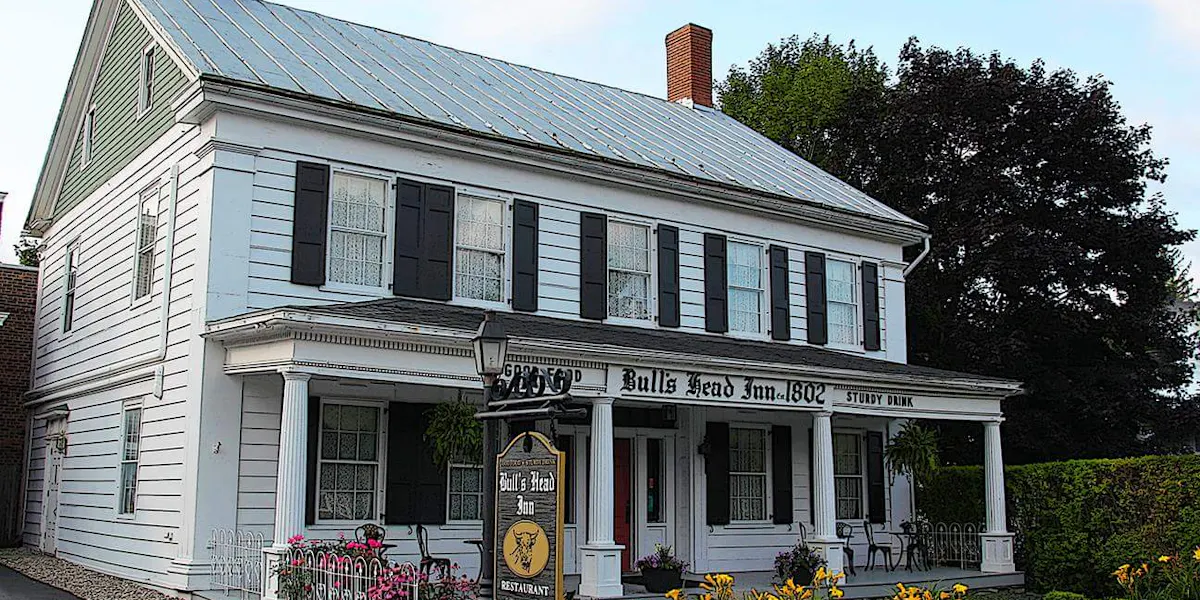
Bull’s Head Inn
Standing at the corner of Park Place in the heart of Cobleskill, New York, the Bull's Head Inn is the oldest building in the village — a Federal-style structure built in 1802 that has served, across more than two centuries, as tavern, town hall, Masonic temple, courthouse, meeting hall, private residence, and restaurant. It carries that layered institutional history the way old buildings do in small upstate New York towns — quietly, in the woodwork, in the reoriented staircase, in the central fireplace that has warmed a rotating cast of merchants, soldiers, politicians, and neighbors across generations. A portrait of Thomas Jefferson hangs in the foyer, a reminder that he was President when the building was new. But the site itself is older than the building by half a century. George Ferster constructed one of the first structures in Cobleskill here in 1752, and what followed was a sequence of catastrophes that left a mark the land has apparently not forgotten. On May 30, 1778, during the Battle of Cobleskill, Mohawk forces under the command of Joseph Brant — fighting alongside Tories and British — burned the settlement nearly to the ground. Retreating patriots were killed, and the structure on this site was destroyed. The two buildings that followed met the same fate, each burned in subsequent enemy raids on Cobleskill in the spring and fall of 1781. Local tradition holds that occupants perished in one or more of these fires — including, in one account, a young girl in an upstairs bedroom who froze in terror and could not escape the blaze. Another story maintains that a Native American was killed inside the building during one of the conflicts. Three buildings destroyed on the same ground, within a single generation, each one carrying its dead. The current structure was built in 1802 by Seth Wakeman — the same builder responsible for the Beekman Mansion in Sharon Springs — and established as an inn and tavern to serve merchant traffic along the newly charted Loonenburg Turnpike, which ran commerce between Central New York and New York City. The inn thrived until the Erie Canal redirected that traffic north through Albany, bypassing Cobleskill and draining the commercial foot traffic that had kept it busy. By 1839, the building had transitioned into a private residence, and it remained one for well over a century. In 1810, when Cobleskill's Main Street was developed, the building was physically reoriented — its staircase repositioned, its front entrance redesigned to face the new brick-lined street. The building adapted, as it always had. The architecture reflects its early Federal character — three floors, a central staircase, original wide-plank floors, and stone cellar walls that the current owners exposed and incorporated into the lower tavern space using reclaimed brick from Cobleskill's own Main Street. The building is divided across three distinct atmospheres: a ground floor dining room anchored by a classic brick fireplace, an upper floor with vintage glass windows suited for private gatherings, and a lower tavern built from the bones of the old cellar. It is a building that wears its age honestly, without staging. The last private residents of the Bull's Head were John and Grace Steacy, whose opposing natures apparently outlasted them both. John drank; Grace was a dedicated member of the Women's Christian Temperance Union. When the building was sold after their deaths and former Cobleskill mayor Monte Allen reopened it as a restaurant and bar in 1966, he placed the bar in the room that had served as Grace Steacy's bedroom. What followed, according to staff, guests, and ownership across multiple decades, has been consistent and specific. A woman in a white gown — long-sleeved, floor-length — has been seen moving around the central staircase, along the upper and lower landings, and through the first-floor dining room by guests and staff working late. Silverware and napkins have been knocked to the floor or sent across the room. Plates and utensils have been disrupted mid-service. Doors slam on their own. Faucets turn themselves on. The current ownership reports these occurrences as ongoing. The paranormal activity at the Bull's Head is notable for its consistency across unrelated witnesses spanning more than fifty years of restaurant operation. The apparition of the woman in white has been described in nearly identical terms by guests who had no prior knowledge of the building's story. Paranormal investigators have conducted formal sessions at the property, and the inn is an established stop on New York State's official Haunted History Trail. The figure most commonly associated with the activity is Grace Steacy — a teetotaler whose bedroom became a bar — though older stories from local family tradition point toward the Revolutionary-era fires and the girl reportedly trapped in the upstairs room as an earlier and perhaps deeper source. Skeptics will note that a two-hundred-year-old building with three destroyed predecessors on the same site is exactly the kind of place where stories accumulate and feed on each other. The convergence of documented historical violence, a colorful final resident with a grudge against alcohol, and decades of reported encounters makes the Bull's Head something of a perfect storm for haunted reputation. None of that makes the firsthand accounts less consistent or less specific. The woman in white keeps appearing near the staircase. The silverware keeps moving. And the bar, to Grace Steacy's apparent displeasure, remains open.
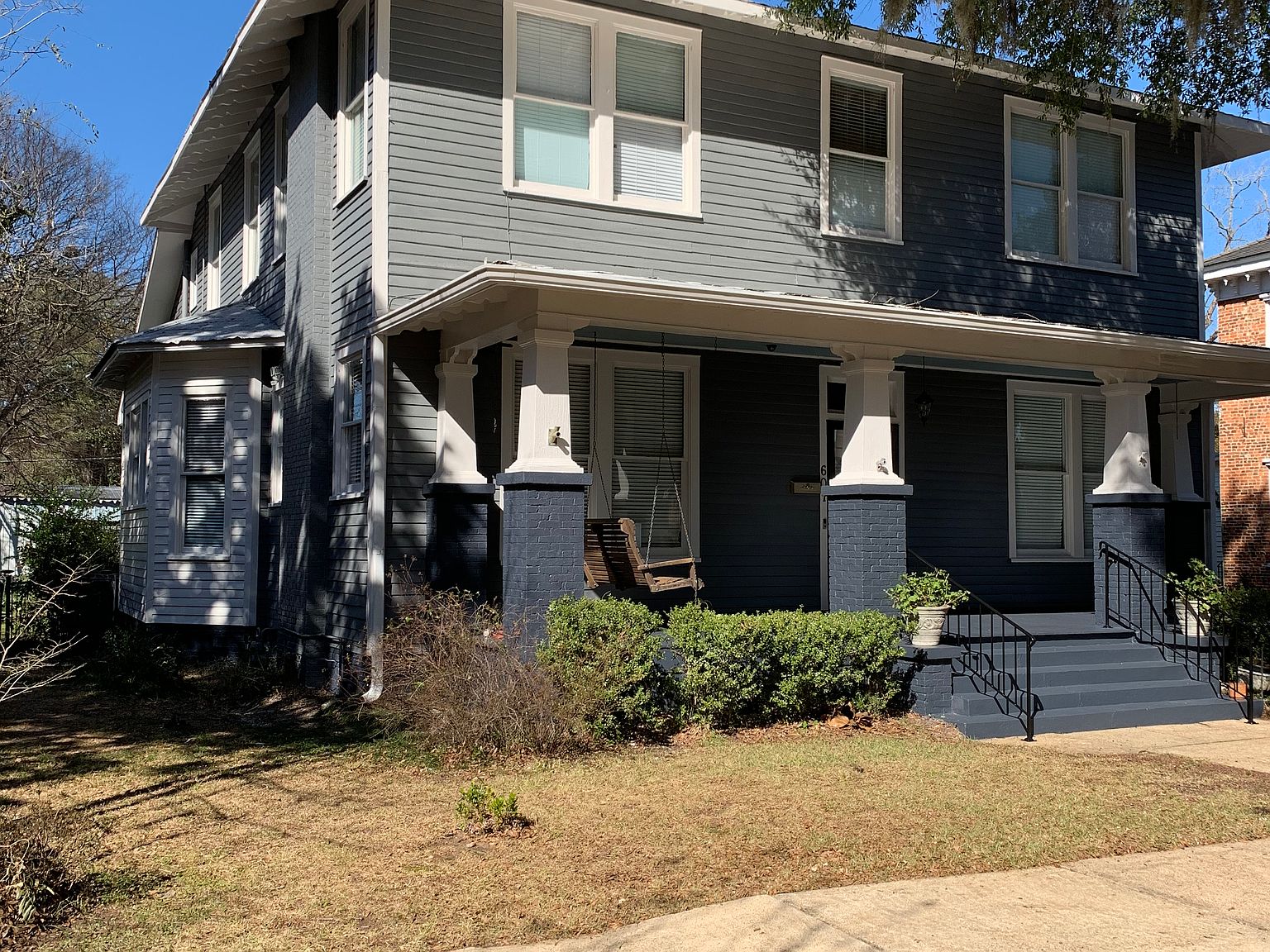
Trotter Home
On a tree-lined stretch of Selma Avenue in one of Alabama's most historically saturated cities, the Trotter Home sits as a quiet two-story Victorian-era residence that has accumulated, over the course of more than a century, a reputation that far exceeds its modest exterior. Built in the 1880s during the period of post-Reconstruction recovery that followed the Civil War's devastation of Selma, the house functioned for decades as a boarding house — one of the many private homes along its block that opened their doors to transient workers, young professionals, and families passing through a city still finding its footing in the New South. It is a structure defined less by grandeur than by longevity, the kind of house that absorbs lives rather than showcasing them, and it is precisely that quality of accumulated human experience that gives it its particular atmosphere. Selma itself provides the backdrop that makes stories like this one feel credible even to skeptics. The city sits in the heart of Alabama's Black Belt, on the banks of the Alabama River, with iron-rich bedrock running beneath its streets and centuries of layered history pressing down from above. It served as a Confederate industrial stronghold before Union forces swept through in the Battle of Selma on April 2, 1865, and it became the epicenter of the American civil rights movement a full century later. Paranormal investigators who have worked extensively in the area note that the combination of the city's geology — iron in the ground, a river running alongside, old structures holding old grief — creates what they describe as conditions unusually favorable to the retention and replay of energy. Whether or not that framework carries scientific weight, Selma produces more consistent accounts of unexplained phenomena per city block than almost anywhere in Alabama. The story at the heart of the Trotter Home's haunting begins in September 1941, when a twenty-one-year-old man named Robert Edgar was living in the house's upper front corner bedroom with his mother, the property then operating as a boarding house. He was driving near Marion Junction with his fiancée when the car tipped over and his arm was caught beneath it on the gravel road. The injury was severe enough to require amputation. Gangrene set in quickly. Surgeons removed the arm on September 16, 1941, but the infection had already progressed beyond saving. Three days later, on September 19, Robert Edgar died. His funeral was held in the home where he had lived, and his body was laid in state in the dining room for three days before burial. His gravestone, later discovered by the home's subsequent residents, reads: Although he sleeps, his memory doth live. The family that gives the house its current name — Norm Trotter, his late wife Pat, and their two teenage daughters — moved in on September 16, 1991, fifty years to the day that Robert Edgar's arm was amputated, and three days before the fiftieth anniversary of his death. They had no knowledge of Edgar when they purchased the house. The seller mentioned in passing, just before closing, that the home had a ghost. The Trotters moved in anyway. What followed was a sustained period of unexplained activity that the family documented carefully over years. Strange things began within weeks of their arrival. Guests sleeping in the home woke feeling a brush across their cheek with no one nearby. Coat hangers jangled loudly inside closed closets. A jar sitting on top of a kitchen cabinet with a raised lip fell and shattered without explanation. The daughters, getting ready for prom upstairs, heard the hangers going and opened the closet to find nothing disturbed. One of them woke in the night, saw a figure standing at the foot of the bed, assumed it was a friend staying over — and realized the friend was asleep beside her. In October 1992, during the World Series, a luminous ball of light floated down the staircase and into the foyer, where it lingered for several minutes while Pat watched it, unwilling to move for fear it would leave before she could make sense of it. The same experience was repeated years later by Norm's second wife, Jaclyn, who watched a glowing orb descend the stairs and pause in the foyer while she sat alone watching television. The spirit, when it appears visually, tends to present at the periphery — a shadow glimpsed at the edge of vision that disappears when turned toward directly. Lights switch on and off without anyone near the switch. Doors open on their own. Plants are knocked from their places. The activity was most concentrated when the daughters were living in the house, and diminished somewhat as they grew up and moved away, though occasional incidents have continued. Pat Trotter, who died in 2003, kept a running file of documented encounters during the years the family was most actively experiencing the phenomena. Research into the house's history eventually led Norm Trotter to newspaper accounts of Edgar's death and to the gravesite that confirmed the timing. The coincidence — that the family moved in on the precise anniversary of Edgar's amputation, and that his funeral had been held in the very dining room beneath their feet — struck the Trotters as something beyond accident, though Norm Trotter has consistently framed the situation with measured curiosity rather than fear. The activity, he has noted, was never threatening. It felt more like the presence of someone who remained attached to a place he knew, visiting the rooms he had occupied in life. The Trotter Home has been featured on Fox's Encounters television program and on Alabama Public Television, and has been included in the Selma and Dallas County Chamber of Commerce's Haunted History Tours for years. It remains a private residence, not open for public investigation. The dining room is still there. So, apparently, is Robert Edgar.

Lawther Hall – University of Northern Iowa
Sitting quietly on the residential edge of the University of Northern Iowa campus in Cedar Falls, Lawther Hall doesn't announce itself the way a prison or asylum does. It's a brick dormitory, institutional and understated, built in 1940 and named for Anna B. Lawther — the first woman appointed to the Iowa State Board of Education and a figure in the women's suffrage movement. From the outside, it looks like exactly what it is: a mid-century college residence hall with long corridors, small rooms, and a top-floor attic that students haven't had access to in decades. What makes it notable isn't architecture or tragedy. It's a name. Augie. The building opened for the summer 1940 term, initially housing 293 women. During World War II, the adjacent Bartlett Hall was converted to house a training unit for the U.S. Navy WAVES — Women Accepted for Volunteer Emergency Service — which pushed Bartlett residents into Lawther, sometimes four students to a room designed for two. That wartime compression is the most dramatic chapter in Lawther's documented history. The building was always a women's dormitory. It was never officially used as a military infirmary, though the legend that eventually grew up around it says otherwise. Somewhere between the wartime crowding, the sealed attic floors, and the particular way old dormitories settle at night, a story took shape. The legend of Augie describes a World War II soldier who died in Lawther Hall when the building was being used as an infirmary — a detail that university archivists have been unable to verify and that conflicts with the building's known history as an exclusively female residence. What is documented is that the upper attic floors of Lawther were closed off in the early 1970s, deemed unsafe and in disrepair, and that students began reporting strange experiences around that time and after. The earliest recorded reference to Augie by name dates to 1977, when someone rearranged the lettering on a hall bulletin board to read: "Augie will return to haunt Bordeaux House." It is unclear whether that was a prank, a genuine report, or the moment a legend crystallized into campus fact. The building itself contributes to its reputation through atmosphere alone. The sealed upper floors — inaccessible, dusty, and unlit — created the kind of physical mystery that college-aged imaginations tend to populate. For years, a student-run haunted house called Augie's Attic operated in those upper spaces during Halloween season, drawing four hundred to a thousand visitors annually from campus and the surrounding Cedar Falls-Waterloo area. The event ran until the late 1990s, when fire code violations and roof damage ended it. The last Augie's Attic was held in 1997. After that, the attic stayed quiet, and Augie, according to students, moved to other parts of the building. Reports associated with Lawther Hall are consistent in their details if not in their explanation. Residents describe electronics behaving erratically — televisions switching on unprompted, radios continuing to play after being unplugged, alarm clocks failing without any mechanical defect. Posters found inverted or relocated overnight. Closet lights switched back on after being taped down. A resident assistant reported seeing a man in a striped outfit walking the hall during a period when the building was closed for break, who vanished into a women's restroom. One widely circulated account describes a resident waking in the night to find her television screen illuminated blue, hearing footsteps in the room, feeling her bedsheets pulled from her grip despite her resistance, and seeing the words "Good Night" appear on the screen before the pulling stopped. Skeptics — and there are reasonable ones — note that residence halls are among the noisiest, most suggestible environments imaginable. Hundreds of people have lived in Lawther Hall over the decades, sharing close quarters and trading stories across generations of students. Pipes, drafts, settling foundations, and shared folklore account for a great deal. The Augie legend itself may have its origins in misidentified history, a bulletin board prank, or simply the appeal of having a named ghost in a building with a sealed attic. These are not unreasonable explanations. What they don't fully account for is why the accounts from Lawther have remained so specific and so consistent for nearly fifty years, told by students who arrived with no prior knowledge of the legend and left with stories that matched the ones before them. Lawther Hall is not a place defined by documented violence or suffering. It's a place defined by accumulation — of stories, of residents, of years. Whether Augie is the ghost of a soldier, the product of a long-running campus tradition, or something harder to categorize, the building has earned its reputation through simple persistence. Generations of students have lived there, and a notable number of them left convinced that something in Lawther Hall was paying attention.