
Intelligent Hauntings in America
95 haunted locations
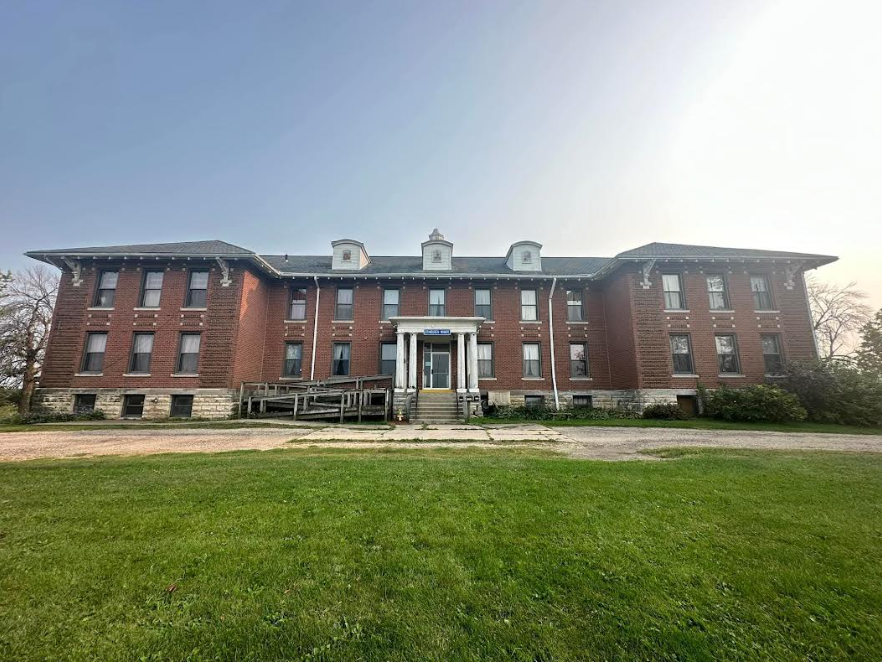
Edinburgh Manor
Rising from the rolling hills outside Scotch Grove, Iowa, Edinburgh Manor looks exactly like what most people picture when they think of a haunted asylum—massive brick walls, tall narrow windows, and an isolated presence that feels cut off from the modern world. But Edinburgh Manor wasn’t built as an asylum in the cinematic sense. It began in 1910 as the Jones County Poor Farm, part of a nationwide system designed to house society’s most vulnerable. Like many county poor farms of the era, the facility provided housing for the elderly, disabled, mentally ill, and those who had nowhere else to go. Residents worked the land if they were physically able. Crops were grown. Livestock was raised. The goal was self-sufficiency, but life inside these institutions was rarely comfortable. Resources were limited, oversight was minimal, and many residents spent their final years there. Over time, the Manor transitioned into a county home and later included mental health care wards as state systems evolved. Unlike locations tied to one infamous act of violence, Edinburgh Manor’s weight comes from duration. Decades of illness, poverty, isolation, and death unfolded inside its walls. Records confirm that many residents died on the property, and a cemetery sits nearby where some former occupants were buried. For paranormal believers, that long accumulation of hardship forms the foundation of the Manor’s reputation. The building itself amplifies the experience. Four stories tall, with an imposing central staircase and long corridors branching into patient rooms, it feels institutional and austere. The basement once housed storage areas and mechanical systems, while upper floors were dedicated to living quarters and later mental health wards. Paint peels from plaster walls. Old hardware remains intact. Natural light struggles to fill certain hallways, even during the day. Paranormal claims at Edinburgh Manor are among the most persistent in Iowa. Visitors frequently report hearing footsteps when no one is nearby. Doors are said to slam or move on their own. Disembodied voices—sometimes calm, sometimes distressed—are reported in EVPs and live sessions. Some investigators claim to capture direct responses to questions, suggesting intelligent interaction rather than residual replay. One of the most discussed areas is the former mental health ward, often described as heavy or oppressive. Guests report sudden mood shifts, unexplained anxiety, or the sensation of being watched. Shadow figures are commonly described moving across doorways or at the end of hallways. Others claim to see full-bodied apparitions, particularly near the central staircase. Cold spots and equipment malfunctions—draining batteries, REM pods triggering—are also frequently cited. Skeptics point out that the building’s age and structure naturally produce creaks, pressure changes, and temperature fluctuations. Large brick facilities amplify echoes. Wildlife in surrounding rural areas can create unexpected sounds. The power of suggestion plays a significant role, especially in a location marketed as haunted. Still, even seasoned investigators often describe Edinburgh Manor as unusually active compared to similar historic properties. Today, the Manor operates as a public paranormal investigation site. It has been featured in television shows, documentaries, and countless independent investigations. Unlike heavily themed attractions, it remains largely preserved in its institutional form—rooms mostly empty, hallways intact, the original layout maintained. That authenticity contributes to its atmosphere. There are no staged jump scares. Just silence, old architecture, and whatever people believe may still linger. Edinburgh Manor represents a chapter of American history that many communities quietly moved past—the poor farm system and early institutional mental health care. Whether you approach it as a historical landmark or a paranormal hotspot, it forces visitors to consider the lives once lived inside its walls. Some leave convinced they encountered something beyond explanation. Others walk away with logical answers. But almost everyone agrees on one thing: once the doors close and the building settles into darkness, Edinburgh Manor feels anything but empty.

Farrar Schoolhouse
Just northeast of the Des Moines metro, surrounded by quiet farmland and gravel roads, sits the tiny unincorporated community of Farrar, Iowa. The town itself is small—just a church, a handful of homes, and one enormous brick building that seems strangely oversized for the countryside around it. That structure is the Farrar Schoolhouse, a former rural school that educated generations of local children before eventually becoming one of the Midwest’s most recognized paranormal investigation locations. The community of Farrar formed in the early 1900s after a railroad line was built through the area. As farms developed across the surrounding countryside, the need for a centralized school became clear. At the time, many children in rural Iowa attended scattered one-room schoolhouses. Local leaders decided to consolidate those small schools into a single modern facility that could serve the wider farming community. Land for the new school was donated by local farmer C.G. Geddes, and construction began in the early 1920s. When the Farrar School officially opened in 1922, it was considered remarkably modern for rural Iowa. The two-story brick building spanned roughly 17,000 square feet and included amenities many country schools lacked at the time: electric lighting, boiler heat, indoor plumbing, and multiple classrooms under one roof. The project came with a steep price tag—nearly $100,000—which sparked debate among local residents who believed the building was too extravagant for such a small community. Despite the controversy, the school quickly became the educational and social center for the surrounding farmland. Generations of students attended classes, played basketball in the gymnasium, and gathered for community events inside its large halls. For roughly eighty years, the school served families throughout the region. Like many rural schools in the Midwest, however, declining populations and district consolidations eventually made it difficult to maintain such a large aging facility. In 2002, the Farrar Schoolhouse officially closed when students were absorbed into newer schools within the Bondurant–Farrar district. After the final class graduated, the building sat empty for several years. In 2006 it was purchased by Jim and Nancy Oliver, who began restoring the property and living inside the former school. It was during this period that stories of unusual activity began gaining wider attention. Visitors and investigators reported unexplained footsteps in empty hallways, doors closing on their own, children’s voices echoing through classrooms, and shadowy figures moving between rooms. Over time, Farrar Schoolhouse developed a reputation as one of Iowa’s most active paranormal locations. The building attracted numerous investigative teams and media coverage, including appearances on television programs such as My Ghost Story, Ghost Stalkers, and Kindred Spirits. Independent investigators and YouTube creators also began documenting their experiences inside the school, further expanding its reputation among paranormal enthusiasts. In 2024, the property gained even wider attention when it was purchased by paranormal YouTubers Sam Golbach and Colby Brock—better known online as Sam & Colby. The pair, whose channel reaches millions of viewers, bought the school after learning it might be demolished. Their goal was to preserve the building and continue investigating its claims while opening it to other paranormal researchers. Their multi-episode investigation series filmed inside the school brought a new wave of global interest to the location. During their time at the property, they collaborated with several well-known figures in the paranormal community, including Exploring With Josh, Dakota Laden from Project Fear, and creators such as CelinaSpookyBoo and KallMeKris. These investigations introduced Farrar Schoolhouse to a massive online audience and helped cement its status as one of the most recognizable haunted schools in the United States. Today the building remains largely intact from its days as a rural school. Classrooms, staircases, chalkboards, and administrative offices still stand much as they did decades ago. For historians, the structure represents a rare surviving example of early 20th-century rural school consolidation. For paranormal investigators, it has become a place where history, folklore, and modern digital storytelling intersect. Whether the strange reports inside Farrar Schoolhouse stem from paranormal forces, the psychology of expectation, or simply the acoustics of a century-old building is still debated. What is certain is that this once-quiet rural school now sits at the center of one of Iowa’s most widely discussed paranormal case files.
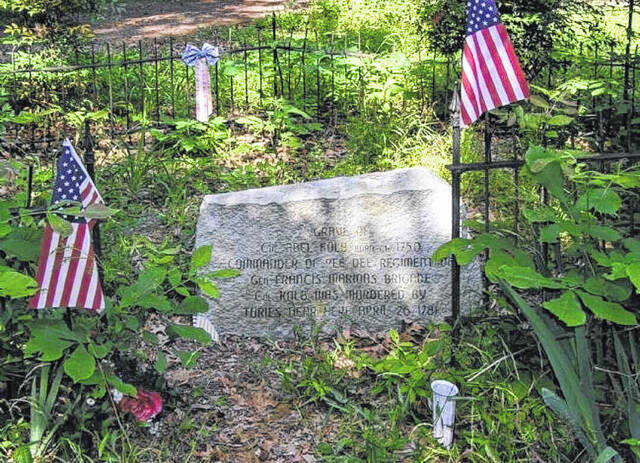
Colonel Kolb’s Tomb
The Great Pee Dee River moves through the coastal plain of South Carolina the way all rivers move through that kind of country — brown and wide and slow, flanked by bottomland that floods in spring and holds the heat in summer, lined with cypress and oak and the particular stillness of a landscape that has not changed its character in three hundred years. On its eastern bank, near the old Marlboro-Darlington county line, a small clearing holds what remains of the Old Welsh Neck Baptist Church cemetery — a few stone markers, several river rocks, and a modest obelisk that marks the grave of Colonel Abel Kolb, commander of the Pee Dee Regiment of General Francis Marion's Brigade. It is one of the more remote historic sites in South Carolina, sitting at the end of a county road in a place that the Darlington County Historical Commission's director has described, simply, as not having the peaceful, easy feeling you normally get from being on the banks of the Pee Dee River. The community that produced Abel Kolb was among the oldest in the Carolina interior. Welsh Baptist settlers from Pennsylvania and Delaware had been establishing homesteads on the eastern bank of the Pee Dee River as early as 1737, building Welsh Neck Church in 1738 — one of the foundational Baptist congregations in the American South — and creating a tight-knit community of farmers, planters, and dissenting Protestants who would, by the time of the Revolution, furnish a disproportionate number of committed patriots to the cause. Abel Kolb was born into this world around 1750, the son of Peter Kolb and Ann James, daughter of the Reverend Philip James, an early minister of Welsh Neck Church. His family's roots ran back to German Mennonite immigrants who had arrived in Pennsylvania in 1707; by the time Abel was born, the Kolbs were part of the established planter community on the Pee Dee. He was a gentleman farmer, a politician, a founding member of St. David's Episcopal Church in Cheraw, and, when the Revolution came, a soldier of considerable consequence in his region. Under General Francis Marion — the Swamp Fox, whose partisan warfare among the rivers and marshes of South Carolina has become one of the defining stories of the Revolutionary War in the South — Kolb served as commander of the Pee Dee Regiment, operating in the borderland between what is now Marlboro and Darlington counties. Marion's men fought without uniforms and without regular pay, relying on mobility and local knowledge to harry British forces and their Loyalist allies across the Carolina lowcountry. By 1781, Kolb and his regiment had contributed meaningfully to re-securing Patriot control of the Pee Dee region. That success made him a target. On the night of April 27–28, 1781, approximately fifty North Carolina Loyalist irregulars under Captain Joseph Jones — believed to have been operating under the command of the notorious Major Micajah Gainey — surrounded Kolb's home on the Pee Dee. His family was inside. Kolb came to the door and agreed to surrender himself as a prisoner of war at the urging of his wife and children. He stepped onto the porch. One of Jones's men shot him on the spot, in front of his family. The home was plundered and burned. His wife and children, along with other women and children present on the property, were spared. The historical marker erected in 1973 by the Marlboro County Historic Preservation Commission records the event without elaboration: he was shot while surrendering himself as a prisoner of war and his home was burned. The stone at his grave reads: "Col. Kolb was murdered by Tories near here April 26, 1781." Kolb was buried in the Welsh Neck cemetery a mile north of his home site, at the foot of the same eastern riverbank on which his community had built its first church forty years earlier. The obelisk that originally marked the grave was moved to the Marlboro County Historical Museum in Bennettsville for preservation after the site suffered repeated vandalism; a replacement marker now stands at the gravesite. The cemetery itself is old and largely abandoned — when the Welsh Neck congregation relocated to Society Hill in the nineteenth century, the graveyard was left behind. What remains are two stone monuments, several river rocks, scattered remnants of Kolb, Marshall, and Wilds family burials, and the accumulated presence of a site that has been undisturbed for close to two centuries except by those who come looking for something. The paranormal tradition attached to Kolb's tomb is specific and consistent. Visitors who come to the gravesite after dark report hearing the sound of someone walking in the woods around the clearing — footsteps without a visible source, movement in the tree line that does not correspond to any identifiable animal. Several witnesses have reported the apparition of a man appearing suddenly beside them at the grave, present for a moment and then gone. The site sits on the same ground where Kolb was shot, close enough to his home site that the killing and the burial are effectively collocated — the tomb is not a distant memorial but a marker placed within yards of the porch where he died. Paranormal investigators have conducted sessions at the site with EVP equipment and spirit communication devices, receiving responses including the words "commanded," "troops," "brass," and "shot" — the last considered by investigators to be consistent with the actual circumstances of the murder rather than the popular legend, which in some versions holds that Kolb and his family were burned alive together. The popular legend diverges from the historical record in its details but not in its emotional weight. The documented facts — a soldier who agreed to surrender to protect his family, shot the moment he stepped through his own front door, his house torched while his children watched — carry enough of their own gravity to sustain a haunting tradition without embellishment. The site sits in a region so saturated with Revolutionary War violence that artifacts turn up routinely in the surrounding fields and woods, alongside remnants of the Welsh Neck settlement that preceded the war by a generation. The Darlington County Historical Commission's director put it directly: if there is any indication of ghostly spirits in the area, Col. Kolb would be a likely candidate.
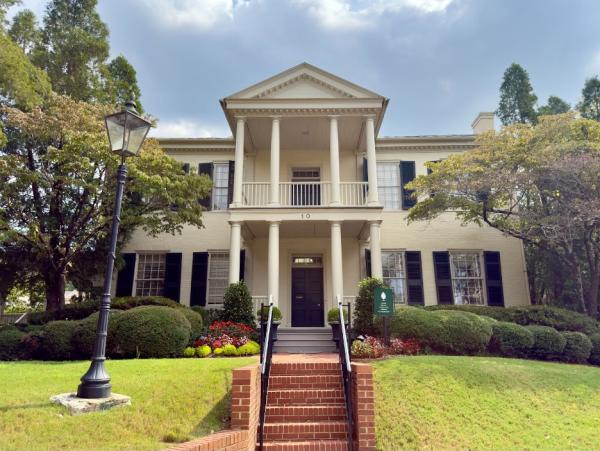
Cedarhurst Mansion
Tucked inside a quiet gated subdivision off Drake Avenue in Huntsville, Alabama, Cedarhurst Mansion doesn't announce itself the way haunted places often do. There are no rusted gates, no crumbling facades, no dramatic hilltop silhouette. What stands instead is a handsome two-story Federal-style structure built in 1823, its fifteen-inch-thick brick walls still solid after two centuries, now serving as a clubhouse for the surrounding residential community. It is a place that has aged gracefully on the outside while carrying, on the inside, one of the most persistently retold ghost stories in the entire state of Alabama. Stephen Ewing built Cedarhurst shortly after Alabama achieved statehood, making it one of the earliest substantial private residences in Huntsville. The Ewing family established themselves as prominent figures in the growing city, and the mansion reflected their standing — a well-proportioned, carefully constructed home in a region still finding its footing. By the 1820s and 1830s, Huntsville was developing rapidly, and properties like Cedarhurst represented the aspirations of its merchant and planter class. Ewing himself met an untimely end and did not enjoy his estate for long, leaving the mansion to pass through family hands. It was through those family connections that the defining event of Cedarhurst's history arrived. In 1837, a young woman named Sally Carter came to visit her sister Mary Ewing at the mansion. Sally was fifteen years old, just three weeks shy of her sixteenth birthday, when an unexpected illness overtook her during the stay. She became bedridden not long after arriving and died at Cedarhurst on November 28, 1837. She was buried on the property in the family cemetery plot, her grave marked with a stone that bore an epitaph reflecting the religious sensibilities of the era. The loss of a young woman in a household is not an uncommon tragedy for the antebellum South, but Sally Carter's story did not end with her burial. For decades, the grave sat quietly on the estate. The legend didn't fully ignite until 1919, when a seventeen-year-old boy from Dothan, Alabama, was visiting the mansion with his family and sleeping in the room that had once been Sally's. During a violent storm that night, he experienced what he described as a dream so vivid it barely felt like sleep. A tall girl with dark hair appeared before him and pleaded with him to help her — the wind had knocked her tombstone over, and she needed it set right. When he woke and told his family, they dismissed it as nothing more than a dream brought on by the weather. But the boy felt compelled enough to walk to the family cemetery and check. Sally Carter's headstone was face down in the grass. He returned to Dothan and, by most accounts, never came back to Huntsville again. That story became the foundation of a local legend that has only grown in the century since. Sally Carter became Huntsville's most famous ghost — a gentle, melancholy presence rather than a menacing one. Reports describe her spirit watching over children as they sleep, a behavior that tracks with the nature of her appearance in the 1919 account. Visitors and residents have described seeing a figure moving through the halls and across the grounds outside, always described as a young woman, always unhurried. Disembodied footsteps have been reported in empty corridors. Voices have been heard with no source. Electrical devices malfunction without explanation. Furniture has reportedly shifted position on its own. The cemetery itself became a focal point of curiosity for generations of Huntsville teenagers and paranormal enthusiasts, which eventually caused significant problems for the property. Repeated vandalism of Sally's grave led the family to make a difficult decision in 1982, when development of the surrounding subdivision began — they had her remains, along with others in the family plot, exhumed and relocated to Maple Hill Cemetery. The new location was never publicly disclosed. The vandalism stopped, but the sightings did not. Sally's presence, according to those who report it, seems tied to the house itself rather than to any grave. There is ongoing debate about the historical verifiability of Sally Carter's existence. Some researchers have found no official death records, birth records, or burial records under her name, pointing to this absence as evidence that the story is folklore rather than fact. Others note that record-keeping in rural Alabama in the 1830s was inconsistent at best, and that unmarked or poorly documented graves at Maple Hill are not unusual for that period. The epitaph on her original stone has been quoted in historical accounts, suggesting something physical once existed. Whether Sally Carter was a real person who died young or a legend that crystallized around a stone and a storm, the story has outlasted nearly everything else about the mansion's history. Today Cedarhurst is not open to the public. The gated community surrounding it means access is restricted to residents and their guests, and organized paranormal investigations of the property are not a regular feature. The mansion endures as a private space carrying a very public legend — a building that looks entirely ordinary from the outside and holds, according to the people who have spent time inside it, something that ordinary buildings do not. Whether that something is the restless spirit of a teenage girl who loved the estate enough to stay, or simply the accumulated weight of a story told for nearly two centuries, Cedarhurst Mansion remains one of the most quietly compelling haunted locations in the American South.
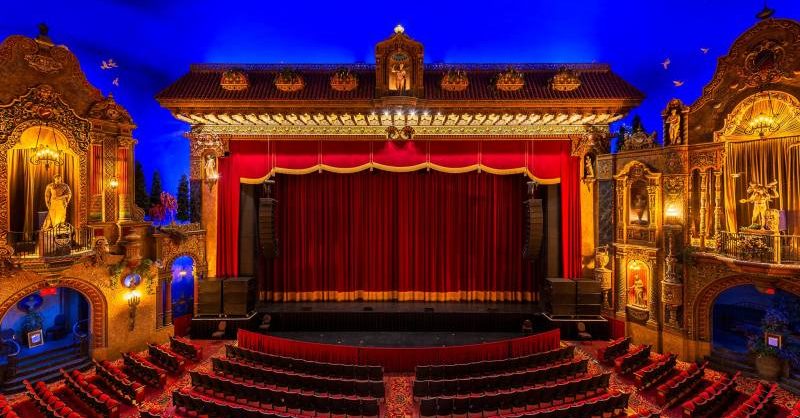
Louisville Palace Theater
Standing on the east side of South Fourth Street in downtown Louisville, the Louisville Palace announces itself before you ever reach the door. Castle-like towers flank a copper-domed marquee blazing the word PALACE in synchronized light. Terra-cotta niches, cartouches, and finials crawl across the Churrigueresque facade in a riot of Spanish Baroque ornamentation that feels closer to a fever dream of old Madrid than a Kentucky movie house. That disorienting grandeur is entirely intentional. It was designed that way from the beginning to pull you out of your life the moment you arrived. Architect John Eberson — an Austrian immigrant trained in electrical engineering who found his calling building fantastical movie palaces across America — designed the building in 1928 for Loew's and United Artists as a first-run cinema seating 3,300. Eberson called his style "atmospheric theater." His theory was that audiences should feel transported before the film even started, and the Louisville building delivers on that completely. Step through the front doors and you enter what reads as an elaborate Spanish courtyard open to the night sky. The barrel-vaulted ceiling overhead is painted midnight blue and studded with lights positioned after a photograph in National Geographic to approximate actual stars. Over 500 plaster statues and reliefs populate the walls and alcoves. The mezzanine Faces Lobby is lined with 139 sculpted busts of historical figures — composers, philosophers, writers — gazing down from every surface. The original 1,000-pipe Wurlitzer organ was still in place at opening night on September 1, 1928, when Eberson himself attended, accompanied by a live macaw, the Loew's company mascot. It was immediately heralded by the Louisville Courier-Journal as an architectural marvel. For decades the Palace was the premier entertainment destination on Fourth Street, which the locals called Theater Square. Frank Sinatra performed there in 1941 during his early career. Ray Charles appeared in 1959. Al Capone, legend holds, frequented the theater during Prohibition, traveling there from the Seelbach Hotel through underground steam tunnels beneath the city. The building carried Louisville's glamour through the post-war era before the familiar forces of suburban flight and multiplex competition hollowed out downtown entertainment districts everywhere. The Palace went dark in the 1970s, was briefly reborn in 1981 under local businessman John Siegel's ambitious $4.4 million restoration, then closed again in 1985 when the costs of maintaining a century-old atmospheric theater outran the revenue. Siegel eventually declared bankruptcy. The building sat in fragile limbo until Sunshine Theater Inc. brought it back in 1994. Live Nation has owned it since 2005, and it operates today as a 2,800-seat concert and event venue — the only surviving movie palace of its era in the city, listed on the National Register of Historic Places since 1978. The paranormal claims here are numerous, specific, and consistently reported by staff, workers, and visitors across multiple decades. The most documented figure is Ferdinand Frisch, a theater employee who died in the building in 1965. During the 1990s restoration, workers began encountering an older man in work clothes, flat-top haircut, and outdated eyeglasses appearing at various points throughout the building — sitting in the balcony watching workers on stage, standing in corners, observed by multiple unrelated crew members. Tools were moved. Voices were heard in empty spaces. One painter who fell asleep on scaffolding near a high ceiling was woken by a voice speaking directly in his ear, and found himself dangerously close to the edge. His name has reportedly been found scratched into the dust in the basement. Current staff refer to him as Bernie, and the projection booth — where a separate apparition, believed to be a projectionist who suffered a fatal heart attack on the job, is also reported — remains one of the most consistently active areas in the building. The Grand Staircase leading to the mezzanine lobby has its own persistent figure: a faceless woman in 1940s clothing, seen climbing the stairs, who vanishes before she reaches the top. A man in 1930s attire has been spotted repeatedly in the balcony by ushers; when approached, he disappears. The Ladies' Parlor bathroom has generated reports of a child giggling, and a production manager arriving to lock up alone one night reported hearing running footsteps, searching the building and finding it empty, then being physically shoved from behind as he headed for the exit — followed by the sound of two children laughing and running away. The theater's marketing manager has publicly described seeing the Grey Lady: a translucent female figure walking four or five paces in the lobby before simply ceasing to exist mid-step. She noted that nearly every member of the facilities staff has had their own encounter with the same figure. The Louisville Palace is open for performances year-round. The stars on the ceiling still burn. The faces in the lobby still watch. And the people who work there after the crowds leave have stopped being surprised by what shares the building with them.

Boone-Hutcheson Cemetery
Set on a high hilltop overlooking Big Walnut Creek and the picturesque Houck Covered Bridge, Boone-Hutcheson Cemetery occupies one of the most striking pieces of ground in Putnam County, Indiana. The view stretches across open farmland in every direction—soybean fields, cornrows, and the kind of rolling central Indiana terrain that looks peaceful enough in daylight but takes on a different character entirely after dark. The cemetery was established in 1812, a full nine years before Putnam County itself was officially founded, making it one of the oldest burial grounds in the region and a direct artifact of the earliest American settlement in what was then unbroken wilderness. The names on the stones tell the story of who came first. Susan Boone Rissler, buried here, was the great-niece of Daniel Boone. Three children of Squire Boone—Daniel's brother—are also interred on the grounds. A monument to Phoebe Rissler Boone, Squire's wife, stands in the cemetery as well, though some records suggest the stone was erected by the family when she and Squire left Putnam County for Iowa in 1852, and debate persists over whether she is actually buried beneath it. The Hutcheson family arrived soon after—Dr. Walter Hutcheson reached the area in 1827, and his descendants have maintained a presence ever since. Civil War veterans, War of 1812 soldiers, and pioneer families fill the rows, their stones dating back to the 1820s and forward through the present day. But it is the landscape beneath the cemetery, as much as the one above it, that has given Boone-Hutcheson its particular hold on local imagination. A cave opening sits on or near the grounds, and the lore surrounding it has been accumulating for nearly two centuries. Legend holds that this cave connects to Sellers Cave near the DePauw University campus in Greencastle, roughly five miles northeast, through a tunnel system running beneath much of the town. One persistent story claims enslaved people escaping via the Underground Railroad used the passages, and that some who entered never emerged—their remains occasionally surfacing in macabre fashion. Another tale links the cave to John Dillinger's escape after his Greencastle robbery, though records confirm he left by automobile. Geologists have been considerably less impressed. The president of the Indiana University Caving Club has stated that caves in the Greencastle area are very small due to thin limestone, and that a five-mile underground passage is unlikely in the extreme. Visitors who have entered the opening confirm it is barely large enough to crawl into. None of that has done much to quiet the paranormal reports. The most distinctive claim involves a spectral police officer from the 1950s who sits inside the cemetery accompanied by a floating blue light. Multiple witnesses over multiple decades have described this figure independently. One longtime Greencastle resident recalled seeing the blue lantern drifting across the grounds as a teenager. Another visitor described finding an older-model police cruiser parked at the hilltop in broad daylight, the officer waving from the driver's seat—a vehicle consistent with no currently active patrol car. Others have reported seeing a car driving up the narrow road toward the cemetery only for it to vanish before arriving, with no turnoff that could explain its disappearance. Then there are the dogs. Phantom canines with glowing red eyes are among the most frequently reported phenomena here, and the accounts carry unusual consistency. Visitors describe aggressive growling directly outside car doors without any visible animal. Others have seen a black dog with red eyes running alongside their vehicle as they fled. The sounds are described as unlike anything recognizable—a moaning that grows louder and closer without resolving into a visible source. A woman in white has been spotted on the road leading to the cemetery. Investigators using spirit boxes report responsive communication and repeated warnings to stay away from the surrounding woods. The persistent sensation of being watched and the sound of footsteps mirroring a visitor's movement from the opposite side of the gravel loop appear in account after account. Skeptics can fairly point to the power of atmosphere—a hilltop cemetery at night, surrounded by open farmland and backed by woods, with a cave and generations of legend practically demanding a fear response. Real cows graze the adjacent field and have startled more than one visitor who mistook them for something worse. But the blue light reports predate the internet. The dog encounters come from people who arrived expecting to debunk them. And the cemetery itself, with two centuries of burials rooted in the earliest days of Indiana statehood, carries a weight that has nothing to do with legend. Boone-Hutcheson remains active, maintained through donations with no government funding. The covered bridge is visible from the hilltop. The Boone family section sits near the front. Whether you come for genealogy, the view, or the things that move between headstones after dark, the cemetery asks only that you respect the ground—because the people beneath it have been there a very long time.
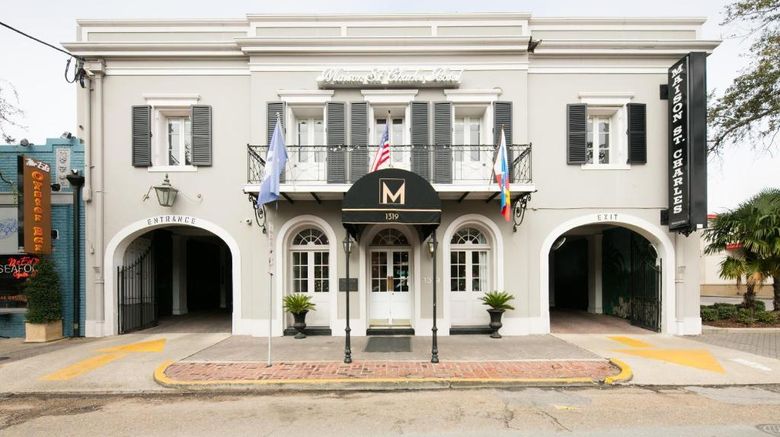
Maison St. Charles
Maison St. Charles sits at 1319 St. Charles Avenue in the Lower Garden District of New Orleans, a boutique hotel assembled from five antebellum townhouses arranged around brick courtyards and wrought-iron patios, directly on the route of the St. Charles streetcar line. The property operates today as a 128-room hotel with exposed brick walls, crystal chandeliers, and murals by local artist Robert Dafford depicting scenes of southern Louisiana life. It is charming, accessible, and laced with the particular brand of theatrical history that New Orleans produces better than any other American city. Because long before there was a hotel at 1319 St. Charles Avenue, there was—according to one of the city's most enduring legends—a mansion built by the Devil himself. The story, recorded in Jeanne deLavigne's 1946 collection of New Orleans folklore and retold in numerous subsequent accounts, holds that sometime in the 1820s, the Devil took up residence in New Orleans, drawn by the city's decadence and its hospitality toward the damned. Around 1840, he took a woman named Madeleine Frenau as his mistress and erected a mansion for her at the 1300 block of St. Charles Avenue. Some versions claim the house appeared overnight; others allow seven days. The structure was said to be architecturally disorienting, with rooms stacked on separate floors connected by stairways that seemed to lead only downward. The Devil entered not through the front door but through the upper gable, and at dusk could be seen peering down at the avenue, horns silhouetted against the fading light. The household was reportedly staffed by small red demons who cooked, cleaned, and dressed Madeleine in jewels. Madeleine, however, grew bored with infernal luxury and began an affair with a Creole gentleman named Alcide Cancienne. The Devil discovered the betrayal and offered Alcide a sum of money to leave town, on the condition the couple adopt the name Monsieur and Madame L. Alcide, having already tired of the affair, told Madeleine over dinner that he intended to leave. When she realized he meant to go without her, she flew into a rage and strangled him with a dinner napkin, severing a blood vessel in his neck and drenching herself and the table in blood. The Devil returned at that moment, gathered both Madeleine and her dead lover, and devoured them on an upstairs balcony. He left town the next day. For decades afterward, occupants of the mansion reported that each evening the murder scene replayed itself—a spectral dining table appearing at sunset, the figures of Madeleine and Alcide reenacting the fatal dinner, followed by the bloodied ghost of Madeleine moving from room to room wiping her hands on the linens. In 1878, Laure Beauregard, daughter of Confederate General P.G.T. Beauregard, moved into the mansion with her husband Charles Larendon. Rather than flee, the couple accepted the nightly apparitions as grim housemates. Charles documented the events for two decades, continuing even after Laure died in childbirth on July 4, 1884. He finally left around 1909. In the years that followed, passersby reported seeing the face of the Devil imprinted high on the crumbling facade. The mansion was torn down in the summer of 1930. The legend is almost certainly fiction—a gothic Creole folktale built from the same cultural soil that produced the stories of the LaLaurie Mansion, the Sultan's Palace, and Marie Laveau. No historical records confirm the existence of Madeleine Frenau or Alcide Cancienne. But the story's persistence says something real about the site and the city's relationship with its own mythology. New Orleans does not distinguish sharply between history and legend; both are treated as forms of truth, and both leave residue. The modern hotel at 1319 St. Charles Avenue carries its own set of claims, separate from the Devil's Mansion folklore. Room 126, located in the older portion of the property, has attracted the most attention. According to local accounts, a young woman was murdered in that room on her wedding day—stabbed repeatedly and found still in her blood-soaked dress after she failed to appear at the church. Guests and staff have reported seeing a woman in white or a hazy luminous figure looking out the window of Room 126. The room is said to go inexplicably cold in summer with the air conditioning off. Electronics behave erratically—televisions turning on after being unplugged, remote controls hurling across the room. Brightly colored socks have a documented tendency to vanish from guest luggage and reappear elsewhere on the property days later. Other guests have reported footsteps outside their doors in otherwise empty hallways, unexplained breezes in sealed rooms, sounds of arguments from unoccupied adjacent rooms, piano music at four in the morning, and the sensation of something pressing down on them while they sleep. A paranormal group reportedly captured EVP recordings on the property. Today, Maison St. Charles operates as a gated courtyard hotel on one of America's most storied avenues, with the streetcar rattling past the front entrance and the French Quarter a short ride away. It is a working hotel, not a haunted attraction, and the management does not trade on the property's darker reputation. But the site at 1319 St. Charles Avenue has been generating stories for nearly two centuries now—stories of appetite, betrayal, and things that refuse to leave when the lights go out. In New Orleans, that is less an anomaly than a qualification for residency.
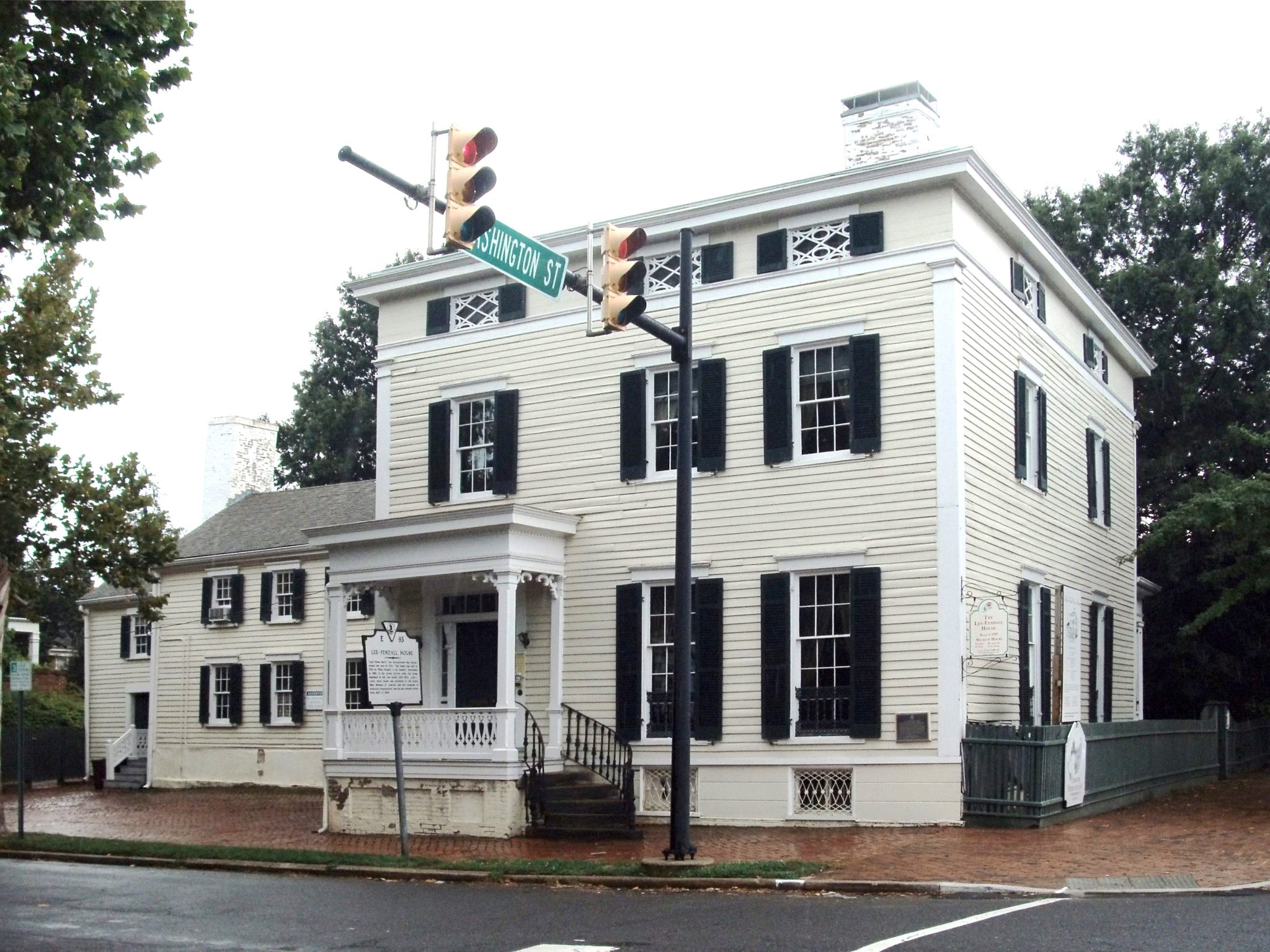
Lee-Fendall House
On the corner of Oronoco and Washington Streets in Old Town Alexandria, the Lee-Fendall House has been standing since 1785 — long enough to have absorbed nearly every defining era of American history within a single set of walls. It was built in the vernacular telescopic style common to Maryland but rare in Northern Virginia, constructed by Philip Richard Fendall on land sold to him by his stepson-in-law Henry "Light-Horse Harry" Lee, the Revolutionary War cavalry commander and father of Robert E. Lee. From 1785 until 1903, thirty-seven members of the Lee family lived here. The house was completed by November 1785, when George Washington noted in his diary dining at the Fendall home — one of at least seven recorded visits. Following Washington's death in December 1799, the house became a gathering place where Alexandrians organized their participation in his funeral at Mount Vernon. Former President John Quincy Adams visited in 1841. President Woodrow Wilson was received there in 1914. The Civil War interrupted all of that. In 1863, Union Chief Surgeon Edwin Bentley requested the use of what he called "the rebel house opposite Grosvenor Hospital" and was granted authority to seize it. The current occupant, Harriotte Cazenove, refused to swear the Loyalty Oath to the Federal Government, so the house was confiscated for unpaid taxes and converted into Grosvenor Branch Hospital. The Army expanded the property with additional wooden ward buildings and constructed a dead house on the grounds. Approximately 1,700 Union soldiers were treated there between 1863 and 1865, and nearly 100 died within those walls. The hospital's place in medical history is singular: it was the site of the first documented successful blood transfusion performed in North America, carried out by Dr. Bentley during the war. When the hospital closed in April 1865, the house was returned, sold, and passed through several families before Robert Downham — an Alexandria haberdasher whose father had twice been the city's mayor — purchased it in 1903. In 1937, labor leader John L. Lewis bought the house. Welsh-born, Iowa-raised, Lewis had risen from coal miner to president of the United Mine Workers of America for over four decades, eventually defying both Franklin Roosevelt and Harry Truman, founding the CIO, and reshaping American labor law from his base in Washington. At one point during a wartime strike he was strung up in effigy at the corner of Washington and Oronoco — directly outside the house he lived in. He died there on June 11, 1969, at age 89. His son sold the property to the Virginia Trust for Historic Preservation. The Lee-Fendall House Museum and Garden opened to the public in 1974. The paranormal claims are understated but consistent, and the museum leans into its haunted reputation enough to host annual ghost tours each October. Visitors have reported a female apparition in period dress moving through the interior rooms. A separate figure — a woman accompanied by a child — has been seen appearing on the back stairs. The sound of an antique telephone ringing has been heard by multiple people in rooms where no working telephone exists. The museum appeared in an episode of the television series Ghost Hunters. The weight of what occurred inside — nearly a century of Lee family life, hundreds of soldiers dying during two years of wartime medical care, the passing of one of the most consequential labor figures in American history — leaves the kind of residue that tends to generate these accounts. Open Wednesday through Sunday for guided tours. The garden is free.

Bethlehem United Methodist Church
Sitting on McElderry Road in the rural northeast corner of Talladega County, Bethlehem United Methodist Church is the kind of small-town Alabama congregation that holds the bones of a community. Its attached cemetery has served the surrounding area for generations, and its burial records reach back into the 1800s, when the first settlers were still arriving in the region and the land was young enough that families lived and died within a few miles of where they were born. The church is still active, still holding Sunday services, still tending its grounds — which makes its quiet reputation for strange happenings at night feel more intimate than the usual deserted-ruin ghost story. Munford itself carries a particular weight in American history. First settled in the early 1830s, the town sits in northeastern Talladega County against the backdrop of Cheaha Mountain, the highest point in Alabama. It grew slowly through the antebellum period as a small farming community, surrounded by the kind of Appalachian foothills landscape that kept large plantation agriculture limited but did not insulate it from the broader cruelties of the era. What Munford is best known for historically is an event that happened fourteen days after the Civil War should have already been over. On April 23, 1865 — two weeks after Robert E. Lee's surrender at Appomattox — roughly 150 exhausted Confederate soldiers, described in accounts as convalescents, home guards, and pardoned deserters, faced off against 1,500 veteran Union cavalrymen under General John T. Croxton, armed with repeating carbines. The skirmish lasted only minutes before the Confederate position collapsed. One soldier died on each side, and Lieutenant Andrew Jackson Buttram became what many historians consider the last Confederate soldier killed in battle east of the Mississippi River. The fight at Munford is widely regarded as the final engagement of the Civil War in the Eastern Theater — a war that ended, in part, right here on this ground. That history hangs over the entire area. A community that absorbed the last shots of the Civil War and carried forward its dead through Reconstruction, through the mill era, through the industrial decline of the 20th century, accumulates a particular kind of layered grief. Church cemeteries like Bethlehem's are repositories for all of it — the marked graves and the unmarked ones alike. A regular churchgoer noted in one account that the cemetery contains unmarked graves of families whose descendants still remember them, tracing names like Nabors back to the 1800s through Decoration Day visits, the Southern tradition of gathering at church graveyards each spring to clean and decorate the graves of the dead. The paranormal claims at Bethlehem are modest but consistent. Visitors and passersby report seeing orbs rising over the cemetery after dark — soft, hovering lights that lift above the headstones and dissipate. The accounts come from multiple unrelated sources over time, spanning casual visitors and people who know the property well. One regular churchgoer offered a rational interpretation, suggesting the lights result from moonlight or passing headlights reflecting off certain headstones at specific angles, visible only at the right position. Others who visited on Halloween captured balls of light in photographs that were invisible to the naked eye at the time of shooting, a detail they described as disorienting. Whether the orbs at Bethlehem reflect something genuinely unexplained or are a product of old reflective stone and the human tendency to see meaning in light and shadow, the cemetery has earned its quiet local reputation. It is a functioning sacred space, maintained and attended by a congregation that has gathered here across generations, and the dead buried within it are not strangers — they are neighbors, relatives, and the people who built this community. The church remains open to its members. The cemetery asks for respect.

Ancestor’s Inn at the Bassett House
Standing along Sycamore Street in the village of Liverpool just north of Syracuse, the historic Bassett House has long been one of the older surviving structures connected to the early development of the community. The building at 215 Sycamore Street traces its roots to the early nineteenth century, a period when the region surrounding Onondaga Lake was transforming from scattered frontier settlements into an active corridor of commerce tied to salt production and canal travel. Liverpool in particular grew rapidly after the opening of the Erie Canal in 1825, which turned the nearby waterways and roads into important transportation routes linking central New York to markets across the state. Inns and taverns quickly followed the movement of travelers and laborers, and the Bassett House developed within this environment as a place of lodging and social activity. The structure is believed to date to the early 1800s and is commonly associated with the Bassett family, whose name became permanently attached to the property. Buildings like this served a variety of roles during the canal era. Travelers arriving by boat or carriage needed places to stay overnight, while canal workers, merchants, and farmers used taverns as informal meeting places where business was conducted and news from other towns circulated. The Bassett House functioned as both a residence and a hospitality property during different periods of its history, reflecting the changing character of Liverpool as the canal economy expanded and later declined. Throughout the nineteenth century the surrounding community remained closely tied to transportation and industry. The nearby salt works at Onondaga Lake drew workers and traders, while canal traffic brought a steady flow of strangers through the village. Buildings like the Bassett House witnessed decades of everyday life associated with this movement—meals served to passing travelers, rooms rented to overnight guests, and local residents gathering in common spaces that doubled as community hubs. Over time the property passed through multiple owners and uses, but the core structure remained intact, preserving elements of early nineteenth-century construction within a town that gradually modernized around it. In the twentieth century the building took on a new identity as Ancestor’s Inn, a restaurant and gathering place that embraced the property’s historic atmosphere. The name itself reflected the owners’ intention to connect the dining experience with the deep past of the house and the generations of people who had lived, worked, or stayed within its walls. Visitors often remarked on the building’s aged interior features—low ceilings, thick wooden beams, narrow stairways, and rooms whose shapes reflected centuries of additions and alterations. The sense of stepping into an earlier era became part of the appeal, particularly for diners interested in local history. It was during these later years that stories of unexplained activity began to circulate among staff and guests. Reports most often centered on strange sounds heard after closing, including footsteps on the staircases or movement in rooms that had already been locked for the night. Employees occasionally described objects being shifted or found out of place between shifts, while others spoke of doors opening or closing without an obvious cause in the quieter parts of the building. Some witnesses claimed to have seen shadowy figures moving through hallways or glimpsed the brief outline of a person standing in doorways before disappearing. Accounts varied, but the apparitions were often described as resembling individuals dressed in clothing from an earlier century, leading many to associate the sightings with the building’s canal-era past. Guests dining in the restaurant sometimes reported sudden cold drafts or the uneasy sensation of being watched when seated in the older dining rooms. Paranormal investigators who visited the site during the years the restaurant operated occasionally reported capturing unexplained audio responses during electronic voice recording sessions or experiencing sudden malfunctions in investigative equipment. As with many historic structures, skeptics have suggested that the building’s age and layered construction could easily produce creaking timbers, shifting floorboards, and air movement that mimic footsteps or other sounds. The powerful atmosphere created by an old house filled with local stories can also shape how ordinary events are interpreted. Despite these explanations, the Bassett House developed a modest reputation in regional ghost lore. The combination of its canal-era origins, its long service as an inn and gathering place, and the number of travelers who passed through its rooms over nearly two centuries created the sense that the building held echoes of the past. Today the property remains one of the older historic sites associated with Liverpool’s early development. Even as ownership and use have changed over the years, stories of unexplained encounters continue to circulate among locals, maintaining the quiet belief that some of the house’s earliest occupants—or perhaps former guests—may never have fully left the Bassett House behind.

Nunica Cemetery
Nunica Cemetery stretches across a rural landscape in Nunica, Michigan, serving as a burial ground and final resting place for generations of individuals from the surrounding communities. Like countless cemeteries throughout North America, Nunica Cemetery represents centuries of history, loss, and commemoration, containing graves dating back to the early settlement periods and extending through modern times. The cemetery is maintained with varying degrees of attention, with some sections showing careful upkeep while others contain aging monuments and weathered markers that testify to the passage of decades and centuries since the burials. The quiet setting, natural landscaping, and atmospheric qualities typical of cemeteries have traditionally made the location peaceful and serene, a place for reflection and remembrance. However, Nunica Cemetery has become recognized as one of Michigan's most actively haunted cemeteries, a location where paranormal phenomena manifest with unusual intensity and frequency. The paranormal reputation of Nunica Cemetery is anchored by specific entities that have been identified through investigation and eyewitness accounts, most prominently a child spirit identified as a little girl who has become particularly active in her interactions with living visitors. The child spirit is reported to hold hands with investigators and visitors, her touch distinctly cold despite the ambient temperature and despite the impossibility of physical contact with a non-corporeal entity. The sensation of the child's hand grasping the hands of living individuals is described as unmistakably real and intentional, suggesting an entity with sufficient energy and focus to create prolonged physical contact with the living. The child spirit appears to seek interaction and connection rather than to frighten or harm, though her presence inevitably creates profound emotional reactions in those who experience the encounter. Additionally, the cemetery is home to Joel A. Bond, identified as an intelligent spirit who demonstrates awareness of his surroundings, recognition of living visitors, and the capacity to communicate through various paranormal phenomena. A mysterious lady in white has been observed throughout the cemetery, her apparition appearing in multiple locations and her intentions and identity remaining unknown despite extensive investigation. The paranormal phenomena documented at Nunica Cemetery extend beyond apparitions to include a comprehensive array of manifestations suggesting active and varied spiritual presences. Visitors and investigators report unexplained lights that float through the cemetery without apparent source or mechanism of movement, described as ranging from dim glows to bright illuminations that appear and vanish inexplicably. Ghostly sounds and whispers have been recorded and witnessed, with investigators capturing audible phenomena that cannot be attributed to natural sources such as wind or animal activity. The smell of cigar smoke materializes in specific locations despite no living person smoking, and the odor appears concentrated as though a specific individual is producing the smoke. Odd electromagnetic readings have been documented through sensitive instrumentation, and orbs captured in photographs suggest the presence of residual energy or manifesting entities. Uneasiness and anxiety are commonly reported by nighttime visitors, with many individuals describing overwhelming feelings of being watched and a sense that they are unwelcome in the space. Paranormal activity is distributed throughout the cemetery but concentrates in specific areas and around particular features. A small shack located within the cemetery grounds appears to be a focal point of paranormal activity, with investigators reporting that ghosts bang on the structure and produce sounds suggesting agitation or distress. Figures materialize and disappear throughout the cemetery, suggesting either multiple entities with distinct manifestation patterns or a limited number of spirits with the capacity to move rapidly between locations. The phenomena appear most intense during evening and nighttime hours, with paranormal activity beginning at sunset and extending through the predawn hours. The child spirit appears particularly active in specific areas, often approaching visitors who display signs of sensitivity or emotional receptivity. The intelligent spirit of Joel A. Bond appears capable of deliberate communication, possibly responding to questions posed by investigators through electronic voice phenomena or other means of paranormal interaction. Numica Cemetery continues to function as an active burial ground and site of commemoration, with the paranormal phenomena acknowledged by local paranormal investigation groups and included in regional haunted location registers. The cemetery has attracted paranormal researchers who conduct formal investigations documenting the phenomena through various methodologies and technologies. The mixture of childlike manifestations, intelligent interactions, and diffuse paranormal activity suggests that Nunica Cemetery may serve as a haven for spirits of varying levels of consciousness and intentionality, a location where the veil between living and dead appears unusually thin. Whether the phenomena result from genuinely supernatural activity or from psychogeographic and environmental factors triggering human perception of the paranormal remains a matter of debate, though the consistency and specificity of reported phenomena across multiple independent witnesses and investigation teams support the conclusion that Nunica Cemetery is a location of active and well-documented haunting.
Twin City Opera House
Twin City Opera House stands as an architectural landmark in McConnelsville, Ohio, having been constructed in 1892 during a period of robust cultural development and economic growth in the region. The opera house represented a significant community investment in the performing arts and sophisticated entertainment, reflecting the aspirations of a prosperous mid-sized town that wished to establish itself as a center of culture and refinement. The building was designed to accommodate theatrical productions including operas, dramas, concerts, and other musical performances that would attract audiences from McConnelsville and surrounding communities. The architectural grandeur of the Victorian opera house design, combined with its dedicated stage equipment and acoustical systems, made it a facility that could compete with regional cultural institutions in larger metropolitan areas. The structure survived more than a century of operational service, witnessing countless performances and gatherings that accumulated emotional significance and potentially created psychological imprints within the building's physical structure. The paranormal reputation of Twin City Opera House developed gradually over the latter twentieth century, becoming increasingly documented and intensively investigated beginning in the 1980s and continuing into the 2000s. Investigators conducted systematic after-hours investigations spanning sixteen years, during which they documented consistent and reproducible evidence of paranormal activity across multiple areas of the building. The frequency and intensity of reported phenomena became sufficiently remarkable that paranormal investigators directly compared the activity levels to those documented at Waverly Hills Sanatorium in Kentucky and Trans Allegheny Lunatic Asylum in West Virginia, both of which rank among the most actively haunted locations in North America. This comparison suggests that Twin City Opera House experienced a level of paranormal manifestation that exceeded typical haunted location activity patterns and indicated multiple entities or an unusually energetic single presence capable of generating persistent phenomena across extended time periods. The primary identified spirit at Twin City Opera House is Robert Lowery, a former stagehand who died while performing his duties on the theater's elevated catwalk system. Lowery's spirit appears to have remained attached to the theatrical equipment and the upper reaches of the building where he spent his professional life, manifesting through various phenomena including disembodied voices, footsteps in restricted areas of the theater, and unexplained sounds and shadows observed in the catwalk and surrounding spaces. The intensity of Lowery's paranormal presence suggests either an unusually strong attachment to the theater or particularly traumatic circumstances surrounding his death. Beyond Lowery, investigators documented evidence of multiple additional spirits inhabiting the structure, though the identities of these entities remain unclear from available documentation. One particularly significant piece of evidence involves the theater's janitor during the 1960s, who allegedly fled the building under circumstances connected to paranormal encounters and subsequently refused to return, suggesting an experience sufficiently traumatic or disturbing to overcome professional obligations and regular employment. The Twin City Opera House continues to operate as a functional theater venue, with staff and performers navigating their professional duties alongside the persistent paranormal phenomena that characterize the space. The building's architectural preservation and continued cultural use have maintained it as an active gathering place and performance venue, ensuring that the spirits inhabiting it continue to encounter the living through theatrical events and community gatherings. The twenty-first century operations at Twin City Opera House represent a unique situation where documented paranormal activity persists within a building that remains in active public use, creating an environment where the supernatural has become integrated into the cultural and operational identity of the institution itself.
Kalamunda Hotel
The Kalamunda Hotel, constructed in 1928 in the Perth hills of Western Australia, stands as a significant example of 1920s Australian hospitality architecture and represents a period of economic expansion and development in Western Australia following the discovery of precious mineral resources in the region's interior. Built during the interwar period, the hotel reflects architectural sensibilities that blended Victorian-era decorative traditions with twentieth-century construction practices and design innovations, creating a structure that balanced historical aesthetic references with contemporary comfort and functionality. The building's location in the Kalamunda region, situated in Perth's eastern hills, positioned it to serve visitors drawn to the area by both leisure pursuits and business interests as Western Australia's economy expanded and developed. The ornate Victorian-era architectural elements incorporated into the building's design, including detailed woodwork, period-appropriate fixtures, and lavish interior decoration, reflected the prosperity of the era and the aspiration to create a hospitality establishment worthy of affluent patrons accustomed to quality accommodations and refined service. Throughout the subsequent decades of the twentieth century, the Kalamunda Hotel continued to serve the Perth hills region as a hospitality and social venue, adapting to evolving travel patterns and accommodation expectations as Australian tourism developed. The building witnessed decades of human habitation and social interaction, its rooms and common spaces hosting celebrations, business gatherings, intimate encounters, and countless individual experiences that accumulated emotional resonance within the physical structure. The hotel's particular architectural character, with its ornate decorative traditions and period furnishings, created an atmosphere distinctive from more modern hospitality establishments, generating considerable appeal among visitors seeking accommodation with historical ambiance and distinctive character. The building's survival through the latter twentieth century and its preservation in contemporary times reflects community recognition of its architectural and historical significance. The Kalamunda Hotel has become established within Australian paranormal research and ghost tour communities as a location of particular interest and significance, known for its reported haunting phenomena and inclusion in regional paranormal investigation programs. The Kalamunda Hotel has acquired a well-documented reputation as one of the most actively haunted buildings in the Perth metropolitan region, with multiple categories of paranormal phenomena reported by guests, staff, paranormal investigators, and tour participants. Room 024 located on the second floor has emerged as the focal point of reported paranormal activity, with visitors and investigators reporting diverse manifestations of supernatural phenomena concentrated within this particular space. The apparitions reported within the hotel include both full-body and partial manifestations, with witnesses describing encountering ghostly forms of individuals who appear to be dressed in clothing consistent with early twentieth-century fashion. Shadow figures have been observed by multiple independent witnesses, entities that appear as dark silhouettes moving through hallways and rooms without apparent physical substance or visible features. Disembodied voices emanate from unoccupied spaces, with reports ranging from whispered conversations to clear audible statements and greetings directed at living witnesses. Visitors and investigators have documented cold spots throughout the building, areas where temperature suddenly drops to uncomfortable levels regardless of ambient temperature or season, suggesting spiritual entities drawing thermal energy from the surrounding environment. Strange lights and luminous phenomena have been reported by guests and investigators, particularly concentrated around the most actively haunted second floor and within Room 024, ranging from faint glowing orbs to unexplained light displays without obvious electrical source. Visitors have reported profound feelings of being watched and scrutinized by unseen entities, sensations that suggest conscious awareness of the living individuals occupying the space. The diverse range of documented phenomena and the consistency of reports across independent witnesses and paranormal investigation teams suggest authentic paranormal activity. The Kalamunda Hotel operates in contemporary times as both a functioning hospitality establishment and an intentional paranormal attraction, with the building's owners and managers explicitly acknowledging and marketing the location's haunted reputation, offering specialized ghost tour experiences for visitors interested in paranormal investigation and apparition sightings.
Biddeford City Theatre
The Biddeford City Theatre, originally constructed as the Biddeford Opera House, represents Gilded Age theatrical architecture and community ambition, a structure designed to serve as cultural and social center for York County in southwestern Maine. Built in 1895, the opera house was designed by John Calvin Stevens, a renowned Maine architect known for quality design and understanding of theatrical requirements. Stevens' design reflected contemporary theatrical architecture standards, creating an elegant facility serving as performance venue and symbol of community pride. The original structure was destroyed by fire, threatening the theater's existence before establishment. However, community commitment to maintaining a theatrical venue prompted rapid reconstruction, and the rebuilt opera house reopened in January 1896, less than a year after the fire. Reconstruction incorporated lessons learned from the fire, with improved safety features and structural enhancements designed to prevent recurrence. Throughout its operational history from the 1890s to present, the Biddeford City Theatre has served as a cultural hub for York County and venue for wide spectrum of theatrical productions. The theater attracted accomplished performers including renowned soprano Eva Gray, who performed during early twentieth-century years. Eva Gray's voice and artistry impressed audiences throughout New England, and her association with the theater elevated its cultural standing. On December 1, 1904, Eva Gray died, her voice silenced and career ended at the height of her recognition. Her death represented genuine loss to the musical world, and her association with the Biddeford Opera House created permanent link between building and celebrated performer. The theater continued hosting performances as entertainment patterns changed, with cinema rising and traditional theater declining. The spirit of Eva Gray appears bound to the theater where she performed and achieved recognition, manifesting through consistent paranormal phenomena documented over multiple decades. A caretaker named Mr. Murphy, employed during the 1930s and 1940s, reported unusual activities attributed to paranormal causes. Additional supernatural presences appear to inhabit the theater, creating environment with multiple distinct entities. The concentration of theatrical performances, emotional expression, and human gathering over more than a century appears imprinting psychic energy upon the location, creating multiple paranormal phenomena layers. Paranormal investigations have documented diverse phenomena at the Biddeford City Theatre. Apparitions have been observed including full-bodied figures in audience seating, backstage regions, and dressing rooms. Disembodied voices have been recorded and reported, sometimes identified as intelligently responsive to investigator questions. Phantom music has been detected during investigations, including musical strains inconsistent with ongoing performances or machinery, suggesting spiritual manifestation of performances occurring within the space. Unexplained sounds including footsteps, doors, and theatrical sounds have been documented. Electromagnetic anomalies consistent with paranormal energy have been detected, with field variations exceeding baseline measurements. Activity appears particularly intense in backstage and performance spaces where emotional expression concentrated. The Biddeford City Theatre continues operating as performance venue and community cultural center, hosting productions and events while serving as active paranormal investigation site. The theater has been featured on paranormal investigation programs and extensively documented in paranormal literature. The coexistence of lively performances and paranormal activity creates unique environment where boundaries between artistic passion and supernatural manifestation appear unusually permeable.
Antoine’s Restaurant
Antoine's Restaurant, established in 1840 by Antoine Alciatore at its current location of 713 Rue St. Louis in the Vieux Carre district of New Orleans, stands as one of the oldest continually operating Creole fine dining establishments in the United States and represents a remarkable continuity of family business and culinary tradition spanning nearly two centuries. Antoine Alciatore emigrated to New Orleans from France, bringing with him mastery of classical French cooking techniques and the aspirations of establishing a fine dining establishment that would serve the city's elite and discerning diners. He selected a location in the historic French Quarter, the oldest continuously occupied neighborhood in the continental United States, positioning his restaurant within a district characterized by centuries of cultural accumulation, architectural distinction, and the layered history of multiple civilizations and populations. The building that houses Antoine's reflects the Creole architectural traditions of Spanish colonial New Orleans, with characteristic wrought-iron railings, interior courtyards, and decorative elements that embody the aesthetic fusion of Spanish, French, and African influences that characterize French Quarter architecture. Throughout the nineteenth and twentieth centuries, Antoine's Restaurant remained in operation under the Alciatore family's stewardship, becoming progressively more established as an iconic New Orleans institution and one of the city's most prestigious and sought-after dining venues. The restaurant's reputation grew beyond the local level, with the establishment becoming nationally recognized as a temple of classical Creole and French cuisine prepared by chefs who maintained the highest standards of culinary excellence and authentic technique. The building itself expanded over its long operational history, acquiring adjacent properties and creating a complex of dining rooms, private dining spaces, and kitchen facilities capable of serving hundreds of patrons nightly. The restaurant's architecture became increasingly distinctive, with each dining room reflecting different periods of ornamentation, renovation, and aesthetic evolution while maintaining overall coherence and elegance. The physical spaces became saturated with more than one hundred and eighty years of accumulated human experience, from celebratory meals to intimate encounters, from business transactions to romantic anniversaries. Antoine's Restaurant operates as a functioning fine dining establishment in contemporary times, maintaining the family's culinary traditions and standards while adapting to modern hospitality practices and changing customer expectations. The restaurant continues to serve sophisticated French and Creole cuisine prepared according to classical techniques and recipes refined across generations of family operations. The establishment remains prominently featured in regional culinary guides and national restaurant rankings, maintaining its position among America's most respected and historically significant dining venues. The building itself, with its multiple dining rooms, courtyard spaces, and historic architecture, provides an atmospheric setting distinctive from more modern restaurant environments, generating considerable appeal among diners seeking dining experiences that evoke historical periods and cultural traditions. Paranormal phenomena documented within Antoine's Restaurant suggest the presence of spirits connected to the building's long operational history and the countless human experiences that have transpired within its spaces. Multiple witnesses, including restaurant staff members such as waiters Jerry Messina and Matthew Ousset, have reported encountering supernatural manifestations within the building's various dining rooms and work spaces. Apparitions have been documented by staff and investigators, with witnesses describing encounters with full-body ghostly forms that appear to represent individuals dressed in period-appropriate clothing consistent with historical periods encompassing Antoine's long operational history. Shadow figures have been observed moving through the restaurant's spaces, entities that appear as dark silhouettes without clear facial features or visible details. Disembodied voices emanate from various locations throughout the building, sometimes manifesting as whispered conversations and sometimes as audible words or phrases that may represent direct communication with living witnesses. Objects have been reported moving without apparent physical cause, doors opening and closing in the absence of visible human agency, and mysterious mist phenomena appearing in dining spaces where environmental conditions do not suggest natural explanations. The paranormal activity suggests that conscious spirit entities actively inhabit the building and may respond to the presence of living individuals.
Sun Inn
The Sun Inn stands as a meticulously preserved example of colonial-era American hospitality, its substantial stone structure rising from Bethlehem, Pennsylvania with architectural distinction. Built in 1758 by the Moravian community that founded Bethlehem, the inn was constructed during prosperity in the Pennsylvania colonies when expanding commercial networks created demand for quality accommodations. The Moravians, known for meticulous craftsmanship and hospitality commitment, designed the inn to reflect both practical requirements and aesthetic principles, with stone walls, multiple stories, well-appointed rooms, and dining facilities reflecting architectural standards of the era. The location at the intersection of important colonial trade routes made it a natural gathering place for merchants, government officials, and military leaders. Throughout the late eighteenth century and into the nineteenth, the Sun Inn became famous for exceptional accommodations and association with prominent historical figures including George Washington, Alexander Hamilton, and Benjamin Franklin. The inn achieved legendary status during the American Revolutionary period when it served as a gathering place for prominent figures conducting important discussions of governance, military strategy, and political philosophy. The combination of superior accommodations, excellent cuisine, and reputation for discretion made the Sun Inn the preferred establishment for prominent visitors. Beyond its Revolutionary history, the inn continued serving as a significant social and commercial hub for Bethlehem, hosting civic events, weddings, and business transactions throughout the nineteenth century. The reputation for exceptional service became so established that its name became synonymous with Bethlehem hospitality and comfort. In 1897, a tragedy occurred that marked the beginning of documented paranormal phenomena. Elizabeth Moore, a nurse employed at the inn, died suddenly within its walls under mysterious circumstances. Her spirit appears bound to the location where she spent much of her working life, manifesting through various paranormal phenomena documented continuously since. A child spirit known as Sarah has also been identified as present, along with Mrs. Bender, suggesting multiple distinct entities occupying the space. The combination of the inn's long history of human activity and emotional residue of significant meetings and farewells created conditions conducive to paranormal manifestation. Paranormal activity at the Sun Inn has been extensively documented through anecdotal reports and systematic investigation. Apparitions of full-bodied human figures have been observed throughout the inn, including period-costumed figures appearing to derive from colonial and early American periods. Disembodied voices have been recorded, sometimes responding intelligently to questions, suggesting intelligent haunting rather than residual impressions. Cold spots create dramatic temperature differentials in specific rooms. Phantom sounds of footsteps, doors opening, and period-appropriate noises have been documented. Electromagnetic phenomena have been detected during investigation sessions. Activity intensifies in kitchen and dining areas where former staff spent considerable time. The Sun Inn was restored as a historical site in 1882, returning the building to colonial-era appearance while maintaining function as a public establishment. Today it operates as a historic inn, museum, and active paranormal investigation location regularly visited by research teams. The property has been extensively documented in paranormal literature and featured on paranormal investigation television. The coexistence of historical significance, ongoing operation, and recognized paranormal activity makes the Sun Inn unique where history, hospitality, and the paranormal intersect.
Simpson College – Old Chapel – College Hall
Simpson College's College Hall, formerly designated as the Old Chapel, stands as one of the central academic and spiritual structures on the Indianola, Iowa campus, constructed in 1870 during the institution's foundational development. The building was originally conceived as a multipurpose structure serving both chapel and academic instruction functions, reflecting the integrated spiritual and educational missions characteristic of nineteenth-century American colleges with Methodist affiliations. The architectural design reflects Romantic-era institutional construction principles, with emphasis on verticality, ornamental detailing, and spaces conducive to both contemplation and scholarly activity. Over the course of its existence spanning more than one hundred and fifty years, the building has served generations of students, faculty, and visiting scholars while accumulating a complex history intertwining academic progress, social change, and unexplained paranormal phenomena. The structure has been maintained and renovated multiple times to accommodate evolving institutional needs while preserving its fundamental architectural integrity and historical significance. The most significant tragedy associated with College Hall occurred on a fateful day in 1935 when Mildred Hedges, a first-year student known locally as Millie, fell from an interior staircase and sustained fatal injuries. The exact circumstances surrounding the fall remain somewhat unclear and have been subject to various interpretations over the decades. Millie's death at such a young age, during what should have been the beginning of her academic and personal development, created a profound emotional and spiritual imprint upon the building. She was not the only young person to meet an untimely death within the structure's walls, as historical records indicate that multiple students died by suicide within the building during the 1920s and surrounding decades. These tragedies collectively created layers of grief and psychological trauma absorbed by the physical structure, establishing College Hall as a location bearing the accumulated sorrow of multiple untimely deaths. Paranormal activity at College Hall has been extensively documented and validated through multiple independent witness accounts collected over the past several decades. Mildred Hedges's apparition appears with remarkable consistency in the locations where she spent her final moments, particularly in proximity to the staircase where her fatal fall occurred. Her spirit maintains apparent awareness of living persons present in the building, responding to attempts at communication and demonstrating knowledge of current events and campus activities occurring within the structure. One legendary incident involves a female spirit dressed in a distinctive purple dress whose manifestation occurred in response to a perceived transgression by a living individual. According to the account, a person stole an item from the chapel, and the spirit in the purple dress allegedly pursued this individual with apparent determination, following them across substantial distances of several hundred miles before the apparition's manifestation ceased. This incident suggests a level of spiritual agency and purpose extending beyond simple residual haunting phenomena, indicating intelligent communication and intentional action by deceased spirits. The paranormal phenomena documented at Simpson College's College Hall reflect a complex haunting incorporating elements of both residual and intelligent manifestation. Residual phenomena manifest through repetitive sounds and apparitional appearances occurring at specific times and locations, suggesting recordings of past events imprinted upon the physical environment. Intelligent phenomena are evidenced by responses to direct communication attempts, apparent awareness of human presence, and actions that suggest purposeful communication. The building has become recognized throughout paranormal research communities as an exceptional location for the study of multiple-spirit haunting phenomena and the interaction between intelligent spirits and living persons. The college administration has maintained appropriate respect for the building's paranormal history while facilitating legitimate research and documentary efforts. College Hall remains actively used for academic purposes, yet the persistent paranormal activity has established it as one of Iowa's most thoroughly documented haunted locations, attracting ongoing paranormal research and gaining mention in multiple national paranormal databases and publications.
One if by Land, Two if by Sea
One if by Land, Two if by Sea stands as one of New York City's most prestigious and historically significant restaurants, occupying a structure with roots extending deep into American history and the political narratives that have shaped the nation. The restaurant operates within what is known as the Carmine Sardi House, a Greenwich Village townhouse dating to the early nineteenth century and possessing architectural and historical significance reflective of this era of New York development. The location occupies space within Greenwich Village, a neighborhood that has long attracted writers, artists, intellectuals, and bohemian communities drawn by the neighborhood's distinctive character and cultural ferment. The restaurant's name itself derives from the famous signal system used by American revolutionaries to coordinate opposition to British occupation, embedding the establishment within the narrative of American independence and resistance. The sophisticated dining environment, refined service, and premium pricing of One if by Land, Two if by Sea position it as a destination for urban elites and celebratory occasions, creating an atmosphere of elegance and distinctive experience. Beneath this contemporary sophistication, however, the structure harbors an extraordinarily rich paranormal history encompassing numerous spirits and diverse manifestations across multiple temporal periods. The documented paranormal phenomena at One if by Land, Two if by Sea exceed in scope and specificity most other haunted restaurants or hospitality establishments in North America, suggesting either unusually powerful spiritual attachments or multiple distinct entities maintaining presence within the structure. The restaurant apparently hosts approximately twenty or more distinct spirits, each with apparent individual identity and characteristics. Among these entities, Aaron Burr and his daughter Theodosia Burr represent figures of substantial historical prominence, their presence within the restaurant suggesting significant connections to the location during their lifetimes. Aaron Burr, third Vice President of the United States, engaged in political intrigues and military activities that generated powerful emotional and traumatic consequences. His daughter Theodosia, known for considerable intelligence and accomplished education, disappeared under mysterious circumstances while traveling at sea, her ultimate fate remaining unknown. The apparitions of both father and daughter apparently manifest within the restaurant spaces, suggesting either residence during life or profound emotional attachments anchoring them to this location. Beyond the Burrs, numerous other entities apparently inhabit One if by Land, Two if by Sea, each contributing to the building's extraordinary paranormal complexity. A woman in black, dressed in period-appropriate clothing suggesting her temporal origin, manifests with sufficient consistency that she has acquired quasi-legendary status among paranormal researchers and devoted restaurant patrons. A dancer from the Flo Ziegfeld Follies—the famous theatrical productions of the early twentieth century—apparently maintains presence within the structure, possibly connecting to the entertainment and performance traditions characteristic of bohemian Greenwich Village culture. A blacksmith, temporally displaced and occupationally distinct from the restaurant's refined contemporary function, suggests longer historical occupation of the Greenwich Village location predating the structure's conversion to a restaurant. The co-presence of twenty or more spirits of distinct historical origins and biographical circumstances indicates a location of extraordinary spiritual complexity, possibly accumulating supernatural residents across more than two centuries of occupation and usage. The paranormal phenomena at One if by Land, Two if by Sea encompass the full spectrum of contemporary paranormal classification, with appearances occurring in diverse locations within the establishment. The Constitution Room, situated within the building, represents a particular focus of paranormal activity, with apparitions, disembodied voices, and other phenomena concentrated in this space. The stairwell functions as a liminal zone characterized by heightened paranormal activity, with spirits apparently moving through this transitional space with particular frequency. The bar area has become associated with unusual experiences, including the notorious disappearance of earrings belonging to guests or staff, suggesting either poltergeist activity or small-scale thefts by spirits apparently capable of manipulating physical objects. The upper story stairways similarly host paranormal phenomena, with witnesses reporting apparitions, disembodied voices, and the sensation of unseen presences accompanying their movement through these architectural spaces. The paranormal manifestations at One if by Land, Two if by Sea reflect both residual and intelligent haunting patterns, suggesting varying degrees of active awareness and responsiveness among the resident spirits. Full body apparitions provide the most direct evidence, allowing observers to witness spectral figures with sufficient clarity to identify individuals and register temporal clothing and appearance. Disembodied voices emanate from various locations, sometimes conversing with one another as if entirely unaware of the living observers present, other times apparently responding to questions or comments from restaurant patrons or staff. Doors and objects move without apparent physical causation, suggesting either poltergeist activity by particularly forceful spirits or deliberate manipulation by entities maintaining substantial paranormal agency. The sensation of being watched—a psychological impression distinct from objective paranormal data—permeates certain areas of the restaurant, suggesting that observing consciousness accompanies the spectral manifestations. Intelligent haunting behavior manifests through selective apparitions, with some individuals apparently attracting more attention from the spirits than others, implying discrimination and preference on the part of the resident entities. The historical context encompassing more than two centuries of occupation and use explains the extraordinary accumulation of paranormal residents at One if by Land, Two if by Sea. The location's significance within the narrative of American independence, its association with prominent historical figures, and its role within the cultural development of Greenwich Village all contribute to its attractiveness as a location apparently conducive to spiritual manifestation and attachment. The building's period of use as a residential townhouse, followed by transformation into a restaurant, created overlapping layers of human experience and emotional intensity. Deaths occurring within the structure—from illness, accident, or violence—may have accumulated over generations, each contributing additional spiritual residents. The prominence of individuals like Aaron Burr and Theodosia within American historical narratives may have generated sufficient emotional and narrative weight to anchor their spirits particularly strongly to locations of significance in their lives. Contemporary operations at One if by Land, Two if by Sea continue without interruption by the paranormal phenomena, the establishment maintaining its prestigious reputation and commitment to refined dining regardless of the supernatural occupancy within its walls. Restaurant patrons, primarily unaware of the building's extraordinary paranormal complexity, dine and celebrate occasions within spaces simultaneously inhabited by spirits spanning centuries of American history. The restaurant management acknowledges the paranormal reputation while maintaining professional operations focused on hospitality and culinary excellence. The twenty or more spirits apparently coexist within the building in generally non-disruptive patterns, suggesting either peaceful cohabitation or spiritual civility among entities potentially capable of greater disturbance. The restaurant thus functions as a unique intersection between celebrated dining destination and one of North America's most thoroughly documented paranormal locations, where the historical past and supernatural present remain perpetually intertwined.
James and Ann Whitall House
The James and Ann Whitall House stands as a carefully preserved testament to the Revolutionary War era and the pivotal events that unfolded across the landscape of National Park, New Jersey. Located strategically near the Delaware River—a region that saw extensive military action during the American Revolution—the Whitall House represents the intersection of domestic life and the broader conflicts that defined the birth of the American nation. The house was constructed in 1764 as a residence befitting the prosperous Whitall family, whose economic fortunes were tied to the agricultural and mercantile activities that characterized the New Jersey colonial economy. Built in the Georgian architectural style, the structure reflects the stability and permanence that the Whitall family represented within their community, with carefully proportioned rooms and solid construction that would ensure the building's survival through centuries of American history. The Whitall House gained particular historical significance during the winter of 1777, when American and British forces engaged in conflict around the Delaware River region. The proximity of the house to military movements and the chaos of Revolutionary War operations exposed it to the violence and trauma of warfare in ways that marked the building and its occupants profoundly. The house was commandeered by military forces and, like many private residences in contested areas, was transformed into a field hospital—a role that thrust the domestic space into the frontline of human suffering and medical crisis. Ann Whitall, the female head of the household, became a historical figure in her own right, known for her brave attempts to tend to the wounded of both American and British forces, demonstrating the humanitarian impulses that persisted even amid the horrors of warfare. The rooms that had once served only familial purposes were converted into spaces where soldiers lay dying, their blood staining the floorboards and their final moments playing out within walls designed for domestic comfort rather than battlefield medicine. The paranormal activity reported at the James and Ann Whitall House is profound and extensively documented within paranormal research circles. Disembodied voices have been heard within the building—some attributable to spectral conversations between ghostly soldiers from opposing armies, suggesting that the trauma of war and the bonds of shared suffering may transcend death itself. Cold spots manifest in unexpected locations, particularly in areas where the field hospital once operated, as if the residual energy of death and injury has left an indelible mark upon the physical space. Shadow figures have been observed moving through the house with apparent purpose, often described as wearing period military uniforms or clothing consistent with the eighteenth century. Most compellingly, paranormal investigators have documented what appears to be intelligent haunting—responsive phenomena that suggest the presence of consciousness rather than mere residual imprints. Visitors have reported being the subjects of attention from unseen presences, and some accounts suggest protective behaviors or interactions that imply ongoing awareness and agency from whatever entities inhabit the space. The attic space has emerged as a particular focal point for paranormal activity, yielding numerous reports of unusual sounds, inexplicable phenomena, and strong presences that even skeptical visitors acknowledge. This concentration of activity in the uppermost reaches of the house may reflect the use of attic spaces as refuges or medical wards during the chaos of wartime occupation. The perimeter of the house and certain transitional spaces also report significant activity, suggesting that the haunting is not confined to a single location but rather represents a kind of embedded trauma spanning the entire structure. The nature of the haunting—characterized as both residual and intelligent—suggests that something fundamental about the house's role during the Revolutionary War has imprinted itself upon the physical and perhaps spiritual dimensions of the location. The James and Ann Whitall House remains a working historical property, maintained as a museum and research facility that allows visitors to walk through the spaces where American history and personal tragedy intersected. The preservation of the building has been undertaken with meticulous care, respecting both its architectural integrity and its role as a repository of historical memory. Scholars, historians, and paranormal investigators continue to visit the property, drawn by its documented paranormal activity and its undeniable historical significance. The house continues to yield new insights into the American Revolution and the human costs of warfare, while simultaneously functioning as one of New Jersey's most compelling examples of how spaces bearing witness to tragedy may remain forever marked by those events.
The Holland Hotel
The Holland Hotel stands in the heart of Alpine, Texas, a structure that has witnessed the tumultuous evolution of the West from its days as a frontier trading post into its contemporary status as a cultural and geographical hub. Built during the early twentieth century when Alpine was a bustling waypoint for travelers and merchants navigating the vast expanse of the Trans-Pecos region, the hotel embodies the architectural sensibilities and historical circumstances of that transformative era. The building occupies a strategic location that made it an essential stopping point for countless travelers whose journeys intersected with the sparse landscape of West Texas. The hotel's design reflects both practical necessity—accommodating visitors during an period when lodging options were severely limited across vast distances—and the aesthetic aspirations of early twentieth-century commercial hospitality. The structure itself, with its distinctive character and prominent placement within Alpine's downtown area, has maintained its presence through decades of changing fortunes, serving as a tangible link to the region's pioneer heritage. The third floor of the Holland Hotel has become the focal point of paranormal activity, emerging as the most actively haunted section of the building according to numerous reliable accounts. This upper level, with its concentration of guest rooms and intimate spaces, apparently harbors the strongest spiritual presences. Among the most frequently reported phenomena involves a woman and child occupying the third floor, their apparitions observed with enough consistency and clarity to suggest specific identities rather than vague impressions. Witnesses describe the woman as appearing distraught or melancholic, sometimes accompanied by a young child, their presence seemingly fixed within particular rooms or corridors. The manifestations suggest a story of tragedy, separation, or loss—dramatic circumstances that might anchor spirits to a location with particular emotional resonance. One room in particular, identified as Nina's room, has acquired special significance within the hotel's paranormal history, with an elevated frequency of experiences reported by guests and staff members. The bathrooms on the third floor have similarly become points of concentrated paranormal activity, with visitors reporting sudden temperature fluctuations, unexplained sounds, and the distinct sensation of unseen presences. Additional entities reportedly inhabit the Holland Hotel beyond the woman and child, expanding the scope of haunting phenomena. A man in boots—described with period-appropriate clothing suggesting his temporal origin in the early twentieth century or earlier—has been observed moving through the hotel spaces with purposefulness and clarity. This apparition conveys the impression of a person conducting business within the building, a figure seemingly unaware of or unconcerned with the temporal displacement of his continued existence. A child that plays and giggles, distinct from the aforementioned child accompanying the woman, introduces an element of lighter paranormal activity. This younger spirit reportedly manifests auditory phenomena—playful sounds, childish laughter—suggesting a presence less burdened by the emotional weight that characterizes other reported hauntings. The concurrent presence of multiple entities within a single building suggests a structure that has accumulated spiritual residents over generations, each with their own story and tragic circumstance. The paranormal experiences documented at the Holland Hotel encompass a spectrum of phenomena consistent with modern paranormal research classifications. Full body apparitions provide the most direct and compelling evidence, allowing witnesses to observe spectral figures with sufficient clarity to register details of appearance and clothing. Doors and objects within the building reportedly move of their own volition, sometimes locking guests in or out of particular spaces, demonstrating apparent intentionality and possibly indicating protective or defensive behaviors by the resident spirits. Guests and employees alike report profound feelings of being watched, a sensation distinctly different from general unease—a specific awareness of observance by an intelligence distinct from the physical occupants of the space. The paranormal activity often manifests as intelligent haunting behavior, suggesting that the entities interact with and respond to the living inhabitants of the hotel. Some reports indicate selective responses to particular individuals, suggesting that the spirits may communicate through choices about which guests they appear to or interact with most actively. The historical narratives embedded within the Holland Hotel remain partially obscure, though the emotional tenor of the reported phenomena suggests stories of genuine tragedy and loss. The early twentieth century was a period of remarkable transformation for West Texas, characterized by economic opportunity alongside significant personal and social disruption. Travelers could encounter disaster—illness, violence, accident—far from home and family, leading to deaths that went inadequately memorialized or mourned. The hotel, as a way station and temporary home for countless transient visitors, may have absorbed the accumulated anguish of those whose final hours or days occurred within its walls. The specific tragedy involving the woman and child remains speculative, though the emotional quality of their manifestations suggests separation, loss, or sudden death interrupting their journey or stay. The Holland Hotel continues to operate as an active hospitality business while simultaneously hosting one of West Texas's most documented paranormal phenomena. This dual existence—functioning hotel and haunted location—creates a unique environment where the boundaries between the mundane and the supernatural remain perpetually permeable. Contemporary guests arrive with varying degrees of expectation regarding paranormal encounters, with some specifically seeking spiritual experiences while others arrive with skepticism or indifference. The hotel management acknowledges the paranormal reputation while maintaining professional operations, creating a space where the documented phenomena and ordinary commerce coexist. The Holland Hotel thus represents a fascinating intersection between historical preservation, regional tourism, and genuine paranormal phenomena, making it a significant location within the broader landscape of American haunted locations.