
Poltergeist Activity in America
266 haunted locations

Belleview-Biltmore Hotel
For more than a century, the Belleview-Biltmore Hotel commanded one of the highest points along Florida's Gulf Coast, its white clapboard exterior and green-shingled roofline visible for miles across Clearwater Bay. Known as the "White Queen of the Gulf," the massive Queen Anne–style structure was one of the largest occupied wooden buildings in the United States—a sprawling 350,000-square-foot monument to the Gilded Age ambition that transformed Florida from frontier into winter playground. Its story is one of opulence, slow decline, and a demolition that erased most of the original structure but could not, according to decades of witness accounts, erase everything that happened inside it. The hotel was the creation of Henry B. Plant, a railroad and shipping magnate who spent the late nineteenth century building a transportation empire along Florida's western coast. Plant purchased the Orange Belt Railway in 1895 and recognized that the rail line alone would not generate sufficient tourist traffic without significant accommodations. He commissioned a massive resort on a bluff overlooking the bay between Clearwater and St. Petersburg. Construction began in 1896, and the Hotel Belleview opened January 15, 1897. Built primarily of native Florida heart pine, it featured peaked gables, deep verandas, steam-generated electricity, Tiffany glass, and a resident orchestra. Three long wings fanned from a central core, creating an interior of seemingly endless corridors, stairwells, and hidden service passages. The hotel drew America's industrial aristocracy immediately. The Vanderbilts, DuPonts, and Studebakers were regular guests. Railroad presidents arrived in private cars on the hotel's own siding. Among the more colorful figures in the hotel's history was Maisie Plant, who married Henry Plant's son Morton after Morton reportedly offered her existing husband eight million dollars to step aside. Maisie later traded the Plant family mansion on Fifth Avenue to the jeweler Cartier in exchange for a double strand of Oriental pearls valued at over a million dollars. According to persistent local legend, she lost those pearls somewhere inside the Belleview—a story that has become inseparable from the hotel's paranormal lore. During World War II, the hotel was requisitioned to house servicemen stationed at MacDill Air Force Base, adding another layer of transience to the building's dense history. Through the decades, the guest list included Presidents Ford, Carter, George H. W. Bush, and Obama, along with Margaret Thatcher, the Duke of Windsor, Thomas Edison, Babe Ruth, and Bob Dylan, who rehearsed for his 1976 Rolling Thunder Revue tour in the hotel's Starlight Ballroom. Decline set in during the 1970s as newer beachfront properties drew tourists elsewhere. The hotel was added to the National Register of Historic Places in 1979 but closed in 2009. Despite efforts by preservation organizations, demolition began in 2015. A portion of the 1897 structure was saved, relocated, and restored as the Belleview Inn, a boutique hotel that opened in 2018. The paranormal reputation of the Belleview-Biltmore was among the most widely reported of any hotel in Florida, drawing national attention through a Travel Channel Weird Travels episode filmed in 2004 and regular ghost tours in its final years. The most iconic claim involves Maisie Plant herself—guests and staff reported an apparition in a white dress and hat drifting through corridors and ballrooms, seemingly searching for her lost pearls. At least one investigator described seeing a full-bodied apparition matching this description. Other recurring reports included transparent elevator operators who vanished before reaching their floor, poltergeist activity involving doors banging and lights switching on unprompted, and dresser drawers opening on their own in occupied rooms. Guests on the first floor frequently heard children running through hallways at night, consistent with the fourth floor's historical use as quarters for servants and children kept out of sight during the Gilded Age. Room 4336 carried a specific legend involving a bride who allegedly leapt from its balcony after her husband was killed. The sealed fifth floor was described by paranormal teams as the most active area in the building, home to an aggressive presence investigators called "the angry man," alongside equipment anomalies, cold spots, and unexplained footsteps. A couple photographed at the base of a stairway during a 2004 holiday party discovered, upon developing their film, a misty white figure hovering above them that had not been visible to the naked eye. Today the Belleview Inn preserves a fragment of the original building, restored with heart-pine flooring, wainscoting, and original Tiffany glass. Most of the hotel's immense footprint is gone—the sealed fifth floor, the service tunnels, the rooms where guests heard running children and felt unseen hands. Whether the spirits that reportedly inhabited the White Queen survived demolition is a question no one can answer. But for over a century, the Belleview-Biltmore carried the kind of accumulated presence—grief, glamour, war, and loss—that tends to leave traces deeper than any wrecking crew can reach.
Grant House Hotel and Eatery
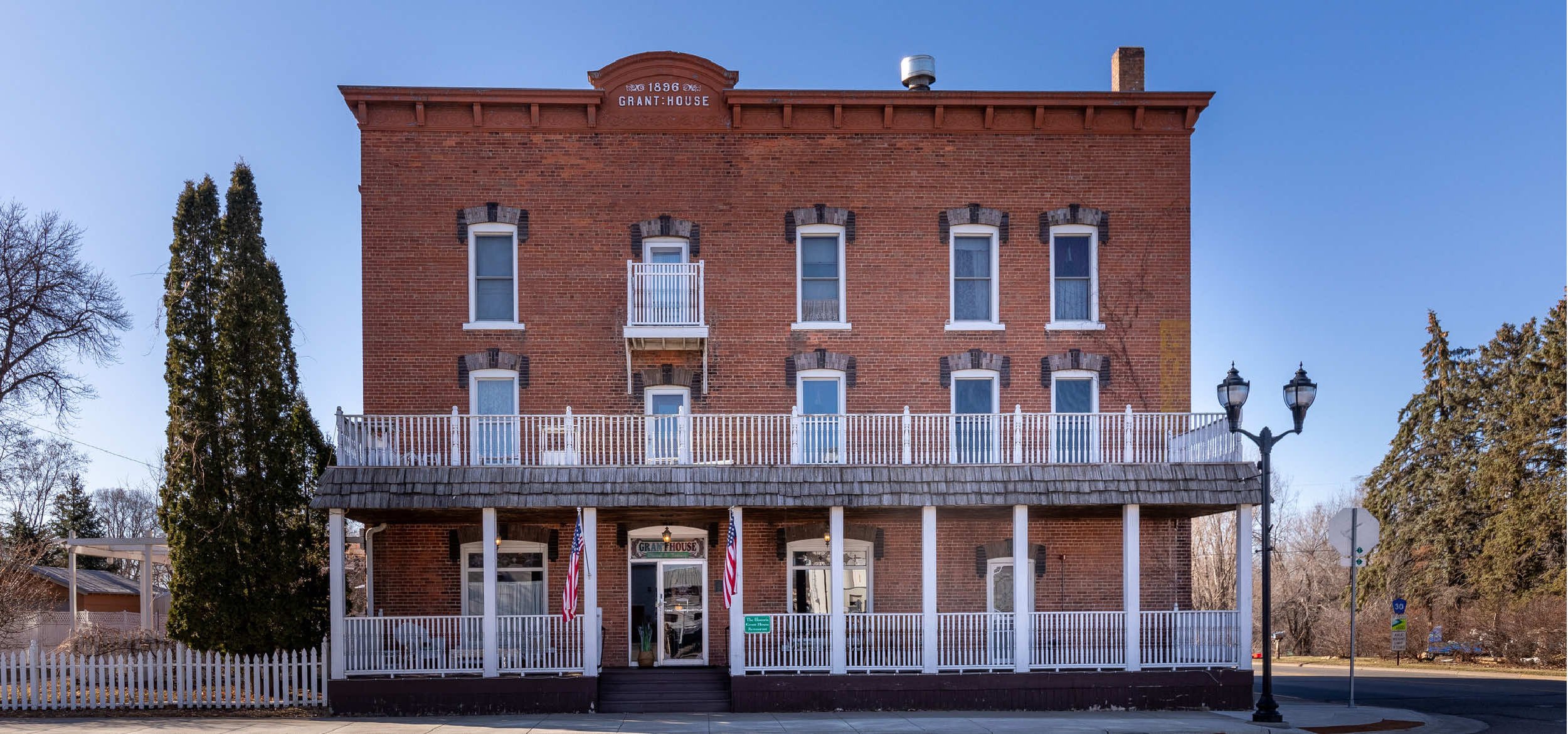
At the corner of Fourth Street and Bremer Avenue in downtown Rush City, Minnesota—a small town along Highway 61 roughly sixty miles north of the Twin Cities—a three-story brick hotel has been standing since the last years of the nineteenth century, carrying with it a history of fire, reinvention, and a reputation for paranormal activity that has drawn ghost hunters, television crews, and paranormal authors to a place most travelers on Interstate 35 pass without a second glance. The Grant House was originally built in 1880 by Colonel Russell H. Grant, second cousin to President Ulysses S. Grant. The original structure was a white-board building with an expansive porch, situated to serve the travelers and commerce flowing through Rush City along what was then a stagecoach route connecting St. Paul to Superior, Wisconsin. President Grant himself reportedly stayed at the hotel while visiting family in the area, taking advantage of Minnesota's hunting and fishing. The hotel prospered for just over a decade before fire destroyed the original building in 1895. Colonel Grant rebuilt the following year, this time in brick, and the 1896 structure—listed on the Registry of Historic Places—is the building that stands today, a 7,500-square-foot establishment with eleven rooms spread across its upper floors. The Grant House's history between the fire and the present day is marked by the kinds of uses that tend to leave residual energy in old buildings. During certain periods, the hotel reportedly operated as a bordello, and local accounts connect it to the bootlegging trade that ran through small Minnesota towns during Prohibition. Rush City's location along the railroad made it a natural waypoint for the kind of transient commerce—legal and otherwise—that characterized rural Midwestern towns in the early twentieth century. The Twin Cities Paranormal Society has noted that old railroad hotels in small towns are particularly prone to paranormal activity, citing the combination of constant human turnover, proximity to rail energy, and the fires and violence that frequently accompanied frontier-era hospitality. The paranormal reputation of the Grant House is well established and has been acknowledged by successive owners. Todd Johnston, who owned the hotel in the early 2010s, stated publicly that he, his staff, and guests had experienced numerous unexplained incidents during his tenure. In 2011, Johnston opened the hotel to a formal paranormal investigation, drawing ghost hunters and fans of SyFy Channel's Ghost Hunters International for an evening of organized investigation. The event confirmed what locals and staff had been reporting for years. Paranormal researcher Chad Lewis, author and lecturer for Unexplained Research LLC, has included the Grant House in his presentations on Minnesota's most haunted locations, noting the kinds of subtle evidence—recorded sounds inaudible to the naked ear, unexplained beams of light—that characterize active sites. The Grant House is also featured in The Big Book of Minnesota Ghost Stories by author Andy Weeks, who investigated the property as part of his broader survey of Minnesota hauntings. The reported phenomena at the Grant House span a range consistent with a building carrying multiple layers of occupation and use. Guests have heard ghostly laughter and disembodied voices in the hallways and rooms. Phantom footsteps are heard moving through the building when no one is present. Furniture has been found shifted or rearranged in rooms overnight by unseen hands. The most striking recurring claim involves the apparition of a woman who appears behind guests as they look into mirrors—visible in the reflection but not in the room itself when the guest turns around. The activity has been consistent enough to attract repeated visits from organized paranormal groups, including North Metro Paranormal, whose founder has described the Grant House as one of the locations that first drew him into ghost hunting after experiencing intense activity there on an early visit. Ghost tours have been held at the property, and the building's haunted reputation is embraced rather than concealed—the city of Rush City's own tourism page directs visitors interested in the paranormal to the hotel's website for ghost stories. Today the Grant House continues to operate in downtown Rush City, most recently housing The Fort, an eclectic American restaurant whose owners moved into the historic building in 2024. The new proprietors were aware of the building's reputation before signing the lease and were undeterred. The clawfoot tubs and pedestal sinks remain in the renovated guest rooms. The second-story porch still overlooks Main Street. The railroad tracks that once brought travelers and trouble to Rush City still run nearby. And the woman in the mirror, if she is still there, presumably has new faces to appear behind—and new guests to remind that in a building this old, the reflections do not always belong entirely to the living.
The Crescent Hotel
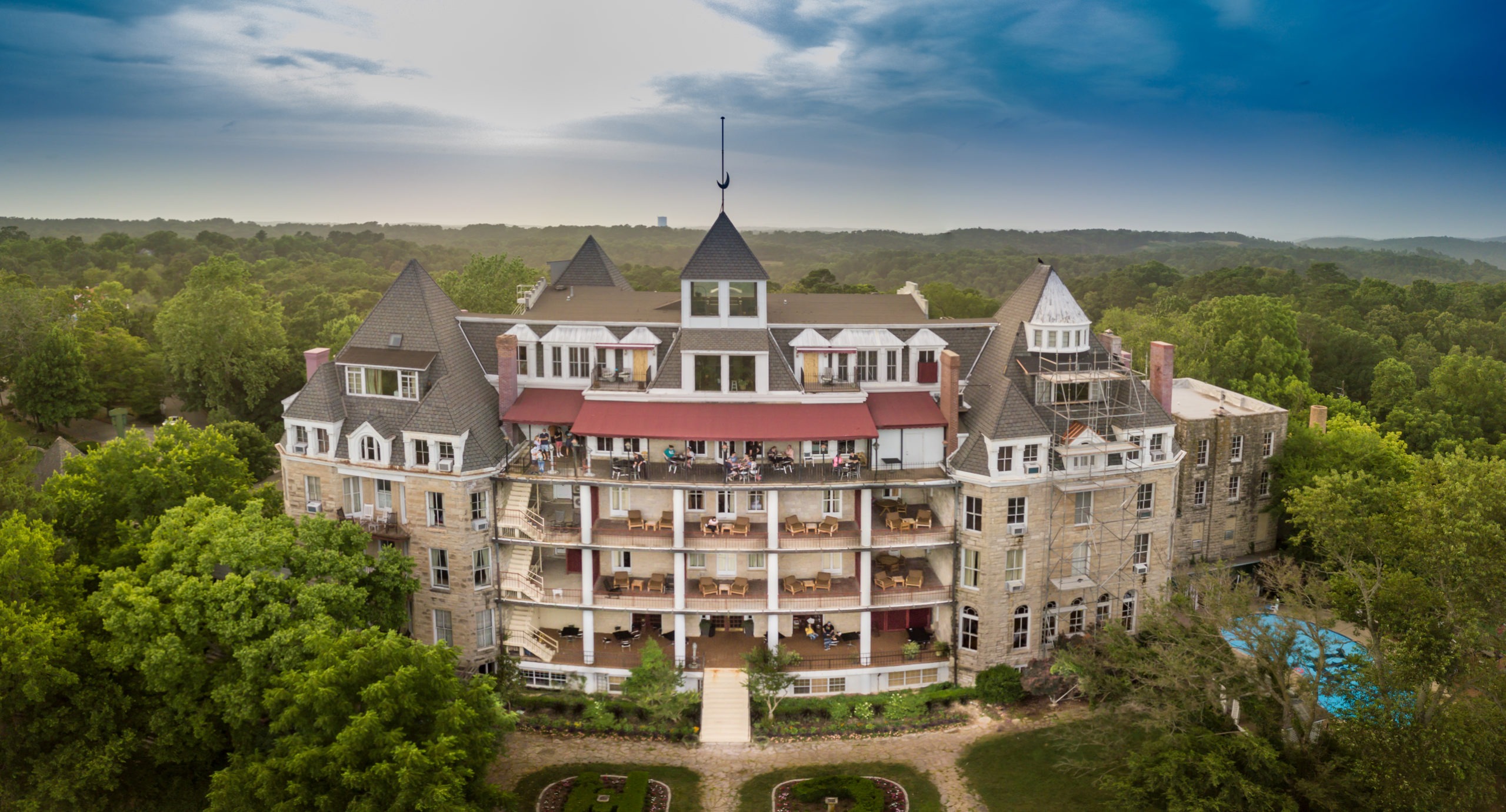
Perched on the crest of a limestone mountain overlooking the Victorian village of Eureka Springs, Arkansas, the 1886 Crescent Hotel commands the Ozark skyline like something lifted from a Gothic novel and dropped into the middle of the Bible Belt. Built from hand-cut limestone blocks so precisely fitted they required no mortar, the hotel rises in a blend of Richardsonian Romanesque and French Renaissance styling—arched windows, turrets, broad verandas, and a presence that can be seen from nearly anywhere in town. It was designed by architect Isaac S. Taylor, who would later design buildings for the 1904 St. Louis World's Fair, and funded by the Eureka Springs Improvement Company under former Arkansas governor Powell Clayton. When its doors opened on May 20, 1886, six hundred guests arrived from six states, greeted by a band stationed at the train depot. Eureka Springs had boomed almost overnight after its founding in 1879, drawn by sixty natural mineral springs that Native Americans had long known and that white settlers began marketing as miracle cures. By 1880, over fifteen thousand people had descended on the area. The Crescent was built to serve that wave—a luxury resort at nearly $300,000, the equivalent of roughly eight million dollars today. For its first two decades it operated as an exclusive destination, but interest in the springs faded, and the hotel couldn't sustain itself through the off-seasons. By 1902 it had been leased to the Frisco Railway. In 1908, it was converted into the Crescent College and Conservatory for Young Women, reportedly one of the finest women's seminaries in the country. That institution closed in 1924 for lack of funding, and a successor junior college folded during the Depression. By the mid-1930s, the grand hotel sat vacant and deteriorating. Then came Norman Baker. A former vaudeville performer and radio showman from Muscatine, Iowa, Baker had no medical training whatsoever but had already operated a fraudulent cancer clinic in his home state before being driven out. In 1937 he purchased the Crescent for $40,000 and transformed it into Baker's Cancer Curing Hospital, painting the interior in garish lavender and broadcasting his claims over the airwaves. His so-called treatments centered on injections of a concoction he called Formula 5—a mix of alcohol, carbolic acid, watermelon seed, corn silk, and clover leaves—administered up to seven times daily. Patients arrived from across the country, many spending their life savings on the promise of a painless cure. What they received was theater. At least forty-four patients died during the twenty months the hospital operated, their bodies moved to a basement morgue fashioned from the hotel's original kitchen, stored in the walk-in freezer. In 1940, federal authorities arrested Baker for mail fraud. He served four years in prison and died in Florida in 1958—of liver cancer. The hotel sat empty again until 1946, when new owners restored it to its original purpose. The paranormal reputation of the Crescent begins not with Baker but with the building itself. During construction in the 1880s, an Irish stonemason reportedly fell to his death from the upper framework into what is now Room 218. Staff have long referred to his spirit as Michael, and the room remains the most consistently active in the hotel. Guests report doors opening and slamming shut, pounding in the walls, the sound of a man falling through the ceiling, and, most disturbingly, hands emerging from the bathroom mirror. Room 419—known as Theodora's room—is associated with a former Baker patient who also worked as a hospital assistant. Guests find her straightening furniture or fumbling at the door as though searching for her key. On the third floor, witnesses describe the sound of squeaking wheels and the apparition of a nurse pushing a gurney down the corridor, only to watch it vanish. A young boy called Breckie, believed to have died from complications of appendicitis, has been seen bouncing a red ball on the second floor. In the hotel kitchen, a former chef reported pots and pans flying from their hooks, and another staff member witnessed a boy in old-fashioned knickers skipping through the room. Even Baker himself has reportedly been seen, appearing in his trademark white linen suit near the basement morgue. The morgue itself—still containing Baker's original autopsy table and walk-in cold storage—produces some of the most intense reports. Visitors describe oppressive atmosphere, sudden temperature drops, shadowy figures near the examination area, and the sensation of being touched by unseen hands. In 2019, groundskeepers digging near the hotel unearthed hundreds of glass bottles—remnants of Baker's operation—some containing preserved human tissue later confirmed by pathologists at the University of Arkansas for Medical Sciences. The discovery seemed to intensify reported activity, particularly in and around the morgue. Today the Crescent Hotel is owned by Elise Roenigk, who along with her late husband Marty purchased the property in 1997 for $1.3 million and undertook a six-year restoration. The hotel was listed on the National Register of Historic Places in 2016 and operates as a full-service resort and spa. It runs nightly ghost tours that draw over thirty-five thousand visitors annually, and hosts the Eureka Springs Paranormal Weekend each January. The morgue is open for public viewing. Room 218 books months in advance. The Crescent doesn't hide from what it is. It sets a place at the table for it.
The Goldfield Hotel
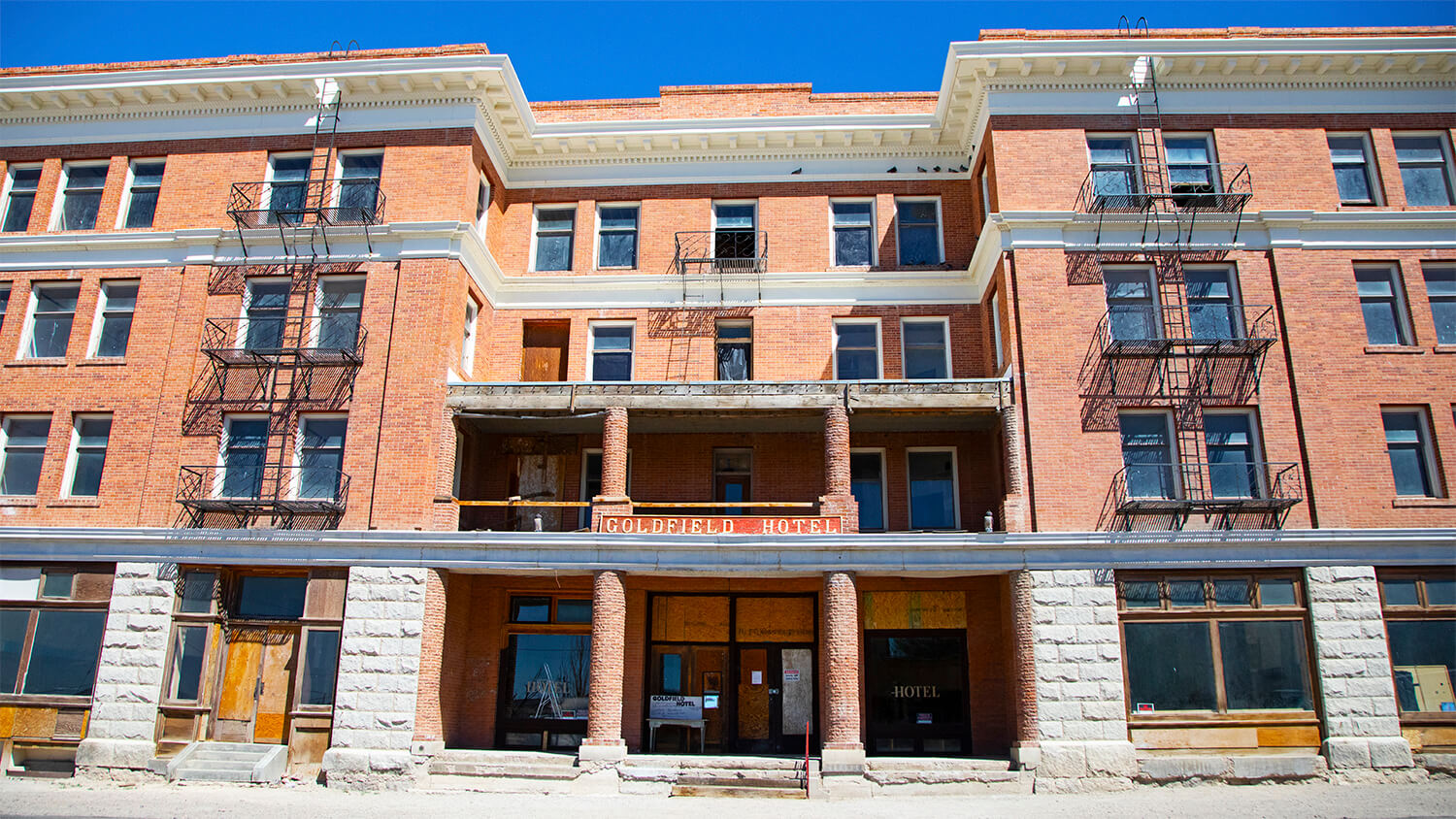
The Goldfield Hotel rises four stories above a town that barely exists anymore, its granite-and-brick façade still dominating the main intersection of Goldfield, Nevada—a place that was once the largest city in the state and is now home to roughly 250 people. The hotel was built to match the ambitions of a boomtown drunk on gold, and it stands today as a monument to how quickly all of that can disappear. Gold was discovered near Goldfield in 1902, and within a few years the population surged to 20,000. The town supported three newspapers, five banks, and a mining stock exchange. At the center of it all was George Wingfield, a former cattle driver and card dealer who had grubstaked his way into control of the Goldfield Consolidated Mines Company. The hotel, designed by Reno architects Curtis and Holesworth, opened in 1908 at a cost of over $300,000. Legend holds that champagne was poured down the front steps at the grand opening. The 154-room interior featured mahogany paneling, gilded columns, crystal chandeliers, gold-leaf ceilings, European chefs, and one of the first Otis elevators west of the Mississippi. It was proclaimed the finest hotel between Chicago and San Francisco. But Goldfield was a storm, not a city. Mine output dropped sharply by 1910. A flash flood hit in 1913. In 1923, a moonshine still exploded and ignited a fire that consumed twenty-seven blocks. The hotel survived—stone and brick don't burn easily—but the town was gutted. By the 1930s, the Goldfield Hotel was a flophouse for cowboys. During World War II it housed officers from the nearby Tonopah Army Air Field, and when they checked out in 1945, the hotel closed for good. The hotel's paranormal reputation centers on Room 109 and a legend involving a woman named Elizabeth—said to have been a prostitute and mistress of Wingfield who became pregnant with his child. The story claims he chained her to a radiator in the room, kept her alive until the baby was born, and then either let her die or killed her. The infant was allegedly thrown down a mine shaft beneath the hotel. It is a vivid and horrible story, and it has no verified historical basis. Researchers at the Central Nevada Museum have noted significant inconsistencies—the mine shafts were dug in 1925, years after Wingfield sold the hotel and moved to Reno, and no contemporary records corroborate Elizabeth's existence. The legend appears to trace largely to a book by 1980s owner Shirley Porter, likely crafted to boost interest in the property. However, there is a documented shadow behind the myth: a 1904 lawsuit by a woman named May Baric, who claimed to be Wingfield's common-law wife, accused him of abuse, and was given $400 and forced to leave town with their child. She and the child died in obscurity. The Elizabeth legend may be an embellishment of a real and quieter cruelty. Regardless of origin, the reports attached to Room 109 are persistent. Visitors describe sudden extreme cold, disembodied crying, and an overwhelming sadness that causes some to weep without explanation. Elsewhere, cigar smoke is reported on the first floor—attributed to Wingfield—along with unexplained piles of fresh ash. The lobby staircase is associated with child spirits who tap visitors on the back. The basement became nationally known after a 2004 Ghost Adventures investigation in which a brick appeared to fly across the room on camera. The show returned multiple times. Investigators have reported equipment malfunctions, shadow figures, and physical aggression from an entity known locally as "the Stabber." Today the hotel is privately owned, closed to the public, and mired in renovation efforts that have stalled repeatedly over decades. It is listed on the National Register of Historic Places. You cannot walk in. You can only look through the windows at the mosaic tile floors and the mahogany front desk and the elevator shaft, all of it frozen in place since the last guest left eighty years ago.
Bull’s Head Inn
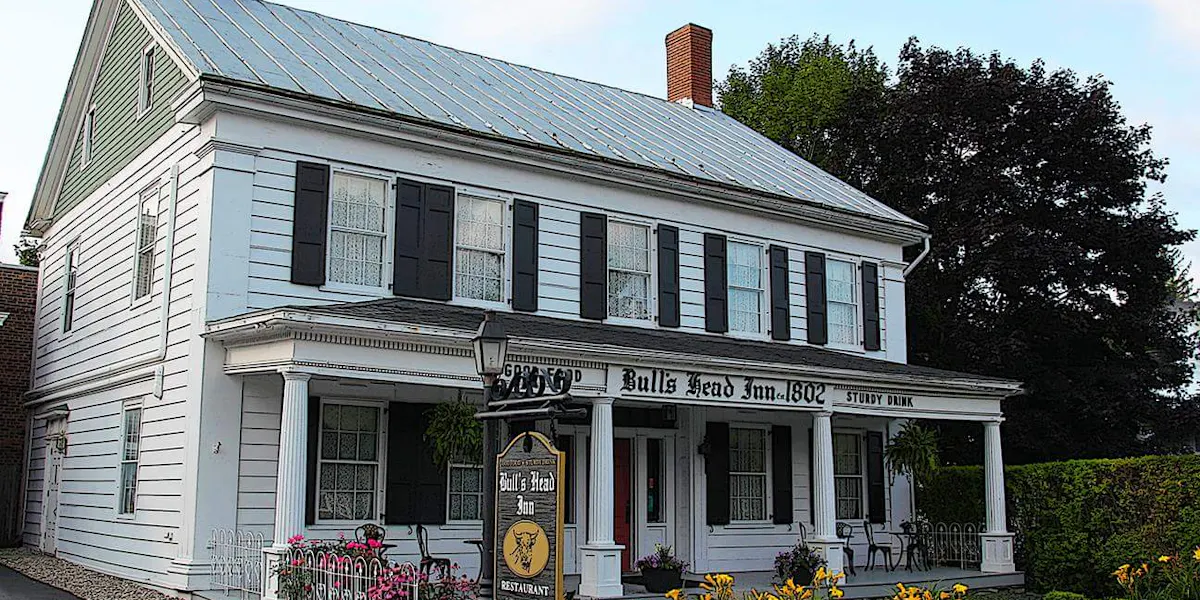
Standing at the corner of Park Place in the heart of Cobleskill, New York, the Bull's Head Inn is the oldest building in the village — a Federal-style structure built in 1802 that has served, across more than two centuries, as tavern, town hall, Masonic temple, courthouse, meeting hall, private residence, and restaurant. It carries that layered institutional history the way old buildings do in small upstate New York towns — quietly, in the woodwork, in the reoriented staircase, in the central fireplace that has warmed a rotating cast of merchants, soldiers, politicians, and neighbors across generations. A portrait of Thomas Jefferson hangs in the foyer, a reminder that he was President when the building was new. But the site itself is older than the building by half a century. George Ferster constructed one of the first structures in Cobleskill here in 1752, and what followed was a sequence of catastrophes that left a mark the land has apparently not forgotten. On May 30, 1778, during the Battle of Cobleskill, Mohawk forces under the command of Joseph Brant — fighting alongside Tories and British — burned the settlement nearly to the ground. Retreating patriots were killed, and the structure on this site was destroyed. The two buildings that followed met the same fate, each burned in subsequent enemy raids on Cobleskill in the spring and fall of 1781. Local tradition holds that occupants perished in one or more of these fires — including, in one account, a young girl in an upstairs bedroom who froze in terror and could not escape the blaze. Another story maintains that a Native American was killed inside the building during one of the conflicts. Three buildings destroyed on the same ground, within a single generation, each one carrying its dead. The current structure was built in 1802 by Seth Wakeman — the same builder responsible for the Beekman Mansion in Sharon Springs — and established as an inn and tavern to serve merchant traffic along the newly charted Loonenburg Turnpike, which ran commerce between Central New York and New York City. The inn thrived until the Erie Canal redirected that traffic north through Albany, bypassing Cobleskill and draining the commercial foot traffic that had kept it busy. By 1839, the building had transitioned into a private residence, and it remained one for well over a century. In 1810, when Cobleskill's Main Street was developed, the building was physically reoriented — its staircase repositioned, its front entrance redesigned to face the new brick-lined street. The building adapted, as it always had. The architecture reflects its early Federal character — three floors, a central staircase, original wide-plank floors, and stone cellar walls that the current owners exposed and incorporated into the lower tavern space using reclaimed brick from Cobleskill's own Main Street. The building is divided across three distinct atmospheres: a ground floor dining room anchored by a classic brick fireplace, an upper floor with vintage glass windows suited for private gatherings, and a lower tavern built from the bones of the old cellar. It is a building that wears its age honestly, without staging. The last private residents of the Bull's Head were John and Grace Steacy, whose opposing natures apparently outlasted them both. John drank; Grace was a dedicated member of the Women's Christian Temperance Union. When the building was sold after their deaths and former Cobleskill mayor Monte Allen reopened it as a restaurant and bar in 1966, he placed the bar in the room that had served as Grace Steacy's bedroom. What followed, according to staff, guests, and ownership across multiple decades, has been consistent and specific. A woman in a white gown — long-sleeved, floor-length — has been seen moving around the central staircase, along the upper and lower landings, and through the first-floor dining room by guests and staff working late. Silverware and napkins have been knocked to the floor or sent across the room. Plates and utensils have been disrupted mid-service. Doors slam on their own. Faucets turn themselves on. The current ownership reports these occurrences as ongoing. The paranormal activity at the Bull's Head is notable for its consistency across unrelated witnesses spanning more than fifty years of restaurant operation. The apparition of the woman in white has been described in nearly identical terms by guests who had no prior knowledge of the building's story. Paranormal investigators have conducted formal sessions at the property, and the inn is an established stop on New York State's official Haunted History Trail. The figure most commonly associated with the activity is Grace Steacy — a teetotaler whose bedroom became a bar — though older stories from local family tradition point toward the Revolutionary-era fires and the girl reportedly trapped in the upstairs room as an earlier and perhaps deeper source. Skeptics will note that a two-hundred-year-old building with three destroyed predecessors on the same site is exactly the kind of place where stories accumulate and feed on each other. The convergence of documented historical violence, a colorful final resident with a grudge against alcohol, and decades of reported encounters makes the Bull's Head something of a perfect storm for haunted reputation. None of that makes the firsthand accounts less consistent or less specific. The woman in white keeps appearing near the staircase. The silverware keeps moving. And the bar, to Grace Steacy's apparent displeasure, remains open.

Lawther Hall – University of Northern Iowa
Sitting quietly on the residential edge of the University of Northern Iowa campus in Cedar Falls, Lawther Hall doesn't announce itself the way a prison or asylum does. It's a brick dormitory, institutional and understated, built in 1940 and named for Anna B. Lawther — the first woman appointed to the Iowa State Board of Education and a figure in the women's suffrage movement. From the outside, it looks like exactly what it is: a mid-century college residence hall with long corridors, small rooms, and a top-floor attic that students haven't had access to in decades. What makes it notable isn't architecture or tragedy. It's a name. Augie. The building opened for the summer 1940 term, initially housing 293 women. During World War II, the adjacent Bartlett Hall was converted to house a training unit for the U.S. Navy WAVES — Women Accepted for Volunteer Emergency Service — which pushed Bartlett residents into Lawther, sometimes four students to a room designed for two. That wartime compression is the most dramatic chapter in Lawther's documented history. The building was always a women's dormitory. It was never officially used as a military infirmary, though the legend that eventually grew up around it says otherwise. Somewhere between the wartime crowding, the sealed attic floors, and the particular way old dormitories settle at night, a story took shape. The legend of Augie describes a World War II soldier who died in Lawther Hall when the building was being used as an infirmary — a detail that university archivists have been unable to verify and that conflicts with the building's known history as an exclusively female residence. What is documented is that the upper attic floors of Lawther were closed off in the early 1970s, deemed unsafe and in disrepair, and that students began reporting strange experiences around that time and after. The earliest recorded reference to Augie by name dates to 1977, when someone rearranged the lettering on a hall bulletin board to read: "Augie will return to haunt Bordeaux House." It is unclear whether that was a prank, a genuine report, or the moment a legend crystallized into campus fact. The building itself contributes to its reputation through atmosphere alone. The sealed upper floors — inaccessible, dusty, and unlit — created the kind of physical mystery that college-aged imaginations tend to populate. For years, a student-run haunted house called Augie's Attic operated in those upper spaces during Halloween season, drawing four hundred to a thousand visitors annually from campus and the surrounding Cedar Falls-Waterloo area. The event ran until the late 1990s, when fire code violations and roof damage ended it. The last Augie's Attic was held in 1997. After that, the attic stayed quiet, and Augie, according to students, moved to other parts of the building. Reports associated with Lawther Hall are consistent in their details if not in their explanation. Residents describe electronics behaving erratically — televisions switching on unprompted, radios continuing to play after being unplugged, alarm clocks failing without any mechanical defect. Posters found inverted or relocated overnight. Closet lights switched back on after being taped down. A resident assistant reported seeing a man in a striped outfit walking the hall during a period when the building was closed for break, who vanished into a women's restroom. One widely circulated account describes a resident waking in the night to find her television screen illuminated blue, hearing footsteps in the room, feeling her bedsheets pulled from her grip despite her resistance, and seeing the words "Good Night" appear on the screen before the pulling stopped. Skeptics — and there are reasonable ones — note that residence halls are among the noisiest, most suggestible environments imaginable. Hundreds of people have lived in Lawther Hall over the decades, sharing close quarters and trading stories across generations of students. Pipes, drafts, settling foundations, and shared folklore account for a great deal. The Augie legend itself may have its origins in misidentified history, a bulletin board prank, or simply the appeal of having a named ghost in a building with a sealed attic. These are not unreasonable explanations. What they don't fully account for is why the accounts from Lawther have remained so specific and so consistent for nearly fifty years, told by students who arrived with no prior knowledge of the legend and left with stories that matched the ones before them. Lawther Hall is not a place defined by documented violence or suffering. It's a place defined by accumulation — of stories, of residents, of years. Whether Augie is the ghost of a soldier, the product of a long-running campus tradition, or something harder to categorize, the building has earned its reputation through simple persistence. Generations of students have lived there, and a notable number of them left convinced that something in Lawther Hall was paying attention.

Waltz Inn
At the intersection of Waltz Road and Mineral Springs Road in the unincorporated community of Waltz, Michigan—about twenty-five miles southwest of Detroit in Huron Charter Township—a modest two-story building has stood since the early 1900s, carrying within its walls more than a century of small-town history and a haunting story rooted in love, loss, and an owner who apparently never left. The Waltz Inn began its life not as a restaurant but as a German bier garten and hall, established by Joseph Waltz Jr., the man for whom the surrounding community is named. The elder Joseph Waltz had moved his family from Detroit to a 160-acre plot of farmland along Territorial Road in 1857, settling what would become one of Wayne County's quieter rural communities. When he died in 1865, the land passed to his widow and eventually to his son, who platted the area in 1872 and became a prominent local figure, serving as Huron Township Clerk and Supervisor, Wayne County Superintendent of the Poor, and a Michigan State Representative. Joseph Jr. operated a general store on Territorial Road and opened the bier garten on Mineral Springs Avenue, establishing the building that would eventually become the Waltz Inn. Property records date the current structure to approximately 1912, and it has operated in various capacities—as an inn with upstairs lodging, a tavern, a gathering hall, and eventually a full restaurant—across the generations that followed. The building retains the sturdy, unpretentious character of early twentieth-century rural Michigan commercial architecture, with two rental apartments still occupying the upper floor above the restaurant space. The Waltz Inn's modern identity was shaped most directly by Tom Monastersky, who owned and operated the business until the early 1980s. Tom and his wife Olga lived upstairs in the building, running the inn as both their livelihood and their home. According to accounts preserved in the restaurant's own menu and passed down through subsequent owners, Olga died in the upstairs bedroom, and Tom followed her just two weeks later, passing away in the same room. The proximity of their deaths—two people who had shared the building as both home and business, dying within days of each other in the same space—forms the core of the haunting narrative that has followed the Waltz Inn ever since. The paranormal activity reportedly began shortly after the Monasterskys' deaths and has continued through every subsequent ownership. The current owners, who took over the restaurant in 1984, have acknowledged that strange occurrences are a regular part of life in the building. The most common reports involve classic poltergeist-style phenomena: objects moved from one location to another without explanation, doors opening on their own, furniture rearranged when no one has been upstairs, and lights turning on and off throughout the building at hours when the restaurant is closed and empty. Staff members over the years have described the activity as mischievous rather than menacing, as though someone were playing small pranks—nudging a glass, relocating a utensil, flipping a switch. The ghost is widely identified as Tom, still tending to the business he ran in life, unwilling or unable to leave the building where he and Olga spent their final years together. Some employees and visitors have reported the sense that the upper floor, particularly in the evening hours, carries a feeling of occupation—as if unseen guests were moving through the rooms above the dining area, footsteps and ambient sounds suggesting a building that is never quite as empty as it appears. The haunting at the Waltz Inn also exists within a broader neighborhood of reported paranormal activity. Roughly a block away on Waltz Road, a house that once stood on a lot next to the Waltz Feed Store was considered haunted by its former residents, who described being physically thrown, seeing shadowy figures in bedrooms, and encountering an apparition of a man outside on the street who vanished when looked at directly. That house eventually burned to the ground. Whether there is any genuine connection between the two locations or whether the proximity is coincidental remains a matter of speculation, but the clustering of claims in such a small community has added to the Waltz Inn's reputation as a paranormally active site. The Waltz Inn closed as a restaurant during the COVID-19 pandemic and has not reopened. As of 2025, the property is listed for sale, fully intact with its inventory, kitchen equipment, and carryout liquor license. The building's roof was replaced in 2024. The two upstairs apartments—including the bedroom where Tom and Olga Monastersky died—continue to generate rental income. Whether a new owner will reopen the restaurant and inherit its resident ghost remains to be seen, but the building still stands at its quiet crossroads in Waltz, holding onto a history that stretches back to the German immigrants who settled this corner of Michigan and to the couple who loved the place enough, it seems, to never entirely leave it behind.

Bethlehem United Methodist Church
Sitting on McElderry Road in the rural northeast corner of Talladega County, Bethlehem United Methodist Church is the kind of small-town Alabama congregation that holds the bones of a community. Its attached cemetery has served the surrounding area for generations, and its burial records reach back into the 1800s, when the first settlers were still arriving in the region and the land was young enough that families lived and died within a few miles of where they were born. The church is still active, still holding Sunday services, still tending its grounds — which makes its quiet reputation for strange happenings at night feel more intimate than the usual deserted-ruin ghost story. Munford itself carries a particular weight in American history. First settled in the early 1830s, the town sits in northeastern Talladega County against the backdrop of Cheaha Mountain, the highest point in Alabama. It grew slowly through the antebellum period as a small farming community, surrounded by the kind of Appalachian foothills landscape that kept large plantation agriculture limited but did not insulate it from the broader cruelties of the era. What Munford is best known for historically is an event that happened fourteen days after the Civil War should have already been over. On April 23, 1865 — two weeks after Robert E. Lee's surrender at Appomattox — roughly 150 exhausted Confederate soldiers, described in accounts as convalescents, home guards, and pardoned deserters, faced off against 1,500 veteran Union cavalrymen under General John T. Croxton, armed with repeating carbines. The skirmish lasted only minutes before the Confederate position collapsed. One soldier died on each side, and Lieutenant Andrew Jackson Buttram became what many historians consider the last Confederate soldier killed in battle east of the Mississippi River. The fight at Munford is widely regarded as the final engagement of the Civil War in the Eastern Theater — a war that ended, in part, right here on this ground. That history hangs over the entire area. A community that absorbed the last shots of the Civil War and carried forward its dead through Reconstruction, through the mill era, through the industrial decline of the 20th century, accumulates a particular kind of layered grief. Church cemeteries like Bethlehem's are repositories for all of it — the marked graves and the unmarked ones alike. A regular churchgoer noted in one account that the cemetery contains unmarked graves of families whose descendants still remember them, tracing names like Nabors back to the 1800s through Decoration Day visits, the Southern tradition of gathering at church graveyards each spring to clean and decorate the graves of the dead. The paranormal claims at Bethlehem are modest but consistent. Visitors and passersby report seeing orbs rising over the cemetery after dark — soft, hovering lights that lift above the headstones and dissipate. The accounts come from multiple unrelated sources over time, spanning casual visitors and people who know the property well. One regular churchgoer offered a rational interpretation, suggesting the lights result from moonlight or passing headlights reflecting off certain headstones at specific angles, visible only at the right position. Others who visited on Halloween captured balls of light in photographs that were invisible to the naked eye at the time of shooting, a detail they described as disorienting. Whether the orbs at Bethlehem reflect something genuinely unexplained or are a product of old reflective stone and the human tendency to see meaning in light and shadow, the cemetery has earned its quiet local reputation. It is a functioning sacred space, maintained and attended by a congregation that has gathered here across generations, and the dead buried within it are not strangers — they are neighbors, relatives, and the people who built this community. The church remains open to its members. The cemetery asks for respect.
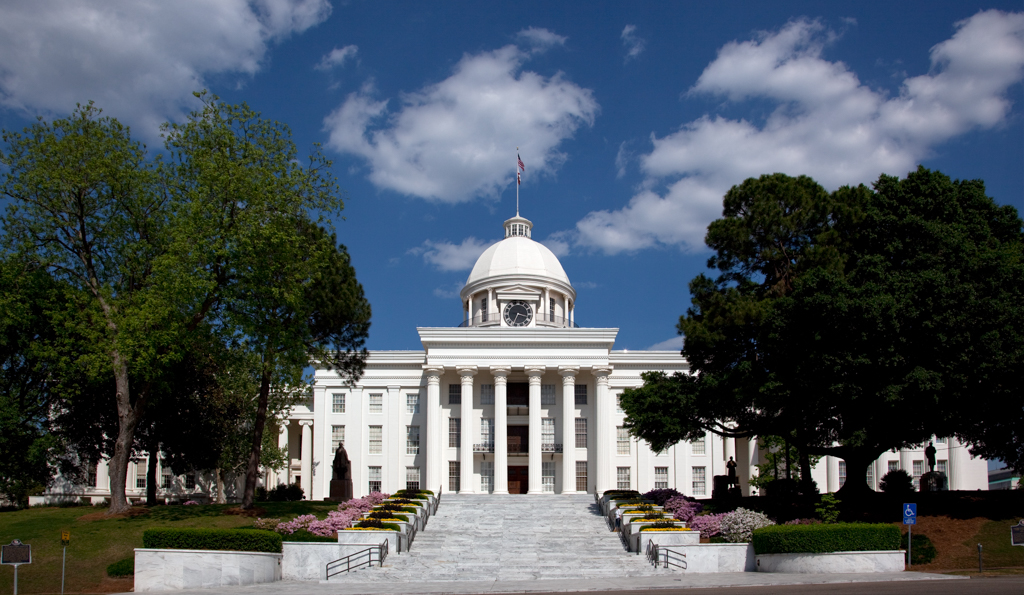
State Capitol Building
Rising at the end of Dexter Avenue at the top of a hill originally called Goat Hill, the Alabama State Capitol building has presided over Montgomery since 1851 — a Greek Revival structure of white columns and a central dome that has witnessed more pivotal and painful moments in American history than almost any comparable building in the country. It has served as the seat of state government, the cradle of the Confederacy, the backdrop of the Civil Rights Movement, and the site of a blood feud murder. That it carries a haunted reputation is almost difficult to avoid. The current building is the second capitol on this ground. The first, completed in 1847, burned down two years later. The current structure was completed in 1851, built partly by enslaved laborers, with its famous cantilevered spiral staircases crafted by Horace King, a formerly enslaved man who became one of the most accomplished builders in the antebellum South. The building immediately became the center of enormous historical forces. On January 11, 1861, Alabama voted to secede from the Union in the old Senate Chamber. Within weeks, delegates from six seceding states gathered in that same room and drafted the Provisional Constitution of the Confederate States of America. On February 18, 1861, Jefferson Davis arrived by carriage and was inaugurated as the Confederacy's only president on the front portico — the exact spot now marked by a brass six-pointed star embedded in the marble. Montgomery served as the Confederate capital for just over three months before the government relocated to Richmond. What remained was a building soaked in the weight of a nation's collapse. More than a century later, the Capitol stood at the center of history again. The third Selma to Montgomery Voting Rights March ended on its steps on March 25, 1965, with 25,000 protesters gathered on Dexter Avenue as Martin Luther King Jr. addressed the crowd. The building had once been the seat of the government that institutionalized slavery. Now it was the terminus of a march demanding the right of Black Americans to vote. That collision of meanings is embedded in the architecture itself. The most documented paranormal claim involves a murder committed inside the building on Halloween 1912. A property dispute between a young man named Will Oakley and his stepfather P.A. Woods came to a head in the Capitol offices of the state convict board president. Oakley produced two pistols, offered one to his stepfather for a duel, and when Woods refused, shot him four times. Oakley fled down the Capitol stairs, walked to the county jail, and surrendered. He was eventually committed to Bryce Hospital in Tuscaloosa, escaped, and was never heard from again. Since then, employees and security guards have repeatedly reported bathroom faucets turning on by themselves in the offices near the old convict board rooms — water running from fixtures with no one present, stopping only when manually shut off. Renovations over the decades have done nothing to stop it. The prevailing legend holds that Oakley's spirit returns endlessly to wash his stepfather's blood from his hands. The building's Civil War associations generate a separate layer of claims. A security guard quoted in a 1994 Birmingham News article reported seeing a female apparition near the statue of Governor Lurleen Wallace, wearing white opera-length gloves that matched those in Wallace's official portrait. Ghost tour operators describe the figure as a Civil War widow roaming the upper offices, wailing for a husband lost to the war. Cold spots and unexplained sounds have been attributed to the presence of Jefferson Davis, Civil War surgeon John Allan Wyeth — whose statue stands on the Capitol grounds — and an unidentified Confederate soldier. The Alabama State Capitol is open to the public Monday through Saturday and offers free guided tours. The governor's office still operates here. The old Senate Chamber where the Confederacy was born still stands. The brass star still marks where Davis took his oath. And somewhere in the building, according to those who have worked the late shifts, the water still runs.

Watson Hall - University of Jamestown
The University of Jamestown sits on a hill on the north side of the city, looking out over a landscape that is as flat and open as any in North America — the James River bottomland, the prairie extending in every direction, the sky enormous and unobstructed the way it only gets in the northern Great Plains. The institution was founded in 1883 by Presbyterian settlers, six years before North Dakota achieved statehood, making it the first private college chartered in what would become the forty-first state. Classes began on September 29, 1886, with thirty-five students and four courses of study. The original campus consisted of a single building and a barn, heated by wood stoves and lit by oil lamps, on a hill above a frontier town that had itself been incorporated only that same year. The college closed during the economic panic of 1893 and did not reopen until 1909, when Dr. Barend Kroeze came from Whitworth College to serve as president and rebuilt the institution largely through force of will. Kroeze served thirty-seven years. The Association of American Colleges later declared that Jamestown College was truly the lengthened shadow of that one man. The first building ever constructed on that hill — the original Old Main, built in 1883 from local brick fired at Anton Klaus's Jamestown brick yard and laid by a contractor named H.C. Hotchkiss — was the entire college in physical form. It housed all classrooms, the library, administrative offices, the chapel, the dining room, and the men's dormitory. Women students, in the custom of frontier institutions, lived in private homes in the surrounding neighborhood. Old Main was the institutional memory of the place made brick, the building that had been there from the beginning, that had survived the closure and the reopening, that carried in its walls the accumulated presence of every student and faculty member who had passed through in the college's first half century. On a night in September 1930 — part of a startling series of fires that struck Jamestown that year, leading the Fargo Forum to accuse the town of harboring a pyromaniac — Old Main burned. A brisk wind and low water pressure made it impossible to direct water into the cupola at the center of the roof. When the fire was over, only the brick walls were standing. The president placed the loss between $50,000 and $75,000. The building that had been Jamestown College's original body was gone. Watson Hall was built on that site. The current structure — a residence hall occupying the footprint of the original Old Main — serves primarily as a freshman dormitory, part of a residential campus that houses over seventy percent of its students. It is a standard mid-century brick dormitory, unremarkable in appearance, with the campus surrounding it on all sides and the James River valley visible from the hill below. Its name honors a donor family, as most buildings at the University of Jamestown do, and its administrative function as a student residence gives it the churning, year-over-year population typical of any college dorm — new students every fall, rarely anyone in the building for more than four years, institutional memory maintained by tradition rather than continuous occupancy. The paranormal reports associated with Watson Hall center on two specific elements. On the second-floor hallway, late at night, students have reported seeing the apparition of a girl approximately six years old — her appearance is described consistently in terms of age and location, a small figure in the corridor above the first floor. The other active location is a single first-floor room, which in the accumulated testimony of residents over the years has developed a reputation as a poltergeist space: posters torn from walls, objects thrown across the room without a detectable source, doors slamming on their own. The activity in that room is characterized less by visual appearance than by physical disruption — the kind of report that tends to be specific enough to follow a room from one occupant to the next across years and class years, building a reputation that incoming residents inherit along with the key. The ghost on the second floor does not obviously map onto the building's documented history — no child died in Watson Hall, and no child appears in the record of Old Main's long life as classrooms, chapel, and men's dormitory. The fire of 1930 destroyed the building but killed no one on record. What the site does carry is a specific kind of institutional weight: it is the exact ground where the college began, where every version of the institution before the fire took physical form, where the first students slept and ate and studied on a windswept prairie hill in a territory that was not yet a state. Whether that accumulated presence accounts for anything is a question the paranormal record cannot answer. Watson Hall is an active freshman residence hall and the most haunted-by-reputation building on a campus where the other dormitory, Kroeze Hall, has its own distinct legend — a former student said to have died by suicide and whose clicking sound, attributed to a beloved Rubik's Cube, has been reported in the corridors ever since. The University of Jamestown is a small, close-knit institution where campus folklore circulates with the density typical of residential liberal arts colleges, and where the stories that attach to specific buildings get told to new students by the people who lived in those buildings the year before. Watson Hall's second-floor corridor, and the room on the first floor, have been in that conversation for long enough that they exist in the institutional tradition now alongside the chapel programs and the athletics records and the photographs of Dr. Kroeze's thirty-seven-year presidency — embedded in the life of the place, whatever their ultimate source.

Selma Mansion
The Selma Mansion, located in Norristown, Pennsylvania, represents a significant example of American domestic architecture whose aesthetic and historical merits are eclipsed by the persistent and well-documented paranormal phenomena that define the property's contemporary reputation. The mansion was constructed during a period of substantial economic growth in the nineteenth century, built by members of families whose names appear repeatedly in the region's historical records as major landholders and commercial entrepreneurs. The architectural design reflects the influence of contemporary aesthetic movements and incorporates materials and construction techniques consistent with the period of its construction. Interior spaces reveal careful attention to domestic comfort and aesthetic refinement, with decorative elements and structural features that indicate substantial financial resources dedicated to the property's creation and maintenance. The mansion has served various purposes over its long history, functioning at different periods as a private residence, institutional facility, and currently as a location available for private investigation and historical tourism. The paranormal activity at Selma Mansion is directly connected to the building's history as the residence of multiple family lines whose members lived, loved, and died within its walls. Members of the Porter, Knox, and Fornance families all occupied the mansion during different historical periods, each generation leaving behind emotional imprints and spiritual residues that appear to persist in the structure's physical fabric. When deaths occurred within the mansion, whether from natural causes or unexpected tragedy, the location seemed to retain the energetic signature of those departures. Contemporary paranormal investigators operating within the mansion have documented an extraordinarily dense concentration of paranormal phenomena that suggests the simultaneous presence of multiple distinct spiritual entities rather than a single haunting. The most prominent of these entities appears to respond to the name John, based on documented evidence gathered through electronic voice phenomena recording and direct communication attempts by experienced paranormal researchers. This entity demonstrates interactive capabilities and appears to serve as a form of psychic anchor within the mansion, perhaps responsible for the maintenance or attraction of other spiritual presences. Disembodied voices throughout the mansion express themselves in ways that range from casual conversation to expressions of distress and anguish. Some vocalizations appear in languages or dialects consistent with historical periods preceding contemporary American English, suggesting that the voices may derive from residents of the mansion during earlier historical eras. Poltergeist activity throughout the mansion includes the spontaneous movement of objects, the creation of eerie sounds with no visible source, and the manipulation of the physical environment in ways that suggest intentional rather than merely residual haunting phenomena. Electronic voice phenomena recordings conducted at Selma Mansion have captured clear vocalizations on multiple occasions, providing evidence that investigators believe supports the reality of the phenomena rather than resulting from misinterpretation of environmental sounds. Paranormal investigation groups from across the region have conducted extensive research at Selma Mansion, and the property has become a destination for those interested in serious investigation of documented hauntings. The mansion's availability for private paranormal investigations ensures that researchers will continue to accumulate evidence regarding the nature and extent of the supernatural activity occurring there.
State University of New York Geneseo
Erie Hall stands as a dormitory building on the campus of State University of New York at Geneseo, a college town nestled in the Finger Lakes region of upstate New York. Constructed as a residence facility for the university's growing student population, the building was designed with the conventional architectural features typical of mid-twentieth-century dormitory construction: narrow corridors, compact living quarters, and communal facilities. The building has housed countless generations of students seeking higher education, its rooms serving as temporary homes for thousands of young people pursuing academic achievement and formative life experiences. Room C2D1, a modest residential space within the dormitory, appeared indistinguishable from any other student housing until 1985, when documented paranormal encounters thrust it into the national spotlight and transformed it into one of the most studied cases of dormitory-based supernatural activity. The building's location in a region with centuries of recorded history and indigenous heritage added layers of historical significance to the campus grounds, though few students understood the full context of the place they inhabited. The dormitory was erected during the post-World War II expansion of American higher education, when universities across the nation constructed residence halls to accommodate unprecedented enrollment. Erie Hall emerged from this period of institutional growth, its construction meeting the functional requirements of student housing while reflecting the architectural sensibilities of its era. The building's design emphasized efficiency and economy, prioritizing utility over distinctive character. For decades, it functioned as an unremarkable component of campus infrastructure, hosting study sessions, romantic encounters, and the mundane activities of undergraduate life. However, the existence of dormitory paranormal accounts stretching back through multiple decades suggests that something far more mysterious may have inhabited the building's spaces from its earliest years, waiting for the right circumstances to manifest fully. On March 13, 1985, student Chris Di Cesare experienced a violent encounter in the shower room connected to room C2D1 that would fundamentally alter the trajectory of his life and establish the dormitory's reputation for supernatural malevolence. According to Di Cesare's detailed account, an unseen force attacked him in the shower, leaving three deep claw marks across his back—physical evidence of contact with something that defied conventional explanation. The attack was severe enough to cause bleeding and lasting trauma, representing one of the few documented cases of a paranormal entity causing verifiable physical injury to a living person. This incident gained further corroboration through photographic evidence: a skeletal image manifestation was captured on film on Valentine's Day, 1985, presumably by Di Cesare or a fellow researcher documenting the haunting. The apparition, appearing in photographs but not visible to the naked eye, suggested the presence of an intelligent entity capable of interacting across the boundary between the visible and invisible worlds. The entity haunting room C2D1, known as Tommy, has become the subject of extensive paranormal documentation and investigation. Witnesses describe a ghostly presence manifesting as a young boy, though accounts suggest Tommy may be trapped in a state of perpetual aggression and torment. Beyond the physical attack documented in 1985, visitors to the room have reported inexplicable poltergeist phenomena, including objects moving of their own accord, disembodied footsteps echoing through corridors, unexplained knockings on doors and walls, and vivid apparitions of a skeletal figure that appears with terrifying clarity. Chris Di Cesare eventually transformed his traumatic experience into a career as an author, educator, and public speaker, dedicating himself to documenting paranormal phenomena and sharing his story through multiple platforms, including a Netflix documentary series titled True Haunting that brought national attention to the Erie Hall haunting and established it as one of the most comprehensively documented cases of residential paranormal activity in American universities.
Eloise Asylum
Eloise Asylum, originally established in 1839, represented one of America's most ambitious attempts to address mental illness through institutional medicine, evolving from a modest facility into a sprawling psychiatric complex that eventually encompassed seventy-five buildings across its extensive campus. The institution developed during an era when psychiatric conditions were poorly understood and treatment approaches ranged from benign to barbaric, creating an environment where vulnerable individuals faced uncertain futures and sometimes encountered practices that modern ethics would condemn. Eloise Asylum served the Detroit, Michigan region and neighboring areas, accepting patients whose conditions ranged from treatable mental illness to severe developmental disabilities to behavioral disorders that defied contemporary psychiatric classification. At its height, the facility housed hundreds of patients simultaneously, creating a small city unto itself with dormitories, medical facilities, kitchens, laundries, and support infrastructure. The asylum's sheer scale and complexity created an environment where individual patients could become lost within bureaucratic systems, their identities subsumed into institutional processes that prioritized efficiency over individual welfare. The primary spectral entity identified at Eloise Asylum is the "Lady in White," a female apparition whose identity remains shrouded in historical obscurity yet whose presence proves among the most consistently documented phenomena at the location. Witnesses described the Lady in White as a tall, elegant apparition dressed in white clothing, moving with purposeful intention through the asylum's spaces. Her appearance conveyed a sense of authority and familiarity with the building's layout, suggesting either staff status or long-term patient residency. The Lady in White has been reported in hallways, common areas, and patient rooms throughout the asylum complex, always maintaining an ethereal presence that inspired awe rather than fear. Her identity may never be conclusively determined, yet her apparent need to maintain presence within the asylum suggests deep emotional or professional connection to the institution. Additional prominent entities include the Hat Man, a figure of uncertain nature whose sinister presence contrasted starkly with the benign energy of the Lady in White. The Hat Man's identity remains unknown, appearing in shadows and periphery, suggesting he may represent malevolent intentions rather than protective spiritual presence. Eloise Asylum harbors spirits of numerous individuals who experienced trauma, abuse, loss, and death within its institutional confines. Ghostly children, identified as orphans who apparently lacked family connection sufficient to facilitate complete spiritual departure, manifest throughout the building complex. Witnesses described hearing children's voices, laughter, and sounds of movement from empty areas where no living children were present. The spirits of these young individuals apparently became bound to the institution during their vulnerable years, remaining trapped in a location where they experienced isolation and loss. The poltergeist activity documented at Eloise proved extensive and severe, with doors slamming spontaneously, medical equipment overturning without visible cause, and objects relocating from their original positions. Apparitions appeared in patient rooms, hallways, and staff areas, sometimes maintaining visibility long enough for witnesses to observe apparent features or expressions. Eloise Asylum achieved particular notoriety in paranormal research communities due to the concentration and intensity of documented phenomena. The institution's original purpose, combined with the suffering endured by vulnerable populations within its walls, apparently created ideal conditions for robust spiritual manifestation. Paranormal investigation teams documented significant electromagnetic anomalies, temperature fluctuations, and apparent spirit communication throughout the facility. The building's current status as a haunted experience venue featuring cutting-edge production technology reflects the recognition of Eloise's profound paranormal reputation. Visitors to the location encounter both historical presentations of the asylum's medical and social legacy and theatrical experiences designed to simulate paranormal phenomena. Yet the genuine spiritual activity documented at Eloise prior to its transformation into entertainment venue suggests that authentic hauntings persist beneath the entertainment presentation. The revelation that thousands of individuals buried in graves near the former psychiatric hospital remain unidentified underscores the profound human loss associated with the asylum's history. Eloise Asylum stands as a haunting reminder of how institutional approaches to mental illness, particularly during eras of limited psychiatric knowledge, could create tragic consequences for vulnerable individuals whose suffering apparently left lasting imprints upon the physical location.
Little Bighorn Battlefield
The Little Bighorn Battlefield near Crow Agency, Montana commemorates one of the most consequential military engagements in American history, the Battle of the Little Bighorn fought on June 25-26, 1876 in the rolling valleys of southeastern Montana. This decisive victory by Lakota Sioux and Northern Cheyenne warriors resulted in the annihilation of Lieutenant Colonel George Armstrong Custer's Seventh Cavalry regiment, shocking American military and civilian populations accustomed to inevitable military supremacy. The battle emerged from complex historical circumstances involving treaty violations, resource conflicts over the Black Hills, government demands for Indigenous relocation, and the military campaign to subdue plains tribes resisting forced assimilation and confinement. Custer's final stand resulted from strategic miscalculations, refusal to wait for additional military support, and substantial underestimation of the Indigenous coalition's military capacity and determination. The battle resulted in approximately 268 military casualties including Custer and most officers, combined with Indigenous casualties estimated between 60 and 100 warriors. The physical landscape was transformed permanently by the violent conflict—bodies scattered across terrain, blood-soaked grass, destroyed military equipment, and the spiritual wound created by mass death. The paranormal reputation of the battlefield developed through consistent reports of apparitions, disembodied voices, and psychological experiences consistent with residual spiritual energy from the traumatic mass death event that devastated both military and Indigenous populations. Visitors and paranormal investigators have consistently documented apparitions of soldiers materializing across the battlefield landscape, often uniformed figures appearing briefly and vanishing when approached directly. Phantom screams of dying soldiers allegedly echo across the terrain, particularly during twilight hours and after nightfall, representing spiritual imprints of final moments of hundreds of traumatized men. Apparitions depicting horses with mounted warriors have been observed, suggesting paranormal manifestations include Indigenous warriors and their mounts alongside American military forces, reflecting the totality of the battle's participants. The Stone House structure and cemetery areas exhibit particularly intense activity, with cold spots representing sudden temperature drops and disembodied voices captured on recording equipment. The headless soldier apparition reported represents one of the most disturbing specific manifestations, suggesting spiritual distress among soldiers whose deaths involved particularly traumatic circumstances. Paranormal researchers conducting investigations at Little Bighorn have identified concentrated areas of electromagnetic fluctuation and unexplained temperature variations, suggesting spiritual energy manifestations. Psychological experiences reported by visitors frequently include overwhelming dread, unexplained emotional states including grief and anguish, sudden awareness of presences, and vivid sensory experiences. Some researchers interpret these as residual energy recordings—spiritual imprints continuing to replay—while others propose active spirits maintain conscious presence engaging with visitors. The concentration of phenomena during specific temporal windows suggests potential correlation between spiritual manifestations and celestial or commemorative cycles. The site holds profound cultural and religious meaning to Lakota Sioux and Cheyenne peoples as ground where ancestors defended their way of life. Today, Little Bighorn Battlefield operates as a National Monument administered by the National Park Service, preserving historical significance and providing education regarding the battle's participants and consequences for American military and Indigenous history. The site has been extensively developed with visitor facilities, interpretive markers, and museum exhibits designed to contextualize the battle. The paranormal reputation has been acknowledged in paranormal research literature and popular paranormal media, attracting paranormal investigators alongside historians and tourists. Monument authorities maintain neutrality regarding paranormal claims while accommodating serious researchers conducting non-invasive investigations. The perpetual manifestations suggest spiritual consequences persist unchanged by time. The battlefield represents one of America's most significant paranormal sites combining historical importance with consistent documentation.
Evergreen Cemetery
The Soldiers National Museum in Gettysburg, Pennsylvania occupies a structure with profound historical significance relating directly to the American Civil War and specifically to the Soldiers' National Orphanage established to provide shelter and education to children orphaned by the conflict. The building represents architectural and institutional continuity with the American Civil War era, constructed deliberately to serve humanitarian purposes supporting vulnerable populations created by the devastating war's enormous casualties and societal disruption. Gettysburg itself emerged as the epicenter of American Civil War focus following the three-day Battle of Gettysburg in July 1863, which resulted in approximately 51,000 casualties and effectively represented the crucial turning point in the war's trajectory and outcome. The Soldiers' National Orphanage served as an essential institution addressing the humanitarian crisis created by the war, providing structure and support to displaced and orphaned children lacking conventional family support systems. The museum subsequently transformed the historical orphanage structure into an interpretive facility dedicated to documenting Civil War history, military institutional development, and the profound experiences of those affected by the conflict. The paranormal reputation of the Soldiers National Museum centers upon Rosa Carmichael, a spirit entity manifesting consistently throughout the building structure with particular concentration in subterranean spaces and basement areas of the historical complex. The museum's paranormal phenomena concentrate with particular intensity within the dungeon, basement, and associated subterranean structures underlying the building, suggesting traumatic events, emotional distress, or tragic circumstances associated with these lower levels created particularly strong spiritual manifestations. Rosa Carmichael's identity, her relationship to the orphanage institution, and the specific circumstances of her death or paranormal attachment remain subjects of ongoing paranormal research and historical investigation by researchers and paranormal enthusiasts. The basement and dungeon areas allegedly functioned as spaces associated with discipline, punishment, confinement, or other institutional practices that may have created emotional trauma contributing to Rosa's spiritual manifestation and ongoing paranormal presence. Paranormal researchers conducting investigations within these subterranean spaces have documented unexplained phenomena persisting despite the structural separation from upper floors. Disembodied voices captured on electronic recording equipment suggest attempted communication or manifestation of habitual vocalizations from historical periods when the orphanage operated actively. Apparitions of humanoid figures have been observed, described as solid-appearing entities materializing briefly before dissipating when approached or directly observed by investigators and visitors. Poltergeist activity—spontaneous movement of objects without mechanical cause—has been documented throughout the basement and dungeon areas, suggesting powerful energy manifestations concentrated within these subterranean zones. The dungeon itself represents one of the most intensely haunted zones, with visitors descending into the dungeon frequently reporting overwhelming sensations of dread, unexplained fear, sudden emotional shifts, and psychological distress that dissipates immediately upon exiting the space. Paranormal investigators equipped with electronic equipment have detected unusual electromagnetic fluctuations, unexplained temperature variations, and potential electronic voice phenomena within the dungeon exceeding phenomena documented in surface level rooms. Today, the Soldiers National Museum continues functioning as a historical and interpretive institution dedicated to Civil War history and the experiences of soldiers and civilian populations affected by the conflict and its enormous casualties. The paranormal reputation has been acknowledged in paranormal research literature and has attracted paranormal researchers conducting investigations within the building structure and its subterranean spaces. Museum management has accommodated carefully conducted paranormal investigations recognizing the research value of documenting phenomena, though access to dungeon and basement areas has been carefully controlled to balance paranormal research interests with preservation of the historical structures. Rosa Carmichael's spirit shows continuity in paranormal manifestations, with no indication of diminished activity or spiritual departure despite contemporary institutional functions and historical reinterpretation efforts by the museum.
Concord’s Colonial Inn
The Colonial Inn of Concord stands as one of New England's most historically significant and actively haunted hotel properties, its substantial brick structure occupying a commanding position in Concord's town center since the late eighteenth century. Established in 1716, the inn witnessed the tumultuous events of the American Revolution firsthand, serving as headquarters for militia commanders, a refuge for local families, and a gathering place for some of the era's most important political figures during the tense months leading up to and following the Battle of Concord in April 1775. The building's architecture reflects multiple periods of expansion and renovation, with the original colonial structure gradually augmented by additional wings and modern facilities while maintaining its essential character as a living link to America's revolutionary heritage. Throughout its long operational history, the inn has hosted countless notable guests including literary figures, political dignitaries, and military heroes, with many leaving behind impressions that guest accounts suggest persist in the present day. The inn's Revolutionary War period significance cannot be overstated, as the structure directly participated in the unfolding of events that would fundamentally transform the thirteen colonies into an independent nation. Soldiers, both American and British, occupied various rooms within the inn during the conflict, some meeting tragic ends within its walls or departing to face uncertain fates on nearby battlefields. The inn's proprietors during this era walked a delicate political line, maintaining hospitality to various parties while secretly supporting the colonial cause, and the building became a nexus of intrigue, tense negotiation, and divided loyalties. Following the war, the inn transitioned seamlessly into its role as a respectable accommodation for travelers and became deeply woven into Concord's identity as a center of literary and intellectual achievement during the nineteenth century, hosting prominent authors and thinkers of the American Renaissance. Room 24 has earned particular notoriety among paranormal investigators and casual visitors alike, becoming the focal point of numerous documented paranormal encounters spanning decades of accumulated reports. This room is the epicenter of disembodied voices, with multiple witnesses describing hearing conversations, laughter, and singing emanating from empty spaces within the chamber, sometimes accompanied by the distinctive sound of footsteps crossing the wooden floors when no visible figure can be seen. Visitors and overnight guests have reported the distinct sensation of unseen hands touching their shoulders and backs, a presence that some describe as deliberately interactive rather than passively haunting. Apparitions of ghostly children have been observed playing in corridors, described as translucent figures wearing period clothing who vanish when directly approached or observed for extended periods. A woman in a white dress has been repeatedly sighted in the inn's main hallway and sitting room areas, sometimes accompanied by a man in nineteenth-century attire wearing a tall hat, both figures exhibiting sufficient solidity and presence to suggest they remain unaware of their postmortem status. The Colonial Inn continues its operation as a functional hotel and restaurant, deliberately preserving its haunted reputation as part of its historical and cultural identity while maintaining modern amenities and hospitality standards. The inn offers ghost tours and paranormal evening experiences for interested visitors, and the building's staff members have accumulated extensive institutional knowledge regarding the timing and nature of paranormal occurrences, allowing them to anticipate and document supernatural phenomena with increasing sophistication. Research into the inn's Revolutionary War era history has revealed numerous deaths that occurred within the building during the military occupation, providing historical context for at least some of the reported paranormal activity. The inn remains a popular destination for history enthusiasts, paranormal investigators, and ordinary tourists seeking an authentic connection to colonial America, and its dual status as both a functional business establishment and a documented paranormal site has made it one of New England's most visited haunted locations and a fixture in regional ghost tour itineraries.
The Heathman Hotel
The Heathman Hotel in Portland, Oregon represents a landmark of sophisticated urban hospitality and architectural significance dating to the early twentieth century, when Portland was experiencing rapid growth as a Pacific Northwest commercial and cultural center. The hotel was conceived and constructed to accommodate the needs of discerning travelers, wealthy business professionals, and cultural figures visiting the city for extended periods, and its elegant design reflects the architectural confidence and aesthetic refinement of the period. The building combines classical elements with Art Deco influences, featuring a distinctive exterior that has become an iconic element of Portland's skyline and a reference point for architectural historians interested in early-twentieth-century American hotel design. The interior spaces were appointed with exceptional materials and craftsmanship, including elaborate lobbies, fine dining establishments, and guest rooms equipped with the technological innovations available at the time of construction. Over the decades of its operation, the Heathman Hotel has maintained its position as a premier accommodation option, hosting notable guests, serving as a setting for significant cultural events, and functioning as a gathering place for Portland's commercial and artistic communities. The architectural and operational design of the Heathman Hotel reflects contemporary understandings of luxury accommodation and the spatial arrangements believed optimal for creating an atmosphere of refined comfort. The building contains numerous guest rooms distributed across multiple stories, each furnished with period-appropriate fixtures and fittings that have been carefully maintained and periodically updated to meet contemporary expectations. The common areas include elegant corridors, dining facilities, and public spaces designed to convey an impression of wealth, stability, and refined cultural taste. The hotel's operational history has witnessed transitions in architectural fashion, commercial practices, and guest expectations, yet the fundamental character of the building as a space of temporary residential luxury has remained constant. The various guest room configurations, particularly those in the upper stories including rooms numbered in the seven-hundreds and eight-hundreds, have become focal points of particular interest due to the concentration of paranormal reports associated with these specific locations. Paranormal manifestations at the Heathman Hotel have been documented by hotel staff, guests, paranormal investigators, and academic researchers interested in hotel-based supernatural phenomena. The phenomena are not randomly distributed throughout the building but rather demonstrate geographic clustering in specific rooms and corridors, particularly rooms numbered 703, 803, and 1003, as well as room 708, suggesting that the paranormal activity may be connected to particular historical events or individuals associated with specific locations within the hotel. Guest reports describe cold spots appearing without apparent climatic cause, followed by inexplicable sounds including footsteps, doors opening and closing without human intervention, and poltergeist-type phenomena involving the movement and manipulation of physical objects. A particularly compelling category of reports involves towel movement, with witnesses describing towels being removed from bathrooms, transported through chambers, and sometimes aggressively thrown. Some guests have reported returning to their rooms to discover furniture rearranged in significant ways, with beds relocated, chairs moved to unfamiliar positions, and other substantial displacements of room furnishings. The most dramatic paranormal phenomena include reports of television sets turning on spontaneously during the night, displaying no discernible pattern of activation and no apparent mechanical cause. Guests have described awakening to the sound of running footsteps moving rapidly through corridors outside their rooms, followed by the sounds of doors opening and closing, yet investigations have consistently found no evidence of human activity at the reported times. The most compelling evidence for paranormal presence involves the apparition of a woman dressed in vintage clothing from the early-to-mid twentieth century, featuring long hair and period-appropriate styling, who has been observed in guest rooms and common areas by multiple independent witnesses describing consistent physical and behavioral details. Paranormal investigation groups have conducted electromagnetic and thermal investigations at the hotel, documenting anomalies that resist conventional explanation. Today, the Heathman Hotel continues to operate as a luxury accommodation option while simultaneously serving as one of Portland's documented paranormal investigation sites, creating a unique intersection of refined hospitality and spiritual mystery that attracts paranormal researchers and curious guests from around the world.
Old Yarmouth Inn
The Old Yarmouth Inn in Yarmouth, Massachusetts, stands as one of the oldest continuously operating hostelries in the northeastern United States, with its founding dating to 1696, placing it among the earliest commercial establishments in the region and providing historical continuity spanning more than three centuries. The inn's longevity derives from its location on Cape Cod, a geographic position that made it a logical stopping point for travelers, and its reputation for providing quality accommodations and hospitality to guests ranging from ordinary merchants to distinguished visitors. The building's architecture reflects various periods of expansion and renovation across its long operational history, with sections dating from the colonial era existing alongside modifications made in the eighteenth and nineteenth centuries. The inn has functioned continuously as a commercial hospitality establishment, serving its primary purpose of providing food, lodging, and comfort to transient guests with remarkable consistency. Paranormal investigation at the Old Yarmouth Inn has revealed the presence of at least two distinct entities whose manifestations demonstrate characteristics typical of intelligent haunting phenomena—spirits that respond to environmental stimuli, display purpose in their actions, and maintain awareness of the inn's contemporary operations. The primary entity has been identified as a male spirit, typically described by witnesses as appearing in Victorian-era attire and manifesting with greatest frequency in the guest rooms and sleeping areas. This entity has established a pattern of appearances focused on the foot of beds, where it appears to observe sleeping guests. Multiple guests have awakened to discover the translucent figure of a man standing at the foot of their bed, clearly visible enough to permit observation of facial features and clothing but distinct enough in its ethereal nature to identify it as paranormal. Accompanying the male spirit is a female entity whose presence manifests throughout the inn, particularly in the bar area and communal spaces where guests gather for social interaction and relaxation. The identity and historical background of this female spirit remain less thoroughly documented than her male counterpart, though paranormal investigators theorize that she may represent the spirit of a woman who died at the inn or maintained such an intense connection to the location during her lifetime that she remained bound to it after death. The two spirits—male and female—demonstrate awareness of each other and appear to interact within the inn's spaces, suggesting a relationship that transcends the boundary between life and death. The paranormal phenomena at the Old Yarmouth Inn are characteristically described as playful and non-threatening rather than malevolent or frightening. Guests have reported experiencing phenomena including ashtrays sliding across tables without apparent cause, glasses shaking or moving on surfaces, and names being whispered or called out in human voices. Objects have been found relocated from their original positions, and guests have reported being touched or nudged by invisible presences. Paranormal investigators have documented electromagnetic anomalies consistent with spiritual manifestation, temperature variations not attributable to the building's systems, and audio phenomena including disembodied voices captured on recording equipment. The phenomena occur with sufficient frequency and consistency that inn staff have become accustomed to the spirits and regard them as permanent residents. The Old Yarmouth Inn today functions simultaneously as a historical establishment, a commercial hospitality business, and one of Massachusetts' most documented paranormally active locations. The presence of the male and female spirits has become integrated into the inn's identity and promotional activities, with some guests specifically seeking accommodations because of its documented hauntings. Staff members speak matter-of-factly about encounters with the spirits, and visitors often arrive with expectations of experiencing paranormal phenomena. The inn's three-century history provides context in which the paranormal activity appears as a natural extension of the location's role as a space where human experiences accumulate and persist across time. The spirits appear to have chosen to remain because they find meaning, comfort, or purpose in their continued presence.
General Wayne Inn
The General Wayne Inn in Merion Station, Pennsylvania occupies a position of singular historical significance within American colonial and Revolutionary War era architecture. Constructed during a period when the young United States was transitioning from colonial administration to independent nationhood, the inn functioned as a meeting point for travelers, merchants, and political figures navigating the complex landscape of eighteenth-century Pennsylvania. The building itself represents architectural conventions of its era, designed to accommodate lodgers, serve meals, and function as a gathering space for community commerce and social interaction. The inn's strategic location along major travel routes made it a natural crossroads for diverse populations converging on the Philadelphia region during a period of unprecedented historical transformation. Over nearly three centuries of continuous operation, the General Wayne Inn has witnessed the evolution of American society while maintaining its essential function as a hospitality venue. The Revolutionary War period left an indelible mark on the property's history, with documented military engagements occurring in proximity to the inn and credible evidence suggesting that wounded soldiers, both American and Hessian combatants, received treatment within the building. The presence of at least eight Hessian soldiers—troops from Germanic territories serving under British command—has been established through historical documentation and archaeological investigation. Beyond these documented military casualties, historical accounts and oral traditions describe the deaths of young women and at least one young boy within the inn's confines, though precise circumstances and dating of these events remain ambiguous. A Native American spirit has also been incorporated into the paranormal narrative surrounding the location, reflecting broader patterns of cultural displacement and violence that characterized colonial Pennsylvania. These multiple entities, representing different historical periods and demographic groups, create a complex tableau of historical trauma concentrated within a single structure. The basement and bar areas of the General Wayne Inn have emerged as primary locations where paranormal activity is reported with greatest intensity and frequency. Contemporary visitors and paranormal investigators have documented sightings of multiple distinct apparitions, described with sufficient consistency to suggest recurring manifestations rather than isolated incidents. Among the most distinctive reported phenomena is the sensation of unexplained breath or wind across visitors' necks, a tactile experience that contrasts with visual apparitions and suggests a more multisensory paranormal environment. Disembodied screams, poltergeist activity involving inexplicable object movement, and the presence of undefined presences have all been documented in formal investigation reports and visitor accounts. The diversity and specificity of these reported experiences has contributed to the inn's recognition as one of the most actively haunted locations in the Philadelphia region, with investigators identifying approximately seventeen distinct spirits. The sheer number of alleged entities reflects the inn's long history and the multiple tragic events that have occurred within its structure. The General Wayne Inn continues to function as a restaurant and bar, serving its original purpose while simultaneously accommodating the contemporary fascination with its paranormal dimensions. Modern visitors arrive both for conventional dining and drinking experiences and specifically to participate in the location's supernatural narrative. Paranormal investigation groups have conducted formal investigations yielding documented photographic evidence and electromagnetic field recordings that suggest unusual environmental anomalies consistent with reported phenomena. The inn's management acknowledges its paranormal reputation while maintaining focus on hospitality operations, creating an environment where historical consciousness and contemporary commerce coexist. The General Wayne Inn stands as a remarkable convergence of documented American history, documented violent tragedy, and contemporary paranormal narrative, embodying the complex relationship between historical consciousness and paranormal belief in American cultural spaces.
The Lodge Resort and Spa
The Lodge Resort and Spa in Cloudcroft, New Mexico, represents a premiere mountain hospitality destination situated at high elevation in the Sacramento Mountains of south-central New Mexico, combining resort amenities with regional recreational opportunities and serving as a destination for tourists seeking mountain respite and luxury accommodations. The structure was developed during the early twentieth century as a commercial hospitality venture designed to capitalize on the region's scenic beauty, pleasant mountain climate, and growing popularity of mountain resorts as vacation destinations for wealthy Americans seeking escape from urban heat and congestion. The building incorporates architectural elements reflecting early-twentieth-century resort design sensibilities, with attention to comfort, aesthetic refinement, and the creation of an environment that appeals to guests seeking leisure and luxury. The lodge includes extensive facilities encompassing guest rooms distributed across multiple stories, dining establishments, recreational areas, and spa facilities designed to provide comprehensive hospitality services. The building maintains the rustic elegance characteristic of mountain resort architecture, with emphasis on natural materials, expansive windows offering mountain vistas, and interior design creating an atmosphere of refined comfort adapted to mountain environmental conditions. The operational history of the Lodge Resort and Spa encompasses more than a century of continuous hospitality operations, hosting hundreds of thousands of guests across its tenure as a commercial establishment. The facility has been periodically renovated and updated to maintain contemporary standards of comfort and service while preserving architectural elements and design characteristics that establish its historical identity and distinctive character. The location's popularity as a resort destination has resulted in the accumulation of extensive human presence, with staff members dedicating substantial portions of their working lives to the facility and guests experiencing significant moments of personal celebration, relaxation, and family connection within the building's spaces. The saloon and bar area, historically significant as a social nexus and recreational facility, represents a particular concentration of human activity, entertainment, and the convivial interactions characteristic of resort hospitality establishments. The dining facilities have hosted celebrations, family gatherings, business functions, and the ordinary meals of countless guests across the facility's operational span, making these spaces repositories of emotional and social significance. Paranormal phenomena at the Lodge Resort and Spa are extensively documented and attributed by paranormal researchers and local tradition to multiple spiritual entities with distinct personalities and behavioral patterns. The most prominent and well-documented entity is identified as Rebecca, described as a female spirit manifesting mischievous and playful characteristics rather than hostile or threatening behavior. Rebecca is claimed to deliberately interact with living guests and staff by taking beverages that have been served to living guests and subsequently leaving antique poker chips or other small objects as apparent acknowledgment of her actions and presence. The manifestations attributed to Rebecca suggest a spirit maintained distinctive personality traits and preferred modes of interaction with the living, creating a relationship that transcends simple haunting to constitute something approaching playful cohabitation. Additional paranormal entities are reported throughout the facility, including a red-haired woman apparition observed in the dining room and described as maintaining distinct physical characteristics and behavioral patterns. The most tragic entity is identified as the spirit of a murdered maid, whose violent death in service to the resort remains part of the building's traumatic history. The paranormal manifestations at the Lodge Resort and Spa extend beyond apparition sightings to encompass extensive poltergeist-type phenomena and direct interactive activity. Apparitions are reported to appear in mirrors and reflective surfaces, suggesting entities that maintain awareness of their incorporeal condition and deliberately reveal themselves to the living. Moving beverages and displaced objects constitute a pattern of activity suggesting consciousness and intentional agency in paranormal manifestations. Disembodied activity manifests as unexplained movements of physical objects, rearrangement of furniture and fixtures, and object movement that appears responsive to human presence and activity. Bed disturbances during night hours suggest intimate engagement with guest spaces and sleeping individuals, creating paranormal experiences of heightened personal intimacy. The paranormal activity is concentrated but not exclusively localized within the bar and basement saloon areas, the historical center of recreational activity and entertainment within the resort. Today, the Lodge Resort and Spa continues to operate as a premier mountain hospitality destination while simultaneously serving as one of New Mexico's most extensively documented paranormal investigation sites, where visitors seeking relaxation and mountain recreation may encounter verified supernatural phenomena and the resident spirits who appear to have claimed the facility as their eternal home.