
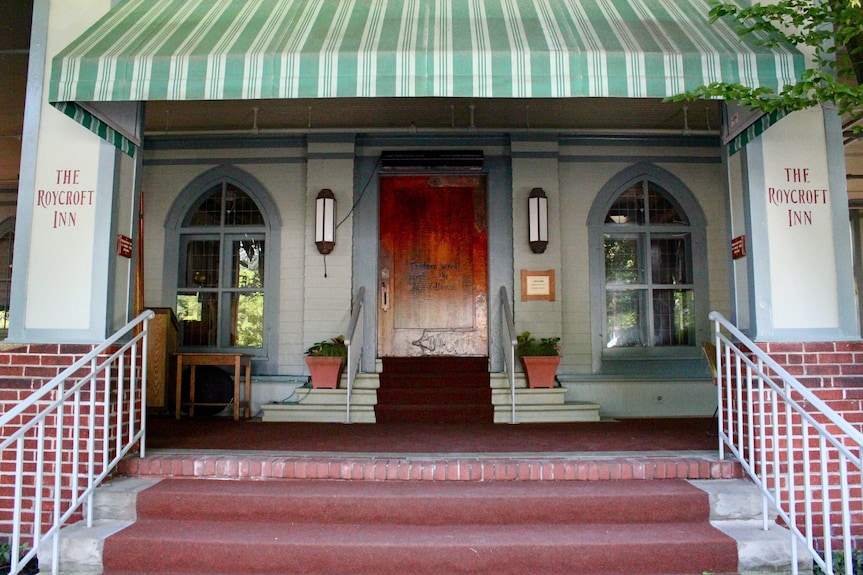
Roycroft Inn
Background & History
Historical context and known paranormal claims surrounding Roycroft Inn.
Set along a quiet, tree-lined stretch of South Grove Street in the village of East Aurora, New York, about twenty miles southeast of Buffalo, the Roycroft Inn does not look like a place built for ghosts. It looks like a place built for ideas. The structure rises in a blend of country Gothic and Prairie Style architecture, its exterior marked by stained glass, hand-hewn woodwork, and a broad peristyle porch that opens onto a campus of historic buildings arranged like a small, purposeful village. The Inn was not conceived as a hotel in any conventional sense. It was built as the public face of one of the most ambitious artistic communities in American history—and its haunting, to the extent that it has one, is inseparable from the singular and ultimately tragic figure who created it.
Elbert Hubbard was born in Bloomington, Illinois, in 1856 and spent his early career as a traveling salesman for the Larkin Soap Company in Buffalo, where his advertising genius helped build the firm into one of the largest mail-order businesses in the country. But Hubbard grew restless with corporate life. After traveling to England in the 1890s and encountering the work of William Morris and the ideals of the Arts and Crafts movement, he returned to East Aurora with an almost evangelical vision: to build a self-sustaining community of artisans dedicated to handcraftsmanship, intellectual life, and creative work. In 1895, he established the Roycroft Press, and by 1897, construction had begun on the South Grove Street campus that would grow to include a print shop, bindery, furniture shop, copper shop, and chapel. In 1899, Hubbard wrote a short inspirational essay called A Message to Garcia that became one of the most widely printed works of its era, selling an estimated forty million copies and bringing national fame to both Hubbard and East Aurora. Visitors began arriving in droves to meet the man and see the community he had built. By 1910, the campus employed over five hundred artisans producing handcrafted books, furniture, metalwork, leather goods, and stained glass.
To accommodate the growing stream of visitors, Hubbard converted the former print shop and workers' quarters into an inn, which opened around 1903 and was significantly expanded and remodeled by 1905. Rooms were individually named for figures Hubbard admired—William Morris, John Ruskin, Ralph Waldo Emerson—and furnished with pieces crafted on-site. The artist Alexis Jean Fournier painted landscape murals in the salon. Dard Hunter designed electrified copper chandeliers and stained glass windows that replaced the building's original Gothic glazing with Secessionist and Glasgow School motifs. Meals were prepared from the Roycroft Farm's own produce, eggs, and grains. The Inn became a destination in its own right, part intellectual retreat, part showroom, part monument to the idea that beauty and utility could coexist.
On May 1, 1915, Elbert Hubbard and his second wife, Alice Moore Hubbard—a noted suffragist and writer in her own right—boarded the RMS Lusitania in New York, bound for England where Hubbard intended to interview Kaiser Wilhelm II and begin a lecture tour. Six days later, on May 7, a German U-boat torpedoed the ship eleven miles off the coast of Ireland. A survivor later described the Hubbards emerging onto the deck after the torpedo struck, linking arms in their characteristic fashion, and standing together as the ship went down. Neither survived. Their bodies were never recovered.
The loss of Hubbard devastated the Roycroft community. His son Bert took over operations and attempted to sustain the enterprise through wider retail distribution, eventually placing Roycroft furniture in Sears and Roebuck catalogs. But without the elder Hubbard's charisma and vision, the community entered a slow decline. Changing tastes and the crushing economics of the Great Depression finished what grief had started. In 1938, the Roycroft Shops closed and filed for bankruptcy. The buildings passed through various owners, and by the mid-twentieth century the campus had deteriorated significantly. The Inn continued operating in diminished form until 1987.
Reports of paranormal activity at the Roycroft Inn have circulated for decades, and they center almost entirely on the figure of Elbert Hubbard himself. Guests and staff have reported seeing an apparition resembling Hubbard—recognizable by his distinctive long hair and period clothing—near the Ruskin Room, which served as his personal study. Sightings of the figure looking out of windows, walking the hallways, and descending the staircase have been described by visitors with no prior knowledge of the claims. Disembodied voices have been heard in empty rooms, and footsteps echo through corridors when no one is present. One guest staying in a room at the top of the stairs reported hearing a woman's voice say a clear and direct greeting directly in her ear while sitting alone on the front porch late at night.
At least one regular visitor has claimed to hold ongoing conversations with Hubbard's spirit near the portrait that hangs behind the bar. Author and paranormal researcher Mason Winfield, who lived on the Roycroft grounds during the 1980s and has led ghost walks on the campus for years, has described the site as occupying ground with unusual energy and has explored the Roycroft community's historical links to mysticism, including connections to the Rosicrucian Society. The painter Alexis Jean Fournier, who created the Inn's murals and is buried in nearby Oakwood Cemetery, has also been identified as a possible spiritual presence on the campus, described by at least one longtime resident as a guardian figure rather than a conventional ghost.
Today the Roycroft Inn operates as a fully restored National Historic Landmark, reopened in 1995 following an eight-million-dollar renovation funded in large part by the Margaret L. Wendt Foundation. The twenty-eight guest rooms are furnished with original Roycroft pieces and Stickley reproductions. The salon murals by Fournier have been meticulously restored. The campus around it—nine of the original fourteen structures still standing—hosts artist studios, galleries, shops, and a visitor center. Whether Elbert Hubbard's spirit truly returned to the place he built with such intensity and devotion, or whether the Inn simply holds the kind of atmospheric charge that a century of creative ambition and sudden loss tends to leave behind, the Roycroft remains a place where history does not feel safely past. The arms are still linked. The deck is still tilting. And somewhere in the glow of a Dard Hunter chandelier, the footsteps continue.
hotel
East Aurora, New York
Erie County
February 26, 2026
Open
People Also Searched For
Have you visited Roycroft Inn?
Share your paranormal experience and help other investigators decide if it's worth exploring.
Activity Breakdown
Types of documented activity recorded at Roycroft Inn, organized by category.
Visual Activity
Audio Activity
Physical Disturbances
Reported Areas
Specific areas within Roycroft Inn where activity has been documented.
No specific areas of activity have been reported for Roycroft Inn yet.
Known Entities
Entities, spirits, and figures that have been identified or reported at Roycroft Inn.
Photos
Images sourced from across the web and linked directly to the original host. Ghouler does not download or host these images, nor do we claim them as our own.
Investigator Reviews
Your trust is our priority, so no location can pay to alter or remove their reviews.
No reviews yet.
Be the first to share your experience at Roycroft Inn.
Loading reviews...
Documented Experiences
Paranormal reports and documented occurrences compiled for Roycroft Inn from archived sources and community investigators.
No documented experiences for Roycroft Inn yet.
Best Times to Visit
Equipment & Methods
Equipment and investigation methods reported by community investigators at Roycroft Inn.
Know Before You Go
Important details to help plan your visit or investigation of Roycroft Inn.
Private Property
Open
Not specified
Sources & References
Referenced materials and documentation supporting the Roycroft Inn case file.
Experience Glossary
Detailed descriptions of each type of activity documented at Roycroft Inn.
Disembodied Voices
Definition
Audible speech heard without a visible speaker present.
What People Report
Witnesses report whispers, direct responses, conversations, or voices calling their name in otherwise quiet environments. These events may occur during investigations or spontaneously in residential settings.
Object Manipulations
Definition
Objects reported to move, shift, or fall without visible physical interaction.
What People Report
Items may relocate across rooms, disappear temporarily, or be found in unusual positions. These reports often involve repeated displacement patterns.
Full-Body Apparitions
Definition
A complete human-shaped figure reportedly seen in physical space.
What People Report
Witnesses often describe defined features such as clothing, posture, or movement patterns. These manifestations may appear solid or semi-transparent before disappearing abruptly.
Unexplained Sounds
Definition
Unidentifiable noises such as bangs, growls, music, or movement occurring without environmental explanation.
What People Report
These sounds may be isolated or recurring and are frequently reported during periods of heightened activity.
Important Notices
Information in this case file is compiled from public sources and community reports. Accuracy cannot be guaranteed. Always verify details before visiting, and check with property owners and local or state authorities to confirm access is permitted.
This location is on private property. Do not enter without explicit permission from the property owner.