
Haunted Places in East Aurora, New York
2 haunted locations
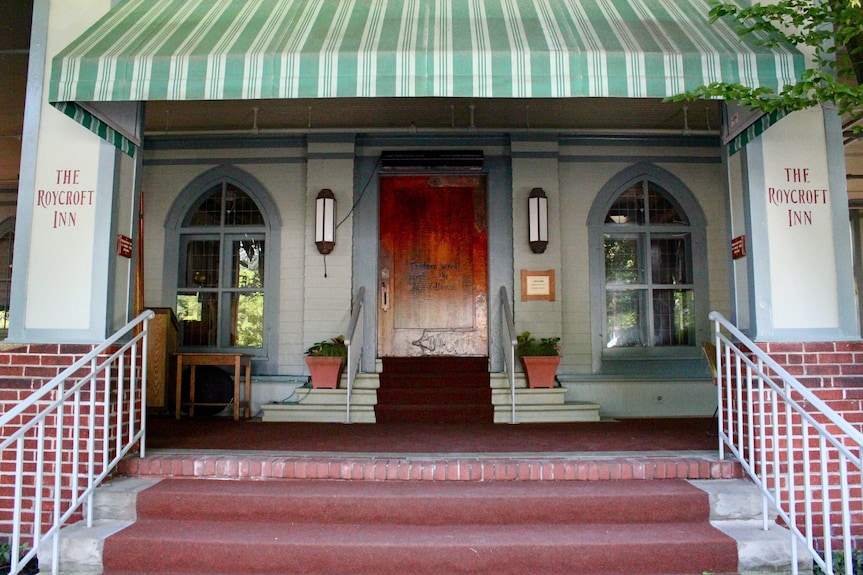
Roycroft Inn
Set along a quiet, tree-lined stretch of South Grove Street in the village of East Aurora, New York, about twenty miles southeast of Buffalo, the Roycroft Inn does not look like a place built for ghosts. It looks like a place built for ideas. The structure rises in a blend of country Gothic and Prairie Style architecture, its exterior marked by stained glass, hand-hewn woodwork, and a broad peristyle porch that opens onto a campus of historic buildings arranged like a small, purposeful village. The Inn was not conceived as a hotel in any conventional sense. It was built as the public face of one of the most ambitious artistic communities in American history—and its haunting, to the extent that it has one, is inseparable from the singular and ultimately tragic figure who created it. Elbert Hubbard was born in Bloomington, Illinois, in 1856 and spent his early career as a traveling salesman for the Larkin Soap Company in Buffalo, where his advertising genius helped build the firm into one of the largest mail-order businesses in the country. But Hubbard grew restless with corporate life. After traveling to England in the 1890s and encountering the work of William Morris and the ideals of the Arts and Crafts movement, he returned to East Aurora with an almost evangelical vision: to build a self-sustaining community of artisans dedicated to handcraftsmanship, intellectual life, and creative work. In 1895, he established the Roycroft Press, and by 1897, construction had begun on the South Grove Street campus that would grow to include a print shop, bindery, furniture shop, copper shop, and chapel. In 1899, Hubbard wrote a short inspirational essay called A Message to Garcia that became one of the most widely printed works of its era, selling an estimated forty million copies and bringing national fame to both Hubbard and East Aurora. Visitors began arriving in droves to meet the man and see the community he had built. By 1910, the campus employed over five hundred artisans producing handcrafted books, furniture, metalwork, leather goods, and stained glass. To accommodate the growing stream of visitors, Hubbard converted the former print shop and workers' quarters into an inn, which opened around 1903 and was significantly expanded and remodeled by 1905. Rooms were individually named for figures Hubbard admired—William Morris, John Ruskin, Ralph Waldo Emerson—and furnished with pieces crafted on-site. The artist Alexis Jean Fournier painted landscape murals in the salon. Dard Hunter designed electrified copper chandeliers and stained glass windows that replaced the building's original Gothic glazing with Secessionist and Glasgow School motifs. Meals were prepared from the Roycroft Farm's own produce, eggs, and grains. The Inn became a destination in its own right, part intellectual retreat, part showroom, part monument to the idea that beauty and utility could coexist. On May 1, 1915, Elbert Hubbard and his second wife, Alice Moore Hubbard—a noted suffragist and writer in her own right—boarded the RMS Lusitania in New York, bound for England where Hubbard intended to interview Kaiser Wilhelm II and begin a lecture tour. Six days later, on May 7, a German U-boat torpedoed the ship eleven miles off the coast of Ireland. A survivor later described the Hubbards emerging onto the deck after the torpedo struck, linking arms in their characteristic fashion, and standing together as the ship went down. Neither survived. Their bodies were never recovered. The loss of Hubbard devastated the Roycroft community. His son Bert took over operations and attempted to sustain the enterprise through wider retail distribution, eventually placing Roycroft furniture in Sears and Roebuck catalogs. But without the elder Hubbard's charisma and vision, the community entered a slow decline. Changing tastes and the crushing economics of the Great Depression finished what grief had started. In 1938, the Roycroft Shops closed and filed for bankruptcy. The buildings passed through various owners, and by the mid-twentieth century the campus had deteriorated significantly. The Inn continued operating in diminished form until 1987. Reports of paranormal activity at the Roycroft Inn have circulated for decades, and they center almost entirely on the figure of Elbert Hubbard himself. Guests and staff have reported seeing an apparition resembling Hubbard—recognizable by his distinctive long hair and period clothing—near the Ruskin Room, which served as his personal study. Sightings of the figure looking out of windows, walking the hallways, and descending the staircase have been described by visitors with no prior knowledge of the claims. Disembodied voices have been heard in empty rooms, and footsteps echo through corridors when no one is present. One guest staying in a room at the top of the stairs reported hearing a woman's voice say a clear and direct greeting directly in her ear while sitting alone on the front porch late at night. At least one regular visitor has claimed to hold ongoing conversations with Hubbard's spirit near the portrait that hangs behind the bar. Author and paranormal researcher Mason Winfield, who lived on the Roycroft grounds during the 1980s and has led ghost walks on the campus for years, has described the site as occupying ground with unusual energy and has explored the Roycroft community's historical links to mysticism, including connections to the Rosicrucian Society. The painter Alexis Jean Fournier, who created the Inn's murals and is buried in nearby Oakwood Cemetery, has also been identified as a possible spiritual presence on the campus, described by at least one longtime resident as a guardian figure rather than a conventional ghost. Today the Roycroft Inn operates as a fully restored National Historic Landmark, reopened in 1995 following an eight-million-dollar renovation funded in large part by the Margaret L. Wendt Foundation. The twenty-eight guest rooms are furnished with original Roycroft pieces and Stickley reproductions. The salon murals by Fournier have been meticulously restored. The campus around it—nine of the original fourteen structures still standing—hosts artist studios, galleries, shops, and a visitor center. Whether Elbert Hubbard's spirit truly returned to the place he built with such intensity and devotion, or whether the Inn simply holds the kind of atmospheric charge that a century of creative ambition and sudden loss tends to leave behind, the Roycroft remains a place where history does not feel safely past. The arms are still linked. The deck is still tilting. And somewhere in the glow of a Dard Hunter chandelier, the footsteps continue.

Roycroft Pavilion
The Roycroft Pavilion stands as a significant component of the Roycroft artistic campus located in upstate New York, representing the legacy of the influential Arts and Crafts movement that flourished during the late nineteenth and early twentieth centuries in America. The Roycroft community, founded by visionary Elbert Hubbard, was conceived as an ambitious artistic utopia dedicated to handcraft, philosophical inquiry, and the creation of beautiful objects through the marriage of artistic sensibility and skilled manual labor. The Pavilion itself served as a performance and assembly space within the Roycroft campus, hosting lectures, theatrical presentations, and communal gatherings that brought together the resident artisans, visiting intellectuals, and members of the broader artistic community interested in the radical cultural experiment unfolding at Roycroft. The structure was designed with attention to architectural detail and artistic merit characteristic of the Arts and Crafts aesthetic, incorporating materials and craftsmanship standards that reflected the movement's philosophy of beauty and quality in everyday objects and structures. The theatrical interior spaces were equipped to accommodate audiences gathered for educational and cultural presentations, creating an environment conducive to artistic expression, intellectual exchange, and the transmission of ideas among creative individuals who participated in the Roycroft community. The Roycroft Pavilion's paranormal reputation centers on the manifestation of a female spirit, described as a dark-haired middle-aged woman who appears to maintain a persistent connection to the structure and the artistic activities that once defined its purpose. Witnesses have reported seeing the apparition of this woman appearing in various locations throughout the Pavilion interior, dressed in period clothing consistent with the early twentieth century timeframe associated with the Roycroft community's most active period. The entity appears to manifest most frequently within the theater interior spaces, suggesting a particular attachment to the performance and presentation functions that the structure served. The woman's identity remains uncertain, though paranormal investigators theorize she may have been an artist, performer, or family member of significant Roycroft figures who died while connected to the community or who maintained emotional attachments to the artistic activities and interpersonal relationships that defined life at Roycroft. Additional phenomena reported at the Pavilion include the sound of footsteps echoing through corridors and interior spaces, vocalizations that sound like fragments of speech or whispered conversation, and the manifestation of floating figures that witnesses describe as appearing translucent and ethereal, consistent with apparitional phenomena documented at other paranormal locations. Paranormal investigations of the Roycroft Pavilion have documented consistent evidence of supernatural phenomena supporting witness accounts and establishing the location as a legitimate paranormal site worthy of serious research attention. Investigators report capturing photographs revealing anomalous figures and shadowy forms not visible to the unaided human eye at the moment of image capture, suggesting the presence of entities existing outside the normal range of human visual perception. Electronic voice phenomena recordings made throughout the Pavilion have captured what researchers describe as disembodied voices, musical fragments, and vocalizations that appear consistent with speech and artistic expression typical of the Arts and Crafts community. Thermal imaging surveys have identified inexplicable cold spots within the theater interior and other areas of the Pavilion, manifesting in locations without obvious environmental explanation for temperature variations. Investigators report experiencing direct paranormal phenomena during investigation sessions, including the manifestation of apparitions witnessed by multiple team members simultaneously and the movement of small objects without any apparent physical cause. The entity appears to maintain particular manifestation strength within the theater interior spaces and corridors associated with performance and presentation functions, suggesting a continued connection to the artistic and cultural activities that defined the space during the Pavilion's active operational period. In contemporary times, the Roycroft Pavilion remains part of an active artistic and cultural campus that has been preserved as a historical site and cultural destination attracting visitors interested in Arts and Crafts history, artistic philosophy, and cultural innovation. The Pavilion continues to function as a performance and assembly space, hosting concerts, lectures, and exhibitions that continue the tradition of artistic expression initiated by Elbert Hubbard and the original Roycroft community. Ghost hunting enthusiasts and paranormal investigators regularly request access to conduct formal investigations of the Pavilion, attracted by its documented paranormal reputation and the compelling historical context of the site. Visitors to the campus during evening hours report experiencing phenomena consistent with documented paranormal accounts, including encounters with the dark-haired woman apparition and the sounds of footsteps and voices echoing through interior spaces. The combination of documented historical reports, physical evidence captured during investigations, consistent witness accounts spanning decades, and the continued cultural relevance of the Roycroft site has established the Pavilion as a credible paranormal location worthy of serious investigation and documentation by researchers interested in how artistic spaces and creative communities may attract or generate supernatural phenomena.