
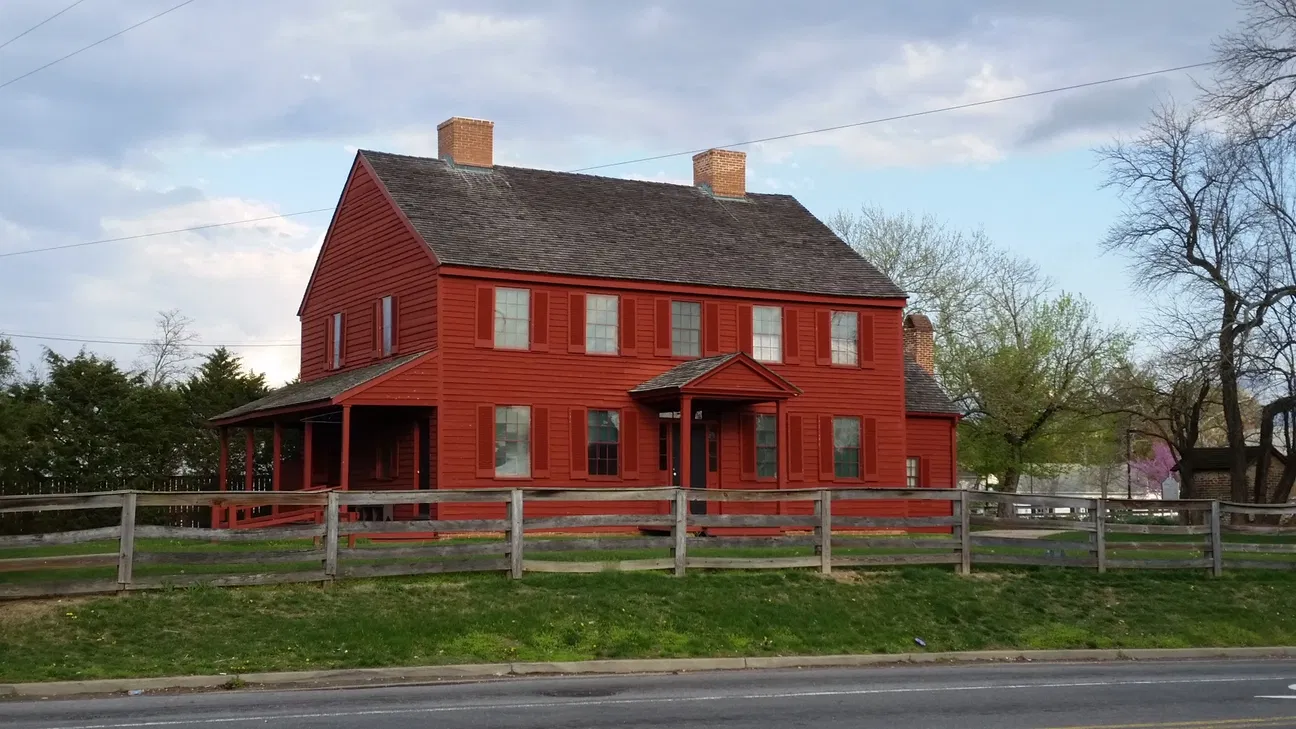
Surratt House Museum
Background & History
Historical context and known paranormal claims surrounding Surratt House Museum.
The two-story red clapboard farmhouse on Brandywine Road in what is now Clinton, Maryland sits less than fifteen miles from Ford's Theatre and looks, from the outside, like any number of modest mid-century plantation homes that once dotted Southern Maryland. It does not announce what it was. But the Surratt House is one of the few surviving physical waypoints in the most consequential crime of the nineteenth century — the assassination of Abraham Lincoln — and the story that runs through it is as tangled and tragic as anything the Civil War produced.
John and Mary Surratt built the house in 1852 on 200 acres of Prince George's County farmland, and from the beginning it served multiple purposes. It was a family home and a working plantation, but also a tavern, a public dining room, a hotel for traveling gentlemen, a post office, and a polling place. The surrounding community took the family name: the area became known officially as Surrattsville in 1853. When the Civil War began, the character of the place shifted. Southern Maryland was Confederate country in sympathy if not in official allegiance, and the Surratt tavern became a clandestine stop on the Confederate underground — a safe house for couriers and communications moving between Richmond and Washington. John Surratt Sr. died suddenly of a stroke in August 1862, leaving Mary with his debts, the farm, and three children. Facing financial collapse and unable to manage the property alone, she rented the Surrattsville tavern to a man named John Lloyd in the fall of 1864 and moved with her children to a rowhouse she owned at 541 H Street in Washington, where she ran it as a boarding house. She would never live in Surrattsville again.
It was at the H Street boarding house that the conspiracy took shape. Mary's son John Jr., already an active Confederate courier, was introduced to actor John Wilkes Booth by Dr. Samuel Mudd in December 1864. Booth's original plan was kidnapping — seize Lincoln, use him as leverage to force the resumption of prisoner exchanges with the Confederacy. The Surratt boarders became his inner circle: Lewis Powell, George Atzerodt, David Herold. As part of the plot, weapons and supplies — two Spencer carbines, ammunition, field glasses — were cached at the Surrattsville tavern ahead of time, hidden there for retrieval during the planned escape through Southern Maryland. The kidnapping scheme collapsed, and Booth turned to assassination.
On April 14, 1865, the same day he shot Lincoln at Ford's Theatre, Mary made one of her regular trips to Surrattsville — ostensibly to collect a debt from a neighbor. Her tenant John Lloyd would later testify that she told him to have the shooting irons ready. She delivered a package from Booth, later found to contain binoculars. Hours after Lincoln was shot, Booth and conspirator David Herold arrived at the Surratt tavern in the early morning hours. Booth had broken his leg leaping from the presidential box. He needed whiskey for the pain and the weapons that were waiting. The stop lasted only minutes. Twelve days later, Booth was dead in a Virginia barn. Mary Surratt was arrested, tried by a military tribunal, and convicted of conspiracy. On July 7, 1865, she was hanged at the Old Arsenal Penitentiary in Washington — the first woman executed by the United States federal government. Her guilt, and specifically the depth of her knowledge of Booth's plans, has been argued by historians ever since.
The house was confiscated by the federal government after her conviction. Between 1868 and 1965, five separate families owned and lived in the former Surratt tavern, making ordinary modifications that gradually obscured its original character. In 1965 the property was donated to the Maryland-National Capital Park and Planning Commission, listed on the National Register of Historic Places in 1973, and restored to its 1865 appearance before opening as the first public historic house museum in Prince George's County on May 1, 1976. The Surratt Society, formed in 1975 by citizens interested in Mary's case — many of whom lean toward her exoneration — now supports the museum with more than 1,500 members worldwide.
The paranormal claims attached to the house are modest but consistent, and notably some of the most credible come from the museum's own staff. The longtime director of the museum, Laurie Verge, described the experience plainly in multiple accounts: though she never saw anything, she repeatedly felt the sensation of a man stepping out of one of the upstairs bedrooms and looking directly at her, enough to raise the hair on the back of her neck. On one occasion, she and five or six employees sitting in her office — which was then located inside the house — all stopped mid-conversation and listened together as footsteps crossed the first floor below them, sounding exactly as though someone had walked in the front door, down the hall, and out the back. When they checked, no one was there. Verge noted that the paranormal attention directed at the house grew significantly after ghost investigator Hans Holzer visited in the 1950s with a spiritual medium — she was skeptical of his conclusions but could not explain what she had personally heard. She theorized, if any spirit was present, it was more likely John Lloyd — the tenant whose testimony condemned Mary — than Mary herself.
Visitors have reported the figure of a bearded man seated in a rocking chair, visible only in a mirror's reflection. Others describe male apparitions on the back staircase, muffled voices of men, and the apparition of a woman believed to be Mary near the main staircase or on the porch. The museum declines paranormal investigation requests — staff receive them at roughly the rate of once a month — out of a deliberate choice to keep the documented history at the center rather than the ghost stories.
The house still holds original furnishings, including Mary Surratt's own writing desk. The tavern room is intact. The staircase is there. Whether or not anything remains in residence, the weight of what happened inside is present in every room.
museum
Clinton, Maryland
Prince George's County
February 26, 2026
Open
People Also Searched For
Have you visited Surratt House Museum?
Share your paranormal experience and help other investigators decide if it's worth exploring.
Activity Breakdown
Types of documented activity recorded at Surratt House Museum, organized by category.
Visual Activity
Audio Activity
Reported Areas
Specific areas within Surratt House Museum where activity has been documented.
No specific areas of activity have been reported for Surratt House Museum yet.
Known Entities
Entities, spirits, and figures that have been identified or reported at Surratt House Museum.
Photos
Images sourced from across the web and linked directly to the original host. Ghouler does not download or host these images, nor do we claim them as our own.
Investigator Reviews
Your trust is our priority, so no location can pay to alter or remove their reviews.
No reviews yet.
Be the first to share your experience at Surratt House Museum.
Loading reviews...
Documented Experiences
Paranormal reports and documented occurrences compiled for Surratt House Museum from archived sources and community investigators.
No documented experiences for Surratt House Museum yet.
Best Times to Visit
Equipment & Methods
Equipment and investigation methods reported by community investigators at Surratt House Museum.
Know Before You Go
Important details to help plan your visit or investigation of Surratt House Museum.
Unknown
Open
Not specified
Sources & References
Referenced materials and documentation supporting the Surratt House Museum case file.
Experience Glossary
Detailed descriptions of each type of activity documented at Surratt House Museum.
Disembodied Voices
Definition
Audible speech heard without a visible speaker present.
What People Report
Witnesses report whispers, direct responses, conversations, or voices calling their name in otherwise quiet environments. These events may occur during investigations or spontaneously in residential settings.
Full-Body Apparitions
Definition
A complete human-shaped figure reportedly seen in physical space.
What People Report
Witnesses often describe defined features such as clothing, posture, or movement patterns. These manifestations may appear solid or semi-transparent before disappearing abruptly.
Shadow Figures
Definition
A dark, human-shaped silhouette seen in peripheral vision or dim lighting.
What People Report
Typically described as featureless and quickly vanishing when directly observed, shadow figures are among the most commonly reported visual phenomena.
Unexplained Footsteps / Knockings
Definition
Clear sounds of footsteps, pacing, or knocking without a visible source.
What People Report
Often reported in empty upper floors, hallways, or sealed rooms, these sounds may follow distinct rhythms or patterns.
Important Notices
Information in this case file is compiled from public sources and community reports. Accuracy cannot be guaranteed. Always verify details before visiting, and check with property owners and local or state authorities to confirm access is permitted.