
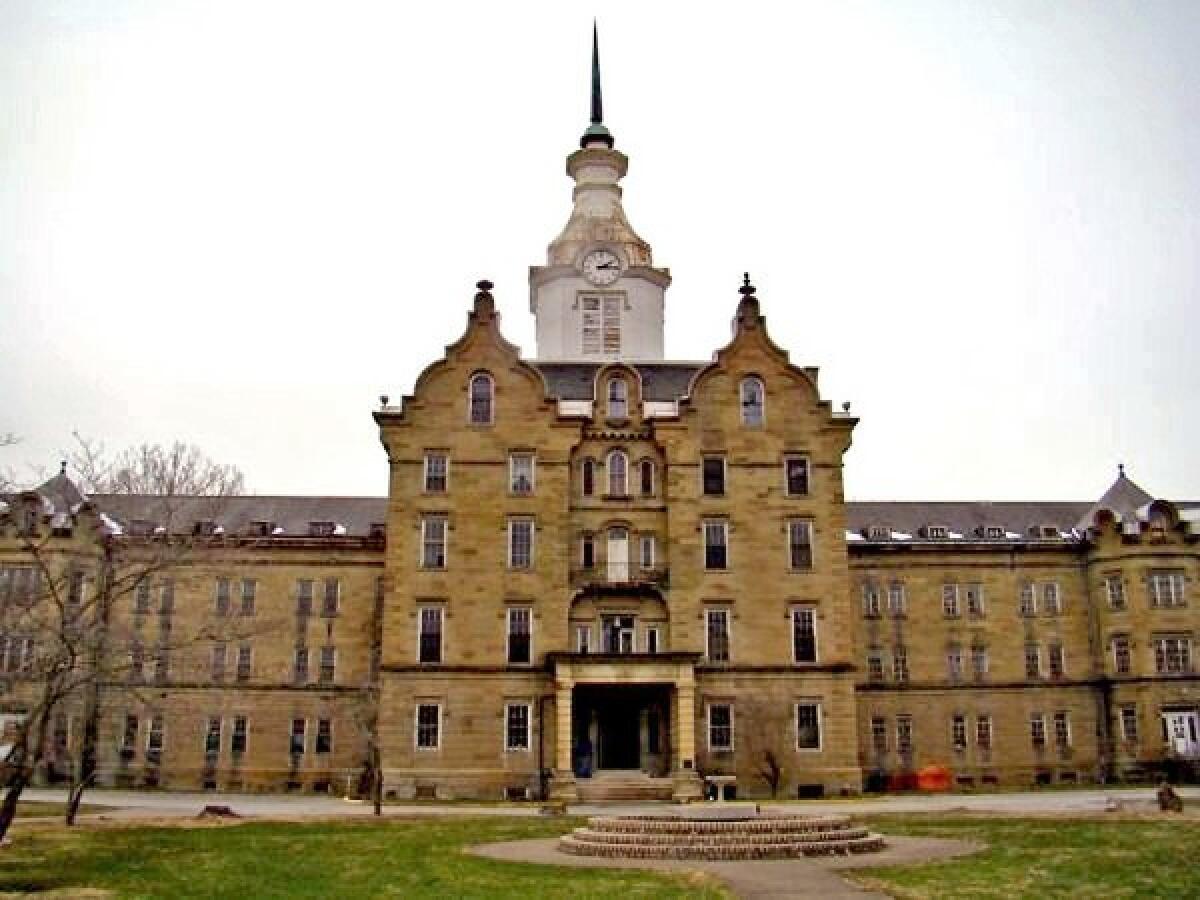
Trans-Allegheny Lunatic Asylum
Background & History
Historical context and known paranormal claims surrounding Trans-Allegheny Lunatic Asylum.
Stretching nearly 1,300 feet across a hillside above the West Fork River in Weston, West Virginia, the Trans-Allegheny Lunatic Asylum is a building that defies casual description. Its staggered Gothic and Tudor Revival wings fan outward from a 200-foot central clock tower in a formation so massive it reads more like a fortified compound than a hospital. The walls are two and a half feet of hand-cut sandstone. There are over 900 windows and 900 doors across four floors and 242,000 square feet of interior space. It is reportedly the largest hand-cut stone masonry building in North America, second in the world only to the Kremlin. And for 130 years, it held some of the most vulnerable people in Appalachia behind those walls — first with the intention of healing them, and eventually with little intention at all.
The Virginia General Assembly authorized the asylum in the early 1850s, part of a national wave of mental health reform driven by activist Dorothea Dix. The building was designed by Baltimore architect Richard Snowden Andrews following the Kirkbride Plan, a progressive model that emphasized fresh air, natural light, and the therapeutic power of environment. Each wing was staggered so that every room received sunlight and cross-ventilation. The capacity was set at 250 patients, reflecting the belief that a superintendent could only manage so many individuals while maintaining quality of care. Construction began in 1858, but the Civil War intervened almost immediately. The partially built structure was seized by Union forces and converted into Camp Tyler, and control of the site changed hands multiple times during the conflict. Confederate raids in 1862 and 1863 disrupted operations, and a final raid in 1864 stripped the building of food and clothing intended for its first patients. Despite all of this, the asylum opened that same year under the name West Virginia Hospital for the Insane.
In its early decades, the facility functioned roughly as intended. Patients worked on a self-sustaining farm spread across more than 600 acres, learned trades like sewing and furniture-making, and lived in conditions that — by the standards of the era — represented genuine progress. But the population grew relentlessly. By 1880, the asylum held over 700 patients. By the 1930s, nearly 1,700. At its peak in the 1950s, more than 2,400 people were crammed into a building designed for a tenth of that number. The reasons for admission had long since expanded beyond what any modern definition of mental illness would recognize — patients were committed for conditions including epilepsy, alcoholism, domestic troubles, and even laziness. The overcrowding brought conditions that were nothing short of catastrophic. A series of investigative reports by the Charleston Gazette documented the deterioration in vivid terms, describing wards without adequate furniture, heating, or sanitation. Patients slept on floors. Some were locked in cages. Isolation cells still bear the rusted iron rings once used to restrain the most violent.
The asylum also became a site for Walter Freeman's lobotomy project in the early 1950s, an effort by the state to reduce patient populations through surgical intervention. Thousands of procedures were performed using Freeman's transorbital method. The results were often devastating — patients left without affect or personality, their neural connections severed by a tool inserted through the eye socket. Combined with insulin shock therapy and electroconvulsive treatment, the facility's medical legacy is one of experimentation carried out on a population with no ability to refuse. A patient named Dean was murdered by two fellow inmates in a back room at the end of a wing, past the solitary confinement cells, where staff had no awareness of what was happening. The building's sheer scale made oversight impossible.
The asylum finally closed in 1994 after decades of decline. The property sat abandoned until 2007, when Joe Jordan purchased the 242,000-square-foot main building at auction for $1.5 million. It reopened in 2008 as a historical and paranormal tourism destination, and it has since appeared on Ghost Hunters, Ghost Adventures, Paranormal Lockdown, and numerous other programs.
Paranormal claims at Trans-Allegheny are extensive and tied closely to specific individuals whose stories are part of the building's documented history. The most widely reported spirit is Lily, a child believed to have been born inside the asylum to a patient and to have died of pneumonia at age nine, never having lived outside its walls. Her room in Ward Four on the first floor has been converted into a small shrine filled with toys and gifts left by visitors. Staff and guests report hearing a child's laughter, feeling small hands tug at clothing, and watching balls roll across the floor without visible cause. On the same floor, a spirit known as Ruth — described in life as a female patient with an intense hostility toward men — is said to throw objects at male visitors near her former holding cell. The third floor produces reports associated with a patient called Big Jim and a nurse named Elizabeth. The fourth floor generates accounts of a spectral Civil War soldier named Jacob. In the back rooms of one wing, investigators describe a dual energy in the space where Dean was killed — a childlike gentleness when encountered alone, and an oppressive coldness when the presence of his killers seems to enter the space alongside him. A figure known as Slewfoot, a patient who was slashed to death in a bathroom, is reported throughout the building.
Beyond the named spirits, the asylum generates the kind of broad, ambient reports common to buildings of this scale and history — disembodied voices, shadows moving through empty corridors, cold spots, unexplained sounds of breaking glass, and the sensation of being watched or physically touched. The underground tunnel system used by staff to move unseen between buildings has its own claims, including the smell of baked goods attributed to a former chef.
Skeptics have no shortage of material to work with. A building this old, this enormous, and this deteriorated will produce sounds, temperature shifts, and visual anomalies entirely on its own. The cultural expectation visitors carry into any asylum-turned-attraction shapes perception before a single door opens. But the consistency of reports across decades — from staff, casual tourists, television crews, and seasoned investigators — and the specificity with which encounters map onto documented residents and events, makes the Trans-Allegheny file difficult to set aside entirely.
Today the asylum operates year-round, offering historical day tours, nighttime paranormal tours, and overnight ghost hunts that run from 9 p.m. to 5 a.m. The first-floor museum preserves patient artwork, medical equipment, restraints, and a restored ward. The remaining twenty-three wards are largely untouched — endless decayed hallways, vacant rooms, and isolation cells open to anyone willing to walk them. The clock tower still rises above Weston. The wings still stretch outward. And the building, for all its emptiness, does not feel empty at all.
asylum
Weston, West Virginia
Lewis County County
March 10, 2026
Closed
People Also Searched For
Have you visited Trans-Allegheny Lunatic Asylum?
Share your paranormal experience and help other investigators decide if it's worth exploring.
Activity Breakdown
Types of documented activity recorded at Trans-Allegheny Lunatic Asylum, organized by category.
Visual Activity
Audio Activity
Behavioral & Interactive
Reported Areas
Specific areas within Trans-Allegheny Lunatic Asylum where activity has been documented.
No specific areas of activity have been reported for Trans-Allegheny Lunatic Asylum yet.
Known Entities
Entities, spirits, and figures that have been identified or reported at Trans-Allegheny Lunatic Asylum.
Photos
Images sourced from across the web and linked directly to the original host. Ghouler does not download or host these images, nor do we claim them as our own.
Investigator Reviews
Your trust is our priority, so no location can pay to alter or remove their reviews.
No reviews yet.
Be the first to share your experience at Trans-Allegheny Lunatic Asylum.
Loading reviews...
Documented Experiences
Paranormal reports and documented occurrences compiled for Trans-Allegheny Lunatic Asylum from archived sources and community investigators.
No documented experiences for Trans-Allegheny Lunatic Asylum yet.
Best Times to Visit
Equipment & Methods
Equipment and investigation methods reported by community investigators at Trans-Allegheny Lunatic Asylum.
Know Before You Go
Important details to help plan your visit or investigation of Trans-Allegheny Lunatic Asylum.
Private Property
Closed
Not specified
Sources & References
Referenced materials and documentation supporting the Trans-Allegheny Lunatic Asylum case file.
Experience Glossary
Detailed descriptions of each type of activity documented at Trans-Allegheny Lunatic Asylum.
Disembodied Voices
Definition
Audible speech heard without a visible speaker present.
What People Report
Witnesses report whispers, direct responses, conversations, or voices calling their name in otherwise quiet environments. These events may occur during investigations or spontaneously in residential settings.
Full-Body Apparitions
Definition
A complete human-shaped figure reportedly seen in physical space.
What People Report
Witnesses often describe defined features such as clothing, posture, or movement patterns. These manifestations may appear solid or semi-transparent before disappearing abruptly.
Unexplained Sounds
Definition
Unidentifiable noises such as bangs, growls, music, or movement occurring without environmental explanation.
What People Report
These sounds may be isolated or recurring and are frequently reported during periods of heightened activity.
Senses of Presence
Definition
A strong sensation that someone unseen is nearby.
What People Report
Often accompanied by chills, heightened alertness, or the instinct to turn around, this experience is frequently reported prior to visual or auditory phenomena.
Important Notices
Information in this case file is compiled from public sources and community reports. Accuracy cannot be guaranteed. Always verify details before visiting, and check with property owners and local or state authorities to confirm access is permitted.
This location is on private property. Do not enter without explicit permission from the property owner.