
Haunted Places in New York
327 haunted locations
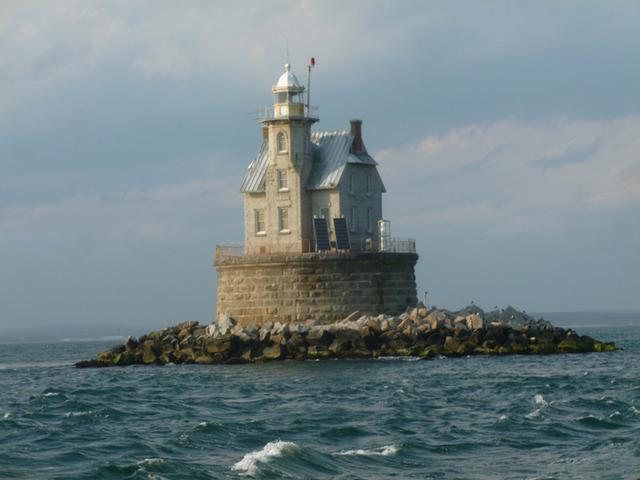
Race Rock Lighthouse
There is a point in the eastern reaches of Long Island Sound where three bodies of water — the Sound itself, Block Island Sound, and Fishers Island Sound — converge in a narrow channel four miles wide and choked with opposing tidal forces. Mariners have called it The Race for centuries, a name that captures the speed and turbulence of currents that can push six knots and reverse direction entirely with the tide. At the center of this convergence sits Race Rock, a submerged ledge rising only three feet above mean low water, decorated with shipwreck after shipwreck and surrounded by water that behaves like a living thing with bad intentions. The lighthouse that stands on that reef — granite, square at the base, octagonal at the top, its fourth-order Fresnel beam visible fourteen miles at sea — is one of the most consequential feats of American marine engineering, and one of the most persistently reported haunted sites along the Eastern Seaboard. By 1837, eight vessels had been lost on Race Rock Reef in eight years. Congress appropriated funds for a lighthouse as early as 1838, but the money was never spent, the engineering problem seemingly unsolvable. Buoys couldn't hold in the current. Iron spindles driven eighteen inches into the reef disappeared with the spring ice. The Lighthouse Board reported in 1852 that every conventional approach had been tried and failed. The danger was well-documented; the solution was not. It would take another two decades and a total of $278,716 — and nearly eight years of continuous effort — before the light was finally activated on January 1, 1879. The man who solved it was Francis Hopkinson Smith, a structural engineer contracted in 1871 who was also, improbably, a painter and novelist — a descendant of Francis Hopkinson, signer of the Declaration of Independence, and later famous for fiction drawn from his own experiences on this reef. Smith had previously built the Block Island breakwater and a seawall on Staten Island; he would later build the foundation for the Statue of Liberty. Race Rock would be his most demanding project. He and his crew — led by master diver Captain Thomas A. Scott — lived on the construction site during working months, erecting a shanty on the partial foundation while the water moved around them. When the initial riprap foundation of 10,000 tons of granite began to shift, Smith donned diving gear himself and went down to examine it. He came up certain the design had to change. The Lighthouse Board resisted; he convinced them. The concrete foundation — a stepped, concentric platform sixty-nine feet in diameter — was poured beginning in 1873. The pier rose from it in fourteen courses of heavy masonry, and the lighthouse itself went up in a single working season in 1878. The construction was not without its casualties. A boat carrying two hundred pounds of gunpowder exploded at the site, killing workers. The isolated conditions, the violence of the water, and the years of unrelenting labor extracted their price in lives and in men's minds. Smith later transformed those experiences into the novel Caleb West, Master Diver, thinly disguising Race Rock as its setting. The story had already written itself. Thomas A. Carroll was appointed keeper in 1880. He rowed regularly from Race Rock to Noank for supplies and to visit his family on shore. In January 1885, a severe storm caught him on the mainland and kept him there for several days. When he finally decided he could no longer neglect his post, he pushed his small boat out into the waves alone. He was never seen again. His body was never recovered. Coast Guard crews who later worked maintenance shifts at the lighthouse reported hearing whispers, laughter, and unexplained footsteps moving through the structure. Some reported physical contact — being touched, poked, or pushed — by no visible source. Wet footprints were found leading from the former shower area after the water supply had been disconnected and the fixture removed. Boaters passing at night have reported a shadowy figure visible in the lantern tower when no one is assigned there, illuminated briefly by the rotating beam. Whether the figure belongs to Carroll or to one of the earlier dead — workers from the construction, sailors from the reef's long list of wrecks — has never been resolved. The lighthouse was automated in 1978, ending any permanent human presence on the rock. In 2004, reportedly at the request of Coast Guard maintenance personnel who continued to report unsettling experiences during equipment checks, The Atlantic Paranormal Society conducted a formal overnight investigation, documented in the fourth episode of the first season of Ghost Hunters on Syfy. The investigation was conducted without electricity or facilities, in harsh weather and rough water. The team reported a chair moving across a room without assistance and an electromagnetic field that tracked consistently up and down the spiral staircase. At the conclusion of the twelve-hour session, investigators stated that Race Rock appeared to be genuinely haunted — an outcome the Coast Guard had hoped to disprove. Skeptics point to the obvious: Race Rock is exactly the kind of place where the imagination does what it is built to do. Isolated, unlit, accessible only by boat and only in favorable conditions, surrounded by the sound of water that has killed for centuries, the lighthouse sits in the kind of environment that produces reports almost automatically. The spiral staircase creates drafts; the granite structure amplifies sound; the current generates low-frequency vibration detectable in the bones but not in conscious hearing. All of that is probably true. It doesn't account for the consistency of the reports across unrelated witnesses over more than eighty years, or for the specificity of a keeper last seen rowing into a January storm, still attributed by those who work the light as not entirely gone. Race Rock Lighthouse was added to the National Register of Historic Places in 2005 and transferred to the New London Maritime Society in 2013 under the National Historic Lighthouse Preservation Act. The light remains operational, maintained by the Society and the Coast Guard jointly. Tours are offered occasionally in summer through New London's Custom House Maritime Museum, weather and tidal conditions permitting — the latter qualifier a reminder that the water around Race Rock still sets the terms of everything that happens there.

Sanger Mansion – Sangerfield House
Rising from the crest of West Hill between the villages of Waterville and Oriskany Falls, the Sanger Mansion commands the kind of view that was never accidental. The main entrance overlooks Waterville to the east. The terrace faces Madison to the south. The stone walls, quarried from Oxford, give the structure the appearance of something closer to a castle than a country home—a 52-room estate spread across 61 acres of wooded hills, pastures, and farmed fields, with grounds designed by the Olmsted firm, the same landscape architects responsible for Central Park. It is one of the grandest private residences ever built in central New York, and for more than a century it has carried a reputation that extends well beyond its architecture. The man who built it came from a family already woven into the region's history. Colonel William Cary Sanger was born in Brooklyn in 1853 and descended from Richard Sanger, who arrived in Hingham, Massachusetts, around 1636. His great-great-grandfather was a member of the Provincial Congress that convened at Cambridge in 1775. His great-uncle, Jedediah Sanger, was the first settler of the town of New Hartford and the first judge of Oneida County—the township of Sangerfield itself bears the family name. After graduating from Harvard in 1874 and earning a law degree from Columbia in 1878, Sanger built a distinguished career in law, politics, and military service. He served as a colonel in the New York State National Guard, represented Oneida County in the State Assembly from 1895 to 1897, and was appointed United States Assistant Secretary of War under Theodore Roosevelt from 1901 to 1903. He later chaired the National Guard Commission, served on the New York State Lunacy Commission, and led the American delegation to the International Red Cross Conference in Geneva. In 1892 Sanger married Mary Ethel Cleveland Dodge and moved to Sangerfield, initially building a home called "The Maples" on nearby land. By 1906, construction had begun on the mansion itself, with a contractor and thirty to forty men raising the stone walls on the hilltop. The interior held between thirty and forty rooms, including servant's quarters in the north wing. The house was filled with life-size family portraits, antique furnishings, clocks from around the world, battle weapons dating to the age of the lance, and a suit of armor. Sanger died in New York City in December 1921 after contracting pneumonia following surgery. The estate passed to his son, William Cary Sanger Jr., a writer and World War I veteran who had served in military intelligence and with the American Embassy in Paris. The mansion's trajectory after the family's stewardship is where the story begins to shift. Around 1960, the property was sold to the Stigmatine Fathers and converted into a monastery. Monks lived and worked in the building through the early 1970s, and local craftsmen were brought in for restoration—one carpenter's daughter later recalled her father enjoying lunches with the monks while working to return the house to its original condition. After the monastery closed, the property's history grows murky. It was donated to a camp organization around 1990 and later sat on the market for years. In the 1970s, the Hall family purchased the house from the Stigmatine Fathers and raised Clydesdale horses on the property—the Budweiser horses were reportedly kept in the large horse barn. The family raised four daughters there before selling to a Boston buyer who never occupied the house. After a period of abandonment, subsequent owners invested heavily in restoration. The paranormal claims at Sangerfield House center on the monastery period and its aftermath. Visitors and residents have long reported seeing the ghosts of monks wandering both the house and the surrounding grounds—robed figures moving through hallways and appearing near windows. The most frequently cited modern account comes from a caretaker who witnessed the apparition of a woman standing in a second-floor window. Several paranormal investigation teams have explored the mansion over the years, reporting EVP captures and anomalous photographs. But the most compelling testimony comes from someone who actually lived there. A member of the Hall family, who resided in the house for a decade during the 1970s and 1980s, confirmed plainly that the house is haunted—but described the presence as friendly and loving, an entity the family came to call Henry. In their telling, Henry was not something to fear but something to coexist with, a presence that inhabited the house alongside them without malice. The mansion has been a private residence since 2006, and the current owners do not welcome trespassers or unauthorized visitors. The stone walls still hold. The Olmsted-designed grounds still frame the hilltop. And whether the monks who once walked those halls left something of themselves behind, or whether Henry predates them all, remains a question the house keeps to itself.

Jefferson Market Library
Rising above the intersection of Avenue of the Americas and West 10th Street in Manhattan’s Greenwich Village, the Jefferson Market Library is one of New York City’s most recognizable historic landmarks. With its tall clock tower, red brick façade, and Gothic arches, the building stands out sharply from the surrounding streetscape. Though it now serves as a quiet branch of the New York Public Library, the structure was not originally built for books or study. Its origins lie in the justice system of nineteenth-century New York, when the site functioned as one of the city’s busiest police courts. The property began as part of the Jefferson Market, a public marketplace established in the early 1800s when Greenwich Village was still developing on the northern edge of the city. As the neighborhood expanded, the market complex grew to include civic buildings, including a courthouse and jail. By the 1870s city officials determined a larger and more permanent courthouse was needed. The current structure was completed in 1877 and designed by architects Frederick Clarke Withers and Calvert Vaux in the Victorian Gothic style. Its ornate stonework, pointed arches, and soaring clock tower gave the courthouse a dramatic appearance that made it an immediate landmark in the neighborhood. Inside the building operated the Jefferson Market Police Court, which handled a constant stream of cases from the surrounding districts. During the late nineteenth and early twentieth centuries the court became one of the busiest in New York. The building processed everything from minor disturbances to more serious crimes, reflecting the dense and diverse population of Greenwich Village during that period. One of the courthouse’s most widely remembered moments occurred in 1906 when Harry Kendall Thaw, the man who shot and killed architect Stanford White in a crime that shocked New York society, was arraigned in the building shortly after the incident. Behind the courthouse stood the Women’s House of Detention, a jail where female prisoners were held while awaiting trial or serving short sentences. Conditions in the detention facility were frequently criticized, and the complex became associated with the harsher realities of the city’s criminal justice system. The courthouse itself continued operating until 1945, when changes to the court system led to its closure. For years afterward the building stood largely unused and faced the possibility of demolition. Local preservationists in Greenwich Village organized a campaign to save the structure, arguing that it was one of the city’s finest surviving examples of Victorian Gothic architecture. Their efforts succeeded, and the city eventually approved a plan to convert the former courthouse into a public library. After extensive renovation, the building reopened in 1967 as the Jefferson Market Library, transforming a place once tied to arrests and trials into a community space devoted to learning. Despite its peaceful modern role, the building has developed a reputation for unexplained activity. Stories connected to the courthouse’s past have circulated for decades among library staff, visitors, and local historians. Reports often describe footsteps echoing on staircases or in upper levels after the building has closed for the night. Some employees have reported hearing doors move or sensing someone nearby in otherwise empty areas of the building. One of the most frequently repeated legends centers on the spirit of a former prisoner believed by some to remain connected to the site. According to local lore, a young woman who had been held in the nearby detention facility died under tragic circumstances, and her presence is sometimes said to linger around the upper portions of the building, particularly near the tower and stairways. Visitors have occasionally reported hearing soft crying or glimpsing a faint figure moving along the corridors. Paranormal investigators who have visited the site sometimes focus on the clock tower and upper floors, where reports of strange sounds and shadowy figures are most often described. Skeptics suggest that the building’s age, complex architecture, and acoustics may easily produce unusual noises and shifting shadows that can be mistaken for something supernatural. Today the Jefferson Market Library remains an active and beloved part of Greenwich Village. Sunlight fills its reading rooms, and visitors gather among the shelves where courtrooms once stood. Yet the building’s long history—stretching from marketplace to courthouse, jail complex, and finally library—continues to shape its identity. The echoes of the lives and events tied to its earlier years help explain why the tower that once watched over trials and prisoners has also become the center of enduring ghost stories within the neighborhood.
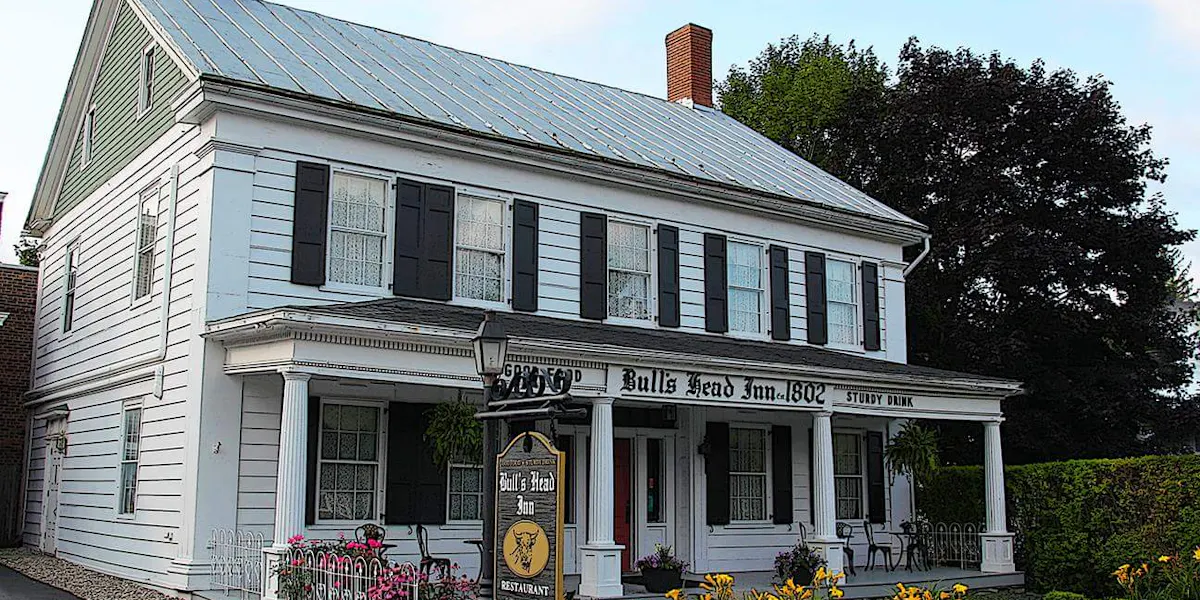
Bull’s Head Inn
Standing at the corner of Park Place in the heart of Cobleskill, New York, the Bull's Head Inn is the oldest building in the village — a Federal-style structure built in 1802 that has served, across more than two centuries, as tavern, town hall, Masonic temple, courthouse, meeting hall, private residence, and restaurant. It carries that layered institutional history the way old buildings do in small upstate New York towns — quietly, in the woodwork, in the reoriented staircase, in the central fireplace that has warmed a rotating cast of merchants, soldiers, politicians, and neighbors across generations. A portrait of Thomas Jefferson hangs in the foyer, a reminder that he was President when the building was new. But the site itself is older than the building by half a century. George Ferster constructed one of the first structures in Cobleskill here in 1752, and what followed was a sequence of catastrophes that left a mark the land has apparently not forgotten. On May 30, 1778, during the Battle of Cobleskill, Mohawk forces under the command of Joseph Brant — fighting alongside Tories and British — burned the settlement nearly to the ground. Retreating patriots were killed, and the structure on this site was destroyed. The two buildings that followed met the same fate, each burned in subsequent enemy raids on Cobleskill in the spring and fall of 1781. Local tradition holds that occupants perished in one or more of these fires — including, in one account, a young girl in an upstairs bedroom who froze in terror and could not escape the blaze. Another story maintains that a Native American was killed inside the building during one of the conflicts. Three buildings destroyed on the same ground, within a single generation, each one carrying its dead. The current structure was built in 1802 by Seth Wakeman — the same builder responsible for the Beekman Mansion in Sharon Springs — and established as an inn and tavern to serve merchant traffic along the newly charted Loonenburg Turnpike, which ran commerce between Central New York and New York City. The inn thrived until the Erie Canal redirected that traffic north through Albany, bypassing Cobleskill and draining the commercial foot traffic that had kept it busy. By 1839, the building had transitioned into a private residence, and it remained one for well over a century. In 1810, when Cobleskill's Main Street was developed, the building was physically reoriented — its staircase repositioned, its front entrance redesigned to face the new brick-lined street. The building adapted, as it always had. The architecture reflects its early Federal character — three floors, a central staircase, original wide-plank floors, and stone cellar walls that the current owners exposed and incorporated into the lower tavern space using reclaimed brick from Cobleskill's own Main Street. The building is divided across three distinct atmospheres: a ground floor dining room anchored by a classic brick fireplace, an upper floor with vintage glass windows suited for private gatherings, and a lower tavern built from the bones of the old cellar. It is a building that wears its age honestly, without staging. The last private residents of the Bull's Head were John and Grace Steacy, whose opposing natures apparently outlasted them both. John drank; Grace was a dedicated member of the Women's Christian Temperance Union. When the building was sold after their deaths and former Cobleskill mayor Monte Allen reopened it as a restaurant and bar in 1966, he placed the bar in the room that had served as Grace Steacy's bedroom. What followed, according to staff, guests, and ownership across multiple decades, has been consistent and specific. A woman in a white gown — long-sleeved, floor-length — has been seen moving around the central staircase, along the upper and lower landings, and through the first-floor dining room by guests and staff working late. Silverware and napkins have been knocked to the floor or sent across the room. Plates and utensils have been disrupted mid-service. Doors slam on their own. Faucets turn themselves on. The current ownership reports these occurrences as ongoing. The paranormal activity at the Bull's Head is notable for its consistency across unrelated witnesses spanning more than fifty years of restaurant operation. The apparition of the woman in white has been described in nearly identical terms by guests who had no prior knowledge of the building's story. Paranormal investigators have conducted formal sessions at the property, and the inn is an established stop on New York State's official Haunted History Trail. The figure most commonly associated with the activity is Grace Steacy — a teetotaler whose bedroom became a bar — though older stories from local family tradition point toward the Revolutionary-era fires and the girl reportedly trapped in the upstairs room as an earlier and perhaps deeper source. Skeptics will note that a two-hundred-year-old building with three destroyed predecessors on the same site is exactly the kind of place where stories accumulate and feed on each other. The convergence of documented historical violence, a colorful final resident with a grudge against alcohol, and decades of reported encounters makes the Bull's Head something of a perfect storm for haunted reputation. None of that makes the firsthand accounts less consistent or less specific. The woman in white keeps appearing near the staircase. The silverware keeps moving. And the bar, to Grace Steacy's apparent displeasure, remains open.

Wellscroft Lodge
Perched on the wooded slope of Ebenezer Mountain in Upper Jay, New York, Wellscroft Lodge is exactly the kind of building that stops you cold — a sprawling Tudor Revival mansion with steeply pitched gables, native fieldstone on its lower exterior, a porte cochere, projecting bays, and a roofline that breaks against the Adirondack treeline in a dozen different directions. It was built not as a hunting camp or rustic retreat, but as a statement of private wealth in one of the most scenic corners of the Northeast. The estate was constructed in 1903 at a reported cost of $500,000 — an extraordinary sum for the era — as a summer home for Jean Wells Smith and her husband Wallis Craig Smith, a Michigan attorney and businessman with interests in iron, hardware, and law. Jean was the daughter of Charles W. Wells, a prominent Saginaw industrialist whose accidental death in 1893 — his canoe capsized while he was shooting game, and he died of heart failure in the cold water before help could reach him — had stunned the Saginaw community and generated public mourning on a citywide scale. The name Wellscroft honored her family. At the time of its completion, it was among the largest private country estates in Essex County. The compound included not only the main house but a powerhouse, firehouse, gazebo, root cellar, reservoir, carriage house, and caretaker's cottage. The interior was finished in Arts and Crafts style, with careful detailing throughout its 22 rooms. The Smiths held the property for several decades before selling in 1942. What followed was a long and uneven second life — periods as a public lodge, stretches of private ownership, and at least two extended periods of abandonment interrupted by attempts at restoration. The building was listed on the National Register of Historic Places in 2004. The paranormal history of Wellscroft is dominated by a single persistent figure: a woman in a red dress. She has been reported appearing on the main staircase, standing in the front windows visible from outside, and moving through the upper floors when the building's power was completely off. Multiple unrelated witnesses, spanning different decades, describe the same apparition in strikingly consistent terms. A former resident who lived in the caretaker's house in the mid-1980s reported seeing the Lady in Red approximately ten times over four years. His family's two beagles refused to enter a specific room off the main lobby — hair raised, growling — and would not be coaxed past the threshold under any circumstances. That same witness described a Ouija board session in which the planchette allegedly launched itself off the table with no hands on it, sending the group of children involved scrambling out of the building. Phantom music has been reported inside the lodge, along with disembodied voices with no visible source. A former lodge manager's son described the death of his father in the second-floor master suite on January 6, 1965 — a deeply personal account that underscores the real human grief woven through the building's history, separate from any paranormal claim. The identity of the Lady in Red has never been confirmed. Whether she belongs to the original family, a later period of use, or to the imagination of a building that simply looks the part is unknown. Wellscroft has been the subject of a 2024 documentary podcast episode titled Seeing Red: The Hauntings of Wellscroft Lodge. It is private property. The mountain keeps its secrets.
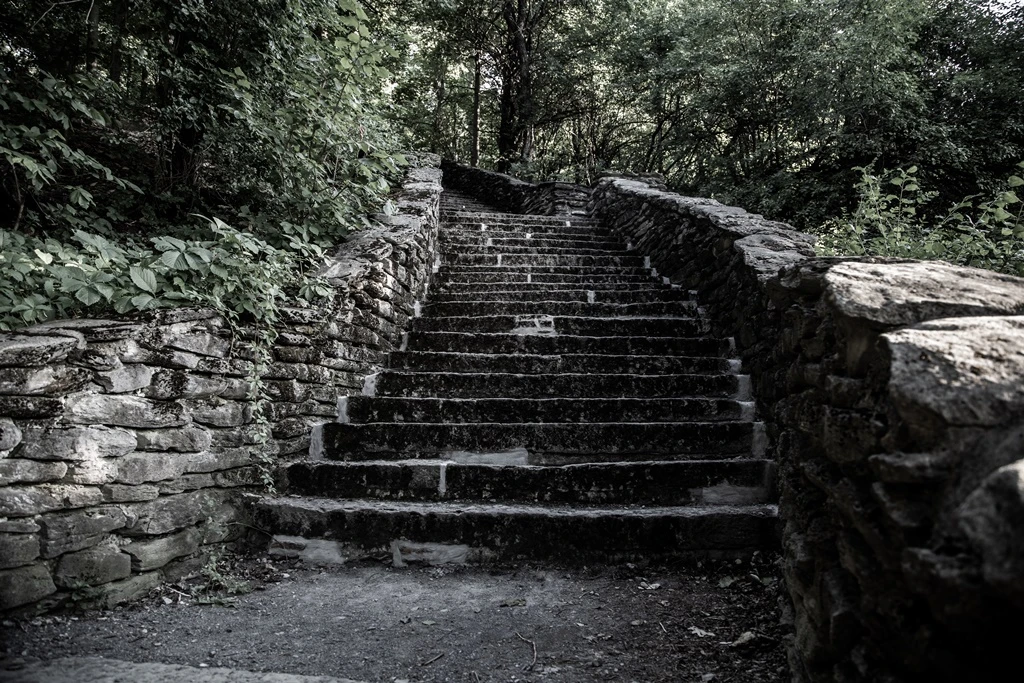
Thompson Park Vortex
Thompson Park sprawls across 355 acres of rocky, wooded hillside on the northwest edge of Watertown, New York, in Jefferson County—a landscape of rolling meadows, steep overlooks, stone pavilions, and curving roads that climb toward a summit known as the Pinnacle, from which you can see clear across the city to Lake Ontario. It is a place designed for picnics, golf, sledding, and afternoon walks. It also has a zoo. None of this sounds like the setting for one of the stranger paranormal claims in the northeastern United States. But for well over a century, people have been reporting something in Thompson Park that does not fit comfortably into any familiar category—not ghosts, not hauntings, but something closer to a glitch in the landscape itself. The park was the vision of John C. Thompson, president of the New York Air Brake Company, who in 1899 anonymously contacted the Olmsted Brothers firm about designing a public green space for Watertown. John Charles Olmsted—nephew and adopted son of Frederick Law Olmsted, the father of American landscape architecture and designer of Central Park—took the lead. He produced a general plan by 1901, and over the next two decades supervised construction on the challenging terrain, designing walls, shelters, overlooks, and stairways into the steep hillside. Thompson secretly acquired the land and donated it to the city around 1916, though his identity as benefactor remained hidden until his death in 1924, when the park was renamed in his honor. A zoo was added in 1920. A golf course followed. The park became a centerpiece of civic life in Watertown, and it has remained one ever since. The claims associated with Thompson Park are not about apparitions or disembodied voices. They are about disorientation—spatial and temporal. Since at least the early 1900s, visitors have reported sudden episodes in which they appear to lose their bearings entirely, finding themselves transported to a different part of the park with no memory of walking there. These episodes are described as brief—roughly four minutes by the clock—but subjectively feel much longer. Witnesses report mist-like visual disturbances, nausea, confusion, and odd sensory effects. Some accounts claim that people have disappeared momentarily and then reappeared, disoriented and insisting they had briefly visited another time. A few darker versions of the legend suggest that not everyone comes back. The phenomenon has been loosely dubbed a "vortex," and witnesses have noted over the years that its apparent location shifts within the park's boundaries. In 2007, a paranormal investigation team called the Shadow Chasers was invited by a local Fox News affiliate to examine the park with electromagnetic field equipment. What they found was unusual: parallel bands of EMF running through the park in a grid-like pattern, intersecting at regular intervals. They could not identify a source. Sustained exposure to elevated EMF is known to produce nausea, headaches, the sensation of being watched, and in some cases visual and auditory hallucinations—symptoms that align closely with what visitors to the park have described. The investigators offered a tentative hypothesis: the so-called vortex may not be a portal at all, but a physiological response to an unexplained electromagnetic environment. They also acknowledged they had never encountered anything like the pattern before or since. The city of Watertown has leaned into the legend rather than away from it. In 2014, during a partial lunar eclipse viewing that drew roughly 250 people to the park's eastern tree line, city officials installed a sign dubbing the site "Watertown's Area 51"—a nod to the coincidence that the CIA's actual code name for Nevada's Area 51 was "Watertown," chosen by former director Allen Dulles, who was born in the city. The vortex is now listed on the Haunted History Trail of New York State, one of fifty paranormal destinations promoted across the state by a coalition of tourism agencies. Today Thompson Park remains open and free to the public. The sign is near the zoo entrance. The vortex, wherever it is at the moment, is somewhere in the trees.
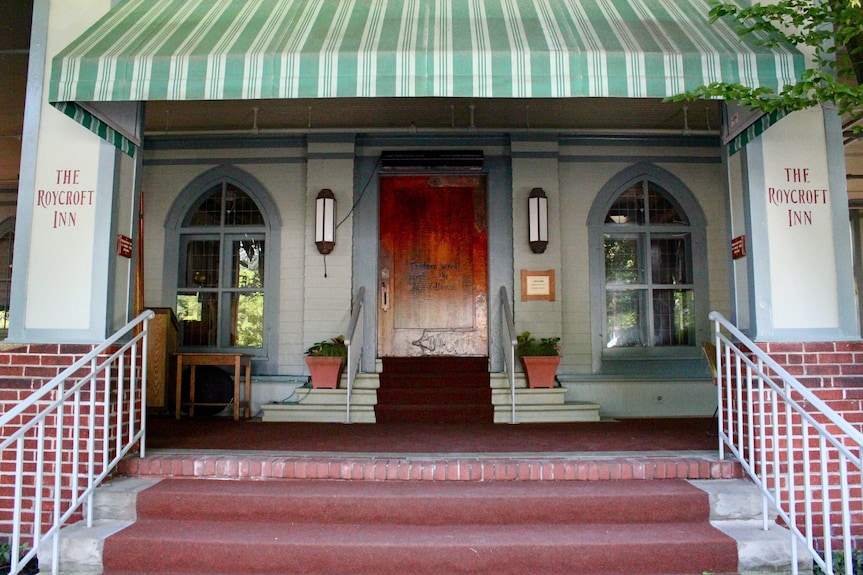
Roycroft Inn
Set along a quiet, tree-lined stretch of South Grove Street in the village of East Aurora, New York, about twenty miles southeast of Buffalo, the Roycroft Inn does not look like a place built for ghosts. It looks like a place built for ideas. The structure rises in a blend of country Gothic and Prairie Style architecture, its exterior marked by stained glass, hand-hewn woodwork, and a broad peristyle porch that opens onto a campus of historic buildings arranged like a small, purposeful village. The Inn was not conceived as a hotel in any conventional sense. It was built as the public face of one of the most ambitious artistic communities in American history—and its haunting, to the extent that it has one, is inseparable from the singular and ultimately tragic figure who created it. Elbert Hubbard was born in Bloomington, Illinois, in 1856 and spent his early career as a traveling salesman for the Larkin Soap Company in Buffalo, where his advertising genius helped build the firm into one of the largest mail-order businesses in the country. But Hubbard grew restless with corporate life. After traveling to England in the 1890s and encountering the work of William Morris and the ideals of the Arts and Crafts movement, he returned to East Aurora with an almost evangelical vision: to build a self-sustaining community of artisans dedicated to handcraftsmanship, intellectual life, and creative work. In 1895, he established the Roycroft Press, and by 1897, construction had begun on the South Grove Street campus that would grow to include a print shop, bindery, furniture shop, copper shop, and chapel. In 1899, Hubbard wrote a short inspirational essay called A Message to Garcia that became one of the most widely printed works of its era, selling an estimated forty million copies and bringing national fame to both Hubbard and East Aurora. Visitors began arriving in droves to meet the man and see the community he had built. By 1910, the campus employed over five hundred artisans producing handcrafted books, furniture, metalwork, leather goods, and stained glass. To accommodate the growing stream of visitors, Hubbard converted the former print shop and workers' quarters into an inn, which opened around 1903 and was significantly expanded and remodeled by 1905. Rooms were individually named for figures Hubbard admired—William Morris, John Ruskin, Ralph Waldo Emerson—and furnished with pieces crafted on-site. The artist Alexis Jean Fournier painted landscape murals in the salon. Dard Hunter designed electrified copper chandeliers and stained glass windows that replaced the building's original Gothic glazing with Secessionist and Glasgow School motifs. Meals were prepared from the Roycroft Farm's own produce, eggs, and grains. The Inn became a destination in its own right, part intellectual retreat, part showroom, part monument to the idea that beauty and utility could coexist. On May 1, 1915, Elbert Hubbard and his second wife, Alice Moore Hubbard—a noted suffragist and writer in her own right—boarded the RMS Lusitania in New York, bound for England where Hubbard intended to interview Kaiser Wilhelm II and begin a lecture tour. Six days later, on May 7, a German U-boat torpedoed the ship eleven miles off the coast of Ireland. A survivor later described the Hubbards emerging onto the deck after the torpedo struck, linking arms in their characteristic fashion, and standing together as the ship went down. Neither survived. Their bodies were never recovered. The loss of Hubbard devastated the Roycroft community. His son Bert took over operations and attempted to sustain the enterprise through wider retail distribution, eventually placing Roycroft furniture in Sears and Roebuck catalogs. But without the elder Hubbard's charisma and vision, the community entered a slow decline. Changing tastes and the crushing economics of the Great Depression finished what grief had started. In 1938, the Roycroft Shops closed and filed for bankruptcy. The buildings passed through various owners, and by the mid-twentieth century the campus had deteriorated significantly. The Inn continued operating in diminished form until 1987. Reports of paranormal activity at the Roycroft Inn have circulated for decades, and they center almost entirely on the figure of Elbert Hubbard himself. Guests and staff have reported seeing an apparition resembling Hubbard—recognizable by his distinctive long hair and period clothing—near the Ruskin Room, which served as his personal study. Sightings of the figure looking out of windows, walking the hallways, and descending the staircase have been described by visitors with no prior knowledge of the claims. Disembodied voices have been heard in empty rooms, and footsteps echo through corridors when no one is present. One guest staying in a room at the top of the stairs reported hearing a woman's voice say a clear and direct greeting directly in her ear while sitting alone on the front porch late at night. At least one regular visitor has claimed to hold ongoing conversations with Hubbard's spirit near the portrait that hangs behind the bar. Author and paranormal researcher Mason Winfield, who lived on the Roycroft grounds during the 1980s and has led ghost walks on the campus for years, has described the site as occupying ground with unusual energy and has explored the Roycroft community's historical links to mysticism, including connections to the Rosicrucian Society. The painter Alexis Jean Fournier, who created the Inn's murals and is buried in nearby Oakwood Cemetery, has also been identified as a possible spiritual presence on the campus, described by at least one longtime resident as a guardian figure rather than a conventional ghost. Today the Roycroft Inn operates as a fully restored National Historic Landmark, reopened in 1995 following an eight-million-dollar renovation funded in large part by the Margaret L. Wendt Foundation. The twenty-eight guest rooms are furnished with original Roycroft pieces and Stickley reproductions. The salon murals by Fournier have been meticulously restored. The campus around it—nine of the original fourteen structures still standing—hosts artist studios, galleries, shops, and a visitor center. Whether Elbert Hubbard's spirit truly returned to the place he built with such intensity and devotion, or whether the Inn simply holds the kind of atmospheric charge that a century of creative ambition and sudden loss tends to leave behind, the Roycroft remains a place where history does not feel safely past. The arms are still linked. The deck is still tilting. And somewhere in the glow of a Dard Hunter chandelier, the footsteps continue.
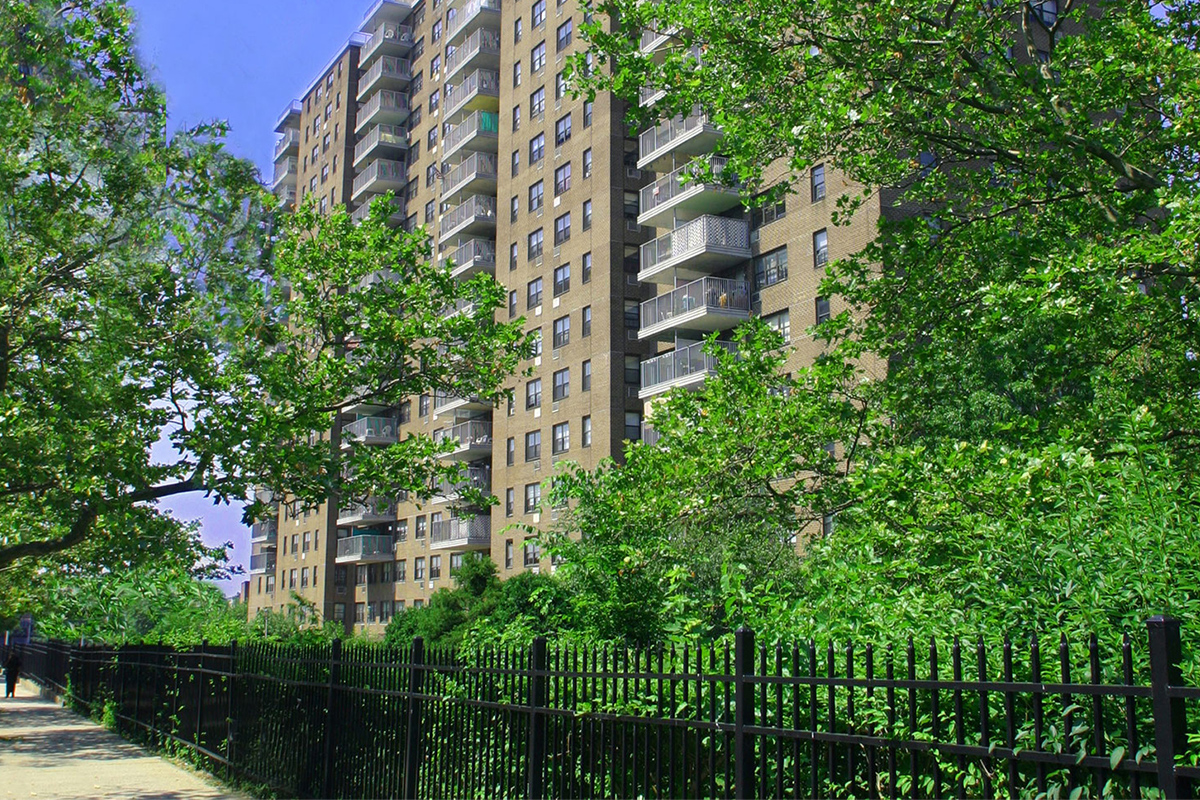
Hazel Towers
Standing eighteen stories over the Pelham Bay section of the Bronx, Hazel Towers is the kind of building that doesn't announce itself as haunted. There are no crumbling facades or Gothic embellishments—just a postwar residential high-rise at 1730 Mulford Avenue, brick and concrete, squared off against the sky like dozens of other mid-century towers that define New York City's outer borough skyline. It was built in 1968, designed by the architectural firm Pomerance & Breines, whose portfolio included hospitals and large-scale residential projects across the city. It went up during the great wave of high-rise construction that reshaped the Bronx in the 1960s, part of a broader effort to house the borough's growing working- and middle-class population in modern, elevator-serviced towers with balconies and amenities that older walkup tenements could never offer. The land beneath Hazel Towers carries a longer history than the building itself. The Pelham Bay neighborhood sits on ground originally purchased by Englishman Thomas Pell from the Siwanoy people in 1654—a vast tract that would eventually lend its name to the park, the parkway, and the surrounding streets. For centuries the area remained agricultural. It wasn't until the extension of the IRT Pelham Line in 1920 that the eastern Bronx opened to dense residential development, drawing Italian, Irish, and Jewish families outward from Manhattan. The postwar decades brought larger structures—towers like Hazel Towers—rising above a neighborhood that still retained the feel of a quiet enclave just two blocks from the 6 train. The building contains roughly 286 units with one-, two-, and three-bedroom apartments. Nelson Management Group acquired the property in 1999 and has since invested over four million dollars in upgrades including new elevators, windows, lobbies, and a security system. A tenants' association has been active since at least 1991. By all outward measures, Hazel Towers is a functioning, well-maintained residential building in one of the Bronx's more desirable neighborhoods. And yet the building appears on multiple databases of allegedly haunted locations, and the accounts from residents are remarkably consistent. Tenants across various apartments—not concentrated on any single floor—report shadow figures in hallways and rooms, particularly during late-night hours. Some describe orbs of light moving through darkened spaces. Objects reportedly fall or shift without explanation. Cold spots appear and dissipate with no apparent cause. Disembodied voices have been reported in apartments and common areas. Several residents describe an oppressive feeling of sadness or paranoia that lifts the moment they step outside, a phenomenon difficult to attribute to ordinary environmental factors. The basement and boiler room draw particular attention. At least one former resident has described seeing shadow figures near the boiler room during routine laundry trips—a detail that recurs independently in other accounts. One resident recounted a sleepover during which multiple people experienced panic attacks between three and four in the morning, accompanied by shadows, orbs, and objects falling. A follow-up Ouija board session in another apartment reportedly produced additional sightings—notable for involving multiple witnesses across two units on consecutive days. What makes Hazel Towers unusual is the absence of any known originating event. There is no documented tragedy, no publicized death, no fire or crime the narratives attach themselves to. The spirits, according to those who claim encounters, are simply present—and unwelcoming. Multiple sources describe the entities as hostile in demeanor, though no accounts describe physical harm. Most haunted locations build mythology around a specific incident. Hazel Towers offers no such anchor, which either undermines the claims or makes them harder to explain as narrative projection. Skeptics would rightly note that an eighteen-story concrete tower from the late 1960s will produce unexplained sounds—elevator machinery, water pressure shifts, air in aging ductwork. The basement of any large building is inherently atmospheric. And suggestion, once a building acquires a reputation, is powerful. But the consistency across unrelated residents over decades, and the emphasis on emotional effects rather than spectacle, gives the accounts a texture that environmental explanation doesn't fully resolve. Today Hazel Towers remains fully occupied in a neighborhood that continues to attract families. Pelham Bay Park sprawls to the north. The lobby is staffed around the clock. Nothing about the building suggests anything other than ordinary urban life. But behind certain doors, at certain hours, some residents insist the building holds something no renovation has managed to address—and something that does not seem glad to have company.

Ancestor’s Inn at the Bassett House
Standing along Sycamore Street in the village of Liverpool just north of Syracuse, the historic Bassett House has long been one of the older surviving structures connected to the early development of the community. The building at 215 Sycamore Street traces its roots to the early nineteenth century, a period when the region surrounding Onondaga Lake was transforming from scattered frontier settlements into an active corridor of commerce tied to salt production and canal travel. Liverpool in particular grew rapidly after the opening of the Erie Canal in 1825, which turned the nearby waterways and roads into important transportation routes linking central New York to markets across the state. Inns and taverns quickly followed the movement of travelers and laborers, and the Bassett House developed within this environment as a place of lodging and social activity. The structure is believed to date to the early 1800s and is commonly associated with the Bassett family, whose name became permanently attached to the property. Buildings like this served a variety of roles during the canal era. Travelers arriving by boat or carriage needed places to stay overnight, while canal workers, merchants, and farmers used taverns as informal meeting places where business was conducted and news from other towns circulated. The Bassett House functioned as both a residence and a hospitality property during different periods of its history, reflecting the changing character of Liverpool as the canal economy expanded and later declined. Throughout the nineteenth century the surrounding community remained closely tied to transportation and industry. The nearby salt works at Onondaga Lake drew workers and traders, while canal traffic brought a steady flow of strangers through the village. Buildings like the Bassett House witnessed decades of everyday life associated with this movement—meals served to passing travelers, rooms rented to overnight guests, and local residents gathering in common spaces that doubled as community hubs. Over time the property passed through multiple owners and uses, but the core structure remained intact, preserving elements of early nineteenth-century construction within a town that gradually modernized around it. In the twentieth century the building took on a new identity as Ancestor’s Inn, a restaurant and gathering place that embraced the property’s historic atmosphere. The name itself reflected the owners’ intention to connect the dining experience with the deep past of the house and the generations of people who had lived, worked, or stayed within its walls. Visitors often remarked on the building’s aged interior features—low ceilings, thick wooden beams, narrow stairways, and rooms whose shapes reflected centuries of additions and alterations. The sense of stepping into an earlier era became part of the appeal, particularly for diners interested in local history. It was during these later years that stories of unexplained activity began to circulate among staff and guests. Reports most often centered on strange sounds heard after closing, including footsteps on the staircases or movement in rooms that had already been locked for the night. Employees occasionally described objects being shifted or found out of place between shifts, while others spoke of doors opening or closing without an obvious cause in the quieter parts of the building. Some witnesses claimed to have seen shadowy figures moving through hallways or glimpsed the brief outline of a person standing in doorways before disappearing. Accounts varied, but the apparitions were often described as resembling individuals dressed in clothing from an earlier century, leading many to associate the sightings with the building’s canal-era past. Guests dining in the restaurant sometimes reported sudden cold drafts or the uneasy sensation of being watched when seated in the older dining rooms. Paranormal investigators who visited the site during the years the restaurant operated occasionally reported capturing unexplained audio responses during electronic voice recording sessions or experiencing sudden malfunctions in investigative equipment. As with many historic structures, skeptics have suggested that the building’s age and layered construction could easily produce creaking timbers, shifting floorboards, and air movement that mimic footsteps or other sounds. The powerful atmosphere created by an old house filled with local stories can also shape how ordinary events are interpreted. Despite these explanations, the Bassett House developed a modest reputation in regional ghost lore. The combination of its canal-era origins, its long service as an inn and gathering place, and the number of travelers who passed through its rooms over nearly two centuries created the sense that the building held echoes of the past. Today the property remains one of the older historic sites associated with Liverpool’s early development. Even as ownership and use have changed over the years, stories of unexplained encounters continue to circulate among locals, maintaining the quiet belief that some of the house’s earliest occupants—or perhaps former guests—may never have fully left the Bassett House behind.

House of Death
The address 14 West 10th Street in New York's historic Greenwich Village represents one of North America's most famous and extensively documented locations of concentrated paranormal activity, earning the designation "House of Death" through the accumulation of well-documented spiritual phenomena and the remarkable abundance of supernatural entities believed to inhabit its structure simultaneously, a concentration unparalleled in documented haunted locations. The building's history as a residential address in one of Manhattan's most culturally significant neighborhoods positioned it at the critical intersection of artistic creativity, intellectual ferment, political discourse, and the emotional turbulence that characterized Greenwich Village during its emergence as an artistic and cultural capital of American society during the nineteenth and twentieth centuries. The notoriety of 14 West 10th Street among paranormal researchers, ghost enthusiasts, and serious investigators stems significantly from its documented connection to the legendary American author Mark Twain, whose residence at the address and subsequent death within the building established his name permanently within its paranormal record and attracted scholarly interest from both serious literary historians and professional paranormal investigators seeking explanation of sustained phenomena. Mark Twain's ghostly presence has been documented most consistently in and around the stairwell, where multiple witnesses including skeptics and believers have reported observing a masculine apparition that precisely matches Twain's distinctive appearance and physical characteristics, moving with the characteristic gait of an elderly gentleman, traversing the stairs repeatedly as if engaged in some eternal routine or unable to release his profound attachment to the physical space. Beyond Mark Twain's well-documented presence, the building hosts an extraordinary collection of additional entities—estimates from professional paranormal investigations suggest the simultaneous presence of approximately twenty-two distinct spirits, a concentration of supernatural inhabitants unparalleled in most documented haunted locations worldwide. A woman wearing a white dress has been observed multiple times by independent witnesses, appearing as a translucent figure that manifests particularly in residential spaces and common areas throughout the building, suggesting a female resident or frequent visitor from the building's extensive and complex history whose life intersected with tragedy, violence, or profound emotional trauma. A young girl's apparition has been documented by numerous witnesses across multiple decades, often appearing playful or mischievous in demeanor and behavior, suggesting a child who died within the building and retained psychological and emotional attachment to the familiar spaces of her childhood residence. A gray cat, described by witnesses as translucent and distinctly ghostly in appearance, has been observed moving through the building's interior with characteristic feline grace and independence, suggesting the presence of a beloved pet whose emotional bond to the residence transcended biological death and maintained continued existence within the paranormal realm. Jan Bryant Bartell's documented investigation and residential experience at 14 West 10th Street produced detailed accounts of paranormal phenomena including icy cold touch sensations that appeared without corresponding environmental explanation, objects moving through space without visible agency, disembodied voices expressing intense emotion and occasionally apparent distress, and shadow figures that manifested in peripheral vision and moments of partial visibility. The concentration of distinct entities, the detailed documentation by credible investigators, the connection to famous historical figures, and the consistency of phenomena across multiple decades of witness testimony have established 14 West 10th Street as America's most thoroughly documented haunted residence and a primary site of serious paranormal investigation and ongoing research.
Goshen Historic Track
The Goshen Historic Track, located in Orange County, New York, represents the oldest continuously operated harness racing facility in the United States, a distinction it has maintained since its founding in 1838. The facility stands as a living archive of equestrian sporting history, its dirt racing surface having been traversed by countless horses and drivers over more than one hundred and eighty years of continuous operation. The track's infrastructure reflects both its long heritage and ongoing preservation, with original grandstand architecture preserved alongside modern facilities intended to serve contemporary racing enthusiasts. The landscape surrounding the track includes lake shores and wooded areas that have witnessed not only the triumphs and defeats of competitive racing but also at least one tragedy of magnitude sufficient to establish paranormal consequences that persist to the present day. The site's significance extends beyond its role as a sporting venue, representing instead a location where human and equine suffering has become embedded in the physical and metaphysical landscape, manifesting in repeated paranormal encounters that have drawn organized paranormal investigation groups and casual witnesses alike to document its unexplained phenomena. The specific tragedy underlying much of Goshen Track's paranormal reputation involves the simultaneous drowning of both a jockey and his horse in the nearby lake, an event that remains somewhat obscured in historical records but intensely vivid in the experiential reports of those who have encountered its supernatural aftermath. The circumstances surrounding the drowning remain unclear, whether resulting from accident, deliberate act, or some combination of factors that will never be fully ascertained. What remains clear is that the deaths of both the horse and rider, linked so intimately through their professional relationship and their final tragic moment, created a paranormal signature that has persisted across generations. The bond between horse and jockey, forged through hours of training and the intense cooperation required to navigate competitive racing, apparently transcended death itself, manifesting in spectral phenomena that preserve the essential character of both the human and animal participants in the fatal incident. Witnesses describe encountering these apparitions not as isolated ghostly glimpses but as complete supernatural events, with both the spectral rider and the phantom horse appearing together as integrated manifestations. Paranormal encounters at Goshen Historic Track typically follow recognizable patterns reported with consistency by multiple independent witnesses. Visitors and staff members report sightings of a ghostly horseman riding along the lake shores and dirt-road trails that circumscribe the racing facility, the figure appearing so convincingly real that observers initially believe they are witnessing a living person engaged in equestrian exercise. The apparition demonstrates knowledge of the terrain, following established paths and displaying horsemanship consistent with professional training. Equally significant are reports of phantom hoofbeats heard emanating from seemingly nowhere, the sound of a horse galloping at full speed across the grounds even when no living horses are present. The disembodied sounds exhibit the acoustic properties of actual equine movement, with witnesses able to track the apparent trajectory of the invisible horse and describe the diminishing volume as the phantom sound source moves away. Shadow figures have been documented along the racing track perimeter, their form and movement consistent with mounted riders in the process of training or racing. Organized paranormal investigation events conducted at the facility regularly document anomalous electromagnetic readings in the lake area and capture audio recordings of hoofbeats that lack any conventional explanation. The Goshen Historic Track's reputation has evolved such that paranormal investigation has become a significant component of the venue's contemporary operations and cultural significance. The track management acknowledges the haunting and has incorporated this aspect of the location's identity into promotional materials and interpretive frameworks offered to visitors. Events specifically organized around paranormal investigation attract participants from across the northeastern United States who seek to document evidence of the supernatural phenomena. These organized events typically concentrate their investigative activities near the lake area where the original drowning occurred, as this location consistently produces the most significant paranormal signatures. The combination of sporting tradition stretching back nearly two centuries, a specific tragic event creating a focal point for supernatural manifestation, and the persistent quality of the paranormal phenomena have established Goshen Historic Track as one of the Northeast's most accessible and well-documented haunted locations, a place where centuries-old traditions of horsemanship intersect with the eternal presence of two beings who refuse to be separated even by death.
Palmyra Historical Museum
Sweet Briar College stands in rural Virginia as a distinguished institution of higher education for women, founded through an act of profound grief and transformed through that same tragedy into an establishment now equally known for its paranormal phenomena as for its academic reputation. The property upon which the college was established has roots reaching back to the early nineteenth century when Elijah Fletcher, a Vermont schoolteacher, purchased the land originally known as Locust Ridge in 1830. Fletcher acquired the property from the aunt and uncle of his wife, Maria Antoinette Crawford Fletcher, and renamed the plantation Sweet Briar after his wife's favorite flower, a small pink rose scientifically known as Rosa eglanteria that bloomed abundantly across the property. The Fletcher family established themselves on what would become one of the most significant women's educational institutions in the American South, building a substantial plantation estate with graceful architecture and extensive grounds. The plantation operated for many decades as a private estate until a personal tragedy would redirect its future entirely. In 1867, Indiana Fletcher Williams, daughter of Elijah and Maria Antoinette, married James Henry Williams and eventually gave birth to a daughter named Maria Georgiana, known affectionately as Daisy, born in 1867. Young Daisy's life was cut short by hereditary disease while she was attending school in New York at the remarkably young age of sixteen, in 1884. The loss of her only daughter devastated Indiana Fletcher Williams, and in her grief she conceived a plan to honor Daisy's memory that would transform the family estate into an institution serving thousands of young women over more than a century. Indiana Fletcher Williams directed in her final will that virtually her entire estate, valued at over one million dollars and encompassing more than 8,000 acres, be devoted to establishing a school for young women dedicated to Daisy's memory. Sweet Briar College officially opened its doors in 1906 with 51 students, established entirely through the bequest of a mother determined to create lasting legacy in her deceased daughter's name. Daisy Williams, though deceased for more than a century before present day, has become the most active and documented paranormal presence on the college campus, manifesting regularly in ways that suggest she maintains her youthful personality and mischievous character even in death. The most frequently reported paranormal incidents involve the elevator in Meta Glass, a freshmen dormitory building, where Daisy appears to engage in playful pranks. Students consistently report that the elevator malfunctions in patterns suggesting intentional interference rather than mechanical failure. According to student accounts, the only reliable method of accessing the attic through this elevator is to receive Daisy's cooperation or permission, implying that students must somehow petition or acknowledge her presence. The Meta Glass elevator has become a reliable focal point for paranormal activity, with visitors experiencing inexplicable malfunctions suggesting the presence of an intelligent consciousness manipulating the mechanical systems. Beyond the elevator, mirror apparitions have been documented in various campus buildings, with observers reporting seeing unexplained reflections or cloud-like human figures. Objects frequently go missing from dormitory rooms and other campus spaces, only to reappear in different locations, suggesting teleportation phenomena or at minimum a mischievous spirit's interference with physical belongings. Sweet Briar House, the historic main building, has documented multiple supernatural incidents. Visitors and residents have reported screaming sounds emanating from unoccupied areas of the building, and light fixtures throughout campus have been observed flickering without electrical cause. Daisy's monument on campus is a particular focus of paranormal activity, with visitors reporting a concentrated manifestation of supernatural energy at this location dedicated to her memory. The college has embraced its haunted reputation, offering annual ghost tours during October that chronicle both the historical significance of the institution and the ongoing supernatural phenomena attributed to Daisy Williams, whose love for Sweet Briar College apparently transcends the boundary between life and death.
State University of New York Geneseo
Erie Hall stands as a dormitory building on the campus of State University of New York at Geneseo, a college town nestled in the Finger Lakes region of upstate New York. Constructed as a residence facility for the university's growing student population, the building was designed with the conventional architectural features typical of mid-twentieth-century dormitory construction: narrow corridors, compact living quarters, and communal facilities. The building has housed countless generations of students seeking higher education, its rooms serving as temporary homes for thousands of young people pursuing academic achievement and formative life experiences. Room C2D1, a modest residential space within the dormitory, appeared indistinguishable from any other student housing until 1985, when documented paranormal encounters thrust it into the national spotlight and transformed it into one of the most studied cases of dormitory-based supernatural activity. The building's location in a region with centuries of recorded history and indigenous heritage added layers of historical significance to the campus grounds, though few students understood the full context of the place they inhabited. The dormitory was erected during the post-World War II expansion of American higher education, when universities across the nation constructed residence halls to accommodate unprecedented enrollment. Erie Hall emerged from this period of institutional growth, its construction meeting the functional requirements of student housing while reflecting the architectural sensibilities of its era. The building's design emphasized efficiency and economy, prioritizing utility over distinctive character. For decades, it functioned as an unremarkable component of campus infrastructure, hosting study sessions, romantic encounters, and the mundane activities of undergraduate life. However, the existence of dormitory paranormal accounts stretching back through multiple decades suggests that something far more mysterious may have inhabited the building's spaces from its earliest years, waiting for the right circumstances to manifest fully. On March 13, 1985, student Chris Di Cesare experienced a violent encounter in the shower room connected to room C2D1 that would fundamentally alter the trajectory of his life and establish the dormitory's reputation for supernatural malevolence. According to Di Cesare's detailed account, an unseen force attacked him in the shower, leaving three deep claw marks across his back—physical evidence of contact with something that defied conventional explanation. The attack was severe enough to cause bleeding and lasting trauma, representing one of the few documented cases of a paranormal entity causing verifiable physical injury to a living person. This incident gained further corroboration through photographic evidence: a skeletal image manifestation was captured on film on Valentine's Day, 1985, presumably by Di Cesare or a fellow researcher documenting the haunting. The apparition, appearing in photographs but not visible to the naked eye, suggested the presence of an intelligent entity capable of interacting across the boundary between the visible and invisible worlds. The entity haunting room C2D1, known as Tommy, has become the subject of extensive paranormal documentation and investigation. Witnesses describe a ghostly presence manifesting as a young boy, though accounts suggest Tommy may be trapped in a state of perpetual aggression and torment. Beyond the physical attack documented in 1985, visitors to the room have reported inexplicable poltergeist phenomena, including objects moving of their own accord, disembodied footsteps echoing through corridors, unexplained knockings on doors and walls, and vivid apparitions of a skeletal figure that appears with terrifying clarity. Chris Di Cesare eventually transformed his traumatic experience into a career as an author, educator, and public speaker, dedicating himself to documenting paranormal phenomena and sharing his story through multiple platforms, including a Netflix documentary series titled True Haunting that brought national attention to the Erie Hall haunting and established it as one of the most comprehensively documented cases of residential paranormal activity in American universities.
Legs Diamond House
Jack "Legs" Diamond stands as one of the most infamous and enigmatic figures in American organized crime history, a notorious gangster whose violent exploits and improbable survival of numerous assassination attempts earned him a reputation as a figure seemingly invulnerable to mortal consequence. Born in the early 20th century, Diamond rose through the ranks of New York's criminal underworld during Prohibition, establishing himself as a bootlegger, theft ring operator, and contract killer whose brutal methods became legendary even among hardened criminals. The moniker "Legs" referred not to the anatomical feature but to his legendary ability to evade both law enforcement and rival criminals, seemingly able to flee danger with preternatural speed and luck. However, the inevitability of retribution in the underworld finally caught up with Diamond on December 18, 1931, when he was gunned down in his residence in Albany, New York, murdered in his own home by assassins dispatched to eliminate what had become an uncontrollable liability to organized crime figures. The circumstances of his murder suggested an intimate knowledge of his whereabouts and routines, indicating that the killer or killers possessed either advance intelligence about his location or were sufficiently connected to move about his household with ease. The house where Diamond was murdered continues to stand in Albany, its external appearance offering no indication of the violent death that occurred within its walls. The structure itself represents residential architecture typical of early twentieth-century urban construction, distinguishable from neighboring properties only through historical markers and the knowledge of those aware of its notorious provenance. The most significant location within the house is the small upstairs room where Diamond was found with multiple gunshot wounds, a space that has become the focal point for paranormal manifestations documented by residents and paranormal investigators. The stairwell adjacent to this room has also emerged as a site of consistent paranormal activity, with unexplained phenomena occurring with sufficient regularity to establish a clear pattern of supernatural presences. The bedroom in which Diamond was killed retains an atmosphere described by visitors as unusually heavy and oppressive, with many individuals reporting difficulty breathing normally or feelings of profound dread upon entering the space. The violence of his death appears to have left an indelible mark on the physical location, creating circumstances in which the boundary between the living world and whatever exists beyond appears compromised and unstable. Paranormal manifestations at the Legs Diamond House present themselves through multiple categories of phenomena that reinforce each other in creating a comprehensive supernatural presence. Residents and investigators have documented unexplained footsteps occurring with particular frequency during late evening and nighttime hours, the sound of unseen individuals moving through the house with apparent purposefulness. Disembodied voices have been recorded emanating from empty rooms, their content sometimes intelligible as fragmented words or exclamations and other times existing only as audible sounds without discernible linguistic meaning. Apparition sightings represent the most compelling manifestations, with witnesses reporting the appearance of a man matching historical descriptions of Jack Diamond himself, the figure appearing with sufficient physical presence to be momentarily mistaken for a living person before vanishing. The apparition consistently appears in or near the upstairs bedroom, sometimes moving toward the stairwell as though reenacting the final moments of his life or attempting to flee from some unseen threat. Paranormal capture footage has been collected by multiple investigation teams, with video evidence showing unexplained shadows and human-shaped forms moving through spaces documented as empty at the time of recording. The cumulative weight of these phenomena suggests not merely a residual haunting imprinted on the location by traumatic death but rather an intelligent presence capable of selective manifestation and responsive to the activities of living inhabitants. The Legs Diamond House represents a nexus point where historical crime, legendary criminal notoriety, and paranormal phenomena intersect in ways that continue to generate public interest and investigative focus. The house's role in organized crime history ensures that the location attracts attention from true crime enthusiasts and historians, while its paranormal reputation draws paranormal researchers and amateur ghost hunters seeking evidence of the supernatural. The murder that occurred within the house remains partially unsolved in official crime records, with the true identity of the assassins and the precise circumstances of their access to the house never fully determined. This historical ambiguity adds layers of psychological and emotional complexity to the location, as the unresolved violence and the mystery surrounding it may contribute to the intensity of paranormal manifestations. Residents living in the house during recent decades have reported ongoing disturbances sufficiently severe to prompt them to seek alternative accommodations, their accounts suggesting that the supernatural presence of Jack Diamond's spirit or the imprint of his violent death remains a persistent and sometimes overwhelming force within the structure. The combination of legendary criminal history, documented murder, and consistent paranormal testimony has established the Legs Diamond House as a location where the violent past refuses to be forgotten, where the dead seemingly remain unable or unwilling to accept their departure from the world of the living.
Auditorium Theatre
The Auditorium Theatre stands as one of America's most architecturally significant performance venues, its ornate interior and storied history spanning more than a century of theatrical productions. Built during the golden age of vaudeville and live performance, the theatre's design reflects the ambitions of its era, featuring balcony seating that extends into multiple sections and a grand lobby designed to impress arriving patrons. The venue has hosted countless theatrical productions, musical performances, and cultural events that have drawn audiences from throughout its region, establishing itself as a cornerstone of the performing arts community. Throughout the twentieth century, the theatre became an integral part of the city's cultural identity, serving as a gathering place for artists and audiences alike, with generations of families marking important occasions by attending performances within its walls. The theatre's paranormal reputation developed gradually over decades, with reports of supernatural activity emerging from staff members and patrons who experienced unexplained phenomena within its walls. A distinctive figure dressed in a red coat, described as the apparition of a male usher from the theatre's earlier era, has been observed most frequently in the lobby area after hours when the venue is closed to the public. Multiple witnesses have reported seeing this spectral figure in the balcony sections as well, suggesting the spirit frequents areas where it once worked during the theatre's active performance hours. The ghost appears so vivid and realistic that witnesses initially mistake the apparition for a living employee, only experiencing shock when the figure vanishes into empty air with no rational explanation for its sudden disappearance. Beyond the red-coated apparition, the Auditorium Theatre hosts a broader range of paranormal phenomena suggesting multiple spirits with connections to its theatrical past and the building's cultural significance. Unexplained voices have been heard emanating from empty areas, including disembodied conversations and whispered names that cannot be attributed to living persons. Ghostly apparitions resembling audience members and performers from previous eras have materialized in various sections, appearing briefly before vanishing without explanation. Cold spots have been documented in areas where the ghost is most often sighted, and electronic equipment has occasionally malfunctioned during periods of heightened activity, suggesting the spirits maintain capacity to influence physical systems and environmental conditions within the structure. The lobby has emerged as the primary focal point of paranormal activity, where encounters with the red-coated ghost occur most frequently and with remarkable consistency across different time periods and seasons throughout the year. The balcony sections, particularly those elevated areas providing views of performances and affording sightlines of the audience below, also attract investigative attention from those seeking to document the theatre's spectral inhabitants. Multiple paranormal investigation teams have conducted research within the theatre, utilizing thermal imaging and electronic recording devices to document evidence of the phenomena occurring within the structure. In the present day, the Auditorium Theatre continues operating as a vital cultural institution while maintaining awareness of its paranormal legacy and the spirits that appear to maintain presence within its historic walls. Staff members acknowledge the ghostly reputation openly, and paranormal researchers regularly visit to investigate and document the phenomena occurring within its historic walls, contributing to an ongoing and continually expanding body of evidence supporting the reality and consistency of the documented hauntings.
The McGarrah Stagecoach Tavern Inn
Monroe, New York, nestled in Orange County between New York City and the Hudson River Valley, carries a long history of European settlement dating to the colonial period. The McGarrah Stagecoach Tavern Inn emerged during the eighteenth century as a critical hospitality establishment serving travelers navigating difficult roads and treacherous terrain of the colonial era. Stagecoach travel represented the primary mechanism for long-distance transport of people and goods, creating demand for establishments providing lodging, food, and refreshment. The McGarrah Inn occupied a strategic location on Stage Road, the thoroughfare connecting regional population centers and facilitating commerce. The building was constructed with practical architecture characteristic of colonial hospitality establishments, designed to withstand intensive use and accommodate numerous guests. Its location positioned it as an essential node in networks of commerce and communication binding colonial communities from New York to Boston. The structure has remained standing for over two hundred years, surviving the revolutionary period, subsequent wars, and fundamental transformations that redefined American society. Throughout its operational history, the McGarrah Inn accumulated layers of historical significance as successive generations of travelers passed through its doors. The building served as a gathering place where news was exchanged, business transactions concluded, and relationships formed between individuals from diverse backgrounds. The inn's continuity across historical periods created a physical embodiment of American historical experience, with the building's structure and materials encoding centuries of accumulated use and human interaction. In 1998, the McGarrah Stagecoach Tavern Inn was formally placed on the National Register of Historic Places, an official designation acknowledging its significance to American cultural heritage and commitment to preservation. This documentation reflects professional historical consensus regarding its architectural and historical importance. Paranormal phenomena at the McGarrah Inn concentrate around a distinguished gentleman whose existence occurred during the inn's eighteenth-century operational period. Witnesses describe a spectral apparition appearing in a dark suit and top hat, attire consistent with period formal dress conventions. The figure's appearance suggests elevated social status, possibly indicating that the entity was a significant visitor or an inn proprietor from the establishment's active management period. The entity's persistent attachment suggests a powerful emotional connection or unresolved business creating spiritual anchor to the location. Paranormal investigations have documented additional phenomena beyond the apparition, including disembodied voices suggesting attempted communication, cold spots appearing without identifiable cause, and environmental anomalies consistent with paranormal manifestation patterns. Most disturbingly, wireless surveillance cameras operated by researchers have inexplicably malfunctioned, with camera display screens turning blood red—a phenomenon defying conventional technological explanation and suggesting interaction with physical equipment by non-corporeal entities. The McGarrah Stagecoach Tavern Inn stands as a documented haunted location attracting paranormal researchers seeking to understand how historical locations accumulate spiritual energy and consciousness. The building remains partially operational as a historic site and gathering space, allowing visitors and researchers to experience firsthand the atmosphere and potential paranormal phenomena. The combination of documented historical significance, extensive archival records spanning two centuries, and consistent paranormal reports from multiple independent witnesses has established the inn as one of the most credibly haunted locations in New York's historic landscape, drawing those fascinated by the intersection of American history, architectural preservation, and genuine supernatural activity.
St. Mark’s Church in-the-Bowery
Norwich, Connecticut has served as a repository of American colonial history since the eighteenth century, with numerous structures surviving from the earliest days of the nation's founding. Among these historic buildings stands a prominent inn constructed in 1754, which stands as a focal point of Revolutionary War heritage and paranormal activity. This colonial-era establishment witnessed firsthand the transformation of the American colonies from British settlements into an independent nation, hosting officers, soldiers, and civilians whose lives were irrevocably altered by the conflict. During the American Revolution, Continental Army soldiers were garrisoned within the inn's walls, using it as headquarters and barracks during operations throughout Connecticut. The physical space absorbed the fear, hope, and determination of those men who fought for independence, leaving behind emotional residues that would manifest in paranormal phenomena centuries later. The building's construction predated the revolution by more than two decades, allowing it to serve both as a hospitality establishment and, when circumstances demanded, as a military facility. The paranormal history of Norwich's colonial inn encompasses multiple distinct entities representing different periods in the building's long existence. Two Victorian-era ladies have been identified as primary spirits inhabiting the space, their period clothing and behavior suggesting they belonged to the late nineteenth century rather than earlier epochs. Witnesses consistently reported seeing these female apparitions walking the hallways during evening and nighttime hours, their forms appearing solid and deliberate in their movements. These spectral ladies would sometimes manifest in guest rooms where they appeared to acknowledge the presence of living inhabitants before fading away. Additionally, the building hosts the apparition of a colonial-era woman whose presence concentrates primarily in the Adelaide Room, one of the inn's most historically significant chambers. This earlier spirit wears clothing consistent with eighteenth-century colonial America, indicating her residence in the building predated the arrival of Victorian occupants. The paranormal phenomena extend beyond these named entities to encompass a broader spiritual congregation within the structure. Reports document the sounds of footsteps echoing through hallways when the building stood empty, voices speaking in periods consistent with Revolutionary War era speech patterns, and full-bodied apparitions of uniformed soldiers moving through the main spaces as though performing assigned duties. Some witnesses described encounters with ghostly figures wearing period clothing that could not be definitively identified as belonging to any particular era, suggesting that multiple historical layers exist simultaneously within the building's spiritual landscape. The Adelaide Room, in particular, became a focal point for paranormal activity, with guests reporting encounters with the colonial woman spirit who appeared to recognize certain visitors and acknowledge their presence before vanishing. The inn developed a reputation among paranormal researchers and enthusiasts as a legitimate haunted location with consistent, well-documented phenomena. The convergence of multiple spirits representing different historical periods within a single building suggested that the structure had absorbed emotional energy from centuries of significant historical events. Guests reported mysterious voices engaged in conversation, the sensation of unseen hands touching them, and the distinct feeling of being watched by unseen presences. Cold spots appeared spontaneously in certain rooms, and the temperature would plummet without any mechanical explanation. The building's significance as both a civilian establishment and a Revolutionary War garrison apparently created conditions favorable to spiritual manifestation, with soldiers and civilians alike leaving imprints upon the space that persisted across generations. Today, the historic inn in Norwich continues to attract visitors interested in both colonial history and paranormal phenomena, standing as a tangible bridge between America's founding era and the modern world, with spirits from multiple centuries apparently maintaining their presence within its walls.
Hudson River State Hospital
Hudson River State Hospital in Poughkeepsie, New York, stands as one of the most significant and imposing examples of nineteenth-century institutional architecture in America, its massive and imposing structures dominating the surrounding landscape and overlooking the Hudson River majestically from an elevated position on substantial grounds. The hospital was officially and formally opened on October 18, 1871, as a state psychiatric facility designed specifically to provide comprehensive psychiatric care to the region's mentally ill population, representing the most advanced and progressive medical thinking of the era regarding mental health treatment, long-term institutionalization, and moral management philosophies. The sprawling complex comprises numerous interconnected buildings and structures, including the most prominent Ryon Hall with its distinctive and recognizable architectural features and imposing presence, all arranged strategically across extensive grounds that once functioned remarkably as a nearly self-sufficient and economically independent community. During its operational period spanning well over a century and encompassing dramatic changes in psychiatric medicine and hospital practices, the facility treated thousands of patients, many of whom unfortunately experienced tragic outcomes, profoundly inadequate treatment, and the devastating psychological consequences of prolonged and often involuntary institutional confinement. The facility operated during historical eras when psychiatric medicine was extremely primitive and sometimes actively harmful by modern standards, with treatment protocols including electroconvulsive shock therapy, ice water immersion techniques, pharmaceutical experiments with addictive drugs, and surgical procedures that produced extensive trauma, addiction, and high mortality rates among vulnerable patient populations. The building's patient population during peak operational years dramatically exceeded the facility's designed capacity significantly, resulting in severe overcrowding and institutional conditions that actively exacerbated and worsened patients' mental health conditions rather than meaningfully ameliorating them or promoting recovery. Ryon Hall, the most prominent and architecturally distinctive structure within the extensive hospital complex, has become the primary focus of concentrated and intense paranormal phenomena, with numerous witnesses and paranormal investigators carefully documenting extensive manifestations and activity. Ghosts of former patients appear persistently throughout the hospital's various buildings, particularly concentrated in the patient wards where they endured confinement and suffered, with apparitions described consistently as appearing profoundly distressed, agitated, or engaged in repetitive behaviors suggesting ongoing psychological disturbance and institutional trauma. Orbs of luminescence materialize unpredictably throughout the buildings' interiors, appearing as distinct spheres of light that move with what witnesses perceive as apparent intelligence and clear awareness of their surroundings, with some phenomena captured and documented by paranormal investigators actually showing orbs actively chasing or pursuing living people who have entered the abandoned structures. Strange and unidentifiable noises echo persistently throughout the buildings, including highly unusual and unidentifiable sounds, mechanical grinding and machinery noises, and what appear distinctly to be the footsteps of individuals moving purposefully through empty corridors. Screaming, voices of both male and female register clearly at various locations throughout the hospital complex, with detailed recordings captured by paranormal investigators preserving the anguished and disturbing vocalizations of spirits apparently trapped within the structures. Apparitions of hospital staff members have been extensively documented by paranormal exploration teams and researchers, suggesting strongly that those who worked within the institution have become as spiritually bound and trapped to the location as the patients they once treated and supervised. Disembodied voices have been extensively recorded and documented by paranormal investigators, with preserved audio documentation capturing speech of such remarkable clarity that investigators can identify specific words and phrases, many expressing profound anguish, confusion, disorientation, or expressions of active distress. The overall atmosphere within the abandoned hospital buildings produces extraordinarily profound psychological and emotional effects on living visitors, with many reporting overwhelming sensations of sadness, overwhelming dread, and spiritual oppression that can last long after departure. Paranormal investigation societies have extensively and thoroughly documented Hudson River State Hospital, officially designating it among the most actively and intensely haunted locations in New York State, with multiple independent research teams conducting extensive investigations and publishing detailed findings and evidence.
Capitol Theatre
Capitol Theater in Salt Lake City, Utah stands as one of the region's most significant architectural and cultural landmarks, representing the grandeur and ambition of early twentieth-century American theater design. The theater's ornate interior spaces, elaborate stage facilities, and sophisticated acoustic engineering established it as a premier venue for musical performances and theatrical productions throughout its operational history spanning more than a century. The building's architectural styling reflects the opulent sensibilities of the early twentieth century, with decorative elements and gilded surfaces intended to transport audiences into an atmosphere of refinement and cultural sophistication. The theater's location within Salt Lake City's downtown district established it as a central gathering place for the community's cultural and social elite, hosting performances that attracted audiences from throughout the region. The continuous use of Capitol Theater across multiple decades and changing entertainment paradigms created an accumulation of human experience and emotional intensity concentrated within the building's physical structure. The most persistently documented paranormal presence within Capitol Theater centers on the spectral manifestation associated with Richard Duffin, a former usher employed at the theater during its early operational period who allegedly met a tragic and violent death within the building. Historical documentation regarding the specific circumstances of Duffin's death remains somewhat limited, though accounts consistently suggest his demise was unexpected and occurred in a manner leaving unresolved emotional content that apparently drew his spirit back to the location of his greatest employment. The lower levels of Capitol Theater, including basement areas, mechanical spaces, and the piano room, represent the most active focal points for Duffin's paranormal manifestations. The elevator system connecting various levels appears to serve as a particular nexus of paranormal activity, with documented incidents suggesting Duffin's spirit somehow interacts with this mechanical system, creating inexplicable malfunctions. The hallways connecting various theater zones contain numerous reported encounters with his presence. The paranormal manifestations documented within Capitol Theater span a comprehensive range of phenomena types, each contributing substantially to documented evidence of Duffin's continuing presence and activity. Slamming doors occur repeatedly and with particular intensity, with doors moving violently despite secured conditions and no evidence of mechanical malfunction. Burning smells materialize spontaneously throughout theater spaces, particularly in lower level areas, creating an acrid and distinctive odor suggesting fire or electrical burning despite the absence of visible fire. Elevator incidents, including unexpected movements and malfunctions, occur with sufficient frequency to warrant special notation in theater maintenance records. Black shadows materialize in hallways and backstage areas, indistinct forms moving through spaces without apparent physical substance. Ragtime music and phantom piano performances emanate from the piano room and adjacent areas, musical sounds occurring when no musicians occupy the space. Disembodied voices speak individual words and engage in ghostly conversations captured during paranormal investigations. These comprehensive manifestations establish Capitol Theater as one of Salt Lake City's most thoroughly documented and actively haunted locations. Capitol Theater remains operational as a performing arts venue and cultural landmark, with management and staff acknowledging the location's paranormal reputation as integral to its historical significance. The documented paranormal activity has been featured in paranormal investigation television programs, most notably appearing in a full episode of the Paranormal Witness television series. The theater's lower levels, though restricted from general public access, have been documented by multiple paranormal investigation teams whose findings consistently verify reported phenomena and contribute to understanding of Duffin's presence. The combination of Capitol Theater's architectural grandeur, long operational history, and thoroughly documented paranormal phenomena establishes it as a location where artistic and entertainment traditions intersect with unexplained supernatural manifestations, attracting both cultural institutions and paranormal research communities.
Montrepose Cemetery
Montrepose Cemetery in Kingston, New York represents one of the significant burial grounds in the Hudson Valley region, a landscape historically associated with distinctive folklore traditions and cultural narratives that extend back centuries. The cemetery itself occupies terrain typical of nineteenth-century burial grounds, with varied topography, mature trees, and established grave sites representing multiple generations of community interment. The cemetery's location within a historic region of New York state contributes to its cultural resonance, situated within a landscape bearing witness to Native American heritage, colonial settlement, and subsequent American development. The establishment of Montrepose as a formal burial ground reflects the expansion of organized cemetery design during the period when American attitudes toward death, remembrance, and public burial spaces were undergoing transformation. The cemetery remains an active burial site serving contemporary community needs while simultaneously maintaining historical significance as a landscape of accumulated memory and loss. The distinctive paranormal manifestation most prominently associated with Montrepose Cemetery involves the apparition of a long-haired woman dressed in flowing garments consistent with nineteenth-century women's clothing. This apparition has been observed moving among the gravesites with apparent purposefulness and awareness, leading to speculation regarding her historical identity and potential connection to specific burials within the cemetery. The figure's appearance and observed behavior have led some researchers to hypothesize connections to tragic events, untimely deaths, or significant loss within specific family plots. The female voice that has allegedly been captured in audio recordings and reported by multiple witnesses represents a complementary manifestation suggesting a responsive paranormal presence capable of both visual appearance and auditory communication. The consistency of reports describing a woman in flowing dress across multiple time periods and numerous independent witnesses lends a particular credibility to the narrative construct surrounding this specific apparition. Paranormal investigation teams and visitors to Montrepose Cemetery have documented several distinctive phenomena associated with the reported female apparition and more generalized paranormal activity. Knocking sounds have allegedly occurred in response to requests and verbal inquiries, suggesting a responsive paranormal entity capable of interaction with living individuals. Objects have been observed moving without apparent physical agency, with witnesses describing witnessed displacement of cemetery flowers, wreaths, and other objects positioned at grave sites. The reported woman's voice has been documented in audio recordings, with investigators interpreting captured sounds as coherent responses to posed questions and statements. The pattern of responsiveness characterizing Montrepose Cemetery's reported paranormal phenomena suggests interaction rather than passive haunting, with the alleged female presence displaying apparent awareness of and reaction to living visitors. Montrepose Cemetery has been featured in documentary tours focused specifically on paranormal history and has achieved recognition among regional haunted location databases and paranormal tourism guides. The location has been documented through historical research into cemetery records and archival materials exploring the lives and deaths of individuals buried within its grounds. Visitors and paranormal enthusiasts access the cemetery regularly to conduct personal investigations, photography documentation, and direct experience with reported phenomena. Local historical societies and preservation organizations maintain records and documentation regarding the cemetery's historical significance and the identities of significant individuals interred within its boundaries. The combination of documented historical depth, consistent paranormal reports, and the distinctive characteristics of the reported female apparition have established Montrepose Cemetery as a notable location within the broader landscape of New York state's paranormally active sites, representing the intersection of regional history, documented community loss, and contemporary supernatural narrative.