
Haunted Places in West Virginia
24 haunted locations
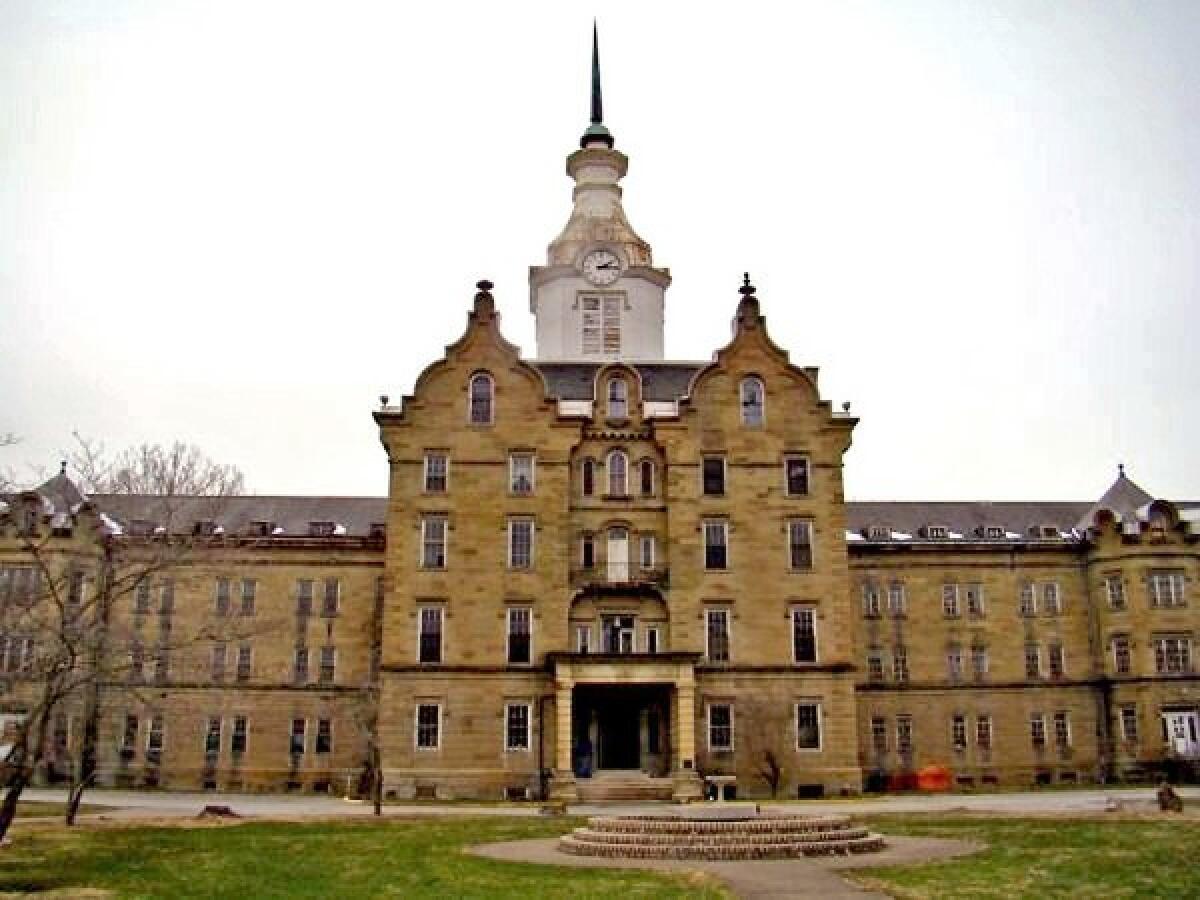
Trans-Allegheny Lunatic Asylum
Stretching nearly 1,300 feet across a hillside above the West Fork River in Weston, West Virginia, the Trans-Allegheny Lunatic Asylum is a building that defies casual description. Its staggered Gothic and Tudor Revival wings fan outward from a 200-foot central clock tower in a formation so massive it reads more like a fortified compound than a hospital. The walls are two and a half feet of hand-cut sandstone. There are over 900 windows and 900 doors across four floors and 242,000 square feet of interior space. It is reportedly the largest hand-cut stone masonry building in North America, second in the world only to the Kremlin. And for 130 years, it held some of the most vulnerable people in Appalachia behind those walls — first with the intention of healing them, and eventually with little intention at all. The Virginia General Assembly authorized the asylum in the early 1850s, part of a national wave of mental health reform driven by activist Dorothea Dix. The building was designed by Baltimore architect Richard Snowden Andrews following the Kirkbride Plan, a progressive model that emphasized fresh air, natural light, and the therapeutic power of environment. Each wing was staggered so that every room received sunlight and cross-ventilation. The capacity was set at 250 patients, reflecting the belief that a superintendent could only manage so many individuals while maintaining quality of care. Construction began in 1858, but the Civil War intervened almost immediately. The partially built structure was seized by Union forces and converted into Camp Tyler, and control of the site changed hands multiple times during the conflict. Confederate raids in 1862 and 1863 disrupted operations, and a final raid in 1864 stripped the building of food and clothing intended for its first patients. Despite all of this, the asylum opened that same year under the name West Virginia Hospital for the Insane. In its early decades, the facility functioned roughly as intended. Patients worked on a self-sustaining farm spread across more than 600 acres, learned trades like sewing and furniture-making, and lived in conditions that — by the standards of the era — represented genuine progress. But the population grew relentlessly. By 1880, the asylum held over 700 patients. By the 1930s, nearly 1,700. At its peak in the 1950s, more than 2,400 people were crammed into a building designed for a tenth of that number. The reasons for admission had long since expanded beyond what any modern definition of mental illness would recognize — patients were committed for conditions including epilepsy, alcoholism, domestic troubles, and even laziness. The overcrowding brought conditions that were nothing short of catastrophic. A series of investigative reports by the Charleston Gazette documented the deterioration in vivid terms, describing wards without adequate furniture, heating, or sanitation. Patients slept on floors. Some were locked in cages. Isolation cells still bear the rusted iron rings once used to restrain the most violent. The asylum also became a site for Walter Freeman's lobotomy project in the early 1950s, an effort by the state to reduce patient populations through surgical intervention. Thousands of procedures were performed using Freeman's transorbital method. The results were often devastating — patients left without affect or personality, their neural connections severed by a tool inserted through the eye socket. Combined with insulin shock therapy and electroconvulsive treatment, the facility's medical legacy is one of experimentation carried out on a population with no ability to refuse. A patient named Dean was murdered by two fellow inmates in a back room at the end of a wing, past the solitary confinement cells, where staff had no awareness of what was happening. The building's sheer scale made oversight impossible. The asylum finally closed in 1994 after decades of decline. The property sat abandoned until 2007, when Joe Jordan purchased the 242,000-square-foot main building at auction for $1.5 million. It reopened in 2008 as a historical and paranormal tourism destination, and it has since appeared on Ghost Hunters, Ghost Adventures, Paranormal Lockdown, and numerous other programs. Paranormal claims at Trans-Allegheny are extensive and tied closely to specific individuals whose stories are part of the building's documented history. The most widely reported spirit is Lily, a child believed to have been born inside the asylum to a patient and to have died of pneumonia at age nine, never having lived outside its walls. Her room in Ward Four on the first floor has been converted into a small shrine filled with toys and gifts left by visitors. Staff and guests report hearing a child's laughter, feeling small hands tug at clothing, and watching balls roll across the floor without visible cause. On the same floor, a spirit known as Ruth — described in life as a female patient with an intense hostility toward men — is said to throw objects at male visitors near her former holding cell. The third floor produces reports associated with a patient called Big Jim and a nurse named Elizabeth. The fourth floor generates accounts of a spectral Civil War soldier named Jacob. In the back rooms of one wing, investigators describe a dual energy in the space where Dean was killed — a childlike gentleness when encountered alone, and an oppressive coldness when the presence of his killers seems to enter the space alongside him. A figure known as Slewfoot, a patient who was slashed to death in a bathroom, is reported throughout the building. Beyond the named spirits, the asylum generates the kind of broad, ambient reports common to buildings of this scale and history — disembodied voices, shadows moving through empty corridors, cold spots, unexplained sounds of breaking glass, and the sensation of being watched or physically touched. The underground tunnel system used by staff to move unseen between buildings has its own claims, including the smell of baked goods attributed to a former chef. Skeptics have no shortage of material to work with. A building this old, this enormous, and this deteriorated will produce sounds, temperature shifts, and visual anomalies entirely on its own. The cultural expectation visitors carry into any asylum-turned-attraction shapes perception before a single door opens. But the consistency of reports across decades — from staff, casual tourists, television crews, and seasoned investigators — and the specificity with which encounters map onto documented residents and events, makes the Trans-Allegheny file difficult to set aside entirely. Today the asylum operates year-round, offering historical day tours, nighttime paranormal tours, and overnight ghost hunts that run from 9 p.m. to 5 a.m. The first-floor museum preserves patient artwork, medical equipment, restraints, and a restored ward. The remaining twenty-three wards are largely untouched — endless decayed hallways, vacant rooms, and isolation cells open to anyone willing to walk them. The clock tower still rises above Weston. The wings still stretch outward. And the building, for all its emptiness, does not feel empty at all.
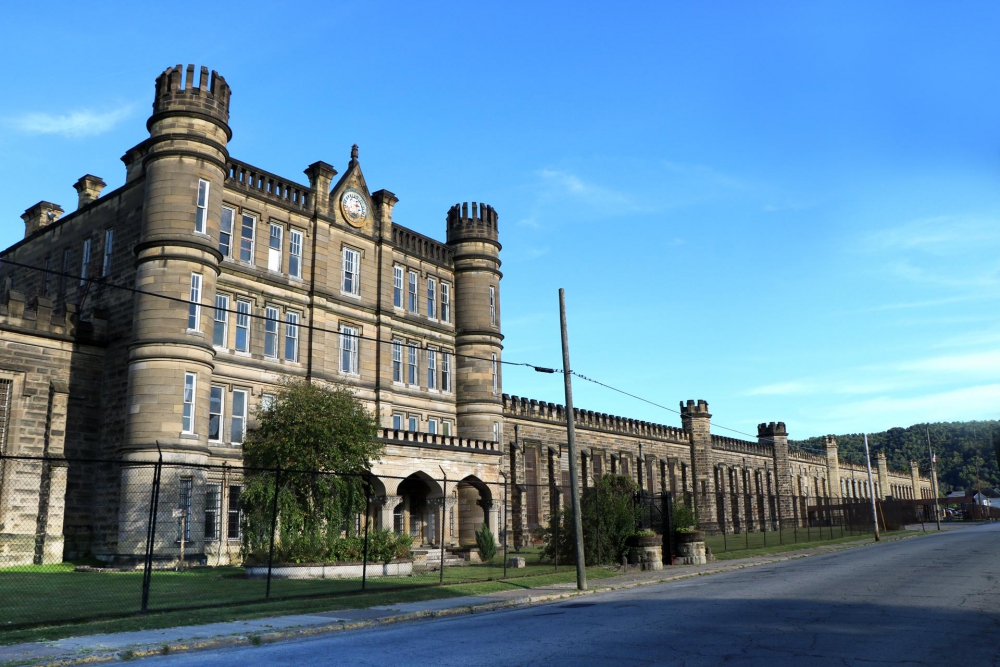
West Virginia State Penitentiary
Rising from a flat stretch along Jefferson Avenue in Moundsville, West Virginia, the West Virginia State Penitentiary looks exactly like what most people picture when they think of a haunted prison—massive sandstone walls adorned with battlements and turrets, a fortress silhouette that feels pulled from a darker century. But the Penitentiary's origins weren't born from cruelty by design. When West Virginia became a state in 1863, it had no state prison at all. Prisoners were held in county jails, an arrangement that quickly proved inadequate for a young state trying to establish its own institutions. Governor Boreman lobbied the legislature for funds to construct a state penitentiary, and in 1866 the legislature appropriated $50,000 to acquire land in Moundsville for construction. The prison at Joliet, Illinois provided the architectural prototype—an imposing stone structure fashioned in the castellated Gothic style, complete with turrets and battlements, though West Virginia's version would be approximately half the size. The Gothic structure officially opened in 1876 and would remain in continuous operation for nearly 130 years. Unlike locations defined by a single dramatic event, the Penitentiary's weight comes from accumulation. It witnessed riots, fires, and the execution of nearly 100 prisoners through either hanging or electrocution over its lifetime. Deadly riots in 1973 and 1979 prompted judicial oversight, and despite efforts to improve conditions, another riot on New Year's Day 1986 led the state Supreme Court to order the facility's eventual closing. A 1986 ruling determined that confinement to the 5-by-7-foot cells constituted cruel and unusual punishment, and the last prisoners were transferred out in 1995. The building itself amplifies everything. The sandstone facade rises with attached buttresses, circular turrets, and lancet windows—one of the finest examples of high Gothic Revival architecture in West Virginia. Long cellblock corridors stretch in either direction from the central administrative tower. The former North Hall, the shower room, and the solitary confinement area known as the Sugar Shack each carry their own particular atmosphere. Natural light barely penetrates the deeper interior. The original hardware, bars, and cell fixtures remain largely intact throughout. Paranormal claims at the Penitentiary are among the most documented in the country. Reports of supernatural phenomena include sightings of phantom inmates by former guards and legends of a shadowy figure that wanders the premises. Visitors frequently report cold spots and unexplained noises, including voices. EVP sessions in the cellblocks often yield results that investigators describe as direct responses rather than ambient noise. Some guests report being touched or physically pushed in areas where no one else is standing. Visitors have reported seeing the "Shadow Man," a static silhouette that roams the grounds. The former execution chamber draws particular attention, as does the Sugar Shack, where inmates were reportedly subjected to extreme punishment. Shadow figures, equipment malfunctions, and sudden drops in temperature are consistently reported across multiple independent investigations. Some claim to hear screaming from empty cellblocks, while others report doors moving on their own in the upper tiers. Skeptics note that any century-old stone structure will settle, creak, and breathe in ways that feel unexplainable. Large facilities amplify sound unpredictably. The history of violence and suffering embedded in this place—by design, by circumstance, and by record—gives visitors a psychological framework that can color every sound and shadow. Still, seasoned investigators routinely describe the Penitentiary as producing some of the most compelling evidence they've encountered anywhere. Today the site is maintained as a tourist attraction, museum, training facility, and filming location, operated by the Moundsville Economic Development Council. It sits directly across from the Grave Creek Mound, the largest prehistoric burial mound in eastern North America, a detail that adds another layer of historical unease to an already loaded site. There are no costumed actors on the standard tours. Just iron bars, cold stone floors, and the long institutional silence of a building that processed more than a century of human suffering. Whether visitors arrive as history buffs or paranormal investigators, most leave with the same feeling: that the West Virginia State Penitentiary has not finished telling its story.

Colonial Lanes
Colonial Lanes operates as a tavern and entertainment venue in the Tri-State region, a location combining food service with leisure activities in a building reflecting period architecture from an earlier era and preserving elements of historical construction. The establishment includes a main tavern area where patrons gather for drinks and socializing, along with functional spaces including a stockroom for inventory storage, a kitchen for food preparation, and a wine room housing bottle collections and vintage selections. Additional facilities include bar areas where beverages are mixed and served by trained staff, and various supporting spaces necessary for operating a contemporary hospitality establishment that maintains historical character. The venue has developed a reputation within the regional community as a destination for quality beverages and social gathering, attracting patrons who appreciate both the culinary offerings and the atmospheric qualities of the historic structure. The paranormal phenomena documented at Colonial Lanes have established it as a significant haunted location within the Tri-State paranormal community, with consistent reports attributed specifically to Mr. Frankel, the venue's former owner whose attachment to the location appears undiminished by his death. Paranormal investigators have theorized that Frankel's strong attachment to the business, combined with the profound identity he developed through decades of ownership and continuous presence, created circumstances binding his spirit to the establishment following his death. The manifestations of Frankel's presence occur with sufficient consistency and specificity that researchers have developed substantial documentation of his continued existence within the structure. Mr. Frankel appears to maintain active engagement with the physical environment and responds to activities occurring within the tavern, suggesting a spirit with both awareness of living occupants and demonstrated capacity to influence the material world around him. The most distinctive manifestation of Mr. Frankel's paranormal presence takes the form of an unmistakable olfactory phenomenon: the sudden appearance of cherry pipe tobacco scent in various locations throughout the tavern without any corresponding source or explanation. Multiple witnesses, including staff members, patrons, and paranormal investigators, have reported encountering this specific odor in areas where no one is smoking and where no tobacco products are physically present in the vicinity. The smell is distinctly recognizable and consistent with the specific tobacco product that Frankel favored during his lifetime, creating an unmistakable signature of his presence. This olfactory manifestation occurs sporadically throughout the building, sometimes concentrated in particular areas such as the bar where Frankel spent considerable time, and sometimes manifesting suddenly in distant locations throughout the establishment. Beyond the distinctive tobacco scent, Mr. Frankel's spirit manifests through additional paranormal phenomena demonstrating active engagement with the physical environment and apparent desire to make his continued presence known. Heavy footsteps have been documented moving through the tavern, stockroom, and kitchen areas, suggesting the spirit continuing familiar patrol patterns that Frankel likely established during his decades of management. Whispered names have been heard emanating from empty areas, as though Frankel is attempting to call out or establish communication with the living occupants of his former domain. The kitchen door has reportedly slammed shut with considerable force despite the complete absence of breeze or any apparent physical cause, occurring repeatedly with sufficient pattern to suggest intentional action rather than random paranormal phenomena. Swinging doors in the tavern have exhibited mysterious movement, opening and closing without human intervention or mechanistic explanation. Objects have been found displaced from expected locations, suggesting the spirit actively manipulating physical items and exerting influence over the material environment. The tavern's radio has been reported turning on independently at various times, emanating music or broadcast content without any human activation or explanation for the mechanism of activation.
Smoot Theater
The Smoot Theater stands as a monument to West Virginia's cultural heritage, a mid-twentieth-century entertainment venue that once served as the beating heart of the region's theatrical and social life. Built during an era when theaters were architectural centerpieces of American communities, the Smoot Theater provided sanctuary for live performances, cinema, and public gatherings that drew residents throughout the surrounding valleys and towns. The theater's elegant interior design reflected the craftsmanship and ambitions of its builders, with ornate detailing and state-of-the-art projection systems that positioned it as a jewel among regional cultural institutions. Throughout its operational decades, the venue hosted theatrical productions, musical performances, and commercial cinema releases, establishing a devoted patron base that crossed generational lines. The architecture represented significant community investment, with its distinctive facade becoming an instantly recognizable landmark. As television technology proliferated and suburban shopping centers redirected commercial activity away from downtown districts, the Smoot Theater experienced gradual decline affecting countless American theaters. The venue's operational capacity diminished as attendance waned, and the building eventually closed as economic realities forced many similar establishments to cease operations. During this transitional period, the theater fell into disrepair despite preservation efforts by those valuing its architectural significance and cultural importance. The empty building accumulated layers of dust and silence, its empty seats a reminder of vanished audiences and forgotten performances. Yet despite abandonment and commercial uncertainty, the structure remained fundamentally sound, preserving its essential character and construction intact through decades of reduced activity. Paranormal phenomena within the Smoot Theater have become increasingly documented by visitors, staff members, and paranormal investigators. Witnesses consistently describe strange sounds emanating from the stage and theater depths during evening and nighttime hours, particularly when the building sits empty and unoccupied. Unexplained shadows move across walls and aisles despite the absence of any apparent light source. Multiple visitors report experiencing sudden cold spots in various auditorium and backstage locations, temperature drops occurring without environmental cause. Electrical systems exhibit erratic behavior, with lights flickering independently, equipment powering on and off without activation, and electrical disturbances in localized areas with no apparent technical malfunction. These phenomena occur most frequently during evening hours and are particularly pronounced when fewer individuals occupy the building. Commentators investigating the Smoot Theater propose various explanations for reported paranormal activity. Some suggest residual psychic energy from decades of human emotion, excitement, and theatrical passion may linger within the structure itself, imprinted upon spaces where countless performances unfolded and memories were created. Others theorize specific tragic events occurring within the theater's history may have triggered spiritual manifestations tied to those particular moments. The regularity of phenomena and consistency of witness accounts have led paranormal researchers to consider the theater as a legitimate investigation location. The building's current status preserves both its architectural integrity and its reputation as an active paranormal site, drawing continued interest from ghost hunters, theater historians, and curiosity seekers alike.
The Historic Lowe Hotel
The Historic Lowe Hotel stands as a distinguished example of early twentieth-century commercial architecture in Point Pleasant, West Virginia, a riverfront community situated along the Ohio River in the Appalachian region. Originally constructed in 1901 as Spencer Hotel, a commercial lodging establishment serving travelers, businesspeople, and visitors to the growing Point Pleasant community, the hotel operated under that designation for several decades before undergoing ownership transition. The Lowe family acquired the hotel in 1929, leading to the name change that persists today. The family's stewardship extended the building's operational and social significance within Point Pleasant, with the hotel continuing to serve as an important hospitality and social venue. Its physical position adjacent to the Ohio River within downtown Point Pleasant contributed to its prominence as a community landmark. The paranormal reputation derives from manifestations of multiple distinct spectral entities, each associated with particular historical circumstances and exhibiting distinctive behavioral patterns documented through guest accounts and paranormal investigation. The most famous manifestation involves the Dancing Lady, identified as Juliette Smith, appearing on the mezzanine spanning the first and second floors, dancing to music existing only in the supernatural realm. Witnesses describe observing the apparition moving rhythmically as if responding to musical accompaniment, barefoot and graceful, her movements suggesting deliberate performance despite the complete absence of audible music. Additional paranormal entities include a little girl manifesting as riding a tricycle through second floor hallways, phantom sounds and sensations of a child at play occurring without any living child present. Captain Jim, identified as a riverboat captain lacking lower extremities, appears in particular locations, particularly positioned near windows facing the Ohio River that was his professional domain in life. The Whistling Maid produces distinctive whistling sounds throughout the hotel, particularly concentrated on the third floor, auditory phenomena attributed to a female spirit whose identity and history remain subjects of ongoing research. These apparitional manifestations create experiences for guests and staff characterized by inexplicable footsteps, disembodied whistling, sensations of unseen presences, and visual apparitions of the identified spirits. The Historic Lowe Hotel has achieved prominence within paranormal enthusiast communities and paranormal television programming as a location of particularly rich and well-documented supernatural phenomena. Guest reviews frequently reference paranormal experiences, with visitors explicitly noting the hotel's haunted reputation as a factor in accommodation selection and reporting encounters with documented spirits. Hotel management has embraced the paranormal reputation as an element of distinctive identity and marketing appeal, positioning the location as a destination for paranormal tourists and enthusiasts seeking authentic haunted accommodations and potential encounters with documented apparitions. The building's status as one of Point Pleasant's most historically significant structures, combined with extensive paranormal reputation and documented manifestations, has established The Historic Lowe Hotel as a primary paranormal destination within West Virginia's paranormal geography and a recognized location within broader North American paranormal investigation and enthusiast communities.
St. Peter’s Roman Catholic Church
St. Peter's Roman Catholic Church in Harpers Ferry, West Virginia, stands as one of the most historically significant and supernaturally active religious structures in the American South, established in 1833 as a center for Catholic worship in a predominantly Protestant region. The church was constructed at a pivotal moment in American history, just before Harpers Ferry became one of the nation's most consequential sites of revolutionary action when John Brown launched his infamous raid on the federal armory in 1859. Built in an era before the Civil War transformed the landscape into a contested battlefield, St. Peter's Church represented a commitment by the Catholic community to establish permanent religious infrastructure within a border region charged with ideological tensions that would eventually explode into open warfare. The church building reflects nineteenth-century American Catholic architectural and liturgical conventions, designed to serve as a house of worship where the faithful could participate in sacramental life and experience spiritual solace. Harpers Ferry's geographic position at the confluence of the Shenandoah and Potomac Rivers made it strategically significant throughout the nineteenth century, but particularly during the Civil War when the town became a contested zone where multiple military campaigns, occupations, and battles unfolded across years of destruction and violence. John Brown's 1859 raid precipitated national consciousness of Harpers Ferry as a flashpoint of sectional conflict. The Civil War itself, erupting a year and a half later, transformed the region into contested territory marked by extraordinary human suffering and loss. Throughout periods of extraordinary historical upheaval and violence, St. Peter's Church stood as a spiritual refuge for those seeking solace and meaning amidst chaos. The profound historical traumas and human suffering characterizing Harpers Ferry's nineteenth-century experience appear connected to the complex paranormal phenomena reported at the church. Multiple paranormal investigators and visitors have reported encountering the apparition of a Catholic priest engaged in solitary prayer or devotional activities within the church structure, a spectral figure appearing to read from a religious text or engage in contemplative prayer before vanishing without apparent transition. Witnesses have identified this apparition as Father Costello, a priest associated with the church during significant historical periods, whose continued spiritual presence manifests as reenactment of his characteristic devotional practices. The apparition demonstrates awareness of surroundings, engaging in behaviors consistent with sincere religious observance. A phantom soldier has been reported standing near the church doors, apparently maintaining a guard position, likely representing a Civil War casualty. Most poignantly, visitors have reported hearing a disembodied voice uttering the words 'Thank God! I am saved,' suggesting a soul expressing relief at attaining spiritual redemption. Additionally, witnesses have reported hearing babies crying from vicinity of the east entrance steps, cries ceasing when investigated yet resuming when withdrawn, suggesting the presence of infant spirits. St. Peter's Church today stands as a living monument to the intersection of American history, religious faith, and the apparent persistence of consciousness beyond death. The church continues functioning as an active parish while maintaining recognition as one of the most paranormally significant religious structures in the Mid-Atlantic region. The accumulation of multiple distinct entities, each manifesting characteristic behaviors suggesting individual identities and unresolved spiritual circumstances, has established St. Peter's as particularly significant to paranormal researchers and ghost tour operators. The church represents a powerful example of how sites deeply marked by historical trauma and spiritual significance become focal points for ongoing paranormal phenomena, places where boundaries between material and spiritual worlds appear particularly thin.
Z. D. Ramsdell House
The Z. D. Ramsdell House in Ceredo, West Virginia, stands as the oldest building in the town, constructed in 1858 as a Greek Revival mansion during the antebellum period, prior to the American Civil War and the subsequent formation of West Virginia as an independent state. The residence exemplifies the architectural preferences and construction techniques characteristic of antebellum southern plantation aesthetics adapted to the borders of slave-holding territory in the upper South and border regions. The mansion's construction reflected the wealth and status of the Ramsdell family within the regional social and economic hierarchy of the period. Beyond its function as a family residence, the Ramsdell House served as a station on the Underground Railroad, the clandestine network facilitating escape and passage for enslaved people fleeing from southern slavery toward northern free territories and Canada. The paranormal phenomena documented at the Ramsdell House reflect the complex historical legacy of slavery, liberation struggle, and trauma embedded within the structure's history. Apparitions appear throughout the interior of the residence, manifesting with sufficient clarity that observers perceive them as entities from former eras rather than products of imagination. Shadow figures move through corridors and rooms, their movements characterized as purposeful and intelligent rather than random manifestations of light and shadow. The apparition specifically identified as Mr. Ramsdell has been contacted through paranormal investigation methodologies, with researchers claiming communication with the spirit of the original builder and owner. Similarly, investigators report contact with the spirit of Mrs. Ramsdell, suggesting that marital partners continue spiritual occupation of the domestic space they formerly inhabited together. The spirits of enslaved people seeking refuge are believed by paranormal researchers to inhabit the structure, manifesting as apparitions in rooms and spaces where they sheltered. Chains rattling in the basement constitute a distinctive paranormal phenomenon associated with the Ramsdell House, a manifestation particularly laden with symbolic significance regarding the history of slavery and the physical bondage that enslaved people endured. The sounds of chains—whether actual physical artifacts remaining from the site's history or paranormal manifestations—carry profound historical meaning within the context of slavery and liberation struggle. The basement location of the chain sounds may indicate that enslaved people sheltered in lower portions of the structure. Cold spots throughout the structure, disembodied voices, and unexplained electrical phenomena complete the array of documented paranormal manifestations. Paranormal investigators have established protocols for respectful communication with the spirits inhabiting the structure, emphasizing that investigation of the Ramsdell House carries historical and moral significance beyond conventional paranormal documentation. The Ramsdell House currently operates under the stewardship of Ceredo, with preservation and interpretation efforts dedicated to ensuring the structure's continued physical integrity and its historical significance within American antislavery history and West Virginia cultural heritage. Paranormal investigators work in cooperation with historical preservation organizations to document paranormal phenomena while maintaining respect for the spirits inhabiting the structure. The house has been recognized as a site of historical significance related to Underground Railroad operations, and paranormal investigation has contributed to broader historical understanding and public awareness of the site's complex legacy. The structure stands as a powerful symbol of the intersection of American slavery, abolition movements, paranormal manifestation, and the continuing spiritual presence of individuals whose lives and deaths shaped the nation's moral trajectory.
Glen Ferris Inn
The Glen Ferris Inn represents one of West Virginia's oldest continuously operating hospitality establishments, its enduring presence along the scenic Kanawha River spanning more than 180 years of American history, encompassing periods of territorial development, slavery and abolition, civil war and reconstruction, industrial transformation, and modern economic evolution. Situated in the scenic valley that surrounds Glen Ferris, nestled between the Kanawha River and the surrounding landscape, the inn has served as a waystation for travelers, a gathering point for regional commerce and social interaction, and a repository of human experience across the nineteenth and twentieth centuries. The building itself witnessed the American Civil War in its immediate regional context, the subsequent period of Reconstruction and its social upheavals, the industrial development of the Kanawha Valley through coal and chemical industries, and the cultural transformations and economic shifts of the modern era. The structure has undergone renovations and adaptations to serve contemporary hospitality functions while maintaining architectural connections to its earlier periods, creating a layered physical manifestation of West Virginia's complex historical trajectory from frontier settlement through industrial development to contemporary tourism economy. The inn's location along the Kanawha River connected it to both commercial river traffic and the broader networks of regional commerce and communication that defined Appalachian economic life, allowing river transport of goods and facilitating the movement of people and commercial activity through the valley. The property's grounds encompass areas rich in historical significance extending back centuries, including land across which the Trail of Tears passed during the forced removal of Cherokee and other indigenous peoples from southeastern territories to western reservations during the 1830s Indian Removal era. The march of tens of thousands of dispossessed indigenous peoples across these valleys and hills, undertaken under conditions of military force and duress, imprinted profound suffering and spiritual trauma upon the landscape. The same grounds were frequented by moonshiners during Prohibition, reflecting the clandestine economic activities and illegal distillation of alcohol that sustained many rural Appalachian communities during that era of federal prohibition and its enforcement challenges. The property has also been a site of documented human tragedy, including at least one recorded suicide by hanging that occurred on the grounds in prior decades, adding to the accumulated psychological weight of the location. The paranormal phenomena reported at the Glen Ferris Inn center on at least two distinct entities whose presences continue to manifest within and around the structure with apparent intentionality and ongoing awareness. The Colonel, a Confederate soldier whose identity and specific military history remain partially obscured by time, appears regularly within the inn's hallway outside the kitchen area, a location that appears to hold particular significance to the entity. Witnesses have described a full-body apparition visible from approximately the waist upward, appearing in period military clothing consistent with Confederate uniforms and manifesting with sufficient frequency to constitute an established pattern of haunting. The Colonel appears to maintain ongoing concern for the inn's operations, allegedly closing doors that have been left open and otherwise interacting with the physical environment in ways suggesting a residual awareness of former responsibilities, military discipline, or attachments to the location. In addition to the Colonel's presence, visitors and staff have reported full-body apparitions of a young girl, with sightings concentrated on the second story of the building, suggesting a child entity with particular attachment to that location. Children's disembodied voices have been heard in various locations throughout the inn, communicating in tones of playfulness or distress, suggesting the presence of multiple child entities. Paranormal activity includes footsteps traversing hallways and staircases without visible source, doors opening and closing without apparent cause, and a pervasive sense of presence in specific areas that intensifies during evening and nighttime hours. The phenomenon extends to the inn's exterior grounds and surrounding acreage, where visitors have reported apparitions in the birdbath area and other locations beyond the main building, suggesting that the spiritual disturbances encompass the entire property.
Old Hampshire County Jail
The Old Hampshire County Jail in Romney, West Virginia stands as a historically significant structure built in the late eighteenth century, a period when the young American nation was establishing systems of criminal justice and developing institutions to house and manage accused and convicted individuals. The construction of the jail during this early period reflected the region's development and the establishment of formal governmental and judicial structures. The building's survival for centuries and its preservation as a historical artifact and paranormal location provide a tangible connection to a formative period in American history and the evolution of law enforcement, incarceration, and frontier justice. The architectural features and spatial organization of the jail reflect the security and containment philosophies of the eighteenth century, creating a structure fundamentally shaped by the purposes of confinement and control. The paranormal activity documented at the Old Hampshire County Jail centers upon a tragedy that occurred within the building, an event so violent and profound that it appears to have left an indelible supernatural imprint. According to persistent local legend, a sheriff was shot to death by bandits on the staircase that connected the jail proper to the jailer's family quarters. The staircase represented a critical architectural and functional element of the jail facility, serving as a transitional space between the institutional jail functions and the residential quarters where the jailer and his family lived. The murder of the sheriff upon this staircase created a traumatic event that violated the safety and security that the jailer's residence was meant to provide, transforming the staircase into a site of tragedy and violent death. The specificity and persistence of this legend across generations suggests a deep historical truth underlying the paranormal phenomena documented at the location. The most distinctive and well-documented paranormal phenomenon at the Old Hampshire County Jail is the auditory manifestation of the sheriff's final moments. Witnesses have reported hearing the sound of the sheriff's body falling down the staircase, a phantom echo that seems to replay the violent event that claimed his life. The sound manifests with sufficient clarity to create the impression that an actual physical event is occurring, even when living witnesses know no actual person is present. The phenomenon appears to repeat in cycles, particularly during the nighttime hours, though reports of its manifestation extend across all times of day and night. This residual haunting phenomenon suggests that the violent death created an imprint upon the physical location so profound that echoes of the event continue to manifest across the centuries that have elapsed since its occurrence. Beyond the phantom sound of the sheriff's body falling, footsteps have been heard coming up the staircase when no living person is present to produce them. The footsteps suggest purposeful movement, as if an unseen person were ascending the stairs with deliberate intention. The phantom footsteps have been reported consistently enough to establish a pattern, suggesting that the staircase represents a focal point for paranormal manifestations. These footsteps may represent either the residual echo of the sheriff ascending the stairs during his final moments or a separate manifestation connected to other individuals associated with the jail. The staircase appears to function as a liminal space where the boundary between the material world and the paranormal realm becomes particularly permeable. The jail's office area also manifests paranormal phenomena including unexplained sounds and reported electrical interference. Equipment malfunctions without apparent cause, lights flicker inexplicably, and electronic devices exhibit unusual behavior suggesting the influence of external, non-ordinary forces. A witness reported pulling into the back area of the jail and observing a light on in a window of the old inmate section, creating the impression that the facility remained staffed and occupied. Upon checking the interior of the building, however, no person was found present and no explanation could account for the illuminated window. This phenomenon of phantom lights suggests both the persistence of residual images from the building's operational past and the possibility of intelligent entities capable of manipulating physical phenomena such as lighting. The Old Hampshire County Jail has achieved recognition as a paranormal attraction and roadside oddity, with its historical significance and documented haunting creating a dual appeal for both history enthusiasts and paranormal researchers. The building's preservation and continued accessibility allow ongoing investigation and documentation of the phenomena occurring within its walls. The ghost of the murdered sheriff appears to remain vigilantly connected to the location where his life was violently ended, his presence serving as a persistent reminder of the tragedy that occurred and the human cost of frontier violence and lawlessness.
Droop Mountain Battlefield State Park
The Battle of Droop Mountain, fought on November 6, 1863, stands as one of West Virginia's most significant Civil War engagements, a brutal confrontation that determined territorial control and represented a critical moment in the regional struggle between Union and Confederate forces. Droop Mountain rises prominently above the surrounding Pocahontas County landscape, providing defenders with exceptional positional advantages that made the elevation a strategic prize both sides understood had immense tactical importance. The battle was waged with particular ferocity, and the mountainous terrain transformed the combat into a series of intense local actions rather than coordinated maneuvering. The battle concluded with Union victory, but the path to that victory was marked by thousands of casualties, desperate charges, and individual moments of extreme violence spread across the mountainous landscape. The specific conditions of combat on Droop Mountain created circumstances particularly conducive to imprinting traumatic experiences upon the physical environment. The enclosed nature of mountain warfare meant that combatants frequently encountered each other at close range, with hand-to-hand combat and point-blank gunfire creating intensely personal and terrifying experiences. The difficulty of evacuating wounded from the elevated terrain meant that casualties accumulated rapidly, with injured and dying soldiers remaining on the battlefield for extended periods. The total human cost of the battle included hundreds of deaths and several thousands wounded, making Droop Mountain a concentrated site of mortality and suffering. The paranormal phenomena reported at Droop Mountain have focused particularly on auditory manifestations consistent with the sounds and voices of Civil War combat. Witnesses have described hearing phantom battle sounds including rifle fire, cannon discharge, and military commands being shouted across the landscape at times when no military personnel are present. These auditory phantoms appear to manifest most intensely during the period approaching the November anniversary of the battle. Full-bodied apparitions of soldiers have been reported by multiple witnesses, with descriptions suggesting appearances consistent with Civil War-era military uniforms. Particularly notable is a headless Confederate soldier who has been observed moving through various locations on the battlefield. Disembodied voices have been documented at various locations across the battlefield, with witnesses reporting hearing conversations, commands, prayers, and anguished cries with no visible source. Unexplained footsteps and knockings have been reported within structures associated with the battle site, including the observation tower. Cold spots have been documented at particular locations, with paranormal investigators using thermal imaging equipment to verify temperature anomalies. Strong presences have been reported at specific locations across the battlefield, with witnesses describing overwhelming sensations of being watched with apparent intelligence. Investigations into the historical record and preservation documents at Droop Mountain have yielded detailed casualty lists, maps of troop positions, and written accounts from soldiers and officers. These historical records provide context for understanding which specific areas have generated the most intense paranormal reports, with apparitions and phenomena clustering around locations identified as particularly costly in casualties. This intersection of paranormal documentation with historical evidence creates opportunities for validating apparition identities through cross-reference with historical sources. The Droop Mountain Battlefield continues to be studied by paranormal researchers and visited by historical enthusiasts. The dedication of the landscape as a state park means that phenomena are witnessed by official personnel as well as paranormal researchers. The intensity of reported paranormal activity appears to correlate with the scale of violence and human suffering that occurred during the 1863 battle, supporting theories that extreme trauma and massive mortality leave persistent imprints upon physical environments.
Historic Hilltop House
Perched on a commanding hilltop overlooking the convergence of the Potomac and Shenandoah Rivers, the Historic Hilltop House stands as a striking monument to Gilded Age ambition and a three-story Victorian sanctuary to architectural grandeur. Built in 1888, this stately structure was erected at the height of Harpers Ferry's transformation from a quiet mill town into a fashionable tourist destination, its position deliberately chosen to command sweeping vistas across the historic landscape where John Brown's raid had shaken the nation three decades prior. The hotel's design reflected the confidence and optimism of the era—imposing facades, generous window apertures, and interior spaces of considerable proportions designed to accommodate the traveling elite. The Hilltop House attracted visitors of genuine prominence during its operational heyday. The guest registry included luminaries whose names shaped the nineteenth and twentieth centuries: Mark Twain, whose literary genius had captivated American readers for decades; Alexander Graham Bell, the inventor whose telephone revolutionized human communication; and presidential figures including Bill Clinton. These were not fleeting stays but often extended visits, reflecting the property's reputation as a destination of substance where one might linger for weeks, taking the waters, enjoying the river views, and participating in the refined social activities that characterized the grand hotel experience of that era. Throughout the subsequent decades, the Hilltop House remained a fixture of Harpers Ferry's landscape, witnessing the dramatic transformations of the region. The Civil War, though decades past when the hotel was constructed, had left indelible marks on the geography and collective memory of the area. The hotel's prominence—visible from across the town, standing above the narrow streets and historic buildings below—made it a natural gathering place for visitors seeking to understand the complex history etched into Harpers Ferry's foundation. Yet as the twentieth century progressed and tourism patterns shifted, the grand hotel found itself increasingly challenged to maintain its former prestige. The building suffered through periods of decline, ownership changes, and deferred maintenance. By 2008, the Hilltop House was forced to close its doors permanently. Two years later, in 2010, the structure sustained a catastrophic partial collapse, its foundations and supporting walls finally succumbing to years of neglect. But the spirits occupying these halls remained long after the last guests departed. Paranormal investigators and visitors have documented a complex and densely populated haunting, suggesting that multiple entities remain bound to the physical structure. Civil War soldiers appear regularly along the property grounds and adjacent streets, their apparitions described as materializing in spectral regiments that march up and down the thoroughfares as if conducting an eternal patrol. These soldier-spirits reportedly wear the uniforms and bearing of Union or Confederate troops, frozen in historical moment, moving with purpose though their war ended more than a century and a half ago. The presence of these military entities may reflect the building's cultural significance within Harpers Ferry's Civil War narrative, or perhaps they were occupants who died during the hotel's early years when memories of the conflict remained visceral and immediate. Within the interior spaces, additional presences make themselves known through distinct and recurring phenomena. Room 66, a second-floor chamber whose tragic history remains somewhat obscured by time, manifests the most intense activity. A young boy died in a fire within that room, an event of sufficient traumatic force that his spirit appears unable to reconcile itself with the passage of decades. Witnesses describe both full-bodied apparitions and a palpable child-like presence—inexplicable sounds, the sensation of small hands, and an overwhelming emotional weight that visitors characterize as sadness and confusion rather than malevolence. The boy's ghost reportedly appears most frequently during the night hours, suggesting a consciousness still oriented to temporal patterns established during his living years. In the kitchen areas, disembodied activity manifests in auditory phenomena of particular vividness. Between 2 and 3 in the morning, observers have documented sounds emanating from an otherwise empty kitchen: pots clang against stoves with metallic violence, laughter echoes through the chambers—both childish giggles and deeper, adult amusement—and intelligible voices engage in conversation-like exchanges that have no identifiable source. The phenomena demonstrate remarkable consistency across witness accounts, suggesting either a genuine residual haunting—a kind of psychic recording replaying the sounds of past kitchen activity—or the presence of spirits who continue performing their daily functions in a liminal space between the physical and ethereal realms. The phantom of a man with white hair and a full white beard has been identified as a presence in and around the kitchen, possibly a former proprietor or long-term resident whose attachment to the space remains powerful enough to manifest audibly decades after his biological death. Throughout the hallways and staircase areas, witnesses report unexplained footsteps accompanied by knocking sounds that seem to follow no rational pattern, creating an atmosphere of constant, restless activity that suggests the building remains inhabited by multiple consciousnesses in states of perpetual occupation and unease.
Soldiers Memorial Theatre
The Soldiers Memorial Theatre in Beckley, West Virginia stands as a monumental testament to civic pride and cultural aspiration, representing the theatrical and entertainment traditions that flourished throughout early twentieth-century America. The theatre was constructed in 1931 during a period of American history marked by both economic sophistication and the impending collapse that would characterize the Great Depression. The building's architecture embodies the theatrical aesthetic of the era, with elaborate interior design elements, extensive seating capacity, and technical infrastructure designed to support professional theatrical productions, musical performances, and motion picture exhibition. The theatre was dedicated as a memorial to military personnel, reflecting the post-World War I cultural context in which many civic institutions bore the names and dedications of fallen service members. The structure served as a cultural hub for the Beckley community, hosting performances and gatherings that brought residents together for entertainment and collective experience. The Soldiers Memorial Theatre's paranormal history became irrevocably linked to a catastrophic structural failure in the form of a bleacher collapse that occurred during the theatre's operational history. This incident, which resulted in multiple casualties and injuries among attendees, created a traumatic imprint upon the physical structure and the consciousness of community members who experienced or witnessed the disaster. The collapse represented not merely a structural failure but a sudden and violent disruption of the expectation of safety within a community gathering space. Multiple deaths resulting from the bleacher collapse created conditions particularly conducive to spiritual manifestation and paranormal activity. The traumatic energy associated with the incident and the violent departure of those who died beneath the collapsing structure appear to have anchored multiple spirits to the theatre location. Paranormal manifestations at Soldiers Memorial Theatre involve multiple classes of phenomena distributed throughout the interior spaces. An apparition identified as Bob, reportedly a band member, has been documented manifesting within the theatre, appearing to patrons and staff with sufficient clarity and consistency to allow for identification. A man appearing to be in his sixties wearing attire consistent with the 1930s historical period has been observed by witnesses, suggesting the spirit of someone from the theatre's original operational era. Mysterious saxophone music has been heard emanating from the stage and interior spaces despite no visible musicians performing. The sounds of children playing echoes through the auditorium in the absence of any actual children, suggesting the spirits of younger victims or family members of those who died in the bleacher collapse. Shadow figures have been photographed and observed moving through interior spaces, appearing on stage, and traversing the auditorium. Footsteps reverberate through the theatre structure without visible sources, creating the impression of multiple individuals moving through the space. The stage area represents a particular zone of paranormal concentration, with the most dramatic manifestations occurring in this theatrical space traditionally intended for human performance. The apparition of Bob manifests with notable consistency, suggesting he maintains a strong connection to the location and a continued interest in the theatrical proceedings that characterize the space. Distinctive paranormal phenomena specific to Soldiers Memorial Theatre include tap dancing sounds emanating from the stage and surrounding areas, and most peculiarly, the sound of an elephant running, suggesting either theatrical reenactment of performance memories or manifestations connected to entertainment and spectacle. These auditory phenomena demonstrate the psychological imprinting of theatrical memories upon the physical structure and the apparent recreation of musical and performance elements central to the theatre's original purpose. The Soldiers Memorial Theatre continues to host performances and community events while maintaining its status as one of West Virginia's most actively paranormal cultural institutions.
Historic General Lewis Inn
The Historic General Lewis Inn in Lewisburg, West Virginia represents a significant building in the architectural and social history of the state, a structure that was constructed around 1929 by Randolph K. and Mary Milton Hock, prominent members of the Lewisburg community who invested in creating a hospitality establishment that would serve travelers and visitors to the area. The inn was built during the latter portion of the Jazz Age, a period of economic vitality and optimism before the onset of the Great Depression would reshape American economic and social realities, and the construction of such an establishment reflected confidence in continued prosperity and demand for quality lodging. The architectural design of the inn reflects the standards and aesthetic preferences of the early twentieth century, and the building has maintained much of its original character while accommodating necessary modifications and updates to serve contemporary guests and to comply with modern building codes and safety standards. The inn has operated continuously since its construction, serving as a gathering place and lodging facility for multiple generations of guests drawn from the surrounding region and from farther afield, becoming embedded in the social fabric and collective memory of Lewisburg through its long history of hospitality. The building itself, constructed of sturdy materials and designed to last, has weathered decades of use and continues to stand as a testament to the craftsmanship and vision of its original builders.\n\nThe paranormal activity associated with the Historic General Lewis Inn centers upon the presence of three distinct spiritual entities, each with particular areas of manifestation and characteristic patterns of supernatural behavior, creating a complex spiritual ecology within the building. The rooms numbered 202, 206, and 208 have emerged as the focal points of paranormal activity, locations where the intensity of phenomena appears particularly concentrated and where visitors and staff report the highest frequency of disturbing or anomalous experiences. The most prominently documented entity is known as the Lady in White, a female spirit who manifests particularly in Room 208 and whose presence is characterized by sounds of crying and laughing emanating from the room, emotional expressions that suggest an entity experiencing profound emotional turbulence and psychological distress. An unidentified young girl also inhabits the building, adding her own manifestations to the complex supernatural atmosphere, contributing to the cacophony of emotional expression and paranormal disruption that characterizes the inn's spiritual population. Perhaps most dramatically, the spirit of a man named Reuben, identified as an enslaved person who was hanged on June 28, 1861, for allegedly conspiring in a slave revolt, maintains a strong presence within the inn, manifesting in the dining area where he is reported to be seen sitting at tables.\n\nThe historical trauma associated with Reuben's execution in 1861 appears to have created a spiritual imprint so profound that his consciousness became bound to the location where he may have been imprisoned prior to his execution or where the memory of his fate became culturally embedded. The Civil War period represented a moment of profound social upheaval and violence, and executions of enslaved people accused of rebellion conspiracies occurred within the context of white panic regarding the potential for violent resistance to slavery. Reuben's haunting of the inn may represent a manifestation of historical injustice, the spiritual persistence of a person whose death was unjust and whose suffering transcended the boundary between life and death. The Lady in White and the unidentified girl similarly appear to represent individual tragedies that have bound spirits to the location, though the specific historical circumstances of their deaths and their identities remain somewhat obscure in the historical record. The combination of these three distinct entities creates a spiritually charged atmosphere within the inn, a place where the accumulated trauma and unresolved emotional content of multiple deaths has created an environment where the boundary between living and dead remains fluid and permeable.
Wells Inn
Wells Inn stands in downtown Sistersville, West Virginia, as a testament to the oil boom era that transformed the Appalachian region in the final decades of the nineteenth century. Constructed in 1894 at the height of the oil industry's expansion into the Upper Ohio River Valley, this brick structure was built by Ephraim Wells, a prominent businessman and petroleum entrepreneur whose fortune was tied directly to crude oil extraction and trade from the surrounding regions. The building was designed as a luxury establishment to house oil executives, visiting dignitaries, and entertainers who traveled to Sistersville during the prosperous years when the town served as a hub for petroleum commerce. The architecture reflects Victorian sensibilities of the era, with ornate details and a layout intended to provide comfortable accommodations for wealthy guests. The inn flourished during its early decades, serving as a social center for Sistersville's business elite and a gathering place for important commercial transactions. Ephraim Wells himself maintained an office within the building, from which he directed his various business interests throughout the oil fields and trading operations. The third floor was traditionally reserved for the most distinguished guests, with Room 324 serving as a particularly prominent suite. Throughout the inn's operation, it became deeply associated with the prosperity and identity of the community, standing as a physical representation of the wealth that oil had brought to this corner of West Virginia. The reputation of the Wells Inn extended throughout the region, making it a destination for those seeking respectable lodging. The paranormal phenomena associated with Wells Inn are primarily attributed to Ephraim Wells himself, whose presence appears to have remained within the building after his death. Guests and staff members have consistently reported unexplained auditory experiences within the structure, including the distinct sound of pen scratching across paper emanating from the founder's office, as though Wells continues to conduct business from beyond mortality. Doors throughout the building, particularly on the third floor and hallways, have been observed opening and closing without any discernible physical cause, sometimes locking guests into their rooms and other times appearing to gesture them toward specific areas. Footsteps have been heard traversing corridors at hours when no one is present, and visitors have reported sudden cold spots appearing without explanation. Elevator activity has been documented, with the elevator moving between floors of its own accord. Sounds of furniture being dragged across floors suggest Wells remains engaged in organizing his domain. Witnesses and staff members have come to interpret these events as evidence of Ephraim Wells's continued presence and attachment to the building he created. Rather than manifesting as a threatening entity, Wells appears to operate as a proprietary presence, maintaining an active interest in the inn's operations. The consistency and nature of phenomena suggest a spirit bound to the location through decades of commercial activity and personal investment. Some guests report that paranormal activity intensifies during business hours or when the inn hosts events, as if Wells is attracted to the bustling atmosphere. The lights turning on in locked rooms, doors slamming to capture attention, and sounds of writing all suggest a spirit with intentionality rather than mere residual haunting, indicating that Wells maintains awareness of current events within his former workplace. Today, Wells Inn continues to operate as a hotel and gathering place in Sistersville, maintaining its historical character while adapting to modern hospitality standards. The building has undergone various renovations over the decades, yet paranormal activity continues unabated, with contemporary guests and staff regularly documenting unexplained experiences. The inn has become known among paranormal researchers as a genuine location of sustained activity, attracting visitors interested in both the history of Ephraim Wells and the Sistersville oil boom and the manifestations attributed to his persistent spirit.
Kingwood Public Library
The Kingwood Public Library in Kingwood, West Virginia, stands as a community institution devoted to preservation and dissemination of knowledge, serving generations with access to books, information resources, and spaces for intellectual and cultural engagement. The building housing the library occupies a location of considerable historical significance, as the current structure was constructed upon the site of a brick jail operating during the nineteenth century. The original jail, completed in 1871, served as the primary institution for detention of individuals accused or convicted of crimes within the region. The jail was built with thick brick walls, barred windows, and design intended to prevent escape and maintain order among detained individuals. The transformation of the jail site into a public library represents symbolic transition from institutional punishment and control to communal education and enlightenment, yet the history of the previous structure and experiences of those incarcerated appear to have left lasting impressions. The brick jail occupying the Kingwood site served as holding facility for individuals awaiting trial, those serving sentences for minor offenses, and individuals serving extended sentences for serious crimes. Prison conditions during the nineteenth century were notoriously harsh, characterized by overcrowding, poor sanitation, inadequate nutrition, and frequent violence among inmates. The detention of human beings in confined spaces under conditions of stress and deprivation created an environment of profound psychological strain and emotional suffering. Multiple individuals passed through the jail over its decades, experiencing degradation and restriction of incarceration, harboring deep anger, frustration, and despair. The accumulated emotional and psychological weight of generations of imprisoned individuals appears to have imprinted itself upon the physical location, creating a spiritual scar that persisted through demolition of the original structure and construction of the public library. The paranormal phenomena at Kingwood Public Library appear directly connected to the presence of the former jail and spirits of inmates incarcerated within it. The most frequent manifestations occur on the basement stairs, a location corresponding geographically with areas of the original jail structure. Witnesses, including library staff and visitors, have reported hearing footsteps on basement stairs without visible source, suggesting passage of invisible entities. Objects within the library have been observed moving inexplicably, with books displaced from positions or found in locations where no one placed them. Doors open and close without human intervention, and in some cases doors have locked behind individuals, suggesting intelligent intentionality rather than mechanical malfunction. Most dramatically, books have been observed jumping off shelves with considerable force, suggesting poltergeist activity distinguished by apparent strength and aggressive expression. The nature of paranormal activity appears to reflect emotional states and circumstances of prisoners incarcerated in the former jail. The footsteps on basement stairs may represent echoes of prisoners being moved between cells and interrogation areas, residual imprints of movements made countless times during decades of jail operation. Objects moving inexplicably and books flying from shelves may represent poltergeist activity often associated with intense emotions, particularly anger and rage in confined spaces. The spirits of imprisoned individuals, denied freedom and subjected to harsh conditions, appear to maintain form of active presence and expression within the location of their suffering. Rather than resigned or melancholic manifestations, paranormal activity expresses itself with force and apparent aggression, as if imprisoned spirits express rage and frustration characterizing their confinement. The transformation of location into public library appears to have intensified rather than diminished paranormal activity. In the contemporary era, Kingwood Public Library continues operating as valuable community resource, providing access to information and educational opportunities for residents. The library has become recognized within paranormal research circles as particularly active location, with poltergeist phenomena documented through investigation and reported consistently by staff and visitors. The library has been featured in paranormal research documentation and on paranormal walking tours of West Virginia, attracting individuals interested in both the location's history and ongoing paranormal activity. Staff members have adapted to working within a haunted environment, and many appear to maintain respectful and sympathetic attitude toward spirits of former inmates. Kingwood Public Library stands as striking example of how paranormal phenomena can persist even after physical structures housing original trauma have been demolished and replaced.
The Empty Glass
The Empty Glass occupies a historic and culturally significant location in Charleston, West Virginia, a substantial structure that has served the community as a commercial entertainment establishment for multiple decades, weathering various economic cycles and notable shifts in recreational preferences while consistently maintaining its position as a recognized cultural landmark and gathering place. Charleston's development as a state capital city and regional commercial hub during the early twentieth century created considerable demand for establishments providing live music performance, food and beverage service, and appropriate social gathering spaces for the community's residents and visitors. The Empty Glass evolved into a venue specifically and deliberately dedicated to live music performance, establishing itself as a significant cultural institution within the regional arts and entertainment landscape where both local musicians and touring acts could perform for dedicated audiences of music enthusiasts. The bar area and upper floors of the venue developed distinctive characteristics reflective of the establishment's primary purpose as a music venue, with performance stages carefully positioned, professional sound equipment installed, and social and logistical infrastructure designed specifically to facilitate live musical entertainment for audiences. Over its extended decades of operation, The Empty Glass accumulated a rich and complex history through countless musical performances, meaningful social encounters, and numerous significant moments of human experience unfolding continually within its walls. The venue attracted diverse populations of musicians, dedicated music fans, and regular patrons drawn consistently to the quality of performance and the social atmosphere characteristic of well-established and respected live music venues. Staff members became integral parts of the venue's distinctive culture and daily operations, managing bar service, maintaining physical facilities, and facilitating the complex logistical requirements of hosting professional live performances on a regular basis. Among the venue's long institutional history of employees and staff members, one particular bartender gained special recognition not merely as a service worker providing drinks but as a figure whose distinctive personality and significant presence became woven into the very fabric of the venue's identity and deeply embedded in the collective memory of regular patrons. Following this bartender's death, phenomena unusual enough to warrant serious documentation and investigation began occurring within The Empty Glass with sufficient regularity and consistency to suggest a clear pattern rather than random coincidental occurrences. The bar area, where this former bartender spent countless working hours during his lifetime and where he developed deep relationships with regular patrons, became the location where inexplicable and repeated occurrences emerged. Disembodied voices have been heard speaking or calling out in the bar area, their origin unclear to witnesses and their content sometimes unintelligible despite careful listening. Cold chills have unexpectedly overcome patrons and staff working in the venue without apparent source or environmental cause, sudden dramatic temperature drops that seem distinctly localized rather than reflecting broader mechanical or environmental conditions affecting the entire space. Objects move of their own accord within the venue, doors open and close without any physical agency or person manipulating them, and musical instruments and audio equipment activate independently of any deliberate action by staff or patrons. The jukebox, a central feature of bar culture and music venue identity, became particularly notable as a focal point for paranormal activity concentrated upon it. Multiple witnesses have independently reported the jukebox activating without anyone inserting payment coins or selecting songs, with the machine consistently playing musical pieces identified as the deceased bartender's favorite songs from during his lifetime at the venue. The pattern of these remarkable occurrences, combined with documented experiences from the venue's upper floor—where multiple distinct apparitions have been thoroughly documented and reported by numerous independent observers over time—has created a substantial and compelling body of evidence suggesting the presence of ongoing spiritual manifestation within The Empty Glass, with the deceased bartender apparently remaining engaged with the venue.
Harpers Ferry
Harpers Ferry, West Virginia, occupies a position of extraordinary historical significance within the American narrative, a place where the violent contradictions embedded within the nation's founding principles and social institutions came to express themselves in dramatic and consequential ways. Situated at the confluence of the Potomac and Shenandoah Rivers, where the Appalachian Mountains descend toward the Chesapeake region, Harpers Ferry developed as a significant military, industrial, and commercial center. The town's strategic location and its role as the site of the United States Armory—a facility producing weapons and ammunition—made it a focus of national attention and, crucially, made it the location chosen for John Brown's final and most dramatic action in his campaign against slavery. In October 1860, Brown and his small band of allies seized the armory in a rebellion intended to inspire wider slave uprisings and challenge the institution of slavery through force and direct action. The raid was suppressed after intense fighting, and Brown was captured and subsequently executed, becoming a martyr figure in the abolitionist movement and a symbol of defiant resistance against institutional injustice. The town's direct experience of pre-Civil War violence, followed by its extensive involvement in the Civil War itself, left Harpers Ferry deeply marked by military conflict, death, and the profound disruptions that war brings to communities. The concentrated historical trauma, the multiple deaths occurring within the town's boundaries, and the intensity of the social and political conflicts played out on Harpers Ferry's streets and structures have contributed, according to extensive paranormal documentation, to the emergence of one of America's most actively haunted locations. The town itself has become recognized as a location where paranormal phenomena are not aberrations but rather the normal state of historical consciousness, where past and present maintain constant and accessible communication. Harpers Ferry's distinction as home to the oldest continuously operating ghost tour in America—boasting over five decades of ghost-spotting experience—speaks to the intensity and consistency of paranormal phenomena within the town and the public recognition of these phenomena as significant and worth formal documentation and investigation. Paranormal activity has been documented extensively throughout Harpers Ferry, with multiple discrete locations serving as focal points for distinct manifestations. St. Peter's Roman Catholic Church, constructed in 1833, allegedly harbors the presence of a long-dead priest who apparently continues his ministry even after the termination of his physical existence, the priesthood transcending, for this particular soul, the conventional boundary of mortality. The steps of the church have been a locus of paranormal activity, with phenomena suggesting continued spiritual presence. John Brown's Fort, the armory structure that was the focal point of Brown's rebellion, is believed to be haunted by Brown himself—his full body apparition reportedly observed on multiple occasions. In Hog Alley, a man brutally murdered during the nineteenth century continues to haunt the site of his ghastly death, his consciousness apparently unable to move beyond the trauma of his violent end. The True Treats Historic Candy Store building, situated in downtown Harpers Ferry, harbors at least two distinct ghostly presences according to reports from store management—a female figure dressed in a white flowy gown, whose presence conveys grace and mystery, and a male spirit identified as Colby, whose manifestations and character remain less clearly defined. The streets of Lower Town Harpers Ferry themselves appear to function as a kind of theatrical stage where history continues to play out through paranormal manifestation. Disembodied voices emanate from empty spaces, shadow figures move through streets and structures, unexplained sounds echo through the town's architectural landscape, and objects move of their own volition. The phenomena suggest not isolated and discrete hauntings but rather a pervasive quality of historical consciousness embedded in the town's physical and spiritual dimensions. For visitors and residents alike, Harpers Ferry functions as a place where American history—its violence, its idealism, its tragic contradictions—remains persistently present, accessible through direct paranormal experience and continuous phenomenological engagement with a place where the past refuses to remain safely contained within historical narrative.
Parkersburg Art Center
Reported haunted house in Parkersburg, WV.
Poor House Farm Park
Reported haunted house in Martinsburg, WV.
Empty Glass Cafe
The Empty Glass Bar and Restaurant occupies a position within West Virginia's hospitality and entertainment landscape, functioning as a social establishment within its community. The building's architectural and operational characteristics reflect the standards typical of contemporary American bar and restaurant establishments, with spaces designed to accommodate patrons seeking food, beverage consumption, and social interaction. The physical structure incorporates elements of commercial construction appropriate to its operational function, with bar areas, dining spaces, and support facilities configured to facilitate efficient service and patron comfort. The establishment has developed a clientele through years of operational history, accumulating the ordinary experiences and interpersonal interactions characteristic of community gathering spaces. The Empty Glass Bar and Restaurant, like many similar establishments throughout the United States, represents a category of commercial property whose primary function centers on providing food, beverage, and social services to the surrounding population. The building's location within West Virginia positions it within a region with extensive documented paranormal phenomena and a rich tradition of folklore and ghost stories. The operational history of the Empty Glass Bar and Restaurant encompasses the typical patterns of commercial hospitality establishments, including staff interactions, patron transactions, and the accumulation of daily operational experiences. The property has been owned and managed by various proprietors across multiple decades, each contributing to the establishment's character and reputation within the community. The building itself has aged through continued use, with fixtures and furnishings modified and replaced as necessary to maintain operational standards and aesthetic appeal. Like most hospitality establishments, the property has hosted countless conversations, celebrations, disputes, and casual encounters that constitute the ordinary texture of community life. The specific historical events or circumstances that may have contributed to paranormal phenomena remain less comprehensively documented than those associated with many other haunted locations. The building's participation in the broader West Virginia narrative of paranormal phenomena and folkloric traditions suggests receptiveness to the consideration of unusual phenomena, though definitive historical causes for specific paranormal manifestations remain somewhat obscure. The Empty Glass Bar and Restaurant has been identified within paranormal investigation databases and haunted location catalogs as exhibiting paranormal phenomena, though the specific nature and extent of documented paranormal activity remains somewhat preliminary and pending comprehensive formal investigation. The location appears on multiple lists of allegedly haunted West Virginia properties, suggesting that preliminary reports or anecdotal accounts have motivated its inclusion within paranormal databases. However, the available documentation regarding specific paranormal manifestations, investigative findings, or witness testimony remains less extensive than that associated with more thoroughly studied haunted locations. The paranormal claims at the Empty Glass Bar and Restaurant appear to fall into a category of documented phenomena awaiting more rigorous investigation and documentation. Reports from staff and patrons regarding unusual occurrences may exist, but these accounts have not yet achieved the systematic verification and multiple-witness confirmation typical of more extensively documented haunted properties. The location's inclusion within paranormal databases suggests sufficient preliminary evidence to warrant investigation, though the specific nature of the alleged paranormal activity requires further clarification and formal documentation. The Empty Glass Bar and Restaurant continues to operate as a functioning hospitality establishment, serving its community and welcoming patrons seeking dining and entertainment services. The establishment's potential paranormal status has not impeded its operational continuity or commercial viability, suggesting that any phenomena occurring at the location do not interfere substantially with normal business operations or patron comfort. The property remains accessible to the public during standard operating hours, allowing potential paranormal investigators and curious visitors the opportunity to observe the location and potentially encounter phenomena that may exist within the building.