Light of Saratoga – Bragg Road Ghost Lights
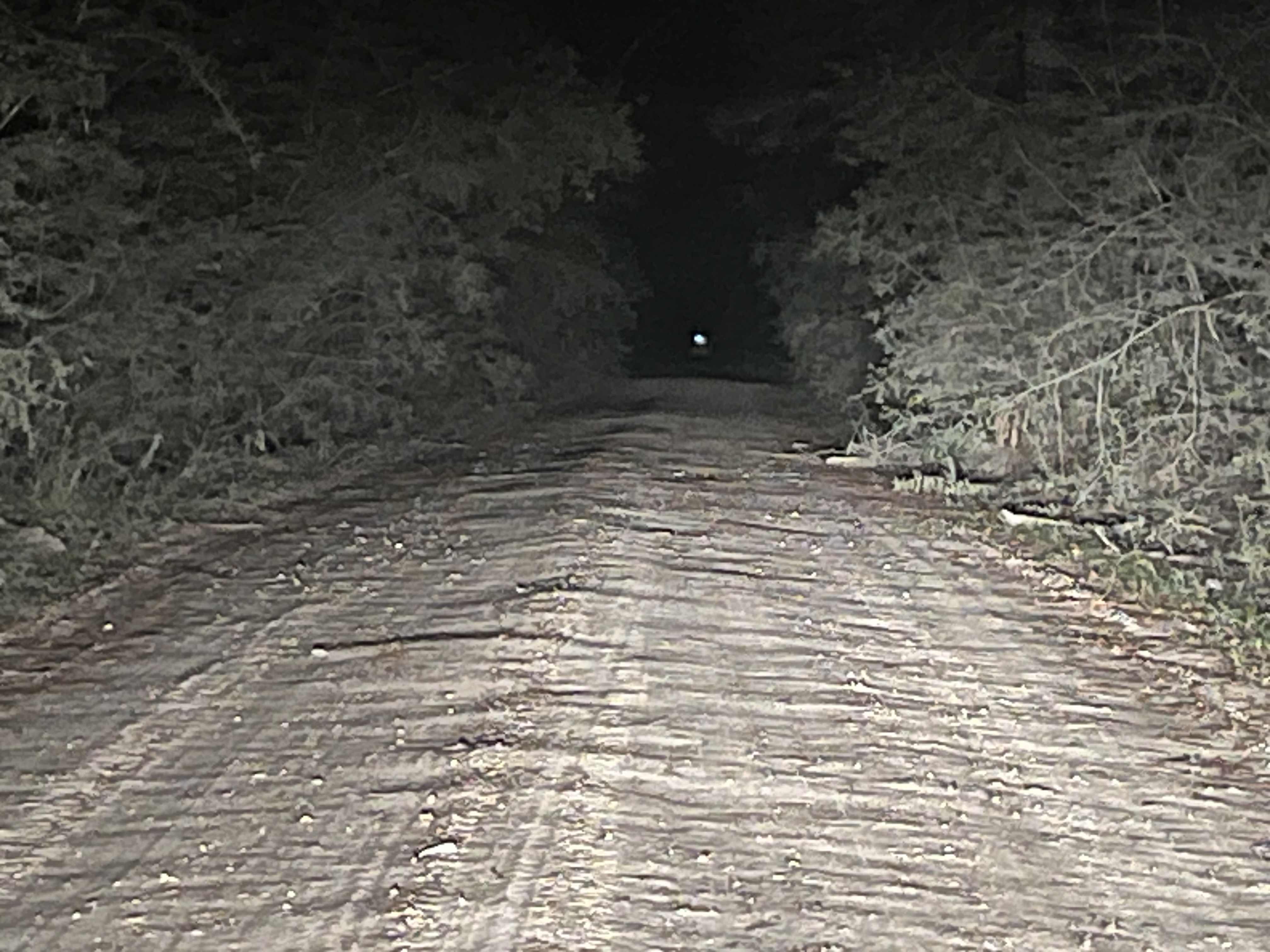
Near Saratoga, Texas·road Bragg Road cuts eight miles through the Big Thicket of Southeast Texas in a line so straight it looks drawn with a ruler, a dirt track running north-south between Farm-to-Market Road 787 near Saratoga and Farm-to-Market Road 1293 near the ghost town of Bragg Station in Hardin County. During the day it is an unremarkable passage through dense piney woods, the canopy closing overhead in a green tunnel, the sandy road wide enough for two cars with a few small turnouts along its length. At night it becomes something else entirely. The trees block out all ambient light. The darkness is absolute. And somewhere down the road, almost every time someone drives it after dark, a light appears—a single orb, roughly the size of a small pumpkin, hovering at an indeterminate distance, shifting in color from pale yellow to green to blue, bobbing gently, approaching and retreating but never arriving. It is called the Light of Saratoga, and it has been reported for over a century.
The road exists because of the railroad. In 1902, the Gulf, Colorado and Santa Fe Railway cut a survey line through the Big Thicket from Bragg Station to Saratoga, bought right-of-way, and laid tracks to serve the booming East Texas oil fields and the timber industry that was stripping the region's longleaf pine. The Saratoga train made daily trips to Beaumont, hauling oil, logs, cattle, and passengers through some of the densest and most inhospitable forest in the American South. The Big Thicket was swamp and wilderness, thick with cypress sloughs, alive with snakes, mosquitoes, and malaria. Railroad crews suffered casualties from accidents and disease, and the work of maintaining the line was brutal. By 1934, the railroad had become obsolete. The rails and ties were pulled up, but the roadbed remained—arrow-straight, flat, and useful enough that it became a link road for local traffic. No one built along it. No one claimed it. The road simply existed, a corridor through darkness that no longer served any industrial purpose.
The ghost light was reported while the tracks were still down. The earliest accounts predate automobile traffic in the area, which eliminates the most common skeptical explanation—that the light is a refraction of headlights from a nearby highway. The highway in question, FM 787, can only be seen from the south end of the road, while the light is typically observed facing north. Reports increased after the rails were removed, and in the summer of 1960, Archer Fullingim, the editor of the Kountze News, began running front-page stories about the phenomenon. Metropolitan newspapers across Texas picked up the coverage, and Bragg Road entered the broader public consciousness as one of the most persistently haunted locations in the state.
The legends that have attached themselves to the light share a common architecture. The most widely told involves a railroad worker—sometimes a brakeman, sometimes a conductor—who was decapitated in a train accident on the Saratoga line. His body was recovered but his head was never found, and the light is his lantern, still swinging as his headless ghost walks the roadbed searching for what was taken from him. A second story involves a newlywed bride who wandered away from a nearby hotel after her wedding and never returned. Her groom seized a lantern and spent every night of his remaining life walking Bragg Road looking for her, and the light is the residue of that search, carried forward past his death. A third, grimmer tale holds that a Mexican road crew was murdered by their foreman rather than paid their accumulated wages. The workers were buried hastily in the dense woods alongside the road, and their restless spirits haunt the ground that cost them their lives.
None of these stories have been historically corroborated. What has been corroborated, by generations of witnesses, is the light itself. Visitors describe it appearing most often in the early evening, hovering at a distance that makes it impossible to judge size or proximity. It shifts color. It moves laterally and vertically in ways inconsistent with a fixed light source. It does not grow larger or brighter as one approaches—a behavior incompatible with oncoming headlights. Some witnesses describe it darting toward their vehicles at startling speed before vanishing. Others watch it bob gently for minutes before winking out. The experience is consistent enough to constitute a rite of passage for East Texans, who have been driving their friends and children out to Bragg Road after dark for as long as anyone can remember.
The scientific explanations are plausible but incomplete. Will-o'-the-wisp—the combustion of swamp gases such as methane and phosphine—is a documented phenomenon in wetlands worldwide, but no laboratory has successfully reproduced it under controlled conditions, and some observers note that Bragg Road does not run through active swampland. Atmospheric refraction of distant light sources is possible along a straight, flat corridor, but the light's behavior does not match the predictable characteristics of refracted headlights. The road is maintained as a park by Hardin County, with weathered historical signs at each end describing the railroad era and the oil boom that brought it into being. Four cemeteries sit in the surrounding woods.
Today, Bragg Road remains open and drivable, though it is unpaved and can become impassable after heavy rain. The nearest town is Saratoga, birthplace of country legend George Jones, roughly sixteen miles west of Kountze. There is no admission, no gate, no guide. You drive in from one end, kill your headlights if you dare, and wait. The peepers sing. The fireflies drift. And somewhere ahead, more often than not, a light appears in the darkness that has no business being there—steady, shifting, patient, and impossible to reach. Whether it belongs to a headless brakeman, a heartbroken groom, a murdered road crew, or a pocket of burning gas that science cannot quite replicate, the Light of Saratoga has been answering the darkness on Bragg Road for over a hundred years, and it shows no sign of going out.
Light Anomalies
Residual Hauntings
Unexplained Sounds