
Haunted Places in Louisville, Kentucky
7 haunted locations
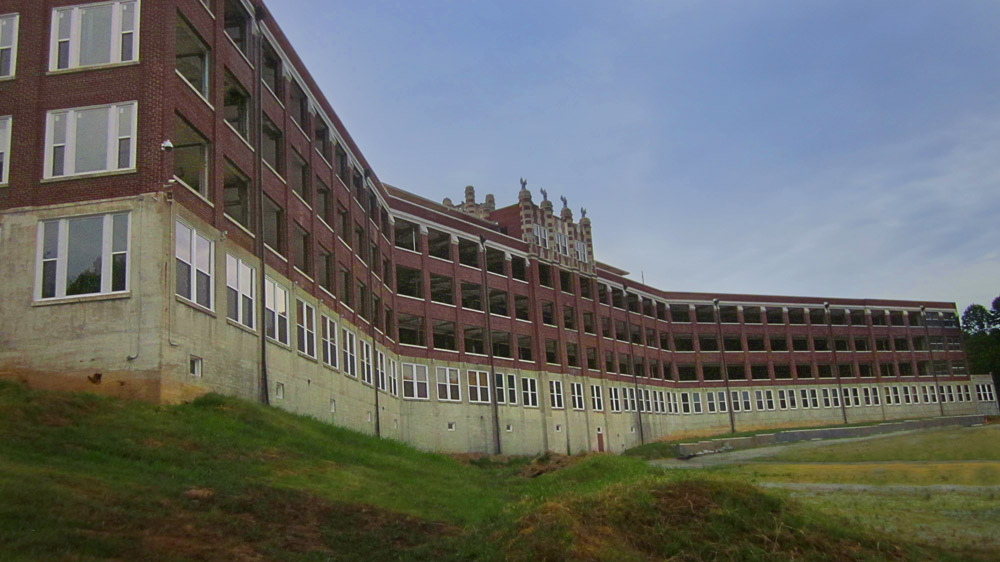
Waverly Hills Sanatorium
Rising from a windswept hill on the south side of Louisville, Kentucky, Waverly Hills Sanatorium looks exactly like what most people picture when they think of a haunted hospital—a massive Tudor Gothic structure with long sun-bleached corridors, cavernous open wards, and an elevation that keeps it visible and isolated all at once. But Waverly Hills wasn't built with darkness in mind. It was built out of desperation, as a response to one of the deadliest disease outbreaks an American city had ever faced. In the early 1900s, Louisville had the highest tuberculosis death rate in the entire country. Nestled in the Ohio Valley along the wetlands of the Ohio River, the city was a near-perfect environment for the disease to spread. To try to contain it, a Board of Tuberculosis Hospital was established in 1906, and a two-story wooden facility opened on the hill in 1910, capable of holding around 40 to 50 patients. As the epidemic worsened, that structure proved woefully inadequate. Construction on a permanent five-story building began in 1924, and the new Waverly Hills opened in 1926—considered at the time to be the most advanced tuberculosis sanatorium in the country. Unlike locations tied to a single act of violence, Waverly Hills carries the weight of prolonged suffering. Patients arrived knowing they might not leave. Treatments of the era were brutal by any measure—surgical procedures to collapse and expand the lungs, removal of ribs and chest muscles, experimental interventions that killed as often as they cured. Fresh air was considered therapeutic, so patients were positioned on open porches in all weather, including winter. Old photographs show men and women bundled in chairs, dusted in snow, staring out over Louisville. Many of them died there. When antibiotic streptomycin finally brought tuberculosis under control, Waverly Hills closed in 1961 with its work done but its halls saturated with decades of illness and death. The building itself is disorienting in scale. Five floors of open corridors stretch across the hilltop, with patient rooms branching off in long rows. The solarium porches jut from the exterior, still open to the sky. Deep in the building's lower section runs what staff called the body chute—an enclosed tunnel leading down the hillside to the railroad tracks below, used to transport the dead away from the facility without demoralizing the living patients above. It remains one of the most viscerally unsettling features of any historic building in the country. Peeling paint, rusted hardware, and collapsing plaster fill the interior, while the structural bones remain largely intact. Paranormal claims at Waverly Hills are among the most extensively documented of any location in the United States. Investigators and visitors report shadow figures moving through doorways, disembodied voices in the stairwells, and the sounds of footsteps trailing through otherwise empty wards. EVP sessions frequently yield responses that investigators describe as intelligent and direct. Some guests report being physically touched or experiencing sudden waves of dread in certain rooms without any obvious explanation. Room 502 on the top floor draws particular attention—the site of an alleged nurse suicide that has circulated in local legend for decades. The body chute produces some of the most consistent reports of any area, with visitors describing feelings of being followed, cold spots, and shadows moving along the tunnel walls. On the upper floors, investigators commonly report equipment failures, sudden battery drains, and apparitions near the open solarium windows. The reports span casual tourists and seasoned paranormal teams alike, and the consistency across unrelated accounts is difficult to dismiss. Skeptics reasonably point out that a massive deteriorating structure will generate sounds, pressure shifts, and visual anomalies on its own. The history of suffering embedded in Waverly Hills is well documented and powerful enough to shape perception before a visitor ever sets foot inside. Suggestion and atmosphere account for much. But even investigators who arrive with clinical skepticism tend to leave describing something harder to categorize than building noise and expectation. Today Waverly Hills is operated by owners Tina and Charlie Mattingly, who purchased the property in 2001 and have dedicated themselves to its restoration. It is listed on the National Register of Historic Places and draws thousands of visitors each year for historical tours, paranormal investigations, and overnight stays. The body chute is accessible. The corridors are walkable. Room 502 is just up the stairs. Whether you come for the architecture, the medical history, or the unexplained, Waverly Hills offers something few historic sites can match—a place where the past doesn't feel past at all, and where the silence between footsteps has a weight all its own.
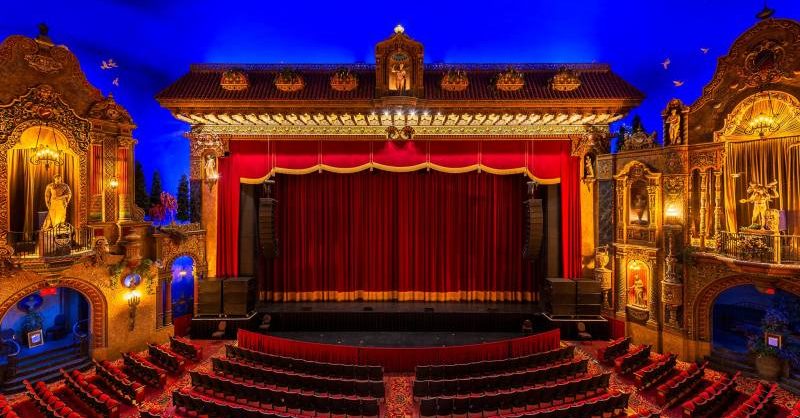
Louisville Palace Theater
Standing on the east side of South Fourth Street in downtown Louisville, the Louisville Palace announces itself before you ever reach the door. Castle-like towers flank a copper-domed marquee blazing the word PALACE in synchronized light. Terra-cotta niches, cartouches, and finials crawl across the Churrigueresque facade in a riot of Spanish Baroque ornamentation that feels closer to a fever dream of old Madrid than a Kentucky movie house. That disorienting grandeur is entirely intentional. It was designed that way from the beginning to pull you out of your life the moment you arrived. Architect John Eberson — an Austrian immigrant trained in electrical engineering who found his calling building fantastical movie palaces across America — designed the building in 1928 for Loew's and United Artists as a first-run cinema seating 3,300. Eberson called his style "atmospheric theater." His theory was that audiences should feel transported before the film even started, and the Louisville building delivers on that completely. Step through the front doors and you enter what reads as an elaborate Spanish courtyard open to the night sky. The barrel-vaulted ceiling overhead is painted midnight blue and studded with lights positioned after a photograph in National Geographic to approximate actual stars. Over 500 plaster statues and reliefs populate the walls and alcoves. The mezzanine Faces Lobby is lined with 139 sculpted busts of historical figures — composers, philosophers, writers — gazing down from every surface. The original 1,000-pipe Wurlitzer organ was still in place at opening night on September 1, 1928, when Eberson himself attended, accompanied by a live macaw, the Loew's company mascot. It was immediately heralded by the Louisville Courier-Journal as an architectural marvel. For decades the Palace was the premier entertainment destination on Fourth Street, which the locals called Theater Square. Frank Sinatra performed there in 1941 during his early career. Ray Charles appeared in 1959. Al Capone, legend holds, frequented the theater during Prohibition, traveling there from the Seelbach Hotel through underground steam tunnels beneath the city. The building carried Louisville's glamour through the post-war era before the familiar forces of suburban flight and multiplex competition hollowed out downtown entertainment districts everywhere. The Palace went dark in the 1970s, was briefly reborn in 1981 under local businessman John Siegel's ambitious $4.4 million restoration, then closed again in 1985 when the costs of maintaining a century-old atmospheric theater outran the revenue. Siegel eventually declared bankruptcy. The building sat in fragile limbo until Sunshine Theater Inc. brought it back in 1994. Live Nation has owned it since 2005, and it operates today as a 2,800-seat concert and event venue — the only surviving movie palace of its era in the city, listed on the National Register of Historic Places since 1978. The paranormal claims here are numerous, specific, and consistently reported by staff, workers, and visitors across multiple decades. The most documented figure is Ferdinand Frisch, a theater employee who died in the building in 1965. During the 1990s restoration, workers began encountering an older man in work clothes, flat-top haircut, and outdated eyeglasses appearing at various points throughout the building — sitting in the balcony watching workers on stage, standing in corners, observed by multiple unrelated crew members. Tools were moved. Voices were heard in empty spaces. One painter who fell asleep on scaffolding near a high ceiling was woken by a voice speaking directly in his ear, and found himself dangerously close to the edge. His name has reportedly been found scratched into the dust in the basement. Current staff refer to him as Bernie, and the projection booth — where a separate apparition, believed to be a projectionist who suffered a fatal heart attack on the job, is also reported — remains one of the most consistently active areas in the building. The Grand Staircase leading to the mezzanine lobby has its own persistent figure: a faceless woman in 1940s clothing, seen climbing the stairs, who vanishes before she reaches the top. A man in 1930s attire has been spotted repeatedly in the balcony by ushers; when approached, he disappears. The Ladies' Parlor bathroom has generated reports of a child giggling, and a production manager arriving to lock up alone one night reported hearing running footsteps, searching the building and finding it empty, then being physically shoved from behind as he headed for the exit — followed by the sound of two children laughing and running away. The theater's marketing manager has publicly described seeing the Grey Lady: a translucent female figure walking four or five paces in the lobby before simply ceasing to exist mid-step. She noted that nearly every member of the facilities staff has had their own encounter with the same figure. The Louisville Palace is open for performances year-round. The stars on the ceiling still burn. The faces in the lobby still watch. And the people who work there after the crowds leave have stopped being surprised by what shares the building with them.

The Seelbach Hilton Louisville
The Seelbach Hilton Louisville stands as a distinguished hotel property in Louisville, Kentucky, combining historic architectural significance with contemporary hospitality services while serving as the permanent residence of one of paranormal research's most thoroughly documented female entities. Originally constructed in the early twentieth century, the Seelbach Hotel represented the pinnacle of luxury and sophistication, featuring ornate architectural details, premium accommodations, and amenities that attracted distinguished guests from across America and internationally. The building's classical design incorporates elements reflecting the aesthetic preferences of its era, with marble appointments, detailed millwork, and spatial arrangements reflecting the architectural aspirations of the Gilded Age. The hotel has maintained its position as a significant Louisville landmark, adapting to changing hospitality expectations while preserving the essential architectural character that distinguishes it from more recently constructed properties. The physical plant of the Seelbach Hilton encompasses multiple guest floors distributed across several stories, with numerous individual rooms arranged along corridors accessed by elevators and staircases. The seventh floor has become particularly associated with paranormal phenomena, with manifestations extending throughout the facility and concentrating in the elevator shaft area and surrounding hallways. The elevator system itself has become a focal point for paranormal activity, with multiple witnesses reporting unusual experiences related to elevator movement and door operation. The building's architectural complexity creates an environment where paranormal phenomena have been extensively documented and catalogued by paranormal researchers working in collaboration with hotel management. The most prominent paranormal phenomenon at the Seelbach Hilton involves the entity known as the Lady in Blue, identified through historical research as Patricia Wilson, whose violent death in 1936 established the foundation for one of America's most comprehensively documented paranormal cases. Patricia Wilson was shot by her estranged husband in a crime of passion, establishing the catalyst for her enduring spiritual presence within the hotel. Her apparition has been encountered by numerous witnesses across the decades, appearing as a full-body manifestation dressed in a distinctive blue gown, with sufficient clarity to enable detailed physical descriptions. The Lady in Blue has been reported moving through hallways with deliberate purpose, appearing in the elevator shaft as if trapped in eternal patrol, and materializing in guest rooms where visitors report encounters ranging from benign observation to interactive phenomena. Guests have communicated with the apparition, describing responses suggesting awareness of contemporary visitors. The Seelbach Hilton Louisville represents a singular case in paranormal research, where a location's haunting has been extensively documented and integrated into the facility's identity as a historical and paranormal destination. The identity of the Lady in Blue, confirmed through decades of research, distinguishes this location from other haunted properties where entities remain unidentified. The hotel continues to attract paranormal researchers and tourists seeking contact with documented phenomena while maintaining its function as a premier hospitality destination. The Seelbach Hilton exemplifies how paranormal phenomena and historical tragedy become integrated into a location's identity, ensuring Patricia Wilson's presence persists across nearly a century following her violent death.
Old Louisville
Old Louisville stands within the city of Louisville, Kentucky as the largest collection of Victorian architecture in the United States, a sprawling neighborhood where hundreds of nineteenth-century mansions, estates, and townhouses form a dense architectural palimpsest of American prosperity, elegance, and urban history. The neighborhood's sheer density of Victorian-era structures—the highest concentration in the nation—creates an environment where the accumulated weight of centuries of human experience has allegedly imprinted itself upon the physical landscape in such intensity that Old Louisville has earned the designation as not merely a haunted neighborhood but as the spookiest neighborhood in the entire country. The neighborhood's reputation extends far beyond regional paranormal circles, achieving national recognition as one of America's most haunted locations and drawing paranormal researchers, ghost hunters, and the simply curious from across the country to walk its gas-lit streets. The history of Old Louisville extends back to the nineteenth century when Louisville emerged as an important American city, and wealthy merchants, industrialists, and professionals invested their fortunes in constructing magnificent homes that reflected their status and taste. The area flourished throughout the late 1800s and early 1900s, becoming a neighborhood where families established generational wealth and social prominence. The architectural style of the neighborhood—Victorian, with its emphasis on ornate detail, multiple stories, and romantic sensibility—combined with the concentration of wealth and activity created an environment of human intensity. As the twentieth century progressed and demographic patterns shifted, many of the grand homes passed out of single-family ownership, becoming rooming houses, apartments, or eventually falling into disrepair. This transition from prosperous residential neighborhood to economically depressed area added layers of tragedy and loss to the physical landscape, as fortunes declined, families scattered, and the neighborhood's golden age became a matter of historical record rather than lived experience. The paranormal reputation of Old Louisville is not centralized in any single structure or location but distributed across the entire neighborhood, with multiple haunted sites forming a network of interconnected paranormal hotspots. Award-winning ghost tours operate throughout the neighborhood, with professional tour operators conducting nightly tours beginning at 7:30 PM, taking visitors on carefully researched routes through the district's most actively haunted locations and sharing accounts of the spirits and paranormal phenomena documented there. The existence of regular, professionally conducted paranormal tours speaks to both the volume of documented activity and the tourist appeal of the neighborhood's supernatural reputation. The tours themselves have become part of the cultural fabric of Louisville, representing a significant draw for visitors interested in paranormal history and American architecture. The apparitions and supernatural phenomena reported throughout Old Louisville reveal a neighborhood haunted by multiple distinct entities and presences, each with particular characteristics and localized manifestations. Witnesses have reported encounters with Victorian spirits—apparitions dressed in period clothing moving through streets and buildings with apparent purpose or melancholy. A particularly notable entity has been described as a woman who possesses the apparent ability to shapeshift or transform into a black cat, manifesting in one form and then appearing as the other, defying conventional understanding of how spiritual entities interact with physical form. This extraordinary phenomenon suggests either a spirit with unusual metaphysical capabilities or a psychological phenomenon where witnesses' perceptions are so influenced by expectation that they interpret shadows and movements through particular frameworks. Alternatively, the phenomenon may represent a genuine capability of certain spirits to manipulate their appearance or the perceptions of the living. A cloaked figure—a man whose form remains largely obscured by his garments—has been reported in multiple locations throughout the neighborhood, appearing in alleyways and streets, sometimes approaching witnesses before vanishing. The figure's consistent appearance and multiple independent reports from different locations suggest a genuine paranormal presence rather than misidentification or folklore. The anonymity created by the cloak—obscuring identity, specific features, and intention—creates an additional layer of mystery and unease in witness accounts. Shadow figures, darker silhouettes without distinct features or form, have been reported in numerous locations throughout Old Louisville, representing a category of paranormal manifestation that researchers have associated with either residual haunting energy or entities that lack sufficient energy to maintain fully formed apparitions. The supernatural activity reported in Old Louisville manifests not merely as visual apparitions but as multiple distinct phenomena that suggest a neighborhood saturated with paranormal activity of different types and origins. Unexplained sounds—footsteps in empty buildings, disembodied voices, the sounds of parties and social gatherings occurring when no events are scheduled or possible—suggest residual haunting energy from the neighborhood's prosperous past being replayed repeatedly. Poltergeist activity, including the movement of objects, the opening and closing of doors and windows, and the manipulation of physical objects by unseen forces, has been documented in multiple locations. The cumulative effect of these phenomena creates a neighborhood where the living and the dead appear to occupy the same space, with paranormal activity occurring with sufficient frequency and consistency that Old Louisville residents and visitors have developed a matter-of-fact relationship with their supernatural neighbors. The academic and historical study of Old Louisville has generated extensive documentation of both the neighborhood's architectural heritage and its paranormal phenomena. Books have been published documenting the paranormal hauntings specifically, providing comprehensive accounts of individual haunted locations, the spirits that inhabit them, and the historical events that may have triggered their manifestations. This scholarly attention has elevated Old Louisville beyond anecdotal ghost stories to a location worthy of serious paranormal study and historical investigation. The neighborhood's status as the site of the most concentrated paranormal activity in a single American neighborhood has made it a destination for paranormal researchers seeking to understand the conditions that facilitate spirit manifestation and the mechanisms by which the dead remain present in the spaces they once inhabited. Today, Old Louisville continues to serve as both a living neighborhood and a paranormal destination. Restoration efforts have begun to preserve and rehabilitate the Victorian mansions, returning the neighborhood to some of its former glory while simultaneously intensifying the layering of old and new, past and present. The neighborhood's residents, businesses, and visitors maintain an awareness of its paranormal reputation while engaging with it at varying levels of belief and skepticism. The regular ghost tours, the paranormal investigation groups that conduct nighttime investigations throughout the district, and the growing body of documentation about the neighborhood's supernatural phenomena have established Old Louisville as one of America's most important and accessible locations for studying the intersection of history, architecture, and the paranormal. For Louisville residents and visitors alike, Old Louisville represents a unique urban landscape where the past refuses to remain historical—where the spirits of the Victorian era walk the gas-lit streets alongside the living, their presence acknowledged, documented, and woven into the neighborhood's contemporary identity.
Lady of the Stairs – First Church of Christ Scientist
The First Church of Christ Scientist in Louisville, Kentucky, represents an elegant and historically significant religious structure situated in the Old Louisville neighborhood, a district of the city characterized by distinctive Victorian-era architecture and significant cultural heritage. The church building itself reflects the architectural and aesthetic principles of Christian Science institutional design, combining functional religious program spaces with architectural elements reflecting the spiritual and intellectual foundations of the denomination. The structure incorporates a prominent internal staircase system serving as a central organizing element within the building's spatial hierarchy, with the main stairs providing both practical circulation connecting the various levels of the building and serving as a visually prominent architectural feature within the interior space. The building's location within the Old Louisville neighborhood positions it within a district long recognized for its historical depth, architectural significance, and accumulation of diverse historical narratives spanning multiple centuries of the city's development. The church structure stands as a monument to both religious practice and architectural craftsmanship, representing the material investment of the Christian Science community in establishing a prominent institutional presence in Louisville. The paranormal phenomenon most prominently associated with the First Church of Christ Scientist is the manifestation commonly known as the Lady of the Stairs, an apparition documented through multiple generations of witnesses and preserved in local historical traditions and paranormal research documentation. The entity is identified through various sources and investigations as possibly being Ms. G or Miss Gathright, though definitive identification of the historical individual represented by the apparition remains uncertain. The apparition manifests visually as a female figure dressed in white gown attire complemented by a grey silk shawl, creating an appearance consistent with early twentieth century or late nineteenth century women's fashions. The entity appears to be concentrated in the vicinity of the church's staircase, particularly the prominent main stairs that serve as the primary vertical circulation within the structure. The apparition does not appear to be hostile or threatening in character, but rather exhibits demeanor suggesting emotional distress, melancholy, and psychological anguish rather than aggressive intent. The behavioral patterns documented in the manifestations of the Lady of the Stairs suggest an entity engaged in repetitive actions or emotional expressions rather than purposefully communicating with living individuals. The apparition is most frequently observed in the act of pacing along the staircase, moving up and down the steps in patterns that may represent reenactment of routines from the entity's life or manifestation of emotional agitation. Witnesses have reported perceiving the apparition as weeping, suggesting that the spirit maintains emotional states and expressions consistent with profound sorrow or distress. The concentration of paranormal activity in the staircase location suggests either that a significant event or tragedy occurred at that location within the building or that the entity maintains particular attachment to that specific spatial location within the structure. The repetitive nature of the manifestations, combined with the emotional character of the apparition's apparent expressions, suggests what paranormal researchers classify as a residual haunting. Historical investigation into the background of the Lady of the Stairs apparition has attempted to identify the specific historical individual represented by the entity and to determine the circumstances that may have resulted in the spirit's attachment to the church location. The apparition's visual presentation in nineteenth or early twentieth century female attire suggests that the individual may have died during that historical period. The concentration of the apparition in the staircase location may indicate that a fall from the stairs resulted in fatal injury, a suicide occurring at that location, or another tragic event associated with the staircase. The name Ms. G or Miss Gathright, though not definitively confirmed, may represent historical documentation of an individual associated with the church or the neighborhood. The Lady of the Stairs has become a legendary figure within Old Louisville's paranormal history, attracting paranormal investigators and individuals interested in the city's historical and spiritual dimensions. The apparition continues to be reported by visitors to the church structure.
Belle of Louisville
The Belle of Louisville stands as a monumental achievement in American riverboat construction and design, a fully operational paddlewheel steamboat that represents the pinnacle of nineteenth-century river commerce technology and aesthetic sensibility. Launched into service as a functioning vessel designed to transport cargo and passengers along the Ohio River and connecting waterways, the Belle embodied the sophisticated engineering and architectural principles that distinguished the finest riverboat constructions of its era. The vessel's design incorporates the characteristic features of classic American paddlewheel steamboats—the distinctive side or stern paddlewheel, the multi-deck configuration allowing for both cargo and passenger accommodation, and the ornamental detailing that elevated functional vessels into expressions of commercial pride and aesthetic achievement. The pilot house commands a position of particular prominence atop the vessel, from which the captain and navigators exercised control over the boat's movements and direction, a space laden with the responsibility of safe passage through often treacherous river conditions. The main wheel mechanism represents the mechanical heart of the vessel, the sophisticated apparatus through which the paddlewheel's rotations propelled the substantial craft through the water. The Belle of Louisville has survived successive periods of riverboat transportation history, remaining in continuous or near-continuous operation across changing commercial circumstances and evolving nautical traditions. The operational history of the Belle of Louisville spans more than a century and a half of service upon American waterways, a tenure marked by the transportation of countless passengers and vast quantities of freight, the navigation of treacherous river conditions, and the establishment of the vessel as an iconic presence within American cultural consciousness regarding river commerce and transportation. The crew members who operated the vessel across these extended years represented a specialized workforce skilled in the demanding profession of riverboat operation, individuals whose expertise and labor sustained the Belle's service and safety. The captain who commanded the vessel during significant periods of its operation—Captain Ben Winters—embodied the authority, knowledge, and judgment required to navigate the complex challenges of river traffic and natural hazard. The relationship between captain and vessel creates profound bonds of responsibility and connection, emotional attachments that embed the individual within the ship's identity and operational continuity. The passenger accommodations and public spaces aboard the Belle facilitated the temporary intimacy of shared travel, creating relationships and memories that became encoded within the vessel's social and emotional atmosphere. Yet beneath the Belle's operational success and iconic status lies a darker history of tragedy and loss that would reshape the vessel's paranormal geography and establish its reputation as one of America's most actively haunted steamboats. The operational demands and mechanical complexity of riverboat service created inherent dangers for crew members, risks that materialized in tragic circumstances involving worker deaths directly attributable to the vessel's mechanical systems. A worker was killed when caught or crushed by the paddlewheel, a catastrophic event in which the vessel's primary mechanical apparatus became an instrument of sudden death, transforming the main wheel from mere mechanical device into a site of tragedy encoded with suffering and loss. This death—and the broader context of worker casualties associated with riverboat service—created an emotional and spiritual imprint upon the vessel's physical structure, binding the consciousness of the deceased worker to the location of his death with unusual persistence. The tragedy appears to have occurred within the context of the vessel's ordinary operations, suggesting that danger and death were integral features of the occupational hazards that accompanied riverboat employment during the period of the Belle's active commercial service. The paranormal manifestations documented aboard the Belle of Louisville present an unusually complex and multifaceted haunting involving the apparitions and continued presence of multiple distinct entities, each apparently bound to specific locations and engaged in distinctive forms of supernatural interaction. The apparition of Captain Ben Winters has been encountered within the pilot house and upper decks, suggesting a continued presence bound to the location of his command and authority, a consciousness perhaps unable or unwilling to relinquish the connection to the vessel he once controlled. The manifestation of the crushed worker—whose death upon or near the paddlewheel marked a traumatic moment in the vessel's operational history—remains concentrated near the main wheel mechanism and the mechanical systems associated with the paddlewheel apparatus, suggesting a spiritual presence bound to the location of death with particular intensity. These distinct entities appear to engage in various forms of supernatural activity observable to sensitive or attentive visitors and crew members aboard the vessel. The documented experiences aboard the Belle of Louisville encompass a comprehensive spectrum of paranormal phenomena extending throughout the vessel and contributing to its reputation as one of America's most actively haunted ships. Apparition sightings have been reported by numerous witnesses observing full-bodied manifestations of distinct individuals whose appearances and behavioral patterns suggest specific identities bound to the vessel's history. Cold spots have been documented in various areas of the vessel, localized temperature anomalies suggesting the presence of supernatural energy or consciousness engaged in physical interaction with the environment. Disembodied voices have been recorded by investigators and reported by visitors, vocalizations arising from empty spaces without visible source, creating an environment where communication from beyond may occur. Doors and objects have been observed moving without conventional explanation, suggesting supernatural interaction with the physical environment. Unexplained sounds—mechanical noises, footsteps, creaking of the vessel's structure—occur with sufficient frequency to have become recognized features of the Belle's paranormal reputation. The pervasive sense of being watched reported by many aboard the vessel suggests the presence of attentive consciousness or consciousness observing the activities of the living, creating an environment of supernatural vigilance and presence. The cumulative effect of these phenomena has established the Belle of Louisville as one of the most comprehensively haunted vessels in American maritime history, a location where the boundary between past and present, life and death, remains remarkably permeable and accessible.
Phoenix Hill Tavern
The Phoenix Hill Tavern in Louisville, Kentucky evolved from nineteenth-century origins into a prominent neighborhood gathering place that served as a social and cultural anchor for the surrounding community. Built during Louisville's period of industrial expansion and economic growth, the tavern served as a social cornerstone where diverse patrons gathered for conversation, refreshment, and social bonding. The structure incorporated architectural conventions of its era, balancing functionality with aesthetic sensibility appropriate to public establishments, reflecting the craftsmanship standards of its construction period. The venue experienced significant decline by the mid-twentieth century before undergoing transformative renovation in 1976 that would prove remarkably consequential for the establishment's future. This reinvention proved remarkably successful, establishing Phoenix Hill as a destination bar and music venue that attracted visitors from across the region. For eight consecutive years, the establishment earned Louisville's prestigious Best of Louisville award, recognized for exceptional quality, community investment, and cultural significance. The venue became known for live music performances and the spirited atmosphere that builds community identity and loyalty around a specific location, creating memories and traditions for patrons. However, economic shifts and changing entertainment preferences eventually impacted even this successful establishment despite its strong community connections and established reputation. In 2015, the tavern closed its doors after decades of successful operation and cultural prominence within Louisville's entertainment landscape. By 2017, the building itself was demolished, erasing the physical structure despite its cultural significance, documented history, and long operational record. The Phoenix Hill Tavern's paranormal reputation, established during operational years through documented investigations, remains carefully preserved within paranormal research archives and ghost tour narratives that continue to reference the location. Staff and patrons consistently reported distinctive phenomena centered in specific locations throughout the establishment. The staircase proved particularly active paranormally, with disembodied footsteps descending deliberately at regular intervals, particularly during late evening hours when the establishment was closed. These purposeful, consistent footsteps suggested a familiar entity traversing spaces it knew intimately during its lifetime, moving with deliberate intent and familiarity. The spirit of Fred Frisch, a former bartender with profound emotional connection to the establishment, appears responsible for consistent paranormal activity documented by multiple independent witnesses. Frisch harbored deep attachment to the tavern, viewing it as central to his identity, personal meaning, and daily existence. His spirit appears anchored to the location, continuing manifestations even after his physical death. Objects move mysteriously in the bar area, bottles shift position on shelves, glasses relocate without intervention, and materials disappear only to reappear unexpectedly in different locations. These phenomena were characterized as mischievous rather than malevolent, suggesting a spirit seeking attention and acknowledgment rather than expressing anger or hostility. Cold spots manifested throughout the tavern, particularly in the stairwell and bar area, where ambient temperature dropped sharply without apparent cause. Patrons reported feeling touched by unseen hands while seated at the bar or moving through dining areas. The phenomena seemed to escalate during busy periods, suggesting the spirit drew energy from human presence and activity.