
Haunted Places in Kentucky
67 haunted locations
Waverly Hills Sanatorium
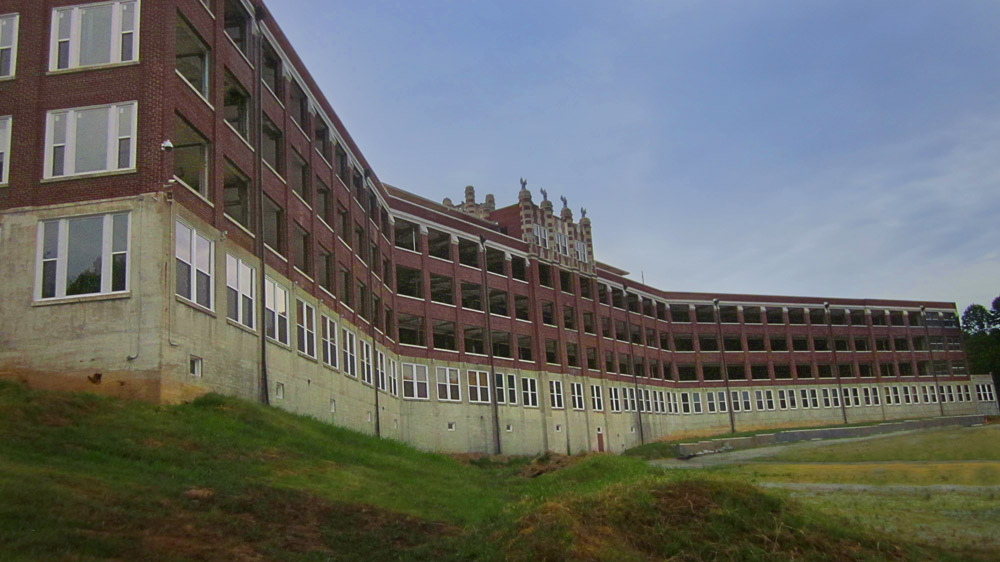
Rising from a windswept hill on the south side of Louisville, Kentucky, Waverly Hills Sanatorium looks exactly like what most people picture when they think of a haunted hospital—a massive Tudor Gothic structure with long sun-bleached corridors, cavernous open wards, and an elevation that keeps it visible and isolated all at once. But Waverly Hills wasn't built with darkness in mind. It was built out of desperation, as a response to one of the deadliest disease outbreaks an American city had ever faced. In the early 1900s, Louisville had the highest tuberculosis death rate in the entire country. Nestled in the Ohio Valley along the wetlands of the Ohio River, the city was a near-perfect environment for the disease to spread. To try to contain it, a Board of Tuberculosis Hospital was established in 1906, and a two-story wooden facility opened on the hill in 1910, capable of holding around 40 to 50 patients. As the epidemic worsened, that structure proved woefully inadequate. Construction on a permanent five-story building began in 1924, and the new Waverly Hills opened in 1926—considered at the time to be the most advanced tuberculosis sanatorium in the country. Unlike locations tied to a single act of violence, Waverly Hills carries the weight of prolonged suffering. Patients arrived knowing they might not leave. Treatments of the era were brutal by any measure—surgical procedures to collapse and expand the lungs, removal of ribs and chest muscles, experimental interventions that killed as often as they cured. Fresh air was considered therapeutic, so patients were positioned on open porches in all weather, including winter. Old photographs show men and women bundled in chairs, dusted in snow, staring out over Louisville. Many of them died there. When antibiotic streptomycin finally brought tuberculosis under control, Waverly Hills closed in 1961 with its work done but its halls saturated with decades of illness and death. The building itself is disorienting in scale. Five floors of open corridors stretch across the hilltop, with patient rooms branching off in long rows. The solarium porches jut from the exterior, still open to the sky. Deep in the building's lower section runs what staff called the body chute—an enclosed tunnel leading down the hillside to the railroad tracks below, used to transport the dead away from the facility without demoralizing the living patients above. It remains one of the most viscerally unsettling features of any historic building in the country. Peeling paint, rusted hardware, and collapsing plaster fill the interior, while the structural bones remain largely intact. Paranormal claims at Waverly Hills are among the most extensively documented of any location in the United States. Investigators and visitors report shadow figures moving through doorways, disembodied voices in the stairwells, and the sounds of footsteps trailing through otherwise empty wards. EVP sessions frequently yield responses that investigators describe as intelligent and direct. Some guests report being physically touched or experiencing sudden waves of dread in certain rooms without any obvious explanation. Room 502 on the top floor draws particular attention—the site of an alleged nurse suicide that has circulated in local legend for decades. The body chute produces some of the most consistent reports of any area, with visitors describing feelings of being followed, cold spots, and shadows moving along the tunnel walls. On the upper floors, investigators commonly report equipment failures, sudden battery drains, and apparitions near the open solarium windows. The reports span casual tourists and seasoned paranormal teams alike, and the consistency across unrelated accounts is difficult to dismiss. Skeptics reasonably point out that a massive deteriorating structure will generate sounds, pressure shifts, and visual anomalies on its own. The history of suffering embedded in Waverly Hills is well documented and powerful enough to shape perception before a visitor ever sets foot inside. Suggestion and atmosphere account for much. But even investigators who arrive with clinical skepticism tend to leave describing something harder to categorize than building noise and expectation. Today Waverly Hills is operated by owners Tina and Charlie Mattingly, who purchased the property in 2001 and have dedicated themselves to its restoration. It is listed on the National Register of Historic Places and draws thousands of visitors each year for historical tours, paranormal investigations, and overnight stays. The body chute is accessible. The corridors are walkable. Room 502 is just up the stairs. Whether you come for the architecture, the medical history, or the unexplained, Waverly Hills offers something few historic sites can match—a place where the past doesn't feel past at all, and where the silence between footsteps has a weight all its own.

Gratz Park Inn
Tucked into the corner of Second and Upper streets in downtown Lexington, Kentucky, just steps from the green canopy of Gratz Park, the building now known as the Sire Hotel—but remembered by most locals as the Gratz Park Inn—sits quietly among some of the oldest and most storied ground in the Bluegrass. The surrounding historic district occupies land first laid out in 1781 by order of the Virginia Assembly, and by the late eighteenth century the neighborhood had already begun its long accumulation of wealth, ambition, tragedy, and memory. Transylvania University, one of the oldest institutions of higher learning west of the Alleghenies, established its campus here in 1793. The park itself served as a Civil War bivouac for both Union and Confederate troops, and the Federal and Greek Revival homes lining its edges housed some of Lexington's most prominent—and most troubled—families. The building at 120 West Second Street was constructed around 1916 and opened in 1920 as the Lexington Clinic, a group medical practice modeled after the Mayo Clinic. What began as a modest venture among three physicians eventually grew to house nine doctors and expanded facilities, including surgical suites and, notably, a basement morgue complete with drainage scuppers that remain in the building to this day. The clinic served central Kentucky for decades before outgrowing its original home and relocating to Harrodsburg Road in the late 1950s. After the physicians departed, the Fuller Engineering firm occupied the structure through the mid-1970s, and the building sat largely underused until the 1980s, when developers converted it into the Gratz Park Inn—a boutique hotel that opened in 1988 and quickly became Lexington's only historic lodging property. The conversion from medical facility to intimate hotel preserved much of the building's original architecture, but it also appears to have preserved something less tangible. Staff and guests began reporting unusual encounters not long after the inn opened, and over the years a small but remarkably consistent cast of recurring figures emerged from the accounts. The most frequently described are three entities said to be linked to the building's years as a clinic—former patients, according to local tradition, who died within its walls and never fully departed. The spirit known as John is described as a mischievous older man with a sense of humor, known for switching televisions on and off in guest rooms and occasionally manifesting as a melancholy figure on the lower level. Little Annie, as she has come to be called, is reported as a young girl seen playing with a doll or jacks in the third-floor hallway, her footsteps sometimes heard running and then abruptly stopping outside occupied rooms. One guest, staying in what they believed was room 207, described waking to the sound of small footsteps approaching the bed—slow, deliberate, as if trying not to be noticed—before the steps broke into a child's sprint back toward the hallway when the guest removed their sleep mask. The front desk staff reportedly logged the encounter in a ledger kept for such reports. The third recurring presence is the Lady in White, an apparition of a woman in a white dress and matching hat who has been seen drifting through the halls and the atrium, described by witnesses as appearing to search for someone or something. Guests have also reported the sound of a woman walking in high heels through the atrium area, unexplained laughter emanating from room 216, levitating objects, and the apparitions of what appear to be rowdy, intoxicated partygoers from another era materializing briefly before vanishing. The building's medical past lends a particular gravity to these claims. The basement morgue, though no longer in active use, still bears the physical evidence of its original purpose, and the knowledge that patients lived, suffered, and died in the very rooms now occupied by hotel guests gives the reported activity a plausibility that pure legend would struggle to achieve. The Blue Grass Trust for Historic Preservation once conducted its Gratz Park Ghost Tails and Tours through the surrounding neighborhood, and the inn featured prominently in the route. Today, MK Paranormal leads ghost walks through the district, and the Gratz Park Inn remains a regular stop on haunted Lexington itineraries. The building was sold in the late 2010s and underwent a full renovation, reopening as the Sire Hotel under the Hilton Tapestry Collection. The 42 rooms were gutted and redesigned with modern finishes and equestrian-themed touches befitting Lexington's thoroughbred culture. The structural bones remain, though—the same hallways, the same third floor, the same basement. Whether the renovation disturbed or displaced whatever had settled into the old clinic is a question the new ownership has not publicly addressed. But the reports that preceded the transformation were consistent enough, and came from enough unrelated sources, that the building's reputation is unlikely to be stripped away as easily as the wallpaper. The Gratz Park district remains one of the most concentrated clusters of reported paranormal activity in the Commonwealth, and the old clinic at its eastern edge remains one of its anchors.
Louisville Palace Theater
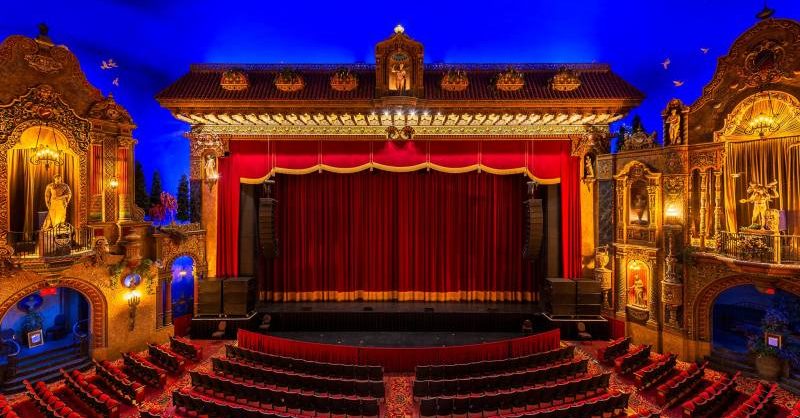
Standing on the east side of South Fourth Street in downtown Louisville, the Louisville Palace announces itself before you ever reach the door. Castle-like towers flank a copper-domed marquee blazing the word PALACE in synchronized light. Terra-cotta niches, cartouches, and finials crawl across the Churrigueresque facade in a riot of Spanish Baroque ornamentation that feels closer to a fever dream of old Madrid than a Kentucky movie house. That disorienting grandeur is entirely intentional. It was designed that way from the beginning to pull you out of your life the moment you arrived. Architect John Eberson — an Austrian immigrant trained in electrical engineering who found his calling building fantastical movie palaces across America — designed the building in 1928 for Loew's and United Artists as a first-run cinema seating 3,300. Eberson called his style "atmospheric theater." His theory was that audiences should feel transported before the film even started, and the Louisville building delivers on that completely. Step through the front doors and you enter what reads as an elaborate Spanish courtyard open to the night sky. The barrel-vaulted ceiling overhead is painted midnight blue and studded with lights positioned after a photograph in National Geographic to approximate actual stars. Over 500 plaster statues and reliefs populate the walls and alcoves. The mezzanine Faces Lobby is lined with 139 sculpted busts of historical figures — composers, philosophers, writers — gazing down from every surface. The original 1,000-pipe Wurlitzer organ was still in place at opening night on September 1, 1928, when Eberson himself attended, accompanied by a live macaw, the Loew's company mascot. It was immediately heralded by the Louisville Courier-Journal as an architectural marvel. For decades the Palace was the premier entertainment destination on Fourth Street, which the locals called Theater Square. Frank Sinatra performed there in 1941 during his early career. Ray Charles appeared in 1959. Al Capone, legend holds, frequented the theater during Prohibition, traveling there from the Seelbach Hotel through underground steam tunnels beneath the city. The building carried Louisville's glamour through the post-war era before the familiar forces of suburban flight and multiplex competition hollowed out downtown entertainment districts everywhere. The Palace went dark in the 1970s, was briefly reborn in 1981 under local businessman John Siegel's ambitious $4.4 million restoration, then closed again in 1985 when the costs of maintaining a century-old atmospheric theater outran the revenue. Siegel eventually declared bankruptcy. The building sat in fragile limbo until Sunshine Theater Inc. brought it back in 1994. Live Nation has owned it since 2005, and it operates today as a 2,800-seat concert and event venue — the only surviving movie palace of its era in the city, listed on the National Register of Historic Places since 1978. The paranormal claims here are numerous, specific, and consistently reported by staff, workers, and visitors across multiple decades. The most documented figure is Ferdinand Frisch, a theater employee who died in the building in 1965. During the 1990s restoration, workers began encountering an older man in work clothes, flat-top haircut, and outdated eyeglasses appearing at various points throughout the building — sitting in the balcony watching workers on stage, standing in corners, observed by multiple unrelated crew members. Tools were moved. Voices were heard in empty spaces. One painter who fell asleep on scaffolding near a high ceiling was woken by a voice speaking directly in his ear, and found himself dangerously close to the edge. His name has reportedly been found scratched into the dust in the basement. Current staff refer to him as Bernie, and the projection booth — where a separate apparition, believed to be a projectionist who suffered a fatal heart attack on the job, is also reported — remains one of the most consistently active areas in the building. The Grand Staircase leading to the mezzanine lobby has its own persistent figure: a faceless woman in 1940s clothing, seen climbing the stairs, who vanishes before she reaches the top. A man in 1930s attire has been spotted repeatedly in the balcony by ushers; when approached, he disappears. The Ladies' Parlor bathroom has generated reports of a child giggling, and a production manager arriving to lock up alone one night reported hearing running footsteps, searching the building and finding it empty, then being physically shoved from behind as he headed for the exit — followed by the sound of two children laughing and running away. The theater's marketing manager has publicly described seeing the Grey Lady: a translucent female figure walking four or five paces in the lobby before simply ceasing to exist mid-step. She noted that nearly every member of the facilities staff has had their own encounter with the same figure. The Louisville Palace is open for performances year-round. The stars on the ceiling still burn. The faces in the lobby still watch. And the people who work there after the crowds leave have stopped being surprised by what shares the building with them.
Bluegrass Inn
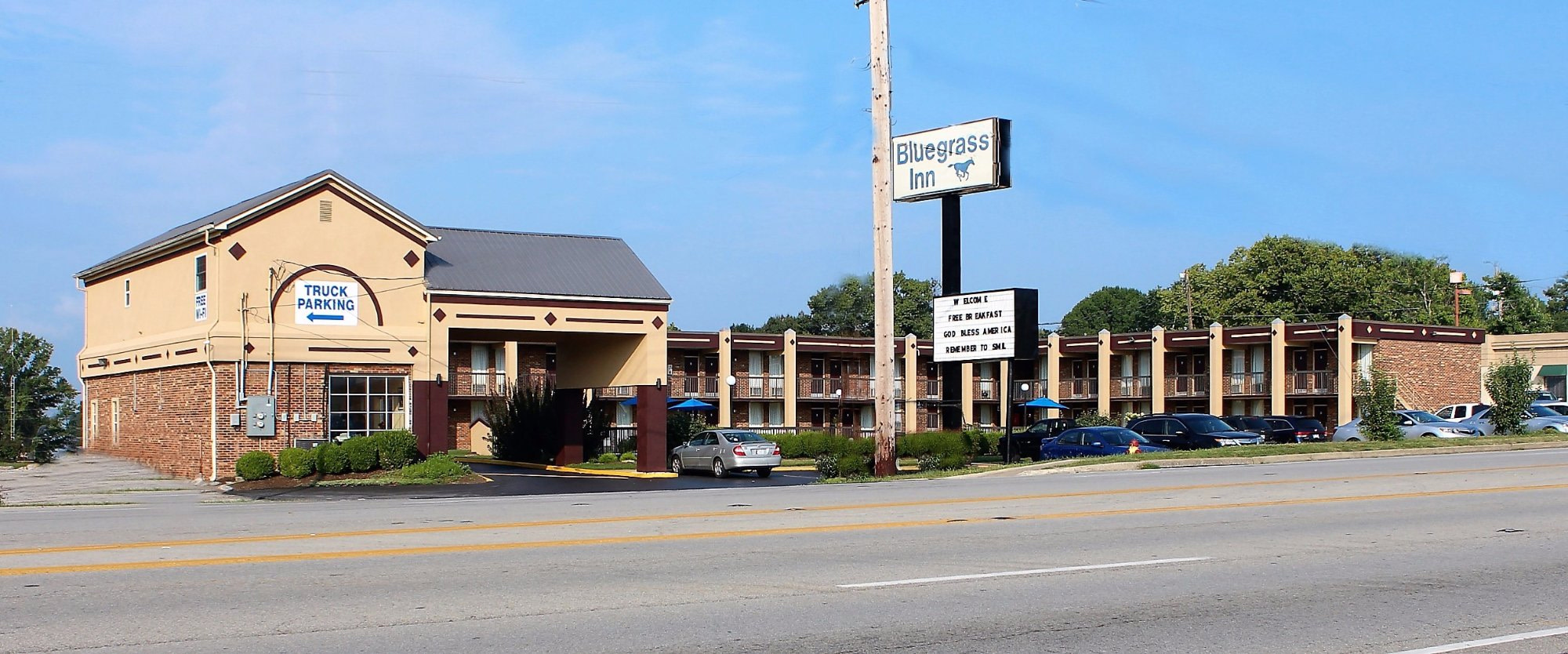
The Bluegrass Inn sits at 1835 Winchester Avenue in Ashland, Boyd County, Kentucky—a budget motel along the commercial stretch of U.S. Route 23 that most travelers pass without a second glance. It does not advertise its reputation. There are no ghost tours, no television crews, no plaques on the wall. It is the kind of place where rooms rent by the week, the parking lot is quiet by ten, and whatever happens behind the doors stays between the guest and the room. But for those who track haunted locations across Kentucky, the Bluegrass Inn carries a listing that punches above its weight—not because the claims are loud, but because they are strangely specific and consistent across people who have no connection to one another. Ashland dates to 1786, when the Poage family came through the Cumberland Gap and settled along the Ohio River. The community that grew around Poage's Landing remained small until the mid-nineteenth century, when iron production transformed the region. The Kentucky Iron, Coal and Manufacturing Company laid out the town in 1854, naming it after Henry Clay's estate in Lexington. Boyd County was formed in 1860, and Ashland became its largest city. By the early twentieth century, the American Rolling Mill Company had built a massive steel complex along the riverbank, employing thousands and anchoring the local economy for decades. Winchester Avenue developed as the city's main commercial artery—banks, theaters, shops, and lodging stretched along the route that connected Ashland to the broader Tri-State corridor where Kentucky, Ohio, and West Virginia converge. The Bluegrass Inn sits within that corridor, a quiet holdover from an era when roadside motels served the steady flow of workers and travelers moving through Appalachian Kentucky. No public record ties the property to a specific death, crime, or documented tragedy. But what the Bluegrass Inn lacks in backstory, it makes up for in the unnerving consistency of guest accounts. Rooms 127 and 129 are identified repeatedly as the source of activity. Guests in those rooms describe light blue orbs, roughly the size of a softball, drifting through the space. A pervasive feeling of dread settles in and does not lift for the duration of the stay. The physical sensation of hair standing on end—not momentarily, but continuously—has been reported by more than one visitor. One guest described waking to find three parallel scratches down their back, evenly spaced like fingernail marks, bright red and warm to the touch, with no explanation for how they got there. In room 205, a separate guest reported the persistent sound of someone else in the room each night—movement, presence, weight—when no one was there. What makes these accounts difficult to dismiss outright is not their drama but their restraint. These are not ghost stories told for entertainment. They read like the reluctant admissions of people who were not looking for anything and found something they could not explain. No investigation team has formally examined the property. No historical event has surfaced to explain why these rooms behave differently than the others. The Bluegrass Inn does not lean into its reputation or monetize it. It remains a working motel—affordable, unassuming, and open to anyone passing through Ashland who needs a place to sleep. Whether sleep is what they get may depend on the room.

Hardin County Historical Museum
The Lion House in Dickinson, North Dakota, stands as a residential structure bearing the profound weight of family tragedy of devastating proportions. The property represents ordinary residential architecture, a dwelling constructed for family life featuring bedrooms, hallways, and domestic spaces designed for household existence. The exterior appearance is consistent with countless residential properties across the Great Plains, presenting no obvious indication of the catastrophic violence that occurred within. However, the building's ordinary external appearance belies the extraordinary trauma imprinted upon its interior spaces by events that have transformed it into one of North Dakota's most actively haunted locations. The master bedroom, hallways, and rooms throughout the structure have become locations of persistent paranormal activity, haunted by the spirits of those whose lives were violently terminated within the home. The tragedy that created the intense haunting at Lion House involved a father who, in an act of devastating violence, murdered his entire family within the home. The exact circumstances of this crime—the date, the specific motivations, the identities of all victims—may be obscured by local historical treatment or variations in how the tragedy has been recorded. What is certain is that the crime was severe in its scope and emotional impact, creating a profound paranormal imprint upon the location. Multiple family members, likely including the father's wife and children, perished in the violence. The emotional trauma associated with familial betrayal, sudden violent death within a space intended as a sanctuary, and the destruction of the family unit created psychical conditions of extraordinary intensity. Paranormal phenomena at Lion House represent some of the most dramatic and disturbing documented in North Dakota paranormal research. Furniture throughout the house moves of its own accord, pieces shifting position despite no visible intervention. Rooms become inexplicably barricaded, doors sealed from within by unknown means, creating physical obstacles to movement. The apparition of a hanging man manifests within the master bedroom, a figure suspended from above as if self-inflicted death. Whether this represents the father's spirit re-enacting his own suicide or a manifestation of his victims remains undetermined. Shadowy figures move through hallways, dark silhouettes suggesting multiple presences simultaneously occupying the structure. Throat clearing sounds emanate from various locations, disembodied vocalizations creating an unsettling acoustic environment. Documented violent phenomena include all forms of poltergeist-like activity, suggesting spirits of considerable psychical intensity and potentially hostile emotional states. The intensity and violent character of the phenomena at Lion House distinguish it from hauntings produced by single deaths or ordinary tragedies. Manifestations suggest the presence of multiple spirits, each potentially experiencing profound emotional turbulence related to the violent circumstances of their deaths. Family members may remain present, unable or unwilling to depart, their spirits bound by the trauma of violent death and unnatural severance from life. The father's spirit may also remain, experiencing the psychical consequences of his violence. The distinction between victim spirits and perpetrator spirits may explain the varied character of manifestations—some appearing defensive or communicative, others aggressive or harmful. The Lion House has achieved recognition as North Dakota's most haunted residential property, featured in paranormal guides and investigated extensively by research teams. The combination of documented family tragedy and intense paranormal phenomena has created a location of formidable paranormal significance. Paranormal investigators have catalogued phenomena and conducted energy readings consistent with locations of intense haunting. The home represents a case study in how extreme violence and family tragedy imprint paranormal consequences upon physical locations.
107-1/2 East Main Cross
The building located at 107-1/2 East Main Cross in Greenville, Kentucky, is an unassuming structure that contains apartments on its upper floors and commercial or residential space on the ground level. The building's modest appearance and location on a main thoroughfare in the small city of Greenville give little indication of the paranormal phenomena that residents, visitors, and investigators have documented within its walls over a period spanning multiple decades. The structure itself appears to date from the nineteenth or early twentieth century, suggesting a long history of human habitation and activity contained within its confines. The building's architecture is consistent with other small-town commercial structures of its era, with sturdy construction and period-appropriate materials and design elements. The apartments on the upper floors were presumably designed to house residential tenants, though the documented history of habitation and the identities of previous residents remain largely obscure. The building's current and previous uses suggest it has served as both a residential and commercial space throughout its history, with various businesses and residents occupying the structure over more than a century of operation. The modest appearance and unremarkable exterior of the building contrast sharply with the unusual and compelling paranormal activity documented within, particularly in the residential areas. The paranormal phenomena reported at 107-1/2 East Main Cross center primarily on the apparition of a male figure that has been witnessed by multiple independent observers. This male apparition appears in the form of a humanoid figure that walks through the apartments, moving between rooms and sometimes appearing in doorways or hallways. The apparition is described as appearing translucent or semi-transparent, suggesting a non-corporeal entity rather than a living human being. The entity does not appear to interact directly with living residents or visitors, instead engaging in what researchers characterize as residual haunting behavior, performing actions and movements that suggest repetitive patterns or routines. The apparent indifference of the apparition to the presence of living individuals suggests that the entity may not be consciously aware of contemporary residents and visitors, instead repeating actions and movements that it performed during its living existence in the building. The identity of the male apparition remains unknown, with no historical records or documentation providing clear information regarding who the entity might be or the circumstances of his death or tragedy that might account for his apparent binding to this location. The apparition has been encountered by at least four different witnesses in separate incidents, lending credibility to accounts of paranormal activity at the location and suggesting the phenomena are genuine and recurrent rather than isolated incidents or misinterpretations. The strange noises reported within the building include unexplained sounds emanating from empty rooms, footsteps on stairs and in hallways, and various acoustic phenomena that do not appear to have identifiable natural sources. Visitors and residents have reported hearing voices, though the content of these voices is often indistinct or unintelligible. Some accounts mention the sounds of movement and activity in areas that are confirmed to be unoccupied, suggesting non-corporeal entities engaging in activities or movement within the building's interior spaces. The prevalence of paranormal phenomena in the residential apartments suggests that something significant occurred within the building related to death, tragedy, or trauma that has created conditions for spirit manifestation. The apparent contentment or neutrality of the male apparition, combined with the absence of aggressive or threatening behavior, suggests that the entity may not pose danger to contemporary residents, but rather represents a residual presence that continues to occupy the space it inhabited during life. The documented sightings by multiple independent witnesses at different times strengthen the case for genuine paranormal activity at this location, distinguishing it from single-incident reports that might be more easily explained through misidentification or psychological factors. The building's location on East Main Cross in Greenville, Kentucky, has made it a point of interest for paranormal researchers and enthusiasts seeking to document and investigate reported hauntings in small-town American locations.
The Seelbach Hilton Louisville
The Seelbach Hilton Louisville stands as a distinguished hotel property in Louisville, Kentucky, combining historic architectural significance with contemporary hospitality services while serving as the permanent residence of one of paranormal research's most thoroughly documented female entities. Originally constructed in the early twentieth century, the Seelbach Hotel represented the pinnacle of luxury and sophistication, featuring ornate architectural details, premium accommodations, and amenities that attracted distinguished guests from across America and internationally. The building's classical design incorporates elements reflecting the aesthetic preferences of its era, with marble appointments, detailed millwork, and spatial arrangements reflecting the architectural aspirations of the Gilded Age. The hotel has maintained its position as a significant Louisville landmark, adapting to changing hospitality expectations while preserving the essential architectural character that distinguishes it from more recently constructed properties. The physical plant of the Seelbach Hilton encompasses multiple guest floors distributed across several stories, with numerous individual rooms arranged along corridors accessed by elevators and staircases. The seventh floor has become particularly associated with paranormal phenomena, with manifestations extending throughout the facility and concentrating in the elevator shaft area and surrounding hallways. The elevator system itself has become a focal point for paranormal activity, with multiple witnesses reporting unusual experiences related to elevator movement and door operation. The building's architectural complexity creates an environment where paranormal phenomena have been extensively documented and catalogued by paranormal researchers working in collaboration with hotel management. The most prominent paranormal phenomenon at the Seelbach Hilton involves the entity known as the Lady in Blue, identified through historical research as Patricia Wilson, whose violent death in 1936 established the foundation for one of America's most comprehensively documented paranormal cases. Patricia Wilson was shot by her estranged husband in a crime of passion, establishing the catalyst for her enduring spiritual presence within the hotel. Her apparition has been encountered by numerous witnesses across the decades, appearing as a full-body manifestation dressed in a distinctive blue gown, with sufficient clarity to enable detailed physical descriptions. The Lady in Blue has been reported moving through hallways with deliberate purpose, appearing in the elevator shaft as if trapped in eternal patrol, and materializing in guest rooms where visitors report encounters ranging from benign observation to interactive phenomena. Guests have communicated with the apparition, describing responses suggesting awareness of contemporary visitors. The Seelbach Hilton Louisville represents a singular case in paranormal research, where a location's haunting has been extensively documented and integrated into the facility's identity as a historical and paranormal destination. The identity of the Lady in Blue, confirmed through decades of research, distinguishes this location from other haunted properties where entities remain unidentified. The hotel continues to attract paranormal researchers and tourists seeking contact with documented phenomena while maintaining its function as a premier hospitality destination. The Seelbach Hilton exemplifies how paranormal phenomena and historical tragedy become integrated into a location's identity, ensuring Patricia Wilson's presence persists across nearly a century following her violent death.
C. C. Cohen Building
Rattlesnake Canyon, located in the Dudleyville area of Pinal County, Arizona, represents a remote and rugged landscape that has witnessed human drama, tragedy, and violence throughout its long history as territory inhabited by indigenous peoples and later by settlers and miners. The canyon's geological features, including distinctive rock formations and narrow passages, create a landscape that appears forbidding and inhospitable to casual visitors, a quality that historical records suggest made it attractive to individuals seeking isolation and refuge from civilized society. The charred rock walls visible throughout portions of the canyon bear witness to intense heat and fire, geological evidence of events that occurred at sufficient temperature to permanently alter the canyon's mineral composition and stone surfaces. Historical records and local legend suggest these burned formations resulted not from natural geological processes but from deliberate human activity, creating physical evidence of dramatic and violent occurrences associated with paranormal activity and supernatural forces. The canyon's remote location within Arizona's sparse desert landscape, combined with its geological distinctiveness and grim historical narratives, established Rattlesnake Canyon as a location evoking fear and apprehension in regional consciousness. At the center of Rattlesnake Canyon's dark reputation stands the legendary figure known as Lepsy, identified in historical sources as an exceptionally evil man whose actions and violent tendencies created a legacy persisting long after his mortal death. Historical documentation regarding Lepsy's specific identity remains ambiguous, though various sources suggest he may have been a fugitive criminal, a disturbed individual with violent proclivities, or a settler whose actions violated fundamental standards of human decency accepted even in remote frontier regions. The most reliable accounts suggest Lepsy engaged in violent activities within Rattlesnake Canyon that resulted in multiple deaths, creating an environment of terror and supernatural resonance. The exact nature of Lepsy's crimes remains historically obscure, though the intensity of paranormal phenomena associated with the location and consistent historical narrative suggest activities of extraordinary violence and brutality. Whether Lepsy actually perished within Rattlesnake Canyon or merely departed the region under circumstances rendering his ultimate fate unknown, his name became permanently associated with the canyon's evil reputation. The paranormal manifestations documented in Rattlesnake Canyon collectively suggest that Lepsy's presence or the spiritual imprint of his violent activities remains concentrated within the canyon's distinctive rock formations and remote passages. Phantom screaming has been reported by numerous visitors and investigators who approached the canyon, described as sounds of anguish and agony emanating from seemingly empty areas, voices suggesting human suffering of extraordinary intensity. The overwhelming emotional atmosphere within the canyon conveys horrible frightening energies that strike observers with palpable force, creating a sense of dread and apprehension transcending psychological suggestion. Eerie and inexplicable smells materialize within the canyon with such regularity that experienced investigators consider them reliable indicators of Lepsy's spiritual presence, odors described as putrid and otherworldly, distinct from normal canyon smells. Disembodied cries and human sounds emanate from the canyon's rocky passages and shadowed areas, voices crying out in apparent distress, suggesting ongoing suffering and torment of supernatural origin. These manifestations establish Rattlesnake Canyon as one of Arizona's most genuinely fearsome haunted locations. Rattlesnake Canyon and its association with Lepsy have achieved legendary status within Arizona's paranormal and historical traditions, serving as the subject of regional folklore and paranormal investigation documentation. The canyon's remote location within Pinal County continues to limit casual access and visitation, preserving its character as a location where modern tourists rarely venture. The physical evidence of the burned rock walls continues to intrigue historians and paranormal investigators, creating ongoing speculation regarding the specific events that created these geological features and their relation to Lepsy's legendary crimes. The canonical narrative of Lepsy and Rattlesnake Canyon persists in regional consciousness as an example of how frontier violence and extraordinary brutality can generate paranormal consequences that transcend conventional death and time, establishing locations where evil actions create lasting disturbances in the fabric separating living and spiritual realms.
Maple Hill Manor Bed and Breakfast
Maple Hill Manor stands as a significant architectural presence in the American South, its substantial structure bearing witness to centuries of human occupation and the turbulent events that have shaped its legacy. Originally constructed as a residential estate during the pre-Civil War era, the manor was converted into a hospital facility during the American Civil War, serving as a makeshift medical center where Union and Confederate forces alike brought their wounded and dying. The building's strategic location and substantial size made it ideal for wartime medical operations, and accounts from the period suggest that hundreds of casualties passed through its corridors. The conversion of the residence into a hospital represented a dramatic transformation of domestic space into one marked by suffering, trauma, and loss of life. The surgical procedures performed on the second floor, documented in period records, were conducted under primitive conditions with limited anesthetics and no antibiotics, resulting in mortality rates that were staggering even by Civil War standards. After the war concluded, the manor returned to private residential use, though its history as a repository of wartime trauma remained embedded in the structure itself. The paranormal phenomena reported at Maple Hill Manor reflect the violent and tragic nature of its history during the conflict. Visitors and residents have documented consistent reports of ghostly figures throughout the building, with the lady in white apparition most frequently encountered in the main halls and upper corridors. The identity of this female spirit remains unclear, though theories suggest she may have been a nurse, a family member of the original inhabitants, or possibly a victim of wartime violence. Civil War soldiers have been reported in various locations throughout the manor, their spectral forms appearing and disappearing in doorways, on staircases, and in the rooms where they likely spent their final hours. The spirits of hospital patients, whose suffering was documented in medical journals and personal accounts, manifest through various phenomena including disembodied voices, the sound of footsteps in empty rooms, and the sensation of cold spots that appear without warning or environmental explanation. These cold zones are particularly prevalent on the second floor, where the most invasive and traumatic surgical procedures took place. Additional experiences reported by guests and investigators include phantom perfume scents that have no identifiable source, eerie lights visible in photographs that are not apparent to the naked eye, and reports of unusual dreams from individuals who have spent the night in the manor's bedrooms. The manifestations suggest that the spirits resident in Maple Hill Manor remain deeply connected to their traumatic experiences. Strange noises are frequently heard emanating from empty rooms, particularly during the evening and night hours when the manor is quietest. Unexplained voices have been recorded during paranormal investigations, some speaking words of pain or distress, others calling out names or crying for assistance. The second floor, where surgical operations were performed, remains the focal point of paranormal activity, with investigators noting a dramatic increase in phenomena when they focus their attention on these particular rooms. The apparition of the lady in white appears to have strong attachment to certain areas of the building, suggesting she may have been physically bound to the location through traumatic circumstance or unfinished business related to the events that occurred during the war. Multiple witnesses have described seeing her walking through the manor at different times, always in period dress consistent with the Civil War era, and her appearance seems to intensify when individuals approach the rooms where the most critical medical procedures took place. The combination of trauma, death, suffering, and unresolved grief appears to have created a powerful psychic imprint that continues to resonate through the manor's physical structure, manifesting in ways that contemporary paranormal investigators continue to document and attempt to understand.
Coral Hill Road
Coral Hill Road near Glasgow, Kentucky has long been regarded as one of the most persistently haunted thoroughfares in the Commonwealth, earning its reputation through generations of consistent paranormal accounts dating back more than a century. The road's dark legacy intertwines with the region's complicated colonial and early American history, particularly the violent conflicts between European settlers and indigenous peoples who had inhabited the area for countless generations before displacement. Throughout the nineteenth and twentieth centuries, travelers passing through the wooded stretches of Coral Hill Road began reporting encounters with a particularly distinctive apparition, a headless figure on horseback that became synonymous with the location's paranormal identity. Local folklore suggests this entity may be connected to a Revolutionary War-era incident involving a decapitated soldier, though historical records on the exact circumstances remain fragmentary and contested among regional historians. The paranormal phenomena associated with Coral Hill Road manifest with remarkable consistency across numerous independent accounts gathered from motorists, residents, and paranormal investigators over the past several decades. Witnesses have reported encounters with a transparent white form of the headless horseman, appearing most frequently during evening hours and in conditions of poor visibility, when the figure emerges suddenly from the tree line adjacent to the road before dissolving into mist. Many experiencers describe a sensation of overwhelming dread preceding visual contact with the apparition, as if the entity broadcasts its presence through an unmistakable psychic pressure that registers before the ghostly form becomes visible. Additionally, residents living in properties adjacent to Coral Hill Road have reported the unsettling experience of witnessing ghostly figures following them from the road itself onto their private property, crossing thresholds and entering yards with apparent ease despite locked doors and closed windows. Paranormal investigators who have conducted systematic research along Coral Hill Road have documented instances where apparitions appear with specific behavioral patterns, including the headless horseman legend that suggests the entity exists in a state of perpetual reenactment, perhaps locked in a cyclical confrontation that plays out across multiple sensory modalities and temporal markers. Some accounts describe occasions when the apparition manifests not merely as a visual phenomenon but as a presence that affects the functioning of electronic equipment, vehicles, and other technological devices carried by witnesses, suggesting a form of electromagnetic disturbance associated with the entity's manifestation. The experiences reported by multiple independent witnesses show striking consistency regarding the geographic locations where encounters occur most frequently, clustering around specific stretches of the road where the tree canopy is thickest and where historically significant events may have transpired unknown to current residents. The enduring reputation of Coral Hill Road has attracted paranormal tourism to the region, with organized investigation groups regularly visiting to conduct research and attempt to document the reported phenomena through contemporary recording technologies. Despite the accessibility of the location and the proliferation of attempted investigations, the paranormal activity shows no signs of diminishing, with new accounts continuing to emerge from both longtime residents and visitors who claim encounters with the headless horseman or other ghostly manifestations. The authenticity of these reports, while difficult to verify through conventional scientific methods, remains anchored in the consistent testimony of witnesses across temporal and demographic boundaries, suggesting that something unconventional does indeed occur along the stretch of Kentucky road that has earned its place in American folklore as a persistently haunted location.
Liberty Hall
Liberty Hall stands as one of the most significant and prestigious historic mansions in Frankfort, Kentucky, a residence of considerable architectural importance and historical consequence that has served as the home of prominent Kentucky families throughout the nineteenth and twentieth centuries. The mansion was constructed in the late eighteenth century by wealthy and politically influential members of Kentucky's early settler community, individuals whose economic power and social status allowed them to construct residences of extraordinary architectural refinement and sophistication. The building represents an outstanding example of late-eighteenth and early-nineteenth-century American residential architecture, with design elements reflecting the neoclassical aesthetic principles that influenced American architectural practice during that period. Liberty Hall has been preserved as a historic house museum, maintained by the Liberty Hall Historic Site as an educational resource that allows visitors to experience the lifestyle and material culture of Kentucky's wealthy planter class during the early decades of American independence. The mansion remains one of Frankfort's most recognizable landmarks and one of Kentucky's most significant historic properties, attracting historical enthusiasts, tourists, and paranormal investigators throughout the year. The primary documented ghost at Liberty Hall is known as the Gray Lady, an apparition identified in historical accounts and paranormal research as Margaretta Varick, a woman whose residence at Liberty Hall and whose death at the property have transformed her into the most prominent and frequently observed spirit at the location. Margaretta Varick appears to have occupied the mansion during a significant period of the property's history, and her emotional attachment to Liberty Hall appears to have been sufficiently strong that her death did not sever her connection to the place. She is typically described in reports as appearing in a tall figure dressed in flowing gray clothing, a silhouette characterized by a definite and distinctive visual presentation that allows witnesses to identify her with consistency across multiple independent reports spanning many decades. The Gray Lady is frequently reported to be observed at windows of Liberty Hall, particularly the upstairs bedroom areas and the front parlor, peering out onto the grounds or into the interior of the mansion as if she remains vigilant and watchful over the property she once inhabited. The apparition of Margaretta Varick, particularly her manifestations at windows, has become the iconic paranormal image associated with Liberty Hall, visible enough and distinct enough to constitute compelling evidence of the property's haunted nature. Beyond Margaretta Varick and the Gray Lady manifestations, Liberty Hall hosts additional spiritual residents whose identities and histories remain less clearly defined in available documentation. Among these other spirits is Madame Rosa, identified in some accounts as a Spanish opera singer who appears to have had some connection to the property and whose death at or near Liberty Hall has resulted in paranormal manifestations that persist to the present day. The presence of an opera singer from Spain at a Kentucky mansion speaks to the complex networks of travel, commerce, and social connection that characterized the nineteenth-century American South, and Madame Rosa's appearance at Liberty Hall may represent a visitor to the mansion whose tragic death created a lasting spiritual imprint. Additionally, historical accounts reference the presence of a soldier from the War of 1812 era whose spirit is believed to occupy portions of Liberty Hall, suggesting that the mansion may have housed or been visited by military personnel during this important historical period, and that the soldier's death at the property resulted in his spiritual binding to the location. The paranormal phenomena occurring at Liberty Hall manifest with striking specificity and consistency, creating a documented case of multiple distinct spiritual entities occupying the same physical space and manifesting in ways that suggest they retain awareness of their surroundings and the presence of living people. The apparition of Margaretta Varick, the Gray Lady, appears at windows with sufficient regularity and clarity that visitors and guests often specifically position themselves to attempt to observe her manifestations, and photographic documentation of the apparition has been collected over many years.
Western Kentucky University
Western Kentucky University sprawls across Bowling Green, Kentucky as one of the region's most significant educational institutions, comprising approximately twenty-five buildings distributed across a substantial campus expanded continuously since nineteenth-century founding. The institution serves thousands of students pursuing undergraduate and graduate degrees across numerous disciplines, operating as both educational center and substantial employer. Campus architecture reflects multiple construction phases spanning more than a century, ranging from Victorian-era structures to contemporary facilities. Accumulated student experiences, intellectual pursuits, and inevitable tragedies have apparently created conditions conducive to extensive paranormal manifestation. Western Kentucky University has acquired a reputation as one of the most paranormally active university campuses in the American South. Paranormal activity concentrates most intensively in Van Meter Hall and Potter Hall, residential facilities housing undergraduate students. The most prominent documented haunting involves a student who fell through a skylight, plummeting to death in a tragedy that continues resonating throughout paranormal phenomena. The student's spirit appears unable to move beyond the trauma. Manifestations include shadowy figures moving through halls and stairwells, ghostly figures in performance areas, and apparitions that startle observers before vanishing. Phenomena often occur peripherally, capturing attention through unexpected movement. Sudden temperature changes characterize paranormal activity, with dramatic drops in temperature suggesting localized paranormal manifestation. Paranormal phenomena extend beyond Van Meter and Potter halls to encompass additional manifestations across campus. Objects vanish from secured areas and reappear unexpectedly. Unexplained sounds and knocks emanate from classrooms and offices when campus is secured and unoccupied. The Humanities Building, Helm Library, Kentucky Museum, McClean Hall, Pearce Ford Tower, and Schneider Hall have generated paranormal reports. Mattie McClean's image in McClean Hall lobby allegedly responds to observers maintaining extended visual contact. A construction worker crushed by an elevator in Pearce Ford Tower haunts the fatal accident location, characteristic of residual haunting phenomena. The diverse paranormal entities have not been individually identified with equal documentation. Some entities connect to documented tragic incidents while others possess fragmentary identities. The sheer number suggests paranormal phenomena may emerge from accumulated emotional impressions of student life or concentrated presence of young people pursuing personal development. Ghost stories have become woven into campus culture, transmitted through incoming students as informal socialization. Western Kentucky University continues functioning as an active institution while maintaining paranormal reputation. Official position remains cautiously detached, focusing on academic mission while permitting student culture to engage with ghost stories informally. Documented evidence including extensive student testimonies suggests either authentic spiritual manifestations or deeply embedded folklore. The haunted reputation has become integral to institutional identity, distinguishing WKU within higher education and generating interest among students and paranormal enthusiasts. The presence of approximately twenty-five haunted buildings represents unusual concentration of paranormal activity.
Mammoth Cave National Park
Mammoth Cave in Kentucky represents one of North America's most geologically significant natural formations, a vast subterranean landscape of limestone passages and caverns that extends for many miles beneath the surface of central Kentucky and has attracted human exploration, habitation, and investigation since indigenous peoples first discovered its passages during prehistoric times. The cave system has supported continuous human activity spanning thousands of years, with evidence of indigenous peoples utilizing the passages for spiritual ceremonies, resource extraction, and shelter, followed by European settlement and subsequent commercial development as the cave became a major tourist destination during the nineteenth and twentieth centuries. The geological immensity of the cave system, with its passages extending far beyond the regions accessible to casual tourists, creates a landscape of mystery and remoteness that has shaped human perception and cultural understanding of the location since the earliest periods of human awareness of its existence. The paranormal phenomena associated with Mammoth Cave are notably extensive and well-documented, with more than one hundred fifty verified reports of supernatural activity collected and analyzed by credible witnesses including professional cave guides, park rangers, scientists conducting legitimate research, and visitors whose testimony suggests genuine experiences rather than imaginative fabrication or suggestibility. The manifestations span multiple distinct spiritual entities with varying characteristics, behavioral patterns, and apparent historical affiliations, suggesting that the cave system serves as a repository for accumulated human trauma, unfulfilled aspirations, and spiritual unrest spanning centuries of exploration and human activity. Floyd Collins, the legendary cave explorer who perished trapped in the cave's passages in 1925, is believed to maintain a spiritual presence within the Crystal Cave section of the greater Mammoth Cave system, with visitors reporting encounters with a translucent apparition and the audible vocalization of Collins' name echoing through passages where his remains were eventually recovered. The spirit of Stephen Bishop, an enslaved guide who conducted cave tours throughout the nineteenth century and who achieved recognition as one of Mammoth Cave's most knowledgeable human inhabitants, is believed to continue manifesting within the passages he so thoroughly explored and documented during his earthly life, with contemporary visitors and tour guides reporting the sensation of being guided or protected by unseen presences and receiving assistance navigating treacherous passages. Additional manifestations include the spirits of tuberculosis patients who were brought to the cave during the nineteenth century based on the medical theory that the cave's constant temperature, moisture, and isolated environment possessed therapeutic properties for treating the disease, though no documentary evidence suggests that such treatments proved efficacious or that patients recovered from their affliction through subterranean habitation. The voices of these tuberculosis victims are reportedly heard uttering ghostly coughs and labored breathing throughout the cave passages, manifestations that create an emotional and psychological atmosphere of profound suffering and desperation. Paranormal phenomena within Mammoth Cave include apparitions of deceased individuals appearing in specific passages, mysterious singing and vocalizations emanating from areas with no apparent human presence, sudden sensations of invisible hands pushing or touching visitors, and disembodied voices calling for assistance from those who have become lost or trapped in the darkness. Mysterious lights of unknown origin have been photographed within the cave passages where no artificial illumination equipment is in operation, and objects have reportedly been thrown by invisible forces at visitors and guides. The Historic Mammoth Cave Baptist Church, incorporated as part of the national park and operated continuously since its establishment, has documented alleged paranormal activity suggesting that the spiritual disturbances extend beyond the natural cave passages into the structures humans have built in association with the cave system. The accumulated paranormal phenomena at Mammoth Cave suggest that the location functions as a concentration point for spiritual entities displaced or trapped by historical trauma, unresolved death, and the profound emotional experiences associated with the cave's complex history of human engagement across centuries of exploration and visitation.
Hiestand House
The Hiestand House in Campbellsville, Kentucky represents a significant example of nineteenth-century residential architecture preserving architectural and domestic traditions of central Kentucky during the period following the American Civil War when the region experienced substantial reconstruction and community rebuilding. The structure was constructed as a private residence during a time when Campbellsville and Taylor County were developing as agricultural and commercial centers, with local families of prominence investing in residences reflecting contemporary architectural fashions and demonstrating their social standing within the community. The Hiestand House exemplifies residential design preferences of its era, featuring interior spaces and decorative elements characteristic of nineteenth-century middle-class to upper-middle-class American homes, with particular attention to formal parlors, dining rooms, and bedroom spaces designed to accommodate family living and social entertaining. The building has been preserved through efforts of local historical societies and cultural preservation organizations who recognized the structure\'s historical significance as a documented example of period residential architecture. The transformation of the Hiestand House from a private residence to a museum property operated by the Taylor County Museum allowed the structure to be preserved and adapted to public use while maintaining its original architectural integrity and historical character. The museum operates as a cultural and educational resource serving Campbellsville and Taylor County, providing public access to the building\'s interior spaces and utilizing the residence as a venue for historical exhibitions, educational programming, and community cultural activities. The conversion to museum operations required careful restoration work addressing the structural integrity of the building and preservation of original architectural details, decorative finishes, and historical furnishings reflecting the lifestyle and aesthetic preferences of residents who occupied the residence during its operational history. The museum\'s interpretive programming has incorporated the building\'s architectural history and its evolution through different periods of occupation and use. Paranormal activity documented at the Hiestand House has attracted attention from paranormal researchers and individuals interested in unexplained phenomena occurring at historic residential properties, with the museum property experiencing reported manifestations attributed to former residents whose spirits remain attached to the building. Apparitions have been observed within the interior rooms and spaces, manifesting as translucent or semi-transparent humanoid figures whose appearance suggests connection to the building\'s historical occupation and individuals who lived within its walls during the nineteenth century. Disembodied footsteps have been documented echoing through hallways and interior passages, occurring when no visible person is present within the building, suggesting movement and presence of unseen entities traversing familiar spaces with apparent knowledge of the building\'s layout. Strange fires have been reported occurring within the Hiestand House, manifestations that have puzzled investigators and property managers through their apparent lack of conventional explanation and their apparently spontaneous origin and cessation. These incidents have generated significant concern regarding safety implications and have prompted investigation by fire authorities and paranormal researchers seeking to determine the nature and origin of these unusual occurrences. Paranormal researchers have theorized that the fires may represent residual phenomena replaying traumatic events from the building\'s history, or potentially result from intelligent paranormal agency manifesting through manipulation of physical materials and thermal energy. The unexplained nature of these fire incidents and their concentration within the Hiestand House property has contributed substantially to the building\'s paranormal reputation.
Harrodsburg Spring – Young Park
Harrodsburg Spring and Young Park represent a significant historical location in Harrodsburg, Kentucky, an area distinguished by the presence of natural mineral springs that have drawn human settlement and interest for centuries preceding European colonization. The spring features have been valued by indigenous peoples, early American settlers, and later generations of inhabitants for both their perceived medicinal properties and their aesthetic appeal as gathering places. The park area encompasses grounds that were historically occupied by early hotels and resort facilities constructed to serve visitors seeking treatments and leisure experiences associated with mineral spring destinations. The natural landscape features mature trees, landscaped grounds, water features, and memorials reflecting the site's evolution from commercial resort destination to contemporary public park. The transformation from commercial hotel operation to public park represents a significant transition in the site's functional purpose and management. The history of resort development at Harrodsburg Spring reflected broader nineteenth-century American trends toward leisure tourism and health-seeking travel centered on mineral springs. Entrepreneurs invested in construction of facilities designed to accommodate visitors for extended stays, creating employment opportunities and generating commercial revenue. The hotels and boarding houses built in the park area generated their own social dynamics, with guests, staff, and local community members interacting within and around these facilities. The commercial development transformed the natural spring location into an intensively used human environment characterized by social gathering, commercial exchange, and temporary habitation of numerous visitors seeking rejuvenation and social engagement. The period of intensive development and operation created a psychologically dense environment marked by human activity, commerce, and pleasure-seeking. The spirit known as the Dancing Lady represents the most prominent paranormal entity associated with Harrodsburg Spring and Young Park, a female apparition whose identity remains unconfirmed despite considerable historical inquiry and paranormal investigation. Witnesses have reported apparitions of a woman performing dancing movements in the park grounds, with descriptions suggesting either graceful, rhythmic motion or possibly frenzied or distressed movement. The phenomenon of unexplained dancing movements has become so characteristic of the location that the spirit has acquired a specific designation within paranormal and folklore circles. Some paranormal investigators have theorized that the Dancing Lady may represent a victim of violent crime or tragedy occurring within or near the park area, with manifestations possibly representing either a joyful memory of the individual's life or a traumatic reenactment. The identity of the Dancing Lady remains the subject of active investigation and speculation, with paranormal researchers attempting to match historical records of missing or murdered women with the reported apparition. The possibility that she was a guest at resort hotels, a staff member, or a local community member has been explored through historical research. The timeline of the apparition's first reported appearances has provided constraints on the possible historical period during which her death may have occurred. The emotional quality of the manifestation, described variously as graceful or distressed, may provide psychological insight into the nature of her experience and circumstances of her death. Persistent reports across multiple decades and numerous independent witnesses suggest either genuine paranormal phenomena or deeply embedded cultural narrative. Harrodsburg Spring and Young Park function in the contemporary period as a public recreational and historical site. The location attracts visitors interested in both historical Kentucky resort culture and documented paranormal activity. The Dancing Lady has become an iconic figure within regional paranormal narrative, with questions of her identity and death circumstances remaining unresolved mysteries. The park grounds continue to host public gatherings while simultaneously serving as a location where paranormal researchers conduct investigations. The spirit of the Dancing Lady represents both human tragedy and enduring cultural significance of mysteries that remain unsolved across historical time.
Grapevine Cemetery
Grapevine Cemetery, formally established in September of 1880, occupies a rural location in Western Kentucky near the communities of Arlington and Madisonville, representing one of the region's formal burial grounds established during the post-Reconstruction period following the Civil War. The cemetery was established during a period of significant economic and social development in western Kentucky, as communities formalized burial practices and created dedicated cemeteries to provide orderly interment for deceased residents separate from family farmland burials and informal grave sites. The landscape surrounding Grapevine Cemetery reflects the agricultural and rural character of the region, with open fields and scattered woodlands creating the typical setting for nineteenth-century rural graveyards established to serve surrounding farming communities and rural populations. Throughout its existence spanning more than one hundred forty years since establishment, Grapevine Cemetery has received the burials of hundreds of individuals from surrounding communities, accumulating the graves of multiple generations of families whose descendants continue to reside in the region and maintain family connections to the burial ground. The cemetery contains monuments and grave markers spanning the period from its establishment in 1880 through the modern contemporary era, providing physical evidence and permanent memorialization of the individuals honored through burial within its grounds and acknowledged by their descendants. The paranormal reputation of Grapevine Cemetery centers on multiple distinct and clearly documented phenomena that have been reported through numerous witness accounts and paranormal investigation reports conducted over the course of several decades. The primary and most well-documented paranormal manifestation involves a marble statue depicting a weeping angel, commonly referred to by visitors and locals as the Crying Angel, which has reportedly exhibited the extraordinary phenomenon of appearing to weep blood during midnight hours coinciding with full moon phases when the celestial conditions align. Witnesses describe observing apparent bloodstains appearing on the angel's stone face and extended down onto the stone surface and pedestal beneath, creating a visual phenomenon that has generated substantial local attention and paranormal investigation interest from multiple research organizations. Beyond the statue-based phenomena, the cemetery is definitively associated with accounts of a young male spirit who allegedly committed suicide after romantic rejection and loss, with numerous witnesses reporting hearing anguished screams and cries of extreme emotional distress emanating from within the cemetery grounds, particularly when musical selections involving themes of love or romance are played in proximity to the burial areas. Multiple independent observers and paranormal investigators have reported distinctive high-pitched vocalizations matching descriptions of extreme emotional anguish and despair, universally attributed by local tradition to the suicide victim's spirit reliving the trauma of romantic loss and personal despair in an eternal cycle. Additional paranormal phenomena documented at Grapevine Cemetery include sightings of an elderly man apparition dressed in green surgical scrubs, apparently accompanied by three canine companions in spectral form, moving through the cemetery grounds in patterns suggesting apparent purpose-driven trajectories and searching behavior. The identity, historical background, and underlying circumstances of this spirit figure remains fundamentally unresolved, though numerous observations and documented sightings have established the consistency of reports regarding his distinctive appearance, dress, and the apparent animal companions that accompany his manifestations. The accumulated paranormal reports from multiple independent witnesses and paranormal investigation teams, combined with physical phenomena documented at specific locations within the cemetery, have firmly established Grapevine Cemetery as one of Kentucky's most significantly haunted burial grounds and locations of paranormal activity.
Motel 80
Motel 80, located in Hindman, Kentucky, exemplifies mid-twentieth-century motor lodge architecture typical of highway-adjacent accommodations that emerged during the post-World War II expansion of automobile tourism. The motel represents economical and functional design that prioritized efficiency and rapid construction over aesthetic distinction, creating structures optimized for rental turnover and minimal maintenance. Located in eastern Kentucky's Appalachian region, Motel 80 served regional travelers and provided a commercial anchor within Hindman's modest downtown economy. The paranormal significance of Motel 80 derives from a specific and dramatic historical event involving a crime of passion in which a woman was murdered by a man who had become her lover, a scenario reflecting historical patterns of violence and jealousy that have punctuated American domestic history. The motivation related to romantic entanglement and possibly the disruption of existing matrimonial bonds by the illicit relationship that resulted in the victim's death. The emotionally charged circumstances of the crime created the kind of intense human trauma and tragic loss that paranormal investigators theorize most likely generate residual haunting phenomena. The specific circumstances and historical record of the crime at Motel 80 have become obscured by time, with contemporary documentation focusing more on reported paranormal phenomena than on establishing precise narrative of the historical event. This pattern of documentation is characteristic of rural and regional haunted locations where local oral tradition and paranormal investigation reports provide more accessible information than formal historical archives. The motel's geographical isolation in eastern Kentucky may have contributed to the persistence of the story within local tradition while limiting broader historical documentation. The paranormal activity manifests through phenomena consistent with the residual or conscious presence of the victim whose life was violently terminated within the structure. Witnesses and investigators have documented recurrent and apparently purposeful manipulation of the building's electrical systems, with lights turning on and off in patterns suggesting intentionality or intelligence rather than mechanical malfunction. A spirit wandering the hallways has been repeatedly reported, with descriptions suggesting a confused, searching, or restless entity moving through corridors in apparent anguish or distress. More unusual phenomena include accounts of pop cans or beverage containers lifting spontaneously from surfaces and then slamming to the floor with force, suggesting poltergeist-type phenomena or the expression of anger and distress through manipulation of physical objects. Modern Motel 80 continues to operate as an active accommodation facility, serving contemporary travelers while maintaining its status as a documented paranormal location within Kentucky's haunted landscape. The ongoing commercial operation ensures continued human presence, which may sustain or intensify the conditions that produce reported phenomena. Paranormal investigation groups and tour companies have incorporated Motel 80 into their regional offerings, highlighting it as part of Kentucky's paranormal trail through Appalachian haunted locations. The motel's paranormal reputation represents the primary factor drawing contemporary attention from paranormal enthusiasts and researchers beyond its function as a highway accommodation facility.
Narrows Road
Narrows Road stretches through Erlanger, Kentucky, as a thoroughfare of relatively modest appearance, distinguished primarily by its location in a region characterized by suburban development and dense network of roads crisscrossing the Cincinnati metropolitan area. The road itself possesses no unique architectural or historical features marking it as particularly significant from conventional historical perspective, yet it has achieved peculiar fame within paranormal research and folk tradition as one of the most reliably haunted roads in the United States. The road runs through landscape transitioning between developed areas and more rural sections with open fields and occasional forests, creating setting conducive to paranormal phenomena. The desolate stretches, particularly during late evening and nighttime hours, create environment in which unusual occurrences are both more likely to be perceived and more likely to generate fear and concern in witnesses. The reputation of Narrows Road has grown through accumulated reports. The paranormal phenomena associated with Narrows Road center on the legend of a phantom police officer from the 1950s who appears to conduct traffic stops during nighttime hours, specifically after midnight when the road is characteristically empty and desolate. The officer identified with this haunting died in circumstances remaining somewhat unclear in popular retelling, though manifestation appears to represent spirit whose attachment to law enforcement and patrol duty persists long after death. The apparition manifests as complete and authentic-appearing police officer with period-appropriate 1950s uniform, operating phantom police cruiser that initiates traffic stops with genuine-appearing enforcement procedures. Witnesses have reported being pulled over by what they initially perceived as legitimate law enforcement vehicle, with uniformed officer performing standard procedures, until officer or vehicle vanished or demonstrated behavior inconsistent with normal police operations. The legend has generated considerable interest among paranormal researchers and those fascinated by American folklore and urban legends. The phenomenon has been investigated by paranormal research teams, discussed extensively on paranormal-focused internet forums and podcasts, and featured in ghost tour guides covering the Cincinnati metropolitan area. The specificity of reported encounters, including details regarding the 1950s police cruiser and period-appropriate uniform, suggests either remarkably consistent pattern of hoaxing or genuine paranormal manifestation of spirit maintaining awareness of his appearance and circumstances. The fact that phenomena appear to occur with particular regularity and that multiple independent reports exist spanning many years suggests haunting represents reliable and recurring phenomenon. Paranormal researchers have noted that transportation-based hauntings, involving phantom vehicles or phantom operators, are relatively common in paranormal tradition. The nature of the ghost cop haunting appears to reflect the life and death of an individual who maintained deep attachment to his role as law enforcement officer and whose sense of identity became inseparably linked with performance of traffic enforcement and patrol duties. The phantom police cruiser and authentic-appearing traffic stop procedure suggest spirit has maintained not only the memory of his role but also capacity to engage in sophisticated performance of that role. The haunting may represent either purely residual phenomenon in which spirit automatically replays activities occupying his attention during life, or more conscious haunting in which ghost cop remains actively engaged in the role that defined his identity. The fact that encounters occur primarily after midnight, a time when traffic enforcement would be most noticeable and disruptive, suggests intentionality in choice of when manifestations occur. Narrows Road has become recognized as premier location for paranormal encounter, generating substantial online searches and considerable attention from those fascinated by ghost stories and unexplained phenomena. The road has been searched extensively by paranormal investigation teams, featured in podcasts and paranormal television programs, and become pilgrimage site for paranormal enthusiasts. Local residents have reported both skepticism and acceptance regarding the phenomenon, with some viewing haunting as elaborate local legend while others acknowledge consistent reports and seeming reliability of manifestations. The ghost cop stands as compelling example of American paranormal folklore, representing intersection of historical memory, occupational identity, and possibility of spiritual continuation beyond death. For those who have reported encounters with the phantom officer, the experience has proven memorable and disorienting, challenging conventional assumptions about nature of reality and finality of death.
Henry Clay Estate – Ashland
The Henry Clay Estate, known as Ashland, stands as a cornerstone of American political history and a testament to early nineteenth-century architectural achievement in Lexington, Kentucky. Constructed between 1805 and 1811, the Federal-style mansion was conceived by Henry Clay, the influential statesman who would serve as Speaker of the House, Senator, and Secretary of State during a transformative period in American governance. Clay selected a prominent location on the outskirts of Lexington, designing the estate to reflect both the prosperity of his hemp and tobacco businesses and his aspirations to political prominence. The mansion features sixteen rooms including a grand library, formal dining room, and the distinctive red parlor room that would later become the focal point of paranormal investigations. The estate's original furnishings and architectural details remain largely preserved, offering visitors a window into the material culture and domestic arrangements of the early republic. Clay's association with the estate extended throughout his adult life, and he maintained Ashland as his primary residence while conducting his political career at the state and national levels. The grounds encompassed extensive gardens, horse pastures, and outbuildings that supported the agricultural operations necessary for the property's self-sufficiency. The mansion received prominent visitors including Presidents James Monroe and Andrew Jackson, and its reputation as a center of intellectual discourse and political networking extended throughout the Kentucky aristocracy. Clay's influence shaped not only the estate's physical development but also its cultural significance, establishing Ashland as a gathering place for debates on tariffs, slavery, and the nature of the Union itself. Following Henry Clay's death in 1852, the estate changed hands several times, eventually becoming a museum dedicated to preserving his legacy and the material record of early American domestic life. Throughout the nineteenth and twentieth centuries, numerous individuals documented their experiences at the property, describing phenomena that they attributed to Clay's continuing attachment to his beloved home. Witnesses in the red parlor room have reported seeing the apparition of a man dressed in nineteenth-century formal attire, described consistently as wearing a black frock coat and standing in a contemplative pose against the mantelpiece. These sightings have occurred across multiple decades and have been reported by guides, visitors, and staff members with no apparent connection to one another, lending credibility to the accounts through their independent corroboration. Beyond the visual apparitions attributed to Clay himself, investigators have documented additional paranormal phenomena throughout the grand halls and secondary chambers of the mansion. Visitors and staff have reported hearing disembodied voices speaking in cultured tones, faint murmurs that seem to originate from empty rooms, and the sound of footsteps traversing hallways when no living person could account for the sounds. Shadow figures have been observed moving along corridors and pausing at doorways, their forms sufficiently defined to suggest intentionality rather than random environmental effects. The paranormal activity appears concentrated in areas where Clay spent considerable time during his life, particularly the library, parlor, and formal reception rooms where he would have conducted business and entertained guests. Today, Ashland operates as a house museum administered by the Henry Clay Memorial Foundation, welcoming thousands of visitors annually who seek to understand the political era Clay inhabited and the architectural traditions of the early nineteenth century. The documented paranormal phenomena at the estate have become an established component of its historical narrative, with museum staff trained to address visitor inquiries regarding the unusual experiences reported by previous guests. Paranormal investigation groups have conducted formal studies using contemporary equipment, producing digital recordings of unexplained vocalizations and documenting thermal anomalies in rooms where apparitions have been most frequently sighted. The combination of rigorous historical documentation and consistent eyewitness accounts of supernatural phenomena has established Henry Clay Estate as among Lexington's most reliably haunted locations, a place where the boundaries between historical preservation and paranormal investigation remain productively ambiguous.
Pope Lick Monster – Goat Man
The Pope Lick trestle bridge spans Pope Lick Creek in the Fisherville area near Louisville, Kentucky, standing as one of North America's most notorious locations associated with both cryptozoological legend and documented tragedy, creating a unique intersection between folklore and verifiable human loss. The railroad bridge, constructed during the nineteenth century to carry trains across the waterway and facilitate commerce and transportation across the topography, became the focal point of an enduring urban legend centered on a creature known variously as the Pope Lick Monster, the Goat Man, the Louisville Monster, or simply the Creature. The legend surrounding the entity has proven remarkably resilient across more than a century of oral tradition, mass media dissemination, and contemporary internet-era communication, spreading throughout North America and inspiring numerous paranormal television programs, internet documentaries, and regional tourism initiatives. The origins of the legend remain shrouded in historical ambiguity and contested interpretation, with multiple origin narratives competing for credence among researchers, cryptozoologists, local communities, and paranormal enthusiasts. One prominent version traces the creature to a farmer who allegedly made a pact with supernatural forces in exchange for wealth, prosperity, or power, and was subsequently transformed into a hybrid being possessing features of both human and goat as punishment or consequence of his transgression. An alternative account suggests the creature was once a circus performer who escaped an accident at a traveling menagerie and became feral, adapting to life beneath the bridge and developing supernatural characteristics over time through some unspecified mechanism of transformation. Others have proposed even more esoteric origins rooted in occult ritual, witchcraft, or unknown natural phenomena that defied conventional scientific explanation and classification. Regardless of origin, the Pope Lick Monster has allegedly manifested as a towering cryptid standing upright on its hind legs, possessing humanoid upper body features with distinctly goat-like characteristics including horns, hooves, and a profoundly unsettling ability to mimic human speech and voices with sufficient precision to lure humans into dangerous situations. The creature is said to employ psychological manipulation and hypnotic power, allegedly using hypnotic compulsion or sophisticated voice mimicry to lure trespassers onto the dangerous railroad trestle bridge where trains frequently pass, exploiting human curiosity and compulsion to invite disaster and potentially feeding on the resulting deaths and suffering. Since the construction of the trestle, numerous deaths have been documented at the location, including confirmed fatalities in 1988, 2000, 2016, and 2019, attributed variously to train strikes, falls from the bridge, and circumstances that suggest potential paranormal influence or supernatural compulsion. Visitors and investigators have reported full-body apparitions of the creature appearing beneath or near the trestle, disembodied voices calling from beneath the bridge and across the waterway, and cryptid sightings consistent across decades of reports and geographical regions. The trestle remains an active location of paranormal investigation and folklore preservation, representing a unique intersection of cryptozoological legend, documented tragedy, and persistent supernatural phenomena that continues to attract researchers seeking to understand the creature's nature and origins.