
Haunted Places in Montgomery, Alabama
4 haunted locations
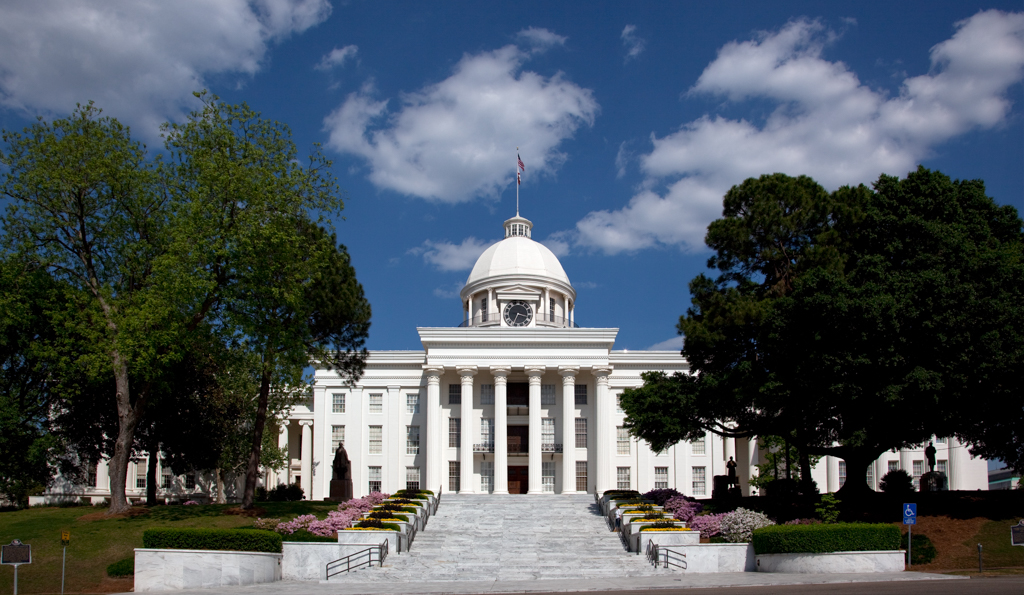
State Capitol Building
Rising at the end of Dexter Avenue at the top of a hill originally called Goat Hill, the Alabama State Capitol building has presided over Montgomery since 1851 — a Greek Revival structure of white columns and a central dome that has witnessed more pivotal and painful moments in American history than almost any comparable building in the country. It has served as the seat of state government, the cradle of the Confederacy, the backdrop of the Civil Rights Movement, and the site of a blood feud murder. That it carries a haunted reputation is almost difficult to avoid. The current building is the second capitol on this ground. The first, completed in 1847, burned down two years later. The current structure was completed in 1851, built partly by enslaved laborers, with its famous cantilevered spiral staircases crafted by Horace King, a formerly enslaved man who became one of the most accomplished builders in the antebellum South. The building immediately became the center of enormous historical forces. On January 11, 1861, Alabama voted to secede from the Union in the old Senate Chamber. Within weeks, delegates from six seceding states gathered in that same room and drafted the Provisional Constitution of the Confederate States of America. On February 18, 1861, Jefferson Davis arrived by carriage and was inaugurated as the Confederacy's only president on the front portico — the exact spot now marked by a brass six-pointed star embedded in the marble. Montgomery served as the Confederate capital for just over three months before the government relocated to Richmond. What remained was a building soaked in the weight of a nation's collapse. More than a century later, the Capitol stood at the center of history again. The third Selma to Montgomery Voting Rights March ended on its steps on March 25, 1965, with 25,000 protesters gathered on Dexter Avenue as Martin Luther King Jr. addressed the crowd. The building had once been the seat of the government that institutionalized slavery. Now it was the terminus of a march demanding the right of Black Americans to vote. That collision of meanings is embedded in the architecture itself. The most documented paranormal claim involves a murder committed inside the building on Halloween 1912. A property dispute between a young man named Will Oakley and his stepfather P.A. Woods came to a head in the Capitol offices of the state convict board president. Oakley produced two pistols, offered one to his stepfather for a duel, and when Woods refused, shot him four times. Oakley fled down the Capitol stairs, walked to the county jail, and surrendered. He was eventually committed to Bryce Hospital in Tuscaloosa, escaped, and was never heard from again. Since then, employees and security guards have repeatedly reported bathroom faucets turning on by themselves in the offices near the old convict board rooms — water running from fixtures with no one present, stopping only when manually shut off. Renovations over the decades have done nothing to stop it. The prevailing legend holds that Oakley's spirit returns endlessly to wash his stepfather's blood from his hands. The building's Civil War associations generate a separate layer of claims. A security guard quoted in a 1994 Birmingham News article reported seeing a female apparition near the statue of Governor Lurleen Wallace, wearing white opera-length gloves that matched those in Wallace's official portrait. Ghost tour operators describe the figure as a Civil War widow roaming the upper offices, wailing for a husband lost to the war. Cold spots and unexplained sounds have been attributed to the presence of Jefferson Davis, Civil War surgeon John Allan Wyeth — whose statue stands on the Capitol grounds — and an unidentified Confederate soldier. The Alabama State Capitol is open to the public Monday through Saturday and offers free guided tours. The governor's office still operates here. The old Senate Chamber where the Confederacy was born still stands. The brass star still marks where Davis took his oath. And somewhere in the building, according to those who have worked the late shifts, the water still runs.

Lucas Tavern – Old Alabama Town
Lucas Tavern represents one of Montgomery, Alabama's oldest existing structures, a building that predates the year 1818 and stands as a tangible testament to the city's colonial and early American heritage spanning more than two centuries. The structure was constructed during an era when the surrounding region was transitioning from frontier outpost to established settlement, and it functioned as a crucial waystation for travelers, merchants, political figures, and adventurers navigating the developing American South during a transformative period of national expansion. The tavern's significance in regional history was profoundly cemented during the famous and celebrated visit of the Marquis de Lafayette in 1825, when the French Revolutionary War hero embarked on his triumphant and emotionally charged farewell tour of the United States, retracing his revolutionary journey and meeting again with aging comrades. Eliza Lucas, the proprietor and operator of the establishment at that historic time, personally welcomed Lafayette into her tavern with appropriate ceremony and hospitality, an encounter that became one of the defining moments in both the building's documented history and in local Montgomery tradition and civic memory. The interaction between Eliza Lucas and this legendary statesman, celebrated throughout the nation as a symbol of liberty and freedom, elevated the tavern's social standing and cultural importance considerably, transforming it from a simple country inn into a site of recognized historical significance and prestige. Over the following decades, the Lucas Tavern continued to serve as a gathering place for prominent citizens, visiting dignitaries, and regular residents of Montgomery, accumulating stories, memories, and the spiritual imprint of countless human interactions within its aged and increasingly weathered walls. The building endured through the vicissitudes of American history, surviving the devastating Civil War and tumultuous Reconstruction era before eventually declining in use and falling into disrepair during the twentieth century's economic and social transformations. In 1980, recognizing the structure's considerable historical and cultural value to the region, preservationists and historical authorities undertook a comprehensive restoration and relocation project, carefully moving the tavern to Old Alabama Town, a museum and living history site dedicated to preserving structures and lifeways of the pre-twentieth-century American South. Since its careful restoration and relocation, the tavern has become widely recognized as one of Montgomery's most actively and consistently haunted locations, with numerous paranormal phenomena documented by visitors, staff members, and paranormal investigators over decades. The apparition of Eliza Lucas herself has been reported on multiple occasions by credible witnesses, materializing near the tavern's doorway in the evening hours, apparently continuing her historical role as welcoming host even from beyond the veil of death that separates the living from the departed. Witnesses describe seeing a Victorian-era woman of approximately five feet three inches in height, dressed in period clothing appropriate to the early nineteenth century, who gestures toward visitors in what is consistently interpreted as a gesture of greeting or warm invitation. Additional paranormal phenomena include unusual activity concentrated at the fireplace, where inexplicable ashes and smoke have been observed emanating from the chimney even when no fire is burning within the hearth and the flue is properly sealed and secure. In the vicinity of the fireplace, numerous visitors have reported hearing the distinct faint giggles of a young girl, believed to be the spirit of a child named Matilda who is thought to have perished in the tavern under circumstances that remain unclear and poorly documented historically. Mysterious reflections appear in the tavern's antique mirrors, sometimes showing images of people not visibly present in the room or displaying scenes apparently from past eras and time periods, suggesting that the mirrors may have absorbed and retained impressions from their long and eventful history.
Red Lady of Huntingdon College
Huntingdon College occupies a prominent location in Montgomery, Alabama, the state capital situated along the Alabama River in central Alabama with a rich history extending to the nineteenth century. The institution was founded in the nineteenth century as an educational establishment, with the college campus gradually expanding through acquisition of properties and construction of academic and residential buildings across multiple centuries of continuous operation. Pratt Hall stands as one of the college's most historically significant structures, a dormitory building that housed generations of student residents throughout the nineteenth and twentieth centuries of the college's existence. The building's architecture reflects educational and residential design standards of its construction period, with multiple floors of residential quarters arranged to accommodate substantial numbers of student residents during the academic year. The structure's age and decades of intensive occupation by student populations created an environment saturated with the experiences, emotions, and activities of countless young people during formative years of their development and education. The college campus itself holds significance as an educational institution dedicated to intellectual development and personal formation, creating an environment rich with human activity and psychological intensity throughout its long history of academic operations. Pratt Hall's prominence within college paranormal folklore and the specific haunting narrative associated with a female entity have made the building a focal point for paranormal interest within the academic community and among paranormal researchers investigating campus hauntings. The dormitory served as residential homes for student populations during academic years, creating intensive social environments where students navigated developmental challenges within institutional contexts. The paranormal entity believed to inhabit Pratt Hall is identified as the Red Lady, named for her distinctive appearance in a scarlet dress and associated with carrying a scarlet parasol according to witness accounts across generations. The ghost is identified as Martha, a young woman who died within the college dormitory through suicide, an act that created profound emotional trauma within the institution and left a persistent spiritual imprint. The apparition is particularly associated with the fourth-floor corridors and a specific transom window from which distinctive phenomena have been documented. One of the most distinctive paranormal phenomena involves periodic manifestation of crimson light rays that flash downward from the transom window on the anniversary date of her death, suggesting cyclical spiritual activity tethered to specific temporal markers. Paranormal manifestations associated with the Red Lady demonstrate characteristics suggesting consciousness attempting to maintain presence and communicate despite physical death occurring within the dormitory building. The apparition has been observed passing through walls and closed doors, demonstrating paranormal abilities unconstrained by physical limitations of ordinary matter. Student residents and visitors have witnessed the ghost move through solid structures, a phenomenon particularly distinctive and disturbing to contemporary witnesses unfamiliar with paranormal phenomena. The apparition's recurrent appearance in fourth-floor corridors and specific areas suggests territorial attachment to particular spaces within the dormitory building where she spent her final days. The phenomenon of crimson light rays manifesting on the anniversary of her death constitutes a particularly dramatic and temporally specific paranormal event observed by multiple witnesses. The college community's awareness of and engagement with the Red Lady haunting has resulted in her becoming a prominent figure within campus folklore and paranormal legend.
Maxwell Air Force Base
Maxwell Air Force Base, located in Montgomery, Alabama, has served as a critical and strategically important military installation for over a century of continuous operation, beginning as an aviation training facility during the early years of powered flight innovation and evolving into a major operational base for the United States Air Force. The base encompasses vast grounds and numerous buildings constructed across different eras, many of them built during the early to mid-twentieth century when Montgomery was establishing itself as an important hub for military aviation research, development, and aerospace industry growth. Building 1433, a mid-century structure situated within the base's original development zone and among its oldest remaining facilities, has become the focal point of persistent and well-documented paranormal reports that have circulated among military personnel, civilian staff members, and outside visitors for multiple decades. According to historical accounts and oral traditions carefully preserved among long-serving base personnel with institutional memory, the building occupies ground that was historically significant during the Civil War era, when Confederate forces maintained tight control over the region and Montgomery served as the capital of the Confederate States of America during the conflict. Specifically, the location is believed to correspond to an area where Confederate soldiers met their deaths during a harrowing river crossing attempt, with many drowning in the powerful current as they attempted to flee advancing Union forces or defend their military positions against superior numbers. These soldiers, caught and trapped between military necessity and impassable natural obstacles, perished in the waters, and according to paranormal investigators and those sensitive to spiritual presences, their confused and deeply traumatized consciousnesses remained tethered to the location long after their deaths. The paranormal manifestations documented in Building 1433 present a complex and multifaceted array of phenomena suggesting the active presence of multiple distinct entities and spiritual consciousness with different characteristics and apparent intentions. Inexplicable phantom smells have been reported repeatedly by personnel entering the building, most notably a distinct burning electrical odor that appears suddenly with no apparent source from the building's modern electrical systems or fixtures and disappears just as mysteriously. This acrid and distinctive scent is often accompanied by the appearance of dark shadow figures that dart rapidly across hallways in the building's interior, moving with unnatural speed and apparent intelligence, defying any explanation as ordinary shadows cast by ambient light sources or passing personnel. Military personnel assigned to Building 1433 have reported finding their bedding inexplicably saturated with water and river-like moisture despite the building being situated well above water level and its plumbing and roof systems being in demonstrably proper working order with no visible leaks. Temperature anomalies have been documented, with specific areas of the building dropping precipitously below normal ambient temperatures despite intact heating systems, creating zones of extreme cold within the otherwise climate-controlled structure. Disembodied voices have been recorded during paranormal investigations conducted within the building, some emanating from empty rooms and others appearing to communicate distress or military-related content in languages and dialects that suggest origins from the American Civil War era. The phenomena appear to intensify when visitors from northern states or the western United States occupy the building, suggesting a possible psychological or historical component to the hauntings related to the historical conflict between Union and Confederate forces and regional identities.