West Virginia State Penitentiary
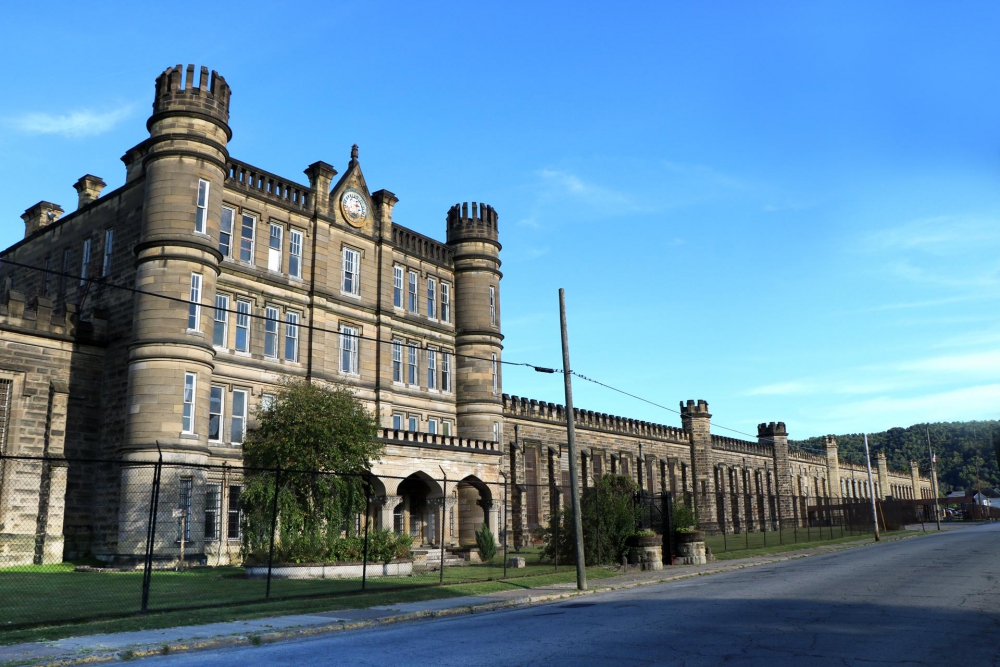
Moundsville, West Virginia·prison Rising from a flat stretch along Jefferson Avenue in Moundsville, West Virginia, the West Virginia State Penitentiary looks exactly like what most people picture when they think of a haunted prison—massive sandstone walls adorned with battlements and turrets, a fortress silhouette that feels pulled from a darker century. But the Penitentiary's origins weren't born from cruelty by design. When West Virginia became a state in 1863, it had no state prison at all. Prisoners were held in county jails, an arrangement that quickly proved inadequate for a young state trying to establish its own institutions.
Governor Boreman lobbied the legislature for funds to construct a state penitentiary, and in 1866 the legislature appropriated $50,000 to acquire land in Moundsville for construction. The prison at Joliet, Illinois provided the architectural prototype—an imposing stone structure fashioned in the castellated Gothic style, complete with turrets and battlements, though West Virginia's version would be approximately half the size. The Gothic structure officially opened in 1876 and would remain in continuous operation for nearly 130 years.
Unlike locations defined by a single dramatic event, the Penitentiary's weight comes from accumulation. It witnessed riots, fires, and the execution of nearly 100 prisoners through either hanging or electrocution over its lifetime. Deadly riots in 1973 and 1979 prompted judicial oversight, and despite efforts to improve conditions, another riot on New Year's Day 1986 led the state Supreme Court to order the facility's eventual closing. A 1986 ruling determined that confinement to the 5-by-7-foot cells constituted cruel and unusual punishment, and the last prisoners were transferred out in 1995.
The building itself amplifies everything. The sandstone facade rises with attached buttresses, circular turrets, and lancet windows—one of the finest examples of high Gothic Revival architecture in West Virginia. Long cellblock corridors stretch in either direction from the central administrative tower. The former North Hall, the shower room, and the solitary confinement area known as the Sugar Shack each carry their own particular atmosphere. Natural light barely penetrates the deeper interior. The original hardware, bars, and cell fixtures remain largely intact throughout.
Paranormal claims at the Penitentiary are among the most documented in the country. Reports of supernatural phenomena include sightings of phantom inmates by former guards and legends of a shadowy figure that wanders the premises. Visitors frequently report cold spots and unexplained noises, including voices. EVP sessions in the cellblocks often yield results that investigators describe as direct responses rather than ambient noise. Some guests report being touched or physically pushed in areas where no one else is standing.
Visitors have reported seeing the "Shadow Man," a static silhouette that roams the grounds. The former execution chamber draws particular attention, as does the Sugar Shack, where inmates were reportedly subjected to extreme punishment. Shadow figures, equipment malfunctions, and sudden drops in temperature are consistently reported across multiple independent investigations. Some claim to hear screaming from empty cellblocks, while others report doors moving on their own in the upper tiers.
Skeptics note that any century-old stone structure will settle, creak, and breathe in ways that feel unexplainable. Large facilities amplify sound unpredictably. The history of violence and suffering embedded in this place—by design, by circumstance, and by record—gives visitors a psychological framework that can color every sound and shadow. Still, seasoned investigators routinely describe the Penitentiary as producing some of the most compelling evidence they've encountered anywhere.
Today the site is maintained as a tourist attraction, museum, training facility, and filming location, operated by the Moundsville Economic Development Council. It sits directly across from the Grave Creek Mound, the largest prehistoric burial mound in eastern North America, a detail that adds another layer of historical unease to an already loaded site. There are no costumed actors on the standard tours. Just iron bars, cold stone floors, and the long institutional silence of a building that processed more than a century of human suffering. Whether visitors arrive as history buffs or paranormal investigators, most leave with the same feeling: that the West Virginia State Penitentiary has not finished telling its story.
Cold Spots
Apparitions
Disembodied Voices
Shadow Figures
+2