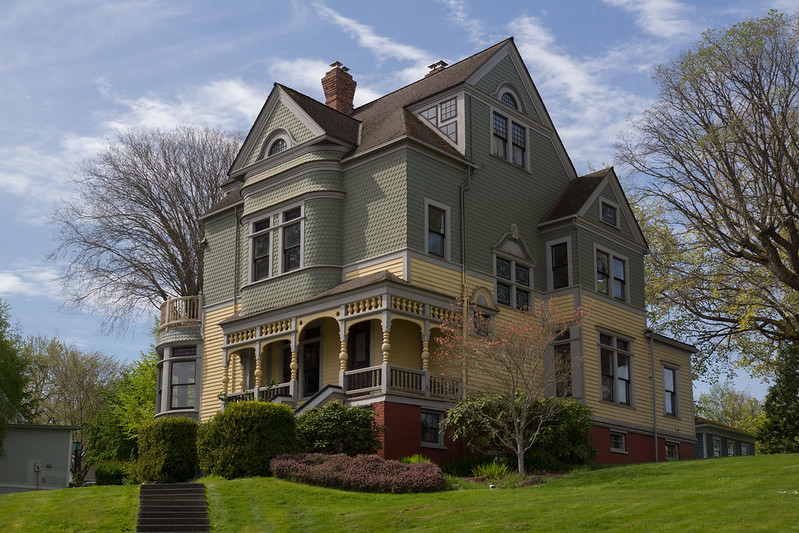
Port Gamble, Washington·museum The Walker-Ames House rises from a wooded hillside on Rainier Avenue in Port Gamble, Washington, a Victorian-era residence overlooking one of the most remarkably preserved company towns in the Pacific Northwest. The house is empty. It has been empty since the sawmill that built the town shut down in 1995. No one lives there, no one has lived there for decades, and yet by nearly every account available—from casual passersby to seasoned paranormal investigators—it is anything but unoccupied. Widely regarded as the most haunted house in Washington State, and possibly the entire West Coast, the Walker-Ames House sits at the center of a town where the dead, by persistent report, have simply chosen not to leave.
Port Gamble was founded in 1853 when William Talbot and Andrew Pope established a sawmill on the shores of Hood Canal on the Kitsap Peninsula. The mill operated continuously for 142 years—the longest-running sawmill in the United States at the time of its closure in December 1995. Around the mill, the Puget Mill Company built a town modeled on the New England villages its founders had known, with tidy clapboard houses, a white-steepled church, a general store, and tree-lined streets arranged along the waterfront. Port Gamble was a company town in the fullest sense: the mill provided the livelihood, the company owned the homes, and the families who lived there were bound to the rhythms of timber, tide, and the company's fortunes.
The original Walker-Ames House was destroyed in a fire in 1885. The current structure was built in 1888 for William Walker, the mill's master mechanic—a position of significant standing in a community organized entirely around the operation of the saw. Walker's daughter Maude married Edwin G. Ames, who served as the mill's resident manager and later its general manager. The house thus became the Walker-Ames, the most prominent and expensive residence in town, occupied by two generations of the family that ran the operation. After the mill closed, the house sat vacant, used occasionally for weddings, events, and eventually as a setting for films and fiction.
Paranormal reports at the Walker-Ames House date back to at least the 1950s, well before the property gained any organized attention from investigators. Former town manager Shana Smith began actively collecting accounts from current and former tenants in 2006, after a paranormal group called Evergreen Paranormal requested permission to investigate. What struck Smith was the consistency across accounts separated by years and offered by people with no knowledge of one another's experiences.
The house produces a range of reported phenomena. Pedestrians walking past have looked up to see the faces of small children peering from the upper-story windows of a house they know to be locked and empty. Attic lights flicker on and off with no one inside. Footsteps are heard running across floors above visitors standing in lower rooms. Disembodied voices have been recorded on electronic equipment. Visitors report being physically touched—one investigator emerged from the basement with a dusty handprint on her leg, claiming she had been grabbed. The basement generates the most intense reactions, with sensitives and casual visitors alike reporting feelings of sadness, heaviness, and an oppressive presence that several have described as darker in character than the rest of the house. The attic produces its own distinct atmosphere, with investigators reporting contact through electronic devices and the sense of a childlike energy.
The most frequently described apparition is a female figure in a long dark dress with her hair pulled back in a bun—identified by some psychics as a nanny, though her name and specific history remain unknown. Paranormal investigator Pete Orbea, who has led guided tours and investigations of the house since 2012, described an encounter in which he heard a scuffle in a hallway, turned around, and found the woman standing expressionless behind him. She vanished the moment others in his group saw her, but not before someone captured a photograph of a form in the doorway. A male figure believed by some to be Edwin Ames has also been described, along with a boy with curly light brown hair in period clothing.
The Walker-Ames House has been featured on A&E's "My Ghost Story" and serves as the centerpiece of the annual Port Gamble Ghost Conference, launched in 2010. Organized investigations are available by reservation, led by Orbea and visiting paranormal teams. One investigator's summary captures the paradox of the house well: despite having no dramatic history of violence or tragedy, the Walker-Ames produces an abundance of unexplainable activity—physical contact, electronic responses, apparitions, and EVP recordings that have left even skeptical visitors unsettled.
Today, Port Gamble itself is a quiet tourist village of galleries, shops, and cafes housed in the old company buildings. The Buena Vista Cemetery on the hill above town holds its own reputation for activity. The Walker-Ames House stands on Rainier Avenue, locked and unrestored, its Victorian facade watching over a town that outlived its industry but not, apparently, all of its inhabitants. Whatever draws the spirits to this particular house—whether it is love of place, unfinished duty, or something less easily named—the Walker-Ames remains what it has been for over a century: a family home, still occupied by a family that no longer needs the door.
Apparitions
Disembodied Voices
Full-Body Apparitions
Shadow Figures
+2