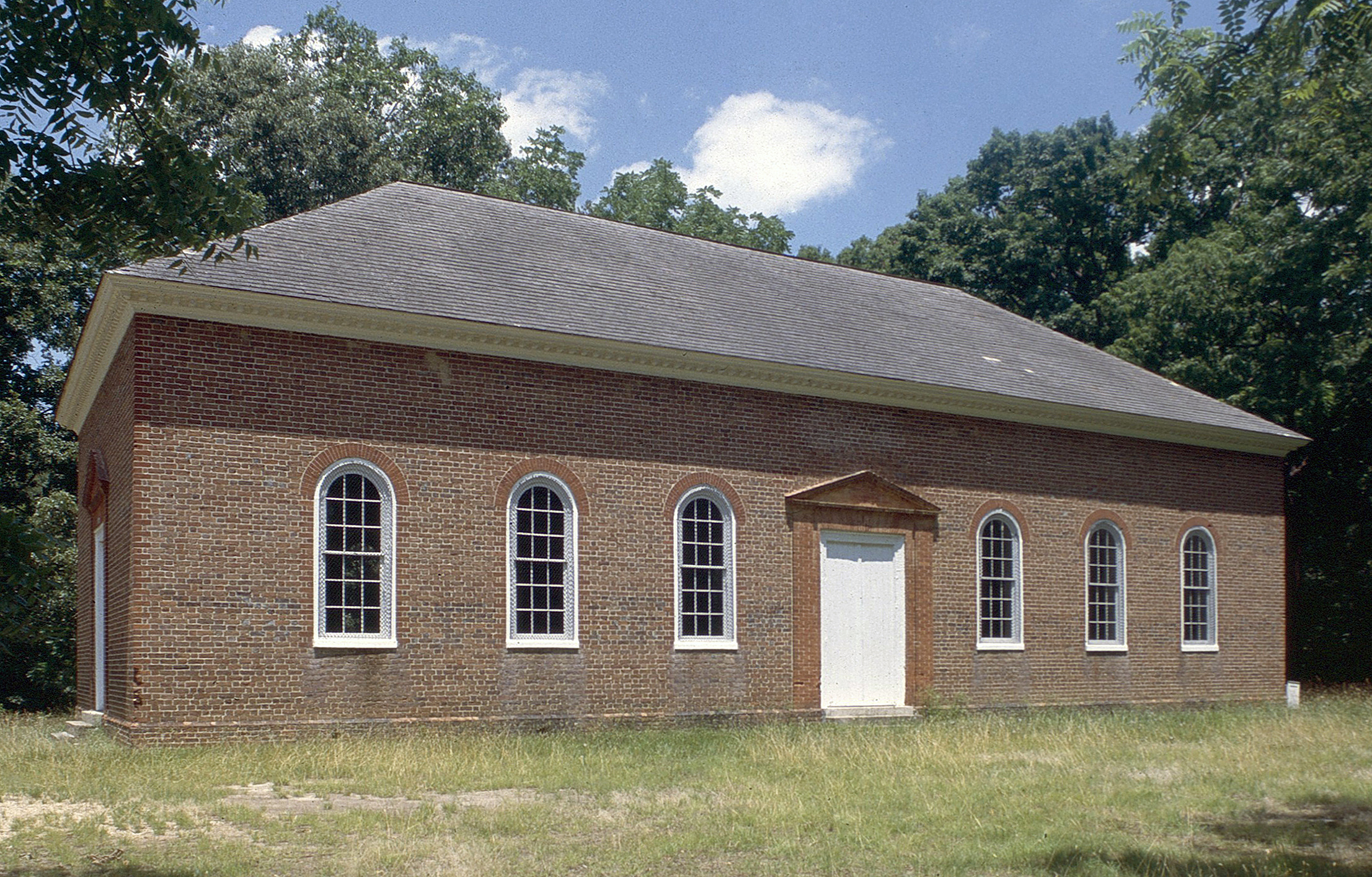
King George, Virginia·church Lamb's Creek Church stands off a quiet rural road in King George County, Virginia, half a mile north of the old King's Highway—a small, elegant brick rectangle with a hipped roof, seven bays of round-headed windows, and gauged brick doorways that represent some of the finest colonial craftsmanship in the Virginia Tidewater. It was built between 1769 and 1770 to serve Brunswick Parish, attributed to architect John Ariss, and it achieved a level of sophistication with almost no ornamentation at all. The brickwork alone tells you everything about what the builders intended—precise, restrained, and built to last centuries. It has.
The parish traces its origins to the early 1700s, when Brunswick Parish was carved from older parishes along the Rappahannock River. Its first house of worship, known as Muddy Creek Church, was likely a log chapel near the boundary of King George and Stafford Counties. As the population shifted eastward, the congregation needed a larger, more centrally located building, and Lamb's Creek Church was the result. The design closely resembles Payne's Church in Fairfax County, also attributed to Ariss, which was demolished by Union troops during the Civil War. Lamb's Creek survived the war, but not without scars. The church still possesses two rare treasures from its colonial past—a 1716 Vinegar Bible, so named for a famous misprint in Luke 20 that reads "the parable of the vinegar" instead of "the vineyard," and a 1662 missal—but the interior tells a harder story.
During the Civil War, Union cavalry used Lamb's Creek Church as a stable. Soldiers of the 1st Pennsylvania Cavalry tore out the pews, scattered the floor with straw and pistol cartridges, hitched horses to the headstones in the surrounding burial ground, and built fires on the graves. A wartime account from the Harris Light Cavalry described the scene with disgust, noting the church was 122 years old, built of three brick walls, and contained two pulpits, paintings, and inscriptions—all of it desecrated. The account concluded that every officer of the 1st Pennsylvania Cavalry should be dismissed from service for what had transpired there. After the war, the church fell into disuse and neglect. It was not restored to active Episcopal service until 1908. Today it stands as part of the Hanover-with-Brunswick Parish of the Diocese of Virginia, largely inactive, used primarily for an annual homecoming service held on the last Sunday of August.
The haunting associated with Lamb's Creek Church is a single, vivid legend that has persisted since the Civil War era. Two Confederate soldiers, the story goes, entered the church during the conflict and encountered the apparition of a woman in white kneeling at the chancel rail in prayer. She was not a living person. The figure appeared and then was gone, and the soldiers carried the account with them. The Lady in White has been the church's signature ghost ever since—a spectral worshipper still attending a service that ended long ago, in a building that had been emptied of its congregation and filled with horses and men who had no use for what the space was built to hold.
It is a restrained claim, almost genteel in its simplicity, and it fits the character of the building. Lamb's Creek Church is not a place that invites sensationalism. It is a place where the brickwork is still tight after 250 years, where the proportions still hold, and where the silence inside carries the weight of everything that has passed through it—colonial worship, revolutionary upheaval, wartime violation, decades of abandonment, and a slow, quiet return. The church was added to the National Register of Historic Places in 1972. It is available for weddings and events. The Lady in White, if she is still there, has the chancel to herself.
Apparitions
Senses of Presence