
Haunted Places in Alexandria, Virginia
4 haunted locations
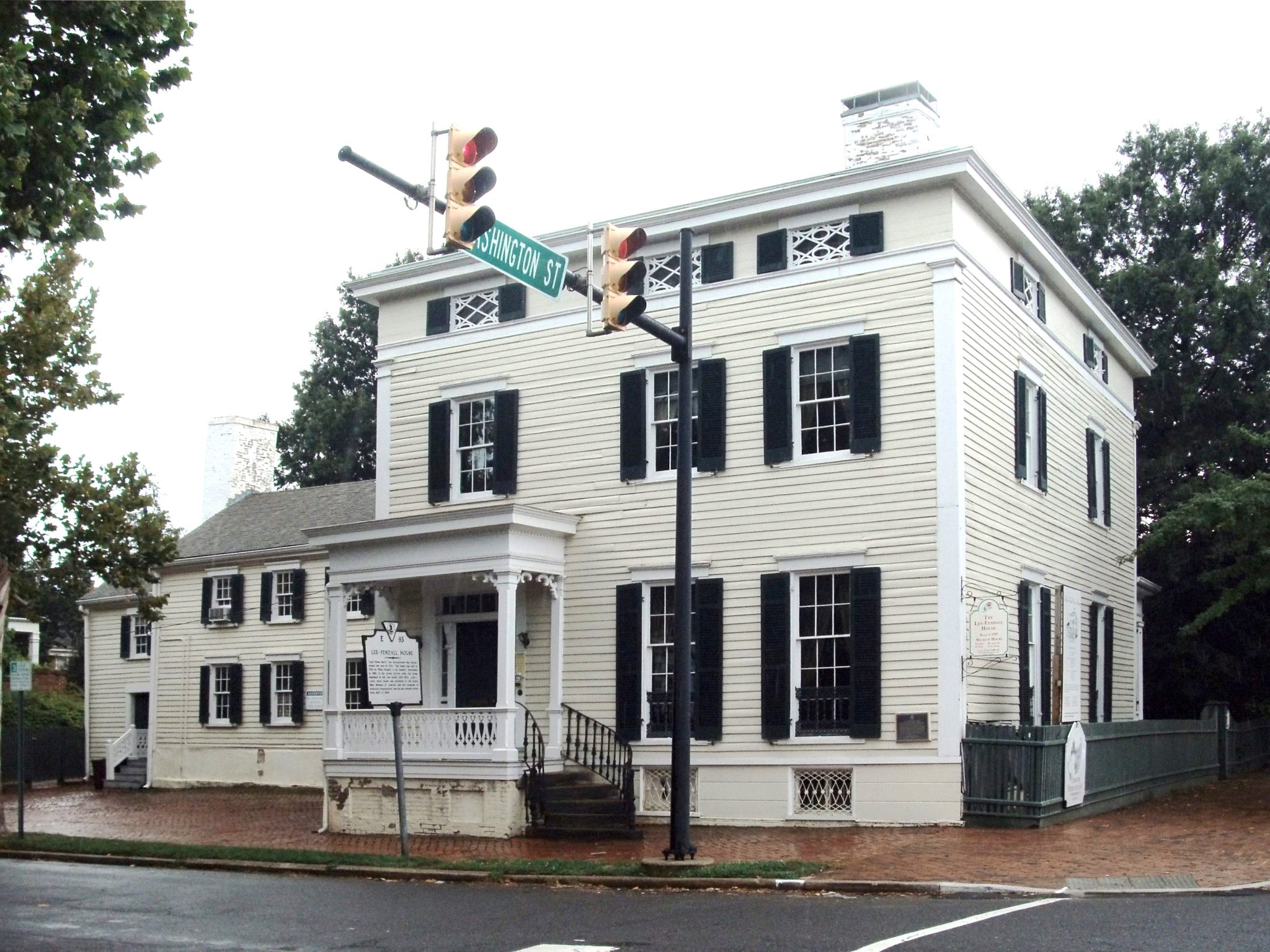
Lee-Fendall House
On the corner of Oronoco and Washington Streets in Old Town Alexandria, the Lee-Fendall House has been standing since 1785 — long enough to have absorbed nearly every defining era of American history within a single set of walls. It was built in the vernacular telescopic style common to Maryland but rare in Northern Virginia, constructed by Philip Richard Fendall on land sold to him by his stepson-in-law Henry "Light-Horse Harry" Lee, the Revolutionary War cavalry commander and father of Robert E. Lee. From 1785 until 1903, thirty-seven members of the Lee family lived here. The house was completed by November 1785, when George Washington noted in his diary dining at the Fendall home — one of at least seven recorded visits. Following Washington's death in December 1799, the house became a gathering place where Alexandrians organized their participation in his funeral at Mount Vernon. Former President John Quincy Adams visited in 1841. President Woodrow Wilson was received there in 1914. The Civil War interrupted all of that. In 1863, Union Chief Surgeon Edwin Bentley requested the use of what he called "the rebel house opposite Grosvenor Hospital" and was granted authority to seize it. The current occupant, Harriotte Cazenove, refused to swear the Loyalty Oath to the Federal Government, so the house was confiscated for unpaid taxes and converted into Grosvenor Branch Hospital. The Army expanded the property with additional wooden ward buildings and constructed a dead house on the grounds. Approximately 1,700 Union soldiers were treated there between 1863 and 1865, and nearly 100 died within those walls. The hospital's place in medical history is singular: it was the site of the first documented successful blood transfusion performed in North America, carried out by Dr. Bentley during the war. When the hospital closed in April 1865, the house was returned, sold, and passed through several families before Robert Downham — an Alexandria haberdasher whose father had twice been the city's mayor — purchased it in 1903. In 1937, labor leader John L. Lewis bought the house. Welsh-born, Iowa-raised, Lewis had risen from coal miner to president of the United Mine Workers of America for over four decades, eventually defying both Franklin Roosevelt and Harry Truman, founding the CIO, and reshaping American labor law from his base in Washington. At one point during a wartime strike he was strung up in effigy at the corner of Washington and Oronoco — directly outside the house he lived in. He died there on June 11, 1969, at age 89. His son sold the property to the Virginia Trust for Historic Preservation. The Lee-Fendall House Museum and Garden opened to the public in 1974. The paranormal claims are understated but consistent, and the museum leans into its haunted reputation enough to host annual ghost tours each October. Visitors have reported a female apparition in period dress moving through the interior rooms. A separate figure — a woman accompanied by a child — has been seen appearing on the back stairs. The sound of an antique telephone ringing has been heard by multiple people in rooms where no working telephone exists. The museum appeared in an episode of the television series Ghost Hunters. The weight of what occurred inside — nearly a century of Lee family life, hundreds of soldiers dying during two years of wartime medical care, the passing of one of the most consequential labor figures in American history — leaves the kind of residue that tends to generate these accounts. Open Wednesday through Sunday for guided tours. The garden is free.

Gadsby’s Tavern
Gadsby's Tavern stands as one of Alexandria, Virginia's most historically significant buildings, a structure that has served continuously since its construction in the eighteenth century as a hospitality, dining, and community gathering establishment accommodating prominent figures from American political and commercial history. The tavern was founded by John Gadsby, an enterprising proprietor who established it as a respectably appointed inn and tavern serving traveling merchants, government officials, and social elite who visited Alexandria during an era when the city functioned as a significant port and commercial center. The building's Federal-style architecture, featuring decorative woodwork, period furnishings, and technical details, has been meticulously preserved across more than two centuries of continuous operation, ensuring that the physical environment closely approximates its appearance during the founding era. Gadsby's reputation for maintaining high standards established it as a preferred destination for distinguished guests whose patronage enhanced the tavern's cultural and social significance. Gadsby's Tavern's operational history encompasses the full span of American national development, from the colonial and revolutionary periods through the nineteenth and twentieth centuries, maintaining its function as a hospitality and cultural venue despite extraordinary transformations in American society. The tavern survived the American Revolution, the Civil War and its immediate aftermath, industrial transformation, and the cultural upheavals of the twentieth century, continuing to serve guests and community members throughout these profound historical transitions. The ballroom became legendary as a venue for elaborate social celebrations and formal dances that established standards for Alexandria's social life. The most distinctive and haunting phenomenon associated with Gadsby's Tavern involves the appearance of a female apparition known historically as the Female Stranger, whose death on October 14, 1816, created one of American history's most enduring mysteries. A woman of unknown identity and origins arrived at the tavern during the autumn of 1816, claiming to be traveling from the Caribbean and intending to meet with a gentleman. The woman fell gravely ill during her stay, and despite the care provided by the proprietor and local physicians, she died after only a brief period of residence. Her identity remained a mystery, as she carried no identifying documents and offered confusing accounts of her origins. She was buried in Alexandria's historic cemetery, where her grave remains marked by a distinctive stone acknowledging her as the Female Stranger. Paranormal phenomena attributed to the Female Stranger have been documented consistently since the nineteenth century, generating Alexandria's most famous haunting legend and establishing Gadsby's Tavern as one of Virginia's most actively haunted locations. The primary manifestation involves the apparition of a woman appearing in windows, most frequently in Room 8 where the Female Stranger resided during her fatal illness, her figure visible holding a candle as though searching for someone or attempting to signal. Witnesses consistently describe her appearance as that of a sad, pale woman dressed in nineteenth-century clothing, her expression conveying melancholy, longing, and spiritual distress. The apparition appears most frequently during evening and nighttime hours, with multiple independent observers reporting remarkably similar descriptions. Faint musical sounds have been reported emanating from the historic ballroom, with some witnesses describing the music as resembling period dances or formal social occasions. A distinguished gentleman apparition dressed in eighteenth-century attire has been sighted in the tavern's public areas, potentially representing John Gadsby himself. This apparition appears far less frequently than the Female Stranger and remains less thoroughly documented. Paranormal researchers have conducted extensive investigations within Gadsby's Tavern utilizing electronic voice phenomenon equipment, electromagnetic field detectors, and thermal imaging technology, generating substantial documentation of paranormal activity concentrated in Room 8 and the ballroom. The mystery of the Female Stranger's identity has never been resolved. Today, Gadsby's Tavern operates simultaneously as a historic museum, restaurant, and active paranormal location, with guided ghost tours capitalizing on the legend of the Female Stranger while offering visitors opportunities to experience the venue's architectural character and historical significance.
Ramsay House
The Ramsay House in Alexandria, Virginia, stands as the oldest residential structure in the historic waterfront city, having been constructed in 1724 during the colonial period when Alexandria was a frontier settlement serving as a tobacco trading port on the Potomac River. The house was built by William Ramsay, a Scottish merchant who emigrated to Virginia to participate in the colonial tobacco trade and accumulated significant wealth through commercial operations. Ramsay established himself as a prominent figure in the developing community, leveraging his business acumen to acquire land and construct a residence reflecting his rising social position. The house represents colonial-era architectural styles with features typical of early eighteenth-century colonial Virginia homes, including timber frame construction and hand-forged hardware. The location overlooking the Potomac River provided Ramsay with proximity to shipping and commercial operations essential to colonial tobacco trading. William Ramsay's merchant operations and social prominence positioned him and his family at the center of the community's emerging elite. The house itself served as a focal point for commercial and social gatherings, with Ramsay hosting fellow merchants, colonial officials, and political leaders. The Ramsay House stands as a testament to the architectural ambitions and economic success of colonial Virginia's merchant class, representing the transitional period when Virginia transformed from frontier outpost into established colonial society. Ramsay's descendants continued to occupy the house for generations, maintaining family connections across the colonial and early American periods. The house underwent modifications with additions and renovations reflecting changing styles while the basic structure maintained continuity with its original construction. Alexandria's historical significance as a colonial port town created layers of historical activity and emotional investment in its properties. The Ramsay House overlooks the Potomac River, a waterway prominent in colonial commerce and the American Revolution. The location provided windows and vantage points allowing William Ramsay to observe the river traffic central to his commercial operations. The house witnessed the American Revolution, the establishment of the new nation, and the development of Alexandria as a prosperous port. The survival as the oldest continuously occupied building in Alexandria has allowed it to maintain direct connection across nearly three centuries of American history. Paranormal phenomena documented at the Ramsay House center on the presence of William Ramsay himself, whose spirit appears to maintain an attachment to the residence where he achieved his greatest success. Witnesses describe apparitions of a figure in eighteenth-century colonial clothing, consistent with the period when Ramsay lived and established his prominence. The spectral figure has been observed in the basement and near windows overlooking the Potomac River, areas where Ramsay would have spent significant time managing merchant operations. A mysterious phenomenon has been documented wherein the coffee maker operates and begins brewing before staff members have arrived, suggesting autonomous operation by an unseen entity. This phenomenon appears benign and helpful in character, possibly representing Ramsay's continued engagement with the household. The Ramsay House today operates as both a historical museum and residence, maintained by the Gadsby's Tavern Museum as part of a larger complex of historic Alexandria properties documenting colonial and early American history. The house is open for guided tours and educational programming, allowing visitors to experience colonial-era architecture and domestic life. The paranormal reputation has become integrated into the broader narrative of Alexandria's haunted history, with paranormal enthusiasts and historical tourists visiting specifically to learn about the documented spiritual phenomena. Paranormal investigation groups have conducted research at the Ramsay House, documenting the apparitions and anomalous coffee maker operation through photographic and testimonial evidence. William Ramsay's continuing presence more than two and a half centuries after his death suggests a powerful attachment to the location where he achieved his commercial success and social prominence.
The John Douglass Brown House – Fawcett-Reeder House
The John Douglass Brown House, located at 517 Prince Street in Alexandria, Virginia, represents one of the most historically significant Colonial-era residences in the region, constructed in 1772 during the tumultuous final years of British colonial rule and subsequently becoming witness to the American Revolutionary War and the formation of the new nation. The house was erected during an era when Alexandria, though technically Virginia, functioned as a commercially important outpost dominated by merchant and military interests connected to both colonial and revolutionary movements. The elegantly proportioned Federal-style dwelling was constructed with the craftsmanship and materials available to a prosperous merchant family during the 1770s, incorporating architectural details that reflected contemporary standards of taste and sophistication among the colonial gentry. The structure has been maintained or restored continuously since its construction, demonstrating an exceptional commitment to historical preservation over a span of more than two and a half centuries. Alexandria itself held considerable military and political importance throughout the Revolutionary War period, serving as a port, supply depot, and location of significant military activity during the conflict. The John Douglass Brown House's proximity to the waterfront and its construction as a substantial private residence meant that it was positioned to witness and potentially house military operations, officer accommodations, and strategic meetings related to the independence movement. George Washington, the commanding general of the Continental Army and subsequently the first President of the United States, is reported to have visited the residence, suggesting connections to the highest levels of revolutionary leadership and early American governance. Whether Washington's visits were formal diplomatic occasions, social engagements, or military consultations remains unspecified in available historical documentation, but the tradition has been maintained within the house's historical record. During the Revolutionary War and immediately thereafter, the John Douglass Brown House likely experienced direct contact with military personnel, the movement of troops through Alexandria, and the general disruptions attendant to armed conflict. Military hospitals were established in Alexandria to treat the wounded, and the house may have served some auxiliary function related to these medical or logistical operations. The trauma and death associated with the Revolutionary War, combined with the passage of hundreds of years and the accumulated weight of historical events witnessed by the structure, appear to have created conditions conducive to paranormal manifestation and ghostly phenomena. Paranormal phenomena reported at the John Douglass Brown House predominantly involve apparitions of individuals in Revolutionary War-era military uniforms, most frequently described as soldiers from the Continental Army. Witnesses have reported observing spectral figures moving through the rooms and spaces of the house, sometimes appearing in the dress and bearing of military officers or enlisted men. The manifestations have been documented through visitor accounts, paranormal investigation reports, and anecdotal testimonies from residents and guests. These apparitions appear to represent the spirits of soldiers who died during or immediately after the Revolutionary War, potentially including individuals who were housed in or passed through the structure during the conflict or subsequent military operations. The consistent historical focus of the manifestations on Revolutionary War soldiers suggests a strong psychic imprint related to the house's role in that transformative historical period. The present-day status of the John Douglass Brown House reflects its continued recognition as both an important historical landmark and an acknowledged paranormal location. The structure continues to be maintained by stewards committed to historical preservation, and it remains accessible to researchers, historians, and paranormal investigators interested in the site's documented supernatural phenomena. The house stands as a testimony to the intersection of American historical significance and unexplained paranormal manifestation, representing a location where the revolutionary past continues to assert its presence through the apparent persistence of spirits bound to the structures and circumstances of the Colonial and Revolutionary War eras. The documented apparitions of Revolutionary War soldiers serve as a poignant reminder that traumatic historical events may leave psychic impressions that persist across centuries.