
Haunted Places in South Carolina
106 haunted locations
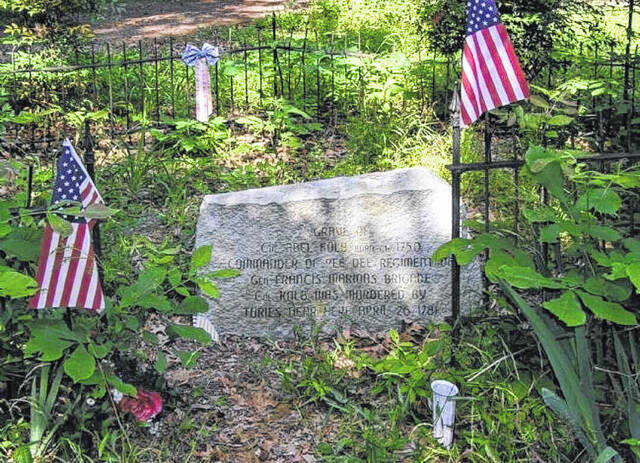
Colonel Kolb’s Tomb
The Great Pee Dee River moves through the coastal plain of South Carolina the way all rivers move through that kind of country — brown and wide and slow, flanked by bottomland that floods in spring and holds the heat in summer, lined with cypress and oak and the particular stillness of a landscape that has not changed its character in three hundred years. On its eastern bank, near the old Marlboro-Darlington county line, a small clearing holds what remains of the Old Welsh Neck Baptist Church cemetery — a few stone markers, several river rocks, and a modest obelisk that marks the grave of Colonel Abel Kolb, commander of the Pee Dee Regiment of General Francis Marion's Brigade. It is one of the more remote historic sites in South Carolina, sitting at the end of a county road in a place that the Darlington County Historical Commission's director has described, simply, as not having the peaceful, easy feeling you normally get from being on the banks of the Pee Dee River. The community that produced Abel Kolb was among the oldest in the Carolina interior. Welsh Baptist settlers from Pennsylvania and Delaware had been establishing homesteads on the eastern bank of the Pee Dee River as early as 1737, building Welsh Neck Church in 1738 — one of the foundational Baptist congregations in the American South — and creating a tight-knit community of farmers, planters, and dissenting Protestants who would, by the time of the Revolution, furnish a disproportionate number of committed patriots to the cause. Abel Kolb was born into this world around 1750, the son of Peter Kolb and Ann James, daughter of the Reverend Philip James, an early minister of Welsh Neck Church. His family's roots ran back to German Mennonite immigrants who had arrived in Pennsylvania in 1707; by the time Abel was born, the Kolbs were part of the established planter community on the Pee Dee. He was a gentleman farmer, a politician, a founding member of St. David's Episcopal Church in Cheraw, and, when the Revolution came, a soldier of considerable consequence in his region. Under General Francis Marion — the Swamp Fox, whose partisan warfare among the rivers and marshes of South Carolina has become one of the defining stories of the Revolutionary War in the South — Kolb served as commander of the Pee Dee Regiment, operating in the borderland between what is now Marlboro and Darlington counties. Marion's men fought without uniforms and without regular pay, relying on mobility and local knowledge to harry British forces and their Loyalist allies across the Carolina lowcountry. By 1781, Kolb and his regiment had contributed meaningfully to re-securing Patriot control of the Pee Dee region. That success made him a target. On the night of April 27–28, 1781, approximately fifty North Carolina Loyalist irregulars under Captain Joseph Jones — believed to have been operating under the command of the notorious Major Micajah Gainey — surrounded Kolb's home on the Pee Dee. His family was inside. Kolb came to the door and agreed to surrender himself as a prisoner of war at the urging of his wife and children. He stepped onto the porch. One of Jones's men shot him on the spot, in front of his family. The home was plundered and burned. His wife and children, along with other women and children present on the property, were spared. The historical marker erected in 1973 by the Marlboro County Historic Preservation Commission records the event without elaboration: he was shot while surrendering himself as a prisoner of war and his home was burned. The stone at his grave reads: "Col. Kolb was murdered by Tories near here April 26, 1781." Kolb was buried in the Welsh Neck cemetery a mile north of his home site, at the foot of the same eastern riverbank on which his community had built its first church forty years earlier. The obelisk that originally marked the grave was moved to the Marlboro County Historical Museum in Bennettsville for preservation after the site suffered repeated vandalism; a replacement marker now stands at the gravesite. The cemetery itself is old and largely abandoned — when the Welsh Neck congregation relocated to Society Hill in the nineteenth century, the graveyard was left behind. What remains are two stone monuments, several river rocks, scattered remnants of Kolb, Marshall, and Wilds family burials, and the accumulated presence of a site that has been undisturbed for close to two centuries except by those who come looking for something. The paranormal tradition attached to Kolb's tomb is specific and consistent. Visitors who come to the gravesite after dark report hearing the sound of someone walking in the woods around the clearing — footsteps without a visible source, movement in the tree line that does not correspond to any identifiable animal. Several witnesses have reported the apparition of a man appearing suddenly beside them at the grave, present for a moment and then gone. The site sits on the same ground where Kolb was shot, close enough to his home site that the killing and the burial are effectively collocated — the tomb is not a distant memorial but a marker placed within yards of the porch where he died. Paranormal investigators have conducted sessions at the site with EVP equipment and spirit communication devices, receiving responses including the words "commanded," "troops," "brass," and "shot" — the last considered by investigators to be consistent with the actual circumstances of the murder rather than the popular legend, which in some versions holds that Kolb and his family were burned alive together. The popular legend diverges from the historical record in its details but not in its emotional weight. The documented facts — a soldier who agreed to surrender to protect his family, shot the moment he stepped through his own front door, his house torched while his children watched — carry enough of their own gravity to sustain a haunting tradition without embellishment. The site sits in a region so saturated with Revolutionary War violence that artifacts turn up routinely in the surrounding fields and woods, alongside remnants of the Welsh Neck settlement that preceded the war by a generation. The Darlington County Historical Commission's director put it directly: if there is any indication of ghostly spirits in the area, Col. Kolb would be a likely candidate.

Heriot-Tarbox House
The Heriot-Tarbox House stands as a significant architectural remnant of Georgetown, South Carolina's colonial prosperity, its weathered facade and elegant proportions testimony to an era when this Low Country port rivaled Charleston in commercial importance. Constructed during the eighteenth century, the house witnessed the rise and fall of mercantile fortunes, hosting guests of considerable prominence and standing as a place of refinement and cultured society. The building's design reflects the architectural sophistication of its period, with symmetrical Federal-style elements and interior details that bespeak the wealth and taste of its original occupants. The exterior features characteristic Low Country construction techniques including piazzas designed to capture sea breezes and shade the interior from intense southern heat. Georgetown flourished as a center of indigo cultivation and trade, with merchant houses such as this one serving as both residences and business headquarters for the planter aristocracy that controlled the region's economy and social life. The waterfront location provided convenient access to shipping lanes and international commerce that enriched the families inhabiting such grand residences. The house absorbed the daily dramas of generations of inhabitants, from intimate family moments to significant historical events, its rooms holding centuries of memories within their walls. The spatial arrangement of the house reflects social hierarchies and domestic customs of the era, with servant spaces segregated from family quarters and public reception areas designed to impress visitors of consequence. The multiple fireplaces, specialized rooms, and decorative finishes indicate considerable wealth and refined sensibilities among successive occupants. Yet Georgetown and this historic house became inextricably linked with one of the most enduring mysteries of early American history, centered on Theodosia Burr Alston, daughter of Vice President Aaron Burr. In 1812, Theodosia embarked on a ship bound for Georgetown to visit her father, who had fled political disgrace in New York and sought refuge in isolation from the hostile political environment. The vessel carrying her vanished at sea under circumstances that remain unexplained to this day, and she was never found despite extensive searches and inquiries. Her disappearance sparked speculation and mourning that reverberated through American society, with theories ranging from piracy and privateering to shipwreck to deliberate assassination. The Heriot-Tarbox House, where she was expected to arrive and likely stayed on prior visits to her father, became associated with her tragic fate and the grief of lost reunion. Paranormal investigators and visitors have reported mysterious presences throughout the house's interior rooms, apparitions that some identify as Theodosia herself, still waiting for a reunion that never came. Witnesses describe seeing a translucent female figure in period dress moving through guest areas where she may have stayed, and experiencing profound sadness and unexplained emotional distress in specific rooms. Cold spots concentrate in chambers where she likely slept, and visitors report feelings of profound longing and despair. The emotional intensity of her situation appears to have impressed itself upon the physical structure. The activity suggests a spirit caught between arrival and departure, eternally present in a house of reunion that became instead a place of permanent absence and eternal waiting. Today, the Heriot-Tarbox House attracts paranormal researchers intent on communicating with its spectral inhabitant and understanding the cryptic messages she may be attempting to convey across more than two centuries.
Abbeville County Museum
The Abbeville County Museum occupies a distinctive position within the South Carolina cultural landscape, both as a repository of regional historical artifacts and as a location of documented paranormal significance that reflects the complex and troubling aspects of the area's past. The building that now houses the museum collections was originally constructed to serve as a county jail, a facility designed and operated according to the standards and practices of nineteenth-century incarceration that would have confined individuals accused or convicted of crimes within its walls. The transition of this former jail building into a museum represented a significant cultural decision to preserve and interpret the structure as a historical artifact itself, transforming the spaces that once functioned as instruments of legal punishment and social control into environments dedicated to educating contemporary populations about the material culture and social history of Abbeville County and the surrounding region. The museum's collections encompass artifacts spanning multiple centuries of regional occupation and development, from indigenous peoples through colonial settlement to the antebellum, Civil War, and post-war periods. The upper floors of the structure, which would have housed the jail cells and secure holding areas during the facility's operation as a detention center, retain particular significance as spaces where individuals experienced confinement, legal proceedings, and the prospect of judicial punishment, including execution. Within the upper floors of the former jail building, particularly on the third floor level, paranormal phenomena of considerable intensity and consistency have been documented by visitors, staff, and paranormal investigators working to understand the spiritual geography of the structure. The most significant of these manifestations centers upon the presence of Earl Miller, an African American prisoner whose confinement within the jail dates to the year 1905 and whose continued presence within the building appears to extend to the present day, more than a century after his initial incarceration. The paranormal activity associated with Earl Miller manifests most distinctly through ghostly footsteps that traverse the third floor hallways, areas where cells would have been located and where detained individuals would have been confined during their incarceration. These footsteps occur without visible human source, echoing through the corridors and exhibition spaces with a deliberate rhythm that suggests purposeful movement through familiar spaces. The third floor area, identified by visitors and paranormal researchers as the most actively haunted section of the building, appears to be a nexus of paranormal phenomena related not only to Earl Miller but potentially to other individuals who experienced confinement and whose fates may have been determined by judicial proceedings and executions that occurred within or in close proximity to the facility. The history of the Abbeville County area, situated within the broader context of the American South's troubled racial history and the mechanisms of legal violence that disproportionately affected African American individuals, provides historical context for understanding the potential origins and nature of the paranormal manifestations documented within the museum. Apparitional figures have been reported on the upper floors where hangings may have occurred, suggesting the possible presence of individuals whose deaths through judicial execution have left persistent spiritual imprints upon the physical spaces where those deaths took place. The emotional and psychological trauma associated with confinement, facing mortality through judicial violence, and the racial dimensions of criminal justice in the American South appear to have created conditions within the building that sustain the continued presence and manifestation of spiritual entities. The Abbeville County Museum remains an active location for paranormal documentation, with ongoing research efforts seeking to understand the nature of these manifestations and their relationship to the historical experiences of individuals such as Earl Miller and others whose lives and deaths intersected with the building's function as a space of incarceration and punishment. Contemporary visitors to the museum continue to experience the footsteps, apparitional sightings, and other paranormal phenomena that suggest the presence of active spiritual forces within the structure, making the building simultaneously a site of historical interpretation and ongoing paranormal investigation.
Sansbury Cemetery
Sansbury Cemetery, located in Timmonsville, South Carolina, represents a typical rural or small-town American burial ground, established to serve the spiritual and familial needs of the surrounding agricultural and residential community. Like many cemeteries in the South, Sansbury Cemetery likely dates to the nineteenth century or earlier, serving as a repository for community members whose lives and deaths shaped the social and familial structure of Timmonsville and the surrounding region. The cemetery grounds feature the characteristics typical of rural American burial sites, including open terrain interspersed with trees, grave markers and monuments of varying ages and styles reflecting different periods of use and changing commemorative practices, and pathways facilitating visitor access to burial plots. The physical environment of Sansbury Cemetery reflects the natural landscape of South Carolina's Clarendon County, an area characterized by relatively flat terrain, mixed hardwood and pine forests, and the hydrological systems that define the region's drainage and water management patterns. Over generations, numerous families have chosen Sansbury Cemetery as the final resting place for their ancestors, creating deeply rooted connections between living community members and the burial ground that extend far beyond simple property ownership or civic obligation. The cemetery remains an active burial ground, continuing to receive new interments and serving as a locus for family remembrance, grief, and connection to ancestral lineages. The specific history that precipitated paranormal manifestations at Sansbury Cemetery relates to the circumstances surrounding the death of an unidentified infant whose burial in the cemetery created psychological and spiritual conditions that apparently persist into the contemporary era. The loss of a very young child represents one of the most profound tragedies a family can experience, and the emotional devastation associated with such losses may create the psychological imprints that some paranormal researchers believe contribute to spiritual manifestations. The documentation available regarding this specific case does not provide details concerning the age of the child at death, the circumstances surrounding the infant's demise, the identity of the parents or guardians, or other biographical information that might illuminate the historical context of this haunting. The absence of detailed historical documentation concerning this particular infant's death is not unusual, as very young children who died during earlier historical periods were often buried with minimal formal record-keeping compared to adult burials, particularly in rural communities with limited institutional resources for maintaining detailed genealogical or burial records. The fact that the spirit of this unidentified infant continues to manifest decades or centuries after death suggests the tragedy was sufficiently profound to create a lasting impression upon the spiritual or psychic landscape of the cemetery. The paranormal phenomena associated with Sansbury Cemetery, specifically attributed to the presence of the deceased infant, manifest in the distinctive form of auditory manifestations characterized by the sound of a baby crying or infants in distress. Multiple witnesses, including cemetery visitors, cemetery maintenance personnel, and paranormal investigators, have reported hearing disembodied infant cries emanating from the cemetery grounds, particularly from areas encompassing the burial sites of young children. The distinctive quality of these sounds, which witnesses characterize as genuinely resembling an infant's vocal distress, distinguishes them from ordinary environmental noises that might have innocent explanations such as animal vocalizations or mechanical sounds. The consistency of witness testimony regarding the nature and characteristics of the sounds suggests a genuine paranormal phenomenon rather than misidentification of natural phenomena or psychological misinterpretation. Beyond the specific infant cries, witnesses report broader categories of unexplained noises at Sansbury Cemetery, suggesting either multiple spirit entities haunting the location or a more general spiritual disturbance affecting the cemetery grounds. The eerie atmosphere and pervasive sense of sadness and despair reported by visitors to the cemetery during and following these auditory manifestations suggest the spirits or psychic impressions at Sansbury Cemetery carry significant emotional weight and psychological impact. Sansbury Cemetery in the contemporary era continues to function as both an active burial ground and a location of paranormal interest within South Carolina's documented haunted places. The cemetery remains accessible to family members visiting ancestral burial plots and to paranormal researchers and enthusiasts drawn by the documented haunting phenomena. Local historical societies have compiled genealogical records and cemetery documentation that preserve information regarding individuals and families buried at Sansbury, contributing to scholarly understanding of Timmonsville's demographic and social history. Paranormal investigation organizations have incorporated Sansbury Cemetery into investigations of South Carolina's most active haunted cemeteries, contributing to the accumulated body of documentation regarding infant hauntings and the emotional intensity associated with losses of very young children. The cemetery's inclusion in comprehensive lists of South Carolina's haunted locations has enhanced its visibility within paranormal tourism circles, attracting visitors who combine interest in genealogy, local history, and paranormal investigation. The persistent auditory manifestations at Sansbury Cemetery suggest an entity or psychic impression of profound emotional significance, one whose sadness and despair remain palpable to sensitive individuals visiting the location. The cemetery stands as a poignant reminder of the vulnerability of infants and young children in earlier historical periods and the enduring emotional power of parental loss, phenomena that transcend the boundary between life and death and continue to resonate within the spiritual landscape of this quiet South Carolina burial ground.
All Saints Cemetery
All Saints Cemetery, situated in Waccamaw, South Carolina, occupies a distinctive landscape characterized by coastal marsh environments, cypress wetlands, and the hydrological systems that define the Low Country ecology of the southeastern United States. The cemetery was established during the antebellum period when communities required formal burial grounds to serve their spiritual and familial needs, and its location reflects both practical considerations regarding available land and the spiritual significance placed upon burial sites adjacent to water systems. The surrounding terrain transitions from developed areas into increasingly wild wetlands, creating a liminal space between human civilization and the primordial landscape that characterizes coastal South Carolina. The marsh areas surrounding the cemetery exhibit unique ecological characteristics, with tidal influences and seasonal water level fluctuations creating environments rich in indigenous flora and fauna. Over the centuries since its establishment, All Saints Cemetery has accumulated considerable historical significance, serving as the burial place for prominent families, community leaders, and ordinary citizens who established deep roots in the Waccamaw area and the broader Waccamaw region. The cemetery reflects the demographic, religious, and social structures of the communities it has served, with grave markers and monuments attesting to the diversity of individuals and families laid to rest there across generations. The specific paranormal figure most prominently associated with All Saints Cemetery is the spirit of a woman identified simply as Alice, whose tragic history and restless haunting have captured the attention of investigators, historians, and local residents for many years. Alice's story, as preserved in oral tradition and written accounts, involves a personal loss of significant emotional magnitude, culminating in a search that appears to transcend death itself. According to the most widely circulated accounts, Alice is believed to have lost a ring of considerable personal or sentimental value, an object that presumably held deep meaning in her life during her earthly existence. The loss of this ring created such profound distress that her spirit, unable to accept the loss or reconcile with the circumstances of her death, became bound to the earthly realm in a quest to recover the lost object. The ring, according to various accounts, is believed to have been lost in the marsh areas adjacent to the cemetery, perhaps during a final journey or in circumstances related to her death. The emotional intensity associated with this loss appears to have imprinted itself upon the landscape and the spiritual atmosphere of the location, creating a residual haunting that manifests across generations and seasons. The manifestations of Alice's ghostly presence exhibit remarkable consistency across multiple witness accounts spanning many decades. She is consistently described as appearing in the form of a young woman dressed in a white or pale-colored dress, garments reminiscent of nineteenth or early twentieth century attire, suggesting the historical period from which her spirit likely originates. The apparition is frequently reported to move with apparent purposefulness from the Hermitage, a significant landmark or location near the cemetery, toward the cemetery grounds themselves and into the surrounding marsh areas. Witnesses describe observing her figure engaged in searching behaviors, peering into marsh vegetation and water as though conducting an urgent, desperate search for something lost beneath the surface or hidden among the dense growth of wetland plants. The apparition appears particularly active during twilight hours and nighttime periods, though credible reports suggest she has been observed at various times of day. Paranormal investigation teams equipped with video recording equipment and electromagnetic monitoring devices have documented phenomena at the cemetery, though capturing clear visual evidence of Alice's manifestation remains challenging due to environmental factors and the ephemeral nature of spiritual apparitions. The search behavior attributed to her spirit suggests a haunting driven by unfinished business and unfulfilled resolution, a psychological or spiritual state that some paranormal researchers believe persists until the lost object is recovered or the spirit achieves peace through alternative means. All Saints Cemetery continues to function as an active burial ground while simultaneously serving as a focus for paranormal research and historical investigation within the Waccamaw area. The cemetery remains accessible to visitors, researchers, and descendants of those interred there, though the increasingly wild nature of the surrounding marsh environment means that exploration of the peripheral areas requires care and consideration of natural hazards. Local historical societies have documented genealogical records and oral traditions associated with prominent families buried in the cemetery, contributing to scholarly understanding of the region's settlement patterns and social structures. Paranormal investigation groups have conducted organized investigations at the site, employing standard investigative methodologies and documentation practices while respecting the sacred nature of the burial ground. The combination of genuine historical tragedy, compelling paranormal testimony, and the atmospheric character of the marsh environment has made All Saints Cemetery a recognized location within both academic historical circles and paranormal research communities, drawing continued interest from those seeking to understand the mysteries of both Waccamaw's past and the unexplained phenomena that persist within its most sacred spaces.
Chiquola Club Hotel
The Chiquola Club Hotel, located in Anderson, South Carolina, represents a distinctive architectural landmark in the historic downtown district, embodying the design aesthetics and hospitality conventions of the late nineteenth and early twentieth centuries when grand hotels served as civic centers and gathering places for prominent citizens. The structure was originally constructed to accommodate travelers, business visitors, and social gatherings within the growing industrial and commercial community of Anderson, which experienced substantial economic expansion during this period. The building features characteristic period architecture with multiple stories, substantial brick or stone construction, and interior spaces designed to provide comfortable lodging and elaborate public areas for entertainment and social functions. The Chiquola Club Hotel gained prominence as a destination for visiting dignitaries, business executives, and cultural events within the Upstate South Carolina region, and its name became synonymous with refined hospitality and Southern charm. The building's design reflects the architectural trends of its era, with particular attention to ornamental details, quality materials, and functional layouts that maximized both guest comfort and operational efficiency for the hotel staff. The religious and educational significance of the Chiquola Club Hotel is inextricably linked to the Society of the Sacred Heart, a Catholic religious community devoted to education and spiritual service throughout the United States. Rose Lummis, a nun belonging to this venerable order, maintained a strong connection to the hotel and the surrounding community in Anderson. The Society of the Sacred Heart was known for its commitment to educating young women from Catholic families and maintaining a visible presence in urban centers throughout America. Rose Lummis's association with the hotel and the broader Anderson community suggests she played a meaningful role in spiritual and social activities connected to both the Catholic Church and the broader civic life of the region. Historical records documenting her tenure with the Society of the Sacred Heart indicate she was a devoted religious figure whose service extended across multiple decades, making her memory particularly enduring within both religious and secular historical accounts of Anderson's cultural development. The paranormal manifestations at the Chiquola Club Hotel focus overwhelmingly on the presence of a spectral nun, identified consistently across accounts as Rose Lummis, who appears dressed in the traditional white habit characteristic of her religious community's ceremonial and daily attire. Witnesses describing encounters with this apparition report seeing her figure moving through common areas of the hotel, appearing to conduct devotional activities or observing the modern operations of the building as though monitoring the spiritual state of the location. The haunting appears concentrated in public spaces rather than guest rooms, suggesting the entity may be oriented toward the communal and social functions that once characterized the hotel's primary purpose. Visitors and staff members have reported encountering the apparition during both daylight and evening hours, with descriptions remaining remarkably consistent regarding her appearance, demeanor, and the general area of manifestation. Some investigators have noted that the presence seems most pronounced in areas connected to the hotel's historical religious or social functions, suggesting emotional or spiritual attachment to specific locations within the building. Video documentation of paranormal phenomena at the hotel has been compiled and shared within paranormal research communities, adding credible eyewitness testimony to the historical record of this haunting. The Chiquola Club Hotel has undergone significant transformations since its original construction and operation as a traditional hospitality establishment. In recent decades, the historic structure has been converted into residential condominiums, a common adaptive reuse strategy that preserves architecturally significant buildings while providing modern living spaces for contemporary residents. The conversion process involved substantial renovation and modernization of interior systems while maintaining exterior architectural integrity and historical character. Despite these structural and functional changes, reports of paranormal activity have persisted, with current residents and visitors to the building continuing to document encounters with the ghostly nun. The transition from public hotel to private residential space has not diminished the haunting but rather has transformed the nature of the phenomena, shifting from encounters involving hotel staff and guests to manifestations experienced by permanent residents and occasional visitors to the building. The Chiquola Club Hotel, now a condominium complex, remains a recognized location within paranormal tourism and historical preservation circles, drawing continued interest from those fascinated by the intersection of religious history, architectural heritage, and unexplained spiritual phenomena in the American South.
Mansfield Plantation
Mansfield Plantation stands as a significant historical estate in Georgetown, South Carolina, representing the antebellum South's complex legacy of agricultural wealth and aristocratic ambition. The grand mansion was constructed during the nineteenth century as the residence of a prominent planter family, its architectural design reflecting the classical revival style that dominated elite residential construction throughout the American South during this prosperous era. The main house and numerous outbuildings were positioned across extensive grounds that once supported large-scale rice and cotton cultivation, the lifeblood of the plantation's economic success and the reason for its construction in such a remote location. The property eventually passed through multiple ownership changes as agricultural economies shifted and the region transformed following the Civil War. During the twentieth century, the plantation was repurposed as a bed and breakfast operation, allowing visitors to experience the ambiance of a historical estate while enjoying modern hospitality services. The structure's imposing architecture, with its grand columns, spacious rooms, and period furnishings, attracted guests seeking immersion in historical atmosphere and Southern charm, drawing heritage tourists from across the country. The North Guest House, a separate residential building located on the plantation grounds, became the focal point of unusual occurrences that defied conventional explanation. Guests and staff members reported experiencing unexplained phenomena concentrated within this structure, including disembodied voices, cold spots that appeared and disappeared without obvious environmental cause, and the sensation of unseen presences moving through the rooms. Electronic voice phenomena recordings captured during investigations within the North Guest House yielded particularly striking results, with audio specialists identifying what appeared to be disembodied voices speaking in distressed tones. One recording repeatedly captured what sounded like a voice pleading "don't leave me," spoken with evident emotional anguish and desperation that suggested genuine psychological distress rather than contamination or mechanical artifact. The identity of the entities speaking these words remained mysterious, though investigation suggested they were former residents or workers connected to the plantation's complex history. Additional paranormal activity was reported throughout other areas of the mansion, with guests experiencing apparitions, sudden temperature fluctuations, and objects relocated from their original positions without any obvious explanation. Investigations conducted by professional paranormal researchers revealed consistent patterns of supernatural activity concentrated within specific rooms and areas of the plantation. The North Guest House demonstrated the highest concentration of documented paranormal incidents, with multiple independent investigations corroborating witness accounts of anomalous activity. Electronic recording equipment consistently captured evidence of disembodied voices and vocalizations that could not be attributed to wind, mechanical systems, or other conventional sources. Thermal imaging surveys revealed inexplicable cold spots that appeared and disappeared in areas of the building where no draft or air conditioning system could account for the temperature variations. Researchers theorized that the entities haunting the property might be connected to the plantation's historical role in the antebellum South, potentially including enslaved individuals whose lives were intertwined with the property or family members who died on the grounds under traumatic circumstances. The emotional content of the recorded voices and the apparent distress evident in the recorded communications suggested entities still attempting to express unresolved emotional trauma or communicate messages to the living world. Contemporary visitors to Mansfield Plantation, now operating as a historical bed and breakfast experience, continue to report paranormal encounters despite the property's transition to hospitality use. Overnight guests in the North Guest House and main residence frequently experience phenomena consistent with documented historical reports, including unexplained sounds, apparitions, and sensations of unseen presences. The plantation's management acknowledges the paranormal reputation and has incorporated this aspect into marketing materials, positioning the property as a location for those seeking genuine historical ambiance combined with potential supernatural encounters. Paranormal investigation teams regularly request permission to conduct formal investigations of the grounds and buildings, attracted by the property's consistent track record of documented phenomena and the compelling emotional resonance of the recorded voices captured during previous investigations. The persistence of paranormal activity across multiple decades and the consistency of reports from independent observers has established Mansfield Plantation as a credible location for serious paranormal research and documentation.
White Point Garden
White Point Garden occupies a prominent position at the terminus of the Charleston Peninsula in Charleston, South Carolina, a verdant public park situated along the waterfront where the Ashley and Cooper Rivers converge, creating one of the city's most picturesque and historically significant locations. The garden itself developed gradually over the course of centuries, beginning as a strategic military fortification in Charleston's earliest days as a colonial settlement, subsequently evolving through various phases of development and use, eventually becoming formalized as a public garden and recreational space intended to serve the city's residents and visiting tourists. The park's landscape features mature oak trees with massive spreading branches, natural waterfront vistas looking across the harbor toward Fort Sumter and the broader Charleston Harbor, and winding paths that guide visitors through the peaceful and aesthetically appealing space that would seem entirely serene were it not for the historical trauma embedded within the site's past and the paranormal phenomena that continue to manifest within its boundaries. The historical significance of White Point Garden extends far beyond its contemporary status as a pleasant recreational space, for the location served for a considerable period as Charleston's primary execution ground, the designated location where individuals condemned for capital crimes, including acts of piracy and other maritime offenses, were brought to face their final punishment and meet their deaths before public witnesses. During the Golden Age of Piracy in the late seventeenth and early eighteenth centuries, the waters surrounding Charleston emerged as a significant nexus for maritime commerce and a territory contested by legitimate merchant vessels and pirate ships seeking opportunity for plunder and profit. The colonial authorities of Charleston, responding to the persistent threat posed by pirate activity, adopted a policy of aggressive prosecution of captured pirates and other maritime criminals, executing those convicted at White Point Garden in a deliberate strategy intended to discourage piracy through the public spectacle of capital punishment and the visual reminder of the consequences awaiting those engaged in such criminal enterprises. The most historically notable execution occurring at the location involved the entire crew of Captain Stede Bonnet, a pirate captain whose vessel and crew were captured after a sustained conflict with legitimate naval forces, with Bonnet himself and forty-nine members of his crew being executed at White Point Garden in a mass execution that became one of the most infamous capital punishments in Charleston's history. The execution of Bonnet's crew represented an attempt by colonial authorities to eliminate an entire pirate organization at once, erasing the threat posed by the vessel and crew through the simultaneous termination of every participating member through hanging and subsequent display of the bodies as a grim warning to others who might consider engaging in similar maritime crimes. The site consequently became saturated with death, with dozens of executions occurring at the location across the span of several decades, creating an accumulation of violent death that seemingly left enduring paranormal residues within the landscape. The paranormal phenomena occurring at White Point Garden represent manifestations of unusual intensity and consistency for an outdoor public space, phenomena that suggest the lingering attachment of executed pirate spirits that continue to haunt the location of their deaths and punishment across the centuries that have elapsed since their executions. Visitors to the park have reported experiencing distinct apparitions and ghostly manifestations, including observations of full-bodied phantom figures appearing and disappearing without rational explanation, apparitions that frequently appear particularly vivid and detailed in the area immediately adjacent to the massive oak trees scattered throughout the park's landscape. Witnesses have reported observing hanging apparitions suspended from the oak trees, grotesque phantom recreations of the execution method that claimed so many lives at this location, ghostly replays of the historical trauma that continues to imprint itself upon the physical location. Paranormal investigators and ghost enthusiasts have documented strange and unexplained luminescent phenomena throughout the garden, including mysterious lights and illuminated manifestations that appear and move through the space without apparent physical source, lights that have been interpreted as manifestations of spectral energy or conscious entities. The area near the waterfront has proven particularly rich with paranormal phenomena, with multiple witnesses reporting observations of spectral faces appearing within or upon the surface of the water itself, faces that seem to emerge from the water and recede back into it, suggesting the presence of consciousness associated with those who died at the location or who were buried in unmarked graves on the site. Additional accounts describe horrifying auditory phenomena including the sounds of distant screaming and anguished cries that seem to emanate from the water or from the depths of the earth beneath the garden, sounds suggestive of profound suffering that resonate with the historical violence and brutal executions that occurred at the location. The cumulative effect of these paranormal experiences has established White Point Garden as one of Charleston's most persistently haunted locations, a place where the accumulated trauma of historical violence continues to manifest in supernatural phenomena that persist despite the passage of centuries since the executions occurred.
Three Bridges Road
Three Bridges Road represents a rural thoroughfare within the South Carolina landscape, carrying layers of historical significance extending through centuries of regional history encompassing indigenous populations, colonial settlement, agricultural development, and the traumas of slavery and the American Civil War. The road traverses a region marked by creeks, natural waterways, and bridges facilitating passage across water barriers, creating the physical conditions from which the road's distinctive name derives. The broader Powdersville area contains numerous historical significance sites related to the antebellum South, Civil War period, and postbellum reconstruction. The natural landscape surrounding the road contains elements that may have held spiritual significance to indigenous peoples prior to European settlement, and the region's abundant water resources drew settlement and activity from various populations across centuries. The combination of natural features, historical events, and accumulated human tragedy has created a landscape rich in paranormal reports and documented ghostly phenomena. The most prominent paranormal entity is the spirit of a woman named Eloise, believed enslaved during the antebellum period who suffered violent death within the immediate vicinity of the road, possibly within or near the creek beneath one of the bridges. Historical records and oral traditions from local residents and African American communities suggest Eloise's death resulted from violent circumstances including potential murder or summary execution related to slavery's brutal realities. Witnesses and paranormal investigators have documented an apparition appearing in nineteenth-century clothing consistent with the slavery and Civil War era. The entity's manifestations frequently include disembodied screams, anguished vocalizations, and desperate sounds suggesting extreme trauma, suffering, and unresolved emotional agony. The spirit appears most active in areas proximate to the creek and bridge structures, suggesting geographical connection to where her death or greatest suffering occurred. An alternative narrative suggests Three Bridges Road may be haunted by the spirit of a young girl who suffered torture and murder at perpetrators' hands whose identities and motivations remain historically obscured. This second narrative proposes violent death of a young female victim occurred within the immediate vicinity during an unspecified historical period, possibly during the twentieth century rather than the nineteenth-century slavery era. The two narratives create ambiguity regarding the precise historical basis for the haunting, though both involve violent deaths of female victims and both point to unresolved trauma and injustice as probable causes of paranormal manifestations. Paranormal investigators and ghost story chroniclers have documented both legend versions, presenting conflicting accounts as alternative explanations for phenomena consistently reported by multiple witnesses. Paranormal activity documented along Three Bridges Road extends beyond singular apparition encounters to include broader environmental phenomena and supernatural presence manifestations affecting multiple visitors and investigators across extended periods. Witnesses consistently report profound emotional disturbance, inexplicable fear and anxiety, sensations of being watched or followed, and encounters with shadowy forms in the vicinity of bridges and creek areas. Paranormal investigation teams have documented electromagnetic anomalies, temperature fluctuations, and audio phenomena consistent with spiritual presences using specialized equipment. The road has become established within regional paranormal folklore, attracting paranormal investigators, curious visitors, and those interested in South Carolina haunted locations. The uncertainty regarding precise historical basis does not diminish consistency of reports from multiple independent witnesses or the apparent genuine nature of paranormal phenomena, making Three Bridges Road a significant example of the intersection between historical tragedy and documented paranormal activity.
DuPre House
The Dupre House, located in Georgetown, South Carolina, stands as a tangible connection to the colonial and Civil War era history of the coastal Lowcountry region. Constructed circa 1740, the house represents the architectural and social traditions of the eighteenth-century planter class, featuring the distinctive design elements characteristic of colonial-period dwellings in maritime South Carolina. The property witnessed successive waves of historical events as the American colonies developed independence, the fledgling nation consolidated itself, and ultimately became divided by the Civil War. Georgetown itself served as a significant colonial and early American port, and the Dupre House occupied a position within that prosperous commercial and agricultural society. The passage of centuries brought transformation to the structure and the landscape around it, yet the house retained much of its original character and the spiritual impressions of those who dwelled within its walls. Paranormal investigation and historical research have identified two distinct entities inhabiting the Dupre House, described as a woman and a young daughter who appear to be temporally connected to the Civil War era and the turbulent years surrounding that conflict. The woman exhibits characteristics suggesting she was a person of household authority and responsibility, likely the matriarch or primary female occupant of the residence during the mid-nineteenth century. The daughter's presence suggests that family units lived within the house, creating emotional bonds and domestic routines that may have anchored the spirits to the location following traumatic events. The simultaneous manifestation of two related entities is relatively uncommon in paranormal investigation, suggesting that a shared traumatic experience bound these spirits together in their departure from the material realm. The most distinctive paranormal signature of the Dupre House is the persistent smell of smoke that manifests without any identifiable source or active fire within the structure. Investigators and visitors report encountering the odor in various locations throughout the house's interior, sometimes concentrated in specific rooms and other times dispersed throughout the entire building. The smell is consistently described as acrid and distinct, resembling wood smoke or the residue of burning materials, yet no evidence of active combustion or smoke damage appears in the contemporary structure. This olfactory phenomenon suggests either a residual haunting replaying the sensory impressions of a fire or traumatic burning event, or an active manifestation through which the spirits communicate the circumstances of their spiritual anchoring to the location. Historical records may document a significant fire or conflagration affecting the property or the family dwelling there, events that could explain both the persistent spiritual presence and the olfactory manifestations. Guests and researchers who stay within the Dupre House for extended periods report elevated levels of paranormal activity during their residency, suggesting that the spirits respond to human presence and attention. Some visitors describe disrupted sleep patterns, vivid nightmares, and the sensation of unseen presences throughout their overnight stays. Others report hearing disembodied voices, footsteps in unoccupied portions of the house, and the sound of domestic activities occurring outside of normal operational hours. The woman and daughter appear to maintain habitual patterns reflecting their earthly existence, possibly reenacting routines and activities from their former life. The Dupre House has attracted paranormal researchers and ghost hunters seeking to document and communicate with the spirits of the woman and daughter, making it one of South Carolina's recognized haunted locations accessible to serious investigation and study of Civil War-era hauntings.
Ninety Six National Historic Site
Ninety Six National Historic Site stands in rural South Carolina as a testament to the American Revolutionary War's complex legacy and frontier warfare characterizing the nation's struggle for independence. The site encompasses the Star Fort, an earthen fortification constructed during the devastating siege of Ninety Six in May and June of 1781, marking a crucial turning point in the Southern Campaign. The siege lasted twenty-eight days, resulting in significant casualties and hand-to-hand combat as soldiers fought desperately for control of this strategic position. The landscape bears visible scars, with earthen ramparts and trenches still evident after more than two centuries. The construction of the Star Fort between 1780 and 1781 coincided with one of the American Revolution's most brutal periods, when the conflict had devolved into a complex civil war with fierce neighbor-against-neighbor combat characteristic of the Southern frontier. The original settlement of Ninety Six, established in the 1750s as a frontier outpost, had been named for its distance from a Cherokee town. When the Revolutionary War erupted, the region became violently divided between those supporting independence and those loyal to the British Crown, creating lasting resentment that would persist long after the military campaign concluded. The fort's garrison consisted primarily of Loyalist militiamen fighting for their survival and their communities' futures. The siege descended into a brutal affair marked by repeated assaults, mine warfare, and desperate combat characteristic of frontier Revolutionary warfare. General Greene brought overwhelming force against the fort, employing siege tactics combined with frontier improvisation. The defenders, numbering around five hundred men, mounted increasingly desperate resistance as casualties mounted on both sides. The bombardment and siege warfare left the landscape scarred with evidence of intense fighting, with historical records documenting violence extending beyond formal military engagement to include acts of reprisal and summary executions. Paranormal investigators and visitors have long reported unusual phenomena within the Star Fort area and throughout the historic grounds, with an unidentified spirit whose identity remains disputed among residents and paranormal researchers. Witnesses describe encountering apparitions within the earthen fortifications, particularly near the central bastion where the most intense fighting occurred, and report an overall atmosphere of unease throughout the site. The haunting entity's identity remains speculative, with some attributing phenomena to specific soldiers whose deaths occurred during the siege. Visitors report sudden cold spots, inexplicable dread, and the distinct impression of being observed by an unseen presence. Some researchers have documented phenomena consistent with intelligent hauntings. Ninety Six National Historic Site now operates as a National Park Service facility preserving and interpreting the American Revolutionary War experience, with the Star Fort remaining the focal point of visitor engagement and historical education. The site welcomes thousands of visitors annually to walk the historic grounds, examine earthen fortifications, and contemplate the siege's role in American history. Paranormal activity remains an undocumented but persistent aspect of the site's reputation within the community and among paranormal enthusiasts, though official park documentation does not acknowledge these claims. Archaeological work continues revealing details about the fort's construction and use. The coexistence of historical importance and reported paranormal phenomena makes this a unique destination for history enthusiasts and those interested in intersections of historical trauma and alleged spiritual manifestation.
Salem Black River Church
Salem Black River Church stands as a historic religious structure in South Carolina, positioned within the landscape of the American South with its particular history, culture, and spiritual traditions developed across centuries of indigenous presence, European settlement, slavery, and reconstruction. The church building embodies architectural styles and construction methods characteristic of nineteenth-century American religious structures, built to serve community spiritual needs while functioning as a center of social activity and cultural identity. The surrounding cemetery contains generations of graves marking the deaths and burials of those connected to the church community, creating a physical repository of local history. The location is situated within a region rich in both natural beauty and profound historical trauma, where the landscape itself carries memories of joy and suffering. The antebellum South created conditions profoundly shaping human experiences and often tragic outcomes. The social hierarchies, power dynamics, and economic systems generated specific suffering often undocumented in official records but persisting in local memory and oral tradition. The apparition of a Southern belle in antebellum dress suggests a specific historical figure from the planter class connected to the church community. The presence of a young boy approximately six to eight years old suggests childhood mortality from disease or accident, tragically common in the nineteenth-century American South where yellow fever and other epidemic diseases periodically devastated communities. The third entity, a priest whose entire family died from plague, represents trauma specific to those serving the church while watching loved ones die from contagious disease. The combined presence of three spirits creates a haunting extending throughout the church building and cemetery grounds, manifesting in paranormal phenomena depicting profound grief, loss, and spiritual anguish. The Southern belle in her elaborate antebellum dress appears as a distinct apparition, her emotional state seemingly frozen in distress or sorrow. The melancholic little boy ghost moves through hallways with presence many describe as heartbreaking, as though searching for comfort or maternal care. The priest's presence seems more diffuse, his haunting perhaps less about aggressive poltergeist activity and more about overwhelming grief and loss bound to the location. Witnesses consistently report experiencing cold spots appearing and disappearing without meteorological explanation, concentrated in specific locations including the cemetery. A feeling of being watched manifests strongly, with visitors describing supernatural observation creating unease despite the location's sacred purpose. Faint crying sounds, identified as a child's weeping or an adult's muted grief, emanate from various locations with no identifiable human source. Battery drains affecting electronic devices occur with unusual frequency, a phenomenon associated with spirit activity as paranormal researchers theorize entities may draw electrical energy from available sources. These phenomena collectively create a clear impression of active supernatural presence. Salem Black River Church continues functioning as a place of worship and community gathering while openly acknowledging its profound paranormal history. The church and cemetery are recognized as significant paranormal locations within South Carolina and the broader American South, attracting paranormal investigators and researchers seeking to document and understand the spirits present. The Southern belle, young boy, and priest represent specific historical experiences and traumas resonating within Southern history's complex legacy. Local historians and paranormal researchers continue investigating the identities and circumstances binding these three spirits to Salem Black River Church, transforming the haunting into documented historical narrative honoring those whose spiritual presence manifests within the sacred space.
Trinity Episcopal Church
Trinity Episcopal Church, situated in Virginia, represents one of the oldest and most historically significant religious institutions in the region, tracing its origins to the colonial period when European settlement and Anglican religious practice became established in North America. The church building itself, constructed during the eighteenth and nineteenth centuries, embodies architectural traditions reflecting the ecclesiastical aesthetics and construction techniques characteristic of its era, featuring the stone or brick work, stained glass windows, and interior furnishings appropriate to a religious institution of considerable importance and resources. The church grounds include a cemetery that serves as the burial place for centuries of parishioners, including prominent community members, clergy, and ordinary believers whose graves form a temporal archive of the region's social and genealogical history. The institution has maintained continuous religious operations throughout centuries of American history, surviving wars, social transformations, and economic disruptions while serving as a constant spiritual anchor for successive generations of the surrounding community. The paranormal phenomena at Trinity Episcopal Church and its cemetery are rooted in two distinct historical traumas that left indelible marks upon the location, creating persistent manifestations that seem inextricably linked to moments of violence and sudden death. The first source of paranormal activity stems from the American Civil War, when the church and its surrounding area became a theater of military conflict, resulting in casualties among soldiers from both the Union and Confederate armies. The proximity of the church to battlefields and military operations meant that wounded and dying soldiers found shelter within and around its buildings, and the violent deaths of these military combatants apparently created spiritual disturbances that have persisted for more than a century and a half following the conclusion of the war. Multiple visitors to the cemetery have reported encountering shadowy figures in military attire, hearing disembodied voices speaking about battles and military operations, and sensing the presence of restless spirits seemingly unable to find peace following their violent deaths in service to their respective causes. The second major source of paranormal activity at Trinity Episcopal Church involves a historical love triangle involving three individuals, the exact identities and temporal period of whom remain partially obscured by the selective preservation and transmission of historical records. This romantic conflict apparently culminated in violence, resulting in deaths of one or more of the individuals involved, whose remains were interred within the church cemetery. The emotional intensity and sense of betrayal surrounding this tragic romantic entanglement apparently created spiritual disturbances that have endured across generations, manifesting as apparitions of the deceased individuals and unexplained phenomena within the church building and cemetery grounds. Witnesses have reported sightings of ghostly figures, including what appears to be the apparition of a woman in period clothing, suggesting that at least one participant in the fatal love triangle remains bound to the location by unresolved emotions and unfinished business. Trinsity Episcopal Church continues to operate as an active religious institution, welcoming congregants for worship services and ceremonies while simultaneously harboring a substantial population of spiritual entities apparently unable or unwilling to depart from the location. Paranormal investigators have documented the coexistence of living and deceased residents within the same sacred space, with the church's spiritual significance as a house of worship apparently creating an environment in which both religious and paranormal phenomena flourish simultaneously. The church grounds have become a destination for paranormal research and investigation, with historical researchers and spiritual seekers coming to document the manifestations and to explore the historical events that gave rise to them. Today, Trinity Episcopal Church stands as a unique location where centuries of history, religious devotion, violent conflict, and romantic tragedy have all become encoded in the very stones and soil, creating a place where the past refuses to remain silent and the dead apparently maintain a persistent presence within the realm of the living.
Rutledge Victorian Guest House
The Rutledge Victorian Guest House occupies an elegant and architecturally distinctive structure located within the Harleston Village district of Charleston, South Carolina, a neighborhood renowned for its concentration of well-preserved Victorian and antebellum residential architecture and its historical significance in Charleston's urban development. The building exemplifies Victorian architectural principles and design sensibilities, featuring decorative details, period-appropriate materials, and spatial configurations characteristic of residences constructed during the Victorian era when such dwellings represented expressions of aesthetic refinement and markers of social status for their occupants. The structure was originally constructed as a private residence for a family of some means and standing within the local Charleston community, a dwelling intended to accommodate permanent residential occupation by its owners and their household members across multiple generations. The Rutledge Victorian Guest House subsequently underwent conversion from private residence to commercial lodging establishment, a transformation that required modifications to the building's interior configuration and utility systems to accommodate the requirements of transient guest accommodations while attempting to preserve the building's architectural integrity and historical character. The conversion to guest house use rendered the building accessible to a much broader array of visitors and guests than would have been possible during its period of private residential use, democratizing access to the architectural and historical features of the structure while simultaneously exposing the building to more intensive and varied use patterns that would accompany its transformation into a commercial establishment. The building's location within the historically significant Harleston Village district and its architectural distinction have contributed to its recognition as a notable heritage property worthy of preservation and historical documentation. The paranormal phenomena occurring at the Rutledge Victorian Guest House centers upon the presence of a female child spirit identified in local legend and paranormal accounts as Sarah, a young girl purportedly twelve years of age at the time of her death, whose passing resulted from exposure to a catastrophic fire that consumed the building or a portion thereof during an unspecified historical period. The circumstances of the fire, the specific year in which it occurred, and the precise location of the building relative to where the fire originated or reached its maximum intensity remain unclear from available historical records, though multiple accounts and paranormal reports consistently reference the occurrence of a devastating fire in which Sarah perished. The trauma associated with Sarah's death in the fire appears to have resulted in a persistent attachment of her consciousness or spiritual presence to the building, manifesting as ongoing paranormal phenomena that suggest the continued presence of a youthful entity that maintains some form of awareness and capacity for interaction with the living world and the physical environment of the guest house. The manifestations attributed to Sarah's presence include unpredictable and unexplained variations in the electrical lighting systems throughout the building, with lights in individual guest rooms and throughout the corridors and common areas suddenly switching on and off without any apparent intervention or mechanical explanation. Guests have reported experiences of observing phantom figures moving through the hallways of the guest house, shadowy and translucent humanoid forms that appear momentarily before fading from visibility, figures that are frequently interpreted as manifestations of a youthful entity rather than an adult ghost, consistent with the characterization of Sarah as a child spirit. Additional paranormal phenomena attributed to Sarah's presence include the disturbing and unsettling experience of pillows being physically removed from beneath guests' heads as they lay sleeping, a phenomenon that suggests not merely the existence of a spiritual presence but the capacity and willingness of that entity to interact directly with living persons and to manipulate the physical environment in ways that create discomfort or surprise. Such direct physical interaction, often termed poltergeist phenomena in paranormal investigations, represents a more active and aggressive form of haunting than manifestations limited to visual or auditory phenomena, suggesting that Sarah's consciousness possesses both the awareness of the living world and the capacity to affect it in deliberate ways. Guests have also reported experiencing a distinctive odor of smoke permeating certain areas of the building, an olfactory phantom that seems to evoke the fire that claimed Sarah's life, a sensory manifestation that appears to recur particularly intensely in certain specific rooms or locations within the guest house. The consistency of reports regarding these paranormal phenomena across multiple independent guests and across extended periods of time has established a clear pattern of genuine paranormal activity at the Rutledge Victorian Guest House, phenomena that appear to persist regardless of season or temporal factors. The guest house continues to operate as a commercial lodging establishment, and the proprietors appear to maintain awareness of the building's haunted reputation and the presence of Sarah's spirit, an acceptance of the paranormal phenomena as an integral if unsettling aspect of the property's historical identity and contemporary operational context.
Poinsett Bridge
Poinsett Bridge stands as a remarkable example of early American stone masonry, rising from the waters of the Little Reedy River in the Piedmont region of South Carolina as a testament to nineteenth-century engineering achievement and historical resilience. Constructed in the early 1800s as a critical transportation artery, the bridge served vital commercial and personal travel routes through the countryside, connecting distant communities and enabling the flow of goods and people across what would have otherwise been an impassable waterway. The structure's distinctive single elliptical arch and precisely cut limestone blocks represent the craftsmanship and determination of its builders, who created a monument to progress in a region experiencing rapid expansion and development. Over its two centuries of existence, the bridge witnessed countless journeys, from commerce-laden wagons to families traveling to new settlements, establishing itself as a fixture of local culture and memory. Historical records indicate the bridge endured various periods of repair and maintenance, testament to the devotion of successive generations to preserving this vital crossing. The surrounding landscape transformed from wilderness to settled farmland to modern preserve, yet the bridge itself remained constant, a physical anchor to the region's past and a gathering place for those drawn to its distinctive architecture and tranquil setting. Accompanying the bridge's physical history is a darker narrative woven into local folklore and documented accounts of tragedy that befell those who traveled its length. Historical accounts suggest multiple incidents of violence, accidents, and unexplained deaths occurred at or near the crossing, with some sources referencing conflicts during periods of civil unrest and other accounts describing accidental drowning in the river below. Local tradition speaks of an older woman with long black hair who appears in conjunction with the most persistent hauntings, her appearance forever frozen in time by the violence or tragedy that took her life. Military-era figures, identified through witness accounts as uniformed soldiers, are reported alongside this primary apparition, suggesting a possible connection to wartime violence or militaristic activity centered at the bridge location. The exact circumstances surrounding these deaths remain partially obscured by time and the selective nature of historical record-keeping, creating an enduring mystery that continues to provoke speculation and historical inquiry among researchers and local historians. The paranormal phenomena reported at Poinsett Bridge have accumulated substantial documentation through multiple decades of witness accounts and investigative efforts. Visitors and investigators have consistently reported that vehicles lose their ability to start and operate near the bridge, with engines refusing to turn over despite mechanical soundness, subsequently resuming normal function once distance is achieved from the location. Bizarre and piercing screams emanate from the bridge structure and surrounding preserve area without identifiable human or animal sources, occurring at unpredictable intervals and causing significant psychological distress to witnesses unfamiliar with the location's reputation. Mysterious lights manifest in the darkness, moving through the air and across the bridge structure in patterns inconsistent with traffic, flashlights, or conventional light sources, suggesting some form of non-physical luminescence. Photographic documentation frequently captures unexplained spherical orbs of light within the image frame, appearing without visible light source and clustering in areas of greatest paranormal intensity. Multiple witnesses have reported tactile experiences of ghostly hands touching their bodies, pulling at clothing, and initiating physical contact despite the absence of visible entities. White-robed or white-dressed figures have been observed moving across the bridge structure and through the surrounding preserve area, appearing and disappearing in manner inconsistent with ordinary human movement and visibility constraints. Despite its prominence in paranormal literature and its considerable reputation among ghost enthusiasts and paranormal investigators, Poinsett Bridge remains accessible to the public as a historical site and scenic destination managed as part of a South Carolina preserve area. The structure continues to serve as a crossing point and photographic subject, though the psychological weight of its haunted reputation influences visitor expectations and experiences. Modern investigations employing paranormal detection equipment have documented anomalies consistent with electromagnetic and thermal disturbances localized to specific areas of the bridge and surrounding lands, lending quantifiable dimension to anecdotal reports. Preservation efforts maintain the bridge's structural integrity while acknowledging its status as a significant paranormal landmark, balancing historical conservation with the complex legacy of the supernatural phenomena attributed to this location. The bridge remains in place today, its stone arch still spanning the Little Reedy River, simultaneously serving as an architectural monument to nineteenth-century achievement and as a portal to the dark events embedded within its historical narrative.
St. Philip’s Graveyard
St. Philip's Graveyard in Charleston, South Carolina constitutes one of the most historically significant and paranormally active burial grounds in the American South, a cemetery containing the remains of hundreds of individuals spanning three centuries of Charleston's history. The graveyard is the burial site of colonial and early American figures of tremendous historical importance, including signers of colonial documents, Revolutionary War heroes, and prominent merchants and planters. The cemetery dates to the mid-eighteenth century and occupies land adjacent to the historic St. Philip's Church, one of the oldest continuously operating Episcopal parishes in America. The proximity to the church has invested the burial ground with religious significance and centuries of ritual and spiritual practice. The graves are marked with monuments ranging from simple stones to elaborate marble structures, decorated with symbols and inscriptions reflecting the beliefs, status, and personal histories of those interred. The physical landscape presents a layered geography of tightly packed graves, creating a dense landscape that compresses centuries of history into a compact space. The cemetery has been the subject of multiple urban legends, literary references, and paranormal investigations, acquiring iconic status as one of Charleston's most recognizably haunted locations. The most famous paranormal phenomenon at St. Philip's centers upon Sue Howard Hardy, a woman who gave birth to a stillborn child in 1888 and died shortly thereafter from trauma related to the death. The grief of Sue Howard Hardy appears to have transcended the boundary between life and death, with her spirit manifesting in the cemetery for more than a century as a distinct and recognizable apparition. The ghostly figure appears as a woman hunched over the grave of her stillborn child, an attitude of profound maternal grief frozen into paranormal form, endlessly repeating the gesture of mourning that defined her final moments. Her apparition has been photographed repeatedly since the early twentieth century, with one famous photograph taken in the 1930s or 1940s becoming evidence of genuine spirit manifestation, a clear image of a woman in nineteenth-century mourning dress bending over a grave. The photograph circulated widely in paranormal literature, contributing substantially to St. Philip's reputation as a location where the boundary between past and present seems unusually permeable. Additional paranormal phenomena extend beyond Sue Howard Hardy's apparition to encompass supernatural manifestations suggesting multiple earthbound spirits. Disembodied cries of an infant have been reported emanating from various cemetery locations, particularly near the child's grave, sounds suggesting a newborn's wailing that carry emotional resonance. These cries appear from no identifiable source and cease abruptly at unpredictable moments. Mysterious figures have been reported lurking in various cemetery sections, shadowy entities that observe visitors. Photographs frequently reveal orbs and clusters of light appearing in locations with no visible light sources, suggesting spiritual energy. Light streaks and luminous phenomena have been documented in photographs and eyewitness accounts, particularly during nighttime visits. Mists forming vaguely human shapes have been reported in the cemetery's damp atmosphere, particularly in early morning hours. St. Philip's Graveyard continues operating as an active burial ground and historical landmark, maintained as both a religious space and historical monument. The cemetery is managed as a public historic site welcoming visitors interested in history and the paranormal. Ghost tours regularly feature the graveyard, and paranormal investigation teams have conducted extensive research documenting electromagnetic activity, temperature anomalies, and apparent spirit communications. Sue Howard Hardy's story remains the most celebrated narrative, her apparition becoming the iconic symbol of the haunting. Researchers recognize the location hosts multiple paranormal presences suggesting a complex spiritual landscape. The graveyard stands as testimony to grief and loss's power to shape human experience beyond biological death, suggesting that intense emotion can leave traces on physical locations that persist across centuries.
University of South Carolina
The University of South Carolina occupies a historic position in American educational history, having been established in 1801 as one of the first state universities created in the newly formed United States, predating the majority of comparable institutions and exemplifying the early nineteenth-century commitment to public higher education. The campus itself, centered upon the Horseshoe, a distinctive quadrangle of early nineteenth-century neoclassical structures, represents some of the finest collegiate architecture of its era, with buildings that have survived wars, reconstructions, and the passage of nearly two centuries of continuous institutional operation. The university endured the devastating impacts of the American Civil War, with the campus itself serving as a military installation and the surrounding city experiencing profound destruction and trauma. The institution persisted through Reconstruction and subsequent evolution of American higher education, eventually emerging as a major research university with multiple schools and colleges. This trajectory created a landscape rich with historical layers and residual impressions. The paranormal significance of the University of South Carolina extends beyond individual buildings or locations, encompassing instead multiple campus locations where documented manifestations suggest persistent psychic impressions from different periods and contexts. The Longstreet Theatre, the South Caroliniana Library, DeSaussure College, and the mysterious catacombs beneath the campus represent distinct focal points of paranormal activity, each associated with particular entities or phenomena. The presence of multiple haunted locations across the campus suggests not isolated supernatural events but rather an institution so laden with historical weight, tragedy, and intense human experience that it retains pervasive psychic impressions across its physical space. President James Rion McKissick, who served the institution during a significant period of twentieth-century development, reportedly remains present within the campus buildings, his spirit seemingly reluctant to abandon the institution. A Confederate nurse, likely present during the Civil War period, may be eternally ministering to the injured. The mysterious Third Eye Man appears in various campus locations. The documented paranormal phenomena at University of South Carolina manifest through diverse mechanisms and appear concentrated in particular locations while also occurring throughout the campus broadly. Visitors and staff have reported sudden cold spots that manifest without atmospheric justification, localized temperature drops that seem to indicate proximity to spectral entities. Multiple apparitions have been documented, manifesting as full-bodied figures identifiable as persons associated with the institution's history, including soldiers in Confederate uniforms whose presence may relate to the campus's Civil War role. Unexplained voices have been recorded and heard by witnesses in various buildings, disembodied speech emerging from empty spaces. Orb sightings, which many paranormal researchers interpret as manifestations of spectral energy, have been particularly documented in the library and academic buildings. Elevator malfunctions occur with sufficient frequency in certain campus buildings that they have been incorporated into student lore and campus legend. Phantom footsteps echo through corridors, particularly during late hours. A female apparition of unidentified provenance has been observed in multiple campus locations. In contemporary times, the University of South Carolina has cautiously acknowledged its paranormal reputation, permitting documented research while maintaining focus on its primary educational mission. Organized ghost tours depart regularly from downtown Columbia, with the university campus constituting a major stop on regional paranormal tourism routes. The institution has preserved historical records and documentation that contextualize the paranormal phenomena within the broader narrative of the campus's historical development. Faculty and staff have accumulated extensive oral tradition regarding the hauntings, with narratives preserving details of apparitions, phenomena, and theories regarding their origins. Contemporary paranormal investigation teams have conducted systematic research on campus, employing advanced investigative methodologies. The university's embrace of its paranormal dimension has established the campus as one of the Southeast's most significant supernatural locations.
1790 House Bed and Breakfast Inn
The 1790 House Bed and Breakfast Inn stands as a carefully preserved historical property in Georgetown, South Carolina, exemplifying the architectural and design traditions of the late eighteenth-century American South. Constructed during the height of the colonial and early federal periods, the building represents authentic eighteenth-century craftsmanship and reflects the cultural values and construction methods employed by builders of that era. The structure has been meticulously maintained and restored over its extended history, with particular attention paid to preserving original architectural elements while modernizing internal systems to accommodate contemporary hospitality operations. The property now functions as a bed and breakfast establishment, welcoming history-conscious travelers and genealogy researchers interested in exploring Georgetown's colonial heritage. The historical significance of the 1790 House extends beyond its architectural merits, as the building and its surrounding area possess deep connections to the agricultural and social history of the South Carolina lowcountry. The region's economy during the eighteenth and nineteenth centuries depended heavily upon rice plantation agriculture, which shaped the region's development and the lives of those who inhabited the area. The house itself and its grounds bear witness to multiple centuries of human activity, social interactions, and historical transformations that characterized life in the colonial and antebellum South. Original furnishings, period-accurate decorative elements, and authentic reproductions throughout the property create an immersive experience for guests interested in understanding how inhabitants of that era lived, worked, and conducted daily activities. Within the inn's guest accommodations exists a particularly notable room known as the Rice Planter's Room, which maintains period furnishings consistent with late eighteenth-century domestic arrangements. This room features a traditionally constructed wooden rocking chair, crafted in the style typical of its era, positioned to face toward windows offering views of the property's gardens and surrounding landscape. The chair serves both decorative and functional purposes within the room's historical presentation, yet it has become the focal point of documented paranormal phenomena occurring within the inn's guest areas. Staff members and guests have repeatedly reported observations of this rocking chair moving independently of any human contact or external physical force, generating audible creaking sounds as it rocks back and forth in rhythmic motion. The independent movement of the rocking chair in the Rice Planter's Room has become the most documented and consistently reported paranormal phenomenon associated with the 1790 House. Multiple witnesses have observed the chair in motion during periods when the room was unoccupied by living guests, and guests staying in the room have reported hearing the chair's characteristic creaking sounds throughout the night without discovering any natural explanation for the movement. The phenomenon appears to occur spontaneously and without any apparent pattern or trigger, suggesting that an unknown spirit entity associated with the room maintains some form of attachment to or interaction with this particular piece of historical furniture. Paranormal investigators and paranormal enthusiasts visiting the inn have documented these reports and have observed the chair's movement during investigation sessions. The 1790 House Bed and Breakfast Inn continues to attract visitors specifically interested in experiencing the property's historical atmosphere and documented paranormal activity. The inn's proprietors acknowledge the widespread reports of the rocking chair phenomenon while maintaining the establishment's professional hospitality standards. Guests booking the Rice Planter's Room do so with full awareness of the paranormal reputation associated with this particular accommodation, often explicitly seeking an encounter with the supernatural manifestation. The chair remains in its traditional position within the room, available for observation by guests and researchers interested in studying the phenomenon. The identity of the spirit entity responsible for the rocking chair's movement remains unknown, though speculation suggests a connection to the room's historical function or to a significant individual from the property's colonial past. The 1790 House represents a unique intersection of authentic historical preservation and active paranormal phenomena, offering guests a genuine encounter with both the material culture of the eighteenth century and the spiritual manifestations associated with this important South Carolina landmark.
Rice Hope Plantation
Rice Hope Plantation stands as one of the most historically significant agricultural estates in the lowlands of South Carolina, established during the colonial period when rice cultivation emerged as the dominant economic force shaping the region's development. Located near Moncks Corner in Berkeley County, the plantation occupies lands originally inhabited by Native American peoples before European colonization of the Carolina territories. Established in the late seventeenth century as part of English settlement and economic development, Rice Hope Plantation represents the architectural and agricultural legacy of the plantation economy system, with structures and grounds reflecting centuries of habitation and the complex social relationships characteristic of plantation society throughout the American South. The plantation complex includes multiple structures built across different historical periods, with the main house serving as the residential center and various outbuildings supporting extensive agricultural operations. Architectural style combines eighteenth-century design elements with later modifications, reflecting the evolving tastes and economic capacity of successive owners across different eras. The grounds include formal gardens and landscape features designed to demonstrate wealth and horticultural knowledge to visitors. The plantation includes the Rice Planters Room and Heron Room, distinctively named chambers reflecting the agricultural focus and aesthetic preferences of original inhabitants. The dining room, hallways, and other spaces served as centers of social activity for the planter class during the most prosperous periods of the estate's operation. The paranormal history centers on Mistress Chicken, known as Catherine Chicken, a historical figure associated with the plantation's early history whose spirit manifests throughout the building. Her spirit appears most frequently in the Rice Planters Room and Heron Room, areas that held particular significance during her time at the plantation. Paranormal investigators have documented evidence of a child spirit inhabiting the property, a young entity whose historical identity remains uncertain but whose presence is consistently reported across multiple investigations and visitor testimonies. The spirits appear to maintain attachment to specific areas where they spent considerable time during their earthly existence. Paranormal activity manifests through distinctive physical phenomena consistently associated with these spirits' presence. Furniture has been observed moving during nighttime hours, particularly around three o'clock in the morning, a time frequently associated with heightened paranormal activity across multiple locations. Sounds of chair legs scraping against wooden floors occur in completely unoccupied rooms, suggesting movement of period furniture without any human agency or explanation. Tapping sounds emanate from window panes in rhythmic patterns suggesting possible communicative intent from the spirits. Rocking chairs move back and forth of their own accord, with smooth, deliberate motion despite the absolute absence of any visible or physical agent providing impetus for movement. The combination of documented furniture movement, acoustic anomalies, and manifestations of recognizable spirits has established Rice Hope Plantation as one of the most actively haunted plantation estates throughout South Carolina. The plantation operates as a bed and breakfast establishment, allowing guests to experience the historical and paranormal character of this significant property. Guests have reported encounters with both visible and invisible presences, with some describing experiences of profound historical resonance and spiritual presence. The plantation continues to attract paranormal investigators seeking to understand the multifaceted history and ongoing supernatural phenomena persisting within its walls.
Summerville Light
Summerville Light emerges as one of South Carolina's most enigmatic paranormal phenomena, a mysterious luminescence appearing within landscapes surrounding Summerville and abandoned rail line, creating one of American South's most persistent and extensively documented ghostly manifestations. The phenomenon manifests as eerie glow or lantern-like light visible to observers under appropriate darkness and atmospheric conditions, appearing and vanishing with patterns suggesting either sentient control or response to environmental conditions. The location's historical geography encompasses Old Light Road and wooded areas immediately adjacent to abandoned rail line. The geographical setting within South Carolina places it within region rich with American historical significance and Civil War history. The phenomenon's visibility from roadways created circumstances in which numerous independent witnesses could observe manifestation across generations. The traditional paranormal narrative explaining Summerville Light centers on tragic historical incident involving woman searching for her husband, creating emotional and spiritual circumstances for sustained supernatural manifestation. The narrative describes the woman's desperate search for missing husband along rail line, a quest ending tragically when decapitated conductor spirit became associated with location and manifestation of light. The decapitated conductor narrative suggests separate tragedy involving train incident, a death by mechanical violence creating conditions for one of location's primary paranormal entities. The combination of these two tragic narratives creates complex paranormal situation involving multiple entities and tragedy narratives intertwined through geographical proximity. The woman searching for her missing husband and decapitated conductor together form primary legends associated with Summerville Light. The paranormal manifestation of Summerville Light constitutes primary documented phenomenon, an apparition of luminescence appearing within wooded landscape surrounding abandoned rail line, manifesting as eerie glow or spectral lantern-like light that observers have documented with substantial consistency. The light's appearance suggests either conscious entity deliberately creating visual manifestation or paranormal energy concentrated at location manifesting through luminescent phenomena. The phenomenon's visibility and accessibility to multiple independent witnesses across generations has provided Summerville Light with greater documentation support than many paranormal manifestations. The light appears to respond to presence of observers and investigators, in some instances manifesting when expected and disappearing when searched for directly, suggesting either sentient agency or paranormal phenomena responsive to observation patterns. Scientific investigation introduced alternative explanatory frameworks challenging purely paranormal interpretations, with researchers proposing that earthquake lights might explain observed manifestations without requiring supernatural causation. The United States Geological Survey produced scholarly documentation examining earthquake light theory and seismic analysis. Earthquake light theory proposes that tectonic stress and seismic movement create electrical phenomena within earth's crust and atmosphere, generating visible light manifestations that observers might interpret as paranormal or ghostly. This scientific challenge to purely paranormal interpretation creates distinctive situation in which paranormal research, geological science, and historical legend narratives all contribute to understanding and explaining phenomenon. The competing frameworks demonstrate complexity when well-documented phenomenon permits multiple plausible interpretations. The contemporary investigation of Summerville Light continues attracting both paranormal researchers and scientific investigators interested in understanding phenomenon's underlying causes. The light's continued manifestation maintains Summerville Light's status as active paranormal phenomenon rather than historical curiosity. The abandoned rail line and surrounding wooded landscape preserve geographical setting that has produced phenomenon's manifestations for more than century. Local community awareness and historical memory has transformed it into cultural landmark and regional attraction. The phenomenon's enduring mystery and persistence of manifestations despite alternative scientific explanations have ensured Summerville Light's continued significance within paranormal research communities and its status as one of American South's most distinctive and extensively documented paranormal phenomena.