
Haunted Places in Mansfield, Ohio
2 haunted locations
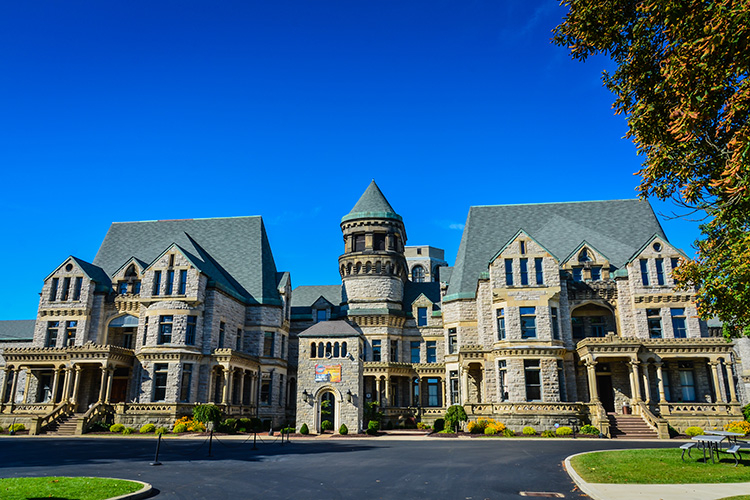
Ohio State Reformatory
Rising from the edge of Mansfield, Ohio, the Ohio State Reformatory looks exactly like what most people picture when they think of a haunted prison—a towering limestone fortress with Gothic turrets, arched windows, and a scale that seems impossible for a building that was never meant to be a maximum-security facility at all. But the Reformatory's origins weren't built on punishment. They were built on the belief that young men could be saved. The land itself carries history before the first stone was laid. The field where the Reformatory stands once served as Camp Mordecai Bartley, a Civil War training ground for Ohio soldiers. In 1867, Mansfield was selected as the site for a new state prison intended to fill the gap between juvenile corrections and the full Ohio State Penitentiary in Columbus. The city raised $10,000 to purchase the land. Construction began in 1886 under Cleveland architect Levi T. Scofield, who blended Victorian Gothic, Richardsonian Romanesque, and Queen Anne styles into a structure specifically designed to inspire moral renewal—its grandeur meant to encourage inmates toward repentance rather than despair. The first 150 prisoners arrived by train in 1896, and construction wouldn't be completed until 1910. Unlike locations shaped by a single catastrophe, the Reformatory's weight comes from a century of drift. The original mission was genuinely rehabilitative—inmates received religion, education, and a trade, with 18-month sentences that could end early for good behavior. By most accounts, the model worked. But as Ohio's criminal population grew and the facility became overcrowded, the state began sending more serious offenders to Mansfield. By the mid-twentieth century, rooms designed for one inmate held two or three. Violence became routine. Guards were killed. Inmates were murdered, drove themselves to suicide, or died from disease. Over 154,000 men passed through the gates before the building was ordered closed in 1990 following a federal class-action suit over inhumane conditions. Just outside the walls, 215 numbered graves mark the ones who never left. The building itself demands attention. The six-tier East Cell Block is widely cited as the largest freestanding steel cell block in the world—a canyon of iron that rises through the interior like something industrial and medieval at once. The warden's quarters, the chapel, the solitary confinement wing, and the basement all carry their own atmosphere. The Hole—a row of pitch-black isolation cells in the basement—is described by visitors as one of the most oppressive physical spaces they have ever entered. Natural light barely reaches the lower levels. The upper tiers stretch upward in iron rows until they disappear into shadow. Paranormal claims at the Reformatory are among the most extensively reported of any site in the Midwest. Visitors and investigators describe shadow figures moving across the upper tiers, unexplained voices in the cellblocks, and the sensation of being followed through otherwise empty corridors. EVP sessions regularly produce what investigators describe as direct, responsive communication. Some guests report being physically touched, grabbed, or scratched with no one nearby. Specific areas generate consistent accounts across unrelated visitors. The Hole produces reports of sudden nausea, cold air, and the feeling of being crowded in a space barely large enough to stand in. The basement is associated with two distinct presences—one described as a young boy, light and flickering, the other heavier and threatening. The warden's quarters carry stories of Helen Glattke, wife of longtime superintendent Arthur Glattke, who died in 1950 from an accidental gunshot wound inside the residence. Investigators report the scent of roses—her signature perfume—in rooms where no one has been. The chapel brings reports of whispered voices and phantom organ tones. Skeptics note that a century-old limestone structure of this scale naturally generates sounds, temperature swings, and optical oddities. The documented history of violence, suffering, and death embedded in this place is powerful enough to shape what any visitor expects to find before they step inside. That suggestion cannot be discounted. Still, the consistency of independent reports across decades, and across visitors with no prior knowledge of specific locations, gives even skeptical investigators reason to pause. Today the Reformatory is operated by the Mansfield Reformatory Preservation Society, which purchased the building from the state of Ohio for one dollar in the mid-1990s and has worked to restore it ever since. It is listed on the National Register of Historic Places, welcomes over 120,000 visitors annually, and is recognized worldwide as the primary filming location for The Shawshank Redemption. But the movie connection is only part of what draws people here. Some come for the architecture. Some come for the film history. Many come for the chance to spend a night in the East Cell Block, lights off, listening. Almost all of them leave with something they didn't have when they arrived—a story they struggle to explain, and a quiet conviction that the Ohio State Reformatory is far from empty.

Bissman Building
The Bissman Building occupies a prominent position on Mansfield, Ohio's skyline, a four-story structure of considerable architectural presence that dominates a full city block and represents significant late nineteenth-century commercial development investment. Constructed during Mansfield's economic expansion driven by industrial manufacturing and commerce, the building embodies architectural confidence and economic optimism of a prosperous American city. The structure originally functioned as a multi-purpose commercial establishment including grocery retail operations and office space reflecting diverse economic activities. The building's substantial height, brick construction, and ornate architectural detailing created a landmark of considerable visual prominence within Mansfield's downtown commercial district. The Bissman Building was constructed when Mansfield experienced rapid industrial and commercial growth. Ben Bissman constructed the structure as a commercial investment reflecting confidence in Mansfield's continued prosperity. The building's design incorporated the latest architectural and engineering standards, creating a structure of considerable durability. The grocery section on lower floors served the local community, while upper floors accommodated office space and commercial tenants. The building represented a typical example of American commercial architecture from this era, projecting permanence, stability, and economic strength. The documented history includes a singular event of profound violence and tragedy that paranormal researchers believe generated conditions for sustained supernatural disturbance. On his final day of employment, F.W. Simon suffered a catastrophic lethal accident involving the elevator mechanism, being decapitated in extraordinary violence. The exact circumstances suggest something functioned incorrectly within the elevator system, positioning Simon where the moving mechanism could inflict fatal injury. This form of death, defined by mechanical violence and workplace tragedy, represents the kind of trauma paranormal researchers frequently associate with locations of intense spiritual imprinting. Simon's spirit is believed to remain attached to the building, particularly to the elevator area where his death occurred. Paranormal phenomena have generated substantial documentation through professional paranormal investigation and eyewitness accounts accumulated over decades. Professional paranormal investigation teams from a major television program conducted a formal investigation, documenting evidence of multiple spiritual presences using standard investigative methodology. The investigation captured electronic voice phenomenon recordings containing the word Annabella, believed to represent the voice of a female spirit identified as Ben Bissman's great grandmother. This presence suggests haunting extends beyond F.W. Simon to encompass other individuals whose lives intersected with the building's history. Visitors and staff have reported consistent paranormal phenomena across multiple building areas. The fourth floor has generated reports of full-body apparitional sightings and shadow figure manifestations. The elevator represents the focal point of the most disturbing phenomena including touching sensations, disembodied voices, unexplained sounds, and intense cold spots. Staff members have experienced physical contact from unseen entities. The main staircase, basement, and grocery section have all generated paranormal reports, suggesting haunting activity extends throughout the building. Visitors describe sensing presences, hearing disembodied voices, and experiencing sudden temperature fluctuations suggesting paranormal rather than environmental causation. The Bissman Building achieved additional contemporary prominence when selected as a filming location for major film productions. Paranormal phenomena reportedly continued manifesting during filming operations. The building's status as a historic landmark combined with its documented paranormal reputation has created a destination appealing to paranormal researchers and those seeking direct encounter with documented supernatural phenomena.