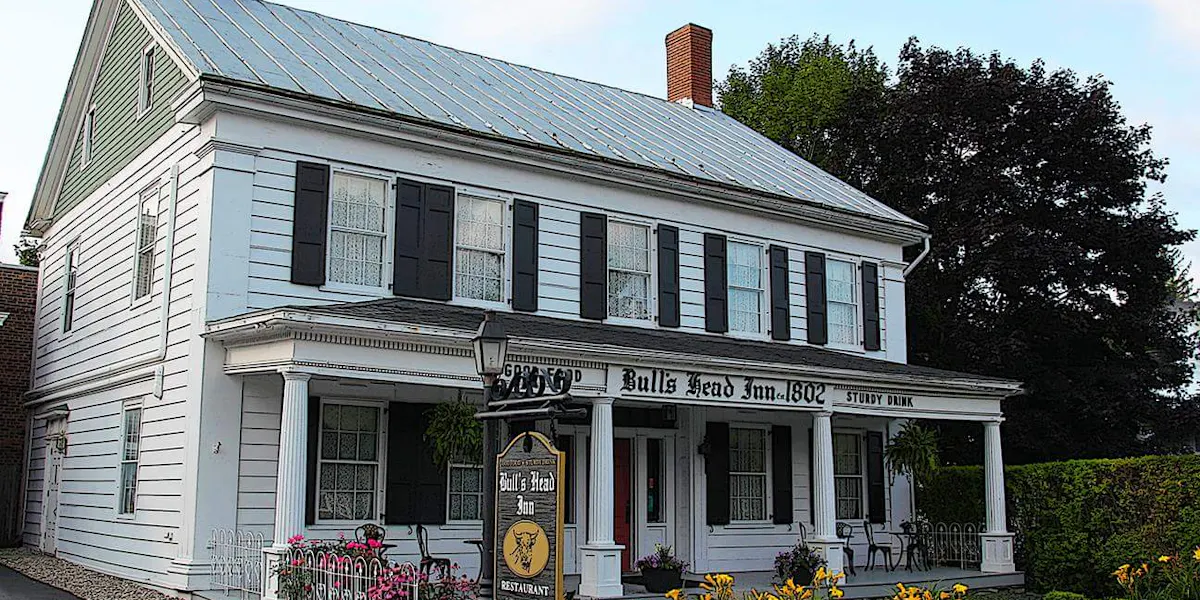
Cobleskill, New York·bar restaurant Standing at the corner of Park Place in the heart of Cobleskill, New York, the Bull's Head Inn is the oldest building in the village — a Federal-style structure built in 1802 that has served, across more than two centuries, as tavern, town hall, Masonic temple, courthouse, meeting hall, private residence, and restaurant. It carries that layered institutional history the way old buildings do in small upstate New York towns — quietly, in the woodwork, in the reoriented staircase, in the central fireplace that has warmed a rotating cast of merchants, soldiers, politicians, and neighbors across generations. A portrait of Thomas Jefferson hangs in the foyer, a reminder that he was President when the building was new.
But the site itself is older than the building by half a century. George Ferster constructed one of the first structures in Cobleskill here in 1752, and what followed was a sequence of catastrophes that left a mark the land has apparently not forgotten. On May 30, 1778, during the Battle of Cobleskill, Mohawk forces under the command of Joseph Brant — fighting alongside Tories and British — burned the settlement nearly to the ground. Retreating patriots were killed, and the structure on this site was destroyed. The two buildings that followed met the same fate, each burned in subsequent enemy raids on Cobleskill in the spring and fall of 1781. Local tradition holds that occupants perished in one or more of these fires — including, in one account, a young girl in an upstairs bedroom who froze in terror and could not escape the blaze. Another story maintains that a Native American was killed inside the building during one of the conflicts. Three buildings destroyed on the same ground, within a single generation, each one carrying its dead.
The current structure was built in 1802 by Seth Wakeman — the same builder responsible for the Beekman Mansion in Sharon Springs — and established as an inn and tavern to serve merchant traffic along the newly charted Loonenburg Turnpike, which ran commerce between Central New York and New York City. The inn thrived until the Erie Canal redirected that traffic north through Albany, bypassing Cobleskill and draining the commercial foot traffic that had kept it busy. By 1839, the building had transitioned into a private residence, and it remained one for well over a century. In 1810, when Cobleskill's Main Street was developed, the building was physically reoriented — its staircase repositioned, its front entrance redesigned to face the new brick-lined street. The building adapted, as it always had.
The architecture reflects its early Federal character — three floors, a central staircase, original wide-plank floors, and stone cellar walls that the current owners exposed and incorporated into the lower tavern space using reclaimed brick from Cobleskill's own Main Street. The building is divided across three distinct atmospheres: a ground floor dining room anchored by a classic brick fireplace, an upper floor with vintage glass windows suited for private gatherings, and a lower tavern built from the bones of the old cellar. It is a building that wears its age honestly, without staging.
The last private residents of the Bull's Head were John and Grace Steacy, whose opposing natures apparently outlasted them both. John drank; Grace was a dedicated member of the Women's Christian Temperance Union. When the building was sold after their deaths and former Cobleskill mayor Monte Allen reopened it as a restaurant and bar in 1966, he placed the bar in the room that had served as Grace Steacy's bedroom. What followed, according to staff, guests, and ownership across multiple decades, has been consistent and specific. A woman in a white gown — long-sleeved, floor-length — has been seen moving around the central staircase, along the upper and lower landings, and through the first-floor dining room by guests and staff working late. Silverware and napkins have been knocked to the floor or sent across the room. Plates and utensils have been disrupted mid-service. Doors slam on their own. Faucets turn themselves on. The current ownership reports these occurrences as ongoing.
The paranormal activity at the Bull's Head is notable for its consistency across unrelated witnesses spanning more than fifty years of restaurant operation. The apparition of the woman in white has been described in nearly identical terms by guests who had no prior knowledge of the building's story. Paranormal investigators have conducted formal sessions at the property, and the inn is an established stop on New York State's official Haunted History Trail. The figure most commonly associated with the activity is Grace Steacy — a teetotaler whose bedroom became a bar — though older stories from local family tradition point toward the Revolutionary-era fires and the girl reportedly trapped in the upstairs room as an earlier and perhaps deeper source.
Skeptics will note that a two-hundred-year-old building with three destroyed predecessors on the same site is exactly the kind of place where stories accumulate and feed on each other. The convergence of documented historical violence, a colorful final resident with a grudge against alcohol, and decades of reported encounters makes the Bull's Head something of a perfect storm for haunted reputation. None of that makes the firsthand accounts less consistent or less specific. The woman in white keeps appearing near the staircase. The silverware keeps moving. And the bar, to Grace Steacy's apparent displeasure, remains open.
Apparitions
Object Manipulations
Poltergeists
Electronic Disturbances
+1