
Haunted Places in Bronx, New York
3 haunted locations
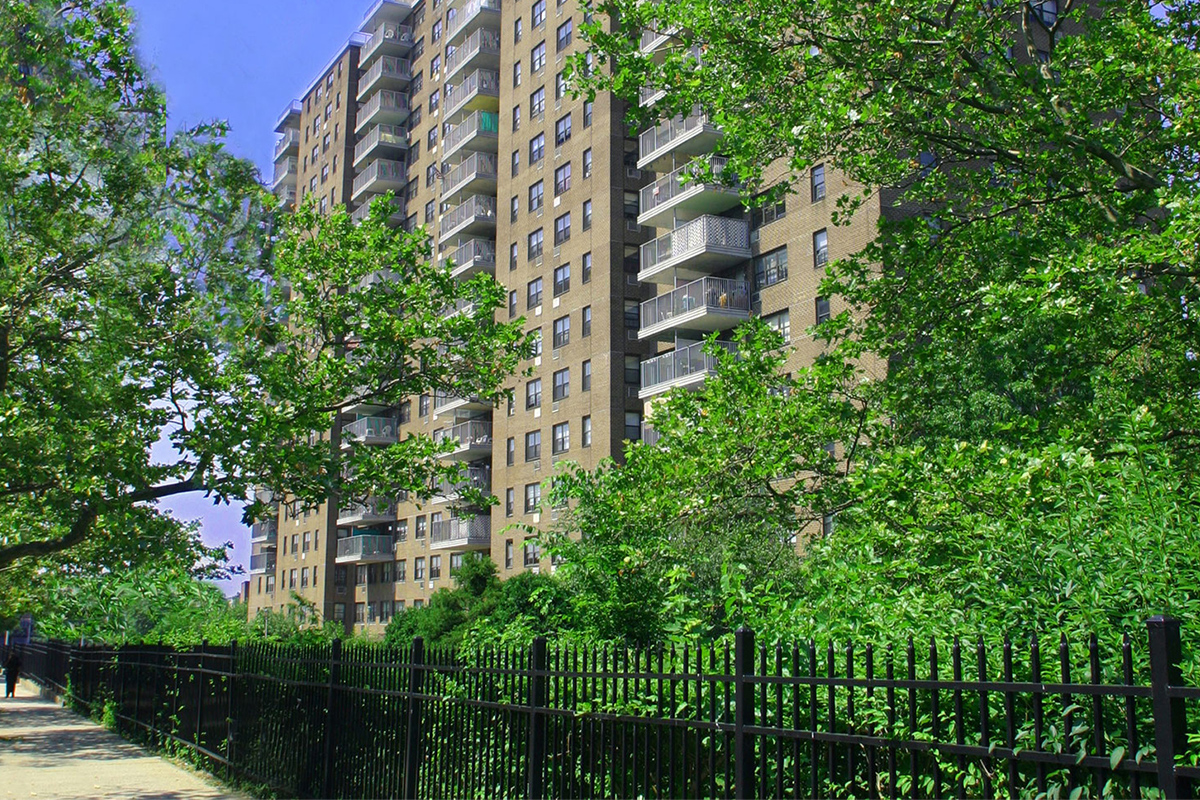
Hazel Towers
Standing eighteen stories over the Pelham Bay section of the Bronx, Hazel Towers is the kind of building that doesn't announce itself as haunted. There are no crumbling facades or Gothic embellishments—just a postwar residential high-rise at 1730 Mulford Avenue, brick and concrete, squared off against the sky like dozens of other mid-century towers that define New York City's outer borough skyline. It was built in 1968, designed by the architectural firm Pomerance & Breines, whose portfolio included hospitals and large-scale residential projects across the city. It went up during the great wave of high-rise construction that reshaped the Bronx in the 1960s, part of a broader effort to house the borough's growing working- and middle-class population in modern, elevator-serviced towers with balconies and amenities that older walkup tenements could never offer. The land beneath Hazel Towers carries a longer history than the building itself. The Pelham Bay neighborhood sits on ground originally purchased by Englishman Thomas Pell from the Siwanoy people in 1654—a vast tract that would eventually lend its name to the park, the parkway, and the surrounding streets. For centuries the area remained agricultural. It wasn't until the extension of the IRT Pelham Line in 1920 that the eastern Bronx opened to dense residential development, drawing Italian, Irish, and Jewish families outward from Manhattan. The postwar decades brought larger structures—towers like Hazel Towers—rising above a neighborhood that still retained the feel of a quiet enclave just two blocks from the 6 train. The building contains roughly 286 units with one-, two-, and three-bedroom apartments. Nelson Management Group acquired the property in 1999 and has since invested over four million dollars in upgrades including new elevators, windows, lobbies, and a security system. A tenants' association has been active since at least 1991. By all outward measures, Hazel Towers is a functioning, well-maintained residential building in one of the Bronx's more desirable neighborhoods. And yet the building appears on multiple databases of allegedly haunted locations, and the accounts from residents are remarkably consistent. Tenants across various apartments—not concentrated on any single floor—report shadow figures in hallways and rooms, particularly during late-night hours. Some describe orbs of light moving through darkened spaces. Objects reportedly fall or shift without explanation. Cold spots appear and dissipate with no apparent cause. Disembodied voices have been reported in apartments and common areas. Several residents describe an oppressive feeling of sadness or paranoia that lifts the moment they step outside, a phenomenon difficult to attribute to ordinary environmental factors. The basement and boiler room draw particular attention. At least one former resident has described seeing shadow figures near the boiler room during routine laundry trips—a detail that recurs independently in other accounts. One resident recounted a sleepover during which multiple people experienced panic attacks between three and four in the morning, accompanied by shadows, orbs, and objects falling. A follow-up Ouija board session in another apartment reportedly produced additional sightings—notable for involving multiple witnesses across two units on consecutive days. What makes Hazel Towers unusual is the absence of any known originating event. There is no documented tragedy, no publicized death, no fire or crime the narratives attach themselves to. The spirits, according to those who claim encounters, are simply present—and unwelcoming. Multiple sources describe the entities as hostile in demeanor, though no accounts describe physical harm. Most haunted locations build mythology around a specific incident. Hazel Towers offers no such anchor, which either undermines the claims or makes them harder to explain as narrative projection. Skeptics would rightly note that an eighteen-story concrete tower from the late 1960s will produce unexplained sounds—elevator machinery, water pressure shifts, air in aging ductwork. The basement of any large building is inherently atmospheric. And suggestion, once a building acquires a reputation, is powerful. But the consistency across unrelated residents over decades, and the emphasis on emotional effects rather than spectacle, gives the accounts a texture that environmental explanation doesn't fully resolve. Today Hazel Towers remains fully occupied in a neighborhood that continues to attract families. Pelham Bay Park sprawls to the north. The lobby is staffed around the clock. Nothing about the building suggests anything other than ordinary urban life. But behind certain doors, at certain hours, some residents insist the building holds something no renovation has managed to address—and something that does not seem glad to have company.

Van Cortlandt Park
Van Cortlandt Park occupies a prominent position within the urban landscape of the Bronx, New York City, representing one of the largest parks in the city's park system and encompassing extensive natural areas, historical structures, and landscapes that have accumulated layers of historical significance and documented paranormal phenomena across multiple centuries of occupation. Originally developed from indigenous Lenape territories, the area witnessed the establishment of European settlements, including the construction of the Van Cortlandt House, a historic structure dating to the colonial period preserving architectural artifacts from the seventeenth and eighteenth centuries. The park encompasses wooded areas, open meadows, bodies of water, hiking trails, and the Vault Hill area, a location of particular paranormal significance where stone structures and archaeological remains preserve evidence of earlier occupation. The park's transformation into a public park system occurred during the nineteenth century, reflecting changing attitudes toward urban green space and natural area preservation. Throughout its complex history, Van Cortlandt Park has served multiple functions as recreational space, historical preservation site, and location of sustained paranormal manifestations reflecting the area's long history of human occupation and violence. The paranormal phenomena documented within Van Cortlandt Park are associated with multiple historical traumas and spiritual entities whose presences have created sustained paranormal activity throughout the park's natural and built environments. One of the most significant documented entities is associated with Captain Rau, identified as a Hessian soldier who participated in military conflicts during the American Revolutionary War period, whose death may have occurred within the park's geographical area. The manifestations associated with Captain Rau include strange whispers without discernible source, auditory phenomena suggesting vocal utterances of unclear meaning or communicative intent. A second major category of paranormal phenomena is associated with victims of the Stockbridge massacre, a historical incident resulting in multiple deaths, whose spiritual aftermath appears to persist within the park. These spirits manifest through sensations of spirits walking through solid walls, violating physical boundaries suggesting non-material nature of spiritual entities. Dolls and other objects have been documented moving of their own accord, a telekinetic phenomenon suggesting active spiritual agency. Doors repeatedly close of their own volition, creating repeated cycles of the same seemingly purposeful action without human agency. Additional paranormal phenomena include sensations of people feeling physically touched by invisible presences. Whispering voices traverse the wooded areas and near the Van Cortlandt House, creating auditory manifestations suggesting multiple communicating entities. Most distinctively, paranormal investigators have documented repetitive melodic chants in unknown language or intelligible utterances, vocalizations suggesting ritualistic or linguistic communication from entities whose origins may predate contemporary New York City, possibly deriving from indigenous populations whose presence and displacement preceded European settlement. The combination of Revolutionary War-era military spirits, trauma victims from historical violence, and possibly pre-contact indigenous spiritual presences creates a palimpsest of spiritual density throughout Van Cortlandt Park. The Van Cortlandt House and Vault Hill serve as particular loci of paranormal concentration. Contemporary visitors to the park, particularly those venturing into wooded areas and around historical structures, frequently report experiences of paranormal phenomena that collectively establish the park as one of the most significantly haunted locations within New York City.
Fordham University
Fordham University, located in the Bronx, New York, represents one of the oldest and most prestigious Jesuit institutions of higher education in the United States, with a history extending back to the nineteenth century and a mission grounded in Catholic theology, moral philosophy, and the liberal arts tradition. The university's multiple buildings and residential areas, including the distinctive structures of Keating Hall, Finlay Hall, Queen's Court, and Martyr's Court, reflect the architectural evolution of American collegiate design across more than a century of continuous development, expansion, and the refinement of academic facilities and residential spaces. Fordham's Jesuit heritage established the institution as a place of rigorous intellectual pursuit combined with spiritual contemplation and moral development, attracting generations of ambitious students seeking education infused with both academic excellence and ethical guidance rooted in Catholic theology and humanistic philosophy. The campus evolved from its origins as a small academy into a comprehensive university serving thousands of students, with facilities for advanced research, residential life, and diverse academic disciplines spread across the urban New York landscape and integrated into the Bronx community. The university's commitment to the liberal arts and sciences, theology, medicine, law, and professional education created an environment that drew ambitious minds and idealistic young people seeking to develop their intellectual and moral capacities during the formative years of their lives and education. Queen's Court and Martyr's Court, residential areas named to honor Christian martyrs and the institutional memory of religious sacrifice, became particularly significant spaces within the Fordham community, serving as dormitories where countless students formed lifelong friendships and developed their identities during transformative college years. The university's location in urban New York and its comprehensive educational mission, particularly in medical education, created circumstances for tragedy and dark historical episodes that would embed themselves into the institution's collective memory and psychological atmosphere. Medical education at Fordham, as at many medical schools of the nineteenth and twentieth centuries, necessarily involved the use of human cadavers for anatomical study, surgical training, and pathological research, a practice that raised profound ethical, spiritual, and psychological questions for an institution grounded in Catholic faith and theology. The procurement, storage, preparation, and use of deceased human remains for educational purposes created unique psychological tensions and spiritual disturbances within the institution, generating complex emotional responses among students, faculty, and religious authorities who grappled with the moral implications and spiritual consequences of such practices. The handling of human remains in medical education created exposure to death, bodily decomposition, and the material reality of human mortality in concentrated form within institutional spaces. Beyond the documented use of cadavers in medical education, the residential areas of the university witnessed tragic events including documented suicides, accidental deaths, unexplained fatalities, and deaths from infectious disease that claimed the lives of students, faculty, and university staff across multiple generations. The accumulation of such tragedies within the university's dormitory spaces, particularly in Queen's Court and Martyr's Court, created psychological weight and spiritual disturbance that residents reported sensing even during normal operations and throughout the academic calendar. Paranormal phenomena reported throughout Fordham University's campus, particularly in its residential areas and medical education facilities, suggest an active haunting involving multiple spirits with distinct behavioral patterns and characteristic manifestation modes. Witnesses in various dormitory areas, most notably in Queen's Court, have reported experiencing sudden sensations of hands gripping at their throats in the darkness, an aggressive physical manifestation of spectral presence that has left witnesses shocked, traumatized, and unable to explain the unexplained physical contact. These throat-grabbing incidents have been reported independently by numerous students across different time periods and academic years, suggesting either a persistent entity or residual psychic imprint triggered repeatedly in the same locations by conditions not yet fully understood. Apparitions of multiple distinct figures have been documented in different campus locations, with witnesses describing encounters with translucent or partially visible human forms appearing in dormitory hallways, residential rooms, building interiors, and adjacent outdoor spaces without rational explanation for their manifestation. Floating objects and unexplained movement of inanimate matter have been observed in campus facilities, with reports of items shifting position, hovering above surfaces, or moving across spaces despite no visible external force or mechanical explanation for the observed movement. The shower phantom phenomenon, particularly notable in residential bathroom facilities and locker room areas, involves reports of an unseen presence manifesting during bathing, generating overwhelming sensations of being watched, observed, or physically confronted while completely vulnerable in isolated shower spaces. The spatial distribution of these paranormal phenomena across multiple named locations within the Fordham campus suggests that the haunting represents a genuine supernatural presence or residual manifestation of tragic events that occurred across the institution's extensive history. Fordham University has become increasingly recognized within paranormal research communities as a significant hotspot for supernatural activity and ghostly manifestations affecting both student populations and campus visitors throughout the academic year. The university's documented history, combined with eyewitness accounts from credible observers including established faculty members, administrative staff, and long-term residential students, has attracted paranormal investigation teams to the campus to document and analyze the reported phenomena. The ongoing reports of paranormal activity within Fordham's residential areas and academic buildings continue to perplex university administrators while maintaining the institution's place within the broader landscape of American college hauntings and university-based paranormal phenomena. The contrast between Fordham's identity as a prestigious educational institution and its role as a location of sustained paranormal manifestation creates a unique tension that continues to fascinate scholars of both institutional history and paranormal phenomena. This tension suggests that the pursuit of knowledge, medical education involving contact with death, and spiritual development undertaken at universities can sometimes interact with tragic circumstances in ways that generate supernatural consequences and persistent manifestations within campus structures designed to nurture the development of young minds and souls.