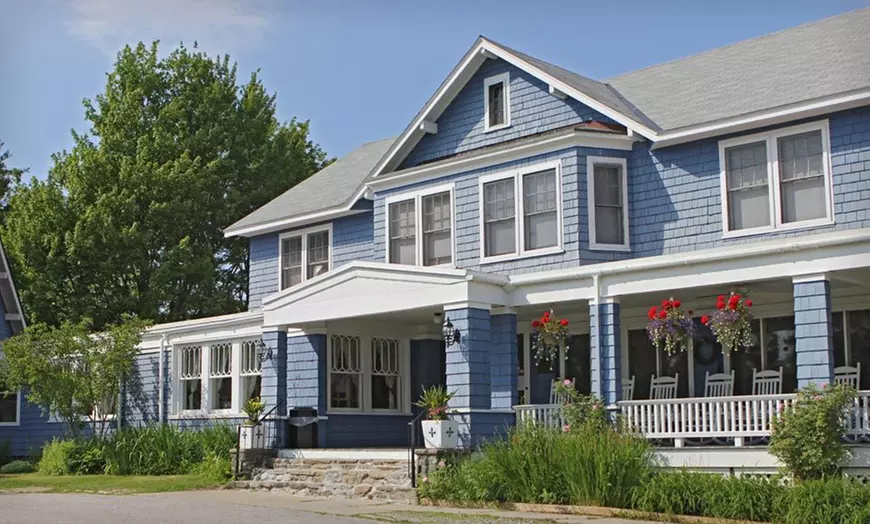
Whitefield, New Hampshire·hotel Set on nearly eight acres of rolling land along Mountain View Road in Whitefield, New Hampshire, the Spalding Inn looks out across orchards and perennial gardens toward the smoky ridgeline of the Presidential Range. It is the kind of White Mountains property that seems to have always been there—a sprawling, white-columned Victorian structure flanked by a carriage house and framed by the kind of landscape that drew Bostonians and New Yorkers north by rail during the Gilded Age, when the region's grand resort hotels were at the peak of their influence. The building dates to the 1860s, when it was known as the Cherry Hill House—a modest structure with an attic that was later expanded by lifting the roof and adding a full second floor.
It began its life as a private residence, and like many properties in northern New Hampshire's hotel corridor, it eventually transitioned into lodging as the White Mountains tourism trade grew. By 1926, the property had been formally established as the Spalding Inn, operating as a seasonal resort that welcomed guests for the spring and summer months, with some visitors staying the entire season. For a time it functioned as a private members-only establishment, a country club of sorts, offering tennis, a heated pool, golf, and formal dining against a backdrop of mountain scenery. Brochures from the mid-twentieth century advertise it as a gracious retreat—the kind of place where guests dressed for dinner and rocked on the veranda in the long northern twilight. Over the decades the property changed hands several times, and like many of the grand old lodging houses of the White Mountains, it experienced cycles of prosperity and decline.
By the early 2000s the building was aging and in need of significant attention, its long history beginning to show in the bones of the structure. Reports of unusual activity inside the inn, however, had been circulating for far longer than anyone could precisely date. Guests and staff described shadow figures drifting through hallways, doors opening and closing without explanation, and a pervasive sense of unease in certain parts of the building—particularly the carriage house and the basement bar area. The stories were persistent enough that the inn had acquired a reputation for being haunted well before it attracted national attention. Local tradition holds that a former owner took his own life in the carriage house, and that a woman and a child also died on the property under circumstances that have blurred with time into the kind of half-documented, half-whispered accounts that cling to old New England buildings like woodsmoke.
In 2008, the property was purchased by Jason Hawes and Grant Wilson, the co-founders of The Atlantic Paranormal Society and stars of Syfy's Ghost Hunters. The purchase was not incidental to the inn's reputation—both men were drawn to it precisely because of the paranormal claims that predated their ownership. They invested heavily in restoring the building, reopening it as a working inn with 36 rooms across the main house and carriage house, a main dining room, and a basement pub called 2 Kings. The inn debuted on Ghost Hunters in April 2009, in a Season 5 episode titled "Crossing Over," in which Hawes and Wilson brought in the Ghost Hunters International team to conduct an independent investigation. The results were striking. Digital recorders in the carriage house captured what investigators described as the sound of a door opening and closing on its own and a male voice saying a single word. In the bar area, a female voice with what was described as an English accent was captured—a detail investigators noted as significant given the inn's long history of hosting British guests. In the kitchen, where a dark shadow had been observed moving through the room, a recorder picked up a voice speaking the word "cherry," an apparent reference to the building's original name.
The team's conclusion was unequivocal: they deemed the inn haunted. Subsequent investigations by other paranormal groups and by visitors attending the TAPS ghost-hunting events held at the property produced additional accounts. The carriage house consistently generated the most activity. Rooms 15, 16, and 17 on the upper floor were identified as hotspots, with Room 16 reportedly carrying a heavy male energy and Room 17 producing sightings of a shadowy female figure wearing what appeared to be a pearl necklace. One investigator who observed the figure from outside later learned that a former owner of the inn had been known for always wearing pearls. Room 33 in the main house drew reports from guests who described being awakened by unexplained disturbances in the night. In the main building, a hunched figure was reportedly observed moving slowly across the first floor, and investigators noted that nearly every room in the inn seemed to carry its own distinct energy.
A massive dark mass was repeatedly witnessed in the bar and kitchen areas by both staff and guests. One visitor reported being tapped on the shoulder three times while sitting with his back to an empty room. Hawes's wife described an occasion when she and her son looked out a window of the main house and saw a woman standing in an upstairs carriage house window, staring back at them before vanishing. The inn also appeared in Ghost Hunters Season 8, in an episode titled "Sign the Ghostbook," which served as Grant Wilson's final investigation before departing the show. Hawes and Wilson listed the property for sale in 2013 at $795,000, noting that while they loved the building, they no longer had the time to operate it.
The inn changed hands again and continued to operate on a limited basis in subsequent years, though its status has remained uncertain. As of recent reports, the Spalding Inn is not currently open to guests, and its future remains unclear. The building still stands on its hillside, the carriage house still flanks the main structure, and the view of the Presidential Range from the front porch has not changed. Whether the property will be restored again or allowed to continue its slow drift toward silence is an open question. What is less open to debate is the volume and consistency of the accounts that have accumulated within its walls—reports spanning casual visitors, seasoned investigators, and the families of the men who made their careers studying exactly this kind of thing, and who chose this particular building to call their own.
Apparitions
Disembodied Voices
Object Manipulations
Shadow Figures