
Haunted Places in Nevada
46 haunted locations
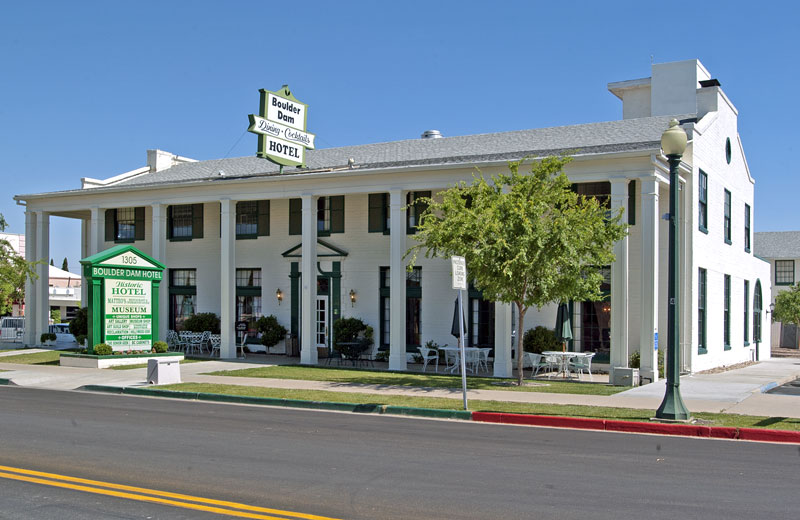
Boulder Dam Hotel
Boulder City, Nevada, is one of the strangest towns in the American West—a place that exists only because the federal government built it from nothing in 1931 to house the thousands of workers constructing what was then called Boulder Dam. In a state defined by gambling, Boulder City was the opposite: a tightly controlled government town with no casinos, no saloons, and strict rules governing daily life. It was engineered for productivity, not pleasure. But it needed a hotel. And the Boulder Dam Hotel, completed in 1933 at 1305 Arizona Street, was built to fill that gap—not for the workers who poured concrete in killing heat down in Black Canyon, but for the dignitaries, officials, and celebrities who came to watch them do it. The hotel was the vision of Paul Stewart Webb, a local businessman who recognized that the thousands of tourists arriving by train from Los Angeles and by car along the Arrowhead Highway would need somewhere to stay. City Manager Sims Ely issued Webb a permit, and the result was a two-story Dutch Colonial Revival structure designed by architect L. Henry Smith—white-columned, with concrete-block walls rising to gable roofs, a wood-paneled lobby, private baths in all thirty-two rooms, and a modern climate system advertised on highway billboards. At its grand opening, the Boulder Dam Hotel had no equal in southern Nevada. Las Vegas, still a small railroad town, had nothing to compare with it. The guest list through the 1930s and 1940s reads like a Hollywood directory crossed with a diplomatic registry. Bette Davis stayed while vacationing after filming in 1934. Mr. and Mrs. Cornelius Vanderbilt Jr. honeymooned there. Will Rogers performed at the nearby Boulder Theatre during a stay in 1935, weeks before his death. Boris Karloff visited while obtaining a divorce. The Maharajah and Maharani of Indore passed through, as did Cardinal Pacelli, who would later become Pope Pius XII. Howard Hughes recuperated at the hotel after crashing his amphibious plane on Lake Mead. Shirley Temple was a regular guest. The hotel also became popular with movie stars establishing Nevada residency for quick divorces, adding a layer of personal upheaval to the building's social history. The hotel's fortunes declined along with passenger rail and shifting tourism patterns. It changed hands over the decades but avoided demolition. In 1982, it became the first hotel in Nevada listed on the National Register of Historic Places. In 2005, the Boulder City Museum and Historical Association acquired the property and renovated it, reducing the room count to twenty-two while expanding public spaces. The Boulder City/Hoover Dam Museum now occupies the first floor, telling the story of the dam workers and the Depression-era community built to house them. Paranormal claims at the Boulder Dam Hotel are varied, persistent, and span decades. The most frequently cited phenomenon involves the sounds of music, conversation, and laughter emanating from the ballroom when it is entirely empty. Staff working alone at night have reported hearing what sounds like a party in full swing—piano music, clinking glasses, voices—only to find the room dark and vacant. The smell of cigar smoke has been reported throughout the hotel despite a no-smoking policy, particularly in the room once occupied by Howard Hughes, who was known to smoke cigars. Some staff believe Hughes himself lingers in the building. The apparition of a former night desk clerk named Tommy Thompson has reportedly been seen in the main lobby, and guests have described an overwhelming sensation of heaviness in the same area. Rooms 209 and 219 are cited as the most active, with reports of faucets turning on in unoccupied rooms, doors opening and closing on their own, and cold spots appearing without drafts. Some guests have described being physically touched or grabbed by unseen hands. Boulder City historian Dennis McBride, who kept offices in the hotel's basement, documented many of these accounts in his book on the property. McBride himself reported seeing an apparition in his basement office. During a reading he arranged with psychic Patsy Welding, she reported sensing strong presences on the upper floors and refused to descend into the basement, describing the energy as overwhelming. The hotel's proximity to Hoover Dam—where at least ninety-six workers died during construction—has led some to speculate that dam workers may account for some of the activity, and figures in old-fashioned work clothes have been glimpsed in restricted areas of the building. Today the Boulder Dam Hotel operates as a boutique historic hotel and museum. The staff generally downplays the haunting reports, and at least one investigator has noted that asking about ghosts can quickly cool an otherwise warm reception. But the accounts continue to accumulate, logged by guests who arrive knowing nothing of the hotel's reputation and leave describing experiences they cannot explain.
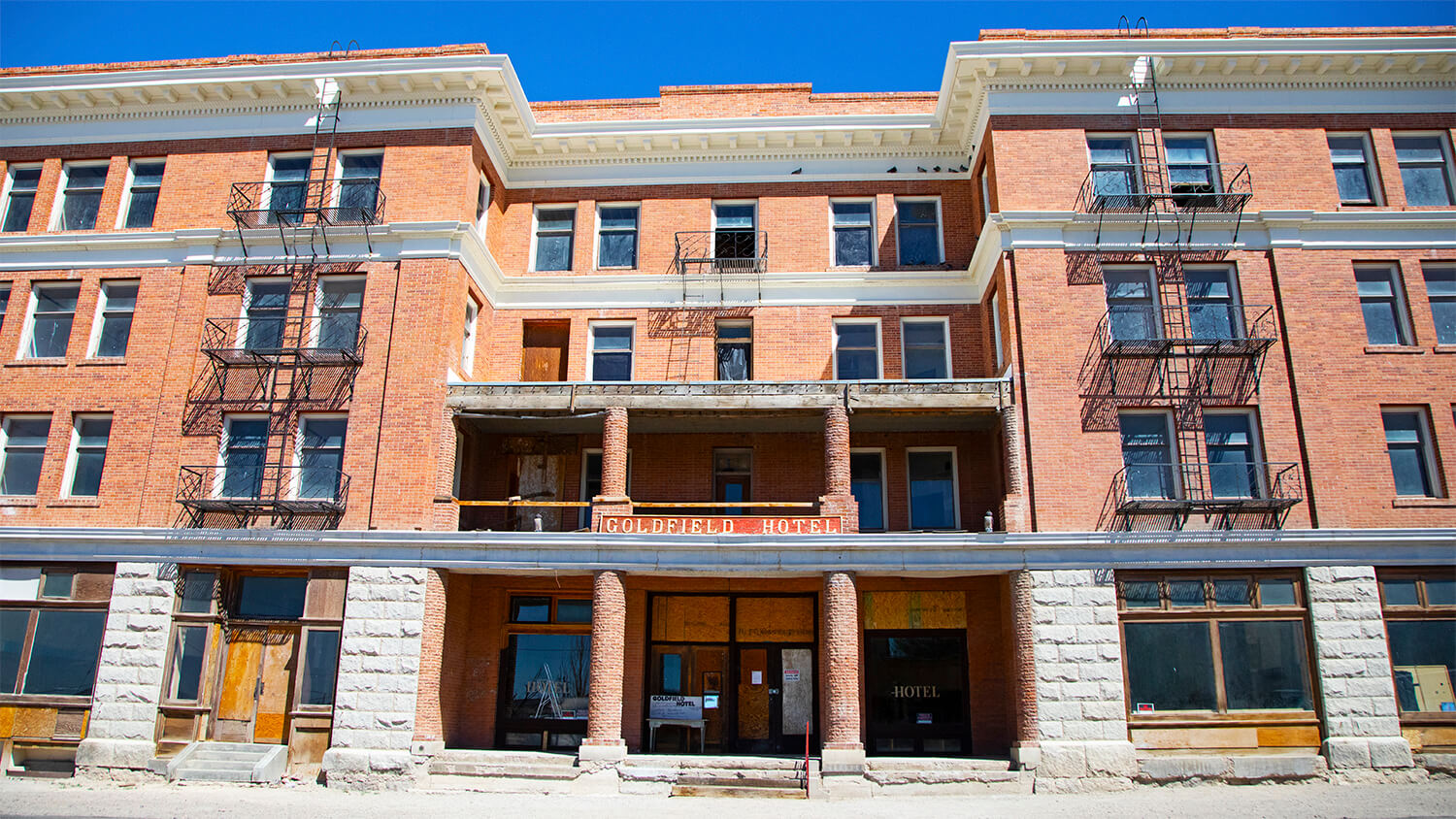
The Goldfield Hotel
The Goldfield Hotel rises four stories above a town that barely exists anymore, its granite-and-brick façade still dominating the main intersection of Goldfield, Nevada—a place that was once the largest city in the state and is now home to roughly 250 people. The hotel was built to match the ambitions of a boomtown drunk on gold, and it stands today as a monument to how quickly all of that can disappear. Gold was discovered near Goldfield in 1902, and within a few years the population surged to 20,000. The town supported three newspapers, five banks, and a mining stock exchange. At the center of it all was George Wingfield, a former cattle driver and card dealer who had grubstaked his way into control of the Goldfield Consolidated Mines Company. The hotel, designed by Reno architects Curtis and Holesworth, opened in 1908 at a cost of over $300,000. Legend holds that champagne was poured down the front steps at the grand opening. The 154-room interior featured mahogany paneling, gilded columns, crystal chandeliers, gold-leaf ceilings, European chefs, and one of the first Otis elevators west of the Mississippi. It was proclaimed the finest hotel between Chicago and San Francisco. But Goldfield was a storm, not a city. Mine output dropped sharply by 1910. A flash flood hit in 1913. In 1923, a moonshine still exploded and ignited a fire that consumed twenty-seven blocks. The hotel survived—stone and brick don't burn easily—but the town was gutted. By the 1930s, the Goldfield Hotel was a flophouse for cowboys. During World War II it housed officers from the nearby Tonopah Army Air Field, and when they checked out in 1945, the hotel closed for good. The hotel's paranormal reputation centers on Room 109 and a legend involving a woman named Elizabeth—said to have been a prostitute and mistress of Wingfield who became pregnant with his child. The story claims he chained her to a radiator in the room, kept her alive until the baby was born, and then either let her die or killed her. The infant was allegedly thrown down a mine shaft beneath the hotel. It is a vivid and horrible story, and it has no verified historical basis. Researchers at the Central Nevada Museum have noted significant inconsistencies—the mine shafts were dug in 1925, years after Wingfield sold the hotel and moved to Reno, and no contemporary records corroborate Elizabeth's existence. The legend appears to trace largely to a book by 1980s owner Shirley Porter, likely crafted to boost interest in the property. However, there is a documented shadow behind the myth: a 1904 lawsuit by a woman named May Baric, who claimed to be Wingfield's common-law wife, accused him of abuse, and was given $400 and forced to leave town with their child. She and the child died in obscurity. The Elizabeth legend may be an embellishment of a real and quieter cruelty. Regardless of origin, the reports attached to Room 109 are persistent. Visitors describe sudden extreme cold, disembodied crying, and an overwhelming sadness that causes some to weep without explanation. Elsewhere, cigar smoke is reported on the first floor—attributed to Wingfield—along with unexplained piles of fresh ash. The lobby staircase is associated with child spirits who tap visitors on the back. The basement became nationally known after a 2004 Ghost Adventures investigation in which a brick appeared to fly across the room on camera. The show returned multiple times. Investigators have reported equipment malfunctions, shadow figures, and physical aggression from an entity known locally as "the Stabber." Today the hotel is privately owned, closed to the public, and mired in renovation efforts that have stalled repeatedly over decades. It is listed on the National Register of Historic Places. You cannot walk in. You can only look through the windows at the mosaic tile floors and the mahogany front desk and the elevator shaft, all of it frozen in place since the last guest left eighty years ago.

Sahara and Sandhill
Sandhill Road in Las Vegas, Nevada has earned recognition as one of the most intensely haunted locations in the American Southwest through decades of documented paranormal activity, witness testimony, and paranormal investigation concentrated along this relatively ordinary-appearing urban thoroughfare stretching across metropolitan territory. The road segment between Sahara Avenue and surrounding residential areas has accumulated a complex and tragic paranormal history that manifests through multiple categories of supernatural phenomena suggesting the presence of intelligent consciousness and residual emotional imprinting within the environment. The most frequently reported paranormal activity along Sandhill Road involves the apparition of an elderly woman who materializes from the darkness in a vehicle, reportedly pursuing vehicles that traverse the roadway during nighttime hours with relentless determination and threatening demeanor. Witnesses describe the woman's approach as aggressive and threatening, her elderly vehicle apparently capable of following at high speeds despite mechanical limitations that would prevent such performance in the physical world, suggesting paranormal enhancement. The phenomenon suggests not a passive haunting but an active paranormal consciousness engaged in behavior resembling pursuit or enforcement of some unknown boundary within the physical space, her manifestations representing interactive engagement. The paranormal activity at Sandhill Road extends beyond the road surface itself into the flood control tunnel system running beneath the streets between Charleston and Sahara Avenue, creating geographically dispersed paranormal phenomena. These tunnels, constructed for water management and partially flooded during heavy precipitation events, have become the site of manifestations linked to a tragic accident involving a motorcycle couple whose deaths occurred within the tunnel system decades past. The spirits of the deceased couple are reported to manifest within the tunnels, their presence announced through electromagnetic phenomena, disembodied cries recorded on paranormal investigation equipment, and the sensation of phantom touches upon investigators conducting research. Electronic voice phenomena recordings obtained within the tunnels have captured what investigators interpret as cries of anguish and distress, acoustic signatures suggesting the ongoing trauma associated with the couple's deaths and their awareness of paranormal existence. Cold spots concentrate in areas where the couple's vehicle came to rest, paranormal energy apparently anchored to the location of their fatal accident creating zones of concentrated manifestation. Additional paranormal phenomena throughout the Sandhill Road area include invisible contact wherein investigators feel hands or pressure upon their bodies despite the absence of any visible source or rational explanation. Researchers have documented these experiences with sufficient consistency to determine that conventional explanation cannot account for the phenomenon, establishing it as legitimate paranormal manifestation. The paranormal activity at Sahara and Sandhill appears to intensify during nocturnal hours and during periods of emotional or electromagnetic elevation, suggesting that the haunting represents a responsive phenomenon rather than simple residual energy locked in temporal repetition. The intersection of multiple tragic deaths with the emotional aftermath of loss has apparently created an environment of exceptional paranormal activity requiring specialized investigation protocols and protective measures for researchers willing to document the ongoing manifestations.
Redd Foxx’s Home
Redd Foxx's Home represents the residential property formerly occupied by the famous comedian and entertainment personality Redd Foxx, a figure of considerable cultural significance within American entertainment history, particularly within comedy and television of the second half of the twentieth century. The residence likely carries architectural features and design characteristics reflecting celebrity lifestyle and personal preferences, potentially including elements distinctive to the period in which Foxx maintained occupancy. The property's location in Las Vegas, Nevada places it within the cultural epicenter of American gambling, entertainment, and popular culture, a city characterized by concentrated wealth, celebrity residents, and intense human experiences. Las Vegas carries a reputation for paranormal activity and haunted locations, reflecting both emotionally intense experiences generated by entertainment environments and historical depth encompassing Native American history and frontier settlement. Redd Foxx's residence connects the property to both the entertainment industry and the paranormal landscape characteristic of the city. Redd Foxx achieved prominence as a comedic entertainer particularly celebrated for groundbreaking television work in the 1970s, representing an important figure in American comedy history. His death occurred at an advanced age after a career spanning multiple decades of entertainment work, during which he achieved significant financial success, cultural influence, and celebrity status. The intensity of Foxx's personality and cultural significance created a public figure of considerable presence and charisma, qualities that may have translated into persistent spiritual presence following physical death. The residence in which Foxx lived became associated with his public identity and professional life, creating a location saturated with memories, experiences, and personal resonance frequently correlating with paranormal activity following prominent individuals' deaths. The persistence of Foxx's presence through paranormal manifestations suggests either intense emotional attachment to the property or concentrated spiritual energy sustaining paranormal presence. The paranormal phenomena manifest through physical and sensory phenomena typically associated with deceased individuals remaining bound to occupied locations. Electrical systems exhibit mysterious and unexplained behavior, with lights turning on and off without human manipulation or apparent mechanical malfunction. The autonomous activation and deactivation of electrical lighting creates sensory impressions of presence and activity, suggesting invisible agency manipulating systems. Doors throughout the residence open and close without visible cause, seemingly randomly or potentially following behavioral habit patterns from Foxx's life. Disembodied footsteps have been documented by residents and paranormal investigators, creating auditory impressions of movement despite absent visible persons. Paranormal activity frequently manifests as pranks or mischievous behaviors rather than hostile phenomena, suggesting a spirit maintaining personality or humor consistent with Foxx's public reputation. The paranormal manifestations appear to carry characteristics consistent with the entertainer's public personality, with playful phenomena suggesting a spirit maintaining identity and personality aspects following death. The residence continues functioning as a private dwelling while simultaneously serving as a documented paranormal activity location and ghost hunting interest, attracting paranormal investigators and enthusiasts. Paranormal investigation teams have visited documenting electrical anomalies, photographic phenomena, and evidence consistent with spiritual presence. The property has been featured in paranormal tourism materials dedicated to haunted Las Vegas locations, making it a recognized interest point within the city's paranormal geography. The haunting represents a unique example of a celebrity residence continuing to manifest its famous former occupant's personality and presence long after physical death, serving as a tangible reminder of cultural significance and persistent spiritual attachment to personally significant locations.
Luxor Hotel and Casino
The Luxor Hotel stands as one of Las Vegas's most architecturally distinctive casinos, its distinctive pyramid structure dominating the southern Strip since its opening in 1993. Designed as a recreation of the Great Pyramid of Giza, the hotel was constructed with 110 stories of gaming, lodging, and entertainment facilities spread across its glass-clad exterior. The building immediately became a landmark feature of the Las Vegas skyline, attracting millions of visitors annually with its unique Egyptian-themed aesthetic and the promise of world-class gaming and hospitality. The pyramid's construction process itself proved to be unexpectedly treacherous, with multiple construction workers losing their lives in accidents during the building's assembly, a fact that would remain largely unexamined in the public record despite the tragic loss of life. Throughout its decades of operation, the Luxor accumulated a significant roster of unexplained deaths and incidents that troubled both guests and staff members. Multiple documented deaths occurred within the facility's upper floors, including sudden collapses and apparent medical emergencies that defied conventional explanation. The hotel's lower floors, particularly around the Titanic artifact exhibition and display areas, became focal points for guest complaints about inexplicable sensations and occurrences. Many visitors reported profound feelings of suffocation and choking sensations while touring certain corridors and exhibition spaces, particularly in the mid-level floors where the majority of incidents were concentrated. Staff members working late shifts reported witnessing unusual phenomena during their routines, including equipment malfunctions and lights flickering in patterns that maintenance teams could never adequately explain. Paranormal investigators studying the Luxor have documented numerous accounts from both guests and employees describing apparitions and phantom sensations concentrated in floors twelve through fourteen and throughout the pyramid's interior. A recurring report involves a blonde woman in contemporary clothing who manifests in hallways and stairwells, often described as seeming distressed or frantically searching for something or someone. Investigators have compiled accounts from multiple independent witnesses who claim to have experienced phantom pushing sensations in crowded corridors, sudden inexplicable temperature drops, and the distinct sensation of invisible hands making contact with their bodies. The manifestations appear to intensify during late evening hours and have been documented in multiple separate paranormal investigations conducted by professional research teams. The construction-era deaths that accompanied the building's assembly have led researchers to theorize that some manifestations may be connected to workers who perished during construction rather than deaths occurring after the facility's opening. The pyramid structure itself, combined with the concentration of deaths and incidents documented within its walls, has prompted serious paranormal researchers to examine whether the location's unique architectural design may have created psychological or electromagnetic conditions conducive to unusual experiences. The Luxor continues to operate as a full-service casino hotel, with current management acknowledging the property's paranormal reputation while maintaining professional skepticism regarding the claims. Despite substantial revenue from its reputation as one of Las Vegas's most haunted properties, the hotel has not officially documented or publicly catalogued the paranormal incidents that guests consistently report. Visitors continue to frequent the Luxor with full knowledge of its haunted reputation, many specifically seeking encounters with the reported manifestations and unexplained phenomena. Tourist paranormal investigation groups regularly conduct overnight investigations within guest-accessible areas with permission, and numerous paranormal television programs have featured the Luxor prominently in their documentation of American haunted locations. The hotel's management has neither confirmed nor denied the existence of paranormal activity, allowing the location's reputation to persist and grow through anecdotal reporting and paranormal enthusiast communities. The pyramid structure remains one of Las Vegas's most iconic buildings, drawing guests from around the world who come for gaming, entertainment, and the undeniable allure of potential paranormal encounters within its glass-enclosed chambers.
Mackay Mansion
The Mackay Mansion, located in Nevada, represents a significant historical structure constructed during the American frontier mining era's height, when precious metal discovery transformed remote mountain regions into economic centers. The mansion was constructed by a prominent mining entrepreneur whose wealth accumulation enabled an architecturally impressive residential structure symbolizing success, power, and refined taste. The building exhibits Victorian-era American residential design characteristics, featuring ornate detailing, multiple stories, extensive interior spaces, and nineteenth-century domestic luxury furnishings. The mansion served as private residence and social position statement, a physical owner status and influence manifestation. Advanced domestic systems including elaborate heating, plumbing, and lighting infrastructure represented significant technological achievement. The grand staircase represented particular architectural triumph combining aesthetic beauty with functional utility. The Mackay Mansion's history extends far beyond original construction, encompassing multiple generations and numerous historical events contributing to Nevada's most actively paranormal location transformation. Within mansion spaces, tragedy and loss accumulated across extended temporal periods, creating emotional residue layers and spiritual imprinting ultimately rendering the structure susceptible to persistent paranormal manifestation. Multiple deaths occurred including violent incidents with particularly traumatic human existence terminations. A notable robbery attempt resulted in gunfire and fatalities when two burglars forcibly entered accessing valuable safe contents were shot and killed. Their violent deaths in criminal confrontation context appear anchoring consciousness to mortal existence termination locations. Additional tragic incidents contributed to complex Mackay Mansion spiritual landscape including household staff death. Harriet, a maid employed within the mansion, remained spiritually anchored following death, her consciousness seemingly unable or unwilling to transition to the deceased realm. Harriet's location connection transcended employment, involving relationships, trauma, or circumstances creating profound spiritual consciousness-structure bonds. Her parlor area manifestation suggests reenacting daily labor aspects, continuing duties characterizing mortal existence. Most poignant Mackay Mansion spiritual presences involve two young girls' entities, identified as Emma and Lily, who perished within the mansion. Child apparitions consistently manifest upon the grand staircase, spectral forms witnessed running and playing in joyful activity manner. These youthful entities create particularly haunting paranormal phenomena dimension, manifestations representing premature death tragedy and innocent consciousness continuation long after mortal existence termination. Additional paranormal documentation identifies Mrs. Mackay, the original owner's wife, remaining within the created mansion, consciousness apparently choosing eternal architectural monument binding. A Shadow Man figure detected in upper levels represents a mysterious entity whose intentions and origins remain obscure despite systematic investigation. Mackay Mansion paranormal manifestations became subject to organized documentation through formal paranormal investigation programs and tourism-oriented paranormal experiences. Visitors and investigators reported unseen agents' clothing tugs, invisible entities' inexplicable touch sensations, remarkable clarity visual apparitions, and overwhelming observation sensations from supernatural inhabitants. The mansion transformed into paranormal attraction and museum allowing public historical education and paranormal experience access. The structure stands as compelling Victorian-era history and richly documented supernatural phenomena repository, representing exceptional locations where accumulated extended historical period tragedies and losses created consciousness persistent manifestation conditions beyond physical death boundaries. The Mackay Mansion remains a destination for paranormal researchers, amateur enthusiasts, and historical tourists seeking frontier history, architectural achievement, and persistent human consciousness mysteries and physical location relationship understanding.
Bally’s Las Vegas Hotel and Casino
Bally's Las Vegas Hotel and Casino, originally constructed as the MGM Grand Hotel, represents a significant chapter in Las Vegas' development as an entertainment and gambling destination during the latter twentieth century. The building emerged from competitive Las Vegas resort development, where operators continuously raised stakes in architectural ambition and entertainment offerings necessary for financial success. Located on Las Vegas Boulevard South, the primary thoroughfare connecting the Strip's most prominent resorts, the facility occupied a premier position ensuring high visibility and accessibility to tourists and local gamblers. The MGM Grand Hotel featured thousands of guest rooms distributed across multiple floors, extensive gaming areas with slot machines and table gaming opportunities, restaurants catering to diverse preferences, and theatrical venues hosting world-class entertainment acts leveraging the operational structure and customer base to generate revenue. On November 21, 1980, the MGM Grand Hotel was devastated by a catastrophic fire beginning in the casino area and rapidly spreading through the building, consuming vast sections and claiming eighty-five lives, making it one of the deadliest hotel fires in American history and a disaster that exposed critical failures in fire safety protocols. The fire killed trapped residents in upper floor guest rooms who were overcome by smoke inhalation or burned to death desperately seeking escape routes, many from rooms lacking adequate emergency exits or safety equipment. The tragedy resulted in significant changes to building codes and fire safety regulations throughout Nevada and influenced national fire safety policies and procedures. Paranormal phenomena at what became Bally's concentrate directly upon manifestations attributed to fire victims, entities whose traumatic deaths apparently bind them spiritually to death locations with unusual permanence and intensity. Guests and staff report hearing unexplained weeping and screaming emanating from areas particularly affected by the fire, suggesting ongoing emotional distress and traumatic reenactment by spirits unable to achieve peace or resolution. The distinctive smell of smoke permeates certain corridors with particular intensity, as if spirits continue experiencing the fire as an ongoing event. Apparitions manifesting in blue color appear in upper floor hallways where guests were trapped, possibly reflecting supernatural skin coloration distortion from heat and smoke inhalation. Disembodied feet appear in various rooms and hallways, partial manifestations suggesting spirits may only partially materialize. A woman surrounded by smoke manifests in certain locations. Foul acid smell accompanies some encounters, possibly relating to chemical combustion processes. Today, Bally's Las Vegas operates as a functional hospitality and gaming facility serving thousands annually while acknowledging the paranormal reputation inseparable from its historical identity. Management has not suppressed or denied paranormal phenomena; instead, documented ghostly manifestations have become incorporated into the property's narrative identity and marketing materials acknowledging historical tragedy while accepting ongoing spiritual presence. Staff are familiar with paranormal phenomena and have developed practical understandings of areas manifesting strongest activity and times when manifestations appear most likely. Fire victims' continued spiritual presence has made Bally's a significant paranormal investigation site and destination for tourists interested in one of America's most documented haunted hotel properties, serving as a permanent memorial to a tragedy.
Flamingo Las Vegas
The Flamingo Las Vegas stands as an iconic establishment on the Las Vegas Strip, representing one of the most historically significant casinos and hotels in the history of Las Vegas and the American gambling industry during the mid-twentieth century. The hotel was founded by Benjamin "Bugsy" Siegel, a notorious organized crime figure who envisioned the Flamingo as a luxury resort destination that would transform the desert landscape of Las Vegas into a premier gambling and entertainment venue attracting wealthy clientele from across the nation. Siegel's vision for the Flamingo involved substantial financial investment and meticulous attention to detail, creating an establishment designed to appeal to wealthy clientele and establish Las Vegas as a destination comparable to established resort locations throughout the nation. The Flamingo's grand opening and early operational years became the stuff of Las Vegas legend, with the casino and hotel establishing standards for luxury, entertainment, and hospitality that would influence the subsequent development of the Las Vegas Strip and shape the city's evolution into a major entertainment center. The construction and opening of the Flamingo represented a pivotal moment in Las Vegas history, marking the transition from a small desert town to a major commercial and entertainment destination that would reshape the cultural and economic landscape of Nevada and the American West for generations. Despite the casino's legal operational status and legitimate business purposes, its founding by Bugsy Siegel and the circumstances of his violent death have embedded the location within American criminal history and paranormal lore. The paranormal activity associated with the Flamingo Las Vegas centers on the presence of Benjamin "Bugsy" Siegel, whose violent death in 1947 appears to have tethered his spirit to the location he created and envisioned as his greatest achievement. Reports from hotel staff and guests describe the appearance of an apparition dressed in a smoking jacket, observed in various locations throughout the building but particularly concentrated in the Presidential Suite, the luxurious accommodations that Siegel himself designated and personally oversaw during the hotel's construction and early operations. The apparition has been described with sufficient consistency by multiple independent observers to suggest a genuine paranormal manifestation rather than isolated misinterpretations or hoaxes constructed by sources seeking attention. Visitors and staff have reported experiencing inexplicable cold spots occurring in specific locations within the hotel, temperature anomalies that suggest the presence of spiritual entities affecting the physical environment in measurable ways. Lights in various rooms and hallways have been documented flickering on and off without apparent electrical malfunction, consistent with the electromagnetic disturbances often reported in association with paranormal activity in haunted locations. Individuals staying in the Presidential Suite have reported experiencing the distinct sensation of being watched, a feeling of unseen presence creating an uncomfortable and intrusive atmosphere within the luxurious accommodations. The paranormal phenomena occurring at the Flamingo extend beyond general manifestations to include aggressive behavior and interactions with female guests and staff working within the hotel. Benjamin Siegel is reported to have made women feel threatened within the hotel, manifesting paranormal behavior that suggests continued possessiveness or aggression from beyond the grave toward female visitors. Most disturbingly, witnesses have described seeing Siegel's ghostly face appearing in bathroom mirrors throughout the hotel, creating encounters of intimate and disturbing nature that suggest the spirit may retain aspects of the criminal personality that characterized Siegel's life in his earthly existence. The bathroom manifestations represent a particularly invasive form of paranormal activity, occurring in spaces of privacy where individuals would not expect to encounter supernatural entities or manifestations of deceased persons. The intensity and specificity of these phenomena suggest intelligent haunting behavior rather than residual recording of past events, with the apparition apparently capable of targeting specific individuals and creating psychological disturbance through his presence and manifestations. The Flamingo Las Vegas has become recognized as one of Las Vegas's most prominently haunted locations, with Bugsy Siegel's paranormal presence attracting paranormal researchers, ghost hunters, and supernatural enthusiasts from throughout the nation and beyond. The casino and hotel continue to operate as a major resort destination, allowing contemporary guests to potentially encounter the paranormal phenomena that persist within the building decades after Siegel's death. The documented paranormal activity at the Flamingo appears directly connected to Siegel's unfinished business and the violent circumstances of his death, with his spirit apparently refusing to abandon the establishment that represented his vision and ambition in the development of the Las Vegas Strip. The combination of Las Vegas history, organized crime lore, and well-documented paranormal phenomena has made the Flamingo a uniquely significant location at the intersection of American cultural history and supernatural phenomena continuing to manifest in the present day.
Mizpah Hotel
The Mizpah Hotel stands as one of the most extensively documented and internationally recognized haunted hotels in the United States, maintaining a reputation rooted in comprehensive paranormal records, professional investigations, and widespread media coverage. The building was constructed in 1907 during Nevada's mining boom, a period of extraordinary economic expansion driven by the discovery and extraction of precious metals in the desert regions of Nevada. Built in Tonopah, Nevada, a mining town established in 1900 that rapidly became one of the most important mining centers in the American West, with silver deposits of legendary richness. The name 'Mizpah,' derived from the Hebrew word meaning 'watchtower,' conveys the hotel's elevated status as a sentinel of hospitality and commerce within Tonopah's boom economy. The building's architectural design reflected the prosperity of the era and created a time capsule of architectural and interior design from the Edwardian era. The most famous haunting associated with the Mizpah Hotel centers on a spirit known as the Lady in Red, a female figure whose tragic death allegedly occurred on the hotel's fifth floor. According to legend and paranormal documentation, the Lady in Red was murdered on the fifth floor, though the specific circumstances of her death and perpetrator's identity remain subjects of ongoing investigation and debate. The specificity of her red attire, consistently reported across multiple witness accounts spanning decades, suggests either a historical incident or a remarkably persistent narrative. Paranormal phenomena associated with the Lady in Red include the distinctive olfactory experience of smelling roses in the absence of floral sources, suggesting either phantom scent or a phenomenon related to the deceased's identity or preferences in life. Guests report finding pearls and pearl fragments under pillows and in unexpected locations throughout their rooms, phenomena attributed to the Lady in Red's presence. The apparition of the Lady in Red herself has been reported by multiple witnesses, with sightings establishing the visual presence of a full-bodied female figure dressed in red clothing. Beyond the concentrated haunting of the Lady in Red, the Mizpah Hotel exhibits paranormal phenomena throughout its structure, suggesting multiple distinct entities or a pervasive spiritual presence affecting different areas. The third floor is noted as a location where the laughter of children has been heard by guests and investigators, suggesting the presence of spirit children who may have perished within the building or retained strong emotional attachments to the location. Apparitions of miners have been reported throughout the building and its premises, suggesting the presence of multiple spirits of men who worked in Tonopah's silver mines and may have died within or near the hotel. These miner apparitions appear most frequently in basement areas and lower sections of the building, potentially corresponding to locations associated with mining industry activities. The Mizpah Hotel has achieved international recognition within paranormal research communities and television documentary programming. Featured extensively in paranormal investigation programming, the television series Ghost Adventures dedicated an episode (Season 5, Episode 2) to investigating the location and documenting evidence of paranormal activity. The hotel actively welcomes paranormal researchers and enthusiasts, marketing its haunted status as a feature of its hospitality offerings. The combination of documented historical significance, consistent paranormal reports spanning over a century, and the presence of multiple distinct entities has established the Mizpah Hotel as arguably the most comprehensively documented haunted location in the American West. The preservation of the building in near-original condition has enabled temporal continuity in paranormal phenomena.
The Clown Motel
The Clown Motel in Tonopah, Nevada presents a striking and incongruous architectural statement on the high desert landscape, its eccentric collection of clown memorabilia contrasting sharply with the desolate mining town's austere surroundings. The motel's location adjacent to the historic Old Tonopah Cemetery has long been noted by paranormal researchers as a significant factor in the intensity of the paranormal activity reported within its rooms and corridors. Tonopah itself emerged as a significant mining settlement in the 1890s following the discovery of substantial silver deposits in the surrounding region. By the early twentieth century, the town had grown into a prosperous community with a population that exceeded fifteen thousand residents at its peak, supporting numerous mines that extracted considerable quantities of precious metals from deep underground. The economic prosperity that mining brought to Tonopah was accompanied by the typical hardships and dangers associated with underground extraction, including periodic mining disasters that claimed numerous lives. The most catastrophic event in Tonopah's mining history occurred on May 15, 1911, when the Tonopah-Belmont Mine experienced a devastating fire that resulted in the deaths of numerous miners who were working in the deep shafts. The exact death toll varies between historical accounts, with some estimates suggesting that more than thirty men perished in the conflagration, while other sources cite numbers approaching fifty. The men were trapped far underground when the fire ignited, and rescue efforts proved impossible given the technological limitations of the era and the extreme depth at which the disaster unfolded. Many miners were never recovered from the mine, their remains left in the deep earth alongside the invaluable mineral deposits that had drawn them to risk their lives. The mining families of Tonopah were devastated by the catastrophe, and the town's fortunes began a gradual decline. The Clown Motel, which was constructed decades after the mine fire, has become a repository for more than six thousand individual clown figurines, masks, paintings, and artifacts. The motel's eccentric proprietor accumulated this extraordinary collection over many years, transforming the simple roadside lodging into a peculiar roadside attraction. Guests and investigators have reported encountering apparitions of miners dressed in period clothing, their ghostly forms appearing in hallways and rooms. The spirits seem to retain consciousness and memory of their traumatic deaths, with disembodied voices frequently heard repeating phrases suggesting a spiritual reenactment of their final moments. Room 107, designated as the "Fear Unlimited" room, became so intensely active that the motel management closed it for a four-year period following reports of multiple guest deaths. The room's paranormal activity includes dramatic temperature fluctuations, apparitions of distressed miners, severe cold spots, and intense feelings of oppression. Beyond the spectral miners, investigators have documented younger spirits, including apparitions of a small child. Paranormal researchers have captured compelling photographic evidence of clown dolls shifting positions when no human movement could account for displacement. The combination of the motel's uncanny clown collection, its proximity to a cemetery, and the documented intensity of paranormal manifestations has established it as one of the American West's most persistently haunted paranormal locations.
Yellow Jacket Mine
The Yellow Jacket Mine near Virginia City, Nevada stands as a monument to one of the most catastrophic mining disasters in American history. The mine operated as part of the Comstock Lode mining complex, one of the most productive precious metal mining regions in North America during the nineteenth century. Virginia City itself emerged as one of the wealthiest and most important cities in the American West when the silver extracted from underlying mines generated astronomical profits and attracted thousands seeking employment, wealth, or opportunity. The mines represented extraordinary feats of engineering, with shafts sinking hundreds of feet beneath the surface and tunnels extending horizontally through solid rock for considerable distances. Miners working in subterranean passages endured conditions of extreme danger, including constant threats of cave-ins, flooding, fires, and exposure to poisonous gases. On April 7, 1869, the Yellow Jacket Mine experienced a catastrophic disaster claiming the lives of more than thirty-five miners, with the precise death toll remaining historically uncertain. The disaster resulted from catastrophic combination of factors: fire ignited in the mine's wooden infrastructure, poisonous gases accumulated in underground passages, and primitive ventilation systems proved inadequate to prevent lethal atmospheres. Miners attempted escape through primary shafts and connecting passages, but the combination of smoke, flames, and toxic gas rendered such attempts increasingly futile. The miners trapped below ground had no modern communication devices, pressurized oxygen supplies, or sophisticated rescue equipment. The disaster unfolded over hours as miners gradually succumbed to asphyxiation, burns, or crushing injuries. The surface operations became a scene of chaos and helplessness as operators and families watched, unable to render meaningful assistance. The Yellow Jacket Mine disaster represented one of several major mining catastrophes in the Comstock region during the 1860s, each adding to the human cost of extracting precious metals. Adjacent mines, to which poisonous gases migrated, contributed to overall casualty counts. The miners who died came from diverse backgrounds—some were experienced miners from Cornwall, others were recent immigrants, and some attempted industrial labor for the first time. Their deaths represented the ultimate human cost of industrial mining operations and ruthless wealth extraction without adequate regard for worker safety. The disaster occurred before regulatory frameworks protecting worker safety existed, when mine owners bore no legal obligation to maintain safe conditions. The profound trauma, sudden loss of breadwinners, and catastrophic waste of human life created emotional and spiritual impressions apparently leaving permanent marks. The paranormal phenomena at Yellow Jacket Mine suggest approximately eleven spirits continue haunting the location, though this may represent only a portion of those who actually died. The spirits manifest through various phenomena concentrated near the sealed shaft entrance where the original catastrophe occurred. Sudden temperature drops create cold spots of remarkable intensity, with air temperature plummeting precipitously in localized areas without apparent physical explanation. Apparitions of miners, some appearing soot-covered, manifest to paranormal investigators. The apparitions appear clothed in nineteenth-century mining garb. Disembodied voices echo through accessible passages, speaking words in miners' regional dialects and occasionally expressing warnings or fragmentary expressions of distress. The Yellow Jacket Mine operates as a paranormal investigation site and tourist attraction. Multiple paranormal research teams conduct documented investigations of documented supernatural phenomena. The mine was featured extensively on Ghost Adventures, with overnight paranormal investigations conducted within accessible passages and adjacent structures. The miner's shack near Gold Hill Hotel serves as a base for paranormal investigations where spiritual presences manifest with particular intensity. Visitors and investigators report experiencing profound emotional reactions, including sudden feelings of grief, despair, and the overwhelming weight of historical tragedy. The accessible portions, though sealed for visitor safety, retain an atmosphere of oppressive darkness and palpable spiritual presence.
Las Vegas Academy of the Arts
The Las Vegas Academy of the Arts stands as a significant cultural and educational institution in Las Vegas, Nevada, occupying a location with a complex history spanning the performing arts community of the region. The academy and its associated theaters have served as centers for drama, music, dance, and other artistic disciplines, providing training and performance opportunities for students and professional artists throughout the Las Vegas area. The second-floor classrooms and the theatrical performance spaces have witnessed countless hours of instruction, rehearsal, and artistic development, creating an environment dedicated to creative expression and the cultivation of talent. The physical spaces of the academy, particularly the theaters and performance areas, have absorbed the emotional intensity of artistic work, the passion of performers and teachers, and the aspirations of generations of students who have passed through its halls. This concentration of human emotion and creative energy in dedicated performance spaces appears to have created conditions favorable to paranormal phenomena, as multiple witnesses have documented unusual and unexplained occurrences within the building. The theatrical and performance arts traditions at the academy extend back several decades, creating a long history of professional and educational activity within the building. The academy has established itself as a prominent training ground for performing artists and a venue for theatrical productions of varying scales and ambitions. Multiple generations of performers have used the facilities for rehearsal and performance, with some individuals achieving regional or wider prominence through their work at the academy. The theaters and performance centers within the academy complex, particularly the main performance venue, have hosted thousands of productions, showcases, and training exercises. The concentrated activity of artistic practitioners within these spaces, particularly the intensity of performance and the emotional commitments that accompany theatrical work, appears to have created a powerful spiritual resonance within the physical structures. The academy's reputation as a center for arts education and performance has been maintained consistently despite the documented paranormal phenomena, suggesting that both the institution's mission and its hauntings are accepted as permanent features of the location. The paranormal phenomena at the Las Vegas Academy of the Arts appear concentrated in specific areas, particularly the second-floor classrooms, the theaters, and the hallways connecting these spaces. The most frequently reported apparition involves a male figure identified as Mr. Petre, reportedly dressed in a white tuxedo and observed primarily in and around the orchestra pit of the theater. Witnesses describe Mr. Petre's apparition as appearing detailed and realistic, often in positions that suggest he is conducting or otherwise engaged in musical instruction or direction. Beyond the apparition of Mr. Petre, visitors and staff have reported observations of a young piano player, described as a spirit capable of interacting with the musical instruments within the academy. Apparitions of children dressed in outdated clothing have been observed in hallways and classrooms, their presence suggesting a historical connection to the building that predates the academy's current operating period. The phenomena associated with these apparitions include cold spots of significant intensity, moving objects that shift position without visible cause, and poltergeist activity including the slamming of doors and the activation of electrical systems without human intervention. Lights in the theaters flicker and dim during performances, and doors are reported to slam with particular frequency during active theatrical performances, as if the spirits are responding to or interfering with ongoing human activity. The electrical interference documented at the academy appears particularly concentrated in the theaters and performance spaces, where technical systems controlling lighting, sound, and other theatrical effects are subject to unexplained malfunctions. Investigators have documented instances where electrical systems activate independently of their control systems, producing effects that appear purposeful rather than random. The phenomena suggest an intelligence directing the disturbances, rather than passive residual haunting activity. Multiple witnesses have described feelings of sadness and emotional heaviness in specific areas of the building, sensations that appear independent of rational causes and that persist across multiple visits and observation periods. The intensity of these emotional phenomena varies, apparently responding to conditions within the building, the presence of observers, and the timing of performances and rehearsals. The Las Vegas Academy of the Arts continues to function as an active educational and performance institution despite the well-documented paranormal phenomena. Staff and students have adapted to the unexplained occurrences, incorporating them into the institutional culture and lore of the academy. The apparitions and phenomena are discussed openly within the academic community, with experienced staff members able to point out locations where phenomena are most frequently observed. The reputation of the academy as a haunted location has contributed to its prominence within Las Vegas culture and has attracted paranormal researchers and enthusiasts to investigate the site. The consistent documentation of phenomena by multiple independent observers has established the Las Vegas Academy of the Arts as one of Nevada's most reliably haunted buildings, a location where the boundary between the artistic and the supernatural appears permeable and where the spirits of previous artists continue to inhabit the spaces they once occupied.
Cal Neva Lodge and Casino
Cal Neva Lodge and Casino occupies a unique position in both gaming history and paranormal lore, situated on the border between California and Nevada at the shores of Lake Tahoe, a location that has drawn visitors and celebrities since the early twentieth century. The resort's history became inextricably linked with some of the most famous entertainers of the mid-twentieth century, particularly Frank Sinatra and Marilyn Monroe, whose presences at the location created a mystique that would endure long after their deaths. The casino and lodge evolved into a destination for Hollywood elite seeking privacy and discretion, offering them a space where they could enjoy entertainment, dining, and gaming away from the public eye. The architecture of Cal Neva combined luxury accommodations with modern casino facilities, designed to cater to wealthy patrons who expected the finest amenities and service. As the decades progressed, the resort became known not only for its glamorous history but also for the persistent reports of paranormal activity that suggested the spirits of its most famous visitors might never have left the premises. Marilyn Monroe's stay at Cal Neva Lodge in the months before her death in August 1962 became a focal point for paranormal investigation at the resort. The cabin she occupied during her visits to the property has become one of the most heavily investigated and documented paranormal hotspots at Cal Neva, with visitors and researchers reporting encounters with what many believe to be Monroe's apparition. The cabin carries an overwhelming sense of her presence, with witnesses describing the feeling of being watched by an unseen observer, sudden temperature fluctuations, and occasional visual manifestations of a feminine form. These experiences are concentrated in the spaces Monroe inhabited during her lifetime, suggesting a profound connection between the location and her spirit. The tragedy of her death in 1962, still surrounded by mystery and unanswered questions, has led many paranormal investigators to believe that her spirit remains emotionally attached to places associated with her final months. The supernatural phenomena reported at Cal Neva extend throughout multiple areas of the property beyond Monroe's cabin, suggesting that the resort harbors additional spirits with strong attachments to the location. The tunnels beneath the casino have become particularly active investigation sites, with visitors and staff reporting the sound of disembodied footsteps echoing through the passageways, accompanied by what some describe as spectral singing and other unexplained vocalizations. Paranormal investigators have documented electronic voice phenomena recordings that appear to contain voices from decades past, captured as if the spirits of former visitors remain engaged in their activities from life. The tunnels are historically significant as passages reportedly used by famous visitors seeking privacy, and the concentration of paranormal activity there suggests these spaces retain impressions of the secrets and drama that once unfolded within them. Moving objects have been reported in various rooms throughout the main casino and lodge areas, along with sudden cold spots that appear without meteorological explanation. The enduring paranormal activity at Cal Neva Lodge has been taken seriously by paranormal investigation teams, including television programs that have featured the property as one of the most compelling haunted locations in Nevada. The resort continues to welcome paranormal tourism enthusiasts, offering ghost tours that guide visitors through the most active areas, particularly the tunnels where much of the phenomena is concentrated. The combination of Frank Sinatra's connections to the property, reports of his spirit's presence, the documented history of Marilyn Monroe's final visits, and consistent accounts of paranormal activity from multiple independent sources have established Cal Neva as one of the most credible haunted locations associated with Hollywood's golden age, a place where the glamour and mystery of mid-century entertainment history appears to persist in ghostly form.
Gold Hill Hotel
Gold Hill Hotel stands as Nevada's oldest continuously operating hotel, a distinction that carries significant weight for a structure that has witnessed nearly one hundred and fifty years of Nevada's tumultuous history. Located in the historic mining town of Virginia City on the slopes of the Virginia Range, the hotel was established in 1876 during the height of the Comstock Lode silver mining era, when Virginia City functioned as one of the wealthiest and most chaotic settlements in the American West. The hotel was built to accommodate the influx of miners, investors, and fortune seekers drawn to the region by the promise of extracting vast quantities of silver from the earth beneath their feet. In those early years, Virginia City functioned as a genuine frontier boomtown, a place where fortunes could be made or lost in days, where violence was common, and where the social order remained fluid and unstable. The Gold Hill Hotel, despite its proximity to the mines and its role as a gathering place for the transient mining population, established itself as a relatively genteel establishment, maintaining standards of hospitality that distinguished it from the numerous saloons and brothels that dominated the town. The most storied resident of the Gold Hill Hotel, according to decades of witness testimony and paranormal documentation, is Rosie, a woman believed to have worked in the hotel as what historical accounts delicately refer to as a "lady of the night" or prostitute during the nineteenth century. Accounts of Rosie's life are fragmentary and incomplete, as was typical for women who occupied such marginal positions in frontier society. What is known with certainty is that she became associated with a specific room in the hotel, later designated Rosie's Room, where her presence has been reported with remarkable consistency by guests, staff, and paranormal investigators. The apparition most commonly encountered in this room is described as a woman in period clothing, often reported as appearing suddenly in mirrors, manifesting in photographs taken by guests, or making her presence known through audible vocalizations—disembodied voices that some witnesses have described as distinctly feminine. The second major haunting at Gold Hill Hotel is attributed to William, a miner believed to have perished in the Yellow Jacket Fire, a catastrophic underground mine explosion and fire that occurred in 1869 and killed scores of miners in a single day. William's Room, designated as such due to repeated apparition sightings and persistent paranormal activity, has become another focal point for ghost stories and paranormal investigation. Witnesses have reported seeing a male figure in miners' clothing, encountering disembodied voices that identify themselves as William, and experiencing distinct olfactory phenomena—strong smells of smoke, ash, and burning that appear with no corresponding physical source. Some accounts describe the smell as so intense and realistic that witnesses initially assume an actual fire has broken out in the hotel before realizing the phenomenon to be entirely paranormal. The temperature in William's Room is frequently reported by guests and investigators to be significantly lower than ambient temperature, sometimes dropping dramatically and suddenly with no apparent cause. The experiences reported at Gold Hill Hotel extend beyond simple apparition sightings to include what researchers classify as intelligent hauntings—phenomena suggesting active communication or awareness on the part of the spirits involved. Guests have reported that Rosie's Room exhibits signs of what might be interpreted as feminine vanity or concern with appearance: objects moving mysteriously, the sensation of an unseen presence occupying space near mirrors or dressing tables, and a persistent perfume scent that appears and disappears without obvious explanation. William's manifestations are often accompanied by sounds consistent with mining labor—the sensation of vibrations or distant rumbling sounds that guests describe as reminiscent of explosions or underground collapse. Some paranormal investigators have reported audio recordings captured in William's Room that they believe contain disembodied voices speaking in what they interpret as distressed or warning tones. The Gold Hill Hotel remains in operation today, drawing both conventional tourists interested in Nevada history and paranormal enthusiasts specifically seeking to document the hotel's supernatural phenomena. The hotel actively acknowledges its haunted reputation, and Rosie's Room and William's Room are marketed to guests with explicit reference to their paranormal associations. Staff members working at the hotel report ongoing encounters with unexplained phenomena, and numerous paranormal investigation teams have conducted documented research at the location. The hotel's longevity as a continuously operating business, combined with its role as a repository of Comstock Lode history and mining era culture, has made it one of the most thoroughly documented haunted locations in Nevada, with accounts of paranormal activity spanning more than a century of consistent witness testimony.
Little Choo Choo Daycare Site
The Little Choo Choo Daycare site in Las Vegas, Nevada, represents a location where the normal joyfulness associated with childhood and play has been overlaid by a darker narrative of loss and inexplicable paranormal manifestation. The property existed as an actual daycare facility, a space designed and maintained specifically for the care and education of young children, making the darker elements of its paranormal history all the more profoundly unsettling. The site no longer exists as a functional daycare—the building has been demolished or repurposed entirely—yet the location itself apparently retains the imprint of incidents that unfolded there, continuing to generate paranormal phenomena even in the absence of the structure that once occupied the land. The vacant lot in contemporary Las Vegas stands as a monument to something that refuses to be forgotten or erased, despite the removal of the physical structure that bore witness to the events that created this haunting. The historical context of the Little Choo Choo Daycare hauntings remains somewhat obscure, with various accounts suggesting that a child or multiple children met untimely deaths either on the property itself or in close proximity to the daycare location. The details of these deaths—whether accidental, negligent, or deliberately harmful—remain contested in various paranormal accounts, with different sources offering different interpretations of how children came to meet their ends at or near this location. What remains consistent across these varying narratives is the consensus that children died, that the deaths were tragic, and that something about the location or the manner of death created conditions in which their spirits have remained attached to the location rather than departing into whatever realm awaits the deceased in the afterlife. The emotional resonance of childhood death creates a particularly profound psychic weight, potentially explaining the persistence and intensity of paranormal manifestations at this site. The primary apparition associated with the Little Choo Choo Daycare takes the form of an unnamed little boy who appears to observers as a full-bodied figure engaging in the simple activity of digging with a toy shovel. The specificity of this image—a child engaged in innocent play—creates a poignant and deeply disturbing juxtaposition with the tragic context that has rendered this child a ghost. The apparition appears with enough clarity and consistency that independent witnesses separated by years have described the boy, his clothing, his apparent age, and his activity with remarkable correspondence. He appears to be engaged in his solitary play, seemingly unaware of or indifferent to the presence of living observers. The repetitive nature of his manifestation—eternally digging in the vacant lot where children once played and learned—suggests a spirit trapped in a single moment or action, unable to progress beyond the activity that occupied his final hours or days. A second apparition reported at the location takes the form of a Black woman appearing in traditional dress, her appearance suggesting a historical era significantly predating the daycare's operational period. This second apparition presents a more complex narrative, suggesting that the property may have been the site of significant tragedy or loss across multiple time periods rather than being solely defined by the childcare-related deaths. The woman's presence, described by witnesses with less frequency and specificity than the boy's, suggests a spirit who may have been connected to the location through different circumstances or a different era. The conjunction of these two spirits at the same location raises questions about whether the lot itself has become a focal point for traumatic loss across generations, or whether these spirits are somehow related to the same historical events. The abandonment of the daycare and the subsequent demolition of the structure that housed it did not diminish paranormal activity at the site. If anything, the removal of the building created a kind of negative space where the manifestations seem even more persistent and harder to dismiss as merely architectural properties or theatrical effects inherent to a functioning facility. Visitors to the vacant lot report encounters with the apparitions despite the absence of the physical structure, suggesting that the hauntings are not dependent upon the building itself but rather rooted in the land or in the specific tragic events that occurred there. The continued manifestation of these spirits in a location stripped of its original context and purpose creates a particularly stark and undeniable form of paranormal activity. The Little Choo Choo Daycare site remains accessible as a vacant lot in Las Vegas, unmarked and without official recognition of its paranormal reputation. The location has become known to paranormal researchers and investigators seeking to document evidence of children's spirits remaining attached to locations of their death or trauma. The boy eternally digging with his toy shovel and the woman in traditional dress continue their manifestations, bearing witness to something that the living world has largely forgotten or chosen not to acknowledge. The site serves as a reminder that childhood is not immune to tragedy, that some losses create spiritual consequences that persist far beyond conventional understanding of death and departure, and that certain places seem to hold onto the weight of what has transpired within their bounds with a permanence that refuses the comfort of closure or resolution.
Circus Circus Hotel
Circus Circus Casino and Hotel stands on the Las Vegas Strip as a distinctive landmark recognizable by its grand circus tent architecture and large neon clown sign since opening in 1968. The property occupies significant real estate in the gambling and entertainment district, its Strip location ensuring constant visitor traffic and twenty-four-hour operational intensity. The building's design deliberately evokes carnival atmosphere—circus-themed décor, midway games, live performances in the casino floor—elements creating spectacle and entertainment masking gambling's mechanical mathematics. Beneath the carnival aesthetic lies institutional complexity: thousands of hotel rooms, extensive gaming floors, restaurant and bar operations, and transient populations of guests and employees. Circus Circus opened when Las Vegas was evolving from a gambling town catering primarily to adults into a family-oriented entertainment destination. The addition of circus-themed entertainment represented strategic business expansion to demographic markets for gambling tourism. The hotel portion provided accommodations for thousands of visitors attracted to Las Vegas's allure of gambling, entertainment, and escape from ordinary life. Over decades, Circus Circus became an institutional fixture in Las Vegas's competitive casino landscape, operating through boom periods, recessions, ownership changes, and shifting entertainment fashions. The property's long operational history as a major casino resort has involved the full spectrum of human drama characteristic of Las Vegas entertainment culture. Gambling-related suicides, overdoses, accidents, and tragic incidents have occurred at the property, documented through news accounts and regulatory filings. The transient population means the property has been the site of numerous deaths—some documented, others handled discreetly to protect casino reputation. The intensive emotionally charged environment where fortunes are won and lost, addictions flourish, and desperation exists alongside elation, creates psychological intensity that some paranormal researchers theorize might contribute to spiritual unrest. Paranormal folklore surrounding Circus Circus has generated accounts of spiritual manifestations with multiple reported entities and activity areas. Guests and staff report hearing disembodied voices and unexplained sounds throughout the property, with concentration in certain rooms and corridors. One widely circulated legend involves Room 123, supposedly witnessing a tragedy resulting in haunting, though investigation has revealed the account to be largely unsubstantiated or embellished beyond documented incident. However, the legend's persistence demonstrates the property's association with paranormal phenomena in popular consciousness, suggesting the account serves cultural function in processing darker possibilities inherent to casino resort environments. Spirit entities reportedly manifesting at Circus Circus include a child ghost and mother and son spirit. These familial entities suggest possible family tragedy resulting in death within the property, though specific documented cases remain difficult to verify. The presence of a child spirit in a casino resort raises particular emotional resonance, evoking parental tragedy and youthful loss generating powerful sympathy. The mother and son spirits suggest a family unit that may have perished in a single incident under tragic circumstances leading to joint haunting. The massive size and complexity of Circus Circus makes comprehensive paranormal investigation challenging. Thousands of rooms, miles of corridors, multiple levels, and service areas provide numerous potential locations for manifestations. Guest reports of strange occurrences accumulate over years, though the casino's business interests minimize negative publicity. The constant flux of transient guests means potential witnesses are difficult to identify retrospectively. Today, Circus Circus continues operating as a major casino resort, its Strip position ensuring continued visitor traffic. Paranormal accounts persist in online forums, investigation websites, and visitor accounts. The property functions simultaneously as an active commercial establishment and alleged repository of restless spirits—a haunting within one of America's most intensely commercialized entertainment environments, where the boundary between real and constructed experience remains perpetually ambiguous.
Westgate Las Vegas Resort and Casino
The Westgate Las Vegas Resort and Casino towers over the Las Vegas Strip as a massive hotel and gaming facility, its glittering façade and bustling interior concealing a complex paranormal history that extends across multiple decades and involves both historical tragedy and celebrity legacy. The building's elevators, upper floor hallways, and the legendary Elvis Suite on the 30th floor are particularly associated with paranormal phenomena, locations where guests and staff have reported encounters with apparitions and unexplained phenomena. The International Theater, where numerous celebrity performers have graced the stage, carries its own paranormal significance. The Westgate is widely regarded as Las Vegas's most haunted hotel, a distinction that reflects both the intensity and the frequency of paranormal reports documented across decades. The Westgate's paranormal reputation derives from at least two distinct sources: a catastrophic fire that killed eight people in 1981 and the profound association of the building with Elvis Presley, the King of Rock and Roll, whose performances at the property created an indelible connection between the celebrity and the hotel. The 1981 fire represented a tragedy that, while smaller than many hotel fires in American history, was concentrated and devastating to the individuals trapped within the building. The fire killed eight people, a relatively small number compared to the building's massive capacity, yet a tragedy nonetheless that resulted in deaths that could potentially create spiritual imprints in the physical spaces where those deaths occurred. Elvis Presley performed at the Westgate (then known as the International Hotel) for extended engagements beginning in 1969, during a period of his career known as his "comeback" phase following years of relative professional dormancy. Between 1969 and 1976, Elvis performed 837 shows at the venue, an extraordinary number of performances that concentrated a massive portion of his late-career work in a single location. The extended residencies meant that Elvis spent more time at this hotel than at any other single venue in his later life, making the building an intimate part of his professional identity and daily existence. The intensity of his association with the Westgate—837 performances over seven years—appears to have created a spiritual connection so profound that his presence reportedly lingers at the location decades after his death in 1977. The paranormal phenomena attributed to Elvis Presley's ghost center primarily on the upper floor hallways of the building, areas where guests traveling to their rooms have reported apparition sightings and encounters with an apparent presence. Elvis has been described as appearing in full-body manifestation, sometimes dressed in the elaborate jumpsuits he famously wore during performances. The apparition is reportedly observed for brief periods before fading, a classic apparition manifestation pattern. The presence of Elvis in these hallways suggests that his spirit may have become so embedded in the location that it remains attached to the building despite his death occurring elsewhere. Additional paranormal phenomena throughout the Westgate include unexplained lights that appear and vanish without electrical explanation, disembodied voices heard in hallways and rooms, and objects moving without visible agency. Reports describe elevator malfunctions in which elevators operate independently, moving to various floors without being called or summoned by passengers. The phenomena appear to concentrate in areas of the building associated with Elvis's performances and residencies, suggesting that his presence, and the residual energy of his legendary performances, may be the primary source of the haunting. Guests in the famous Elvis Suite on the 30th floor have reported encounters with paranormal phenomena, including apparitions, cold spots, and the sense of being watched by an unseen presence. The suite, decorated to commemorate Elvis's tenure at the hotel, attracts guests specifically interested in paranormal experiences and Elvis memorabilia. The International Theater, where Elvis performed night after night to sold-out audiences, has also been associated with paranormal phenomena, suggesting that the locations most intimately connected to his professional work remain most strongly marked by his spiritual presence. The Westgate's paranormal reputation has become part of its cultural identity, with the hotel acknowledging and even capitalizing on its haunted status. The building's association with both celebrity legacy and historical tragedy makes it a unique paranormal location, one where spiritual phenomena may derive from multiple sources and historical periods. The persistence of Elvis Presley's apparent presence despite the passage of decades since his death suggests that the intensity of an individual's connection to a location—the sheer volume of time spent there, the emotional significance of the work performed there—may be sufficient to bind a spirit to a location across the span of a lifetime and beyond. The Westgate Las Vegas Resort and Casino stands as one of America's most famous hotel hauntings, a location where paranormal investigation, celebrity culture, and historical tragedy intersect to create ongoing supernatural phenomena. The building remains one of Las Vegas's premier paranormal destinations, attracting both traditional tourists seeking to experience Elvis's legacy and paranormal researchers documenting contemporary manifestations of century-old spiritual attachments.
Hoover Dam
The Hoover Dam rises from the Colorado River at the Nevada-Arizona border as an engineering marvel towering above red rock landscape. Completed in 1936 after five years of intense construction labor, the dam represents technical mastery of an era, yet its completion exacted profound human cost manifesting in paranormal accounts persisting within tunnels and corridors. The power house, tunnels, walkways, and operational corridors have all become locations where visitors report encounters with presences connected to extraordinary sacrifice during construction. Construction between 1931 and 1936 represented one of the most ambitious twentieth-century engineering undertakings. The project required excavation and relocation of entire communities, creation of settlement infrastructure housing unprecedented workforce, and development of construction techniques without historical precedent. Workers poured into harsh desert landscape, experiencing extreme environmental conditions. The dam's construction consumed over three million cubic yards of concrete, poured continuously to manage thermal properties and avoid fatal cracking. The human toll emerged as tragic reality throughout construction. Official records document at least ninety-six worker deaths directly attributable to construction, though historical accounts suggest actual mortality exceeded one hundred twenty individuals. Deaths resulted from falls, electrocution, crushing injuries, heat-related illness, and drowning. Workers understood the dam's completion literally required human sacrifice, that their safety remained subordinate to project timeline and budget. Tunnels and chambers created unique occupational hazards where workers excavated deep within embankment, laboring in confined inadequately ventilated spaces accumulating dangerous heat. Paranormal investigators document phenomena suggesting continuing presence of workers whose lives ended during construction. In the power house, visitors report disembodied voices emerging from empty corners, sounds reverberating through vast space. Footsteps echo through corridors—measured worker tread—yet no visible figure accompanies these sounds. Apparitions appear briefly in various locations, figures dressed in work clothing consistent with construction era before vanishing. The tunnels have become focus points for paranormal documentation, with researchers reporting auditory phenomena—cries, utterances of distress, sounds suggesting communication. The walkways and corridors throughout the dam structure present spaces where visitors frequently report uncanny sensations and atmospheric disturbance. Individuals describe sudden temperature fluctuations, inexplicable cold spots in warm desert environment, sudden warmth in chilled spaces. Some experience emotional shifts without understanding their source—profound sadness in some areas, anxiety in others. Tour guides and security personnel regularly encounter visitors requesting information about construction period deaths, acknowledging that the dam's human cost has become defining aspect of the visitor experience. The dam continues operating as functional infrastructure and significant tourist destination. Paranormal research teams periodically request investigation access, though operational security and public safety restrictions limit intensive study. Accounts of workers' spirits persisting within the dam have become embedded in regional folklore and paranormal literature. Whether interpreted as genuinely supernatural or as psychological responses to tragic history, persistent reports reflect how intensive human suffering marks locations, creating legacies transcending conventional understanding.
Fox Ridge Park
Fox Ridge Park in Henderson, Nevada, appears from the outside to be an ordinary recreational space—a municipal park with playground equipment, open grounds, and the standard amenities of suburban outdoor leisure areas. Yet beneath this surface normality lies a darker history, one that local residents associate with tragedy, loss, and the persistent presence of a child consciousness unable to move beyond the trauma of violent death. The park's reputation among paranormal researchers and local folklore networks stands in stark contrast to its contemporary function as a place where families bring children to play. According to accounts circulating within paranormal communities, Fox Ridge Park is believed to be haunted by the ghost of a small boy who died in a tragic accident in the late 1980s or early 1990s. The specific circumstances of his death vary somewhat across different retellings, but the consistent narrative involves a drunk driving incident in which the child was struck and killed in or near the park. The boy's death was sudden, unexpected, and marked by the violence characteristic of vehicular trauma. Something in that moment—the shock of death, the incompleteness of his young life, the abruptness of the transition from living to deceased—appears to have fractured his consciousness in such a way that he became unable or unwilling to move beyond the location of his death. The most frequently reported phenomenon associated with the boy's haunting involves the playground's swing set. Witnesses have documented the swing moving in the absence of any human actor—the apparatus moving back and forth as though an invisible child were seated in it, swinging with the repetitive motion characteristic of childhood play. The phenomenon is reported with particular frequency at midnight and in the hours surrounding midnight, a time associated with paranormal manifestations throughout haunted location folklore. The boy appears to be replaying the act of swinging, cycling through the same motions repeatedly, as though frozen in a loop of activity that should have been interrupted by maturation but continues endlessly instead. Encounters with the apparition itself have been less frequently reported than the swing phenomenon, but those who claim to have seen the boy's full-body apparition describe a child of perhaps ten to twelve years old, dressed in clothing consistent with the late twentieth century, appearing confused and disoriented in the park setting. The apparition's behavior suggests minimal awareness of contemporary time or current surroundings. Some accounts suggest the boy's presence intensifies during late evening and night hours, when the park is typically empty of human activity and the child becomes more clearly perceptible. Local folklore surrounding the Fox Ridge Park haunting includes supernatural warnings and cautionary narratives. Some accounts suggest that making direct eye contact with the boy's apparition results in a transformation of the entity into something demonic, causing it to vanish suddenly and leaving witnesses with the sensation of having encountered something fundamentally hostile. These narrative elements bear the hallmarks of urban legend elaboration, yet they suggest the intensity with which local residents have engaged with the haunting narrative, transforming a documented tragedy into a complex folklore construction. Paranormal enthusiasts and investigators have spent nights at Fox Ridge Park attempting to make contact with the spirit of the boy, documenting temperature fluctuations, electromagnetic anomalies, and attempting audio communication. The park remains accessible to the public, and the swing set continues to be observed and reported upon by those monitoring paranormal activity. The boy's identity—his name, his specific age, the exact circumstances of his death—remains obscured in the available accounts, suggesting that many such hauntings persist in folklore without complete historical documentation. Fox Ridge Park represents a haunting that exists primarily in contemporary oral tradition and paranormal investigation rather than in archived historical records, yet the consistency of reports across multiple witnesses and decades suggests something genuinely unusual persists at the location.
Abraham Curry House
Reported haunted house in Carson City, NV.