
Haunted Places in Boulder City, Nevada
3 haunted locations
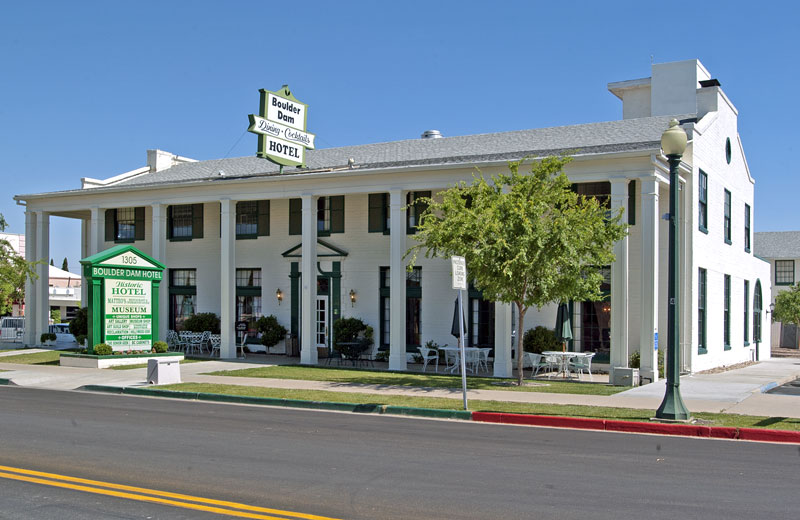
Boulder Dam Hotel
Boulder City, Nevada, is one of the strangest towns in the American West—a place that exists only because the federal government built it from nothing in 1931 to house the thousands of workers constructing what was then called Boulder Dam. In a state defined by gambling, Boulder City was the opposite: a tightly controlled government town with no casinos, no saloons, and strict rules governing daily life. It was engineered for productivity, not pleasure. But it needed a hotel. And the Boulder Dam Hotel, completed in 1933 at 1305 Arizona Street, was built to fill that gap—not for the workers who poured concrete in killing heat down in Black Canyon, but for the dignitaries, officials, and celebrities who came to watch them do it. The hotel was the vision of Paul Stewart Webb, a local businessman who recognized that the thousands of tourists arriving by train from Los Angeles and by car along the Arrowhead Highway would need somewhere to stay. City Manager Sims Ely issued Webb a permit, and the result was a two-story Dutch Colonial Revival structure designed by architect L. Henry Smith—white-columned, with concrete-block walls rising to gable roofs, a wood-paneled lobby, private baths in all thirty-two rooms, and a modern climate system advertised on highway billboards. At its grand opening, the Boulder Dam Hotel had no equal in southern Nevada. Las Vegas, still a small railroad town, had nothing to compare with it. The guest list through the 1930s and 1940s reads like a Hollywood directory crossed with a diplomatic registry. Bette Davis stayed while vacationing after filming in 1934. Mr. and Mrs. Cornelius Vanderbilt Jr. honeymooned there. Will Rogers performed at the nearby Boulder Theatre during a stay in 1935, weeks before his death. Boris Karloff visited while obtaining a divorce. The Maharajah and Maharani of Indore passed through, as did Cardinal Pacelli, who would later become Pope Pius XII. Howard Hughes recuperated at the hotel after crashing his amphibious plane on Lake Mead. Shirley Temple was a regular guest. The hotel also became popular with movie stars establishing Nevada residency for quick divorces, adding a layer of personal upheaval to the building's social history. The hotel's fortunes declined along with passenger rail and shifting tourism patterns. It changed hands over the decades but avoided demolition. In 1982, it became the first hotel in Nevada listed on the National Register of Historic Places. In 2005, the Boulder City Museum and Historical Association acquired the property and renovated it, reducing the room count to twenty-two while expanding public spaces. The Boulder City/Hoover Dam Museum now occupies the first floor, telling the story of the dam workers and the Depression-era community built to house them. Paranormal claims at the Boulder Dam Hotel are varied, persistent, and span decades. The most frequently cited phenomenon involves the sounds of music, conversation, and laughter emanating from the ballroom when it is entirely empty. Staff working alone at night have reported hearing what sounds like a party in full swing—piano music, clinking glasses, voices—only to find the room dark and vacant. The smell of cigar smoke has been reported throughout the hotel despite a no-smoking policy, particularly in the room once occupied by Howard Hughes, who was known to smoke cigars. Some staff believe Hughes himself lingers in the building. The apparition of a former night desk clerk named Tommy Thompson has reportedly been seen in the main lobby, and guests have described an overwhelming sensation of heaviness in the same area. Rooms 209 and 219 are cited as the most active, with reports of faucets turning on in unoccupied rooms, doors opening and closing on their own, and cold spots appearing without drafts. Some guests have described being physically touched or grabbed by unseen hands. Boulder City historian Dennis McBride, who kept offices in the hotel's basement, documented many of these accounts in his book on the property. McBride himself reported seeing an apparition in his basement office. During a reading he arranged with psychic Patsy Welding, she reported sensing strong presences on the upper floors and refused to descend into the basement, describing the energy as overwhelming. The hotel's proximity to Hoover Dam—where at least ninety-six workers died during construction—has led some to speculate that dam workers may account for some of the activity, and figures in old-fashioned work clothes have been glimpsed in restricted areas of the building. Today the Boulder Dam Hotel operates as a boutique historic hotel and museum. The staff generally downplays the haunting reports, and at least one investigator has noted that asking about ghosts can quickly cool an otherwise warm reception. But the accounts continue to accumulate, logged by guests who arrive knowing nothing of the hotel's reputation and leave describing experiences they cannot explain.

Hoover Dam
The Hoover Dam rises from the Colorado River at the Nevada-Arizona border as an engineering marvel towering above red rock landscape. Completed in 1936 after five years of intense construction labor, the dam represents technical mastery of an era, yet its completion exacted profound human cost manifesting in paranormal accounts persisting within tunnels and corridors. The power house, tunnels, walkways, and operational corridors have all become locations where visitors report encounters with presences connected to extraordinary sacrifice during construction. Construction between 1931 and 1936 represented one of the most ambitious twentieth-century engineering undertakings. The project required excavation and relocation of entire communities, creation of settlement infrastructure housing unprecedented workforce, and development of construction techniques without historical precedent. Workers poured into harsh desert landscape, experiencing extreme environmental conditions. The dam's construction consumed over three million cubic yards of concrete, poured continuously to manage thermal properties and avoid fatal cracking. The human toll emerged as tragic reality throughout construction. Official records document at least ninety-six worker deaths directly attributable to construction, though historical accounts suggest actual mortality exceeded one hundred twenty individuals. Deaths resulted from falls, electrocution, crushing injuries, heat-related illness, and drowning. Workers understood the dam's completion literally required human sacrifice, that their safety remained subordinate to project timeline and budget. Tunnels and chambers created unique occupational hazards where workers excavated deep within embankment, laboring in confined inadequately ventilated spaces accumulating dangerous heat. Paranormal investigators document phenomena suggesting continuing presence of workers whose lives ended during construction. In the power house, visitors report disembodied voices emerging from empty corners, sounds reverberating through vast space. Footsteps echo through corridors—measured worker tread—yet no visible figure accompanies these sounds. Apparitions appear briefly in various locations, figures dressed in work clothing consistent with construction era before vanishing. The tunnels have become focus points for paranormal documentation, with researchers reporting auditory phenomena—cries, utterances of distress, sounds suggesting communication. The walkways and corridors throughout the dam structure present spaces where visitors frequently report uncanny sensations and atmospheric disturbance. Individuals describe sudden temperature fluctuations, inexplicable cold spots in warm desert environment, sudden warmth in chilled spaces. Some experience emotional shifts without understanding their source—profound sadness in some areas, anxiety in others. Tour guides and security personnel regularly encounter visitors requesting information about construction period deaths, acknowledging that the dam's human cost has become defining aspect of the visitor experience. The dam continues operating as functional infrastructure and significant tourist destination. Paranormal research teams periodically request investigation access, though operational security and public safety restrictions limit intensive study. Accounts of workers' spirits persisting within the dam have become embedded in regional folklore and paranormal literature. Whether interpreted as genuinely supernatural or as psychological responses to tragic history, persistent reports reflect how intensive human suffering marks locations, creating legacies transcending conventional understanding.
Old Boulder City Hospital
Old Boulder City Hospital stands as a testament to the rapid development of Boulder City, Nevada, a town that emerged from the desert landscape in the early 1930s as a purpose-built community for workers constructing the Hoover Dam. The hospital was established in 1931, constructed to serve the influx of laborers and their families who descended upon the region to work on one of the most ambitious engineering projects of the twentieth century. The facility was designed with the practical efficiency characteristic of Depression-era construction, providing essential medical services to a growing population whose occupational hazards and industrial injuries required immediate and competent care. The structure itself reflected the functional architecture of its era, with corridors and wards organized to accommodate the medical needs of a young, predominantly male workforce engaged in dangerous construction work. The hospital operated during one of the most transformative periods in American industrial history, serving not merely as a medical facility but as a crucial support system for the Hoover Dam project. Workers who suffered injuries on the construction site would be brought to the hospital for treatment, and the institution became known for its capacity to handle trauma cases and acute medical emergencies. The building's design, while utilitarian, provided adequate space for surgical theaters, patient wards, and recovery areas where physicians and nurses worked to save lives and restore injured workers to productivity. The hospital became deeply woven into the community fabric of Boulder City, representing both hope for recovery and, for many, the final chapter of their stories. As the decades progressed and the hospital's original purpose diminished, it served various medical functions before eventually ceasing regular operations. The building itself, however, retained the imprints of its history, and former staff and visitors have long reported experiencing unexplained phenomena within its walls. Moaning and groaning sounds emanate from empty patient rooms, and disembodied footsteps traverse hallways where medical personnel once made their rounds. Shadow figures have been observed in various corridors and rooms, while lights toggle on and off without explanation, and doors open and close of their own accord. One of the most unusual phenomena involves the sensation of invisible presences reaching out to touch visitors, with reports of toes being inexplicably tickled by unseen hands. These experiences suggest that the spirits of patients who died within the hospital's walls, many during times of great suffering and far from home, may remain present, bound by trauma or unresolved circumstances. The hospital's paranormal reputation has attracted the attention of professional paranormal investigators, including appearances on television programs dedicated to ghost hunting, where investigators documented many of the reported phenomena. Their work has provided some validation of the long-standing claims by locals and visitors that the building harbors genuine supernatural activity. The investigators noted the consistency of reports and the intensity of the manifestations, rating their investigations as among the more compelling cases they had examined. The Old Boulder City Hospital remains accessible for paranormal investigations and guided tours, allowing visitors and researchers to experience firsthand the inexplicable phenomena that continue to occur within its corridors. Whether these manifestations represent residual emotional imprints or the conscious presence of departed spirits, the hospital stands as a location where the boundary between the living and the dead appears particularly thin, offering a haunting reminder of the human cost exacted by progress and the persistence of those who suffered within its walls.