
Haunted Places in Missouri
109 haunted locations
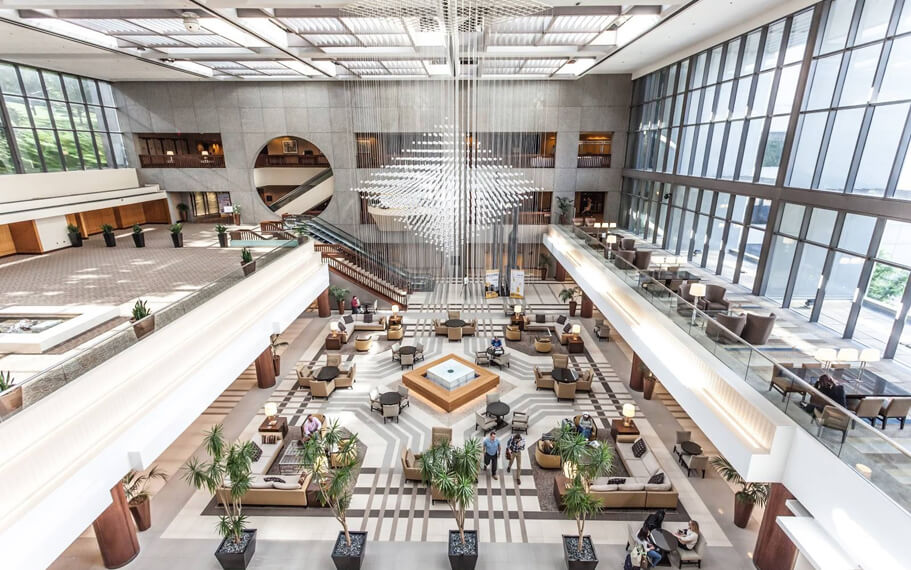
Sheraton Kansas City Hotel at Crown Center
The lobby of the Sheraton Kansas City Hotel at Crown Center is bright, modern, and busy—a soaring atrium with polished floors, a silver sculpture suspended from the ceiling, and sunlight streaming through walls of glass. Guests move through it on their way to conventions, shopping, and meetings at the adjacent Hallmark Cards headquarters. Nothing about the space announces what happened here. There is no plaque on the wall, no marker on the floor, no indication that on the evening of July 17, 1981, this lobby became the site of the deadliest structural failure in American history. The building opened July 1, 1980, as the Hyatt Regency Kansas City, a forty-story, 733-room tower developed by Don Hall of Hallmark Cards as the centerpiece of the Crown Center complex. At the time it was the tallest building in Missouri. The atrium was its showpiece—a cavernous open space crossed by suspended pedestrian walkways on the second and fourth floors, connected by steel rods. The hotel hosted weekly tea dances in the lobby, events that drew hundreds for big-band music and dancing beneath the soaring ceiling. On the evening of July 17, 1981, more than 1,600 people were gathered for one of those dances. At approximately 7:05 p.m., the fourth-floor walkway broke free from its suspension rods and collapsed onto the second-floor walkway below. Both structures crashed to the lobby floor, carrying dozens of people and crushing dozens more standing beneath. The cause was a design change made during construction: the original engineering called for continuous steel rods supporting both walkways, but the design was altered to use shorter rods each supporting only one level. The connection points bore twice the intended load. The National Bureau of Standards later determined the walkways could barely support their own weight. The rods tore through the box beams. One hundred and fourteen people were killed. Two hundred and sixteen were injured. Rescuers worked through the night, pulling the last survivor from the wreckage at four in the morning. The aftermath reshaped American engineering standards. The engineers who approved the design lost their licenses. The Crown Center Redevelopment Corporation paid over $140 million in claims. The hotel underwent reconstruction, replacing the skywalks with a single balcony supported by ground columns. The tea dances ended permanently. The hotel changed hands—becoming the Sheraton Kansas City in 2011 after Starwood assumed management. A memorial was not dedicated until 2015, when the Skywalk Memorial Plaza opened in Hospital Hill Park with a sculpture of dancers and the engraved names of all 114 victims. The paranormal accounts carry a weight distinct from most haunted hotel stories because the event that produced them is not legend—it is documented, investigated, and seared into the memory of a city. Guests who know nothing of the history report an oppressive heaviness in the lobby, particularly a downward pressure on the head and shoulders. One flight attendant described the sensation as feeling like her head was being physically pushed down from the moment she entered the atrium. Visitors have heard screaming echoing through the mezzanine—loud, hysterical, unmistakable—with no source found. The most commonly identified apparition is a woman in a tea gown, believed to be victim Kathryn Sullivan, seen in guest rooms, reflected in windows, and standing in the lobby. A young man in a black tuxedo with a blue bow tie has been reported disappearing through elevator doors. Figures in period attire have been observed in the atrium. A local paranormal investigator named Jim Schwalm, who had reportedly experienced premonitory dreams before the collapse, photographed the lobby shortly after the disaster and claimed to have captured an image of several couples dancing. Today the Sheraton Kansas City operates as a major convention hotel with over 42,000 square feet of function space and the largest ballroom in the city. The lobby is open, bright, and full of life. The skywalks are gone. The architecture has been redesigned to ensure nothing like the collapse could recur. But the space remembers what the building cannot say, and some who pass through it feel something no renovation has removed—a gravity in the air, a sound just below hearing, the sense that not everyone who came to dance that night has left the floor.

Peace Church Cemetery
Peace Church Cemetery, located near Joplin, Missouri, occupies a rural setting among rolling hills and open farmland with considerable elevation changes, its grounds containing graves dating back to the nineteenth century and the earliest periods of European settlement in the region. The cemetery was established formally as a burial ground associated with a small Protestant church community that served the spiritual needs of pioneers and settlers, evolving to serve multiple generations of local families and becoming the final resting place for residents who shaped the development of the rural Missouri landscape through their labors and sacrifice. The grounds contain numerous graves from the Civil War era of soldiers who died in the region's conflicts during the war or were laid to rest by grieving family members during and immediately after the conflict, with many graves remaining deliberately unmarked due to the administrative chaos of the period and the widespread loss of burial records in the upheaval of warfare. The most imposing and threatening paranormal presence in the cemetery is the manifestation locally known as the shadow man, a dark and seemingly malevolent figure that materializes against the tree line at the cemetery's entrance and moves along its perimeter with apparent awareness and intention. The shadow man has been observed by multiple independent witnesses across different time periods as moving deliberately through the cemetery grounds with what witnesses describe as apparent purpose and direction, disappearing and reappearing in different locations in ways that completely defy rational explanation and strongly suggest non-corporeal existence. Billy Cook, a historically documented serial killer and spree killer who was executed for his violent crimes in the region, appears to manifest at the cemetery despite unclear historical connection to the location through burial or documented presence, his violent and disturbed spirit creating a distinctly palpable and oppressive atmosphere of danger and menace that frightens visitors. The cemetery grounds, particularly concentrated in the vicinity of the unmarked Civil War graves and the nearby Rader farm property, produce unexplained sounds that witnesses consistently describe as moaning, screaming, and phenomena acoustically consistent with military combat, cannon fire, and gunfire from the Civil War period. Disembodied voices echo persistently throughout the burial grounds, with some voices appearing to plead desperately for help or cry out in profound anguish, while others seem deliberately to issue warnings to living visitors to avoid certain locations or turn back. Eerie luminescent phenomena have been extensively documented by paranormal researchers moving across the cemetery grounds without any apparent physical source, appearing variously as orbs of light, wisps of ethereal luminescence, and what some experienced witnesses describe as the torches or oil lanterns characteristic of the Civil War era. Shadows dart rapidly and unpredictably through the tree line in patterns that suggest deliberate sentient movement rather than tricks of light or natural phenomena, with witnesses consistently reporting the deeply unsettling sensation of being closely watched and followed throughout cemetery visits. The overall paranormal atmosphere of the cemetery intensifies noticeably during twilight and evening hours and appears particularly active during the anniversary periods of Civil War battles and significant historical conflicts when emotional energy peaks. Civil War soldier apparitions have been reported in military formation near the unmarked graves, suggesting strongly that the spirits of those who died far from home continue seeking proper recognition, formal burial rites, and acknowledgment of their sacrifice. The paranormal investigation society has extensively documented the cemetery's phenomena through scientific investigation, including detailed audio recordings of the disembodied voices and electromagnetic mapping of the concentrated hotspots of paranormal activity. The cemetery remains simultaneously an active burial ground for modern families while functioning as one of Missouri's most actively and intensely haunted locations, a profound duality that speaks eloquently to the complex and troubled nature of the spirits inhabiting its hallowed grounds.
Drury Inn and Suites Creve Coeur
The Drury Inn and Suites in Creve Coeur, Missouri stands as a relatively modern hospitality establishment in a suburb of St. Louis, a region with deep roots in French colonial history and complex layers of cultural heritage. The hotel itself was constructed during the late twentieth century as part of the Drury Inn chain's expansion into the Midwest market, designed to provide comfortable mid-range accommodations for business travelers and leisure visitors alike. The building's architecture reflects the practical modernism typical of chain hotels from this period, with standardized floor plans, efficient room layouts, and contemporary amenities that prioritize functionality over historical character. Yet despite its recent construction and ostensible ordinariness, the Drury Inn has become the subject of persistent paranormal speculation, with particular focus on its fifth floor, suggesting that age is not necessarily a prerequisite for supernatural phenomena. The building stands in a region steeped in old legends about heartbroken spirits and unresolved tragedies that may have somehow imprinted themselves upon newer structures built in haunted territories. The paranormal legend associated with this hotel centers on the fifth floor, where reports of spectral activity have accumulated with notable consistency among guests and staff. According to available accounts, the haunting appears to be connected to unidentified spirits, though some speculation suggests a connection to regional folklore regarding a heartbroken woman from Creve Coeur legend, a tale whose origins remain obscure and whose truth has been obscured by decades of retelling and reinterpretation. The focus on the fifth floor suggests a concentrated area of spiritual disturbance, though investigators have struggled to establish a definitive historical anchor for the haunting or explain why this particular floor should bear such concentrated paranormal activity. The mystery deepens when one considers that the hotel's construction predates any obvious historical tragedy that might explain the phenomenon, raising questions about whether spiritual entities might traverse time and space to manifest in locations associated with places of their earthly demise. Paranormal experiences reported by guests and staff at the Drury Inn encompass a range of phenomena consistent with active haunting patterns. The most frequently documented experiences involve phantom footfalls heard in hallways and corridors when no individuals are present, often accompanied by the sound of disembodied voices engaged in conversation that seem to emanate from nowhere and echo toward nowhere. Multiple witnesses have reported seeing what appear to be invisible people conversing in common areas, complete with the sensation of bodies moving through space despite the absence of visible forms. Apparitions have been observed vanishing instantaneously, defying conventional explanation and suggesting the presence of entities that exist partially outside ordinary perceptual reality. Elevator systems on the fifth floor have demonstrated unusual behavior, with elevator dings occurring without corresponding calls or movements, as though ghostly passengers ride between floors in search of destinations long since forgotten or altered beyond recognition. Guests frequently report an indefinable sense of strange presence, a psychological and perhaps spiritual awareness that something otherworldly shares the hallways and elevators of the hotel. The Drury Inn and Suites Creve Coeur continues to operate as a functional hotel, welcoming guests unaware of or unconcerned with its paranormal reputation. The hotel management takes a pragmatic approach, neither promoting nor actively denying the haunting claims, recognizing that ghost stories can attract interest without necessarily driving away business-oriented travelers. Paranormal enthusiasts have conducted informal investigations on the property, gathering photographic evidence and electronic voice phenomena recordings that they interpret as confirming the presence of spirits. Whether guests arrive with preconceived notions of the haunting or encounter the phenomena with genuine surprise, the fifth floor maintains its reputation as a focal point for unexplained occurrences. The hotel stands as an intriguing example of how paranormal claims can attach themselves to contemporary structures, suggesting that supernatural activity may not be confined to aged and historically significant buildings but might arise anywhere human drama and unresolved sorrow have left their ethereal imprint.
Jack’s Gourmet Restaurant and Bar
Ashley's Of Rockledge stands as one of Florida's most prominently haunted restaurants, earning widespread recognition as the nation's most actively haunted dining establishment through consistent paranormal phenomena occurring across multiple decades of documented operation and investigation. Located in Rockledge along Florida's Space Coast region, the restaurant occupies a historic structure with architectural characteristics reflecting its original construction and era of operation. The building functioned as a dining establishment for extended periods, serving the local community with food service and social gathering space. The restaurant's paranormal reputation has transformed it from a conventional dining establishment into a paranormal destination attracting supernatural enthusiasts, paranormal researchers, and ghost hunters from across the nation. The haunting centers upon the spirit of Ethel Allen, a woman whose tragic death and subsequent spiritual attachment to the location resulted in the most thoroughly documented paranormal phenomena at any active commercial restaurant in the United States. Ethel Allen's spiritual presence manifests throughout multiple locations within the restaurant with particular intensity in the stairs, women's restroom, and bar area where various paranormal manifestations occur regularly. Apparitions of a female figure materializing briefly before vanishing have been reported consistently by numerous witnesses across decades of operation. Furniture and objects move spontaneously on their own without any mechanical cause or human agency, suggesting powerful poltergeist phenomena concentrated throughout the restaurant's interior spaces. Glasses break suddenly and unexpectedly without apparent physical cause, shattering within seconds of being placed or handled, with paranormal investigators documenting instances where glasses fractured mid-air while completely untouched by staff or patrons. Random songs play without any musical source or conventional explanation, suggesting Ethel or another spirit may deliberately select and broadcast music. Visitors and staff consistently describe feelings of being pushed or tapped by invisible forces, indicating direct physical contact between spiritual entities and living individuals. The restaurant has become a central hub for paranormal investigation activity, attracting professional paranormal research teams conducting rigorous documentation of the supernatural phenomena occurring within the establishment. Television programs specializing in paranormal investigation and supernatural phenomena have featured Ashley's Of Rockledge extensively, significantly elevating its profile within paranormal media and popular culture. The restaurant has strategically leveraged its paranormal reputation through marketing and promotional activities, scheduling special paranormal investigation nights and encouraging visitors to experience the haunting firsthand. Staff members at Ashley's Of Rockledge have become completely accustomed to the paranormal manifestations, developing effective coping strategies and standard protocols for managing paranormal incidents while maintaining normal restaurant operations. Ethel appears to interact intentionally with restaurant patrons and paranormal investigators, suggesting conscious awareness and possible desire for recognition or communication with living individuals. Today, Ashley's Of Rockledge continues successful operation as a restaurant and paranormal destination, carefully balancing conventional dining service with paranormal investigation activities and supernatural tourism interests. The restaurant has achieved significant national recognition as one of America's most haunted commercial properties, with paranormal documentaries, television features, and paranormal media coverage establishing its prominent reputation among paranormal enthusiasts and casual tourists seeking genuine paranormal experiences. The restaurant's management maintains strong commitment to paranormal research and documentation, permitting investigators to conduct investigations with professional equipment while continuing normal restaurant operations. Ethel's spirit shows no indication of diminished activity or spiritual departure, suggesting her attachment to the location and ongoing manifestations persist indefinitely.
Missouri Southern State University
Missouri Southern State University, located in the southeastern region of Missouri, stands as an institution of higher education serving the regional community's need for accessible undergraduate instruction and professional development opportunities within a campus environment designed to support student learning and residential life. The university's physical plant includes multiple academic buildings, administrative structures, residence halls, and recreational facilities distributed across the campus grounds, creating a comprehensive institutional environment designed to support the diverse activities and needs of a contemporary university community. The campus environment has become known within paranormal investigation circles as a location inhabited by at least one prominent spectral entity referred to as the Dark Lady, an apparition that has been documented by multiple observers and investigated by paranormal research organizations. The identity of the Dark Lady remains obscure despite ongoing investigation and documentation efforts, though her manifestations suggest a female spirit whose presence carries emotional weight and apparent intentionality. The Dark Lady's apparition has been documented in various locations throughout the campus grounds, though her presence appears to concentrate in specific areas of particular significance or emotional intensity. Paranormal phenomena associated with the Dark Lady include the movement of objects without human agency, manifestations described as poltergeist-type phenomena in which items shift position or relocate to unexpected locations. Cold spots have been documented at various campus locations, localized areas of atmospheric temperature reduction that cannot be explained by conventional meteorological or environmental causes. These cold spots appear to coincide with sightings of the Dark Lady or with increased manifestations of paranormal activity, suggesting a direct relationship between her spiritual presence and the physical phenomena documented at the location. Missouri Southern State University hosts a science-based paranormal investigation organization known as the MoSo Ghost Hunters, an organization established by university students and community members interested in documenting paranormal phenomena using systematic investigative methods and equipment. This investigation group has conducted multiple studies and investigations within the university environment, documenting phenomena and maintaining records of their findings. The establishment of this paranormal investigation organization within the university suggests that the institution's leadership recognizes the significance of the documented paranormal phenomena and supports scientific study of the manifestations occurring within its facilities. The location has been listed among recognized paranormal places in the Missouri region, establishing its credibility as a site of documented and ongoing paranormal activity. The Dark Lady's persistent presence within the Missouri Southern State University environment suggests a spirit unable or unwilling to depart from the location, apparently maintaining attachment to specific campus areas for reasons that remain unclear despite investigation efforts. The combination of documented apparition sightings, object movement phenomena, cold spot manifestations, and the establishment of dedicated paranormal investigation groups within the university suggests that Missouri Southern State University represents a genuine site of ongoing paranormal phenomena worthy of continued research and documentation.
Belvoir Winery
Belvoir Winery and Inn occupies a historic property in the Kansas City region, combining wine service with lodging accommodations in a structure reflecting the architectural ambitions and construction methods of an earlier era. The building represents significant investment in both its original construction and its conversion to contemporary use, with period architectural features preserved alongside modern conveniences serving contemporary guests. The property includes hallways connecting various sections, a basement level serving functional purposes, and grounds encompassing structures and features such as a nearby cemetery contributing to the property's historical significance and atmospheric character. The establishment has developed a reputation within the hospitality community for providing quality wine selections and pleasant accommodations. The paranormal phenomena documented at Belvoir Winery and Inn have established it as one of Kansas City's most notable haunted locations, with consistent reports spanning multiple decades. The primary manifestations involve the spirits of children, entities appearing to have maintained presence within the structure since their deaths. Multiple witnesses have reported seeing apparitions of children, visual manifestations suggesting young individuals in spectral form moving through hallways and common areas. These childlike ghosts appear to engage in behavior patterns consistent with living children, including playing and vocalizing, manifesting through the sounds of spectral singing echoing through hallways. The presence of children's spirits has been corroborated through electronic voice phenomena recordings during paranormal investigations, capturing disembodied vocalizations consistent with children's voices. Accompanying the children's spirits are reports of elderly individuals, entities whose existence appears connected to the structure's historical use. Witnesses have reported the distinctive sounds of shuffling footsteps moving through hallways at times when no living person could account for the sounds. The elderly spirits appear to maintain routines suggesting residual haunting phenomena, in which entities replay actions repeated during their lives. The combination of children's and elderly entity presence suggests the building may have served as a residential institution, orphanage, or family home in which multiple generations lived or died. The supernatural activity extends beyond passive manifestations to include interactive phenomena suggesting some degree of intentional engagement by the spectral inhabitants. Visitors and staff have reported experiencing what appear to be pranks enacted by the spirit entities, including objects displaced and doors mysteriously opening. Most distinctively, assistance has been provided by the spirits, particularly regarding doors and barriers. Guests and staff have reported experiencing assistance in opening heavy or stuck doors, with sensations of unseen force aiding their efforts or doors opening without apparent physical cause. Contemporary operations at Belvoir continue with full acknowledgment of the paranormal reputation, with management and staff recognizing that some guests specifically seek accommodations because of documented paranormal activity. Paranormal investigation groups have been granted access to conduct research, establishing the venue as one of the most comprehensively documented haunted commercial properties in Kansas City.
Rotary Park
The Avila Adobe stands as Los Angeles's oldest residential building, constructed in 1818 by Don Francisco Avila, a prominent landowner and political figure in Spanish colonial Los Angeles. The structure represents a significant example of early nineteenth century Spanish colonial architecture in Alta California, featuring the characteristic adobe construction, thick walls, and internally focused design typical of the period. The building originally served as a residence for the Avila family and successive inhabitants, maintaining its residential function throughout the turbulent transformations that characterized Los Angeles during the Mexican period and American territorial acquisition. The adobe's location in the heart of downtown Los Angeles places it at the intersection of multiple historical eras, from Spanish colonial times through Mexican independence and American acquisition through the Civil War and into the modern metropolitan era. The building has been preserved and operates as a museum and historic site, allowing contemporary visitors to experience the spatial arrangement and daily life of early Los Angeles residents. The paranormal phenomena at Avila Adobe center on multiple locations including Room 8, the master bedroom, the main entrance, and throughout the house, suggesting that emotional and traumatic events occurred in various locations throughout the structure. Period-dressed apparitions appear regularly, spectral figures clothed in the fashion of the early nineteenth century moving through rooms and corridors as if engaged in ordinary domestic activities. Footsteps echo through the adobe without visible origin, the sounds suggesting multiple individuals walking and moving within the structure at various times. Whispers emanate from empty areas, disembodied voices that seem to be engaged in conversation or communication with unseen companions. Faint music materializes from nowhere, melodies and instrumental sounds that many associate with the era of the building's original construction and occupation. These auditory phenomena create a sensory backdrop to the visual apparitions, reinforcing the impression of a location inhabited by spectral residents continuing their daily lives in a realm beyond ordinary perception. A female apparition dressed in black has been reported extensively throughout the Avila Adobe, appearing in various locations and identified by some researchers as Encarnación, the second wife of Don Francisco Avila. This entity is described as a woman in black attire, possibly mourning dress, appearing sorrowful and anguished. Feminine crying has been documented emanating from various locations within the adobe, particularly from the master bedroom and Room 8, suggesting specific locations held traumatic or emotionally significant moments in Encarnación's experience. A male apparition dressed in old-fashioned attire has also been documented, possibly representing Don Francisco Avila or another prominent male resident whose consciousness remains bound to the location. Additional shadow figures move through the adobe, translucent and difficult to fully observe, appearing to exist partially outside normal perception. Historical research suggests that Encarnación may have experienced suffering, loss, or tragedy during her residence at Avila Adobe, circumstances that created emotional imprints powerful enough to manifest as paranormal phenomena across nearly two centuries. The concentration of feminine manifestations and the focus on specific rooms suggests that women experienced particularly significant emotional or traumatic events at the location. The presence of both male and female apparitions suggests household conflict, loss, or unresolved relationships that may have contributed to the spiritual imprinting of the location. The specific identification of Room 8 and the master bedroom as locations of heightened activity suggests these spaces held particular significance in the tragic or traumatic narrative of those who once inhabited the adobe. Today, Avila Adobe functions as a historic house museum operated by the Los Angeles Department of Recreation and Parks, welcoming visitors interested in early Los Angeles history and architectural heritage. The building's status as the city's oldest residence makes it a significant landmark in understanding the continuity of habitation and urban development in Los Angeles from its colonial origins through the present day. Paranormal activity continues to occur within the adobe despite its public function and preservation status, with visitors, staff, and paranormal investigators documenting ongoing manifestations. The ongoing presence of apparitions and other phenomena suggests that the spirits of those who lived, suffered, and died at Avila Adobe remain attached to the location, unable or unwilling to depart, creating a multilayered experience where contemporary visitors encounter both the material artifacts of early Los Angeles history and the spiritual presences of those who once called the adobe home.
Governor Thomas Fletcher House
The Governor Thomas Clement Fletcher House, located in Missouri and constructed during the nineteenth century, represents an exceptional example of period residential architecture and a significant landmark in the history of Missouri governance and civic life. Governor Fletcher served as Missouri's chief executive during the Reconstruction era following the Civil War, a period of profound social upheaval and complex political maneuvering. The house itself, built with the refined craftsmanship characteristic of upper-class residences of that period, features elegant proportions, period-appropriate architectural detailing, and interior spaces designed to accommodate both family life and the official entertainment obligations of the gubernatorial position. The property includes well-maintained grounds and outbuildings that provide insight into the domestic economy and household operations of a prominent nineteenth-century political family. Over the decades since its construction, the house has been preserved, adapted for public interpretation, and maintained as a museum and historical site, allowing contemporary visitors to experience the material culture and spatial arrangements of elite nineteenth-century Missouri society. The architectural features of the Governor Thomas Fletcher House reflect the considerable wealth and status of its original inhabitants, with carefully detailed room arrangements, high-quality furnishings, and decorative elements that demonstrate the aesthetic values and social aspirations of the era. The kitchen, in particular, represents a space of significance both for its historical role in household operations and for its prominence in the paranormal phenomena reported throughout the residence. The various rooms of the house, from formal parlors to private sleeping chambers, have been preserved or carefully recreated to reflect their historical appearance and function. The spatial organization of the residence reflects period conventions regarding gender-separated activities, hierarchical arrangements of family and servant spaces, and the architectural embodiment of social status. Visitors to the house can trace the daily movements and interactions that occurred within these walls across more than a century and a half of residential occupation and subsequent public use. Paranormal phenomena reported at the Governor Thomas Fletcher House center on manifestations that suggest the continued presence of residents from the house's historical period. Most prominent among these reports is the persistent smell of bread baking emanating from the kitchen area, an olfactory phenomenon reported with unusual consistency by visitors and staff despite the absence of any active baking operations within the residence. The kitchen, historically the domain of domestic servants and the heart of household production, appears to be a focal point for paranormal activity, suggesting that the spiritual energy of those who labored there remains imprinted upon the space. Additional reports include the spontaneous sound of piano music arising from unoccupied rooms, mysterious footsteps traversing the hallways and moving between chambers without visible origin, disembodied voices speaking in unintelligible whispers, and unexplained feelings of cold that manifest in specific locations throughout the residence. Witnesses consistently describe an overall sensation of being observed or watched by an unseen presence. The accumulated documentation of paranormal phenomena at the Governor Thomas Fletcher House has attracted the attention of paranormal investigation groups and academic researchers interested in the intersection of material history and spiritual manifestation. The intelligible character of some reported phenomena, particularly the deliberate nature of the piano music and the contextual appropriateness of the bread-baking scent, suggests what some researchers term "intelligent haunting," wherein the manifestations appear responsive to temporal patterns or human presence. The most compelling interpretation of these phenomena suggests that individuals who occupied these spaces during life have maintained such profound attachment to the house that their spiritual presence continues to animate its spaces. Today, the Governor Thomas Fletcher House operates as a museum and paranormal investigation site, attracting both history enthusiasts and those interested in documented supernatural phenomena, making it a significant location where Missouri's political legacy and its spiritual mysteries converge.
St. Mary’s Episcopal Church
St. Mary's Episcopal Church in Kansas City, Missouri stands as a significant religious institution representing the Anglican ecclesiastical tradition within the Kansas City community, serving as a place of worship and spiritual practice for congregants throughout its long operational history. The church building itself reflects architectural and design principles characteristic of Episcopal church construction, with interior spaces dedicated to worship activities, prayer, religious instruction, and sacramental practices central to Episcopal tradition. The church's position within Kansas City reflects its importance within the local religious and community landscape, with the building serving multiple functions beyond merely providing space for worship services, including hosting community gatherings, educational activities, and various social functions that reinforce the church's role as a community institution. The physical structure of St. Mary's Episcopal Church incorporates architectural details and design elements that reflect the aesthetic and spiritual values of Episcopal tradition, with religious iconography and spatial organization designed to facilitate contemplation and worship. Throughout its operational history, the church has served generations of parishioners, with individuals marking significant life events including baptisms, confirmations, marriages, and funerals within its walls. The paranormal reputation of St. Mary's Episcopal Church became particularly associated with Father Henry D. Jardine, a controversial priest who served at the church at some point in its history and whose tenure appears to have been marked by significant conflict, mystery, or scandal that generated lasting spiritual consequences. Father Jardine's controversial nature and the circumstances surrounding his time at St. Mary's remain somewhat veiled in available historical accounts, with detailed biographical and professional information about this particular clergy member being limited in readily accessible sources. However, the strength of the paranormal association between Father Jardine and St. Mary's Episcopal Church suggests that his presence at the church and the circumstances of his departure or death created sufficient spiritual or emotional impact to generate ongoing paranormal manifestations within the church building. The controversy surrounding Father Jardine may have involved theological disputes, personal misconduct, interpersonal conflicts with congregants or other clergy members, or circumstances related to his death that created spiritual turbulence at the location. His apparent reluctance or inability to find peaceful rest after death has resulted in his spirit remaining bound to St. Mary's Episcopal Church, continuing to assert his presence through various paranormal phenomena that visitors and staff members have documented. Visitors to St. Mary's Episcopal Church have reported experiencing paranormal phenomena particularly concentrated on the church's second floor, though manifestations occur throughout the building as well. Individuals present at the church, particularly during late evening hours and nighttime when fewer people are present and the building is more quiet, report feeling a distinct sense of being watched by an unseen presence, with this sensation appearing to intensify late at night. An apparition matching the description of Father Jardine has been reported multiple times, with witnesses describing a spectral figure holding a candle, creating a visually striking and distinctive paranormal manifestation that has been documented by multiple independent observers. Unexplained sounds echo throughout the church building at irregular intervals, including disembodied voices and vocalizations that seem to emanate from the church structure itself rather than from any identifiable source. The voices appear to communicate or express emotion, though the specific content and meaning of these disembodied vocalizations remain difficult to interpret with certainty. The paranormal activity at St. Mary's Episcopal Church has become sufficiently documented and notable that the church community itself has embraced acknowledgment of the building's haunted status, with the church recognizing its paranormal history as a component of its cultural identity. This unusual situation, in which a religious institution publicly acknowledges and discusses its haunted status, has contributed to St. Mary's Episcopal Church becoming a recognized paranormal destination within Kansas City, attracting the attention of ghost tour companies, paranormal investigators, and curious visitors interested in experiencing the church's acknowledged supernatural phenomena.
Gillioz Theatre
The Gillioz Theatre stands as an architectural landmark within the Springfield, Missouri metropolitan area, representing a significant chapter in the region's cultural and entertainment history dating from the early twentieth century. Constructed during the golden age of theater architecture, the Gillioz was designed to provide exceptional experiences for audiences seeking live entertainment and motion pictures during an era of unprecedented cultural flourishing. The building's architectural design incorporated elaborate decorative elements and sophisticated technical systems, with distinct functional areas including main floor seating, elevated balcony sections, bathrooms and comfort facilities, a projection room, and backstage areas designed for theatrical productions. Throughout its operational history, the theatre served as a community focal point for entertainment and cultural events that enriched the broader community and shaped local identity. The main floor seating areas hosted audiences experiencing the full spectrum of theatrical and cinematic offerings. The balcony sections provided optimal viewing positions for patrons, while the projection room, staffed by skilled technicians including a projectionist named Martin, represented the technological cutting edge of motion picture presentation. The bathrooms and comfort facilities reflected the theatre's commitment to comprehensive entertainment experiences for patrons from all social backgrounds. The transition toward its current status as a paranormal hotspot appears to have coincided with broader shifts in entertainment preferences and challenges facing historic theatrical establishments in contemporary market conditions. The building's accumulated history, emotional residue of countless performances, presence of individuals who spent significant portions of their lives there, and apparent violent or tragic circumstances have all contributed to substantial paranormal phenomena documented within the theatre. Paranormal investigators have identified multiple distinct entities associated with the theatre, each demonstrating recognizable patterns of behavior. A ghost boy, appearing to be between eight and twelve years of age, has been encountered in various locations, particularly in bathrooms and balcony sections, exhibiting behaviors consistent with playfulness and curiosity. A woman dressed in a striking yellow dress has been observed multiple times, her elegant attire and refined demeanor suggesting a connection to the theatre's cultural mission. The apparition of a sleeping man has been encountered in comfortable seating areas, suggesting he may have been a long-term resident. The projectionist Martin manifests as a shadow figure within the projection room and surrounding technical spaces. Cold spots of significant intensity occur throughout the theatre, particularly in bathrooms, projection room, and backstage areas. Electrical systems occasionally exhibit unusual behavior, with lights activating or deactivating without manual intervention. The Gillioz Theatre continues to operate as a venue for cultural events despite persistent paranormal phenomena. The theatre's management, staff, and patrons have adapted to the presence of supernatural entities, viewing them as integral aspects of the building's unique character. Paranormal researchers continue documenting ongoing manifestations and attempting to piece together historical circumstances resulting in entities' apparent attachments to this significant cultural institution.
Bass Country Inn – Campus Inn
The Bass Country Inn, also known as the Campus Inn, stands as a historic lodging establishment in Springfield, Missouri, representing multiple eras of hospitality services, architectural evolution, and the economic and social history of its location within Springfield's downtown or commercial districts. The structure itself reflects construction practices and architectural aesthetics characteristic of the period of its original development, with subsequent modifications and renovations undertaken to maintain contemporary hospitality standards and appeal to successive generations of travelers and guests. The building encompasses multiple guest rooms, common gathering spaces, dining facilities, kitchen areas, a ballroom suitable for events and celebrations, office spaces for administrative functions, and hallways connecting the various rooms and functional areas of the inn. The inn has served the hospitality needs of countless visitors to Springfield across its operational history, providing temporary accommodation, meals, and gathering spaces for travelers, business visitors, and those participating in local events and celebrations. The structure maintains its fundamental role as a hospitality establishment while simultaneously serving as a repository for the experiences, conversations, and human interactions that have occurred within its spaces across multiple decades of operation. The paranormal history of the Bass Country Inn Campus Inn centers on multiple spiritual entities that are understood to remain present within the building, each with distinct identities and manifestation patterns that have become established through decades of observation and investigation. Carl, identified as the ghost of a former bus boy who worked at the inn, maintains a distinctive presence throughout the structure, appearing in the kitchen areas where he performed his labor during life and in the hallways of the building. The appearance of Carl's spirit suggests that his identity became so bound to the physical space and routine work of the inn that his attachment persisted beyond the termination of his employment and the conclusion of his physical life. An unnamed female spirit also inhabits the structure, distinguished by her interactive behavior and her tendency to engage in physical contact with the living residents and visitors of the inn, suggesting consciousness and communicative intent despite the absence of physical form. The Colonel, identified as a Civil War era spirit dressed in a black military uniform, represents a temporal layer of the building's history extending back to the turbulent period of American Civil War, suggesting that the inn may have connections to Civil War era events or that the spirit was attracted to the location through mechanisms not yet fully understood. These three distinct entities collectively create a complex paranormal environment reflecting different historical eras and occupational backgrounds. The paranormal manifestations at the Bass Country Inn Campus Inn express themselves through specific behaviors and phenomena attributed to each of the primary spiritual entities and concentrated in particular areas of the building. Carl, the former bus boy's ghost, is known to appear in the kitchen where he once performed his duties and in various hallways of the inn, with sightings suggesting that his spirit continues to traverse the spaces he once occupied during his living employment. Objects inexplicably fall from shelves within the kitchen area and other locations, suggesting physical interaction from non-visible sources and creating a hazard for contemporary staff and guests. A specific phenomenon involves legs appearing beneath table surfaces that vanish or disappear when approached by living investigators or observers, creating an eerie manifestation that suggests partial or selective manifestation of spectral bodies. The office door of the inn mysteriously locks despite the absence of keys or physical locking mechanisms engaged by living persons, suggesting some form of non-physical intelligence or energy capable of manipulating mechanical systems. The unnamed female spirit engages in physical contact with living persons, touching people without visible source and creating tactile sensations that confirm the presence of non-physical entities capable of generating physical sensation. The Colonel, the Civil War era spirit in the black uniform, makes his presence known particularly during the hours between midnight and four in the morning, when he is observed moving through the ballroom and other areas of the inn. In contemporary times, the Bass Country Inn Campus Inn continues to function as a lodging and event establishment, welcoming guests to stay in rooms shared with non-physical entities and to participate in events within spaces where paranormal activity persists. Staff members working at the inn have adapted to the presence of Carl, the female spirit, and the Colonel, treating them as integral if uncompensated members of the hospitality operation. The kitchen continues to operate with the ongoing presence of falling objects and Carl's ghostly activity, while the office door maintains its mysterious locking behavior. Guests checking into the inn sometimes experience encounters with the paranormal residents, from the tactile experiences of the female spirit to witnessing the manifestations attributed to Carl and the appearances of the uniformed Colonel. The ballroom continues to serve as a venue for celebrations and events while simultaneously being the domain of the Civil War era spirit. The Bass Country Inn Campus Inn represents a unique hospitality establishment where living guests and permanent spectral residents coexist within shared spaces, creating an ongoing negotiation between the contemporary functions of the inn and the paranormal dimensions embedded within its environment.
Zombie Road – Lawler Ford Road
Zombie Road, more formally known as Lawler Ford Road, traverses a remote and historically significant area of Missouri. The road itself passes through terrain historically significant during the Civil War period, when military movements, skirmishes, and casualties marked the landscape with armed conflict trauma that continues to resonate across time. The landscape is characterized by dense forests, overgrown vegetation, and abandoned structures gradually succumbing to decay over decades of minimal human activity. The road has become increasingly isolated as surrounding communities abandoned the area and alternative transportation routes drew traffic away, leaving Zombie Road as a remnant of earlier settlement and infrastructure patterns. The paranormal phenomena associated with Zombie Road are diverse and multifaceted, encompassing experiences ranging from subtle environmental anomalies to dramatic confrontations with apparently hostile supernatural entities. Visitors and explorers have repeatedly reported encountering distinct cold spots where ambient air temperature drops precipitously without apparent meteorological explanation, creating physical sensations that can result in discomfort if exposure is prolonged. Manifestations extend to auditory phenomena, with witnesses describing disembodied voices emanating from surrounding forests, sometimes intelligible and sometimes merely inarticulate sounds expressing distress or anger. Most dramatically, some visitors report the disturbing sensation of unseen hands making physical contact, scratches appearing on skin without visible agency, and the sense of being touched by hostile invisible presences. The apparitions encountered on Zombie Road include spirits of Civil War soldiers whose presence reflects violent deaths and tragic circumstances from over a century and a half ago. These military ghosts manifest in various forms, some as full-bodied apparitions in period military uniform, others as shadowy shapes in peripheral vision. Visitors have documented encounters with apparitions of children, ghostly youngsters suggesting distinct historical narratives of deaths or tragedies involving minors. The most enigmatic entity is a mysterious old woman who appears to explorers, yelling at them and expressing anger at their presence, seemingly determined to drive them away through intimidation. Her identity and historical background remain obscure, her appearance suggesting she may date from an earlier or later historical period, or represent a distinct traumatic event. Zombie Road has become a destination for paranormal researchers and ghost hunters seeking to document phenomena and understand underlying historical events. The road remains accessible to vehicular and pedestrian traffic despite its remote location and deteriorating condition, though pervasive unease and documented hostile manifestations discourage casual recreation. Legends surrounding Zombie Road have grown increasingly elaborate and somewhat divorced from documented evidence, with some contemporary accounts describing aggressive zombie-like entities or demonic presences that may represent exaggeration. Nevertheless, Zombie Road stands as a location where historical tragedy, paranormal activity, and remote isolation combine to demonstrate how traumatic death and emotional intensity apparently transcend the boundary between physical and spiritual worlds, leaving indelible impressions and making the dead insistent upon presence and communication with the living.
Old Cooper County Jail and Hanging Barn
The Old Cooper County Jail stands as a grim reminder of frontier justice and incarceration practices in nineteenth-century Missouri. Built to serve the growing Boonville community and surrounding Cooper County region, the facility operated for decades as both a place of confinement and execution. The stone structure, characteristic of mid-nineteenth-century jail architecture, was designed to house prisoners awaiting trial, serving sentences, or facing their final hours. Adjacent to the main jail building stands the Hanging Barn, a separate structure that served the darker purpose of conducting capital executions. This stark juxtaposition of confinement and death defined the facility's role within the county's criminal justice system, and the physical remnants of both structures have survived into the modern era, preserving the architectural record of a bygone era of punishment. Throughout its operational years, the jail cycled through countless prisoners, from petty offenders to those convicted of serious crimes. The cells, constructed with heavy iron and stone, held individuals in varying states of despair and resignation. Among these prisoners, some faced the certainty of execution, a prospect that weighed heavily upon them as they awaited their final fate within the jail's confines. The daily operations of the facility involved a routine of guards, meals, and the constant undercurrent of desperation that permeated the cells. Records indicate that multiple prisoners ended their own lives while incarcerated, unable to face the grim realities of their situations. These suicides added another layer of tragedy to the location's history, creating an atmosphere thick with despair and loss. The suicide cell, a location within the jail specifically tied to at least one documented self-inflicted death, has become a focal point of paranormal investigation and visitor interest. This cell and the hanging barn are considered the most actively haunted areas of the site. Documented paranormal phenomena center around the manifestation of a former prisoner whose spirit appears to remain restless and agitated. Investigators and visitors have reported the distinct and chilling experience of witnessing what appears to be the apparition of a prisoner materializing within the confines of the jail cells, accompanied by the sound of fists pounding forcefully against the cell doors and bars. These knockings are reported to occur spontaneously and with intensity that seems impossible to attribute to natural causes such as wind or settling of the old structure. Additionally, visitors have reported encounters with dark shadow figures that move through the corridors and cells, creating an atmosphere of menace and unease. The entity appears to express its continued anguish through these manifestations. In the hanging barn itself, the presence of death and execution seems to have left an indelible mark on the location's spiritual landscape. Paranormal investigators have documented unusual cold spots, unexplained sounds of distress, and apparitions that appear to enact the final moments of those executed within the structure. The combination of suicide and execution creates a particularly troubled spiritual environment. Various paranormal investigation teams have recorded evidence suggesting intelligent haunting activity, with the spirits seemingly aware of visitors and responsive to questioning and interaction. These investigations have added scientific credibility to the long-standing reports from individuals who have experienced the haunting firsthand. Today, the Old Cooper County Jail and Hanging Barn remains accessible to researchers, paranormal enthusiasts, and historians seeking to understand both the criminal justice history and the reported supernatural phenomena of Missouri. The site has become a notable destination on paranormal tourism circuits, with guided tours and investigations regularly conducted by established paranormal research groups. While the structure has been preserved as a historical landmark rather than a functioning jail, its dark legacy continues to attract attention from those fascinated by the intersection of history and the paranormal. The location stands as both a sobering reminder of nineteenth-century justice practices and as evidence of the enduring presence of troubled spirits bound to the place of their greatest suffering.
Landers Theater
Landers Theater in Springfield, Missouri, represents a significant achievement of late nineteenth-century theatrical architecture, constructed during an era when major American cities invested substantially in public entertainment venues. The building features distinctive architectural characteristics reflecting theatrical design principles of its construction period, including ornamental ceiling elements, balcony configurations providing varied audience sightlines, and stage infrastructure supporting complex theatrical productions. The theater building occupies a prominent location within Springfield's downtown commercial district, positioned within context of period architecture reflecting late nineteenth and early twentieth century urban planning. The structure's distinctive towers make it recognizable within the Springfield skyline and subject to historical preservation efforts. Throughout its century-plus operational history, the theater has hosted dramatic productions, musical performances, and entertainment presentations. The building underwent significant renovations during the twentieth century while preservation efforts maintained original architectural elements. The theater continues to operate under the Springfield Little Theatre organization. The paranormal history of Landers Theater encompasses multiple documented paranormal entities concentrated in specific areas including the balcony, stage, backstage, and fourth floor window level. The primary documented entity involves an old janitor who apparently died during a fire incident in 1920, a tragedy that destroyed portions of the theater structure. The janitor's ghost has been reported manifesting in the balcony area with apparent regularity to multiple independent witnesses. An additional documented entity involves an African-American man who was stabbed during an altercation within the theater during the 1920s. This entity's ghost appears to manifest with less frequency than the janitor's apparition. A ghostly baby manifestation has been documented with witnesses reporting sightings of an infant apparition apparently manifesting in the balcony area. The baby cries heard within the building may correlate with the apparition, though exact circumstances remain unclear. Paranormal phenomena reflect characteristics associated with tragic deaths and unexplained manifestations of spirit entities with apparent awareness. A green hazy orb approximately five feet in height has been observed, manifesting unlike more humanoid forms and suggesting either a different paranormal category or a spirit whose appearance differs substantially. The apparition of a tall blond man dressed in Elizabethan-era clothing has been documented in the fourth floor window, suggesting historical connection potentially extending beyond the documented 1920s tragedies. This figure's theatrical context suggests connection to performances or technical operations. The baby apparition and crying sounds suggest death of a young child within the theater structure. The concentration of paranormal activity in balcony and elevated areas may reflect structural location of tragic deaths and subsequent spiritual attachment. The paranormal character of Landers Theater has become increasingly documented as paranormal investigation organizations have devoted attention to its diverse spirit entities. Paranormal researchers have conducted investigations documenting audio phenomena, electromagnetic fluctuations, and instrumental evidence corroborating eyewitness accounts. The theater's operational use provides ongoing opportunities for contemporary documentation. The multiplicity of documented entities reflects the building's history encompassing multiple tragic events. Contemporary theatrical operations appear unimpeded by paranormal presence. The location has become established as a significant paranormal research site within the Springfield region, attracting investigators seeking to document the complex phenomena associated with this major theatrical structure.
Longview Mansion
Longview Mansion stands as an architectural and historical landmark in Lee's Summit, Missouri, representing the substantial estate holdings of one of America's prominent industrial families during the Gilded Age. Built by Robert A. Long, a wealthy lumber baron and businessman whose vast financial interests shaped the economic landscape of Kansas City and the surrounding region, the mansion exemplifies the grand residential construction of the period with its impressive scale, refined architectural details, and sprawling grounds. The property encompasses extensive acreage that originally served as both a functional working estate and a display of the Long family's considerable wealth and social standing. Constructed during an era when such estates were built as monuments to industrial success, the mansion incorporated the finest materials available and employed skilled craftsmen to create spaces that reflected the family's prominence within regional society. The grounds included not only the main residence but also supporting structures, gardens, and agricultural facilities that made the property largely self-sufficient. The estate became particularly notable for its association with Loula Long-Combs, the daughter of Robert A. Long, whose reputation as an accomplished and renowned horsewoman became legendary throughout Missouri and beyond. Loula Long-Combs developed an intense passion for equestrian pursuits that shaped both her personal identity and her role within the family's social circle. Her skill with horses and her dedication to breeding, training, and competing with fine animals made her a recognized figure in American horsemanship during her lifetime. The property at Longview was ideally suited for such pursuits, with extensive stable facilities, riding grounds, and the landscape necessary to maintain a first-class equestrian operation. Loula invested considerable time and energy into the development of the property's horse-related infrastructure, creating one of the region's premier facilities for serious riders and equine enthusiasts. Her commitment to horses extended beyond mere hobby to become a central organizing principle of her adult life. Loula Long-Combs' life, like many prominent figures of her era, ultimately came to an end, yet her attachment to Longview Mansion and the equestrian lifestyle she built there appears to have transcended the boundary between life and death according to paranormal accounts documented over multiple decades. The primary manifestations of her alleged haunting center on spectral experiences involving mounted apparitions seen traversing the property grounds, particularly during hours when the estate is otherwise quiet and unoccupied. Witnesses have reported observing the apparition of a woman mounted on horseback, the figure appearing to ride across the grounds with familiarity and purpose, suggesting a continued attachment to the location and to the equestrian activities that defined her earthly existence. Multiple independent accounts from different visitors and residents describe similar experiences, noting the transparent or ethereal quality of the apparition and the sense that the figure moves with the accomplished ease of someone whose life was deeply connected to horsemanship. Additional paranormal phenomena reported at Longview Mansion extend beyond the equestrian apparitions to include other manifestations suggesting residual haunting activity or the presence of multiple entities. Witnesses have documented experiences of animal presences that cannot be directly attributed to living creatures on the property, suggesting a supernatural dimension to these encounters. The interior of the mansion itself has become the site of odd phenomena, with reports of beds found mysteriously disheveled or in a state of disarray despite no human activity in those spaces. These incidents suggest a presence that interacts with the physical environment in ways that defy conventional explanation. Some accounts describe feeling an unusual coldness in particular rooms or sensing a presence that accompanies the manifestation of animal-related phenomena, lending further credence to the theory that Loula Long-Combs or another equestrian-connected entity remains attached to the property. The consistent nature of these reports across multiple witnesses and time periods suggests that something unusual and potentially paranormal persists within the mansion and its surrounding grounds. Today, Longview Mansion stands as both a historical property and a location of paranormal interest, attracting those interested in Missouri's history, equestrian heritage, and documented haunting phenomena. The property continues to function as a venue for tours, events, and historical education, allowing visitors to experience the spaces where Loula Long-Combs lived and where her alleged ghost is said to continue her eternal equestrian pursuits. The haunting serves as a poignant reminder of the intense attachments that human beings can develop to places and pursuits, suggesting that such powerful life connections might somehow extend beyond conventional boundaries of mortality. Longview Mansion exemplifies how grand estates often become repositories of paranormal claims and historical mystery, places where the stories of exceptional individuals become interwoven with claims of supernatural persistence and unresolved attachments to earthly locations and beloved activities.
Historic Castle House
The Historic Castle House in Brumley, Missouri represents a distinctive architectural achievement in the rural Ozark region, a structure that diverges sharply from conventional nineteenth-century vernacular building practices prevalent throughout the American heartland. Constructed during a period of relative prosperity in the Ozark region, the building's castle-inspired design reflects the architectural ambitions of its original owner and demonstrates the economic aspirations of the era. Brumley and the surrounding Morgan County area developed primarily through agricultural and timber extraction industries, with the settlement established along transportation routes that connected the isolated Ozark communities to larger commercial centers. The Historic Castle House stands as one of the most unusual residential structures in the Midwest, its distinctive design making it immediately recognizable to visitors and paranormal researchers who journey to this rural Missouri location. The house was originally constructed as a private residence intended to showcase architectural sophistication in a region dominated by modest cabin and farmhouse construction patterns. The building incorporates multiple rooms and distinct living spaces arranged vertically through its castle-like structure, with a master bedroom representing one of the primary residential chambers in the elaborate design. Throughout the house, the architecture incorporates unusual features that distinguish it from contemporary residential construction, including towers, distinctive stonework, and unusual room configurations that reflect its unique design philosophy. The location has been the subject of substantial architectural documentation and historical inquiry due to its unusual appearance and its significance as an unconventional expression of residential design in rural America. Paranormal investigations conducted at the Historic Castle House have documented extensive and well-documented supernatural phenomena that investigators consider among the most compelling evidence of genuine paranormal activity in the Midwest. Multiple spirits appear to inhabit the structure, with distinct entities demonstrating individual behavioral patterns and manifestation styles that suggest the presence of multiple deceased individuals. Investigators and sensitives have reported cold spots that appear suddenly and without meteorological explanation, particularly in bedrooms and interior spaces throughout the building. Footsteps have been documented on multiple occasions moving through hallways and rooms with a regularity suggesting habitual pathways followed by the spirits inhabiting the location. Lights in various rooms turn on and off without physical intervention, with switches located at distances impossible for any single agent to manipulate. Witnesses have reported whistling sounds emanating from empty rooms and hallways, sometimes suggesting responses to the investigators' presence or comments. Whispering voices have been recorded through multiple audio documentation methods, with speech patterns suggesting communication attempts by the spirits toward the living. Shadow people have been observed moving through the structure, dark silhouettes that appear and disappear with supernatural quickness and without consistent physical explanation. Visitors and investigators report sensations of being touched by unseen hands, with some describing contact sensations on their skin and clothing despite the absence of any physical agent. Phantom noises including rappings, knockings, and unidentifiable sounds have been systematically documented throughout the building. The Historic Castle House was featured on the HGTV network's program identifying it as among the scariest residential locations in America, bringing significant media attention to its paranormal reputation and attracting investigators and paranormal enthusiasts from across the country. The convergence of multiple distinct entities, the variety and intensity of reported phenomena, and the consistent documentation of supernatural activity across numerous investigations have established the Historic Castle House as one of the most actively haunted residences in the region. The spirits appear to interact with the physical environment, manipulating electrical systems and physical objects in ways that challenge conventional scientific explanation. Researchers continue to investigate the historical origins of the hauntings, seeking to understand which individuals or events in the building's history might account for the persistent paranormal activity. The structure remains accessible to paranormal investigators and continues to generate reports of supernatural phenomena from visitors and residents.
Main Street Galleria
The Main Street Galleria occupies a historic building located at 501 Main Street in Weston, Missouri, positioned within the downtown district of this well-preserved nineteenth-century community. The three-story structure represents the commercial and architectural traditions characteristic of Missouri's historic main street corridors, featuring storefront spaces on the ground level and upper-floor accommodations originally designed for residential or storage purposes. The building has housed various commercial enterprises throughout its extended history, adapting to changing economic conditions and commercial needs within the Weston community. Currently, the Main Street Galleria operates as a multi-use commercial space, hosting various retail establishments, dining venues, and specialty shops that serve both local residents and tourists attracted to Weston's historic district. The building's architectural features and historically appropriate restoration work have made it a notable landmark within Weston's carefully preserved downtown area. Weston, Missouri itself possesses significant historical importance within the broader context of nineteenth-century American frontier and settlement history. The town served as an important riverport community along the Missouri River and developed substantial commercial and agricultural infrastructure during the antebellum period. The region's growth and development involved interactions between settler populations, enslaved individuals, Native American populations, and the natural environmental challenges characteristic of the frontier era. The Main Street Galleria building stands as a physical testament to this historical period, its three-story structure representing commercial ambitions and construction standards of its era. Throughout its long operational history, the building has witnessed countless human dramas, transactions, celebrations, and tragedies characteristic of any long-inhabited commercial structure. Beginning in the latter decades of the twentieth century, the Main Street Galleria and its three-story interior became recognized as the site of significant paranormal phenomena. Multiple entities, referred to collectively as resident ghosts by paranormal researchers and local residents, appear to maintain an active presence throughout the structure. The manifestations are not confined to a single location or floor within the building but rather occur on all three levels, suggesting multiple distinct spirit entities inhabiting different areas of the structure. Witnesses have reported encountering apparitions, sensing unexplained presences, and experiencing other paranormal phenomena distributed throughout the building's vertical space. The variety of locations where phenomena occur suggests different historical narratives or tragedies associated with different sections of the structure. Significant paranormal activity escalated during periods when the Main Street Galleria underwent structural renovation and modernization work. During construction and renovation phases, witnesses reported heightened supernatural manifestations, including the movement of objects, unusual sounds, and more frequent apparition sightings. Some accounts suggest that the renovations themselves seemed to disturb or agitate the resident spirits, resulting in more pronounced and active paranormal phenomena. Renovation workers and construction personnel reported uncomfortable sensations while working within the building, unexplained accidents or injuries, and equipment malfunctions that suggested something beyond ordinary construction complications. The relationship between structural disturbance and paranormal activity intensification has been noted by paranormal researchers studying the location. Objects have been observed moving without visible cause, and items have been reported as appearing in locations different from where they were originally placed. The Main Street Galleria continues to operate as a functional commercial property while maintaining its status as a paranormally active location within Weston's community awareness. Local residents and business operators acknowledge the presence of multiple spirits within the structure and have adapted their operations accordingly. The property has become a featured location on paranormal tourism circuits, with ghost tour operators regularly including the Main Street Galleria as a significant stop on their Weston itineraries. Paranormal investigation teams continue to conduct research at the location, documenting the diverse phenomena occurring throughout the building's three floors. The resident ghosts appear to coexist peacefully with the living inhabitants of the structure, and the paranormal activity has become an accepted characteristic of the location rather than a barrier to its continued use. The Main Street Galleria represents a unique example of a haunted commercial property functioning simultaneously as a profitable business and an active paranormal site, bridging the historical past with the commercial present.
Glore Psychiatric Museum
The Glore Psychiatric Museum in St. Joseph, Missouri, preserves the history of psychiatric medicine and mental health treatment in the United States, occupying a building originally constructed and operated as a psychiatric institution. The museum's building complex represents multiple decades of psychiatric care delivery from the early through late twentieth century, encompassing periods when psychiatric treatment ranged from humane approaches to methods now recognized as harmful. The building's architecture, institutional design, and physical layout remain largely unchanged from its operational period as an asylum, preserving artifacts and exhibits along with the spatial and atmospheric qualities of a psychiatric institution from an era when mental health care was poorly understood and inadequately regulated. The museum's mission requires displaying disturbing implements of treatment and restraint, creating an environment simultaneously educational and deeply unsettling to visitors encountering the physical reality of historical psychiatric practices. The asylum that occupied this building housed hundreds of patients suffering from severe mental illnesses, developmental disabilities, or behavioral disorders that could not be effectively treated with available medical knowledge. The conditions within psychiatric institutions during the twentieth century ranged from inadequate to abusive, with patients subjected to restraint, isolation, and experimental treatments causing additional trauma. Many patients never returned to the community, living their entire lives within facility walls. Deaths were common, resulting from illness, treatment complications, accidents, and suicide. The accumulation of human suffering, death, and trauma within the physical structure created what paranormal researchers characterize as a spiritually contaminated location where the anguish of deceased patients continues to manifest as paranormal phenomena. The transformation into a museum has not eliminated the activity; instead, the presence of artifacts appears to amplify manifestations. Paranormal phenomena within the Glore Psychiatric Museum have been extensively documented through witness accounts and formal paranormal investigation events. Disembodied voices have been reported in various locations, particularly near areas where restraint devices and harsh psychiatric equipment are displayed. Visitors and staff describe hearing sounds appearing to originate from empty rooms, voices conveying distress, confusion, or anguish. Shadow figures have been observed moving through hallways and exhibition rooms, appearing as dark silhouettes lacking distinct features. A particularly notable apparition is a full-bodied manifestation of a former patient encountered within the morgue area. Physical sensations reported include sudden temperature drops creating cold spots, unexplained touches against visitors' bodies, and sensations of invisible presences. Equipment malfunctions frequently occur during investigations, with electronic devices experiencing unexplained failures in certain areas. The Glore Psychiatric Museum has embraced its haunted reputation by featuring prominently on haunted television series and organizing official paranormal investigation events. The museum has transformed its status as a haunted location into an educational asset, using paranormal interest to draw visitors while continuing its historical preservation mission. Paranormal investigation organizations have conducted multiple investigations documenting alleged paranormal activity. The concentration of human suffering and death within the building's history, combined with preservation of traumatic psychiatric equipment, creates an environment saturated with historical trauma. Paranormal researchers theorize that spirits of deceased patients remain bound to the location, unable to move beyond the institution defining their existence. The museum represents a unique location where historical education, paranormal investigation, and spiritual contamination converge, creating a destination attracting both history enthusiasts and paranormal researchers seeking to understand how institutional trauma manifests as supernatural phenomena.
Walnut Street Inn
The Walnut Street Inn located in Springfield, Missouri operates as a bed-and-breakfast establishment housed within a historic building dating to the nineteenth-century period when Springfield was developing as a commercial and residential center in southwestern Missouri. The structure represents late Victorian-era residential architecture, constructed with careful attention to decorative detail and interior finishes characteristic of homes built for families of substantial economic means. The building underwent conversion to bed-and-breakfast operations in recent decades, a transformation that preserved the historical character while adapting it to contemporary hospitality purposes, allowing visitors to experience overnight lodging within a restored historic residence. The conversion required substantial interior renovation and restoration work to accommodate modern hospitality standards while maintaining architectural integrity and historical authenticity. The Walnut Street Inn has developed a reputation as one of Springfield\'s most significant historic accommodations, attracting guests interested in experiencing overnight lodging within a nineteenth-century residence combined with exposure to documented paranormal phenomena. The Rosen Room has been identified as the most consistently and actively paranormally active space within the inn, with multiple guests and staff documenting paranormal occurrences concentrated within this bedroom and adjacent spaces. A female spirit identified through historical research as inhabiting the room is believed to date from the Victorian era, consistent with the building\'s original construction and the period when it served as a private residence for prominent Springfield families. The presence of this Victorian-era female entity has been documented through guest testimonies, paranormal investigation recordings, and photographic evidence gathered across multiple visits, establishing a consistent pattern of paranormal manifestation within the Rosen Room. The spirit\'s attachment to the specific room suggests possible connection to a significant event or traumatic occurrence within that space, or possibly a strong emotional or personal connection to the room maintained throughout her post-mortem existence. Paranormal phenomena documented at the inn encompass a range of manifestations consistent with the presence of intelligent spirit entities and residual haunting activity concentrated within the building\'s interior spaces. Apparitions have been observed materializing within the Rosen Room and adjacent areas, manifesting as translucent or semi-transparent humanoid figures appearing in Victorian-era clothing consistent with the late nineteenth-century period of the building\'s construction. Shadow figures have been documented moving through hallways and interior spaces, appearing as dark silhouettes that move with apparent purpose before dissipating or fading from perception. Disembodied voices have been heard throughout the structure, including whispered speech, articulate conversations, and vocalizations whose sources cannot be identified. Blanket manipulation has been reported by multiple guests staying in the Rosen Room, describing incidents in which bedding and blankets moved of their own accord despite the absence of visible human agency or natural air currents that could explain the movement. These incidents have been documented consistently across multiple guest visits, suggesting either residual paranormal phenomena replaying specific actions or intelligent manipulation by the spirit entity inhabiting the room. The consistent occurrence of blanket manipulation has become one of the most characteristic and reliable paranormal phenomena associated with the inn, with guests and paranormal investigators anticipating this specific manifestation during visits.
The Lehmann House
The Lehmann House in Saint Louis, Missouri represents a significant example of nineteenth-century residential architecture, constructed as a private residence during a period when Saint Louis was establishing itself as a major commercial and cultural center of the American Midwest. The house was built during the Victorian era, reflecting architectural preferences and aesthetic values of wealthy families who inhabited such residences, with careful attention to decorative detailing, interior finishes, and spatial organization that conveyed status and refined taste. The structure underwent subsequent modifications and renovations throughout the twentieth century as it passed between successive owners, each generation making alterations to accommodate changing lifestyle preferences and technological advances. In more recent decades, the Lehmann House has been converted to operate as a bed-and-breakfast establishment, a business model that allows visitors to experience overnight lodging within the historic structure while contributing to the preservation and maintenance of the building. The house\'s conversion to bed-and-breakfast operations has brought increased attention to paranormal phenomena occurring within the structure, as overnight guests and proprietors have documented unusual occurrences attributed to the presence of former residents whose spirits appear to inhabit the residence. The building\'s main bedroom area has been identified as a particular focal point of paranormal activity, with guests and staff reporting their most disturbing and inexplicable experiences concentrated within this space. Historical research conducted by paranormal investigators and property owners has identified Edward S. Rowse as a former resident whose spirit appears to remain bound to the property, particularly manifesting within the main bedroom where his presence has been most frequently documented through guest testimonies and paranormal investigations. The identification of Rowse as a specific entity has provided a focal point for understanding the paranormal phenomena, though precise circumstances of his death remain subjects of investigation. Paranormal phenomena documented at the Lehmann House encompass a variety of manifestations consistent with residual haunting activity and the presence of intelligent spirit entities. Ghostly orbs have been captured in photographs taken by guests and paranormal investigators within various rooms, particularly concentrated in the main bedroom and adjacent spaces where activity has been most consistently reported. Shadowy figures have been observed moving through hallways and interior spaces, manifesting as dark silhouettes that move with apparent purpose before dissipating or vanishing. Shimmering apparitions have been sighted by witnesses, described as translucent or semi-transparent humanoid figures that appear momentarily before fading from perception, suggesting a weaker form of paranormal manifestation. Disembodied voices have been heard throughout the structure, including articulate speech whose source cannot be identified. Footsteps have been documented echoing through hallways and rooms, occurring when no living person is present in the location where sounds originate, suggesting unseen entities traversing the spaces with apparent familiarity and purposefulness. Doors have been reported to move of their own accord, opening and closing without human interaction. The consistent documentation by multiple independent observers has established the Lehmann House as one of Saint Louis\'s most actively haunted residential properties, with paranormal activity sufficiently documented to support its reputation within paranormal research communities and general popular awareness of haunted locations in the region.