
Haunted Places in Kansas City, Missouri
15 haunted locations
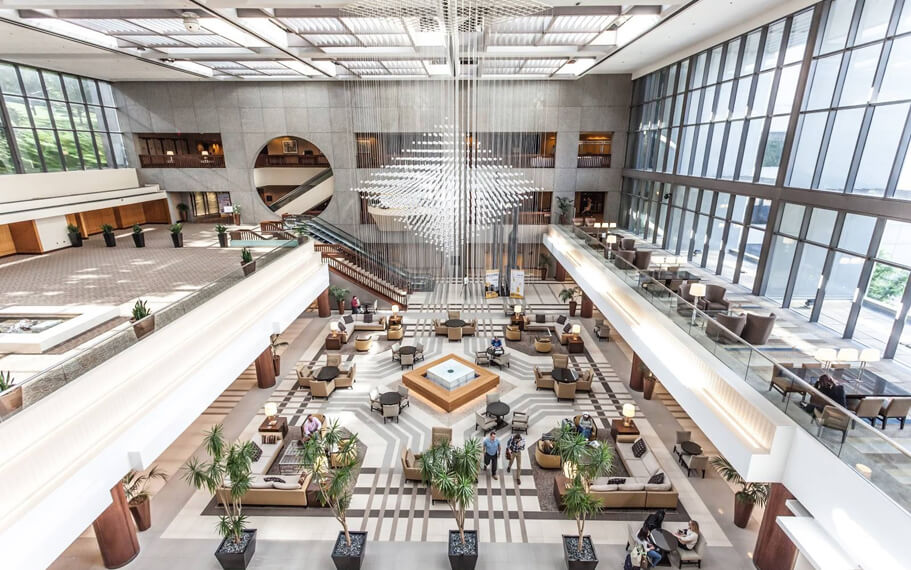
Sheraton Kansas City Hotel at Crown Center
The lobby of the Sheraton Kansas City Hotel at Crown Center is bright, modern, and busy—a soaring atrium with polished floors, a silver sculpture suspended from the ceiling, and sunlight streaming through walls of glass. Guests move through it on their way to conventions, shopping, and meetings at the adjacent Hallmark Cards headquarters. Nothing about the space announces what happened here. There is no plaque on the wall, no marker on the floor, no indication that on the evening of July 17, 1981, this lobby became the site of the deadliest structural failure in American history. The building opened July 1, 1980, as the Hyatt Regency Kansas City, a forty-story, 733-room tower developed by Don Hall of Hallmark Cards as the centerpiece of the Crown Center complex. At the time it was the tallest building in Missouri. The atrium was its showpiece—a cavernous open space crossed by suspended pedestrian walkways on the second and fourth floors, connected by steel rods. The hotel hosted weekly tea dances in the lobby, events that drew hundreds for big-band music and dancing beneath the soaring ceiling. On the evening of July 17, 1981, more than 1,600 people were gathered for one of those dances. At approximately 7:05 p.m., the fourth-floor walkway broke free from its suspension rods and collapsed onto the second-floor walkway below. Both structures crashed to the lobby floor, carrying dozens of people and crushing dozens more standing beneath. The cause was a design change made during construction: the original engineering called for continuous steel rods supporting both walkways, but the design was altered to use shorter rods each supporting only one level. The connection points bore twice the intended load. The National Bureau of Standards later determined the walkways could barely support their own weight. The rods tore through the box beams. One hundred and fourteen people were killed. Two hundred and sixteen were injured. Rescuers worked through the night, pulling the last survivor from the wreckage at four in the morning. The aftermath reshaped American engineering standards. The engineers who approved the design lost their licenses. The Crown Center Redevelopment Corporation paid over $140 million in claims. The hotel underwent reconstruction, replacing the skywalks with a single balcony supported by ground columns. The tea dances ended permanently. The hotel changed hands—becoming the Sheraton Kansas City in 2011 after Starwood assumed management. A memorial was not dedicated until 2015, when the Skywalk Memorial Plaza opened in Hospital Hill Park with a sculpture of dancers and the engraved names of all 114 victims. The paranormal accounts carry a weight distinct from most haunted hotel stories because the event that produced them is not legend—it is documented, investigated, and seared into the memory of a city. Guests who know nothing of the history report an oppressive heaviness in the lobby, particularly a downward pressure on the head and shoulders. One flight attendant described the sensation as feeling like her head was being physically pushed down from the moment she entered the atrium. Visitors have heard screaming echoing through the mezzanine—loud, hysterical, unmistakable—with no source found. The most commonly identified apparition is a woman in a tea gown, believed to be victim Kathryn Sullivan, seen in guest rooms, reflected in windows, and standing in the lobby. A young man in a black tuxedo with a blue bow tie has been reported disappearing through elevator doors. Figures in period attire have been observed in the atrium. A local paranormal investigator named Jim Schwalm, who had reportedly experienced premonitory dreams before the collapse, photographed the lobby shortly after the disaster and claimed to have captured an image of several couples dancing. Today the Sheraton Kansas City operates as a major convention hotel with over 42,000 square feet of function space and the largest ballroom in the city. The lobby is open, bright, and full of life. The skywalks are gone. The architecture has been redesigned to ensure nothing like the collapse could recur. But the space remembers what the building cannot say, and some who pass through it feel something no renovation has removed—a gravity in the air, a sound just below hearing, the sense that not everyone who came to dance that night has left the floor.

St. Mary’s Episcopal Church
St. Mary's Episcopal Church in Kansas City, Missouri stands as a significant religious institution representing the Anglican ecclesiastical tradition within the Kansas City community, serving as a place of worship and spiritual practice for congregants throughout its long operational history. The church building itself reflects architectural and design principles characteristic of Episcopal church construction, with interior spaces dedicated to worship activities, prayer, religious instruction, and sacramental practices central to Episcopal tradition. The church's position within Kansas City reflects its importance within the local religious and community landscape, with the building serving multiple functions beyond merely providing space for worship services, including hosting community gatherings, educational activities, and various social functions that reinforce the church's role as a community institution. The physical structure of St. Mary's Episcopal Church incorporates architectural details and design elements that reflect the aesthetic and spiritual values of Episcopal tradition, with religious iconography and spatial organization designed to facilitate contemplation and worship. Throughout its operational history, the church has served generations of parishioners, with individuals marking significant life events including baptisms, confirmations, marriages, and funerals within its walls. The paranormal reputation of St. Mary's Episcopal Church became particularly associated with Father Henry D. Jardine, a controversial priest who served at the church at some point in its history and whose tenure appears to have been marked by significant conflict, mystery, or scandal that generated lasting spiritual consequences. Father Jardine's controversial nature and the circumstances surrounding his time at St. Mary's remain somewhat veiled in available historical accounts, with detailed biographical and professional information about this particular clergy member being limited in readily accessible sources. However, the strength of the paranormal association between Father Jardine and St. Mary's Episcopal Church suggests that his presence at the church and the circumstances of his departure or death created sufficient spiritual or emotional impact to generate ongoing paranormal manifestations within the church building. The controversy surrounding Father Jardine may have involved theological disputes, personal misconduct, interpersonal conflicts with congregants or other clergy members, or circumstances related to his death that created spiritual turbulence at the location. His apparent reluctance or inability to find peaceful rest after death has resulted in his spirit remaining bound to St. Mary's Episcopal Church, continuing to assert his presence through various paranormal phenomena that visitors and staff members have documented. Visitors to St. Mary's Episcopal Church have reported experiencing paranormal phenomena particularly concentrated on the church's second floor, though manifestations occur throughout the building as well. Individuals present at the church, particularly during late evening hours and nighttime when fewer people are present and the building is more quiet, report feeling a distinct sense of being watched by an unseen presence, with this sensation appearing to intensify late at night. An apparition matching the description of Father Jardine has been reported multiple times, with witnesses describing a spectral figure holding a candle, creating a visually striking and distinctive paranormal manifestation that has been documented by multiple independent observers. Unexplained sounds echo throughout the church building at irregular intervals, including disembodied voices and vocalizations that seem to emanate from the church structure itself rather than from any identifiable source. The voices appear to communicate or express emotion, though the specific content and meaning of these disembodied vocalizations remain difficult to interpret with certainty. The paranormal activity at St. Mary's Episcopal Church has become sufficiently documented and notable that the church community itself has embraced acknowledgment of the building's haunted status, with the church recognizing its paranormal history as a component of its cultural identity. This unusual situation, in which a religious institution publicly acknowledges and discusses its haunted status, has contributed to St. Mary's Episcopal Church becoming a recognized paranormal destination within Kansas City, attracting the attention of ghost tour companies, paranormal investigators, and curious visitors interested in experiencing the church's acknowledged supernatural phenomena.
Pretty Boy Floyd’s Hideout
Pretty Boy Floyd's Hideout, located in Kansas City, Missouri, represents a significant site within documented American organized crime history and the volatile early 1930s when federal law enforcement and gangster organizations clashed across the Midwest. The structure served as a residential property and safe house for criminal elements seeking refuge from law enforcement authorities. Built during and after the Prohibition era, the property became historically significant through associations with notorious criminal figures Pretty Boy Floyd, a legendary bank robber and folk criminal, and Verne Miller, an accomplished gangster involved in significant organized crime operations. The residence's significance was cemented when it served as the planning location for the famous 1933 prison break, involving criminal coordination that influenced law enforcement approaches to criminal conspiracy. The property's occupancy by Vivian Mathias as a hideout for wanted fugitives created a space saturated with tension and danger. The residence, its interior spaces, attic areas, and basement chambers absorbed the presence of dangerous individuals operating outside legitimate society, whose activities involved genuine threats to human life and safety. The planning of a major prison break within the structure's walls represented concentrated criminal intention and coordination, creating a historical nexus point where significant criminal activity was orchestrated. The knowledge that violent criminals inhabited the space, plotted felonies, and potentially engaged in violent acts contributed substantially to the property's physical and spiritual character. Paranormal phenomena concentrated particularly within the attic area, where investigators and previous occupants documented disturbing and eerie sounds of unexplained origin. The attic space, traditionally associated in folklore with hidden secrets and concealment, manifested phenomena consistent with an individual's death within the confined space. Reports suggest a man died within the attic area, possibly involving violence, accident, or tragic consequences of criminal circumstances. The documented paranormal activity appears concentrated and intense, suggesting a particularly traumatic historical event or an entity with strong attachment to this location. Additional paranormal phenomena throughout the property suggest spiritual activity extending beyond the attic. The attic door itself achieved paranormal prominence through reports of the door opening independently and repeatedly without human intervention. Eerie and unexplained sounds emanate from the attic and structure generally, contributing to an atmosphere of uneasiness among occupants and visitors. Basement spaces witnessed phenomena including door slamming without apparent natural cause, and objects in the attic reportedly moved spontaneously despite the attic's apparent isolation. These phenomena suggest multiple spiritual presences or a particularly active poltergeist situation within the structure's most secluded spaces. Pretty Boy Floyd's Hideout remains historically significant as a documented location associated with major organized crime activity of the Prohibition era. The property's paranormal reputation developed substantially through documentation of phenomena and inclusion in Kansas City ghost tours and paranormal investigation itineraries. The violent historical associations combined with documented paranormal activity positioned the property as a significant haunted location within Missouri's paranormal landscape. The spiritual presence concentrated in the attic, manifesting through unexplained sounds, independent door movement, and object displacement, suggests the traumatic conclusion of human existence, creating a haunted space where historical violence remains imprinted.
The Coates House
The Coates House was established in Kansas City, Missouri, in 1867, emerging as one of the city's premier hospitality establishments during a period of rapid urban expansion and commercial development. The building was conceived as a grand hotel, designed to serve the traveling businesspeople, politicians, and cultural figures who increasingly frequented the city as it positioned itself as a major hub of commerce and transportation. At the time of its construction, Kansas City was experiencing the kind of growth trajectory that seemed almost limitless, driven by its position on major railroad routes and its role as a gateway to western expansion. The hotel was built to accommodate this influx of visitors with style and comfort, featuring the amenities and refinements that distinguishing establishments of the era were expected to provide. The structure itself became a symbol of Kansas City's aspirations and its emergence as a city of national significance. Throughout the late nineteenth and early twentieth centuries, the Coates House maintained its position as one of the city's most prestigious lodging establishments, hosting prominent figures from business, politics, arts, and culture. The building became embedded in the social and economic life of Kansas City, serving as a setting for important transactions, celebrations, and encounters. The hotel's lobby and dining rooms became gathering places where deals were made, where social hierarchies were negotiated, where the business of the city was literally conducted. The staff of the Coates House comprised hundreds of people over the decades—clerks, bellhops, housekeeping staff, kitchen workers, and management personnel—all of whom contributed to the institution's reputation for excellence and professionalism. This massive throughput of human activity and emotional investment created layers of accumulated memory within the building's physical structure. One particular tragedy came to define the Coates House in the popular imagination, a tragedy that would haunt both the building's history and its reputation. In 1891, a woman checked into the hotel and, in an act of despair and finality, threw herself from an upper-floor window. The incident was widely reported, shocking the city and becoming a point of reference in discussions of the hotel. From that moment onward, guests and staff began reporting encounters with a woman's apparition, seen at windows in the upper floors of the building, her expression described as profoundly sad, her gaze seemingly directed toward the grounds below. Her appearance became so well-documented and consistently described that she became a fixture of the hotel's paranormal reputation, a spirit seemingly condemned to endlessly relive or contemplate the tragic moment that had defined her death. For nearly a century, the Coates House maintained its operational status, adapting to changing times while retaining its essential character as a hotel. However, the building's trajectory changed dramatically on a catastrophic night in 1978, when a devastating fire erupted within its structure. The fire spread rapidly through the building, consuming its interior with intense heat and smoke, trapping guests and staff in a nightmarish scenario. Sixteen people died in the conflagration, victims of the flames, the smoke, and the chaos of emergency evacuation. The fire transformed the Coates House from a prestigious institution into a site of tragedy, a place forever associated with sudden death and loss. The building, damaged beyond practical repair and no longer economically viable as a hotel, was ultimately demolished in the aftermath of the fire. Today, no physical structure marks the location where the Coates House once stood. Yet its presence lingers in historical records, in photographs and descriptions, in the memories of those who experienced it, and in the paranormal reports that continue to circulate regarding the location. Paranormal researchers have documented experiences of apparitions, poltergeist activity, unexplained sounds, and disembodied voices in the area where the hotel once operated. Some of these phenomena may represent the woman whose suicide in 1891 so profoundly marked the building, while others may represent victims of the 1978 fire, spirits seemingly unable to move beyond the traumatic circumstances of their deaths. The Coates House thus exists now primarily as a location of paranormal significance, a place whose physical presence has been erased but whose spiritual dimensions remain reportedly active, a testament to the way in which locations saturated with human tragedy and loss may retain invisible presences long after their material structures have been removed.
Kansas City Power and Light Company Building
The Kansas City Power and Light Company Building, a prominent Art Deco structure completed in the 1930s, stands as one of Kansas City's most architecturally significant commercial buildings and one of the city's most compelling locations of documented paranormal activity. The building's distinctive design reflects the optimism and aesthetic vision of the Depression-era American architectural movement, with streamlined forms, decorative geometric elements, and a verticality that emphasizes human aspiration and technological progress. The structure was constructed during a period when electric power represented the epitome of modern technological achievement and when power companies occupied positions of considerable prestige and economic significance within their host cities. The building's location in downtown Kansas City placed it at the commercial heart of the city, a building that embodied corporate power and forward-looking modernism. The interior spaces of the building, including its office corridors, elevator systems, and the thirteen-story office area where paranormal phenomena concentrate, reflect the design principles of commercial efficiency and the spatial organization appropriate to a major corporate headquarters. The building continues to operate as an office and commercial space in the contemporary era, though the paranormal traditions associated with specific areas of the structure have become increasingly well-known and documented. The most prominent paranormal narrative associated with the Kansas City Power and Light Company Building centers on the violent death of Richard Armitage, an attorney who met a brutal end within the building's confines during a past era. The specific historical circumstances surrounding Armitage's death—the precise date, the identity of his assailant, the details of the violence that claimed his life—have been preserved in historical records and paranormal documentation, though contemporary familiarity with these details varies among visitors and investigators. Armitage was beaten to death in an office on the thirteen-story level of the building, a location of significance that becomes particularly charged when considered as the epicenter of paranormal manifestations. The violence was substantial enough to overcome a person within the relatively public space of a corporate office building, suggesting either a surprising assault or a location and time when discovery would not be immediately forthcoming. The murder of Richard Armitage within the building appears to have created a spiritual imprint that has persisted across decades, manifesting as apparitional phenomena and other paranormal activity that investigators have attempted to document and interpret. The thirteen-story office area where Armitage met his violent death represents the focal point of paranormal activity at the Kansas City Power and Light Company Building, with investigators consistently directing their research efforts toward this specific location. The office itself, if it has been preserved or maintained in any recognizable form, serves as a magnetic center for paranormal manifestations. The violence of the murder—the beating that claimed Armitage's life—represents the kind of traumatic, sudden, and unexpected death that paranormal researchers frequently associate with the generation of spiritual unrest and persistent haunting. The violation of a person's body and the sudden interruption of life appear to create conditions particularly conducive to paranormal manifestations according to various paranormal theories and traditions. The office building environment—relatively formal, businesslike, and associated with hierarchical power structures—creates an interesting psychological context for understanding the persistence of Armitage's presence. The juxtaposition of routine corporate work with the violent assault and murder creates an incongruity that may contribute to the psychological intensity of the location. The paranormal phenomena reported at the Kansas City Power and Light Company Building, particularly concentrated on the thirteen-story office level, encompass multiple forms of apparent spiritual manifestation. Unexplained sounds have been documented by paranormal investigators and reported by individuals occupying or visiting office spaces in the building, with descriptions including disembodied voices, footsteps when no one else is present, and what some describe as the sounds of struggle or distress. Witnesses have reported hearing what they interpret as the voice of a man, sometimes apparently calling out or expressing emotion. These acoustic phenomena have been captured on digital audio recording equipment employed by paranormal investigation teams, with researchers analyzing the recordings for evidence of meaningful vocal content. Some investigators claim to have identified specific words or phrases in the recorded material, though interpretations vary widely and remain open to dispute. The sounds appear to concentrate particularly in the office area where Armitage's death occurred, suggesting a spatial correlation between the location of the traumatic event and the manifestation of paranormal phenomena. The feeling of being watched represents a consistent subjective experience reported by individuals working in or visiting the thirteen-story office spaces, a sensation that many attribute to the presence of Richard Armitage or to the residual emotional content of the location. Employees and office visitors have described entering specific office spaces and immediately becoming aware of a presence, a sensed entity that appears to observe and respond to human activity. This feeling intensifies when individuals directly acknowledge the presence or speak to the apparent entity, suggesting an interactive quality to the haunting. The oppressive atmosphere sometimes reported in the office area—a heaviness or intensity that affects psychological and emotional states—contributes to the overall paranormal reputation of the location. Some sensitive individuals have reported strong emotional reactions upon entering the office spaces, including feelings of anxiety, sadness, or anger that they attribute to emotional residue from the historical violence. Shadow figures have been observed moving through office corridors on the thirteen-story level, with descriptions suggesting humanoid forms that appear without clear origin or destination. These shadow figures move with apparent solidity and purpose, sometimes observed entering or exiting office spaces and occasionally observed moving through areas where physical obstruction might be expected to prevent such movement. The shadow figures appear primarily during evening hours or after traditional office hours have concluded, suggesting a temporal pattern to the manifestations. Some paranormal investigators have hypothesized that the shadow figures represent a replay of activities occurring at the time of Armitage's murder, a residual haunting of the historical event. Others have interpreted the shadow figures as representative of Armitage or other entities whose presence persists within the building. The consistency of shadow figure sightings across different observers and time periods suggests phenomena that are genuinely perceived rather than products of suggestion or misidentification. Paranormal investigation of the Kansas City Power and Light Company Building has been conducted by professional paranormal investigation teams and independent researchers interested in documenting the phenomena associated with Armitage's death and the building's haunted reputation. The relative accessibility of the building—its location in a downtown commercial district and its ongoing operation as an office building—has facilitated investigation compared to more isolated or restricted haunted locations. Investigators have employed electromagnetic field detection equipment, digital audio recording systems, thermal imaging cameras, and night vision photography in attempts to document paranormal phenomena. The building's electrical systems and associated electromagnetic fields create a complex environment for paranormal investigation, with technological anomalies sometimes attributable to conventional electrical sources and sometimes interpreted as evidence of paranormal activity. Despite these technical challenges, investigators have documented anomalies and experiences that they consider consistent with the existence of paranormal phenomena concentrated in the office spaces where Armitage died. The historical record of Richard Armitage's murder at the Kansas City Power and Light Company Building has been preserved in local historical documentation, newspaper accounts, and contemporary paranormal literature, creating a factual foundation for the paranormal narratives associated with the location. Unlike some haunted locations where historical details remain obscure or contested, the Armitage case benefits from documentation that establishes the reality of the violent death and its occurrence within the specific building and office area. This historical grounding lends credibility to the paranormal claims, as the violence that is hypothesized to have generated the haunting is confirmed by historical records. The convergence of documented historical fact and paranormal tradition creates a compelling narrative suggesting that the trauma of Armitage's violent death left a lasting imprint upon the location, an imprint that manifests as ongoing paranormal phenomena. The Kansas City Power and Light Company Building represents a location where corporate architecture, historical violence, and contemporary paranormal manifestations converge to create one of Kansas City's most intriguing locations of documented spiritual unrest.
John Wornall House
The John Wornall House stands as one of Kansas City's most significant Civil War landmarks, a substantial brick structure that dominates its Kansas City neighborhood with architectural presence and historical weight. Built in the nineteenth century as a residence for the Wornall family, prosperous Kansas City merchants and landowners, the house was constructed during an era of westward expansion when Kansas City itself was still establishing its identity as a major commercial and cultural center. The building's Federal-style brick construction, multiple stories, and commanding windows that overlook the surrounding terrain reflect the status and resources of its original owners. The house contains numerous rooms, each with its own distinct character and history, connected by hallways that wind through the structure's interior, with a second floor that extends across much of the building's footprint and numerous balconies that provided outdoor spaces overlooking the grounds and surrounding landscape. When the American Civil War erupted in 1861, the John Wornall House found itself at a critical intersection of military movements, strategic importance, and civilian vulnerability. Kansas City's location in a border state meant that the conflict was not a distant phenomenon but an immediate and devastating presence in the daily lives of its residents. The war brought soldiers from multiple armies to the region, created refugee situations for civilians caught between opposing forces, and transformed ordinary homes into way stations, headquarters, or refuge for those fleeing combat zones. The Wornall House, by virtue of its size, location, and prominence, likely served some combination of these roles during the conflict. The family matriarch, Eliza Wornall, lived through the siege of the property and the occupation of the area by armed soldiers from both Union and Confederate forces, experiencing firsthand the chaos, fear, and trauma that characterized the Civil War's impact on border communities. The presence of armed soldiers in and around the house, the uncertainty of survival during a volatile period, and the broader tragedy unfolding across the region created an environment of profound psychological and emotional stress. Paranormal manifestations within the John Wornall House have been documented with particular frequency in the halls and second-floor areas of the building, with multiple credible accounts of apparition sightings, full-body manifestations, and other paranormal phenomena that have attracted the attention of paranormal researchers and historical investigators. Witnesses have reported encounters with ghostly figures that appear dressed in period clothing consistent with the Civil War era, with particular accounts describing the apparition of armed soldiers moving through the hallways as if performing duties or patrolling the interior spaces. The presence of Eliza Wornall has been reported by multiple witnesses and investigators, with descriptions suggesting a concerned, observant spirit maintaining vigilance over the property she inhabited during life. Windows and doors throughout the second floor have been associated with paranormal activity, including unexplained openings and closings, sounds of movement, and the sensation of presences moving through these spaces. Auditory phenomena including disembodied voices, footsteps, and other unexplained sounds have been consistently reported across the building's interior, often occurring in locations with significant historical associations. The nature of the paranormal activity within the John Wornall House appears to be deeply connected to the historical trauma of the Civil War period, with manifestations that suggest spirits concerned with protection, communication, or bearing witness to the events they experienced. The repeated appearances of armed soldiers in period dress moving through the halls evokes the original historical trauma—the presence of soldiers and armed conflict—creating a haunting that seems to replay or continue the patterns of the past. Eliza Wornall's apparent concern for the property and its inhabitants suggests a protective presence, a spirit invested in the welfare of those within her former home. The concentration of activity in second-floor areas, windows, and hallways—spaces that would have been critical during conflict situations for surveillance, escape, or refuge—points to the specific historical moments that may have generated enough emotional and traumatic energy to leave permanent marks on the structure. Today, the John Wornall House operates as both a museum and a living historical site, serving the Kansas City community as a place of education about the Civil War's impact on the border states. The building remains a destination for paranormal researchers, historians, and visitors interested in experiencing spaces where history and the paranormal intersect in documented and compelling ways. The house's continued operation as a museum means that its paranormal activity occurs in a context of serious historical scholarship and interpretation, creating opportunities for systematic observation and investigation. The preservation of the building in a manner that maintains historical integrity while allowing for paranormal investigation represents an important approach to understanding structures that carry both historical significance and evidence of paranormal presence. For those seeking to understand how trauma, conflict, and profound loss might manifest in spaces over extended periods, the John Wornall House provides a window into the intersection of American history and the paranormal.
Alexander Major’s Historic Museum
The Alexander Majors House stands among the oldest continuously surviving structures in Kansas City, Missouri, representing architectural and historical preservation of nineteenth-century residential construction. The building's position as one of the oldest structures in Kansas City lends it historical prominence beyond paranormal consideration, as it embodies the physical continuity of Kansas City's founding era. The location's architectural features, while modified and updated across the centuries, retain evidence of its original construction period and design. The house operates in contemporary times as a historic museum, providing public access to the structure and its grounds. The interior spaces—particularly the upstairs bedrooms and parlor areas—have become associated with paranormal phenomena documented through professional paranormal investigation. The house's historical significance as a preserved example of nineteenth-century architecture combines with its paranormal reputation to create an establishment serving simultaneously as a historical and paranormal tourism destination. The grounds surrounding the structure retain features consistent with the original site configuration, though contemporary landscaping and maintenance reflect modern stewardship rather than historical accuracy. Alexander Majors was a prominent historical figure in Kansas City's founding and development, establishing himself as a major commercial and civic figure during the nineteenth century. The house bearing his name reflects his wealth and social prominence, constructed during an era when substantial residential buildings served as markers of economic and social status. The specific date of the house's construction places it within the early phases of Kansas City's development as a settlement and then as a city. Majors' commercial activities and civic involvement shaped the trajectory of Kansas City's early history, making the house not merely a private residence but a location intimately connected to broader patterns of Kansas City development. The house's survival and preservation across subsequent centuries speaks to both its initial construction quality and to the commitment of various historical preservation efforts to maintain the structure. The building's transformation from a private residence to a public museum reflects broader patterns of historical preservation and the conversion of significant historical structures into institutional uses. The paranormal phenomena reported at the Alexander Majors House center on the apparent presence of two distinct entities—a restless blacksmith and a caretaker—whose spirits reportedly manifest within the structure. These entities appear to retain occupational identity consistent with their roles when living, suggesting that paranormal manifestation reflects the identities and concerns of the deceased individuals whose spirits allegedly remain at the location. The phenomena most consistently reported involve cold spots appearing throughout the house, with particular concentration in the upstairs bedrooms and parlor areas. These cold spots lack obvious environmental explanation and appear and disappear without relation to heating systems or external temperature fluctuations. Witnesses and paranormal investigators describe the sensation of being touched or the awareness of a non-physical presence in various locations throughout the house. Temperature fluctuations beyond normal environmental variation have been documented in multiple areas, with thermographic equipment capturing unexplained thermal signatures. Paranormal investigators conducting systematic investigations at the Alexander Majors House have documented multiple varieties of paranormal phenomena. Electronic voice phenomena recordings have captured what researchers interpret as disembodied male voices. Analysis of these recordings suggests intelligible speech content, with male voices apparently giving instructions and female voices commenting on household matters. The presence of female voices in electronic voice phenomena recordings raises interesting questions about the source of these manifestations, as the primary entities traditionally associated with the location are male (the blacksmith and caretaker). The interpretation of voice content as giving instructions and commenting on household matters suggests that the manifestations may retain some connection to the functional operations of the house. Orbs have been photographed in various locations throughout the house, with paranormal investigators interpreting these photographic anomalies as evidence of paranormal manifestation. The consistency of paranormal findings across multiple investigation sessions and independent research teams lends credibility to the paranormal reputation of the location. The operation of the Alexander Majors House as a historic museum with professional paranormal investigation programming represents a sophisticated integration of historical preservation and paranormal tourism. The house hosts paranormal investigation events conducted by certified mediums and professional paranormal investigators who guide small groups through the structure with the explicit goal of facilitating contact with resident spirits. These events leverage the established paranormal reputation of the location to create commercial paranormal tourism experiences. The house's national recognition as a haunted location, documented in prominent media outlets including the Los Angeles Times, demonstrates the degree to which the Alexander Majors House has become established within paranormal tourism networks. The professional investigation programming at the location suggests that the paranormal reputation has become institutionalized and commercialized, with paranormal investigation becoming an accepted and formalized activity at the historic site. The identities of the two primary entities reportedly haunting the Alexander Majors House—the blacksmith and the caretaker—remain somewhat historically ambiguous. The available sources do not provide clear documentation of specific individuals serving in these roles or of particular events triggering their apparent spiritual attachment to the location. The occupational identities suggest roles within the household economy or the broader economic activities associated with the Majors family, though verification of specific historical individuals appears beyond the scope of available documentation. The apparent persistence of these spirits in occupational roles—the blacksmith and caretaker apparently remaining engaged in activities associated with their former work—suggests that paranormal manifestation may reflect continuity of identity and purpose across the boundary between life and death. The houses' connection to Alexander Majors' broader commercial and civic activities may have created the conditions for the historical figures associated with the property to develop sufficient attachment to manifest as paranormal phenomena. The paranormal investigation of the Alexander Majors House has been conducted by professional paranormal investigators, academic researchers, and amateur enthusiasts utilizing various investigative methodologies. The apparent consistency of paranormal phenomena documented across multiple investigation sessions suggests either genuine paranormal manifestation or a pattern of environmental features and guest expectation that generates consistent paranormal interpretation. The house's operational status as both a historic museum and paranormal investigation site creates a unique institutional context for paranormal activity. The economic incentive to maintain and emphasize the paranormal reputation may influence the interpretation and reporting of paranormal phenomena. Simultaneously, the professional documentation of paranormal investigation through certified mediums and professional researchers lends a level of credibility often absent from more casual or amateur paranormal accounts. The Alexander Majors House represents one of Kansas City's most significant architectural and historical resources, while simultaneously serving as a regional paranormal tourism destination. The building's status as the oldest surviving structure in Kansas City, combined with its association with a prominent historical figure, creates substantial historical significance independent of paranormal consideration. The documented paranormal phenomena, professional investigation programming, and national media recognition have established the location as a significant paranormal location within regional and national paranormal tourism networks. The integration of paranormal investigation into the house's operational framework demonstrates the degree to which paranormal tourism has become institutionalized within American tourism and historical preservation. For visitors seeking immersion in Kansas City history combined with paranormal investigation opportunity, the Alexander Majors House provides a destination combining material historical evidence with professional paranormal investigation services and claimed supernatural phenomena.
Charles B. Leach House
The Charles B. Leach House stands as impressive Queen Anne Victorian architecture, a substantial residential structure constructed in 1887 in Kansas City, Missouri by lumber baron Charles B. Leach during rapid urban expansion. The house reflects Victorian architectural extravagance with multiple stories, bay windows, ornate woodwork, and asymmetrical forms characteristic of the Queen Anne style. Its prominent location and substantial construction represent Leach's wealth and social standing as well as Kansas City's architectural ambitions during growth. The house was designed to accommodate large household and serve as venue for appropriate social gatherings. Construction quality and materials reflect resources available to wealthy individuals, with the house representing investment in permanence and status typical of industrial wealth era. Charles B. Leach was prominent in Kansas City's lumber industry, having built substantial wealth through timber acquisition and distribution during explosive Midwest growth. Leach's success in lumber business allowed investment in real estate and civic institutions, constructing this impressive residence representing personal achievement and family stability apex. However, financial circumstances that sustained nineteenth-century wealth gradually transformed, and many prestigious private residences fell into different uses and ownership patterns. The Leach House followed this pattern, transitioning to institutional use in 1915 when it was converted to serve as home for unwed mothers. The transformation into shelter for unwed mothers in 1915 marked significant shift in building's social purpose. Unwed motherhood carried profound social stigma in early twentieth century, and such facilities represented response to desperate circumstances of women facing pregnancy outside marriage. Women coming to the home often faced limited economic options and severe social judgment. Many surrendered children for adoption, experiencing profound trauma and loss. The facility operated as women's shelter until 1990, serving thousands of women through seventy-five years of operation. The concentration of human suffering, loss, grief, and trauma within Leach House walls created intense emotional and psychic environment appearing permanently imprinted upon the location. The particular vulnerability and desperation of many residents, combined with mother-child separation, likely created powerful emotional resonances still evident in paranormal manifestations. Paranormal activity has been documented through reports from residents and staff and through paranormal investigations conducted subsequent to facility closure. Apparitions have been observed including figures of women in period dress, suggesting spirits from shelter's operational period. Shadow figures have been reported moving through rooms and corridors, appearing as dark silhouettes. Disembodied voices have been heard, sometimes identified as female voices speaking in urgent or distressed tones. Unexplained sounds including footsteps, doors, and movement sounds have been documented. Phantom laughter has been reported, creating eerie juxtaposition with location's history of sorrow. Feelings of being watched have been reported by multiple witnesses, creating sense of presence throughout the house. Paranormal phenomena appear concentrated in residential areas where pregnant women and mothers lived with children, suggesting connection to emotions associated with motherhood and separation. The Charles B. Leach House stands as documented paranormal location today, with history of both Victorian wealth and twentieth-century institutional use creating multiple significance layers. The extensive emotional trauma experienced by thousands of women over seventy-five years appears creating powerful paranormal energy field, with multiple spirits potentially remaining at location. The house represents case study in how institutional use and human suffering create lasting paranormal effects, and how physical space becomes repository of human emotion and experience.
Donaldson House
The Donaldson House represented a prominent example of early twentieth-century residential architecture in Kansas City, Missouri, constructed in 1901 during a period of substantial economic growth and development within the urban region. The mansion was located on Oak Street approximately one block north of the Kansas City Art Institute, positioning it in close proximity to major cultural institutions while maintaining sufficient distance to preserve domestic privacy and domestic isolation from public commercial activity. The building embodied architectural ambitions characteristic of the early 1900s, incorporating stylistic elements and spatial configurations reflecting the aesthetic values and functional requirements of prosperous Kansas City households during the period of greatest prosperity and development. The original owners, Mr. and Mrs. Lewin W. Donaldson, occupied the residence from 1939 through 1967, maintaining the property as a private family home during this extended period of ownership and domestic occupation. Following the Donaldson family's tenure, the Kansas City Art Institute acquired the property for conversion into studio and office space to support the institution's educational and administrative functions. This transition from private residential use to institutional adoption by a major cultural organization represented a significant transformation in the building's purpose and function, converting intimate domestic spaces into professional artistic spaces. The Donaldson House accumulated substantial paranormal reputation prior to its eventual demolition, generating significant documentation regarding spectral phenomena within its confines. The paranormal tradition associated with the building included reports of multiple distinct entities, with estimates suggesting the presence of approximately eight different ghosts manifesting within the structure and throughout its various rooms and spaces. One spectral presence was described as possessing a friendly or benevolent character, suggesting an entity maintaining benign interest in the living inhabitants of the space without expressing hostility or malevolence toward the living. In sharp contrast, the remaining seven documented entities were characterized as consistently bad-tempered or malevolent in their interactions with the living inhabitants and with each other. The presence of such a diverse and contradictory collection of spectral entities created an environment where benign and hostile presences coexisted within the same physical space, creating complex paranormal dynamics. The specific paranormal manifestations documented at the Donaldson House included several distinctive phenomena that characterized the intensity of spectral activity and entity presence throughout the structure. Witnesses reported the appearance of bright floating orbs concentrated primarily on the second floor of the residence, suggesting concentrated paranormal energy in upper level spaces. The telephone system in the building experienced persistent and unexplained ringing, with telephones originating calls without any activation by any human user or mechanical malfunction. Witnesses reported hearing footsteps traversing hallways and staircases throughout the building with acoustic properties suggesting entities of substantial corporeal weight. Most dramatically, multiple witnesses reported experiences of objects being thrown by invisible forces, with items in various locations suddenly becoming airborne and traveling across rooms. The eventual demolition eliminated the physical structure but not the historical record of its paranormal significance within Kansas City's haunted location geography.
Union Station
Union Station in Kansas City stands as one of the Midwest's most architecturally significant transportation hubs, its elegant construction completed in 1914 at the height of the Beaux-Arts movement in American civic design and institutional architecture. The station was conceived as far more than merely a functional transportation facility—it embodied the aspirations and self-perception of Kansas City as a major transportation crossroads where multiple railroad lines converged and passengers from across the nation transited through its grand halls on their journeys across America. The architectural ambitions of the building reflected the economic optimism and cultural confidence of the era, with elaborate ticket areas, soaring ceilings, decorative elements of considerable artistry, and design features intended to impress travelers and convey the importance and significance of the Kansas City hub within the national transportation network. For decades following its opening, Union Station functioned as a vital point of connection in the American transportation network, its platforms and corridors accommodating countless journeys, emotional reunions, and farewells between passengers and loved ones seeking connection. The building absorbed the emotional energy and spiritual residue of millions of human transactions—arrivals and departures, greetings and goodbyes, moments of joy and sorrow that accumulated within its walls across generations of continuous operation. The singular traumatic event that fundamentally altered Union Station's spiritual landscape and left an indelible mark on its psychic atmosphere occurred on June 17, 1933, when the station became the site of a violent shootout later known as the Union Station Massacre. During this gunfight between federal agents and gangsters, Frank Nash, an incarcerated criminal being transferred by train, was killed in brutal fashion alongside other victims in a shocking display of violence and bloodshed. The violence was sudden, chaotic, and shocking in its violation of what was considered a public space of safety and institutional routine where innocent travelers should be secure from harm. Multiple casualties resulted, and the incident reverberated through the region as a dramatic confrontation between law enforcement and organized crime that captured national attention. Since that violent episode nearly a century ago, paranormal manifestations have been consistently documented within the station's confines by multiple independent observers and paranormal researchers. Suggs Mailer, a mail transfer worker who died in the building, is reported as an apparitional presence, his form occasionally glimpsed moving through the mail transfer areas where he conducted his duties. Frank Nash, the massacre victim, manifests as a faceless apparition—his form present but his features obscured or absent in ways that may symbolize the violence that deprived him of life and identity. A woman in white appears as a reflection in mirrors and glass surfaces, visible primarily in peripheral vision rather than as a direct full-body apparition observable to everyone present. Staff and visitors report phantom footsteps echoing through corridors late at night, mysterious whispers that seem almost conversational in nature and substance, and full body apparitions near the ticketing area and attic spaces. The phenomena persist with sufficient regularity that paranormal investigators have conducted multiple examinations of the station, documenting experiences and seeking to understand the traumatic imprinting that continues to manifest generations after the violent event itself, suggesting deep spiritual marking.
Hotel Savoy
The Hotel Savoy of Kansas City, Missouri, represents a distinguished example of late nineteenth-century luxury hotel architecture, constructed in 1888 and designed in the European Italian Renaissance architectural style that reflected aspirations toward cosmopolitan elegance and cultural sophistication. The building exemplifies the architectural ambitions of Kansas City's most prominent businessmen and developers during the Gilded Age, when cities competed through the construction of grand public buildings intended to project power, prosperity, and refined taste. The hotel's architectural design incorporated elements of Renaissance Revival aesthetics, including ornamental details, refined proportions, and materials selections that communicated luxury and permanence to arriving guests. The structure occupied a prominent position within Kansas City's downtown commercial and entertainment district, positioning it to serve the city's business travelers, wealthy tourists, and permanent residents seeking premium accommodations. The hotel's architecture and location established it as one of Kansas City's premier hospitality establishments during the early twentieth century. The Hotel Savoy's operational history coincided with Kansas City's emergence as a major regional economic and cultural center, serving guests throughout the prosperous decades of the early twentieth century. The hotel accommodated business transactions, social events, romantic encounters, and the ordinary lodging needs of transient guests and longer-term residents. The property became integral to Kansas City's cultural identity, hosting performers, dignitaries, and notable individuals passing through the region. The second floor spaces, fourth floor chambers, and elevator systems received particular attention from hotel management and architectural enhancement, reflecting their importance to guest experience and the hotel's commercial operations. The architectural sophistication and commercial success of the hotel established it as one of Kansas City's signature hospitality establishments during its peak operational period. The paranormal phenomena associated with the Hotel Savoy center predominantly upon Room 505, the location where a woman identified as Betsy Ward died under mysterious and unexplained circumstances that have never been fully resolved. The exact circumstances of Ward's death remain unclear, with available historical documentation suggesting possibilities ranging from illness to foul play to accident, yet without definitive determination of the actual cause. Ward's death in Room 505 created a historical mystery that has persisted across the decades, with her unexplained demise establishing a permanent connection between her identity and the space where her life ended. The psychological weight of her mysterious death appears to have anchored her spiritual presence to the hotel, with Room 505 becoming the primary locus of paranormal activity and the most intensely haunted space within the structure. The paranormal manifestations within Hotel Savoy encompass numerous distinct phenomena occurring across multiple locations within the structure. Room 505 itself has become the epicenter of documented supernatural activity, with guests reporting disembodied voices, the sensation of an unseen presence, and the experience of doors opening and closing with apparent conscious control. A second prominent entity manifests as the Blue Lady, a spectral figure appearing in flapper-style dress indicating her connection to the 1920s and 1930s Jazz Age cultural period. The Blue Lady appears to manifest a performer's identity, with her apparitional presence suggesting she may have performed as an entertainer within the hotel's entertainment venues. The fourth floor hosts the manifestation of a little ghostly girl dressed in Victorian-era clothing, suggesting her historical connection to an earlier period than the Blue Lady entity. The fourth floor has generated reports of doors opening and closing without apparent cause, with the elevator system itself exhibiting autonomous behavior and frequently becoming immobilized on the fourth floor level. One particularly significant discovery within Room 505 involved the finding of an antique 32-caliber handgun sealed within the wall structure, an artifact that has never been satisfactorily explained and which may relate to Betsy Ward's mysterious death. The presence of a concealed weapon, coupled with Ward's unexplained demise, has fueled theories that her death resulted from violence rather than natural causes, with subsequent attempts to conceal evidence of wrongdoing. The elevator system's apparent preference for stopping at the fourth floor, where the Victorian child appears, suggests possible connections between the hotel's multiple paranormal entities and specific historical tragedies that have occurred within the structure. The diversity of apparitional entities, the autonomous mechanical phenomena affecting the elevator and doors, and the mysterious historical artifacts discovered within the structure combine to establish the Hotel Savoy as Kansas City's most intensely haunted hospitality establishment. The Hotel Savoy continues to operate as a functioning hotel despite the overwhelming reputation for paranormal activity that has established its place within regional and national haunting lore. The property has deliberately embraced its status as the most haunted hotel in Kansas City, recognizing both the cultural significance of the documented phenomena and the substantial tourism benefits generated by the paranormal reputation. Room 505 remains available for guest occupancy, with many visitors specifically requesting the haunted chamber in hopes of personally encountering Betsy Ward's spirit or experiencing the documented phenomena. The hotel's management facilitates paranormal investigations and welcomes ghost tour participants, creating an environment where historical mystery and ongoing supernatural activity persist within a functioning commercial establishment. The Hotel Savoy exemplifies the integration of profound historical tragedy and vigorous paranormal activity into the ongoing operations of a historic hospitality landmark.
Muehlebach Hotel
Muehlebach Hotel stands as a historic luxury hotel in Kansas City, Missouri, representing the architectural and hospitality achievements of the early twentieth century when grand hotels served as symbols of urban sophistication and commercial prosperity. The hotel was designed to accommodate wealthy travelers, business executives, and entertainment industry professionals seeking the finest accommodations available in Kansas City. The structure reflects the architectural ambitions of the Gilded Age through Jazz Age period, when hotels served not merely as lodging facilities but as cultural institutions and statements of urban identity. The elegant design, refined finishes, and attention to detail throughout the building created an environment of considerable luxury and aesthetic refinement. The location within Kansas City positioned the hotel at the heart of the commercial and entertainment district, convenient to theaters, restaurants, and business establishments that formed the center of urban activity. During its operational heyday, Muehlebach Hotel attracted guests from across the nation and internationally, including entertainment industry professionals, political figures, and wealthy merchants conducting business in Kansas City. The hotel hosted theatrical performances, formal dinners, and social events that shaped the cultural life of the city. The first floor and lobby areas functioned as public spaces where guests interacted, conducted business, and experienced the refined atmosphere created through careful architectural design and professional hospitality services. The bedrooms provided private spaces where guests retreated from the public areas, configured with luxury furnishings and modern conveniences appropriate to their status and expectations. The hotel's reputation for excellence and its architectural prominence made it a defining institution in Kansas City's urban landscape throughout much of the twentieth century. Within the Muehlebach Hotel, paranormal phenomena have been documented suggesting the presence of a female entity known as the Blue Lady, identified through various accounts as a 1920s-era actress who appears to have met a tragic fate or experienced profound emotional trauma during her association with the hotel. The apparition has been described as a blonde-haired woman dressed in the fashion of the 1920s Jazz Age, specifically wearing a blue flapper-style dress consistent with entertainment industry attire of that period. Witnesses have consistently reported seeing the Blue Lady in the first floor, lobby, and bedroom areas of the hotel, appearing with expressions suggesting distress or emotional anguish. The apparition maintains a sense of purposeful presence, as though the entity is searching for something or someone rather than manifesting random or undirected phenomena. The paranormal activities associated with the Blue Lady include temperature fluctuations in the areas she frequents, with sudden drops in ambient temperature preceding or accompanying sightings of the apparition. Running water has been reported activating spontaneously in bathroom facilities, and lights have been observed flickering or malfunctioning in the proximity of the Blue Lady's manifestations. Perhaps most compellingly, witnesses have reported hearing sobbing sounds emanating from empty rooms and hallways, accompanied by a sense of overwhelming emotional sadness and despair. The character of the phenomena suggests an entity profoundly distressed, apparently searching for a lost lover or attempting to communicate unresolved emotional attachments. Multiple accounts describe the entity's emotional state as one of desperate longing and grief, manifesting through both auditory phenomena and the palpable emotional atmosphere created in the entity's presence. Today, Muehlebach Hotel remains an active hospitality establishment in Kansas City, operating as a luxury hotel while maintaining its reputation as the home of the Blue Lady and other paranormal phenomena. The documented presence of the 1920s-era actress has elevated the hotel's cultural status within the paranormal community and among guests seeking paranormal experiences within a historic luxury setting. The contrast between the refined hospitality services offered by contemporary hotel operations and the persistent manifestations of a ghost from the Jazz Age creates a unique environment where historical tragedy and present-day commerce coexist. The Blue Lady serves as a poignant reminder of the human stories embedded within historic buildings, embodying emotional attachments and unresolved circumstances that apparently transcend the boundaries between life and death.
Chestnut House
The Chestnut House in Kansas City, Missouri stands as a significant example of Victorian Gothic architecture, a three-story structure constructed in 1884 reflecting Gilded Age aesthetic and technical aspirations. The building's architectural style exemplifies late-nineteenth-century residential design, with characteristic Gothic elements including peaked roofs, decorative woodwork, and distinctive fenestration. The structure's substantial construction and Victorian Gothic styling suggest an owner or owners of considerable means and refined taste, representing statements of status and aesthetic preference. Located within Kansas City's expanding residential areas during the city's establishment as a commercial and cultural center, the house represents investment in distinctive residential architecture during a period of significant urban development. The builder or original owner deliberately chose architecture making clear aesthetic statements through Gothic Revival language. Throughout the late nineteenth and early twentieth centuries, the house functioned as a substantial family residence accommodating upper-middle-class Kansas City households. The building's generous proportions suggest it housed extended families or provided impressive entertaining spaces for social and commercial gatherings. The most significant paranormal association centers on the Finch family, former tenants who reportedly resided at the property for approximately seventy years. This exceptional tenure suggests integration into the property's identity transcending conventional rental arrangements. The family presumably experienced major life events, relationships, triumphs, and losses within the house's interior spaces, accumulating decades of intimate connection to the physical structure and spatial arrangement. Both Finch family apparitions—mother and son—are reportedly capable of visual manifestation. The mother's apparition appears in nineteenth or early twentieth-century dress, while the son's ghost manifests in formal attire including a bow tie. The specificity of these visual descriptions suggests either genuine paranormal experiences or vivid psychological impression management. The mother-son relationship as the primary paranormal presence creates a family narrative within the haunting, suggesting emotional bonds extending into apparent posthumous existence. Paranormal manifestations at the Chestnut House focus on apparition sightings rather than poltergeist phenomena or auditory experiences. Reports center on full-body appearances of both entities, suggesting visual phenomena primarily. The entire house appears affected rather than specific rooms being particularly problematic, suggesting the Finches' attachment extends throughout the property. The Chestnut House's paranormal reputation has established it as a documented real haunted location within Kansas City's paranormal landscape. The property appears on paranormal websites and in regional ghost story compilations, indicating sufficient recognition to warrant inclusion in paranormal databases. This documentation suggests independent observers and paranormal investigators have examined the property and found sufficient evidence or consistent accounts to classify it as genuinely haunted. The house's continued residential status suggests the Finch family's apparitions have not rendered it uninhabitable or genuinely threatening. Phenomena appear limited to visual sightings rather than manifestations designed to disturb, suggesting haunting represents attachment and presence rather than malevolence.
The Folly Theater
The Folly Theater stands as one of the oldest continuously operating theatrical venues in the Midwest and a landmark of Kansas City cultural history, weathering more than one hundred and twenty years of operation and witnessing the transformation of American entertainment from vaudeville through modern theatrical productions. The theater was constructed in the early twentieth century during tremendous growth in Kansas City, when the city positioned itself as a major cultural center. The Folly Theater represents significant architectural achievement with an ornate interior featuring intricate plasterwork and decorative elements reflecting grand ambitions of its original designers. The venue has hosted legendary performers from vaudeville stars to jazz musicians to Broadway productions, with the stage absorbing energy and talent of countless artists. The theater was saved from demolition and meticulously restored to original grandeur while incorporating modern theatrical technology. The structural integrity has been maintained across a century of operation, making it a tangible link to Midwest entertainment history. Paranormal activity at The Folly Theater concentrates in the stage, lobby, and balcony sections, with phenomena suggesting multiple spirits associated with the theater's long performance history. The most famous spirit is Eddie, a stagehand who worked for many decades and remained so attached after death that he continues performing duties and manifesting throughout the building. Eddie has been credited with stage equipment movement, lighting adjustments, and prop manipulation. Joe Donegan, the first stage manager, has also been reported manifesting, described as continuing to oversee operations from beyond death. A mysterious Lady in Blue, whose identity remains obscure, appears in various sections, described as elegant and dignified. Paranormal manifestations frequently center upon music and theatrical phenomena suggesting spirits maintain connection to artistic endeavors. Phantom performers have appeared on stage, dressed in formal attire despite absent audiences, suggesting performance and reality boundaries blur. Piano music emanates from various theater locations, particularly near stage or lobby, with witnesses describing accomplished pianists playing recognizable pieces despite no visible person at the keyboard. The music is technically proficient and emotionally expressive, suggesting spirit musicians maintain skill and passion. Ghostly applause follows theatrical performances, distinct and recognizable despite absent visible audiences, as if previous audience spirits remain and continue appreciating performances. Apparitions in white tails and top hat appear on stage and audience areas, suggesting formally dressed performers or patrons. The Folly Theater continues operating as an active performance venue, hosting theatrical productions, concerts, and live events attracting audiences throughout the Kansas City region. The paranormal reputation has enhanced rather than diminished cultural and entertainment value, with ghostly resident stories becoming integral to historical identity and marketing appeal. Theater staff are knowledgeable regarding paranormal history and openly discuss phenomena with visitors and performers. Eddie, Joe Donegan, and the Lady in Blue's ongoing activity continues manifesting in contemporary reports, suggesting spirits' theater attachment has not diminished. The Folly Theater stands as testament to creative spaces' power to attract and retain spiritual presences, and the possibility that those devoted to artistic endeavor find it impossible to abandon venues where devotion was fulfilled.
Kansas City Music Hall
The Kansas City Music Hall stands as an architectural and cultural landmark within Kansas City, Missouri, a performance venue established in 1927 during an era of remarkable American artistic flourishing and technological advancement in entertainment. The construction of the Music Hall reflected Kansas City's status as a thriving metropolitan center with the economic resources and cultural aspirations to support world-class performance facilities and the programming that such venues demanded. The building was furnished with an antique pipe organ of extraordinary mechanical sophistication and musical capability, an instrument that represented the pinnacle of organbuilding technology during the 1920s and that possessed the capacity to produce the full range of musical colors and emotional expression that organists sought. The pipe organ itself, a marvel of mechanical engineering and musical design, became a centerpiece of the venue's identity and a major attraction for musicians and audiences alike who appreciated the instrument's unique capabilities and the particular acoustic properties that it imparted to performances within the space. The establishment quickly became recognized as a significant cultural institution within Kansas City's entertainment landscape, attracting touring performers, symphony orchestras, organ recitalists, and theatrical productions that required the kind of acoustical properties and technical capabilities that the Music Hall provided. During its decades of operation, the Kansas City Music Hall served as the setting for countless performances that ranged from classical music concerts to theatrical productions, from organ recitals to orchestral presentations that showcased the versatility of the venue and its capacity to serve diverse artistic communities and audience interests. The building's acoustic properties, enhanced by its distinctive architecture and the presence of the antique pipe organ, made it a particularly desirable venue for musical performances where the quality of sound reproduction and amplification directly affected the audience's experience and the performers' ability to express their artistic intentions. The elegant interior design and the sophisticated theatrical infrastructure that the hall provided made it an appealing destination for audiences who appreciated high-quality performance in an environment that conveyed cultural refinement and artistic seriousness. The venue became embedded in Kansas City's cultural identity, representing the city's commitment to supporting the arts and providing audiences with access to performances that might otherwise have been available only in larger metropolitan centers. Over the decades, the Music Hall hosted performances by renowned artists and became a launching point for local talent that achieved broader recognition beyond Kansas City's boundaries. The Kansas City Music Hall has earned a distinctive reputation within paranormal research circles for what appears to be intelligent and purposeful haunting phenomena associated with the building's performance spaces and historical identity. Audiences attending performances have reported witnessing apparitions of what appear to be theater-goers from a distant historical period, spectral figures dressed in clothing and styles consistent with early twentieth-century formal wear who take empty seats among the living audience members as though they were fully present and engaged in the performance. These transparent figures, visible but clearly distinguishable from living patrons, have been observed displaying attentive postures and apparent engagement with the performances occurring on stage, suggesting a continued enthusiasm for the artistic activities that the venue facilitates. The apparitions appear to materialize and vanish with the kind of discretion and consistency that suggests intelligent manifestation rather than random haunting phenomena. The well-dressed spirits seem to materialize with particular frequency during musical performances, especially those featuring the antique pipe organ that remains a centerpiece of the Music Hall's identity. Building managers and paranormal investigators have captured photographic evidence of what appear to be anomalous light formations and luminous disturbances inconsistent with conventional photographic artifacts or camera malfunction, phenomena suggestive of spectral presence and energy manifestations. The spirits appear to include individuals from the early twentieth century who may have attended performances during the Music Hall's early operational years, their attachment to the venue apparently strong enough to sustain their presence long after death.