
Haunted Places in Sarasota, Florida
4 haunted locations
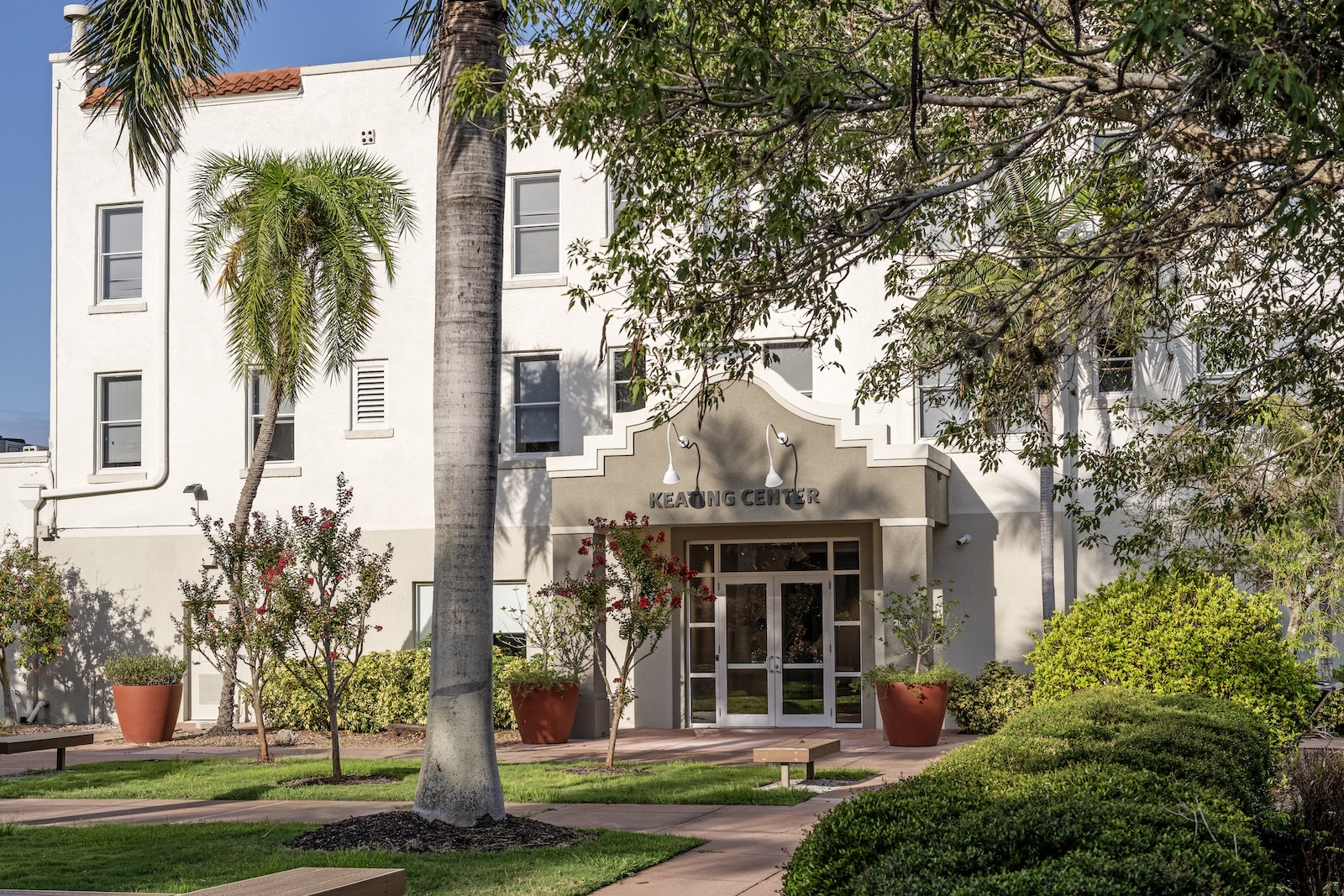
Ringling School of Art and Design
Along North Tamiami Trail in Sarasota, a short distance from the Ringling Museum estate and the circus money that shaped this stretch of Florida coastline, Ringling College of Art and Design sits on a campus that blends contemporary studio buildings with a handful of older structures carrying far heavier histories. At its center stands the Keating Center — a Spanish Mission Revival building constructed in 1925, listed on the National Register of Historic Places since 1984. Before it was an art school, it was a hotel. And before it was merely a hotel, it was something darker than that. The Bay Haven Hotel opened in the mid-1920s during the Florida land boom, a period when Sarasota was exploding with speculative wealth and circus-empire prestige. The Bay Haven was built to attract the traveling businessman and seasonal wealthy visitor. It was moderately successful for a few years. Then the boom crashed. By 1928, the man who developed the Bay Haven subdivision was killed in a car wreck near Arcadia, and his wife struggled to keep the hotel afloat. By 1930 the banks were closing, insurance payments lapsed, and the hotel fell into receivership. What replaced the original clientele, according to accounts passed through generations of students and staff, was a considerably different population: gamblers, Prohibition-era bootleggers, and women working in prostitution on the second floor. Into this compromised building, Dr. Ludd M. Spivey — president of Southern College in Lakeland — brought his plan for a Florida art school. He courted John Ringling, who was nearly bankrupt but agreed to lend his name and fund the $45,000 renovation. On October 2, 1931, the School of Fine and Applied Art of the John and Mable Ringling Art Museum opened with 75 students and 13 faculty. Students attended chapel daily and needed written permission to leave town. The school became independent in 1933 and eventually grew into Ringling College of Art and Design. The Keating Center has served as the campus heart ever since, housing administration below and student dormitory rooms above. The ghost came with the building. She is called Mary, and her legend is among the most consistently reported haunting accounts in Sarasota. The story holds that Mary was one of the women living and working on the second floor of the Bay Haven during its decline — a live-in prostitute who fell in love with a client who didn't return her feelings and took her life by hanging in the stairwell at the end of the second-floor corridor. Hotel management concealed the death. Alumni accounts from as far back as the 1960s reference a locked room off that hallway near the stairwell that was left unused. The manifestations are specific and consistent across decades. Students have described a young woman in her late teens or early twenties gazing down from a second-floor window at students below — sometimes smiling, sometimes not — wearing a cream-colored dress with ruffled armlets or a lavender flapper-style dress, a tight skull cap from the 1920s, with one foot bare and the other in a small blue shoe. Others report anguished sobbing from the stairwell at night with no visible source. Those who investigated described an overpowering smell of stale perfume and a crushing wave of sadness — shortness of breath, racing heart, an uncontrollable urge to weep. Former students from the 1970s and early 1980s described certain rooms on the haunted side as persistently thick and dark, prompting room transfers. A local priest reportedly performed an exorcism at the Keating Center in the 1990s — an event that those who claim ongoing encounters with Mary generally describe as unsuccessful. The Travel Channel featured the legend in 2004. Ringling College today is a thriving institution and the Keating Center is fully restored, its upper floors still active as student housing. Students still report seeing her at the window. The perfume still turns up where no one is wearing any.

Ringling Towers
The Ringling Towers, known as the "Ghost Hotel" among paranormal researchers, stood as a prominent downtown Sarasota, Florida landmark during the latter twentieth century. Named for association with circus magnate John Ringling, the tower structure was constructed during an era of economic optimism and expansive real estate speculation. It subsequently became the locus of multiple fatal falls and concentrated paranormal phenomena attracting paranormal researchers until its 1998 demolition. Precise construction dates and original purpose remain incompletely documented, though the structure appears to have been constructed mid-twentieth century as residential or mixed-use building. The tower rose multiple stories above surrounding landscape, providing commanding views. The structure underwent abandonment and degradation periods, with vacancy and neglect resulting in deterioration of envelope, utilities, and interior finishes. By the twentieth century's latter decades, the Ringling Towers had become a recognizable deteriorating, increasingly unstable building subject to squatter occupancy. Most significant and disturbing aspect of history involved multiple deaths from falls from elevated positions. Paranormal documentation indicates eight individuals died by falling, though whether all deaths occurred within the building remains unclear. The fatal fall concentration from a single structure, combined with abandoned, unsupervised condition, created circumstances where accurate death documentation became difficult. Deaths at abandoned buildings often go unreported with incomplete detail, particularly involving transient individuals or squatters. Paranormal researchers theorize the fatal fall concentration reflected either architectural conditions increasing accident likelihood or paranormal influences precipitating lethal falls. The building's deteriorated condition with unstable flooring, malfunctioning elevators, and structural damage provided objective hazards. Whether these fully explain fatal incident concentration or paranormal forces contributed remains unresolved. The intensity and death concentration appears creating psychological expectations among investigators that paranormal causation was involved. King Richter, identified as high school student, reportedly died falling from unfinished stairs. Exact circumstances remain incompletely documented, though his death became widely publicized. Paranormal accounts describe investigators hearing what they interpreted as Richter's voice calling friends' names within empty building, suggesting his consciousness or imprint remained location-bound. Young person's sudden violent death appears generating powerful paranormal consequences, with researchers reporting the associated entity manifested distressed and seeking communication with living persons. Upper floors and penthouse areas became locus of intense paranormal phenomena. Investigators documented cold spots with temperatures dropping to levels inconsistent with surrounding conditions. Cold spots concentrated in areas identified with deaths or possessing psychological significance. Temperature fluctuations unexplainable by environmental factors provided reproducible evidence. Consistency of cold spot manifestations across multiple investigations provided foundation for taking paranormal claims seriously, as this phenomenon appeared less susceptible to subjective interpretation than visual apparitions or auditory phenomena. The Ringling Towers' deteriorating condition, combined with concentrated paranormal phenomena and deaths, eventually led to demolition. By the 1990s, the building posed public safety hazards independent of paranormal considerations. The 1998 demolition eliminated the primary paranormal phenomenon location. Though paranormal researchers theorize trauma associated with deaths may persist location-wise despite building removal, demolition eliminated continued investigation and documentation opportunities. The Ringling Towers remains a historical example of how concentrated violent deaths can generate sustained paranormal consequences within building environments.
Belle Haven Inn
The Belle Haven Inn occupies a distinctive place in Sarasota's architectural and paranormal heritage, its Mediterranean-Revival design conveying an air of historical significance that resonates with contemporary visitors and investigators alike. Constructed in 1887, the building originally served as the DeSoto Hotel, a name that carries its own historical weight within the region's development narrative. The structure emerged during Florida's earliest commercial expansion, when speculative investment and tourism infrastructure were beginning to transform what had been a frontier outpost into a destination of regional significance. As the DeSoto Hotel, the building would have served various purposes across the decades, hosting travelers, accommodating business ventures, and bearing witness to the gradual modernization of Sarasota from a modest settlement into the thriving city it would eventually become. The architectural transition from the DeSoto Hotel to its current incarnation as the Belle Haven Inn represents more than a simple change of name or operational focus; it reflects the continuous evolution of commercial hospitality in Sarasota and the adaptation of historical structures to meet the needs of subsequent generations. The Mediterranean-Revival aesthetic that characterizes the building's exterior and interior spaces speaks to the aesthetic preferences that influenced architectural development in Florida during periods of renewed investment and renovation. This style, with its emphasis on graceful arches, ornamental detailing, and a sense of Mediterranean elegance, provides a visual framework for understanding the building's historical journey from nineteenth-century hospitality to its current status as an inn drawing visitors from across the region. Yet beneath the structure's historical legitimacy and commercial function lies a layer of paranormal activity that has drawn both serious investigators and curious observers to the location. Reports of orbs—those mysterious spheres of luminosity captured in photographs and witnessed in direct observation—have accumulated across multiple investigations conducted within the building. More substantially, witnesses have documented full-body apparitions of discernible humanoid form, suggesting the presence of intelligences capable of materializing with considerable specificity rather than remaining as mere ambient presences or diffuse impressions. The majority of these manifestations appear to center on a distinctly female energy, a presence that announces itself most forcefully when children are present within the building, suggesting a consciousness that may retain some maternal or protective quality despite its separation from the living world. The Paranormal Society of Bradenton has conducted investigations at Belle Haven Inn, bringing systematic documentation and technical apparatus to the study of the paranormal activity concentrated within the structure. Their investigations have lent credibility to the numerous anecdotal reports accumulated from guests and staff, providing a framework of professional inquiry that elevates the location beyond mere folklore into the domain of documented paranormal research. The society's involvement has also expanded the scope of awareness regarding Belle Haven Inn's status as one of Sarasota's most significantly haunted locations, a designation that now appears in regional haunting guides and paranormal tourism itineraries. The identity of the presiding spirits remains uncertain, though the date of construction in 1887 provides chronological parameters for speculation. The feminine presence that manifests with such apparent regularity may derive from events occurring during the building's original tenure as a hotel, or from periods subsequent to its conversion into various commercial and residential incarnations. The attraction of this consciousness to children is particularly intriguing, suggesting either a connection to innocence and youth that transcends mortality, or a specific historical tragedy involving young lives cut short within the building's walls. Whatever the origins of the haunting, contemporary visitors and investigators encounter a location where the historical architecture and the paranormal activity coexist in compelling and mutually reinforcing juxtaposition. Belle Haven Inn stands today as a functioning inn that welcomes guests and visitors, a hospitality venue that maintains professional standards while simultaneously offering the peculiar attraction of a location with documented paranormal significance. For many visitors, the historical charm of the Mediterranean-Revival structure enhanced by the frisson of possible supernatural encounter creates a distinctly appealing proposition. For serious paranormal investigators, the location offers the rare opportunity to study systematic manifestations of organized intelligence within a controlled commercial setting. The inn thus represents a convergence of historical preservation, contemporary hospitality, and the inexplicable phenomena that suggest the boundaries between the living and the departed remain considerably more permeable than conventional understanding would allow.
Timber Chase Apartments
Timber Chase Apartments in Sarasota, Florida, represent the residential expansion that characterized American suburban development in the late twentieth century. Located in the Sarasota metropolitan area, the complex was constructed during the period of rapid population growth and increased housing demand that transformed Florida's communities from the 1970s through the 1990s. The apartment complex emerged as part of broader patterns of real estate development that converted raw land into densely populated residential zones designed to accommodate the influx of residents seeking employment opportunities and the subtropical climate that drew thousands of newcomers to the region each year. The complex was designed with conventional residential architecture, featuring upstairs rooms arranged along hallways, creating the typical layout of mid-range apartment communities. The Sarasota area during the 1990s experienced rapid demographic change and social transformation as the region became increasingly urbanized and cosmopolitan. The population growth created both opportunities and social tensions, as newer residents from across the United States established lives in communities that were themselves undergoing rapid change. Like many residential complexes of its era, Timber Chase Apartments stood as both a symbol of American optimism and a container for the anxieties and vulnerabilities inherent in modern urban living. The complex provided homes for families, working professionals, and transient residents, each with their own stories and circumstances. On a date that remains difficult for residents and survivors, a violent murder occurred within the complex. In 1992, a young female resident was brutally stabbed to death, her life cut short in an act of sudden violence. The circumstances surrounding her death left traumatic imprints upon the community, creating a rupture in the everyday normalcy of residential living and introducing an element of dread into a space ostensibly devoted to domestic safety and privacy. The crime shocked residents and became part of the building's historical record, a dark punctuation mark in its narrative. Following the murder, residents and subsequent occupants of Timber Chase Apartments reported manifestations they attributed to the deceased victim. Witnesses described encountering an unseen presence moving through the upstairs rooms and along the hallways at night. Residents reported bedroom doors opening and closing of their own accord while they slept, a phenomenon that combined physical evidence with psychological distress. Some residents described hearing footsteps in empty corridors, the sound of invisible movement suggesting a presence unable or unwilling to depart. Others reported encountering what they described as the apparition of a young female, most often observed in the late hours of darkness. These phenomena clustered particularly around the areas where the victim had lived and where the crime had occurred, suggesting to investigators that the haunting possessed a geographic and personal specificity. Paranormal researchers have theorized that traumatic deaths, particularly those involving violence and the sudden cessation of life, can create disturbances in the psychic environment of a location. The theory suggests that the victim's spirit, unable to reconcile the violence of her death or torn from life before completion of her earthly purpose, became bound to the place where her life ended. The persistence of the phenomena across multiple resident generations lends support to the view that the haunting represents something more than isolated psychological phenomena affecting individual residents. Today, Timber Chase Apartments continues to serve as residential housing for Sarasota-area residents, its paranormal reputation acknowledged among those familiar with the building's history. The apartment complex stands as a sobering reminder of the capacity for violence in American communities and the enduring questions about consciousness, trauma, and the boundaries between life and death that such tragic incidents raise. The reports of the young woman's presence continue to circulate through local paranormal communities and ghost-hunting enthusiasts investigating Florida's haunted locations.