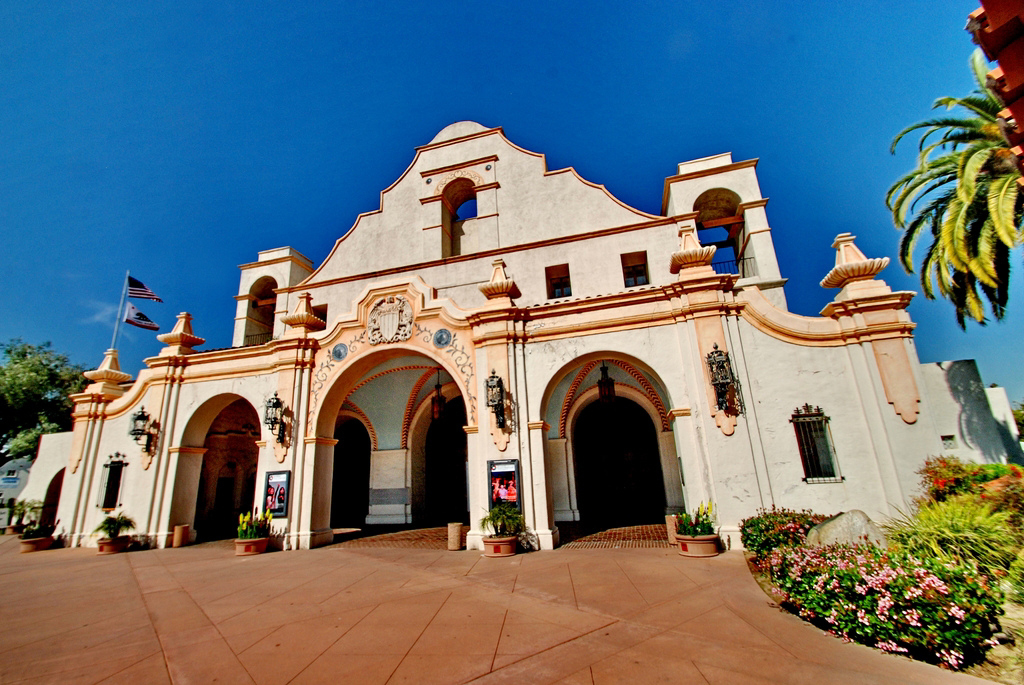
San Gabriel Mission Playhouse
San Gabriel, California·house At 320 South Mission Drive in San Gabriel, California, directly across from the old Mission San Gabriel Arcángel, a building designed to look like a Spanish mission but built to house a theatrical spectacle has been attracting audiences—and, according to those who work inside it, retaining at least one permanent resident—since 1927. The San Gabriel Mission Playhouse is a 1,387-seat performing arts venue constructed in the Mission Revival style by architect Arthur Burnett Benton, its facade modeled after Mission San Antonio de Padua in Monterey County. Inside, the theater is an extravagance of cultural layering: a carved and painted ceiling with Native American motifs, replica Spanish galleon lanterns hanging from the beams, woven tapestries gifted by King Alfonso XIII of Spain, and a fully restored 1924 Wurlitzer pipe organ originally built for the Albee Theatre in Brooklyn. The building was added to the National Register of Historic Places in 2019.
The Playhouse was built for one man and one production. John Steven McGroarty was born in Pennsylvania in 1862, worked as a county treasurer, lawyer, and mining executive before moving to Los Angeles in 1901, where he joined the Los Angeles Times and began a career as journalist, poet, and chronicler of California history. His most ambitious work was The Mission Play, a three-hour pageant dramatizing the founding, flourishing, and ruin of the California missions from 1769 to 1847. The play opened in 1912 at a smaller venue and became a sensation—over its twenty-year run, more than 2.5 million people saw it across 3,198 performances. McGroarty, known locally as Uncle John, was knighted by the Pope and by the King of Spain, named California's Poet Laureate in 1933, and elected to two terms in the U.S. House of Representatives. He died in 1944 at eighty-one. The Playhouse was completed in 1927 to give his production a permanent home. When the Depression ended the play's run in 1932, the building served as a movie theater, then had its dressing rooms converted to apartments during the wartime housing shortage. The City of San Gabriel purchased it in 1945, renaming it the San Gabriel Civic Auditorium until the original name was restored in 2007.
The paranormal claims revolve primarily around Uncle John himself. Staff report that McGroarty has never left the theater he built. His apparition has been spotted during performances and has appeared on security monitors. A metal bar inside the theater is said to swing on its own when a show particularly pleases him—a detail reported by a former employee as a known phenomenon among staff. The top floor and backstage areas carry the strongest reputation. A former stage manager is also said to haunt the building, and the ghost of a young girl has been reported in the theater's interior.
Beneath the Playhouse lies a network of tunnels McGroarty had built so he could move between backstage and the foyer without crossing through the audience. One account—unverified but embedded in local lore—holds that during the Depression the tunnels were used to store dead bodies, and when full, were sealed shut. Whether or not the story is true, the tunnels exist and remain partially accessible. A former employee described seeing the entrance to one unsealed section, and multiple staff members have reported an oppressive feeling near the staircase on stage right. The upstairs areas and backstage dressing rooms are described as deeply unsettling when occupied alone.
The building sits in a district saturated with history far older than the Playhouse. Mission San Gabriel Arcángel was founded in 1771 and served as one of the most productive of the twenty-one California missions. The surrounding ground holds the remains of thousands of Indigenous people who lived, labored, and died under the mission system. Residents have reported finding arrowheads while digging in their yards. One visitor described sensing robed figures walking in procession outside the Playhouse—hooded monks who paused only when a large cross was raised before them.
Today the Mission Playhouse continues to host music, theater, dance, and community events. The Wurlitzer still plays. The tapestries from Spain still hang. The carved ceiling still catches the light the way it did when Uncle John first walked beneath it. And if the accounts from those who work the building are to be believed, he is still walking beneath it—swinging the bar when a show earns his approval, and refusing, nearly a century after his death, to give up the theater he built to tell the story of California.
Apparitions
Light Anomalies
Object Manipulations
Full-Body Apparitions
+1