
Haunted Places in San Diego, California
20 haunted locations
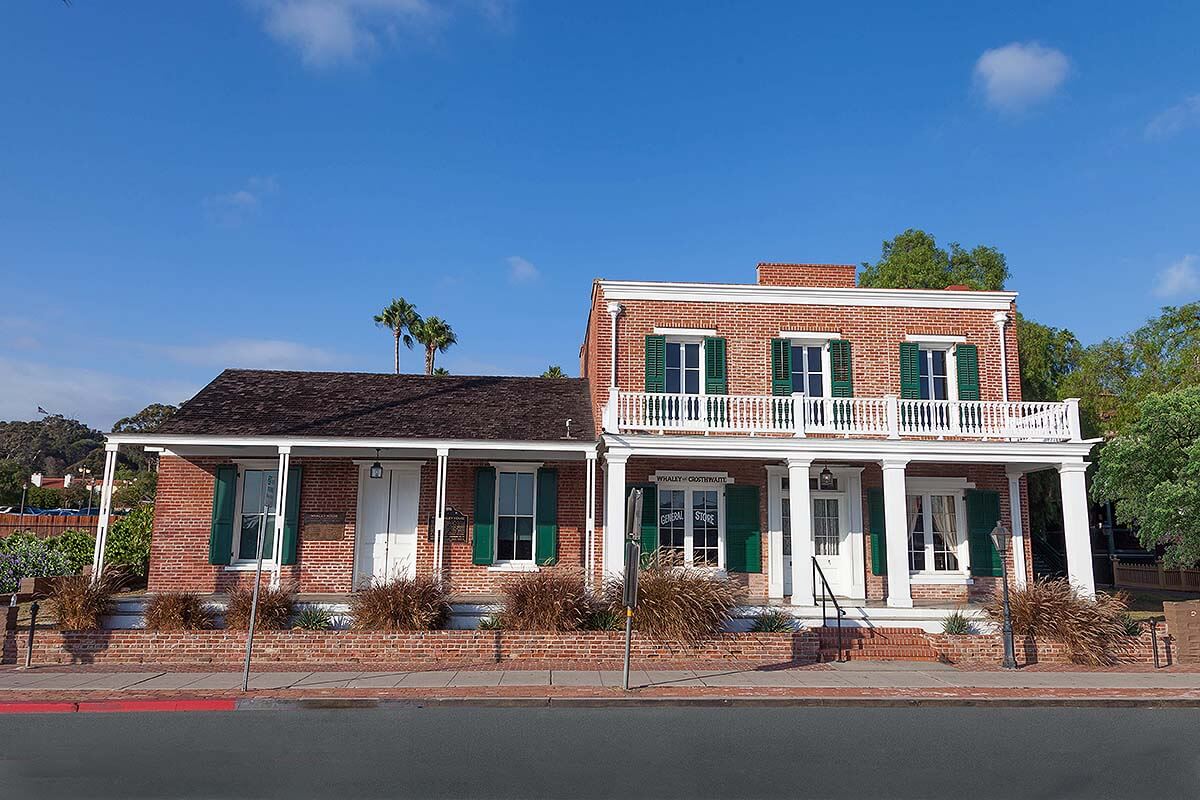
Whaley House
The Whaley House sits on San Diego Avenue in the Old Town neighborhood, a two-story Greek Revival brick home that looks, at first glance, like the kind of place a prosperous merchant would build to announce that he had arrived. And that is exactly what Thomas Whaley intended when he began construction in 1856. The house was the oldest brick structure in Southern California, built from clay bricks fired in Whaley's own kiln on Conde Street, with cedar woodwork and hardware shipped from New York. It cost over ten thousand dollars—a significant sum for a dusty frontier town that had only recently become part of the United States. What Whaley built on, however, was not ordinary ground. The property had served as San Diego's public gallows, and Thomas Whaley had personally witnessed the site's most notorious execution. In September 1852, a man named James Robinson—known locally as Yankee Jim—was hanged there for stealing a rowboat from San Diego Harbor. The trial had been swift and dubious: the jury included two men who owned the stolen boat, and the judge was reportedly drunk for much of the proceedings. Yankee Jim, a towering figure at six-foot-three, did not believe the sentence was real until he saw the rope. The gallows were too short for his frame. When the mule cart was pulled away, his feet grazed the ground, and he strangled slowly rather than dying from a broken neck. Thomas Whaley stood in the crowd and watched the entire thing. Three years later, he bought the land and built his family home directly over the spot. The archway between what became the music room and the parlor stands precisely where the gallows once were. The Whaley family moved in in 1857, and the house quickly became a civic centerpiece—it served at various times as a general store, San Diego's first commercial theater, and the county courthouse. But tragedy followed the family through its walls. Their eighteen-month-old son Thomas Jr. died of scarlet fever in the house. In 1871, armed men held Anna Whaley at gunpoint while seizing courthouse records during a bitter dispute between Old Town and the rising New Town. In 1885, their daughter Violet—devastated after discovering her new husband was a con artist who had married her for the family's money—shot herself in the chest with her father's revolver at the age of twenty-two. Thomas Whaley died in the house in 1890. Anna followed in 1913. Their son Francis died there in 1914, and their daughter Corinne lived in the home until her death in 1953, the last of the family to occupy the residence. Thomas Whaley himself was the first to report something wrong. He wrote in his journal of heavy footsteps moving through the upstairs rooms when no one was there—footsteps he attributed to Yankee Jim. That claim has persisted for over 160 years. Visitors today report a choking sensation when passing through the archway where the gallows stood. Staff and guests describe the sound of tiny footsteps and a child's crying attributed to baby Thomas. A young woman believed to be Violet is seen on the second floor. The scent of perfume associated with Anna drifts through rooms with no apparent source. Disembodied voices, cold spots, doors opening and closing on their own, and full-bodied apparitions have been reported by tourists and investigators alike. The house has been featured on numerous paranormal television programs, and EVP sessions have reportedly captured direct responses. The U.S. Department of Commerce has officially designated the Whaley House as haunted—one of only two homes in California to receive that recognition. Skeptics note that the house trades heavily on its reputation, and that the combination of dim lighting, period atmosphere, and primed expectation accounts for much of what visitors experience. That is a fair observation. But the reports predate the tourism industry by over a century—Thomas Whaley was documenting disturbances in the 1860s, long before anyone was selling tickets. Today the Whaley House operates as a museum maintained by Historic Tours of America. It is a California Historical Landmark and draws thousands of visitors annually for both historical and evening paranormal tours. The archway still stands. The parlor is still furnished. And the ground beneath the house has never forgotten what happened on it.
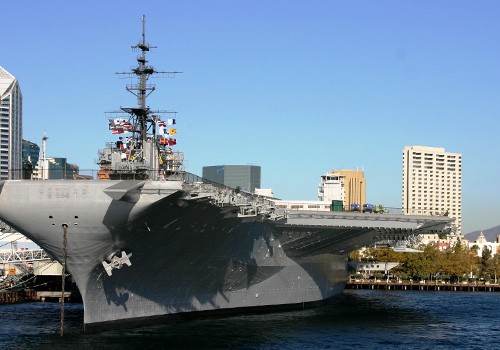
USS Midway
Moored at Navy Pier along San Diego's Embarcadero, the USS Midway is not a building haunted by a single tragic event or a house where someone died in the night. It is a 69,000-ton floating city that carried approximately 200,000 sailors across forty-seven years of continuous service, from the final week of World War II through the Persian Gulf War—the longest-serving aircraft carrier of the twentieth century. That kind of history does not sit quietly. The Midway was commissioned on September 10, 1945, one week after the formal Japanese surrender that ended the Second World War. Named for the decisive 1942 Battle of Midway, the carrier was the first in a new class of large ships featuring an armored flight deck and an air group of 120 planes. At the time of her launch, she was the largest ship in the world, a distinction she held for a full decade. Too massive to fit through the Panama Canal, the Midway was in a class by herself in more ways than one. Her Cold War service began almost immediately. In 1946, she became the first American carrier to operate in midwinter sub-Arctic conditions. The following year, she launched a captured German V-2 rocket from her deck—a trial that helped lay the groundwork for naval missile warfare. She later demonstrated that a carrier could deliver atomic weapons, fundamentally reshaping naval strategy. For ten years, the Midway patrolled European waters with the Atlantic Fleet before a round-the-world cruise brought her to the Pacific in 1955, where she was rebuilt with an angled flight deck to accommodate jet operations. The Midway's first combat deployment came in 1965, flying strikes against North Vietnam. Her aircraft shot down three MiGs, including the first air-to-air kill of the war, but seventeen Midway planes were lost to enemy fire during that cruise alone. In April 1975, during the fall of Saigon, the Midway served as the floating base for Operation Frequent Wind, rescuing more than 3,000 desperate refugees over a chaotic two-day evacuation. In 1991, she served as the flagship for Persian Gulf air operations during Operation Desert Storm. She was decommissioned in San Diego in 1992. After more than a decade of community effort to secure the ship as a museum, the USS Midway Museum opened on June 7, 2004, and quickly became the most visited naval warship museum in the United States, drawing over a million visitors annually. The paranormal claims aboard the Midway have accumulated steadily since the ship became a museum, though specifics have historically been kept close by staff and volunteers. The museum's curator, David Hanson—who also leads San Diego's largest paranormal investigation group—has investigated the ship's haunting activity for over a decade and maintains a log of all unusual incidents reported by staff, volunteers, and guests. Hanson prefers the term "paranormally active" to "haunted," noting that the spirits present on the Midway are overwhelmingly benign. He estimates that as many as thirty distinct entities have been recorded on the ship in recent years. Most, he believes, are not ghosts of sailors who died aboard the Midway but rather former crewmen who passed away later in life and returned to the ship out of duty and camaraderie. As Hanson has said of them, if that is their choice to be here, the museum welcomes them. Hanson's paranormal group has identified several spirits by name. A ghost called Monty inhabits the ship's library. Another named Jerome reportedly occupies the third row, third seat from the left in the Battle of Midway theater. A spirit identified as Chad, believed to have served in the Navy in 1953, was found in one of the ship's storage annexes, along with what investigators described as a swirling concentration of unidentifiable spiritual energy. Even before the ship became a museum, at least two hauntings were reported during active service—one occupying a cold storage food locker in the bow of the fourth deck, another in the Career Guidance Counselor's office near the stern. Visitors report hearing unexplained sounds echoing through corridors and compartments, sudden drops in temperature on the lower decks and in the engine room, the sensation of being watched or followed in isolated areas like the brig and old storage rooms, and the smell of what some describe as old blood in the sick bay area, accompanied by heavy, oppressive air. Museum mannequins positioned throughout the ship to represent sailors have been reported moving or appearing to speak. A phantom figure in uniform has been seen on the flight deck, vanishing when approached. Interestingly, some of the spirits encountered are not military at all—investigators have also identified female spirits and civilians who appear to pass through the ship without remaining, as though the Midway draws visitors from the other side just as it draws over a million living ones each year. Today the USS Midway Museum hosts more than 700 events annually, including military ceremonies, film screenings, and overnight educational programs where guests can sleep aboard the carrier. Twenty-nine restored aircraft sit on the flight deck and hangar deck. The self-guided audio tour, narrated by former Midway sailors, leads visitors through more than sixty locations. The ship that once carried atomic weapons and launched rescue helicopters over Saigon now carries schoolchildren, veterans, and tourists through corridors where the living and whatever remains of the dead share the same steel passageways—a floating city that never quite emptied out, even after the Navy was done with her.

Star of India
The Star of India, originally launched as the Euterpe in 1863, holds the distinction of being the oldest active sailing ship still in service on the planet, a maritime vessel that has weathered more than a century and a half of oceanic voyages, storms, and human drama. This barque-rigged merchant ship was constructed using iron, a revolutionary material for maritime construction during the Victorian era, allowing the vessel to endure conditions that would have destroyed wooden predecessors. The Star of India sailed the world's trade routes during the height of the nineteenth-century merchant marine, transporting cargo, passengers, and crew across vast expanses of open ocean. The vessel eventually arrived at San Diego harbor, where it was preserved as a museum ship and historic monument, representing a critical chapter in maritime history. Yet beneath the prestigious designation of oldest active sailing ship lay a darker narrative, one involving tragedy, death, and the apparent inability of some souls to fully depart from the vessel that carried them through life's final moments. The primary tragic incident that scholars and paranormal researchers associate with the Star of India's haunting involves young John Campbell, a stowaway who boarded the ship during its earlier incarnation as the Euterpe. Campbell, attempting to escape circumstances in his life that remain partially obscure in historical records, concealed himself among the cargo and crew quarters hoping to gain passage to distant lands. The boy's secret identity as a stowaway was eventually discovered, and the circumstances surrounding his death remain murky in formal documentation. Accounts suggest that Campbell fell during circumstances related to his position as a stowaway, meeting a tragic end somewhere within the vast machinery and rigging of the vessel. Whether his death resulted from an accident, punishment, or deliberate harm continues to be debated by maritime historians, yet the impact of his demise appears absolute in the paranormal phenomena subsequently reported throughout the ship's various spaces. Beyond John Campbell, numerous other deceased sailors have apparently found themselves unable to depart the vessel that defined their final experiences on earth. Crew members who perished at sea, died from illness in the cramped quarters, or succumbed to accidents during maritime operations apparently left spiritual imprints throughout the Star of India's structure. The crew quarters, where men lived in close quarters separated from the rest of society by endless ocean, became a particular focal point for paranormal manifestations. A sense of profound unease and dread has been reported by numerous visitors to these spaces, distinct from the melancholic atmosphere expected in maritime museums. Guests described a thick, heavy atmosphere that seemed to carry the weight of countless lives lived in confinement, fear, and homesickness. The sensation of an unseen presence watching from shadowed corners proved sufficiently consistent that multiple paranormal investigation teams documented identical experiences across independent visits. The paranormal phenomena documented aboard the Star of India encompass diverse categories of manifestation. Visitors reported ghostly apparitions appearing unexpectedly throughout the vessel, taking solid form before vanishing when approached directly. Inexplicable noises echoed through the ship's interior spaces, including sounds consistent with rope creaking, equipment moving, and voices speaking in maritime vernacular. An unnatural chill permeated certain areas independent of external weather conditions or the time of year, suggesting concentrated spiritual energy. Multiple witnesses reported the sensation of a freezing hand grasping them, a visceral encounter suggesting physical contact from an entity no longer bound by normal thermal properties. The mast area, where crew members worked at tremendous heights under dangerous conditions, proved particularly active in paranormal phenomena. The Star of India was visited by the paranormal investigation television program Ghost Adventures, whose team documented unusual electromagnetic fluctuations and apparent spirit communication within the vessel's historic spaces. The ship stands today as both a museum piece celebrating maritime achievement and a haunted location where the boundaries between past and present, living and deceased, appear remarkably thin.
William Heath Davis House Museum
The William Heath Davis House stands as one of San Diego's oldest surviving residential structures, representing the earliest period of American settlement in the city and embodying architectural styles and construction methods that predate the modern urban development that would subsequently transform San Diego into a major metropolitan area. Constructed during the mid-nineteenth century, the residence reflects the living standards and domestic arrangements of affluent households during an era when San Diego remained a small coastal settlement characterized by maritime commerce, military presence, and territorial development patterns. The structure has survived earthquakes, fires, and urban reconstruction throughout its history, maintaining its historical identity and architectural authenticity while surrounding neighborhoods underwent complete transformation from residential to commercial and ultimately into contemporary mixed-use districts. The house represents a tangible connection to San Diego's early American period and to the families and individuals whose lives shaped the city's foundational decades. The William Heath Davis House has served multiple distinct functions across its long and complex historical development, beginning as a private residence for prominent families whose names and accomplishments shaped early San Diego society and influenced regional development. During the twentieth century, the structure underwent transformation and transitioned to museum use, carefully preserving its architectural integrity while simultaneously opening interior spaces to public visitation and historical interpretation. The building's balcony areas and upper floors witnessed significant household activity, intimate family moments, entertaining of guests, private conversations, and the daily private life of residents who populated the structure across multiple generations and time periods. The residence absorbed the emotional resonance of domestic life, family conflicts and reconciliations, celebrations and quiet moments, and ordinary daily experiences that accumulated across decades of occupancy and domestic use. The accumulated weight of human experience within the house's interior spaces created powerful emotional imprinting. Paranormal activity within the William Heath Davis House has manifested through multiple distinct entities and phenomena, beginning with a figure known as the Lady in Black, an apparition appearing in distinctive black clothing who has been sighted in various interior locations including the balcony and upper floor areas. A spirit associated with the World War II era has been reported and documented through paranormal investigation, potentially representing an individual with historical connection to San Diego during the period when military installations expanded dramatically throughout the region and the city transformed into a major naval and military center. A ghostly cat has been documented and reported by multiple visitors and staff members, with distinct meowing sounds emanating from empty areas where no living feline is present or identifiable. Witnesses have experienced lights extinguishing and then mysteriously reilluminating without mechanical or electrical explanation, cold temperature spots concentrated in specific rooms and areas, and shadow figures visible in peripheral vision throughout the building's interior. Paranormal investigation teams and professional ghost tour guides have conducted extensive systematic documentation of paranormal activity at the William Heath Davis House Museum, with reported phenomena and experiences suggesting multiple spiritual entities coexisting within the historic structure. The apparitions appear consistently benign and non-threatening, with manifestations interpreted as residual hauntings reflecting the emotional imprints and spiritual attachments of individuals who lived within or frequented the house during their earthly existence and daily lives. The museum's dual function as a public institution and historical preservation site has created unique conditions where both living visitors and spiritual residents interact within the same spaces, potentially contributing to increased paranormal activity resulting from the dynamic intersection of living and deceased consciousness. The William Heath Davis House continues operating as a museum and cultural landmark while simultaneously maintaining its established reputation as one of San Diego's most reliably haunted historical structures, offering visitors opportunities to experience both architectural heritage and authentic paranormal phenomena within a single location.
Cosmopolitan Hotel and Restaurant
The Cosmopolitan Hotel in San Diego's Old Town represents one of California's most storied properties, originally constructed as the residential estate of Don Juan Bandini, a prominent Mexican-Californian rancher and politician whose family name remains woven through the region's founding history. Following Bandini's ownership, the property was converted into a stagecoach stop serving travelers on routes connecting San Diego to interior communities, the building's location making it a natural waystation for commerce and communication. The structure subsequently transformed into a hotel and restaurant operation during the nineteenth century, phases of use that introduced numerous travelers, temporary residents, and workers into its spaces. The building's architectural style reflects the transitional Mexican and American influences characteristic of San Diego's mid-nineteenth century, with construction materials and design elements that speak to cultural blending during a period of significant regional transformation. The most famous haunting at the Cosmopolitan Hotel centers upon Ysidora Bandini, daughter of Don Juan Bandini, whose tragic incident allegedly occurred during the early 1800s when she fell from a balcony overlooking the courtyard. According to the account preserved in local legend, she would have perished from the fall were it not for the intervention of Colonel Cave Johnson Couts, an American military officer who happened to be present and whose quick response cushioned her fall or provided medical assistance that preserved her life. Ysidora subsequently married Colonel Couts, the two individuals forming a romantic bond forged through trauma and rescue that bound them together for life. The emotional intensity of Ysidora's near-fatal experience appears to have created a spiritual anchor within the building, particularly in the rooms where her romance with Couts flourished and where intimate moments of their relationship occurred. Ysidora Bandini's ghostly presence haunts multiple rooms within the Cosmopolitan Hotel, with Rooms 4, 5, and 11 experiencing the most consistent and well-documented paranormal phenomena. Her manifestations involve opening and closing curtains without physical cause, moving mirrors to different positions on walls, and placing folded bathroom robes on floors in patterns suggesting intentional arrangement rather than accidental displacement. Guests report witnessing these physical objects move through the air and relocate across rooms during their stays, events that cannot be explained by natural physical causes or building settling. A secondary spirit known as the Lady in Red appears in various locations throughout the hotel, her crimson-dressed apparition distinct from Ysidora's manifestations. A phantom cat has been reported by multiple guests who felt the distinct weight of a feline body jumping onto their beds during darkness, the sensation registering on their bodies despite the absence of any visible animal. The phantom cat's presence suggests either an animal that died within the hotel or the echo of a beloved family pet mourned by a former resident or guest. Phantom footsteps traverse hallways during quiet hours, phantom perfume scents materialize without identifiable source, and visitors report hearing child laughter echoing through empty corridors, particularly at night when the hotel's active population diminishes. The Cosmopolitan Hotel continues to operate as a functioning hospitality establishment, welcoming both historical enthusiasts and paranormal seekers who specifically request rooms with documented haunting phenomena. The building's preservation of original architectural features and period-appropriate furnishings reinforces the sense of temporal displacement that visitors experience while staying in spaces where eighteenth and nineteenth century events occurred. Ysidora Bandini's continued manifestations span nearly two centuries since her near-fatal fall, her spiritual presence proving remarkably consistent and well-documented across generations of witnesses. The intensity of paranormal activity increases during certain periods, with activity spikes potentially related to seasonal changes or guest populations that attract particular spirits. Staff members report familiarity with the supernatural phenomena, treating Ysidora and the other spirits as established residents of the property whose presence requires acknowledgment and respect.
Presidio Park
Presidio Park, situated in San Diego, California, represents one of the state's most historically significant cultural and natural spaces, encompassing more than 1,400 acres of terrain that has witnessed the foundational events of European colonization, Spanish missionary activity, military operations, and the development of one of America's most important cities. The park's landscape combines natural beauty with historical architecture, including the Serra Museum and various other structures that document the region's complex past. Yet beneath its historical importance and architectural significance, Presidio Park has emerged as one of San Diego's most actively haunted locations, drawing paranormal researchers and curious visitors eager to encounter the supernatural phenomena that persist within its boundaries. The park's paranormal reputation is distinguished by its diversity, with multiple distinct entities and manifestations documented across different areas of the extensive grounds. The most celebrated paranormal phenomenon associated with Presidio Park involves the manifestation known as Lucy the doe spirit, an apparition that has appeared to visitors across decades of paranormal documentation. This spirit, taking the form of a deer or doe rather than a human entity, represents an unusual category of paranormal manifestation, as many haunting cases involve exclusively human spirits. The appearance of Lucy suggests that the boundaries of what may remain attached to a location extend beyond the merely human, encompassing perhaps other creatures whose deaths occurred in the area or whose emotional connections to the space created bonds transcending the barrier between life and death. The Witches Tower, located within Presidio Park, has become the focal point for some of the park's most intense paranormal activity and has generated significant folklore and urban legend. The tower, marked by the presence of a pentagram symbol, has attracted paranormal researchers investigating the possibility that the structure or its location may serve as a focal point for supernatural manifestation. Paranormal phenomena throughout the broader Presidio Park grounds demonstrate considerable variety, extending beyond specific locations to encompass the entire expanse of the historical site. Apparition sightings have been documented across various areas of the park, with visitors encountering full-body manifestations of figures dressed in historical attire, suggesting that spirits from different periods of the park's past may remain present. Unexplained lights have been reported throughout Presidio Park, appearing without apparent source or cause and moving in patterns inconsistent with natural or conventional explanation. These luminous phenomena have been documented by multiple independent observers and photographed in some cases, providing objective evidence of the manifestations beyond subjective witness accounts. Object movement has been documented within the park, with visitors and investigators reporting the displacement of physical items and the observable movement of objects without human agency. A pervasive strong presence has been documented throughout Presidio Park by sensitive individuals and professional paranormal investigators, a quality of atmosphere described as heavy, oppressive, or charged with supernatural energy. Presidio Park stands as a location where historical significance and paranormal phenomenon intersect profoundly, creating one of Southern California's most compelling and well-documented cases of widespread haunting activity.
Fort Rosecrans National Cemetery
Reported haunted cemetery in San Diego, CA.
Horton Grand Hotel
The Horton Grand Hotel stands within the historic Gaslamp Quarter of San Diego, California, as one of the most distinctive and architecturally significant examples of Victorian-era hospitality construction from the nineteenth century. The hotel was completed in the 1880s during a period of intensive economic development in San Diego, when the discovery of gold and silver in surrounding regions, combined with the city's strategic position as a Pacific port, created unprecedented opportunities for commercial development and urban expansion. The hotel's construction reflects the architectural sensibilities of the Victorian era, incorporating ornate detailing, quality materials, and design principles that emphasized grandeur and permanence. The establishment quickly became a destination for wealthy merchants, mining magnates, and other affluent travelers who arrived in San Diego conducting business related to the extractive industries that drove the region's economy during the final decades of the nineteenth century. The hotel's reputation for excellence and its prominent location within the developing commercial district ensured its status as one of the city's most prestigious and expensive hospitality venues. The Gaslamp Quarter itself evolved during this period into the commercial and cultural heart of San Diego, though its reputation would subsequently suffer considerable decline during the mid-twentieth century before experiencing significant revitalization beginning in the 1970s. The paranormal narrative of Horton Grand Hotel centers upon two distinct entities whose stories have become intertwined with the building's history and reputation. The first involves a gambler known to historical records as Roger Whitaker, who met his death within the hotel under violent and contested circumstances during the 1800s. According to accounts preserved in historical documents and paranormal databases, Whitaker was shot and killed, apparently by an assailant, and the location of his death was subsequently determined to be within a wooden armoire that occupied room 309 of the hotel. The exact circumstances surrounding the shooting remain obscured by historical distance and the incomplete documentary record, but accounts suggest that Whitaker may have been engaged in illicit gambling activities and may have incurred significant debts to dangerous individuals. Some versions of the story suggest that Whitaker attempted to hide within the armoire to escape his pursuers, only to be found and shot while concealed within the wooden furniture. The violence of his death, the element of betrayal potentially involved, and the ignominious nature of his final moments seemingly created conditions favorable to the manifestation of paranormal phenomena within the space that witnessed these traumatic final moments. In addition to the presence that appears to derive from Roger Whitaker's violent death, the Horton Grand Hotel is also home to the apparition of a woman identified as Ida Bailey, who is described in contemporary accounts and paranormal literature as a friendly ghost whose presence is characterized by benevolent and protective intentions. Ida Bailey's historical identity and her specific relationship to the hotel remain subjects of interpretive speculation, though some sources suggest she may have worked within the hotel during the nineteenth century. Reports describe her spirit as moving through the halls and rooms of the hotel, apparently watching over guests and staff, manifesting through phenomena that are generally described as comforting rather than threatening. She has reportedly appeared to guests in their rooms and has been credited with protective interventions that have prevented harm or injury. The dynamic interaction between the two distinct spiritual presences within the hotel creates a complex metaphysical environment characterized by simultaneous manifestations of both malevolent and benevolent supernatural forces. Room 309 has achieved widespread recognition as the epicenter of paranormal activity within Horton Grand Hotel, with reports of phenomena occurring with particular frequency and intensity within this space. Guests have described experiencing bed shaking that occurs without discernible physical cause, lighting fixtures that flicker and dim inexplicably, and phantom footsteps that echo through the room during hours when no physical persons are present. Doors have been observed opening and closing seemingly of their own volition, with witnesses unable to attribute the movement to drafts or structural settling. Disembodied laughter has been heard by multiple independent observers, sometimes described as hollow and echoing, at other times characterized as mocking or derisive. Within the adjoining bathroom, guests have reported that personal items such as toiletries and cosmetics have been moved or displaced from their original positions. The armoire within the room, the very piece of furniture within which Roger Whitaker met his death, has been specifically noted as an epicenter of paranormal manifestation, with witnesses describing it opening and closing repeatedly throughout the night. These phenomena have been documented by both guest accounts and by paranormal investigation teams that have conducted on-site research. The Horton Grand Hotel remains in operation as a functioning luxury hotel, hosting guests from around the world and maintaining its reputation as both an architectural jewel of Victorian San Diego and as one of the most extensively documented haunted locations in the Gaslamp Quarter, attracting paranormal enthusiasts and historical researchers in equal measure.
Old Point Loma Lighthouse
The Old Point Loma Lighthouse, situated on the San Diego Peninsula overlooking the Pacific Ocean, represents one of the earliest navigational structures established on the California coast and has served for over a century and a half as both a functional aid to maritime safety and a repository of human stories connected to the sea. The lighthouse was constructed in the mid-nineteenth century to guide vessels safely through the treacherous waters surrounding San Diego Bay, serving a critical function for the maritime commerce and naval operations that depended upon accurate navigation through these passage ways. The structure itself is architecturally distinctive, featuring a tower of considerable height from which a powerful light could project across the water to warn ships of the rocky shoreline and potential hazards. The building also contains keeper's quarters, where the lighthouse keepers and their families lived while maintaining the light, creating a unique domestic space within an otherwise utilitarian structure dedicated to maritime safety. Captain Robert Decatur Israel served as one of the most significant lighthouse keepers during the structure's history, dedicating himself to the maintenance and operation of the light with a seriousness that seemed to transcend the ordinary professional responsibilities of the position. Israel understood that his work—keeping the light burning, maintaining its mechanism, ensuring its proper operation—could mean the difference between safe passage and disaster for ships and their crews operating in darkness and fog. The captain took personal pride in the lighthouse and developed what witnesses described as an almost spiritual connection to the structure and to his responsibilities within it. His presence within the keeper's quarters and throughout the lighthouse became not merely physical occupancy but an emotional imprint of dedication and purpose. Legends and historical accounts associated with Point Loma also reference the presence of Juan Rodriguez Cabrillo, the Spanish explorer credited with being the first European to arrive in present-day San Diego. Though Cabrillo died centuries before the lighthouse was constructed, some researchers and paranormal investigators have suggested that his exploratory spirit—his historical significance in the discovery and initial European documentation of the California coast—may have created a lasting energetic imprint that permeates the location. Whether Cabrillo's presence is literal or metaphorical, the suggestion that his exploratory consciousness somehow persists in this strategically important location speaks to the profound historical weight the site carries. The paranormal activity documented at the Old Point Loma Lighthouse represents a complex tapestry of phenomena associated with multiple entities or presences. Cold spots have been reported throughout the keeper's quarters and various rooms of the lighthouse, with visitors describing areas of sudden temperature loss that occur without apparent connection to drafts or ventilation systems. These cold zones are particularly prominent in the area where Captain Israel spent much of his time during life, with some investigators suggesting the temperature anomalies represent a residual manifestation of his presence or spiritual energy. Electromagnetic field fluctuations have similarly been documented, with sensitive equipment registering variations in electromagnetic activity in locations corresponding to where paranormal experiences have been reported. Disembodied voices represent a significant category of paranormal activity at the lighthouse, with multiple investigators documenting audio evidence of what appear to be spectral communications. The voices have been characterized as calm and professional, occasionally issuing warnings or navigational instructions consistent with the maritime focus of the location. Some recordings have captured voices that appear to be responding to questions posed by investigators, demonstrating an intelligence and intentionality beyond what residual haunting theory would predict. Listeners have described the voices as familiar or recognizable, suggesting they may represent distinct entities rather than generic spectral noise. The voices are most frequently heard in the lighthouse tower itself and in the keeper's quarters, locations with the strongest historical association with Captain Israel's living and working presence. Footsteps have been extensively documented throughout the lighthouse, with visitors and staff members reporting the sound of footsteps in empty areas of the structure, particularly on the stairs leading up the lighthouse tower. The cadence and weight of these phantom footsteps suggest they may represent the routines that Captain Israel followed during life—his regular ascent and descent of the lighthouse stairs as he maintained the light and performed his various duties. The footsteps are most audible during quiet hours and during periods of low visitor activity, suggesting they may manifest more strongly when the environment is relatively peaceful. Some investigators have suggested that Captain Israel's spirit continues to perform his duties automatically, walking the familiar paths of the lighthouse in an unconscious reenactment of his professional responsibilities. Feelings of being watched have been reported by numerous visitors to the Old Point Loma Lighthouse, with many describing a sensation of benevolent observation—as though some presence within the structure is aware of the visitors and watching their movements with interest rather than hostility. This sensation is particularly intense in the keeper's quarters, where the atmosphere has been characterized as protective or vigilant. Some visitors have reported that their experience of being watched shifted during their visit from feeling unsettling to feeling comforting, as though the presence had assessed their intentions and determined they meant no disrespect to the location or its history. The Old Point Loma Lighthouse continues to operate as both a historical monument and active tourist attraction, with the National Park Service maintaining the structure and its grounds. Park rangers and tour guides have developed a professional relationship with the documented paranormal phenomena, treating the reports of spiritual activity with respectful acknowledgment while maintaining the educational and historical focus of the site. Whether visitors encounter the tangible manifestation of Captain Israel's dedicated spirit or simply experience the psychological resonance of standing in a location so deeply embedded in American maritime history, the lighthouse continues to generate accounts of unusual experiences that suggest something more than ordinary tourist attraction.
U.S. Grant Hotel
The U.S. Grant Hotel stands as one of San Diego's most historically significant hospitality establishments, a grand hotel structure playing a central role in the city's social and cultural life since its early twentieth-century opening. The hotel served as accommodation for notable guests, site of important civic and social events, and centerpiece of San Diego's downtown commercial district. Its construction reflects the ambitions and aesthetic principles of its era, with multiple stories, extensive interior spaces, elaborate ballrooms, and sleeping quarters configured for varying guests. The building's architectural grandeur and association with San Diego's urban development might suggest simple historical significance. However, the U.S. Grant Hotel has become equally renowned among paranormal researchers as one of California's most prominent haunted hotels, with persistent supernatural phenomena documented across multiple decades and investigated by both amateur and professional researchers. The paranormal phenomena center fundamentally around Fannie's spirit, identified as the deceased wife of Ulysses S. Grant Jr., a historical figure whose family connections establish the hotel within broader American military and political history context. Fannie's death occurred shortly after the hotel's opening, creating profound emotional anguish for family members and resulting in her spirit establishing a persistent presence within the hotel's spaces. Historical circumstances surrounding her death remain somewhat obscured in conventional documentation, with paranormal accounts providing richer detail regarding her emotional state and spiritual condition. Her death's tragedy, compounded by emotional attachment to the location and possible unfinished business, resulted in one of the most recognizable haunting phenomena associated with California's historic hotels. Beyond Fannie's spirit, paranormal documentation indicates an additional unidentified male spirit whose appearances suggest a different historical period and emotional character, creating complexity involving at least two distinct spiritual entities. The primary paranormal manifestation involves Fannie's appearance as a luminous white-dressed apparition recognizable to multiple witnesses across extended investigation periods. The spirit has been repeatedly observed walking through hallways, appearing in guest rooms, and manifesting throughout the hotel with sufficient consistency that staff and investigators have developed familiarity with her appearance and manifestation patterns. The white dress matches wedding or formal dress associated with her lifetime, creating an image carrying profound emotional resonance and indelibly associated with her historical identity across decades. The apparition has been observed by multiple independent witnesses including guests, staff, and investigators, with descriptions remarkably consistent across diverse reports spanning considerable periods. The paranormal activity extends beyond simple visual apparitions, encompassing phenomena indicating interactive spiritual presence and apparent communication attempts. The unidentified male spirit manifests characteristically at the foot of beds in guest rooms, appearing before earthquakes with such consistency that researchers interpret his appearances as potentially predictive of seismic activity. Items throughout the hotel move inexplicably from one location to another, suggesting telekinetic activity or direct physical intervention. Mysterious lights activate and deactivate throughout the building without connection to electrical switches, creating visual anomalies documented by numerous witnesses and representing phenomena particularly common in substantially active paranormal locations. The cumulative effect of multiple manifestation types creates an environment where paranormal character becomes undeniable and spiritual entity presence becomes apparent. The U.S. Grant Hotel today continues operation as a functioning luxury hotel while maintaining its status as one of California's most thoroughly documented haunted hotels, recognized by paranormal researchers and ghost hunters as a premier location for paranormal investigation. The coexistence of active hotel operations with persistent paranormal phenomena has created a unique environment where guests encounter supernatural activity alongside ordinary hotel experiences. The documented paranormal activity has become sufficiently well-known that it appears in major compilations documenting paranormal hotspots throughout California, establishing the hotel as a location of recognized paranormal significance attracting both serious researchers and casual ghost hunters.
Bonita Road
Bonita Road stretches through the San Diego area of California, a typical suburban street that gained paranormal notoriety through a series of disturbing encounters and reports spanning several decades. The road is notable not for any particular building or structure but rather for the persistent reports of supernatural phenomena occurring specifically within vehicles traveling along or parked near the thoroughfare. San Diego, like much of Southern California, experienced dramatic expansion during the twentieth century, with agricultural and open land gradually being consumed by urban and suburban development. Bonita Road represents the kind of suburban street corridor that emerged from this expansion, initially designed and developed to facilitate automobile transportation and connect residential areas to commercial and industrial zones. The road itself is unremarkable in appearance and infrastructure, presenting no obvious architectural or historical features that would suggest paranormal significance. The paranormal phenomena associated with Bonita Road appear to be linked to a tragic traffic accident involving an older man who was struck and killed by a vehicle while on or near the roadway. The exact date of the accident, the identity of the victim, and the precise circumstances surrounding the death remain uncertain, known primarily through anecdotal reports and informal documentation rather than official traffic safety records. The victim appears to have been an elderly individual, described as an older man, whose sudden and traumatic death left an emotional imprint on the location where the tragedy occurred. Traffic accidents, particularly those involving fatalities, create zones of intense human suffering and emotional upheaval. Research into paranormal phenomena suggests that such locations may become magnets for spiritual manifestations and supernatural activity. The death appears to have triggered a persistent haunting phenomenon that has manifested across multiple decades and numerous witnesses. The paranormal manifestations associated with Bonita Road are highly specific and concentrated in vehicles traveling the thoroughfare or parked in the vicinity. The most commonly reported phenomenon involves a shadow figure appearing in the rear-view mirrors of vehicles, typically observed by drivers or passengers during travel. The apparition appears as a dark, indistinct silhouette, sometimes taking a more defined human form, other times remaining ambiguous and partially corporeal. Drivers who have observed the shadow figure in their rear-view mirrors report both immediate visual confirmation and subsequent disappearance when they turn around to look directly at the back seat. Some witnesses have reported the fuller apparition of an older man appearing physically in the back seat of their vehicles, materializing without explanation and generally vanishing within seconds. The apparitions are consistently described as resembling an elderly individual. Multiple witnesses across many years have reported virtually identical experiences, creating a remarkable degree of consistency. The phenomena appear concentrated during certain times of day and environmental conditions, with more frequent reports during evening and night hours. Bonita Road has become known among paranormal researchers and local enthusiasts as one of Southern California's most reliably haunted locations, despite the absence of traditional historical structures or buildings associated with the site. The road itself serves as the stage for ongoing paranormal activity, with the shadow figure and apparition of the older man continuing to manifest decades after his tragic death. The persistence of the phenomena suggests that the sudden and violent nature of the accident created a spiritual attachment to the location that continues to manifest in the present day. Visitors and residents who have experienced encounters with the apparition describe the experiences as startling but not necessarily threatening or malevolent, with the ghost seeming more desperate for acknowledgment than aggressive toward the living. The ghost appears unable to depart from the location of his death, remaining bound to Bonita Road despite the passage of time and the continued transformation of the surrounding environment. The recurring reports and consistent descriptions of the phenomena have made Bonita Road a destination for paranormal investigators and ghost enthusiasts seeking to document and understand this unusual manifestation of spiritual activity tied specifically to a roadway.
PSA Flight 182 Crash Site
The North Park neighborhood of San Diego, California represents a residential community characterized by relatively modest middle-class housing, tree-lined streets, and the particular atmosphere of mid-twentieth-century American suburban development. The intersection of Dwight and Nile Streets, situated within this residential landscape, seemed an ordinary location occupied by ordinary residences and the routine daily activities of the community members who inhabited the neighborhood. The North Park area possessed the quality of countless American suburban neighborhoods constructed during the post-World War II period of suburban expansion, offering affordable housing to families and individuals seeking stability and community within rapidly growing urban areas. The significance of this location was permanently altered on September 25, 1978, when the convergence of technological systems, human decisions, and catastrophic mechanical failure resulted in an event of exceptional tragedy. Pacific Southwest Airlines Flight 182, a commercial airliner carrying one hundred and forty-four human beings, collided with a Cessna general aviation aircraft in controlled San Diego airspace. The resulting collision created conditions that rendered the airliner uncontrollable, precipitating a crash toward the residential neighborhoods below. The aircraft descended in a trajectory that converged upon the North Park residential area, ultimately impacting at or near the intersection of Dwight and Nile Streets with devastating consequence. The impact, the resulting fires, and the immediate aftermath created a scene of destruction and human loss that transformed the residential neighborhood into a disaster zone of unprecedented scale within the community's experience. The human cost of the PSA Flight 182 disaster remains almost incomprehensible in its magnitude and intensity. All one hundred and forty-four individuals aboard the aircraft perished in the crash, their lives terminating abruptly and violently in circumstances they could neither anticipate nor control. Among the passengers and crew who died, the documented information identifies at least two young boys, whose presence on the aircraft remains particularly poignant given the tragedy's implications for family destruction and the loss of the future that those children might have experienced. Additionally, the impact and fires affected residents and structures in the immediate vicinity of the crash site, creating casualties among the residential community as well. The total human death toll from the disaster reached approximately two hundred and ninety individuals, making it one of the deadliest aviation accidents in American history. In the years following the disaster, residents living in proximity to the crash site began reporting paranormal phenomena of distinctive character and intensity. These reports include disembodied voices calling out, screams emanating from seemingly empty locations, and the sounds of individuals in distress occurring at irregular intervals without visible human source. Witnesses describe knocking sounds on walls and doors that appear to originate from within the structures themselves, while simultaneously, objects such as dishes within households move spontaneously without human intervention. Doors and windows open and close of their own accord, and residents consistently report observing shadow figures. The crash site and the surrounding North Park neighborhood have become recognized within San Diego and beyond as a location of significant paranormal activity, with residents and official discussions often approaching the subject with understandable sensitivity given the tragedy's human dimensions. The spirits of those who died in the disaster appear to maintain some form of presence or manifestation within the location where their deaths occurred, their continued existence in non-corporeal form creating ongoing phenomena that affect those living in the neighborhood. Whether these manifestations represent the actual conscious spirits of the deceased, imprints of traumatic events upon the physical environment, or other phenomena beyond current scientific understanding remains subject to interpretation and speculation. The site remains residential and appears outwardly ordinary, though the knowledge of its history and the reported paranormal activity lend it a distinctive and somber significance within regional consciousness and collective memory.
Robinson Rose House
The Robinson Rose House occupies a historic location in San Diego, California, representing the architectural heritage and social history of the city's early development during the Spanish colonial and early American periods. Judge James W. Robinson, a prominent legal and political figure in San Diego's early history, commissioned or became associated with the house through his residence and activities within the community. The structure reflects the architectural styles and construction practices of its era, featuring elements that connect it to San Diego's cultural heritage and the lifestyle of the city's prominent citizens during the nineteenth century. The house has served various purposes across its long history, including residence, commercial space, and contemporary use as a museum or historical site open to public visitation. The interior arrangements and room configurations reflect the social customs and domestic practices of its era, with spaces designed for formal entertaining, private family activities, and the work of household management. The second floor of the Robinson Rose House appears to hold particular paranormal significance, with phenomena concentrated in specific rooms and spaces within that level of the building. Sarah, whose full identity and historical relationship to the house has become somewhat obscured by time, appears to be one of the primary spiritual entities haunting the location, with her presence detected in multiple investigations and accounts provided by staff and visitors. The house has accumulated an extensive record of paranormal reports spanning multiple decades, with consistency in the types of phenomena documented suggesting the presence of established spiritual entities engaged in repeated manifestations and interactions with the living. The elevator within the building has become a particular focus of paranormal activity, with malfunctions and unexplained operational anomalies suggesting either mechanical failure or spiritual interference with the electrical and mechanical systems. Paranormal manifestations within the Robinson Rose House include the sound of phantom footsteps in hallways and rooms, auditory evidence of a persistent presence moving through the domestic spaces. Visitors and staff have reported experiencing hair being pulled by invisible presences, a direct physical phenomenon that suggests aggressive or at least assertive spiritual activity. Lights throughout the building have been observed to turn on and off without switch manipulation, with some accounts suggesting the phenomena occur in response to visitor activity or questions posed by paranormal investigators. Vapor-like figures have been observed in interior spaces, appearing as partially transparent forms that suggest the manifestation of an apparitional presence. The concentration of activity on the second floor suggests particular locations held significance in the deaths or traumatic experiences that bound the spirits to the location. Contemporary paranormal investigation teams have extensively documented the phenomena using modern recording equipment and methodologies, contributing significantly to the substantial body of evidence supporting the house's haunted reputation. The Robinson Rose House has become one of San Diego's most recognized haunted locations, with the documentation of paranormal phenomena contributing to academic and popular interest in the city's paranormal history. Staff members working at the location have become accustomed to the regular manifestation of paranormal phenomena and have developed protocols for interacting with visitors while managing the activities of the resident spirits. The haunting appears to involve multiple spiritual entities, possibly including Judge Robinson himself, Sarah, and potentially other individuals who experienced significant events or deaths within the structure. The persistence of the phenomena across multiple decades and through various occupancy changes suggests the spiritual attachment to specific physical locations within the house rather than attachment to a particular owner or occupant. The Robinson Rose House continues to operate as a historical site and haunted location simultaneously, serving both as a repository of San Diego's architectural heritage and as a center of paranormal activity.
Pioneer Park
Pioneer Park in San Diego, California occupies a location with profound historical significance that predates the modern city itself, with the land serving as a Catholic burial ground from its establishment in 1876 as Calvary Cemetery. The cemetery functioned as the primary burial location for the city's Catholic population and served as the interment site for victims of epidemics, accidents, and the normal mortality that characterized urban life in the American West. Over the decades spanning from 1876 through the mid-20th century, thousands of individuals were interred within the cemetery's boundaries, with the graves representing diverse populations including working-class laborers, prominent citizens, religious figures, and members of families who established their social standing through commerce, professions, and community service. The cemetery's landscape was meticulously maintained with formal gardens, religious monuments, and gravestone arrangements reflecting Victorian burial customs and Catholic commemorative traditions. The physical location itself became deeply embedded in the city's consciousness as a place of solemn remembrance and spiritual significance. During the post-World War II era, as San Diego's urban development accelerated and available land became increasingly valuable, civic planners initiated a controversial project to convert Calvary Cemetery into public park space. The transformation required the disinterment and removal of cemetery occupants from many burial sites, though not all graves were relocated, and authorities allowed numerous bodies to remain in the ground beneath recreational facilities and public gathering spaces. This process proved deeply contentious, with families objecting to the removal of their deceased relatives' remains and religious leaders questioning the appropriateness of converting sacred burial ground into secular public recreation. The decision reflected modernizing attitudes toward land use but generated substantial opposition and ethical concerns that persisted long after the conversion was completed. The removal of headstones and grave markers was comprehensive, eliminating physical evidence of burials that continued to exist beneath the park's surface. When Pioneer Park officially opened following the cemetery's conversion, the site retained a profound spiritual charge stemming from its history as a burial ground and the unresolved nature of numerous graves that remained beneath the park's infrastructure. Visitors and staff began reporting encounters with spectral figures, most prominently a lost, confused female apparition who manifested bewilderment regarding her surroundings and the dramatic transformation that had occurred at the location. Her spectral presence suggests an individual struggling to comprehend the displacement of familiar cemetery landmarks and the substitution of recreational facilities for the burial ground she knew in life. Other paranormal phenomena include unexplained electromagnetic fluctuations detected by sensitive equipment, sudden temperature anomalies involving cold spots, and electrical interference affecting lighting and electronic equipment throughout the park. Nighttime phenomena are particularly pronounced, with strange radio signals activating on their own in nearby homes and unexplained noises echoing across the park grounds during hours of darkness. Today Pioneer Park continues serving as a public recreational facility while simultaneously functioning as one of San Diego's most actively haunted locations. The site represents an intersection between historical trauma, desecration of sacred space, and the spiritual consequence of displacing the dead from their designated resting places. Paranormal researchers have documented consistent electromagnetic phenomena, temperature anomalies, and spectral sightings across multiple investigation sessions, establishing reliable patterns of paranormal activity in specific locations throughout the park. The presence of approximately 800 bodies buried beneath the park's surface, combined with the incomplete removal process, creates a population of spiritual residents at odds with the recreational purpose of the location, resulting in a genuine haunting populated by displaced grave occupants.
Villa Montezuma
Villa Montezuma stands as one of San Diego's most architecturally distinctive residential structures and most intensely haunted private residences, a sprawling mansion constructed in 1887 during the height of the Victorian era when San Diego was rapidly developing from frontier town to established city. The residence was commissioned by Jesse Shepard, a prominent figure in San Diego's cultural and intellectual circles during the late nineteenth century, a man known for his extensive musical talents and his cultivation of a residence intended to showcase artistic achievement and aesthetic refinement. The architectural style exemplifies the Queen Anne Revival movement that dominated American residential construction during the 1880s and 1890s, characterized by asymmetrical facades, multiple turrets, bay windows, and elaborate ornamentation. The mansion encompasses multiple stories, including a notable second-floor observatory tower providing panoramic views of the surrounding San Diego landscape, and a stained-glass window collection representing some of the finest examples of late nineteenth-century residential glass work. The paranormal phenomena documented at Villa Montezuma are both diverse and persistent, suggesting the residence hosts multiple distinct spiritual entities anchored to the physical structure. The manifestation most frequently reported and most thoroughly documented by paranormal researchers is the spontaneous playing of piano music emanating from the music room despite the absence of any human performers. Witnesses describe hearing complete compositions being played with technical proficiency, a phenomenon that has occurred repeatedly over many decades. The spirit believed responsible for this musical manifestation is the poltergeist entity of Jesse Shepard himself, whose attachment to the residence appears rooted in his identification with the mansion as an expression of his artistic vision. Beyond piano music, visitors and staff at the museum currently operating within the residence report disembodied voices, including conversational fragments and musical vocalizations. Footsteps have been documented traversing the elaborate staircase system, with investigators noting that footfall patterns suggest the movement of a solid entity despite the confirmed absence of physical intruders. The most tragic and compelling spirit narrative at Villa Montezuma involves a former servant whose death by hanging within the observatory tower represents the single documented fatality within the residence. The identity of this servant has been obscured by time and historical record loss, but his apparition has been photographed peering from the dome window at the apex of the tower, a haunting image that has become emblematic of the building's supernatural character. Paranormal investigators have documented unexplained temperature fluctuations, particularly intense cold spots that manifest suddenly in specific areas of the residence and dissipate with equal unexpectedness. The second-floor observatory tower and balcony overlooking the main staircase represent particularly active zones of paranormal manifestation, with reports of apparitions, disembodied voices, and poltergeist-type phenomena clustering in these locations. Villa Montezuma currently operates as a museum, a transformation that has preserved the residence while allowing public access to one of San Diego's most significant paranormal locations. The museum acknowledges the supernatural character of the residence through its stated position that the building is "enchanted, not haunted," a semantic distinction that allows the institution to accept and incorporate the paranormal phenomena into its institutional narrative. Visitors to the museum frequently report experiencing paranormal phenomena, including apparitions, disembodied voices, unexplained cold sensations, and the famous piano music heard emanating from the locked music room. Despite the transformation of the residence into a public museum space, the spirits appear to remain as present and active as they were during the Shepard era. The combination of architectural beauty, cultural significance, and intensive paranormal activity has secured Villa Montezuma's position as one of California's most important and most studied haunted residences.
Cara Way
Cara Knott's death in 1986 represents a tragedy of such violence and deliberate cruelty that the event and its circumstances have become permanently embedded in the historical consciousness of San Diego and in broader American awareness of institutional corruption and the abuse of authority. Knott, a twenty-year-old woman, was murdered by Robert Boyce, a California Highway Patrol officer, who exercised his position of power and authority not to protect public safety but to facilitate his own violent assault upon a defenseless individual. The crime's brutal specificity—a beating, strangulation, and the disposal of the body by throwing it from an abandoned bridge—speaks to a degree of callous violence that transcends simple crimes of passion or circumstance. The act represented not merely the taking of a life but the deliberate dehumanization and disposal of a person, carried out by an individual whose position and authority rendered his victim particularly vulnerable and defenseless. The fact that the perpetrator was a sworn officer, someone charged with upholding law and protecting citizens, added dimensions of institutional betrayal and systemic corruption to the crime. The Scripps Ranch area of San Diego, near the location where Knott's body was discovered, has become associated with paranormal phenomena in a way that speaks to the intensity of the trauma and violence that marked this location. The San Diego Crime Victims Oak Garden, constructed as a memorial space honoring Cara Knott and other victims of violent crime, functions simultaneously as a tribute to lives lost and as a focal point for paranormal activity. The garden, with its planted oak trees and its solemn dedication to remembrance, stands as a physical manifestation of grief and loss, a space where community members acknowledge the reality of violent crime and its victims. Within and around this memorial space, paranormal phenomena have been documented with sufficient consistency that local paranormal investigators have begun systematic investigation and documentation of the location. Reported phenomena at Cara Way and the surrounding memorial garden include apparitions and shadow figures—visible manifestations of spectral presences that suggest the continued presence of consciousness or spiritual essence at the location of death and discovery. The apparitions themselves may represent Knott herself or other victims of violent crime being honored through the garden's memorial function. Unexplained sounds have been documented emanating from the garden and surrounding areas, acoustic phenomena without identifiable physical source. Most distinctively, numerous visitors and paranormal investigators have reported overwhelming feelings of dread, unease, and emotional distress upon visiting the location—phenomena that go beyond the natural melancholy and grief associated with memorials and extend into the paranormal realm of inexplicable emotional and psychological impacts upon individuals present at the site. The intensity of the paranormal activity at Cara Way reflects, many paranormal theorists suggest, the intensity of the trauma associated with the crime—the violence, the betrayal of authority, the horrific manner of death and disposal. The memorial garden, rather than serving merely as a historical marker or a passive tribute, appears to function as an active location where the tragedy continues to exert emotional and spiritual impact upon those who enter it. For Cara Knott and for other victims of violent crime, the space represents official community acknowledgment of their deaths and their significance. The paranormal phenomena at the location suggest that their presence, their memory, and the tragic circumstances of their deaths remain actively present and accessible—that the boundaries between the violent past and the memorial present remain permeable at this deeply marked location. Cara Way stands as a reminder both of individual tragedy and of the broader social reality of violent crime, a place where official memorial and paranormal manifestation intersect to create a powerful and unsettling testimony to loss and the persistence of consciousness beyond the threshold of physical death.
El Fandango Restaurant
El Fandango Restaurant occupies a location in San Diego's Old Town district, among California's oldest residential and commercial neighborhoods, where Spanish colonial history intersects with nineteenth-century American settlement. The restaurant was erected on the site where the prominent Machado family, among San Diego's earliest Spanish settlers, maintained a substantial mansion. The original residence was one of three major Machado family houses within Old Town, reflecting their economic prominence and role in shaping early settlement patterns during the Spanish and Mexican periods. The current restaurant structure represents late-twentieth-century construction on this historically resonant site, but the ground beneath carries memory of the Machado family dynasty and the dramatic 1858 fire that destroyed their original home. The Machado family arrived during the Spanish colonial era, when the region was administered as part of the greater Spanish imperial system. Over generations, they accumulated substantial landholdings and established themselves among San Diego's most influential households. The three family mansions represented different periods of construction and architectural evolution, each reflecting the aesthetic preferences and economic resources of its era. The structure at the El Fandango location was positioned to command views and demonstrate the family's elevated social status, furnished with the finest goods available through trading networks connecting San Diego to Mexico City and Spanish maritime commerce routes. On a catastrophic night in 1858, a fire of unknown origin broke out at the Machado family residence. The conflagration spread rapidly through the wooden structure, fueled by interior furnishings and structural elements burning with intense heat. The fire consumed the building completely, reducing the mansion to ash and charred stones. The loss represented not merely material catastrophe but emotional and psychological trauma, destroying accumulated possessions, family records, and the physical anchor of generations of family identity. According to local tradition, the fire contributed to the death or severe trauma of family members present. Local folklore traditions speak of Senora Maria Antonia Machado de Silva, a family member who met tragedy during or connected to the fire. Some versions describe her dying in the flames; others portray her surviving but succumbing to injury or heartbreak afterward. Her spirit, according to paranormal accounts passed through the San Diego community, remained bound to the location of her family's destroyed home, unable to reconcile with the loss or move forward from 1858's traumatic events. When El Fandango Restaurant was established on the site, visitors and staff began reporting encounters with an apparition described as a woman in Victorian-era clothing, interpreted as the spirit of the deceased Machado family woman. The apparition appears as a full-bodied figure seen in broad daylight and dimly lit restaurant areas, wearing nineteenth-century formal dress. Witnesses describe profound sadness and longing, suggesting an entity trapped in cycles of emotional distress related to the fire and family loss. Shadow figures have been observed throughout the restaurant, with some accounts suggesting multiple entities inhabit the space. The White Lady figure has become the primary focus of paranormal tourism connected to the restaurant. Investigations have documented apparitions appearing in particular areas, with increased activity during evening hours and in spaces corresponding to the original mansion's floor plan. Visitors encounter the apparition unexpectedly, sometimes without prior awareness of the location's haunted reputation. Paranormal researchers have documented the phenomenon, which has been incorporated into ghost tour narratives framing Old Town San Diego as a place where Spanish colonial history, family tragedy, and emotional trauma create conditions for paranormal manifestation. El Fandango Restaurant has embraced its haunted reputation, incorporating the ghostly presence into its historical narrative while continuing normal restaurant operations. The establishment exemplifies how commercial enterprises in historically significant locations increasingly acknowledge and market paranormal associations. The Machado family's story—from prominence to catastrophe—finds expression in ghost accounts that transform the site into a location where history, tragedy, loss, and supernatural presence converge into a compelling narrative drawing both skeptics and believers.
El Cortez
The El Cortez Hotel in San Diego, California, represents one of the most prominent haunted hotels in the southwestern United States, commanding attention from paranormal researchers and paranormal enthusiasts throughout the region. The hotel stands as a historical landmark within San Diego's downtown area, with its distinctive Art Deco architecture and prominent position in the local hospitality industry. The construction of the El Cortez dates to the early twentieth century, a period when San Diego was experiencing significant development and modernization as a major Pacific coast city. The hotel was designed to serve the wealthy and influential travelers visiting the region, offering accommodations and amenities that reflected contemporary luxury standards and architectural sophistication. The original design and construction established the El Cortez as a premier hospitality destination that attracted notable guests and celebrities throughout much of the twentieth century. The structural integrity and aesthetic qualities of the original architecture have been preserved through careful renovation and maintenance, allowing contemporary guests to experience something approximating the original ambiance of the historic hotel. During its operational history spanning nearly a century, the El Cortez Hotel witnessed countless human experiences, from celebratory occasions and business transactions to moments of personal tragedy and loss. The hotel's long operational history provided numerous opportunities for traumatic events or untimely deaths to occur within its walls, creating the conditions paranormal researchers identify as conducive to spiritual manifestations and haunting phenomena. The hotel's staff and management have documented various incidents and tragic events occurring within the building throughout its history, though the specific details of individual tragedies have been largely absorbed into the broader historical narrative of the property. The combination of the hotel's age, its prominent role in San Diego's cultural history, and the inevitable human tragedies that accompany any institution's extended operation created a foundation upon which paranormal phenomena could develop and become embedded in the property's reputation. The transformation of the hotel from simply a luxury accommodation into a paranormally active location occurred gradually through accumulation of experiences and reports from guests and staff members. The primary paranormal focus at the El Cortez Hotel centers on the apparition of a young boy, typically reported as appearing to be approximately six years old, and the figure of a woman whose identity remains disputed but who may represent the child's mother. The apparitions are concentrated in the upper floors of the hotel, particularly within specific rooms and hallway areas. Multiple witnesses have reported seeing these apparitions manifesting in translucent or partially visible form, with some descriptions suggesting the figures appear dressed in clothing that appears to represent early twentieth century styles. The relationship between the two apparitions has been interpreted by paranormal researchers as representing a mother-son pair, with the spiritual manifestation suggesting that both individuals died within the hotel under circumstances tragic enough to leave a lasting imprint on the location. The specific details of how the mother and son died and the exact date of the tragedy remain uncertain, though paranormal investigators have suggested various hypotheses based on historical records and paranormal phenomena patterns. The apparitions have been observed by multiple independent witnesses including hotel guests, staff members, and paranormal investigators. Paranormal investigations conducted at the El Cortez Hotel have attempted to document and validate the reported phenomena while also attempting to understand the historical circumstances that may have created the conditions for the haunting. Paranormal research organizations have conducted electromagnetic field measurements, temperature monitoring, photographic documentation, and other investigative techniques within the hotel spaces where apparitions have been most frequently reported. Some investigations have produced evidence that proponents interpret as confirming the existence of paranormal activity, including anomalous electromagnetic field readings and temperature variations inconsistent with normal hotel environmental controls. Skeptical analysis has suggested that reported phenomena may be explained through a combination of factors including psychological suggestibility, expectation bias, and misidentification of ordinary phenomena within an environment already labeled as haunted. Nevertheless, the consistency of reports from independent witnesses who were not aware of previous accounts suggests that some genuinely anomalous phenomena may be occurring within the hotel. The El Cortez has been prominently featured in paranormal television programs, documentaries, and paranormal research publications. In the modern era, the El Cortez Hotel has established itself as one of San Diego's most recognized haunted locations, with its paranormal reputation having become an integral part of its identity and marketing narrative. The hotel management has generally accommodated paranormal researchers and curious visitors, recognizing that the haunting narrative has become inseparable from the property's cultural significance. Contemporary guests report occasional experiences they attribute to paranormal phenomena, with some specifically booking rooms in the upper floors in hopes of encountering the reported apparitions. The hotel continues to operate as an active and functional hospitality venue while maintaining its status as a prominent paranormal destination. Historical society and architectural preservation organizations have worked to document and preserve the hotel's original features and historical significance beyond its paranormal reputation. The El Cortez represents a significant convergence of historical architecture, hospitality history, and contemporary paranormal investigation, making it one of the most thoroughly documented haunted hotels in western North America.
Las Americas Premium Outlets
Las Americas Premium Outlets in San Diego, California, stands as a major contemporary shopping center and commercial development located at 4211 Camino de la Plaza in the greater San Diego metropolitan area. The mall represents modern retail architecture and commercial planning, designed to serve the shopping and entertainment needs of both local residents and tourists attracted to the San Diego region's numerous attractions. The facility embodies the contemporary shopping mall concept, with numerous retailers, restaurants, and entertainment venues arranged within a carefully designed complex intended to maximize customer flow and commercial activity. However, beneath the modern commercial veneer of this shopping destination lies a historical reality that profoundly impacts the paranormal character of the location and the experiences reported by staff and visitors. The land upon which Las Americas Premium Outlets was constructed carries within it the memory of one of San Diego's most significant historical disasters, a catastrophic flood that occurred in 1916 and resulted in the deaths of approximately eighty individuals. This flood event represented one of the region's worst natural disasters, with surging waters overwhelming the area and claiming numerous lives in a sudden, violent, and traumatic manner. The individuals who died in the 1916 flood experienced death in circumstances characterized by panic, struggle, and the overwhelming power of nature, emotions and experiences of the most intense and terrible kind. The memorial to these deaths exists not in monuments or plaques but in the spiritual residue left behind by the catastrophic event, imprinted into the very earth upon which contemporary structures now stand. The construction of a modern shopping mall directly over the site of this disaster created a paradoxical situation in which a location associated with leisure, commerce, and contemporary consumer culture sits atop ground saturated with historical tragedy and loss of life. The juxtaposition between the commercial present and the tragic past appears to create circumstances amenable to paranormal manifestations, as if the spirits of those who died in the flood maintain awareness of and connection to the land where their deaths occurred. The original purpose of the land as a site of such profound human suffering persists energetically beneath the mall's shops and restaurants, creating a dimensional overlay in which both the contemporary commercial space and the historical tragedy coexist. Paranormal phenomena reported at Las Americas Premium Outlets take on a distinctly aggressive character, suggesting spirits motivated by distress or anger rather than passive residual hauntings of routine behavior. Guests at the shopping center have reported being pulled or grabbed by unseen forces, experiences that suggest direct physical interaction between living individuals and deceased entities. Staff members working within the facility have reported feeling an unexplained presence, sensations of being watched or followed by invisible agents, and the awareness of entities occupying the same space without being visible to conventional perception. These phenomena are consistent with the experiences expected from individuals who died suddenly and violently, whose deaths were traumatic and untimely, and who may harbor confusion, distress, or anger regarding their sudden transition from life to death. The specific nature of the paranormal activity at Las Americas Premium Outlets, distinguished by aggressive tactile contact rather than passive visual apparitions, suggests spirits actively attempting to communicate their presence or express the distress associated with their deaths. The flood victims may be attempting to make themselves known to contemporary occupants of the land, asserting their continued existence and drawing attention to the historical trauma that occurred at this location. The shopping mall remains oblivious to much of this activity, continuing its ordinary commercial operations while guests and staff experience inexplicable phenomena that challenge conventional understanding of reality and the boundaries between the living and the dead. Las Americas Premium Outlets thus functions on two simultaneous levels, serving its contemporary commercial purposes while simultaneously bearing witness to paranormal phenomena that connect present-day visitors to the tragic historical events of 1916. The mall stands as an example of how modern development can inadvertently disturb the resting places of the dead and create opportunities for supernatural manifestations rooted in historical catastrophe and human suffering.
Otay Valley Regional Park
Otay Valley Regional Park in San Diego, California encompasses approximately 7,000 acres of protected natural habitat within the eastern San Diego County area, representing a significant preserve of semi-arid chaparral landscape, coastal sage scrub, and other plant communities characteristic of southwestern California's bioregion. The park was established through conservation efforts designed to preserve the region's natural environment and provide public access to hiking trails, nature observation opportunities, and outdoor recreation in an increasingly urbanized region. The valley itself, known as Otay Valley geographically, has occupied this location for millennia, with human presence extending back to indigenous Kumeyaay people who inhabited the region for thousands of years prior to European contact. The landscape carries the weight of this extensive human history, accumulated over centuries and millennia of human activity, resource use, and spiritual practice. The natural features of the valley—rolling hillsides, seasonal waterways, rock formations—formed the backdrop to countless human dramas, spiritual practices, and cultural events that constituted the life of the region's indigenous inhabitants and the Spanish colonial and American historical periods that followed. Following American takeover of the region in 1848, the Otay Valley territory underwent transformation common to California lands—the displacement of indigenous peoples, the introduction of new agricultural and ranching practices, the construction of roads and infrastructure, and the gradual conversion of natural landscape to private property and development. The valley experienced partial development, ranching operations, and a changing relationship to human activity and use. The region retained, despite these transformations, significant natural characteristics and remaining wildland habitat that made it attractive for conservation preservation. The establishment of the regional park represented an effort to reverse or halt further development and to restore and protect the natural systems that continued to persist within the valley. However, this long history of human impact, displacement, and environmental transformation appears to have left enduring impressions upon the land itself, impressions that manifest in contemporary reports of unusual spiritual and paranormal phenomena. Local paranormal folklore and accounts from visitors to Otay Valley Regional Park describe the presence of an entity or force perceived as malevolent or deeply negative, manifesting primarily in the form of a dark shadow or shadow figure observed along the park's extensive trail system. Unlike many paranormal phenomena that appear episodic or concentrated in specific locations, the entity reported in Otay Valley appears to be associated with the park more broadly, with sightings and experiences occurring across various trail systems and landscape features. The manifestation is described as an overwhelmingly dark presence, frequently perceived as a shadow figure or dark shape that moves with deliberate intention, observed both by daylight and nighttime visitors to the park. The entity appears to communicate primarily through projection of psychological states rather than direct interaction—visitors report overwhelming sensations of dread, anxiety, and existential unease concentrated in particular areas of the park, particularly in more remote sections of the trail system or in areas with restricted visibility. One explanation that has emerged within paranormal folklore suggests that the entity reported in Otay Valley Regional Park may have been summoned or created through occult gathering or ritualistic activity conducted within the park's boundaries. According to this narrative, practitioners of some form of dark magical or occult tradition gathered in the park and, through their ritualistic practices, may have created or attracted a negative entity that continues to inhabit and haunt the location. This explanation represents one interpretation of the phenomena within a paranormal-occult framework, suggesting that the entity's presence is not merely a residual haunting from historical tragedy but rather an active malevolent force created through deliberate magical action. The plausibility of this explanation cannot be independently verified, though the consistency of visitor reports describing an unusually dark and negative presence lends credibility to the idea that something distinctly malevolent inhabits the location. Visitors to Otay Valley Regional Park have reported that the entity appears to actively target and communicate with hikers and nature visitors, creating experiences that transcend simple awareness of a paranormal presence to constitute direct psychological or spiritual assault. Visitors have described being followed by the shadow figure despite attempting to escape it, experiencing sudden overwhelming terror in locations where no objective danger exists, and encountering the manifestation in ways that seem deliberately menacing rather than accidental or incidental. Experienced hikers and those relatively resistant to suggestion have reported being profoundly affected by the entity's presence, suggesting that the phenomena represent genuine manifestations rather than mere suggestion or psychological projection. The consistency of reports from multiple independent visitors across significant time periods supports the conclusion that Otay Valley Regional Park harbors an active paranormal presence of unusual negativity and apparent malevolence. Today, Otay Valley Regional Park continues to attract visitors seeking hiking, nature observation, and recreational activities within its protected landscape. The park's paranormal reputation exists somewhat in tension with its function as a public recreational resource, as the documented reports of a malevolent entity would reasonably discourage casual visitors while attracting paranormal researchers and enthusiasts. The park remains accessible to visitors and researchers interested in encountering the reported phenomena, making it one of California's most actively investigated paranormal locations. The valley's extensive history of human occupation, spiritual practice, and environmental transformation appears to have created conditions conducive to the manifestation of supernatural phenomena, whether understood as residual haunting from historical tragedy, as an entity created through occult practice, or as a manifestation emerging from the land itself in response to human activity and displacement. Otay Valley Regional Park represents a location where the natural world and paranormal dimensions appear to intersect in ways that generate credible reports and attract serious investigation from paranormal researchers and scientific observers.