
Haunted Places in Arkansas
66 haunted locations
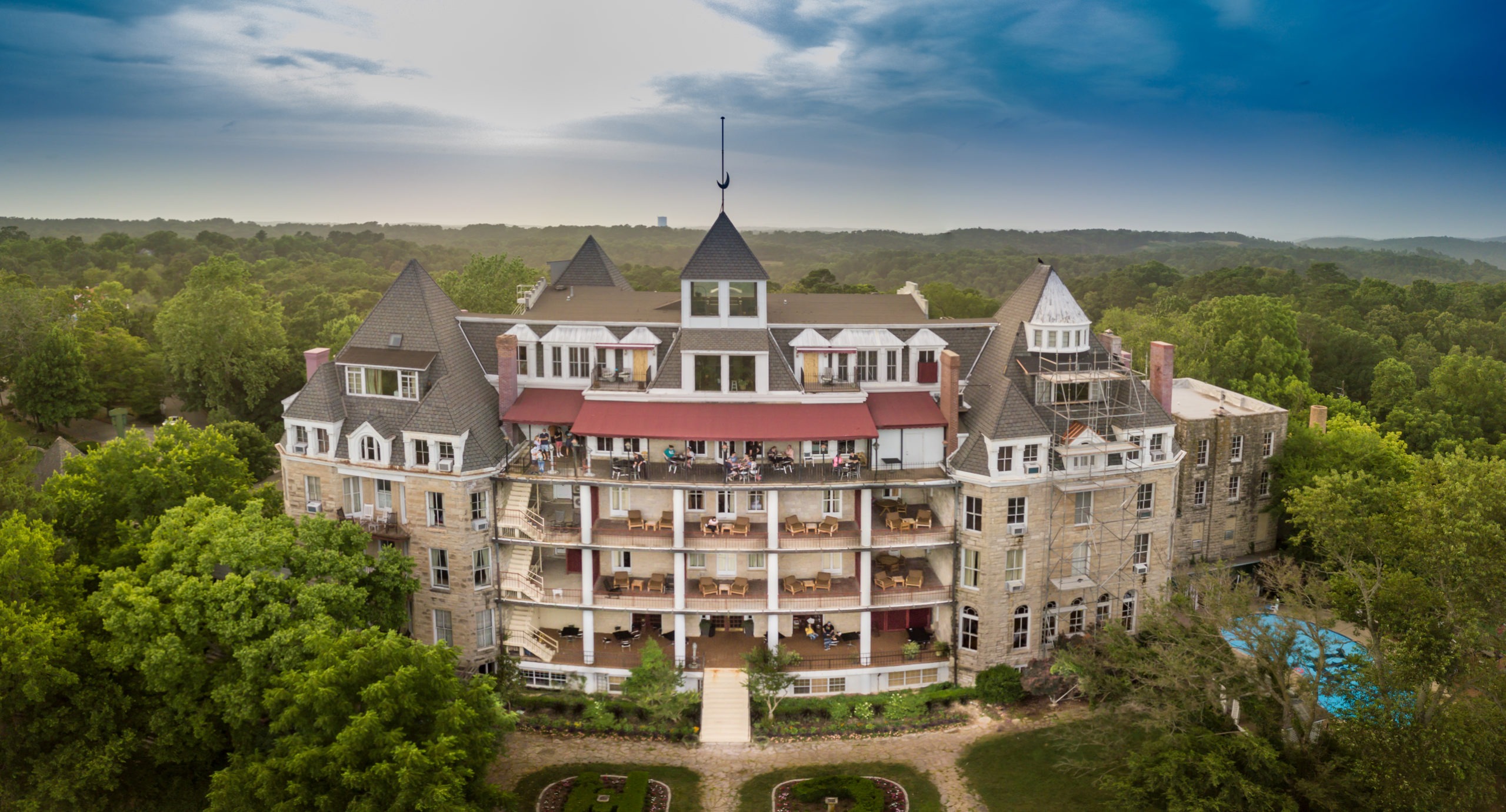
The Crescent Hotel
Perched on the crest of a limestone mountain overlooking the Victorian village of Eureka Springs, Arkansas, the 1886 Crescent Hotel commands the Ozark skyline like something lifted from a Gothic novel and dropped into the middle of the Bible Belt. Built from hand-cut limestone blocks so precisely fitted they required no mortar, the hotel rises in a blend of Richardsonian Romanesque and French Renaissance styling—arched windows, turrets, broad verandas, and a presence that can be seen from nearly anywhere in town. It was designed by architect Isaac S. Taylor, who would later design buildings for the 1904 St. Louis World's Fair, and funded by the Eureka Springs Improvement Company under former Arkansas governor Powell Clayton. When its doors opened on May 20, 1886, six hundred guests arrived from six states, greeted by a band stationed at the train depot. Eureka Springs had boomed almost overnight after its founding in 1879, drawn by sixty natural mineral springs that Native Americans had long known and that white settlers began marketing as miracle cures. By 1880, over fifteen thousand people had descended on the area. The Crescent was built to serve that wave—a luxury resort at nearly $300,000, the equivalent of roughly eight million dollars today. For its first two decades it operated as an exclusive destination, but interest in the springs faded, and the hotel couldn't sustain itself through the off-seasons. By 1902 it had been leased to the Frisco Railway. In 1908, it was converted into the Crescent College and Conservatory for Young Women, reportedly one of the finest women's seminaries in the country. That institution closed in 1924 for lack of funding, and a successor junior college folded during the Depression. By the mid-1930s, the grand hotel sat vacant and deteriorating. Then came Norman Baker. A former vaudeville performer and radio showman from Muscatine, Iowa, Baker had no medical training whatsoever but had already operated a fraudulent cancer clinic in his home state before being driven out. In 1937 he purchased the Crescent for $40,000 and transformed it into Baker's Cancer Curing Hospital, painting the interior in garish lavender and broadcasting his claims over the airwaves. His so-called treatments centered on injections of a concoction he called Formula 5—a mix of alcohol, carbolic acid, watermelon seed, corn silk, and clover leaves—administered up to seven times daily. Patients arrived from across the country, many spending their life savings on the promise of a painless cure. What they received was theater. At least forty-four patients died during the twenty months the hospital operated, their bodies moved to a basement morgue fashioned from the hotel's original kitchen, stored in the walk-in freezer. In 1940, federal authorities arrested Baker for mail fraud. He served four years in prison and died in Florida in 1958—of liver cancer. The hotel sat empty again until 1946, when new owners restored it to its original purpose. The paranormal reputation of the Crescent begins not with Baker but with the building itself. During construction in the 1880s, an Irish stonemason reportedly fell to his death from the upper framework into what is now Room 218. Staff have long referred to his spirit as Michael, and the room remains the most consistently active in the hotel. Guests report doors opening and slamming shut, pounding in the walls, the sound of a man falling through the ceiling, and, most disturbingly, hands emerging from the bathroom mirror. Room 419—known as Theodora's room—is associated with a former Baker patient who also worked as a hospital assistant. Guests find her straightening furniture or fumbling at the door as though searching for her key. On the third floor, witnesses describe the sound of squeaking wheels and the apparition of a nurse pushing a gurney down the corridor, only to watch it vanish. A young boy called Breckie, believed to have died from complications of appendicitis, has been seen bouncing a red ball on the second floor. In the hotel kitchen, a former chef reported pots and pans flying from their hooks, and another staff member witnessed a boy in old-fashioned knickers skipping through the room. Even Baker himself has reportedly been seen, appearing in his trademark white linen suit near the basement morgue. The morgue itself—still containing Baker's original autopsy table and walk-in cold storage—produces some of the most intense reports. Visitors describe oppressive atmosphere, sudden temperature drops, shadowy figures near the examination area, and the sensation of being touched by unseen hands. In 2019, groundskeepers digging near the hotel unearthed hundreds of glass bottles—remnants of Baker's operation—some containing preserved human tissue later confirmed by pathologists at the University of Arkansas for Medical Sciences. The discovery seemed to intensify reported activity, particularly in and around the morgue. Today the Crescent Hotel is owned by Elise Roenigk, who along with her late husband Marty purchased the property in 1997 for $1.3 million and undertook a six-year restoration. The hotel was listed on the National Register of Historic Places in 2016 and operates as a full-service resort and spa. It runs nightly ghost tours that draw over thirty-five thousand visitors annually, and hosts the Eureka Springs Paranormal Weekend each January. The morgue is open for public viewing. Room 218 books months in advance. The Crescent doesn't hide from what it is. It sets a place at the table for it.
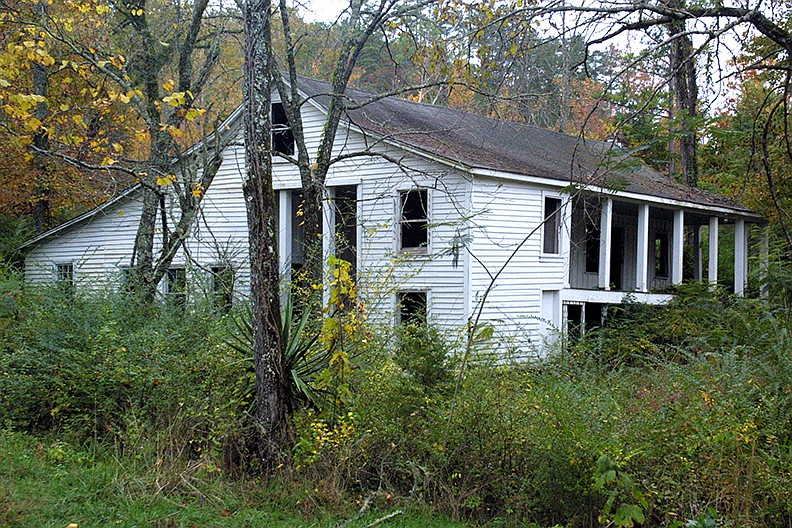
Mayberry Hotel
On Highway 270 between Hot Springs and Mount Ida, roughly five miles east of Crystal Springs near the Garland-Montgomery County line, a site once stood that carried more than a century and a half of traveler history, frontier violence, and local legend deep enough to outlast the building itself. The Mayberry Springs Inn—sometimes called the Mayberry Hotel—burned down on May 30, 2009, but the stories attached to the property have proven far more durable than its wood-frame walls. The site's documented history reaches back to at least 1850, when it served as a stagecoach stop and bathhouse along the route connecting Hot Springs to points west. The location was valued in part for three natural springs on the property, which Native Americans had used long before European settlement. The springs were believed to possess curative properties—one was said to treat kidney ailments, another to restore failing eyesight. There is at least one documented case of a woman who reportedly regained her vision through use of the waters. David Mayberry, who had inherited his fortune from his father, traveled to the area from Tennessee around the 1830s and established the inn to accommodate the travelers and tourists arriving by stagecoach. The main surviving structure before the fire was a single-story wood-frame building with vernacular Greek Revival styling, a shed-roof porch extending across the front, probably built around 1895 on the older site. Historic archaeological remains at the property included cabin foundations and multiple wellheads from earlier periods of habitation. The property was listed on the National Register of Historic Places in 1990, though the listing was removed in 2022 following the building's destruction. The inn's heyday coincided with the mining boom that swept through the region after the Civil War, when silver strikes at Silver City, Joplin, and Bear drew prospectors and freight traffic through the area. Coaches and wagons passed through Mayberry Springs to reach the road to Bear, and the boarding house became a lucrative operation for David Mayberry and his family. The influx of miners and prospectors brought whiskey, gambling, and violence. According to local accounts, outlaws would wait for guests to settle into their rooms before raiding the inn—robbing those who had money and, as legend tells it, killing those who did not. One victim's bloodstain reportedly proved impossible to clean from the floor and was eventually painted over. Stagecoach travel through the region was dangerous by any measure, and local historian John J. Archibald has noted that several people are documented as having been murdered at or near the site after arriving by coach. The most widely circulated legend associated with the property involves David Mayberry himself. According to the story, Mayberry was shot during one of the inn's violent episodes. Though he survived, the injury allegedly triggered a descent into mental instability described in local lore as schizophrenia. In his deteriorated state, the legend holds that Mayberry stabbed his wife to death and burned her body in the fireplace, then drowned their young son. This account has been repeated across paranormal databases and haunted-location guides for decades. However, it should be noted that local historian John J. Archibald, speaking from the Mayberry Springs site for the Hot Springs Sentinel-Record in 2020, identified the tale of Mayberry murdering his wife and burning her body as fictional. Members of the Mayberry family have also publicly disputed the story, stating that David Mayberry never had a mental illness and never murdered anyone, and have called the accounts slanderous to his character. What is documented is that David Mayberry died in 1881 and that the legends surrounding the property proliferated after his death. Regardless of which specific stories are grounded in fact, the paranormal claims at the site have been remarkably consistent. Before the building burned, visitors reported hearing the sound of a woman crying, particularly around midnight. Screaming was reported emanating from a bathtub in the basement. The fireplace, which remained intact through the building's later years, displayed what some described as a cryptic message on the wall above it. Shadowy figures were seen inside and around the structure, and visitors reported a pervasive sense of unease on the property, particularly after dark. As one local publication described it, the inn's white-columned facade was picturesque in daylight but became something closer to an apparition at night. In its final decades, the property also gained a reputation as a gathering place for gambling, with some locals recounting that it had served as a Mafia-connected operation. Several small shacks once stood to the left of the main building, separated by a dirt driveway, adding to the compound's atmosphere of layered and not entirely explainable use. Today the main structure is gone, claimed by fire. The springs still exist behind the site, encased in concrete. The property is marked with caution tape and visible from the highway, though easier to spot heading west than east due to a curve in the road. The archaeological remains beneath the surface—cabin foundations, wellheads, and whatever else the ground holds from a century and a half of occupation—are presumably still intact. Whether the spirits that visitors reported before 2009 departed with the building or remain attached to the land itself is an open question, but at Mayberry Springs the history of violence, healing, and human desperation was always more about the ground than the walls built on top of it.

Evergreen Cemetery
The Soldiers National Museum in Gettysburg, Pennsylvania occupies a structure with profound historical significance relating directly to the American Civil War and specifically to the Soldiers' National Orphanage established to provide shelter and education to children orphaned by the conflict. The building represents architectural and institutional continuity with the American Civil War era, constructed deliberately to serve humanitarian purposes supporting vulnerable populations created by the devastating war's enormous casualties and societal disruption. Gettysburg itself emerged as the epicenter of American Civil War focus following the three-day Battle of Gettysburg in July 1863, which resulted in approximately 51,000 casualties and effectively represented the crucial turning point in the war's trajectory and outcome. The Soldiers' National Orphanage served as an essential institution addressing the humanitarian crisis created by the war, providing structure and support to displaced and orphaned children lacking conventional family support systems. The museum subsequently transformed the historical orphanage structure into an interpretive facility dedicated to documenting Civil War history, military institutional development, and the profound experiences of those affected by the conflict. The paranormal reputation of the Soldiers National Museum centers upon Rosa Carmichael, a spirit entity manifesting consistently throughout the building structure with particular concentration in subterranean spaces and basement areas of the historical complex. The museum's paranormal phenomena concentrate with particular intensity within the dungeon, basement, and associated subterranean structures underlying the building, suggesting traumatic events, emotional distress, or tragic circumstances associated with these lower levels created particularly strong spiritual manifestations. Rosa Carmichael's identity, her relationship to the orphanage institution, and the specific circumstances of her death or paranormal attachment remain subjects of ongoing paranormal research and historical investigation by researchers and paranormal enthusiasts. The basement and dungeon areas allegedly functioned as spaces associated with discipline, punishment, confinement, or other institutional practices that may have created emotional trauma contributing to Rosa's spiritual manifestation and ongoing paranormal presence. Paranormal researchers conducting investigations within these subterranean spaces have documented unexplained phenomena persisting despite the structural separation from upper floors. Disembodied voices captured on electronic recording equipment suggest attempted communication or manifestation of habitual vocalizations from historical periods when the orphanage operated actively. Apparitions of humanoid figures have been observed, described as solid-appearing entities materializing briefly before dissipating when approached or directly observed by investigators and visitors. Poltergeist activity—spontaneous movement of objects without mechanical cause—has been documented throughout the basement and dungeon areas, suggesting powerful energy manifestations concentrated within these subterranean zones. The dungeon itself represents one of the most intensely haunted zones, with visitors descending into the dungeon frequently reporting overwhelming sensations of dread, unexplained fear, sudden emotional shifts, and psychological distress that dissipates immediately upon exiting the space. Paranormal investigators equipped with electronic equipment have detected unusual electromagnetic fluctuations, unexplained temperature variations, and potential electronic voice phenomena within the dungeon exceeding phenomena documented in surface level rooms. Today, the Soldiers National Museum continues functioning as a historical and interpretive institution dedicated to Civil War history and the experiences of soldiers and civilian populations affected by the conflict and its enormous casualties. The paranormal reputation has been acknowledged in paranormal research literature and has attracted paranormal researchers conducting investigations within the building structure and its subterranean spaces. Museum management has accommodated carefully conducted paranormal investigations recognizing the research value of documenting phenomena, though access to dungeon and basement areas has been carefully controlled to balance paranormal research interests with preservation of the historical structures. Rosa Carmichael's spirit shows continuity in paranormal manifestations, with no indication of diminished activity or spiritual departure despite contemporary institutional functions and historical reinterpretation efforts by the museum.
Liberty Baptist Church Cemetery
Liberty Baptist Church Cemetery in Batesville, Arkansas stands as one of the state's most actively haunted burial grounds, a site where multiple distinct paranormal entities manifest with sufficient frequency and consistency to establish it as a premier location for paranormal investigation and study. The cemetery, which serves as the final resting place for generations of community members extending back to the church's founding, encompasses several acres of consecrated ground marked with graves spanning the nineteenth, twentieth, and twenty-first centuries. The surrounding landscape, characterized by mature trees and the church structure itself looming in proximity to the burial grounds, creates an atmosphere conducive to paranormal manifestation and investigation. The combination of historical depth, accumulated burials, and the spiritual significance of the location as sacred ground dedicated to commemoration of the deceased appears to have established conditions under which paranormal phenomena manifest with greater frequency and intensity than at many other locations. The primary paranormal phenomena at Liberty Baptist Church Cemetery center upon the apparition of an elderly woman who has been repeatedly observed standing within an upstairs window of the church structure itself, rocking in a chair whose presence and movement are documented by multiple independent witnesses. This elderly woman's apparition appears clothed in period clothing consistent with dress from the mid to late twentieth century, and her manifestation in the window is characterized by the gentle, repetitive motion of the rocking chair, suggesting peaceful activity rather than agitation or distress. The consistency of her appearance in the window, combined with the distinctive nature of her manifestation, has established her as the church's most recognizable ghost and the primary focus of local paranormal narratives. Researchers and investigators have reported sighting her within the window during evening hours and night investigations, with some suggesting her repeated appearance represents a form of benign haunting where the spirit continues peaceful activities characteristic of her life. The rocking chair and window manifestation have become iconic elements of the cemetery's paranormal reputation, attracting visitors specifically hoping to witness the elderly woman's apparition. Beyond the elderly woman in the window, investigators and visitors to Liberty Baptist Church Cemetery have documented the presence of additional spectral entities, including the apparition of a young woman who died under tragic or violent circumstances during the early twentieth century. This younger female apparition has been observed in various locations throughout the cemetery grounds, with manifestations suggesting agitation or distress distinct from the peaceful manifestation of the elderly woman in the window. Accounts describe her appearance in photographs and documentation of her presence through other paranormal phenomena, establishing her as a second primary entity inhabiting the location. The circumstances surrounding her death apparently involve tragedy or violence that has left her spirit restless and unable to achieve the peaceful state suggested by the elderly woman's manifestation. A third apparition documented at the cemetery involves the spirit of a small boy whose manifestation has been captured in photographs taken throughout the grounds, appearing as a translucent child figure visible in images despite being absent during the original moment of photography. The photographic documentation of paranormal manifestations at Liberty Baptist Church Cemetery represents some of the most compelling evidence of the location's paranormal activity, with images depicting apparitions and anomalies that cannot be readily explained through conventional photographic phenomena or technical malfunction. Paranormal researchers and investigators have documented the small boy's apparition appearing in photographs on multiple occasions, with the consistency of his appearance across different photographs and investigation sessions suggesting genuine paranormal manifestation rather than isolated photographic artifact. These images contribute to the cemetery's recognition as a legitimate paranormal hotspot and provide tangible documentation of phenomena that might otherwise rely solely upon eyewitness accounts. The combination of multiple apparitions, consistent manifestations across time, and photographic evidence establishes Liberty Baptist Church Cemetery as one of Arkansas's most definitively haunted locations. Additional phenomena documented at the cemetery include mysterious lights manifesting in various locations throughout the grounds, with witnesses reporting eerie illuminations that appear and disappear without apparent source or causation. Most notably, multiple visitors have reported witnessing lights turning on and off mysteriously in the church building itself, suggesting poltergeist activity or intelligent manipulation of the electrical systems. These light phenomena add another layer to the paranormal manifestations already documented, expanding the repertoire of phenomena beyond the visible apparitions to include environmental interactions suggesting active engagement by spiritual entities. Liberty Baptist Church Cemetery has gained recognition among paranormal investigators and enthusiasts as one of Arkansas's most haunted cemeteries, attracting regular investigation and visitation from those seeking to document and understand the phenomena. The location serves as a focus for paranormal research and continues to produce new accounts and documentation from visitors and investigators, establishing it as one of the most consistently and actively haunted burial grounds in the American South.
Arkansas Methodist Medical Center
The Arkansas Methodist Medical Center stands as a medical facility and hospital institution in Paragould, Arkansas, dedicated to providing healthcare services, emergency care, surgical procedures, and inpatient hospitalization to the regional population requiring medical treatment and institutional care. The structure encompasses multiple floors of patient rooms, intensive care units, surgical suites, laboratory spaces, imaging departments, emergency facilities, and administrative offices organized to serve the comprehensive medical needs of the institution's patient population. The architectural character of the building reflects medical facility design principles, with particular attention to circulation patterns facilitating efficient movement between departments and the accommodation of medical equipment and monitoring systems necessary for contemporary healthcare delivery. The institution has served the medical needs of the region across multiple decades of operation, providing emergency care to trauma and acute care patients, specialized surgical procedures, and the ongoing treatment of chronic conditions and complex medical situations. The basement levels of the structure serve utility functions including mechanical systems, storage, and support infrastructure required for the functioning of a contemporary medical facility. Like other medical institutions, the Arkansas Methodist Medical Center maintains the fundamental tension between its role as a healing institution and the reality that hospitals are locations where death frequently occurs and where human suffering is concentrated in physical and psychological intensity. The paranormal history of Arkansas Methodist Medical Center is deeply intertwined with the deaths and suffering that have occurred within its walls, creating what appears to be a spiritually charged environment where multiple entities remain bound to the location by various factors. A young blond boy, identified as approximately five years of age, is understood to manifest his presence throughout the facility, appearing in apparition form while dressed in pajamas suggestive of hospital patient clothing. The identity and circumstances of this child's death remain subject to investigation, though his youthful appearance and hospital garb suggest that he was a pediatric patient who did not survive his medical condition or treatment. A Confederate soldier from the American Civil War era is also understood to inhabit the facility, representing a temporal layer extending back more than one hundred and fifty years and suggesting some form of attachment to the location rooted in historical trauma or unresolved spiritual need. An elderly woman apparition has been documented within the facility, though her specific identity and circumstances of death remain unclear. A nurse in a white gown, distinctive in her professional attire and apparently representing the healthcare workers of an earlier era, is understood to remain present within the facility, continuing in some spectral form the professional duties and presence that characterized her living career. These four primary entities create a diverse paranormal population reflecting different ages, eras, and relationships to the medical institution. The paranormal phenomena at Arkansas Methodist Medical Center are distributed across multiple floors and functional areas of the facility, with particular concentration in locations where medical treatment, patient care, and death have occurred. The fourth floor and fifth floor have emerged as particular focal points for paranormal activity, with documented phenomena suggesting the presence of multiple entities and their ongoing manifestations. The morgue hall, a location directly associated with death and the bodies of the deceased, has become a location of particular paranormal intensity, suggesting that the proximity to death and the ritual handling of deceased bodies may serve as an attracting force for non-physical entities. Laboratory areas have documented inexplicable phenomena, suggesting that the paranormal presence extends throughout the medical institution rather than being confined to patient care areas. The basement areas of the facility have generated reports of unexplained presence and phenomena, though the specific manifestations documented in the lower levels remain somewhat less defined than those on the patient care floors. Mysterious voices call out names and utterances without visible source, suggesting either the presence of residual communication attempts or the conscious attempts of spirits to interact with and communicate with the living. The young blond boy has been observed playing, suggesting that his spirit maintains childlike characteristics and behavioral patterns despite his physical death. The presence of the white-gowned nurse figure suggests that healthcare workers' identities become so bound to their professional roles that their spiritual presence persists in the location where they performed their duties during life. Today, Arkansas Methodist Medical Center continues to function as a medical facility and hospital providing healthcare services to the regional population while simultaneously operating as a location of active paranormal manifestation. Patients, families, medical staff, and visitors to the facility encounter the paranormal environment created by the presence of the young blond boy, the Confederate soldier, the elderly woman, and the nurse in the white gown. Staff members have adapted to the presence of these entities, incorporating them into the unofficial narrative of the institution and the experiences shared among those who work within the facility. The facility has acquired a reputation within paranormal research communities as a significant location for paranormal investigation and documentation, attracting investigators interested in medical facility hauntings and the intersection of healthcare, death, and paranormal manifestation. The patient care functions of the institution continue simultaneously with the presence of entities understood to be neither living nor truly departed, creating a complex environment where healing, suffering, death, and paranormal manifestation intersect in the daily operations of the medical facility.
Jones Cemetery
Jones Cemetery in Camden, Arkansas exists as one of region's most historically fraught burial grounds whose paranormal reputation extends beyond typical cemetery hauntings encompassing dark historical events at cemetery itself and residence across street. Establishment reflects historical patterns of rural Arkansas with burials continuing across generations. Cemetery grounds contain remains experiencing full spectrum of human experience from peaceful natural deaths to sudden violent terminations through accident or murder. Particular notoriety derives from systematic abuse and murder of young girl in house across street, historical crime whose emotional and spiritual consequences profoundly affected paranormal character. Spatial proximity of crime location to cemetery combined with victim's vulnerability created conditions for paranormal manifestations of exceptional emotional intensity. Primary entity associated with phenomena believed to be young girl experiencing severe abuse, malnutrition, and violent death at household hands. Historical record remains frustratingly incomplete with formal documentation limited by time period and cultural factors suppressing allegations. Contemporary paranormal investigation and historical research attempted reconstructing girl's life and death through archival research and oral histories. Her manifestations suggest consciousness retaining full awareness of suffering and death maintaining powerful emotional investment ensuring tragic story neither forgotten nor minimized. Paranormal intensity appears directly proportional to girl's emotional vulnerability and fact her suffering occurred in confinement and constraint. Voices emanate from cemetery grounds and adjacent street with witnesses reporting young girl calling out in distress, crying with apparent anguish, and producing vocalizations consistent with child experiencing pain or fear. Clarity and specificity documented through multiple recording attempts with audio equipment capturing disembodied voices exhibiting acoustic characteristics impossible to replicate. Voices frequently convey specific information about girl's suffering with some accounts reporting spirit verbally identifying individuals responsible and describing specific captivity events. Emotional intensity conveyed through vocal manifestations causes listeners reporting profound psychological distress, empathic protective anger, and overwhelming grief associated with injustice. Apparitional phenomena include frequent manifestation of young girl in period-consistent clothing appearing during evening and night hours near cemetery and street. Apparition frequently appears distressed with manifestations including apparent struggling movements or escape attempts. Multiple witnesses report observing ghostly thin malnourished child with visible evidence of neglect and abuse supporting theories spirit locked in traumatic final period. Frequency and consistency proved sufficient attracting paranormal researchers and historians with multiple documentation efforts confirming visual phenomena across varied conditions. Apparition appears particularly active during periods when child abuse or historical injustice awareness becomes prominent as if spirit responds to contemporary emphasis on child protection. Jones Cemetery coexists with paranormal manifestations of Confederate soldier whose presence reported at cemetery though documentation substantially less complete than girl's hauntings. Confederate soldier represents less emotionally engaged less forcefully manifesting entity with reports focusing on visual sightings and occasional auditory phenomena. Possible relationship remains unclear though researchers speculate soldier may have witnessed or connected to girl's abuse circumstances. Coexistence illustrates complexity of historical trauma and spiritual consequences with location serving as repository for anguished remains of multiple violence victims. Jones Cemetery continues serving as active burial ground for Camden community maintaining reputation as significant paranormal activity location. Local historians expanded research efforts utilizing oral histories and paranormal findings constructing complete historical narrative. Cemetery became destination for paranormal researchers conducting regular investigations. Community members became engaged with historical narrative viewing girl's commemoration as part of broader cultural commitment acknowledging injustice and supporting vulnerable population protection. Paranormal phenomena serve as persistent reminder of historical violence and suffering ensuring contemporary residents cannot ignore community's dark chapters.
Bono Bridge
Bono Bridge crosses rail infrastructure in Arkansas as a location that has accumulated one of the most disturbing sets of paranormal legends associated with any bridge structure in the American south, carrying within its physical form and the surrounding rail lines evidence of a tragedy centered on a young victim. The bridge itself is relatively unremarkable in its architecture and construction, a functional structure designed to carry vehicular traffic across railroad tracks in a location that would otherwise appear entirely ordinary to the casual observer passing through. The area surrounding the bridge, particularly the railroad tracks below and the bridge's railings, has become the focal point of paranormal investigation activity and the collection of witness testimonies documenting manifestations of particular intensity and specificity. The geographical isolation of Bono Bridge and its positioning within Arkansas's network of paranormal hotspots has made it a regular destination for both amateur and professional paranormal research teams seeking to document the activity that accumulates at this specific location. The historical catalyst for Bono Bridge's notoriety stems from a tragedy involving a young girl whose death and the circumstances surrounding it remain officially unclear or undocumented within mainstream historical records, existing instead within the collective memory of local communities and the extensive documentation maintained by paranormal investigators. Historical accounts, pieced together from fragmentary local sources and paranormal databases, suggest the girl's death may have been connected to ritualistic practices of a nature that defies conventional explanation and suggests circumstances far more disturbing than accidental death. The positioning of the victim's body at or near the rail lines, combined with evidence of ritual artifacts discovered in the vicinity, has led paranormal researchers to classify this as a location marked by intentional spiritual trauma rather than accident or natural death. The presence of multiple independent accounts describing similar phenomena across different time periods suggests a pattern of haunting that has persisted for decades, with the intensity and nature of the manifestations remaining remarkably consistent despite the passage of years. Paranormal activity at Bono Bridge has been documented with remarkable consistency by multiple independent investigation teams and casual witnesses reporting spontaneous experiences during visits to the location. The most frequently reported phenomenon involves the apparition of a young girl, typically described as transparent or semi-corporeal, appearing on or near the railroad tracks in the vicinity of the bridge structure itself. Witnesses consistently describe the apparition as wearing period clothing of indeterminate age, though the style suggests origins sometime in the historical past rather than recent decades. The apparition is frequently accompanied by unexplained screams of considerable distress and intensity, with multiple witnesses describing the sound as emanating from a child's voice experiencing acute terror or pain. The phenomenon most dramatically manifests at midnight hours, with consistent reports of the apparition appearing directly on the rail tracks in apparent reenactment of the final moments before an oncoming train, leading some witnesses to describe the experience as the manifestation of a traumatic moment preserved in the location's spiritual resonance. The ritualistic dimensions of the events associated with Bono Bridge have been emphasized by paranormal investigators who have discovered artifacts and documentation suggesting the girl's death may have been preceded or accompanied by ritual activity designed to bind her spirit to the location. Satanic ritual artifacts have been recovered in the area surrounding the bridge, leading investigators to hypothesize a connection between organized ritual activity and the intense paranormal manifestations reported at the site. The combination of a young victim, traumatic death circumstances, and evidence of intentional ritual practices has led paranormal researchers to classify Bono Bridge among the locations with the most severe and spiritually damaging histories in American paranormal documentation. The present-day paranormal activity, characterized by consistent apparitional manifestations and repeated screaming phenomena, appears to represent an echo of the trauma and ritual abuse that terminated in the girl's death at this location. The bridge continues to attract paranormal investigation teams from throughout the region seeking to document the haunting activity and potentially offer assistance or closure to the trapped spirit whose presence continues to manifest with distressing regularity at midnight hours.
Arlington Resort Hotel
The Arlington Resort Hotel stands as one of Hot Springs, Arkansas's most iconic hospitality establishments serving visitors seeking thermal spring therapeutic benefits for nearly one hundred fifty years. Constructed in 1875 as premier wealthy tourist destination for naturally heated water seekers, the Arlington represented extraordinary luxury accommodations investment. The original structure exemplified Gilded Age architecture with ornate details and commanding Central Avenue presence establishing it as Hot Springs' primary hospitality anchor. The building underwent numerous renovations and expansions reflecting evolving luxury standards by successive generations. Despite modernizations, the Arlington maintained original character creating environment where historical authenticity and contemporary comfort coexist. The hotel's premier status made it ideal location for documented paranormal phenomena with numerous guests recording spirit encounters. Paranormal manifestations represent remarkably complex haunting involving multiple distinct spiritual entities each with unique characteristics and behavioral patterns. Most prominently documented entity is young girl in pink dress whose apparition observed repeatedly throughout hotel by guests and staff. The girl appears approximately seven to ten years old suggesting consciousness bound to hotel during or after death. Spiritual presence particularly active in lobby and common areas with apparition frequently appearing playing or observing guests. Her manifestations carry emotional quality of innocence and playfulness rather than distress distinguishing her from violent paranormal entities. Second prominent entity is woman in white wedding dress appearing frequently in upper floors and hallway sections. This bridal spirit suggests tragic wedding circumstance with researchers speculating about specific tragedy and spiritual entrapment. Bride in white frequently appears near windows overlooking hotel exterior as if eternally searching for someone from death day. Her manifestations accompanied by melancholic emotional atmosphere creating overwhelming sense of romantic loss and unfulfilled potential. Most intriguing entity is bellhop ghost in Room 443, commonly called Capone Suite due to Al Capone's alleged connection. Bellhop spirit believed to be hotel employee who died under obscured circumstances. Manifestation characterized by persistent odor of expensive cigars emanating from room regardless of occupancy status. Cigar smell sufficiently strong that housekeeping staff and guests consistently report it. Bellhop's presence marked by unpredictable electrical fixture and water system manipulation with faucets turning on and off without human intervention. Paranormal phenomena throughout Arlington Resort extend beyond three primary documented entities encompassing additional manifestations. Guests report ghostly laughter echoing through hallways when hotel relatively quiet. Lights exhibit erratic behavior flickering on and off according to patterns appearing responsive to guest presence. Water systems turn on spontaneously in empty rooms. Elevator systems particularly associated with paranormal phenomena with guests reporting encounters with apparitions, cold spots, and distinctive presence. The Arlington Resort Hotel embraced its haunted reputation incorporating paranormal phenomena into marketing and operations. Hotel implemented policies regarding ghost tours, midnight investigations, and paranormal experiences maximizing guest engagement while maintaining safe treatment of spiritual entities. Staff training includes protocols for managing paranormal encounter guest experiences and providing historical context. Room 443 and high-frequency paranormal activity areas became premium accommodations with guests specifically requesting these rooms. Hotel partnered with paranormal investigation teams conducting regular documented investigations advancing understanding of complex multi-entity hauntings. Arlington exemplifies how historical tragedy and cultural engagement transform hotels into unique paranormal destinations.
Cameo Trio Theatre
The Cameo Trio Theatre in Magnolia, Arkansas stands as a historic cinema establishment in the Columbia County community, representing the architectural and cultural heritage of rural Arkansas during the era when motion pictures provided the primary entertainment source for communities across the American South. The theater was constructed during the golden age of American cinema, when small towns invested in dedicated movie palaces as symbols of civic advancement and cultural sophistication. The Cameo Theatre, like thousands of similar establishments throughout America during the early twentieth century, was designed to provide comfortable seating, quality projection equipment, and an atmosphere of leisure and entertainment for patrons seeking escape from agricultural labor and rural demands. Magnolia developed as a community in the pine forest region of southern Arkansas, with the local economy historically dependent on timber harvesting, sawmill operations, and agriculture that provided steady employment and income for residents. The establishment of the Cameo Trio Theatre reflected the community's desire to provide cultural amenities and entertainment options, transforming the downtown area into a more vibrant commercial district. The theater's construction and operation coincided with the broader modernization of rural American communities, as electricity, improved transportation, and technological advancement began to reach previously isolated communities. Throughout its operational history, the Cameo Trio Theatre served as a cultural and social anchor for the Magnolia community, providing employment for local residents in projection, concession, and ticket sales positions. The theater survived the technological transition from silent films to talkies and the introduction of color cinematography. Like many rural theaters, the Cameo faced competition from larger multiplexes and the rise of television and home video technology, competitive pressures that challenged the sustainability of single-screen theaters in small communities. The theater's operational history reflects the broader narrative of American cinema, with the rise of dedicated cinema establishments followed by gradual decline and closure of many theaters. The paranormal history of the Cameo Trio Theatre, in contrast to many other historic theaters in America, appears to be relatively quiet and undocumented, with minimal accounts of unusual phenomena or ghost manifestations reported by visitors or staff members. Research reveals no documented deaths, tragic incidents, or circumstances that would typically be associated with theatrical hauntings, suggesting that the property may lack the specific conditions or historical traumas that tend to create paranormal manifestations at similar locations. The absence of documented paranormal activity at the Cameo Trio Theatre, despite its historic age and long operational history, presents an interesting contrast to other theaters that have become well-known paranormal locations. The Cameo Trio Theatre in Magnolia represents the thousands of small-town movie theaters that served American communities during the cinema era, establishments that played important cultural roles despite lacking the architectural grandeur or historical drama associated with paranormal theaters in larger cities. The theater's relatively quiet existence, unmarked by significant paranormal phenomena or tragic incidents, suggests that historical and emotional residue alone do not necessarily create conditions conducive to haunting. Genuine paranormal manifestations may require specific circumstances including trauma, violent death, or powerful unresolved emotional states at the time of death. The Cameo Trio Theatre stands as a testament to the importance of local cultural institutions in developing community identity and social cohesion.
Springfield – Des Arc Bridge
The Des Arc Bridge spanning Springfield, Arkansas represents a historic transportation structure crossing the Des Arc River and connecting communities separated by the waterway, functioning as a vital infrastructure element throughout the region's development and settlement patterns across many generations. The bridge itself underwent relocation or reconstruction at various points in its history, with the physical bridge structure potentially moved to a new location while maintaining historical continuity and purpose, suggesting a complex history of engineering modifications and community transitions affecting the location and the broader region's infrastructure development. The Springfield Des Arc Bridge gained considerable paranormal notoriety through consistent and detailed witness accounts describing haunting phenomena apparently connected to tragic events that occurred at or near the bridge's location, events that apparently created powerful spiritual residues and attachments manifesting in ongoing paranormal manifestations visible to sensitive observers. The primary paranormal entities associated with the bridge include the spirit of a woman apparently fleeing from or pursuing some unknown threat, spirits of children whose deaths are connected to the location, a phantom infant whose cries have been heard by multiple witnesses across decades of continuous activity, and spectral hounds apparently pursuing the woman or other entities in a horrifying chase scene that repeats across time in perpetuity. The woman's spirit is described by witnesses as appearing in various states of distress and flight, as though perpetually fleeing from some danger or malevolent force that remains unseen by living witnesses but apparently present to the ghost inhabiting this tragic location. Multiple accounts describe the sound of a girl screaming emanating from the bridge area, a piercing cry of terror that witnesses have found deeply disturbing and suggestive of significant trauma or violent circumstances preceding the girl's death and subsequent spiritual attachment. The phantom cry of an infant has been reported by numerous witnesses approaching or crossing the bridge, a mournful sound that appears to originate from the bridge structure or immediate surroundings but vanishes upon investigation, leaving researchers unable to locate any living child or conventional source for the phenomena. Apparitions of children have materialized near the bridge, appearing as solid figures before fading or vanishing, their identities and circumstances of death unknown but their presence apparently substantial and historically significant to the location and its well-documented haunted reputation. Phantom footsteps have been documented by investigators and casual visitors, the sound of running feet crossing the bridge structure in patterns suggesting flight or pursuit, with the footsteps sometimes heard in conjunction with the woman's spectral form fleeing across the bridge in apparent desperation and fear. The sound of hounds pursuing across the bridge has been reported by multiple witnesses, with accounts describing the barking, howling, and baying of dogs accompanied by the sense of a chase in progress, perhaps reflecting historical circumstances of pursuit that resulted in tragedy and death on the structure. The Des Arc Bridge has become a significant paranormal location within Arkansas, attracting investigative interest and casual visitor attention, with the location's phenomena remaining largely unexplained despite extensive analysis and research efforts by multiple paranormal organizations investigating the concentrated haunting activity.
Opossum Walk Cemetery
Opossum Walk Cemetery stands as a centuries-old burial ground nestled in the remote hills of Coal Hill, Arkansas, its weathered headstones and iron fence bearing witness to generations of local families who sought eternal rest within its consecrated grounds. The cemetery takes its peculiar name from the abundant wildlife inhabiting the surrounding woodlands, though its earliest burials trace back to the pioneer era of the 1800s when settlers began establishing permanent communities in the Arkansas wilderness. The grounds encompass several acres of undulating terrain beneath towering oaks and pines that have grown to considerable size over more than a century. Historical records indicate the cemetery served multiple generations throughout the nineteenth and twentieth centuries, with burials representing various social classes and occupational backgrounds of the rural community. The cemetery experienced periods of neglect during the mid-twentieth century as family members relocated to urban centers and fewer individuals returned to maintain the burial sites of ancestors. Local historians note that some sections became overgrown with vegetation, and pathways fell into disrepair. Despite these periods of abandonment, the cemetery retained cultural and genealogical significance for families researching ancestral connections to the region, and efforts have been undertaken to restore and preserve the historical integrity of the burial ground. The establishment and expansion of the cemetery reflects broader patterns of settlement, community development, and demographic change that characterized rural Arkansas throughout the nineteenth and twentieth centuries. Paranormal activity documented at Opossum Walk Cemetery has drawn attention from both local residents and paranormal investigators seeking to understand unexplained phenomena occurring within the grounds. Multiple witnesses have reported encountering unusually hot iron gates during winter months, a phenomenon that occurs despite ambient temperatures well below freezing and lacking any apparent mechanical or natural explanation. Visitors have described sudden bursts of cold air manifesting without warning at the cemetery entrance, creating stark temperature fluctuations that contradict normal atmospheric conditions. Disembodied footsteps have been heard echoing across the grounds, particularly during evening hours, with witnesses reporting the sound of human footfalls upon soil and grass despite the absence of visible persons. Several apparitions have been sighted, including reports of a headless female figure manifesting near certain burial sections, an entity whose origins and identity remain subjects of speculation. The headless woman apparition represents one of the most consistently documented paranormal entities associated with the location, with multiple independent witnesses describing encounters across different time periods. The apparition has been observed moving through the grounds with apparent purposefulness, though her tragic disconnection from her physical form suggests violent or traumatic death. Historical records from the cemetery and broader Coal Hill area have been examined by paranormal researchers seeking to identify this entity, though definitive confirmation remains elusive due to gaps in historical documentation. Local folklore and oral traditions have developed around this apparition, with various explanations proposed ranging from nineteenth-century murder victims to women who perished in accidents and were subsequently buried within the cemetery grounds.
Woodson Lateral Road Ghost Lights
Woodson Lateral Road, a rural thoroughfare located twelve miles south of Little Rock in Pulaski County, Arkansas, extends through agricultural and sparsely developed landscape characteristic of southern Arkansas' rural regions during much of the twentieth century and continuing into the contemporary era. The road provides essential transportation access through areas that remained relatively undeveloped and rural despite geographic proximity to the state capital, creating an environment of relative isolation and wilderness even within the metropolitan region's geographical influence and sphere of development pressure. Throughout the latter twentieth century, the road gained recognition within paranormal investigation circles and American folklore for the appearance of mysterious luminescent phenomena that residents and travelers consistently reported observing during evening and nighttime hours with remarkable consistency. The primary paranormal legend associated with Woodson Lateral Road centers on a tragic incident involving a young couple returning from an evening spent at their high school's prom celebration, traveling by motorcycle along the rural road in the darkness following the conclusion of the formal dance event. According to the firmly established legend, the couple met with a fatal accident on Woodson Lateral Road, with their motorcycle colliding with obstacles or environmental hazards that resulted in both occupants suffering fatal injuries during the catastrophic incident. Following this tragic occurrence and the young couple's deaths, witnesses began reporting mysterious lights appearing along the roadway at night, with descriptions consistently matching the distinctive illumination characteristics of motorcycle lighting systems and vehicle headlights from that era. Observers consistently reported witnessing what appeared to be a white or yellow headlight beam piercing the darkness with distinct intensity before observing a red tail light appearing behind, despite the complete and verifiable absence of any actual motorcycle or vehicle present on the road to produce such illumination. The reported lights exhibited behavior entirely suggesting purposeful movement and apparent response to approaching vehicles, with witnesses describing the phenomenon as following their cars as they traversed the affected sections of road, appearing to pursue travelers along the highway corridor. A secondary paranormal legend associated with Woodson Lateral Road involves detailed reports of a phantom hitchhiker apparition taking the distinct form of a young woman dressed in vintage prom attire, described as wearing a white or pale colored dress and leather motorcycle jacket typical of the era, soliciting rides from drivers traveling the road during evening hours. Witnesses report picking up the apparent hitchhiker who subsequently disappears from their vehicles either upon arrival at requested destinations or during the journey itself, leaving drivers with unexplained gaps in their recollections and lingering uncertainties regarding the encounter's objective reality. Paranormal researchers have noted the consistency of reported phenomena across multiple decades of documented observations, establishing Woodson Lateral Road as one of Arkansas' most consistently reported and well-documented ghost light locations within the paranormal research community. Some investigators have proposed scientific explanations suggesting that swamp gases or chemical atmospheric conditions, combined with reflections of vehicle headlights on water surfaces or atmospheric moisture and fog conditions, might produce the luminescent phenomena reported by witnesses. Nevertheless, the accumulated reports from multiple independent observers and the remarkable specificity and consistency of descriptions provided by diverse witnesses have maintained Woodson Lateral Road's enduring status as a location of extensively documented paranormal activity.
Crossett Railroad Tracks
The Crossett Railroad Tracks in Ashley County, Arkansas represent a location where the boundary between the physical and paranormal worlds appears unusually permeable, a place where documented paranormal phenomena have persisted for over a century with such consistency and widespread corroboration that the phenomenon has earned scientific attention and historical documentation. The railroad tracks follow a route established during the nineteenth-century expansion of rail transportation through Arkansas, connecting communities and facilitating commerce in a region previously accessible only by water or primitive roads. The specific stretch of track near Crossett gained prominence in local folklore and paranormal databases not through a single documented event but through the recurring manifestation of an unexplained luminous phenomenon that appears with sufficient regularity to be reliably observed and photographed. The Crossett Light, as the phenomenon became known, represents one of many similar spooklight phenomena documented across North America, including comparable phenomena in Joplin, Missouri; Senath, Missouri; and Gurdon, Arkansas, suggesting either a shared natural explanation or a widespread pattern of residual hauntings associated with railroad-related deaths. Historical accounts attribute the origin of the Crossett Light phenomenon to a tragic railroad accident during the early twentieth century involving a railroad brakeman whose identity has been lost to history but whose fate created a legendary ghost. According to accounts passed down through generations of local residents and railroad workers, the brakeman was decapitated by a moving train, his severed head separated from his body and presumably lost or buried in an unmarked location adjacent to the tracks. The traumatic nature of his death, combined with the incompleteness of his physical remains, appears to have created spiritual circumstances conducive to paranormal manifestation. Local tradition holds that the ghostly light represents the brakeman's eternal search for his severed head, wandering the tracks and surrounding landscape in perpetual confusion and distress. This explanation, while impossible to verify through historical records, reflects the folklore interpretation of a death so violent and disorienting that even death itself could not provide finality or resolution. The Crossett Light appears consistently as an inexplicable luminous phenomenon that manifests approximately two to three feet above the ground, displaying colors ranging from pale yellow and orange to blue and green, with the precise color varying between sightings and possibly indicating variations in atmospheric conditions or observer perception. The light exhibits properties that contradict conventional understanding of electrical phenomena or natural bioluminescence, moving with apparent intentionality, responding to observer presence by receding when approached, yet maintaining a consistent distance that prevents close examination. When witnesses advance toward the light, it moves away at comparable speed, maintaining the separation and preventing the investigation that would reveal its nature. When approaching is abandoned, the light reappears in the same general location, suggesting either intelligent response or a mechanism that detects observer intention. The light has been photographed extensively, documented in paranormal databases, and investigated by paranormal researchers who have theorized explanations ranging from residual haunting energy to plasma phenomena to interpretations involving genuine intelligent interaction with living observers. Despite extensive investigation and documentation by paranormal researchers, the true nature of the Crossett Light remains unresolved, existing in the ambiguous territory between explained natural phenomenon and confirmed paranormal manifestation. Scientific investigators have proposed explanations including ball lightning, reflected vehicle headlights, bioluminescent organisms, and electromagnetic phenomena generated by the train tracks themselves, yet none of these explanations satisfactorily account for all observed characteristics of the phenomenon. Paranormal researchers have documented hundreds of sightings spanning generations, with consistent descriptions suggesting a phenomenon that cannot be easily dismissed as misidentification or psychological projection. The persistence of the phenomenon, its apparent responsiveness to observer behavior, and the historical tradition associating it with a decapitated railroad worker create a compelling case for paranormal origin, though absolute proof remains elusive.
Mount Holly Cemetery
Mount Holly Cemetery in Little Rock, Arkansas stands as one of the oldest and most historically significant burial grounds in the state, serving for nearly two centuries as the final resting place for Arkansas's most prominent citizens. Established in the 1800s, the cemetery emerged during a period when Little Rock was consolidating its position as state capital and cultural center. The cemetery's founding represented recognition that a growing city required dedicated space for burial of the dead, preserving memory through monumental architecture. Mount Holly's location on elevated terrain overlooking the Arkansas River provided natural beauty complementing its role as repository for human remains and collective memory. The cemetery's development transformed it into a landscape of considerable aesthetic and historical significance. The burial grounds contain the remains of David Owen Dodd, a Confederate sympathizer executed by Union forces during the Civil War occupation of Arkansas. Dodd's story represents one of the most poignant and controversial episodes in Arkansas's Civil War history, involving questions of youth, allegiance, military necessity, and capital punishment under military occupation. Dodd's grave has become a focal point of paranormal activity. The cemetery also contains remains of numerous Confederate soldiers, representing the human cost of a war devastating the South. The presence of Native American Indians interred within or near the cemetery adds complexity, suggesting occupation and spiritual significance extending centuries into pre-Columbian eras. The paranormal phenomena at Mount Holly are among the most diverse and consistently documented of any haunted location in Arkansas. Native American spirits manifest through various phenomena suggesting presence extending back far beyond the cemetery's formal establishment. David Owen Dodd's apparition has been observed by numerous visitors, appearing in nineteenth-century clothing. Visitors report capturing photographic images of orbs and ghostly figures near his grave. Mysterious statues marking grave sites appear to move from original positions. Sudden chills permeate the cemetery even during warm months. Shadowy figures traverse the grounds at night observed by security personnel and visitors, moving with apparent purposefulness. Unexplained whispers emanate from various locations. The most renowned paranormal phenomenon involves ghostly flute music heard during early morning hours, when the boundary between night and day appears most permeable. These ethereal musical tones float across cemetery grounds without apparent human source, producing a haunting melody capturing attention. The flute music has been documented during paranormal investigations and reported consistently by security personnel, establishing a pattern suggesting genuine paranormal origin. Cold spots create localized areas of dramatically reduced temperature. Unexplained lights appear at various locations, sometimes resembling lanterns and other times manifesting as diffuse glows. Visitors report vivid dreams and visions following cemetery visits, suggesting spiritual presences communicate through non-ordinary perception channels. The cemetery's reputation as a portal to the past attracts paranormal investigators, ghost tours, and visitors. Today, Mount Holly Cemetery remains an active burial ground while functioning as a recognized historical landmark and paranormally active site. The accumulated reports of paranormal phenomena spanning multiple generations establish it as a location where spirits of the dead maintain active presence. The specific manifestations—appearing in appropriate historical clothing, communicating through music and voice phenomena—suggest consciousness and intentionality challenging conventional understanding of death. Mount Holly Cemetery retains status as one of Arkansas's most compelling locations where documented history and unexplained phenomena coexist.
Moore Hill Cemetery
Moore Hill Cemetery stands as one of the established burial grounds in Dardanelle, Arkansas, serving the local community and surrounding region for generations as a place of interment and remembrance. The cemetery represents the typical Victorian-era approach to burial grounds, designed as landscaped spaces for the commemoration of the deceased within a setting of natural growth and contemplative solitude. Like many rural and small-town cemeteries throughout Arkansas, Moore Hill developed gradually throughout the nineteenth and twentieth centuries, with grave sites arranged according to family plots and the chronological sequence of burials. The rolling terrain of the Dardanelle region provides a setting of natural beauty appropriate to the solemn purpose of a burial ground. The Hovis gravestone area within the cemetery marks one section of particular historical and paranormal significance, its stones bearing the names and dates of a family whose legacy extends to the present day. The cemetery's documented paranormal phenomena are directly connected to a tragic episode of violence that resulted in murder within the locality. A man who committed the grave crime of killing his own wife is believed to haunt the cemetery, with his spirit particularly concentrated in proximity to the Hovis gravestone area. This tragedy, rooted in intimate violence and the rupture of marital bonds, appears to have created a spiritual residue that persists beyond conventional understanding of death and the boundary between the physical and spiritual realms. The identity of the victim and specific circumstances remain obscured by historical distance and incomplete local records, yet the weight of this violence seems to have impressed itself upon the physical location where it is remembered and where grief continues to echo across generations. Investigators and visitors to Moore Hill Cemetery have documented a variety of paranormal phenomena concentrated in areas associated with this tragic history. A blue glowing orb has been repeatedly observed moving deliberately through the cemetery grounds, manifesting with particular frequency in proximity to the Hovis gravestone area, suggesting an intentional presence rather than random atmospheric phenomena or conventional explanations. The orb appears to follow a deliberate path, sometimes approaching witnesses before receding into the darkness, behavior consistent with intelligent direction and awareness. The apparition of a female figure dressed in a white dress has been witnessed standing upon a stone wall within the cemetery at night, her pale form contrasting with the darkness surrounding her. Witnesses describe an overwhelming sense of sorrow and unresolved emotional anguish associated with the presence of both the male spirit connected to the murderer and the apparent manifestation of the victim, as if the tragedy continues to resonate across the decades that have passed since the original crime. The cemetery also holds the traumatic memory of a separate tragedy involving the violence perpetrated against two young girls who were murdered near a wooden bridge that provides access to the cemetery grounds. This secondary layer of tragic loss has added to the cemetery's reputation as a location where violent death has left an indelible mark upon the landscape. Witnesses have reported unusual phenomena in proximity to the bridge, including unexplained sounds, apparitional sightings, and sensations of profound dread and sadness that seem disproportionate to ordinary emotional responses. The cumulative weight of multiple violent deaths appears to have created a particularly dense paranormal environment, where the suffering of victims seems to manifest with unusual intensity. Today, Moore Hill Cemetery remains an active burial ground while simultaneously serving as a location of significant paranormal interest. The documented phenomena have attracted paranormal researchers and enthusiasts who seek to understand the nature of the spiritual entities present and the mechanisms through which tragic human violence appears to manifest as enduring supernatural presence. The cemetery stands as a solemn testament to the ways in which violent tragedy can seemingly transcend the boundary between the living and the dead, leaving impressions that persist as long as the graves themselves remain monuments to those who died.
Basin Park Hotel
Basin Park Hotel stands as a historic landmark in the Victorian resort town of Eureka Springs, Arkansas, representing a significant period of American hospitality and leisure culture from the early twentieth century. Constructed in 1905 during the height of the spa town's popularity as a destination for visitors seeking the mineral springs and cultural attractions that made Eureka Springs a fashionable retreat, the Basin Park Hotel was designed to accommodate affluent guests in considerable comfort and style. The hotel's location in the downtown district of Eureka Springs positioned it at the center of the town's social and commercial life, making it a natural gathering place for notable visitors, business people, and travelers passing through the region. The building's architecture reflects the elegant standards of the Edwardian era, with multiple stories rising above the surrounding streetscape and numerous guest rooms offering views of the picturesque surrounding landscape. As the twentieth century progressed and travel patterns shifted, Basin Park Hotel evolved from a purely resort destination into a year-round hospitality establishment, yet maintained its reputation as one of the most distinguished hotels in the Ozark region. The paranormal reputation of Basin Park Hotel developed gradually through the twentieth century, supported by documented reports of apparitions, unexplained cold spots, physical manifestations, and other phenomena concentrated in specific guest rooms and areas of the building. Room 310 has become particularly well-known among paranormal researchers as the location most strongly associated with the spirit of John Chisum, a historical figure whose presence is felt most acutely in that particular space. Guests and staff have reported sensations of being touched by unseen hands, sudden temperature drops, and occasional visual manifestations within Room 310, suggesting an intelligent presence aware of and interacting with those who enter the space. Room 308 has similarly gained attention for reports of physical sensations and paranormal contact, with guests describing the experience of being touched or experiencing pressure from an invisible source. The concentration of paranormal activity in specific numbered rooms, rather than throughout the hotel generally, suggests attachments between particular spirits and particular spaces. Beyond Rooms 310 and 308, additional paranormal phenomena have been documented in Rooms 408, 514, 515, 519, and throughout the hotel's third floor, creating a map of haunted spaces that encompasses a significant portion of the hotel's guest accommodations. The apparition of a young blonde woman has been reported in various locations throughout the building, described as appearing in old-fashioned clothing consistent with early twentieth-century styles, suggesting her death or strongest connection occurred during the hotel's earliest years of operation. The apparition of a small toddler girl has also been documented, with sightings concentrated in particular areas and suggesting the presence of a child who did not survive to adulthood. These apparitions appear to visitors with enough clarity to be described in detail, lending credibility to accounts that distinguish them from vague shadows or unconfirmed presences. In contemporary times, Basin Park Hotel has embraced its paranormal reputation as an element of its hospitality offering, organizing paranormal investigation experiences and ghost tours that operate on select evenings. The hotel provides investigators with access to areas typically off-limits to general guests, allowing for systematic documentation of phenomena and extended observation periods. The combination of historical significance, well-documented paranormal phenomena, professional investigation protocols, and multiple independent witness accounts has firmly established Basin Park Hotel as one of the most credible and thoroughly documented haunted hotels in American history.
Tilly Willy Bridge
Tilly Willy Bridge, spanning a modest creek on the outskirts of Fayetteville, Arkansas, represents the kind of unremarkable infrastructure that dots rural American landscapes—a structure that would ordinarily escape historical notice were it not for the extraordinary concentration of paranormal phenomena that has accumulated around it. The bridge's simple construction and functional purpose mask a location that has become a focal point for some of the most persistent and well-documented hauntings in the state, its reputation spreading through folklore networks and paranormal investigation communities alike. The area surrounding the bridge, including the field beside the road and the creek bed beneath, has developed a dense history of supernatural encounters that spans generations and encompasses multiple categories of paranormal experience. The historical context of Tilly Willy Bridge remains somewhat obscured by the passage of time and the limitations of rural record-keeping, yet the frequency and consistency of paranormal reports suggest that significant tragedy marked this location at some historical point. Local legends speak of deaths and mysterious disappearances in the creek that flows beneath the bridge, stories passed down through family networks and community oral tradition. Whether these accounts describe literal historical events or have evolved into more metaphorical representations of the location's supernatural character remains unclear, yet the details provided by multiple independent witnesses suggest a genuine convergence of traumatic events and paranormal consequences. The primary spectral entities associated with Tilly Willy Bridge have become iconic figures within Arkansas paranormal culture. The Woman in White, perhaps the most frequently reported apparition, manifests most commonly on the bridge itself and in the surrounding field areas, particularly during evening hours and conditions of reduced visibility. Her appearances conform to the archetypal pattern of water-related female spirits found throughout North American folklore—a woman of unclear age dressed in period white clothing, moving with apparent purpose, sometimes described as searching or calling. Equally significant is the presence of what witnesses have characterized as a green goblin-like figure, a more unsettling manifestation that defies easy categorization within conventional paranormal frameworks and suggests the possibility of entities beyond simple human spirits. Paranormal experiences at Tilly Willy Bridge encompass a remarkable range of phenomena, from visual apparitions to the sensing of unseen presences and shadow figures that move with purpose through the area. Visitors to the location report full-body apparition sightings where entities manifest with sufficient clarity to be photographed or observed in considerable detail, creating documentation that has circulated through paranormal communities and generated significant investigative interest. The bridge itself has become a gathering point for paranormal researchers and enthusiasts, particularly on nights considered to hold particular spiritual significance. The shadow figures observed in the field beside the road appear distinct from the more clearly defined apparitions, suggesting the presence of multiple spiritual entities or manifestations operating according to different principles. The experiences reported at Tilly Willy Bridge share characteristics with other high-activity paranormal locations, yet the specific nature of the phenomena—particularly the appearance of the unusual green goblin-like figure—marks this location as singular within the broader paranormal landscape. Witnesses describe feelings of unease that intensify in certain locations around the bridge, particularly where the road curves closest to the water. Some investigators have reported electronic equipment malfunctions and changes in ambient temperature, adding physical documentation to accounts based solely on observation and sensory experience. The consistency of reports across decades and among witnesses without knowledge of previous accounts suggests the presence of genuine paranormal phenomena rather than mass suggestion or folklore embellishment. The cultural significance of Tilly Willy Bridge within Arkansas paranormal tradition has grown substantially as internet connectivity has amplified the circulation of ghost stories and paranormal reports. The bridge has become a pilgrimage destination for paranormal enthusiasts and researchers seeking firsthand encounters with the documented entities, transforming it from an ordinary piece of rural infrastructure into a location marked by the accumulated attention and belief of paranormal communities. The bridge continues to generate new reports and investigative attention, suggesting that the phenomena remain active and responsive to human presence and interaction. Whether understood as manifestations of genuine supernatural entities or as expressions of the location's role within cultural memory and folklore tradition, Tilly Willy Bridge remains one of Arkansas's most intensely haunted sites, a threshold location where the barriers between known and unknown seem particularly permeable.
The Empress of Little Rock Bed and Breakfast
The Empress of Little Rock Bed and Breakfast stands as an elegant Victorian mansion in Arkansas's capital city, representing the architectural aspirations and social ambitions of the Gilded Age. The structure, with its period detailing, formal gardens, and carefully maintained interior spaces, embodies the aesthetic and cultural values of a specific historical moment—a moment when substantial private residences served as stages for the performance of wealth, refinement, and social standing. The building's transformation from a grand private home to a commercial bed and breakfast operation represents a common trajectory for such structures, allowing their preservation through adaptive reuse while simultaneously introducing new inhabitants and visitors into spaces originally designed for a specific family's private life. This transition from intimate domestic space to public accommodation creates an unusual dynamic in which the boundaries between private and shared space become fundamentally altered, sometimes releasing spiritual presences that had been contained within the original domestic context. The primary paranormal entities associated with The Empress are multiple spirits whose identities and historical origins remain partially obscured by the passage of time and the limited documentation available. An African American maid, whose presence is particularly felt in the maid's closet—a small, confined space that speaks to the segregated domestic labor practices of the building's era—represents a spirit whose life and labor were central to the building's operation but whose story was historically marginalized or omitted. A well-dressed gentleman, appearing in formal attire consistent with the late nineteenth or early twentieth century, has been identified as a second primary entity, his presence suggesting either ownership of the building, occupation as a resident, or some other significant historical connection. A lady in pink, whose gentle and feminine presence is distinctly different from the gentleman, adds another layer to the building's spiritual complexity. An old sea captain, seemingly incongruous in an inland city, suggests either travel to coastal regions, maritime business connections, or possibly a spirit whose attachment to the building is less obvious than the others. Paranormal manifestations at The Empress manifest across multiple rooms and locations within the building, suggesting not a single localized haunting but rather a palimpsest of spiritual presences distributed throughout the structure. Apparition sightings, both full-body manifestations and partial appearances, have been documented in hallways outside guest rooms, in the main staircase area, and in the maid's closet where the domestic worker's spirit appears most concentrated. Disembodied voices have been heard by multiple visitors and staff members, often seeming to originate from empty rooms or areas where no physical source is evident. Footsteps—one of the most common paranormal phenomena in haunted structures—have been documented repeatedly, particularly on the stairs and in the upper-floor hallways, suggesting the spirits' regular movement through the building's interior spaces. The phenomenon of residual footsteps may indicate either spirits following habitual patterns from their lives or deliberate movement by entities aware of the living inhabitants. The Empress of Little Rock represents a location where history, social hierarchy, and the emotional imprints of multiple lives have created a complex spiritual ecosystem. The presence of the African American maid in the confined space of her working closet speaks to larger historical narratives about labor, race, and the invisible but essential work that sustained the material comfort of privileged households. The gentleman and the lady in pink suggest domestic relationships and social connections whose details remain unavailable to contemporary investigators. The sea captain's presence, while enigmatic, adds a dimension of mystery that invites speculation about maritime connections, travel, or possible tragedy at sea. The building itself, through its physical structure, accommodates all these spirits simultaneously, creating an environment in which past lives and present operations exist in an ongoing state of coexistence. Guests and staff at The Empress of Little Rock regularly report experiences with the building's spiritual residents, and the management has acknowledged the paranormal phenomena as part of the location's character and appeal. The bed and breakfast continues to operate, offering visitors the opportunity to spend nights in a space shared with its historical inhabitants, creating an unusual form of historical tourism that acknowledges the building's past while embracing the mystery of its present. The spirits documented there remain active, engaged, and present in the spaces they occupied during their lives, their continued manifestations serving as a reminder that the boundary between past and present is never as absolute as conventional historical practice assumes.
Old Fort Smith Courthouse
The Old Fort Smith Courthouse stands as one of the most haunted and historically significant structures in Arkansas, a building that witnessed the most consequential legal proceedings of the American frontier. Constructed in 1846, the courthouse served as the seat of justice for Judge Isaac Parker, the legendary hanging judge whose strict application of federal law transformed the Fort Smith court into an instrument of control over the vast Indian Territory to its north. Between 1875 and 1896, Judge Parker presided over the prosecution of thousands of cases, personally sentencing nearly two hundred defendants to death, with eighty-eight executions carried out on the gallows adjacent to the courthouse building. The concentration of legal authority and capital punishment within this single institution gave the building a character defined by judicial power and systematic death. The structure itself is architecturally imposing, a physical manifestation of judicial authority designed to impress and intimidate. The building housed not only the courtroom but also the jail facilities directly below, creating a vertical arrangement where judgments rendered above were immediately carried out in the cells and on the gallows below. This architectural concentration of judgment and punishment created an environment saturated with human anguish, desperation, and the trauma of capital justice. Condemned men awaited execution in close confinement, hearing the proceedings above while anticipating their own trials, sentencing, and deaths. The gallows, visible from the jail, served as a constant reminder of what awaited those convicted in the courtroom above. The paranormal manifestations at the Old Fort Smith Courthouse focus heavily on these condemned men and the specter of Judge Parker himself, whose stern presence seems to linger in the building he once dominated. Visitors and staff report encounters with apparitions of men in period clothing, most commonly in the jail cells and passages, appearing distressed and attempting to communicate. The sensation of being watched by an authoritative presence in the courtroom is one of the most consistently reported phenomena, with witnesses describing an overwhelming impression of judgment and scrutiny from an unseen judicial authority. Disembodied voices emanate from the jail areas, sometimes articulating pleas and sometimes merely expressing sounds of anguish and despair. The gallows area produces particularly strong paranormal signatures, with multiple visitors reporting apparitions of hanged men and vivid impressions of the moment of execution. Electronic equipment experiences interference and dramatic malfunctions in specific locations, particularly in the courtroom and the upper gallery where spectators once watched trials. Electromagnetic field anomalies spike sharply in the jail cells, suggesting concentrated energy manifestations. The phenomena suggest both residual hauntings, impressions of trauma and violence embedded in the location, and intelligent presences capable of responding to the living and interacting with the physical environment. The psychological weight of the location cannot be separated from its paranormal dimensions. The courthouse was a site of profound suffering, where the apparatus of federal justice eliminated human lives in an assembly-line fashion. Judge Parker condemned men to death with almost bureaucratic efficiency, creating an environment where despair became a tangible force. Researchers and paranormal investigators who have studied the site note that the activity intensifies around historically significant dates and in locations with the strongest associations to specific executions or trials. The Old Fort Smith Courthouse functions as a kind of historical resonator, channeling the anguish of its past into phenomena that challenge conventional understanding of what binds consciousness to place and time.
Hitchhiker of Highway 365
Highway 365 traverses the rural landscape near Woodson, Arkansas, a region characterized by isolated stretches of roadway that cut through sparsely populated terrain far removed from the commercial corridors and metropolitan zones that dominate the modern American highway system. This particular stretch of road has acquired a distinctive place within paranormal folklore not through any single cataclysmic event or well-documented tragedy, but rather through decades of consistent reports from motorists who have encountered phenomena that defy rational explanation. The legend that has crystallized around Highway 365 represents one of Arkansas's most enduring paranormal traditions, embodying themes that resonate throughout American folklore concerning the intersection of modern technology, isolated landscapes, and the persistence of restless spirits. The road itself serves as a liminal space—a boundary between the ordinary world of human habitation and the mysterious realm that exists beyond conventional perception. The vanishing hitchhiker legend that dominates Highway 365's paranormal reputation centers on the repeated appearance of a female figure encountered by drivers traveling the route, particularly during conditions of severe weather and low visibility. According to accumulated accounts spanning multiple decades, this apparition appears dressed in tattered clothing, her appearance suggesting deprivation and distress, requesting transportation from motorists willing to offer assistance. The apparition communicates a destination address to her benefactors before the journey commences, establishing a form of contract between driver and passenger that appears to follow consistent patterns across multiple independently reported incidents. The phenomenology of these encounters suggests a high degree of specificity in the entity's behavior—it does not manifest randomly but rather appears to follow established patterns of interaction. The tattered condition of the figure's garments and her demeanor of desperate need have remained consistent across diverse testimonies provided by drivers from different time periods and backgrounds, lending an element of credibility to claims that something genuinely anomalous persists in this location. The denouement of the vanishing hitchhiker encounters follows a narrative arc that has become canonical in paranormal folklore literature. Upon reaching the address specified by the apparition, the driver consistently discovers that their passenger has vanished entirely from the vehicle, having departed without explanation or perceptible exit. This moment of discovery prompts the driver to approach the residence to inquire about their erstwhile passenger, initiating an interaction that yields the explanation that typically transforms the narrative from inexplicable to tragic. The homeowner—typically an elderly parent or family member—invariably responds that their daughter was killed in a traffic accident years or decades previously. The temporal distance between the original fatal accident and the current encounter adds layers of complexity to the phenomenon, suggesting that something connected to the tragic death persists in the landscape, manifesting periodically to drivers who travel the fateful route. These narratives, repeated across multiple variations and locales, constitute a coherent folklore pattern that speaks to deep human anxieties regarding fate, randomness, and the finality of death. The Woodson Lateral Lights represent a complementary paranormal phenomenon that operates in conjunction with the vanishing hitchhiker legend, creating a comprehensive paranormal landscape within the Highway 365 vicinity. These luminous phenomena manifest as a single brilliant orb resembling a motorcycle headlight, appearing unpredictably along the roadway and creating a visual spectacle that has captivated paranormal investigators and curiosity-seekers for decades. Local legend attributes this light to a motorcyclist who allegedly perished in a catastrophic collision at this location, with the persistent illumination interpreted as a residual manifestation of the final moments preceding the fatal crash. The lights exhibit behaviors that resist conventional explanation—they appear and disappear with apparent autonomy, move across the landscape in patterns that seem intentional rather than random, and generate emotional responses in witnesses that suggest the presence of something fundamentally anomalous. The lights have generated numerous documented reports from credible witnesses, including law enforcement personnel and other motorists, lending credibility to the claims that something genuinely inexplicable occurs at this location. The juxtaposition of the hitchhiker phenomenon with the Woodson Lateral Lights creates a paranormal landscape wherein multiple forms of spectral manifestation appear to coexist within a limited geographical area. This concentration of phenomena suggests to some investigators that Highway 365 may represent a location where the barrier between the living and the dead has grown exceptionally thin, permitting multiple forms of spiritual expression to manifest continuously. The rural isolation of the location, the historical prevalence of fatal automobile accidents in the region, and the consistent reporting patterns across multiple independent sources collectively support the conclusion that Highway 365 deserves serious consideration as a site of genuine paranormal significance. The absence of nearby population centers means that accounts originating from this area have not been subject to the commercialization or sensationalism that often attends paranormal reports from more accessible locations. Instead, the legends surrounding Highway 365 have developed organically through word-of-mouth transmission within rural communities, maintaining an authenticity that often becomes diluted as paranormal narratives gain wider circulation. The modern reputation of Highway 365 as one of Arkansas's most well-known paranormal legends reflects the endurance of the vanishing hitchhiker archetype within contemporary folklore, even as technological changes alter the landscape of human experience. The consistent reproduction of these accounts across different time periods suggests that the phenomena themselves persist despite transformations in road design, vehicle technology, and driver demographics. The legends surrounding Highway 365 continue to attract paranormal investigators, curious travelers, and folklore researchers who travel the route seeking personal encounter with the documented phenomena. The road remains largely unchanged from the era when the original tragedies occurred, preserving the environmental conditions that may facilitate these unusual manifestations. Whether the phenomena derive from residual psychic imprints of tragic deaths, manifestations of restless spirits, or some other paranormal mechanism remains an open question within the paranormal investigation community, but the persistence and consistency of the reports ensure that Highway 365 maintains its position within the landscape of significant American paranormal locations.