
Haunted Places in Eureka Springs, Arkansas
2 haunted locations
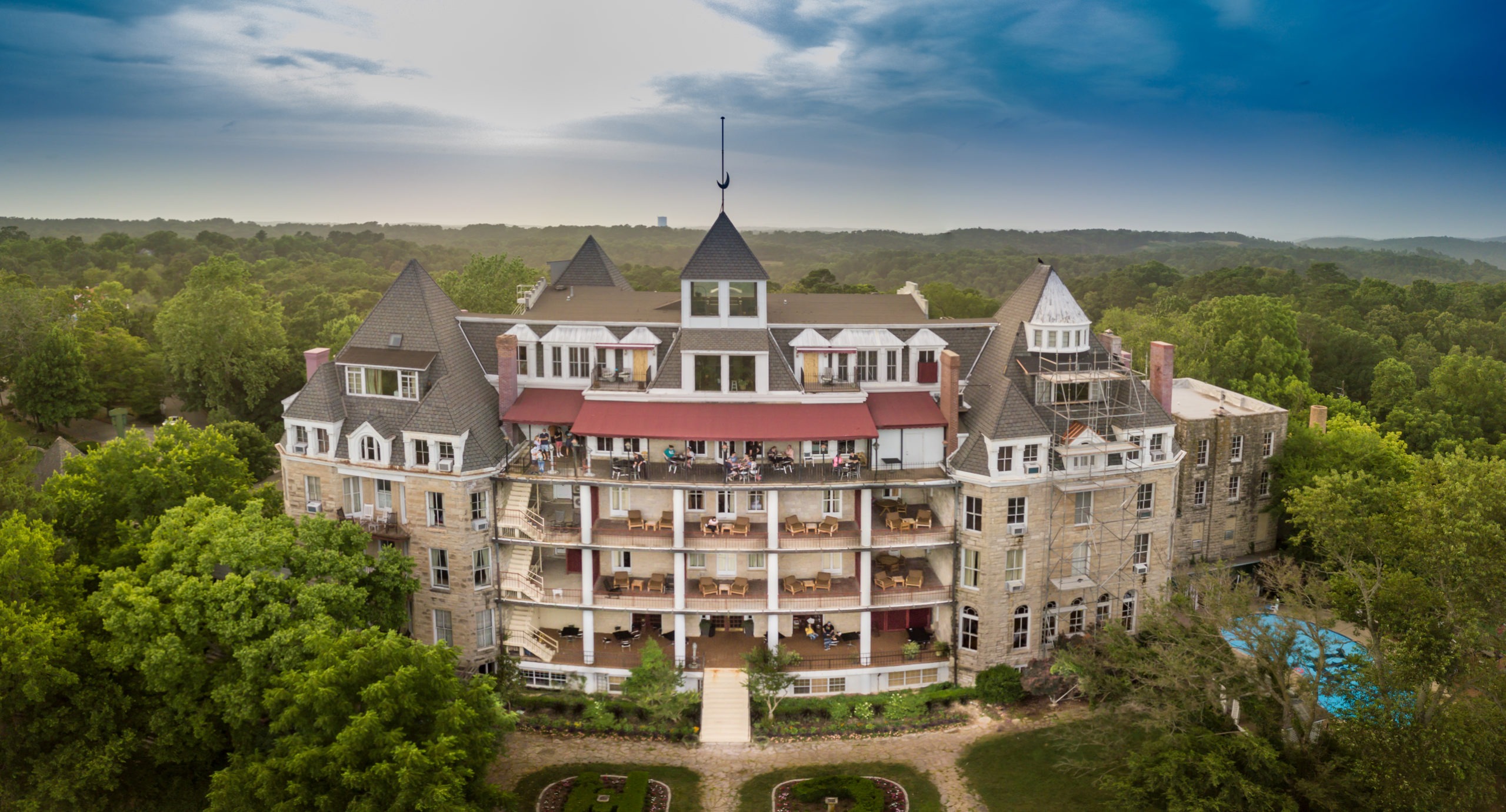
The Crescent Hotel
Perched on the crest of a limestone mountain overlooking the Victorian village of Eureka Springs, Arkansas, the 1886 Crescent Hotel commands the Ozark skyline like something lifted from a Gothic novel and dropped into the middle of the Bible Belt. Built from hand-cut limestone blocks so precisely fitted they required no mortar, the hotel rises in a blend of Richardsonian Romanesque and French Renaissance styling—arched windows, turrets, broad verandas, and a presence that can be seen from nearly anywhere in town. It was designed by architect Isaac S. Taylor, who would later design buildings for the 1904 St. Louis World's Fair, and funded by the Eureka Springs Improvement Company under former Arkansas governor Powell Clayton. When its doors opened on May 20, 1886, six hundred guests arrived from six states, greeted by a band stationed at the train depot. Eureka Springs had boomed almost overnight after its founding in 1879, drawn by sixty natural mineral springs that Native Americans had long known and that white settlers began marketing as miracle cures. By 1880, over fifteen thousand people had descended on the area. The Crescent was built to serve that wave—a luxury resort at nearly $300,000, the equivalent of roughly eight million dollars today. For its first two decades it operated as an exclusive destination, but interest in the springs faded, and the hotel couldn't sustain itself through the off-seasons. By 1902 it had been leased to the Frisco Railway. In 1908, it was converted into the Crescent College and Conservatory for Young Women, reportedly one of the finest women's seminaries in the country. That institution closed in 1924 for lack of funding, and a successor junior college folded during the Depression. By the mid-1930s, the grand hotel sat vacant and deteriorating. Then came Norman Baker. A former vaudeville performer and radio showman from Muscatine, Iowa, Baker had no medical training whatsoever but had already operated a fraudulent cancer clinic in his home state before being driven out. In 1937 he purchased the Crescent for $40,000 and transformed it into Baker's Cancer Curing Hospital, painting the interior in garish lavender and broadcasting his claims over the airwaves. His so-called treatments centered on injections of a concoction he called Formula 5—a mix of alcohol, carbolic acid, watermelon seed, corn silk, and clover leaves—administered up to seven times daily. Patients arrived from across the country, many spending their life savings on the promise of a painless cure. What they received was theater. At least forty-four patients died during the twenty months the hospital operated, their bodies moved to a basement morgue fashioned from the hotel's original kitchen, stored in the walk-in freezer. In 1940, federal authorities arrested Baker for mail fraud. He served four years in prison and died in Florida in 1958—of liver cancer. The hotel sat empty again until 1946, when new owners restored it to its original purpose. The paranormal reputation of the Crescent begins not with Baker but with the building itself. During construction in the 1880s, an Irish stonemason reportedly fell to his death from the upper framework into what is now Room 218. Staff have long referred to his spirit as Michael, and the room remains the most consistently active in the hotel. Guests report doors opening and slamming shut, pounding in the walls, the sound of a man falling through the ceiling, and, most disturbingly, hands emerging from the bathroom mirror. Room 419—known as Theodora's room—is associated with a former Baker patient who also worked as a hospital assistant. Guests find her straightening furniture or fumbling at the door as though searching for her key. On the third floor, witnesses describe the sound of squeaking wheels and the apparition of a nurse pushing a gurney down the corridor, only to watch it vanish. A young boy called Breckie, believed to have died from complications of appendicitis, has been seen bouncing a red ball on the second floor. In the hotel kitchen, a former chef reported pots and pans flying from their hooks, and another staff member witnessed a boy in old-fashioned knickers skipping through the room. Even Baker himself has reportedly been seen, appearing in his trademark white linen suit near the basement morgue. The morgue itself—still containing Baker's original autopsy table and walk-in cold storage—produces some of the most intense reports. Visitors describe oppressive atmosphere, sudden temperature drops, shadowy figures near the examination area, and the sensation of being touched by unseen hands. In 2019, groundskeepers digging near the hotel unearthed hundreds of glass bottles—remnants of Baker's operation—some containing preserved human tissue later confirmed by pathologists at the University of Arkansas for Medical Sciences. The discovery seemed to intensify reported activity, particularly in and around the morgue. Today the Crescent Hotel is owned by Elise Roenigk, who along with her late husband Marty purchased the property in 1997 for $1.3 million and undertook a six-year restoration. The hotel was listed on the National Register of Historic Places in 2016 and operates as a full-service resort and spa. It runs nightly ghost tours that draw over thirty-five thousand visitors annually, and hosts the Eureka Springs Paranormal Weekend each January. The morgue is open for public viewing. Room 218 books months in advance. The Crescent doesn't hide from what it is. It sets a place at the table for it.

Basin Park Hotel
Basin Park Hotel stands as a historic landmark in the Victorian resort town of Eureka Springs, Arkansas, representing a significant period of American hospitality and leisure culture from the early twentieth century. Constructed in 1905 during the height of the spa town's popularity as a destination for visitors seeking the mineral springs and cultural attractions that made Eureka Springs a fashionable retreat, the Basin Park Hotel was designed to accommodate affluent guests in considerable comfort and style. The hotel's location in the downtown district of Eureka Springs positioned it at the center of the town's social and commercial life, making it a natural gathering place for notable visitors, business people, and travelers passing through the region. The building's architecture reflects the elegant standards of the Edwardian era, with multiple stories rising above the surrounding streetscape and numerous guest rooms offering views of the picturesque surrounding landscape. As the twentieth century progressed and travel patterns shifted, Basin Park Hotel evolved from a purely resort destination into a year-round hospitality establishment, yet maintained its reputation as one of the most distinguished hotels in the Ozark region. The paranormal reputation of Basin Park Hotel developed gradually through the twentieth century, supported by documented reports of apparitions, unexplained cold spots, physical manifestations, and other phenomena concentrated in specific guest rooms and areas of the building. Room 310 has become particularly well-known among paranormal researchers as the location most strongly associated with the spirit of John Chisum, a historical figure whose presence is felt most acutely in that particular space. Guests and staff have reported sensations of being touched by unseen hands, sudden temperature drops, and occasional visual manifestations within Room 310, suggesting an intelligent presence aware of and interacting with those who enter the space. Room 308 has similarly gained attention for reports of physical sensations and paranormal contact, with guests describing the experience of being touched or experiencing pressure from an invisible source. The concentration of paranormal activity in specific numbered rooms, rather than throughout the hotel generally, suggests attachments between particular spirits and particular spaces. Beyond Rooms 310 and 308, additional paranormal phenomena have been documented in Rooms 408, 514, 515, 519, and throughout the hotel's third floor, creating a map of haunted spaces that encompasses a significant portion of the hotel's guest accommodations. The apparition of a young blonde woman has been reported in various locations throughout the building, described as appearing in old-fashioned clothing consistent with early twentieth-century styles, suggesting her death or strongest connection occurred during the hotel's earliest years of operation. The apparition of a small toddler girl has also been documented, with sightings concentrated in particular areas and suggesting the presence of a child who did not survive to adulthood. These apparitions appear to visitors with enough clarity to be described in detail, lending credibility to accounts that distinguish them from vague shadows or unconfirmed presences. In contemporary times, Basin Park Hotel has embraced its paranormal reputation as an element of its hospitality offering, organizing paranormal investigation experiences and ghost tours that operate on select evenings. The hotel provides investigators with access to areas typically off-limits to general guests, allowing for systematic documentation of phenomena and extended observation periods. The combination of historical significance, well-documented paranormal phenomena, professional investigation protocols, and multiple independent witness accounts has firmly established Basin Park Hotel as one of the most credible and thoroughly documented haunted hotels in American history.