
Haunted Places in Huntsville, Alabama
7 haunted locations
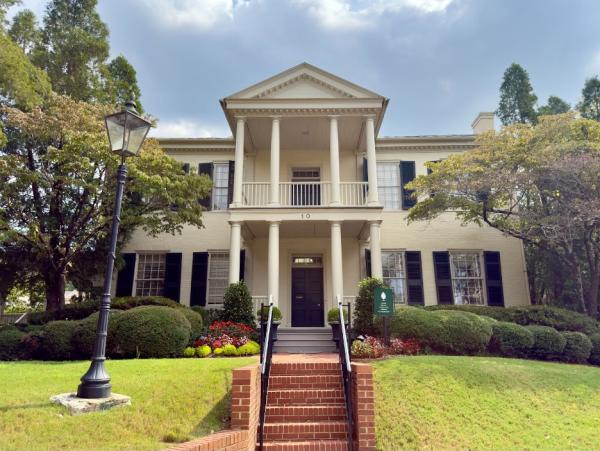
Cedarhurst Mansion
Tucked inside a quiet gated subdivision off Drake Avenue in Huntsville, Alabama, Cedarhurst Mansion doesn't announce itself the way haunted places often do. There are no rusted gates, no crumbling facades, no dramatic hilltop silhouette. What stands instead is a handsome two-story Federal-style structure built in 1823, its fifteen-inch-thick brick walls still solid after two centuries, now serving as a clubhouse for the surrounding residential community. It is a place that has aged gracefully on the outside while carrying, on the inside, one of the most persistently retold ghost stories in the entire state of Alabama. Stephen Ewing built Cedarhurst shortly after Alabama achieved statehood, making it one of the earliest substantial private residences in Huntsville. The Ewing family established themselves as prominent figures in the growing city, and the mansion reflected their standing — a well-proportioned, carefully constructed home in a region still finding its footing. By the 1820s and 1830s, Huntsville was developing rapidly, and properties like Cedarhurst represented the aspirations of its merchant and planter class. Ewing himself met an untimely end and did not enjoy his estate for long, leaving the mansion to pass through family hands. It was through those family connections that the defining event of Cedarhurst's history arrived. In 1837, a young woman named Sally Carter came to visit her sister Mary Ewing at the mansion. Sally was fifteen years old, just three weeks shy of her sixteenth birthday, when an unexpected illness overtook her during the stay. She became bedridden not long after arriving and died at Cedarhurst on November 28, 1837. She was buried on the property in the family cemetery plot, her grave marked with a stone that bore an epitaph reflecting the religious sensibilities of the era. The loss of a young woman in a household is not an uncommon tragedy for the antebellum South, but Sally Carter's story did not end with her burial. For decades, the grave sat quietly on the estate. The legend didn't fully ignite until 1919, when a seventeen-year-old boy from Dothan, Alabama, was visiting the mansion with his family and sleeping in the room that had once been Sally's. During a violent storm that night, he experienced what he described as a dream so vivid it barely felt like sleep. A tall girl with dark hair appeared before him and pleaded with him to help her — the wind had knocked her tombstone over, and she needed it set right. When he woke and told his family, they dismissed it as nothing more than a dream brought on by the weather. But the boy felt compelled enough to walk to the family cemetery and check. Sally Carter's headstone was face down in the grass. He returned to Dothan and, by most accounts, never came back to Huntsville again. That story became the foundation of a local legend that has only grown in the century since. Sally Carter became Huntsville's most famous ghost — a gentle, melancholy presence rather than a menacing one. Reports describe her spirit watching over children as they sleep, a behavior that tracks with the nature of her appearance in the 1919 account. Visitors and residents have described seeing a figure moving through the halls and across the grounds outside, always described as a young woman, always unhurried. Disembodied footsteps have been reported in empty corridors. Voices have been heard with no source. Electrical devices malfunction without explanation. Furniture has reportedly shifted position on its own. The cemetery itself became a focal point of curiosity for generations of Huntsville teenagers and paranormal enthusiasts, which eventually caused significant problems for the property. Repeated vandalism of Sally's grave led the family to make a difficult decision in 1982, when development of the surrounding subdivision began — they had her remains, along with others in the family plot, exhumed and relocated to Maple Hill Cemetery. The new location was never publicly disclosed. The vandalism stopped, but the sightings did not. Sally's presence, according to those who report it, seems tied to the house itself rather than to any grave. There is ongoing debate about the historical verifiability of Sally Carter's existence. Some researchers have found no official death records, birth records, or burial records under her name, pointing to this absence as evidence that the story is folklore rather than fact. Others note that record-keeping in rural Alabama in the 1830s was inconsistent at best, and that unmarked or poorly documented graves at Maple Hill are not unusual for that period. The epitaph on her original stone has been quoted in historical accounts, suggesting something physical once existed. Whether Sally Carter was a real person who died young or a legend that crystallized around a stone and a storm, the story has outlasted nearly everything else about the mansion's history. Today Cedarhurst is not open to the public. The gated community surrounding it means access is restricted to residents and their guests, and organized paranormal investigations of the property are not a regular feature. The mansion endures as a private space carrying a very public legend — a building that looks entirely ordinary from the outside and holds, according to the people who have spent time inside it, something that ordinary buildings do not. Whether that something is the restless spirit of a teenage girl who loved the estate enough to stay, or simply the accumulated weight of a story told for nearly two centuries, Cedarhurst Mansion remains one of the most quietly compelling haunted locations in the American South.

Maple Hill Cemetery
Maple Hill Cemetery represents one of the oldest and largest burial grounds in Huntsville, Alabama, having been established circa 1822 in the early decades of the city's settlement and development. The cemetery has served the community continuously for nearly two centuries, functioning as the primary burial ground for countless generations of Huntsville residents and their families across multiple centuries of American history. The property encompasses a substantial area within the urban landscape, with rolling terrain marked by mature trees, ornamental plantings, and grave markers representing multiple centuries of local history and genealogy. The cemetery's layout and landscape design reflect the Victorian and early twentieth-century aesthetic preferences for burial grounds, incorporating pathways, open spaces for contemplation, and structures designed to accommodate the ceremonies and observances traditionally conducted at grave sites during the nineteenth and twentieth centuries. The most celebrated and notorious feature of Maple Hill Cemetery is the Dead Children's Playground, a designation that derives from the tragic historical circumstances surrounding its creation and continued function. During the influenza pandemic of 1918, which swept across the entire North American continent with devastating consequences, particularly affecting children and young people, the city of Huntsville experienced significant mortality among its youth population. A considerable number of children who died from the flu in 1918 were interred in proximity to one another within the cemetery grounds, creating a cluster of juvenile burials that would define the location's spiritual and historical character. Subsequently, a playground area was developed near the location of these graves, reportedly without specific awareness of or sensitivity to the historical tragedy underlying the concentration of child burials in the vicinity. The juxtaposition of a place of recreational activity and childhood play with graves of children who died in the pandemic created an unusual spatial and emotional complexity that has defined the site's character and reputation for more than a century. Paranormal activity reported at the Dead Children's Playground area represents some of the most intensive and well-documented ghostly phenomena associated with any cemetery in the American South. Witnesses and visitors have reported observing multiple manifestations of supernatural activity centered on the playground equipment and the surrounding burial grounds. Most prominently, visitors have reported seeing the apparitions of child spirits engaged in activities of play and recreation, with observers describing the sight of children swinging on the playground equipment despite the absence of any visible individual producing this motion. Additionally, witnesses have reported hearing the sounds of children's voices, including shouting, laughter, and the auditory signatures of active play, emanating from the playground area during times when no living children were present. Glowing orbs of light have been observed moving through the cemetery grounds near the children's burials, appearing and disappearing according to patterns that suggest conscious agency or intelligent direction rather than random phenomena. Beyond the manifestations concentrated in the Dead Children's Playground area, the broader cemetery grounds have generated reports of additional paranormal entities and phenomena. Witnesses have reported encounters with a figure known as the Lady in White, an apparition described as a female entity clothed in white garments, observed moving through the cemetery grounds during nighttime hours in patterns consistent with mourning behavior. This manifestation, consistent with Lady in White traditions documented throughout paranormal lore in numerous locations across North America, has been associated with themes of mourning, loss, and maternal grief. Additional reports from cemetery visitors describe encounters with an angel apparition appearing in the vicinity of the cemetery's mausoleum structures, manifesting in forms described as luminous, hovering entities exhibiting characteristics associated with religious or celestial iconography. The cumulative effect of these varied paranormal reports has led to widespread designation of Maple Hill Cemetery as Alabama's most haunted cemetery site.
Frat House – Heritage Bible College
The Fraternity House at Heritage Bible College in Huntsville, Alabama represents a residential facility constructed to house male students enrolled in the college's academic programs while providing a structured living environment designed to foster community and social development. The building was constructed as part of the college's broader residential campus infrastructure, with multiple bedrooms, common areas, dining facilities, and bathroom facilities serving the students assigned to reside within the structure. The architectural design reflects early to mid-twentieth-century collegiate residential construction standards, with emphasis on functional space allocation and structural durability. The building has functioned as a residence for successive cohorts of college students, with the transient nature of student populations creating a constantly changing social environment while maintaining physical continuity. The college, as a Bible college, emphasized religious education and character development alongside academic curriculum, creating an institutional environment where spiritual and secular education were theoretically integrated. The history of the fraternity house encompasses decades of student residence, with varying levels of institutional oversight and student autonomy depending on the historical period and administrative policies. The college's religious mission influenced the character of student life, with expectations regarding moral conduct, substance use restrictions, and behavioral standards that differed from secular residential colleges. The tension between institutional authority seeking to maintain disciplinary standards and student populations seeking social autonomy created recurring points of conflict and negotiation. The specific individuals identified in paranormal reports associated with the fraternity house include Anthony Stephens, who served as a Youth Minister connected to the college, Robert Ekisbus, and Adam Cooper, identified as a student. The circumstances surrounding their presence as spirit entities suggest either tragic deaths occurring within the building or other traumatic events that created psychological attachment. Paranormal activity reported at the fraternity house includes disembodied footsteps heard by multiple witnesses in various locations within the building. Unexplained toilet flushing has been documented without apparent mechanical cause or user action, a phenomenon that has become characteristic of the location's reported paranormal activity. Mysterious noises have been heard within the building that witnesses have described, with one particularly unusual characterization involving a sound described as resembling "cheese." Apparitions have been observed by witnesses, though specific descriptions of the spirits' appearance remain limited in available documentation. The paranormal phenomena have been sufficiently consistent and numerous to create awareness among the college community. The identification of Anthony Stephens, Robert Ekisbus, and Adam Cooper as the spirits responsible raises questions about the circumstances surrounding their deaths or traumatic events that created spiritual attachments to the fraternity house. The involvement of a Youth Minister in the reported paranormal activity suggests possible connections between the college's religious mission and the spiritual manifestations, though the specific nature remains unclear. The characterization of one spirit as a student resident suggests the possibility of a death occurring during the individual's college years, potentially from accident or violence. The presence of multiple identified spirits suggests either multiple traumatic events or manifestations of individuals connected through varied historical periods. The Fraternity House at Heritage Bible College continues to function as a residential facility while operating within a context of documented paranormal activity. The paranormal reports have become integrated into student culture and informal campus narratives. The specific phenomena, particularly the unexplained toilet flushing and mysterious noises, have become iconic elements of the location's paranormal reputation. The spirits reported at the location continue to generate interest and investigation from paranormal researchers interested in the intersection of educational institutions and unexplained phenomena.
Dead Children’s Playground – Maple Hill Cemetery
Maple Hill Cemetery stands as one of Huntsville, Alabama's oldest and most significant burial grounds, its origins tracing back to the nineteenth century when the city was establishing its foundational institutions and infrastructure. The cemetery was established during an era when public burial grounds served essential functions for expanding communities, providing dedicated space for the interment of residents from all walks of life. Like many cemeteries of its age, Maple Hill Cemetery reflects the broader history of Huntsville during periods of significant growth and transformation, from the pre-Civil War era through subsequent decades of development and social change. The grounds themselves encompass multiple acres of carefully maintained landscape, with the oldest graves dating back to the 1800s, making it a repository of local history accessible through carved stone monuments and weathered epitaphs. Within the cemetery's boundaries sits a distinctive playground, an unusual feature that emerged from the cemetery's evolution as a communal space serving the surrounding neighborhood. The Dead Children's Playground, as it has come to be known by locals, occupies a parcel of the cemetery grounds where children's graves are concentrated, reflecting the historical reality that childhood mortality was tragically common during the nineteenth and early twentieth centuries. Diseases such as influenza, tuberculosis, diphtheria, and scarlet fever claimed countless young lives before modern medical advances and public health improvements reduced such mortality rates. The playground's existence in close proximity to children's burial sites created a spatial relationship between spaces of play and spaces of death, a reality that shaped the local understanding of the location. Whether established intentionally as a memorial space or simply by circumstance, the playground became inextricably linked with the graves surrounding it, creating a unique environment where recreation and remembrance existed in immediate proximity. The paranormal reputation of the Dead Children's Playground grew steadily over decades, nourished by reported encounters with the spirits of deceased children and adolescents. Witnesses have described apparitions of child-aged figures visible at various times, particularly during twilight hours and evening darkness. Poltergeist activity has been reported, with accounts of playground equipment moving of its own accord, swings activating without human presence, and objects being displaced or thrown inexplicably. Disembodied voices and laughter resembling children's sounds have been documented by visitors and paranormal investigators, often described as emanating from empty areas of the playground or surrounding grounds. Unexplained lights have been observed hovering above or moving through the cemetery grounds, particularly near concentrations of children's graves. These phenomena have transformed the Dead Children's Playground from a simple recreational space into one of Huntsville's most renowned paranormal locations, attracting investigators, curiosity seekers, and researchers interested in understanding the spiritual dimensions of this unique site. The current status of Maple Hill Cemetery and the Dead Children's Playground reflects the location's complex role in Huntsville's cultural landscape as both an active burial ground and a paranormal destination. The cemetery remains in operation, continuing to serve families and the broader community as a place for interment and remembrance. The playground continues to function as a recreational space, though its paranormal reputation is now widely recognized and documented. Paranormal investigation groups regularly request access to conduct documented research at the location, and the site has been featured in regional paranormal television programs and podcasts. Local historical societies have recognized the cemetery's significance as both a repository of Huntsville's past and as a location of ongoing folkloric and paranormal interest, making it an important example of how urban history, loss, and the spiritual realm intersect in contemporary American communities.
Kent Robertson Park
Reported haunted park in Huntsville, AL.
Hell’s Gates
Hell's Gates, located near the base of Green Mountain in Huntsville, Alabama, represents a peculiar intersection of landscape feature and paranormal legend that has generated significant local folklore despite the removal of the physical gates themselves. The location derived its name from a heavy, imposing set of black gates that once guarded a private driveway leading to a substantial mansion situated within the property. The gates themselves, with their dark coloring and substantial construction, created an intimidating appearance that invited speculation and mystery regarding the nature of the property they protected. The private nature of the property meant that few residents of surrounding communities possessed intimate knowledge of the estate's interior, creating an information vacuum that local folklore gradually filled with increasingly elaborate tales of paranormal and unusual activities. The decision by the property owner to eventually remove the gates did not dispel the location's paranormal reputation, as the place name and associated stories persist in local memory and continue to attract curious visitors and paranormal investigators despite the absence of the original architectural feature. The paranormal phenomena documented at Hell's Gates encompass a diverse range of experiences and manifestations that suggest a complex supernatural landscape. Most notably, visitors have reported encounters with a phantom automobile that manifests on the roadway approaching the location, traveling down the road with the expected appearance and behavior of a normal vehicle before abruptly vanishing without explanation. The phantom car appears deliberately designed to frighten witnesses, suggesting either prankish spiritual intent or the residual manifestation of a traumatic vehicular incident occurring at the location. Objects reportedly fly through the air as if thrown by an invisible force, exhibiting the classic characteristics of poltergeist phenomena. Remarkably, these projectiles apparently never strike the ground, suggesting phenomena that operate under different physical laws than normal gravity and impact. Visitors have documented mysterious chanting sounds emanating from the property, disembodied screams and whispers, and the sounds of running and walking when the location appears otherwise deserted. The Owens Cross Roads area immediately behind where the gates stood is consistently described by visitors as unnaturally cold, suggesting a thermal anomaly that paranormal researchers associate with spiritual manifestations requiring energy to generate physical phenomena. The convergence of multiple paranormal phenomena at a single location—visual apparitions, auditory manifestations, object movement, unusual temperature readings, and sensations of dread or being watched—indicates a location of significant paranormal intensity. The specific combination of phenomena suggests that Hell's Gates may represent a nexus where the boundary between the physical and spiritual worlds has become unusually permeable, allowing multiple types of paranormal manifestations to occur with relative frequency. The nature of the phenomena, particularly the phantom car and the chanting sounds, suggests possible connection to traumatic historical events, ritual activities, or the violent deaths of individuals whose spirits remain bound to the location. In contemporary times, Hell's Gates remains a destination for paranormal enthusiasts and curious visitors, despite the physical gates having been removed. Local folklore continues to preserve and transmit the stories and legends associated with the location, ensuring that new generations learn of the paranormal reputation even without the original architectural features that gave the place its distinctive name. Paranormal investigation groups have conducted investigations at the location, documenting experiences consistent with historical reports. The removal of the gates has not eliminated either the phenomena or the cultural memory associated with the location, illustrating how paranormal reputations become detached from the specific physical features that originally generated them and instead become embedded in landscape, place name, and community cultural memory. Hell's Gates continues to represent, in the collective consciousness of the Huntsville region, a location where the supernatural intrudes into the ordinary world with unusual frequency and intensity.
Old Dallas Mill Site
The Old Dallas Mill site in Grundy County, Tennessee represents the remains of an industrial facility that stood as a monument to the region's nineteenth-century economic development through manufacturing and textile production. The mill structure, which once rose prominently from the Tennessee landscape, functioned as a major employer and economic anchor for the surrounding region, processing raw materials into finished goods through mechanized industrial processes. The mill's physical presence—its substantial masonry construction, its towering architecture, its prominent position within the local landscape—established it as a defining feature of the region's physical and economic geography. The facility hummed with activity during operational hours, its machinery driven by water power or steam engines converting natural resources into commercial products. Inside the mill's spaces, workers moved among the mechanical equipment, performing repetitive tasks that required both skill and careful attention to avoid the dangers posed by high-speed machinery and industrial processes. The mill's operational years represented a particular moment in American industrial development, before modern safety regulations and occupational health protections became standard practice. The work environment within the mill exposed workers to significant occupational hazards that characterized industrial labor during the nineteenth and early twentieth centuries. The smoke stacks that rose above the mill's structure channeled the byproducts of combustion into the atmosphere, venting smoke and particulates that represented both the operational necessities of industrial production and a significant occupational hazard to workers in proximity to these structures. The cleaning and maintenance of the mill's smoke stacks represented a particularly dangerous occupational task, requiring workers to ascend within the confined vertical spaces of the stacks themselves to remove accumulated soot, debris, and structural obstructions. This work was conducted at substantial heights within enclosed spaces with poor ventilation, and represented a significant occupational hazard even by the relatively lenient standards of early industrial safety. The economic necessity that drove workers to perform these dangerous tasks reflected the economic desperation of many industrial laborers, who accepted hazardous working conditions in exchange for wages that their families required for subsistence. According to the documented paranormal history of the Dallas Mill site, a man met his death while performing the dangerous work of cleaning the mill's smoke stacks, apparently succumbing to asphyxiation, structural collapse, or some other traumatic occupational accident within the confined vertical space of the stack itself. The specific date and circumstances of his death, the identity of the deceased worker, and the precise mechanism of his fatality remain undocumented or poorly preserved in the fragmentary historical record of Grundy County's industrial past. The worker's death, occurring in a context of industrial necessity and economic desperation, appears to have impressed itself upon the spiritual geography of the mill site with particular force, anchoring his consciousness to the location where his life was violently terminated. A second paranormal presence also inhabits the mill site—a homeless individual who apparently lived within or in close proximity to the abandoned mill structure during the period after the facility ceased formal industrial operations. This individual, whose identity, lifespan, and specific circumstances of death remain entirely undocumented, became associated with the mill site through the basic human imperative to seek shelter within an available structure. The paranormal manifestations at the Old Dallas Mill site reflect the presence of these two individuals whose lives and deaths remained marginal to the historical record and whose deaths were not commemorated or officially documented. According to paranormal investigation and eyewitness accounts, the spirit of the man who died cleaning the smoke stacks continues to haunt the site, with manifestations concentrated in the areas where the mill's structural remnants remain visible and identifiable. The reports of haunting indicate that this spirit continues to be associated with the hazardous work that characterized his mortal employment, as if the traumatic nature of his occupational death bound his consciousness to the location where his labor ended catastrophically. The presence of the homeless individual who lived within the mill after its abandonment suggests another form of attachment to place—the bonds forged through survival, shelter-seeking, and the appropriation of abandoned industrial space as living quarters. The continuing presence of both spirits demonstrates how traumatic deaths, occupational accidents, and the marginal social position of working-class individuals and the homeless can generate paranormal manifestations that persist long after the physical structures where they occurred have deteriorated or been removed. The Old Dallas Mill site thus stands as a location transformed through paranormal activity from an abandoned industrial ruin into a documented paranormal location inhabited by spirits whose deaths exemplify the hazards of industrial labor and the precariousness of life for individuals without secure housing or economic stability. The site preserves, in the form of continuing paranormal manifestations, the memory of individuals whose lives and deaths would otherwise be entirely unknown and forgotten. The worker who died in the smoke stacks and the homeless individual who sought shelter within the mill structure become, through their paranormal presence, documented historical figures whose stories are recovered through investigation into the site's haunting phenomena. The Old Dallas Mill site remains accessible, visible in its ruined state, while simultaneously serving as a location where the spirits of industrial accident and homelessness continue to make their presence known to sensitive individuals and paranormal investigators who venture into the mill's spaces.