
Haunted Places in Dauphin Island, Alabama
2 haunted locations
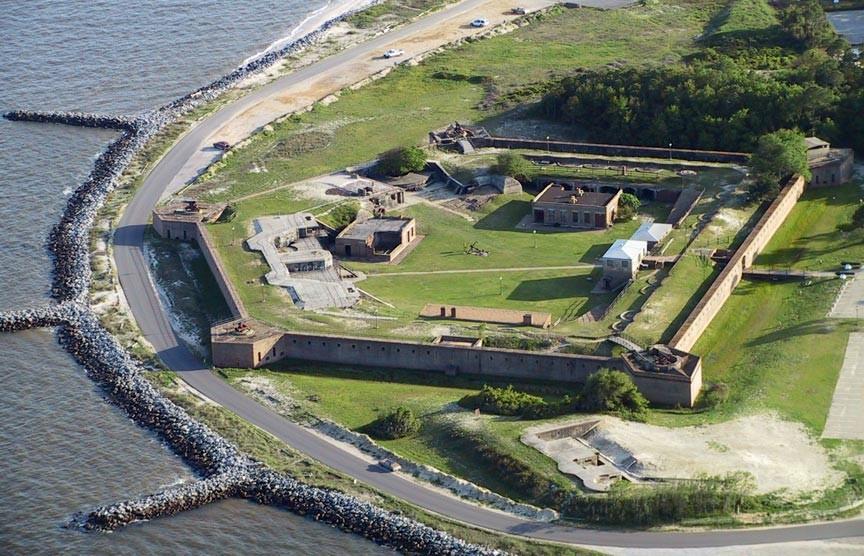
Fort Gaines
Sitting at the eastern tip of Dauphin Island where Mobile Bay meets the Gulf of Mexico, Fort Gaines occupies one of the most strategically loaded pieces of ground on the Alabama coast. The island itself carries death in its name. When French explorer Pierre Le Moyne d'Iberville arrived in 1699, he found so many sun-bleached human bones scattered across the shell mounds that he named the place Massacre Island. The name eventually softened to Dauphin Island, but the bones remained — remnants of Native American burial sites eroded and exposed by the sea. France, Spain, and Britain all used the island as a military platform at various points, each recognizing what the geography made obvious: whoever controlled this narrow strip of land controlled the entrance to Mobile Bay. The United States recognized it too. Following the War of 1812, Congress authorized a network of coastal fortifications along the southern shoreline, and Dauphin Island was identified as a critical position. Construction began in 1821 but lurched along for decades — plagued by poor engineering, flooded foundations, and funding gaps. A new design was ordered in the 1850s under chief engineer Joseph G. Totten, who drew up a five-sided masonry fort with 22.5-foot walls built to absorb artillery rather than shatter under it. Every one of the more than three million bricks had to be transported across the bay, since the island had no suitable clay. The fort was still incomplete when Alabama state militia seized it on January 5, 1861, six days before the state formally voted to leave the Union. Confederate engineers finished the work. Fort Gaines and Fort Morgan, sitting on opposite shores of the channel, formed a pair meant to strangle any naval approach to Mobile. By 1864, Mobile was one of the last Confederate ports open on the Gulf, and the Union was determined to close it. On August 5, Rear Admiral David Farragut led eighteen ships directly into the channel under the guns of both forts. When the ironclad USS Tecumseh struck a Confederate mine and sank almost instantly, Farragut reportedly shouted the order that has echoed through American history: "Damn the torpedoes — full speed ahead." The fleet punched through. Fort Gaines, pounded from sea and besieged from land, surrendered on August 8 with roughly 800 men taken prisoner — including a battalion of military cadets between twelve and sixteen years old from the Pelham Military Academy in Mobile. The fall of both forts sealed Mobile from the outside world and helped secure Abraham Lincoln's reelection that November. The fort remained in military use through both World Wars, serving as a coastal artillery installation and anti-aircraft gunnery school. It was sold to the City of Mobile in 1926, passed to the State of Alabama, and is now considered one of the best-preserved Civil War masonry forts in the country. The paranormal reputation of Fort Gaines draws from every layer of that long history. Visitors and investigators report a Confederate soldier seen standing at one of the cannons facing the water — motionless, as though still at his post. The old officers' quarters are cited as particularly active, with accounts of furniture moving, unexplained whispers filling empty rooms, and the persistent feeling of being watched. Cold spots appear without explanation in the tunnels connecting the bastions to the main courtyard. A dark shadowy figure has been reported following visitors through the inner buildings, vanishing when confronted. Paranormal researchers scouting for MTV's Fear series documented shadowy figures in photographs taken inside the walls, and the Mobile-based group SAPI has held annual ghost hunts at the fort for years. Beyond the fort itself, the ancient shell mounds on the island's eastern end — actual Native American burial sites used for centuries before European displacement — generate their own reports. Visitors describe faint drumming and chanting heard near the mounds after dark, and a blood-covered Native American apparition has been reported in the area. An older island legend speaks of a chief named Double Head who walked the beaches at night, leaving glowing phosphorescent footprints in the sand. Fort Gaines is open to the public. The guns still face the water. The brick walls still absorb the Gulf wind. And according to those who have spent time inside after the crowds leave, something in there hasn't fully stood down.

Indian Mound Park
Indian Mound Park on Dauphin Island, Alabama, encompasses one of the most archaeologically significant and spiritually resonant locations in the American South, representing millennia of indigenous occupation and sacred ceremonial practice. The park preserves two major earth mounds standing as tangible evidence of sophisticated civilizations flourishing throughout the Mississippi River Valley and Gulf Coast regions. The Ceremonial Woodland Mound reaches twenty-seven feet in height, constructed with deliberate architectural intent over generations of building and rebuilding by successive indigenous populations. The Oakville Copena Mound rises approximately twenty feet, representing a distinct archaeological tradition associated with the Woodland period of American prehistory. Together these mounds testify to considerable engineering knowledge, organizational capacity, and cultural significance characterizing the societies that constructed them. The mounds served as ceremonial and religious centers holding profound spiritual meaning for the peoples who built and maintained them. For more than a thousand years before European contact, the Dauphin Island area was occupied and utilized by diverse Native American groups, including the Creek, Yuchi, Shawnee, Chickasaw, and Cherokee nations at various points in history. The islands and coastal regions of the Gulf supported complex trading networks and seasonal occupation patterns, with different groups utilizing locations at different times for different purposes. The mounds represent accumulated sacred spaces of multiple distinct peoples, each adding their own ceremonial layers and spiritual investments to the structures. Archaeological evidence indicates the mounds were utilized for burials with elaborate ceremonial procedures, with elite members receiving special treatment. The spiritual beliefs centered on understanding landscape as imbued with sacred power, with certain locations recognized as particularly potent places where the boundary between physical and spiritual worlds remained permeable. Centuries of ceremonial activity, prayer, and spiritual practice created an environment of intense spiritual energy. The paranormal phenomena at Indian Mound Park appear rooted in profound spiritual significance of the location and intensity of indigenous ceremonial activities occurring there over centuries. Visitors and researchers have reported hearing ancient tribal music and chanting emanating from the mounds themselves, particularly during certain times of day or year when atmospheric conditions facilitate unusual acoustic phenomena. These auditory experiences are described as haunting and beautiful rather than frightening, representing echoes of ceremonial practices that once occurred within the sacred space. The sounds appear to rise from the earth itself, as if mounds have absorbed and retained spiritual energy of countless ceremonies that took place upon their surfaces. Visitors have reported feeling the presence of supernatural specters watching from the mounds, observing present-day visitors with apparent awareness and intentionality. Some individuals have experienced profound spiritual disturbances, including emotional responses ranging from overwhelming sadness to inexplicable joy. The manifestations appear to represent collective spiritual energy, the accumulated force of generations of indigenous people whose lives and deaths were intimately connected to these locations. The sound of tribal music and chanting heard without identifiable source may represent echoes of ancient ceremonies preserved within physical and spiritual structure of the mounds, continuing to resonate across centuries. The sensation of being watched appears to reflect continued spiritual guardianship by indigenous peoples who invested profound spiritual significance in these locations. The spiritual disturbances experienced by visitors may indicate the living presence of sacred power and continuing relevance of these locations as places where spiritual forces remain active and potent. The phenomena at Indian Mound Park offer testimony to enduring power of sacred places. In the modern era, Indian Mound Park remains protected as an archaeological and historical site, with the National Park Service and state agencies working to preserve the mounds and educate the public about their significance. The site has become a destination for those interested in Native American history, archaeology, and spiritual heritage of indigenous peoples in the Southeast. Paranormal researchers and spiritual seekers have documented unusual phenomena occurring at the site, bringing attention to the continuing spiritual significance of the location. The park serves as reminder of sophisticated civilizations flourishing in North America before European contact and of spiritual dimensions of human experience. For many visitors, Indian Mound Park represents a place where history, spirituality, and mystery of human experience converge, where voices and presences of the ancient past remain audible and visible to those approaching with awareness and respect.