
Haunted Places in Anniston, Alabama
3 haunted locations
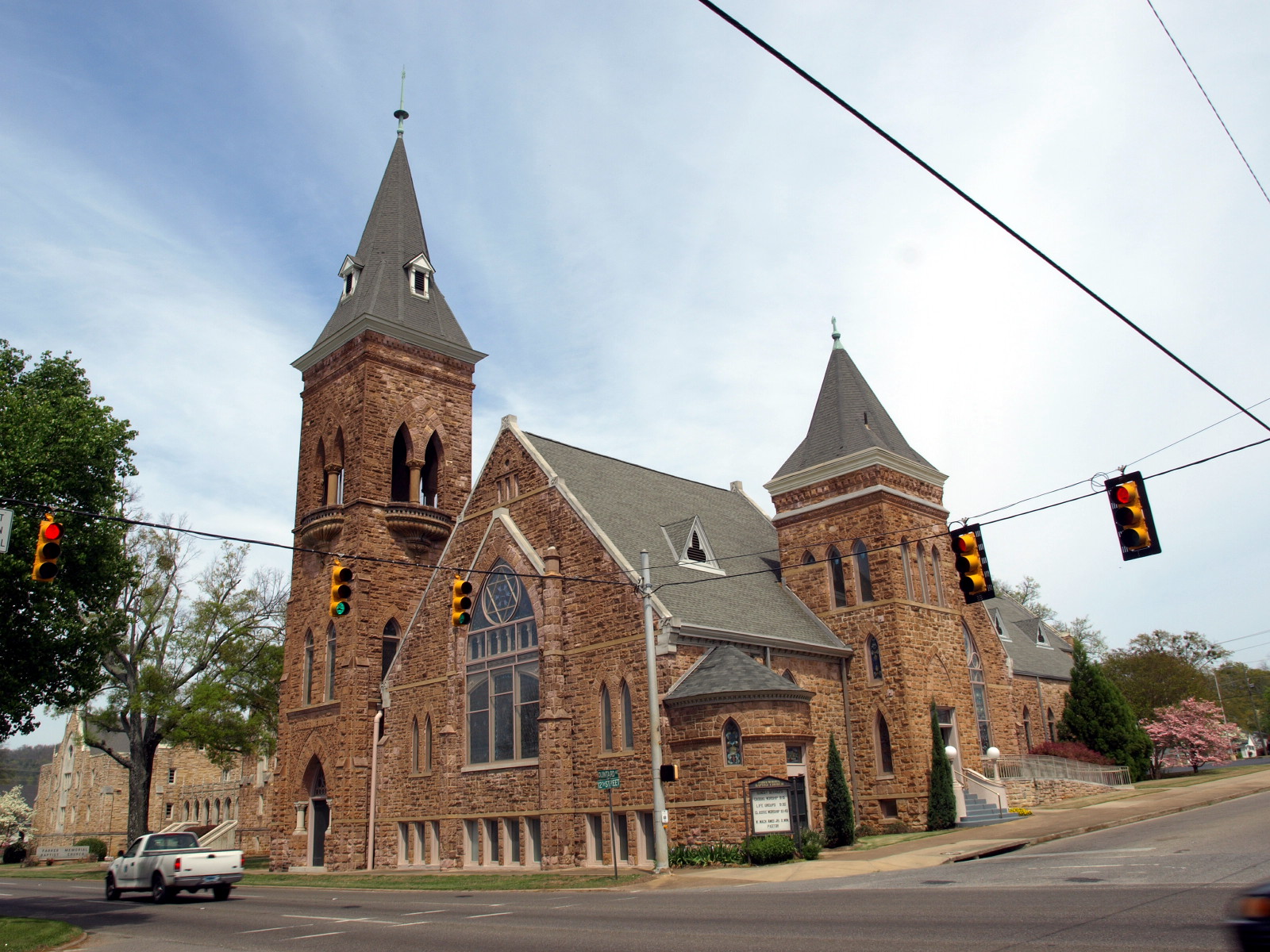
Parker Memorial Baptist Church
Standing along Quintard Avenue in Anniston, Alabama, Parker Memorial Baptist Church cuts a striking silhouette against the Calhoun County sky—a massive Victorian Gothic structure built of native pink sandstone, its corner tower and arched entryway pulling the eye upward in the tradition of grand 19th-century ecclesiastical architecture. It is a building that was never meant to project fear. It was built out of grief, funded by a man who lost everything he loved in the span of a few devastating months, and the weight of that origin has never fully left its walls. The congregation that would eventually call this building home first gathered on July 3, 1887, when 45 people met at the Opera House on Noble Street to organize a new church, originally called Second Baptist Church, before being renamed Twelfth Street Baptist when its location changed. The story of how it became Parker Memorial is one of the most quietly tragic founding narratives of any church in the state. Duncan T. Parker, founder and first president of First National Bank in Anniston, suffered a catastrophic personal loss in 1889. His young son died of pneumonia, and his wife Cornelia—who had served as the church's first organist—died of the same disease shortly after, her resistance already worn down from nursing a sick daughter through her own illness. Parker, devastated, offered to fund the construction of a new sanctuary as a memorial to his wife. The stained glass windows on the north and south sides of the sanctuary were his personal gifts to the congregation. Parker died shortly after construction began, but left instructions with his three daughters for the building's completion. The new building was dedicated in March of 1891. The result is a large masonry structure built in a late Victorian Gothic style, its exterior of randomly coursed native pink sandstone with belt courses, sills, coping, and steps of Kentucky blue stone. The arched main entrance is found in the northwest corner tower. Inside, the sanctuary retains the proportions and atmosphere of its era—soaring ceilings, rich woodwork, and the pipe organ that has become, over more than a century, one of the building's most persistently discussed features. The church was added to the Alabama Register of Landmarks and Heritage in 1981 and to the National Register of Historic Places in 1985. The paranormal claims surrounding Parker Memorial are modest by the standards of more widely documented haunted locations, but they carry an internal logic that connects directly to the building's founding story. The church has been described as reportedly haunted by a ghostly organ player who plays the chapel organ in the wee hours of the morning. Given that Cornelia Parker was herself the congregation's first organist—and that the church was built in her memory by a husband who died before seeing it completed—the specificity of that particular claim is difficult to dismiss entirely as random legend-making. Whether or not music actually drifts through the sanctuary after midnight, the image of a Victorian organist who never lived to see the church dedicated, tied forever to an instrument in a building raised in her honor, carries its own peculiar emotional resonance. The other claim in circulation is considerably less credible. At least one ghost website has proclaimed that the church is haunted by a nun who took her own life in the main hallway—a detail that doesn't survive even casual scrutiny given that this is a Southern Baptist congregation with no historic connection to Catholic religious life whatsoever. It is the kind of story that accumulates around old buildings the way moss does around stone, indifferent to whether it makes any sense. What gives Parker Memorial its genuine atmosphere isn't the folklore. It's the circumstances of its creation. A man who helped build a city lost his son and his wife to the same disease within weeks of each other, and responded by commissioning an $85,000 sandstone church he would never live to enter. His daughters completed it. His wife's organ was placed inside. The stained glass he paid for still filters the Alabama light. There is something melancholy and unresolved embedded in that sequence of events that no amount of skepticism can fully dispel. Buildings built to memorialize the dead have a different quality than buildings built for the living, and Parker Memorial Baptist Church has been, in a very literal sense, a monument to grief from the day its cornerstone was laid. Today the church remains an active Southern Baptist congregation and a legitimate piece of Anniston's architectural and civic heritage. The pink sandstone tower still anchors the Quintard Avenue streetscape. The stained glass still holds. Whether the organ plays on its own in the small hours is a question the congregation leaves largely unanswered. But for a building whose very name was spoken first in mourning, a little unresolved mystery seems entirely appropriate.

Stringfellow Memorial Hospital
Stringfellow Memorial Hospital stands as a significant medical institution in Anniston, Alabama, its brick and stone facade rising prominently in the historic downtown district where it remains a notable architectural presence. The hospital was established in the early twentieth century during an era when medical institutions underwent rapid expansion across the American South, responding to the growing healthcare needs of the region's expanding communities. Named after the Stringfellow family, prominent local philanthropists who contributed substantially to its construction and initial endowment, the hospital became a cornerstone of medical care for the region, housing surgical facilities and patient wards designed to reflect contemporary medical practice standards. Throughout its operational history, Stringfellow Memorial developed a respected reputation among patients and medical professionals, attracting physicians and healthcare workers from across the region who sought positions at this progressive institution. The institution's chapel served as an important spiritual center, with Mary Stringfellow, a devoted musician and accomplished organist, regularly performing at the organ. Her music became integral to the hospital's therapeutic atmosphere and daily rhythms, providing comfort to patients and creating a contemplative environment within the facility's walls. The building's architecture reflected both functional medical design and aesthetic consideration, with corridors connecting various departments, patient rooms positioned to maximize natural light and ventilation, and administrative spaces carefully organized to facilitate complex medical operations. The institution witnessed countless medical emergencies, patient recoveries, and ultimately, patient deaths spanning its operational decades. Among documented tragic events was a suicide that occurred within the facility's walls, an incident that marked the location with profound sorrow and became the subject of persistent local folklore and community remembrance. Staff members and visitors reported experiencing unusual paranormal phenomena in various hospital areas, with detailed documentation remaining largely anecdotal though the pattern of reports became increasingly consistent over many years. The accumulation of these accounts gradually established the facility's reputation extending beyond its primary medical mission into regional paranormal consciousness. Paranormal investigators have reported extensive anomalous activity throughout the hospital in recent decades. The chapel has been the site of organ music playing at night when no one is present at the instrument, with multiple witnesses describing Mary Stringfellow's favorite hymns echoing through empty spaces. Hallways throughout the facility host encounters with a distinctive headless apparition described as a tall masculine figure appearing suddenly before vanishing inexplicably. Facility call buttons have reportedly activated of their own accord, summoning nurses to rooms where no patient requires assistance. Windows have been consistently associated with distinctive knocking sounds from the exterior with no visible source. Investigators have documented missing files and records that later reappear mysteriously in unexpected locations throughout the building. Stringfellow Memorial Hospital continues operating as an active medical facility while carrying its substantial and well-documented paranormal reputation. The hospital remains open to patients requiring medical services, though its darker history has ensured its continued appearance in regional ghost story collections and paranormal research databases. The coexistence of modern medical practice with documented spiritual disturbance creates a unique institutional identity that balances scientific medicine with unexplained phenomena, making the hospital an ongoing subject of continued interest for paranormal researchers, local historians, and visitors.
Camp Cottaquilla
Camp Cottaquilla, situated along the scenic waterfront near Anniston, Alabama, occupies a portion of land steeped in indigenous history and local legend. The camp was established in the early twentieth century as a recreational facility for Girl Scouts, positioned to take advantage of the natural landscape surrounding a pristine alpine lake that has served the region for generations. The lake itself represents a focal point in the area's cultural memory, with accounts of native traditions and rituals stretching back centuries before European settlement. The camp facilities expanded over the decades, accommodating increasing numbers of scouts and visitors who came to engage in outdoor activities and character-building experiences typical of the organization's mission. The location, however, became associated with tragedy when documented drowning incidents claimed the lives of young visitors, marking the water with a somber historical record that locals would pass down through generations. The most persistent legend connected to Camp Cottaquilla involves a young girl scout who drowned in the lake under circumstances that remain somewhat unclear in local memory, though the incident left an indelible mark on the community's consciousness. Reports from the mid-twentieth century onward describe encounters with an apparition of a young girl, often characterized as wearing scout regalia, appearing in both the lake area and along the camp grounds during evening and nighttime hours. One of the most unusual cultural phenomena associated with the haunting emerged in local folklore during Halloween celebrations, when accounts described a one-armed girl scout appearing at nearby residences selling cookies, a spectral version of the organization's traditional fundraising activities. The imagery proved so distinctive that it became woven into the regional paranormal narrative and local Halloween traditions, passed down through families with each retelling adding layers to the original incident. Stories of mysterious lights flickering across the lake surface at night, disembodied voices calling out from the water, and the sound of footsteps on the camp's pathways when no visitors were present became standard elements of accounts from those who ventured to the location after dark. The native heritage of the region has also contributed to the layered folklore surrounding the camp, with references to an Indian Princess named Cottaquilla for whom the camp was named. Local oral tradition describes whispers in unfamiliar tongues emanating from various areas of the grounds, particularly near the lake, attributed by some to the spiritual presence of indigenous peoples displaced from their ancestral lands. These accounts suggest that the location may have significance extending far beyond the documented Girl Scout era, with spiritual unrest potentially rooted in centuries of human presence and loss. Whether these narratives derive from genuine paranormal phenomena or represent a cultural encoding of historical trauma, they have become inseparable from the camp's contemporary identity. In the present day, Camp Cottaquilla remains an intermittently active facility, with paranormal enthusiasts and paranormal investigation teams occasionally conducting research on the grounds with permission from management. Visitors and overnight visitors have reported ongoing experiences including apparitions of the ghostly girl scout, particularly near the lake shore and in residential cabin areas, disembodied voices that seem to respond to questions posed by investigators, and the sensation of being watched while traversing the wooded paths at dusk. Object movement has been documented in several instances, with reported incidents of camping equipment being displaced or arranged in unusual configurations. The legends have ensured that Camp Cottaquilla maintains prominent status within Alabama's paranormal tourism landscape, attracting investigators and curious visitors drawn to the intersection of native history, documented tragedy, and persistent phenomena.