
American Urban Legends & Haunted Folklore
2 haunted locations
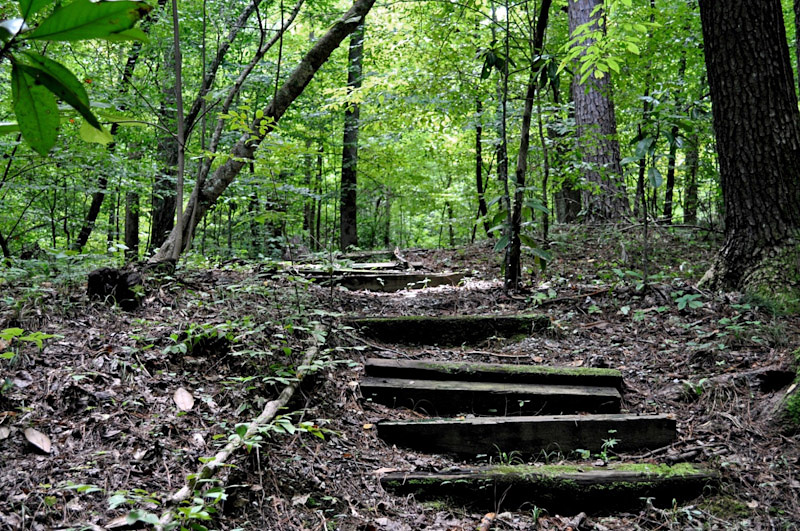
Nancy Mountain – Haines Mountain
Deep in the western reaches of Monroe County, Alabama, where the Alabama River bends through bottomland hardwood forest and the land rises in quiet, forested ridges above the water, there is a two-mile trail on a hill that locals have been calling Nancy's Mountain for generations. It sits within Haines Island Park, a 480-acre tract managed by the U.S. Army Corps of Engineers on the eastern bank of the Alabama River near the small community of Franklin. The park is not widely known outside the region. It has no dramatic overlooks, no landmark architecture, no interpretive museum. What it has is the river, the trees, a cable ferry that has been pulling vehicles across 300 yards of water since the 1830s, and a story that has outlasted every living person who first told it. The landscape itself is worth understanding before getting to the legend. This corner of Alabama sits in the Southern Red Hills, a geographic zone of steep, forested slopes rising above the river plain — unusual terrain for a state where much of the interior lies flat and open. Haines Island Park occupies that transitional ground, where the elevation climbs just enough above the Alabama River to create the kind of isolated, fog-wrapped ridge that naturally invites stories. The river has always been the arterial presence here. For most of American history, the Alabama River was the primary highway through this part of the state, carrying cotton downriver to Mobile and settlers upriver into the interior. Davis Ferry, which has operated at Haines Island in various forms for nearly two centuries, was one of the essential crossing points — a place where lives, cargo, and news traveled from one bank to the other. It was the kind of location that, in the mid-nineteenth century, a farming family might have settled specifically for the access it provided and the proximity to passing river traffic. The legend of Nancy begins in that period, set against the opening months of the Civil War. According to the oral tradition that has been passed down through Monroe County for well over a century, a woman named Nancy lived with her husband and their only son in a farmhouse on the mountain above the river. When the war came, the son enlisted in the Confederate Army and left. Months passed without word. Nancy, as the story goes, became increasingly distressed with each passing boat that arrived at the ferry landing without her boy aboard. Every day she walked down to the river to watch for him. Every day she returned without answers. Her husband, unable to watch her grief and unable to sit still, eventually left to search for the boy himself. Then the news came. Word reached Nancy that her husband had been found frozen to death near the grave of an unknown soldier somewhere in Tennessee — near Lookout Mountain, in some versions of the telling. He had died on his search, beside a grave that may or may not have held their son. No one ever confirmed the identity of the soldier buried there. The son's body was never recovered. Nancy, now alone on the mountain with neither husband nor child, reportedly continued walking — but the purpose of the walk changed. She carried a lantern and a pail of water, walking the trails of the mountain every night, waiting and searching and keeping vigil for a son who never came home. At some point Nancy herself disappeared. Her house fell to ruin and eventually vanished into the hillside. What remained was the mountain and the trail, and the accounts that began accumulating from people who walked it after dark. The reported phenomena at Nancy's Mountain are simple and consistent across decades of accounts. The most common sighting is a light — a lantern glow moving through the trees at night, bobbing as if carried by someone walking the trail, visible at a distance and then gone. Multiple visitors to the park, including local residents who grew up in the surrounding communities, have described seeing this light. Some have heard sounds that don't belong to the forest: footsteps on the trail, or something closer to a voice carried through the fog from the river. The apparition itself, when it appears to witnesses, presents as a woman in old-fashioned clothing moving through the trees, sometimes described as floating rather than walking, always carrying the lantern. Former park superintendent Ike Lyons documented multiple incidents over his tenure in which campers on the mountain abandoned their campsites in a panic after encountering what they described as a woman in period dress moving down the trail toward them. Animals have figured into the accounts as well. One writer who visited the trail with a large dog — a Labrador that had hiked dozens of trails without hesitation — found the animal refusing to move at the trailhead, sitting down and whimpering, unwilling to proceed up the mountain despite every encouragement. Whether that reflects something the dog sensed or simply the particular atmosphere of a foggy morning on a wooded hillside above the river is a question the story leaves open. The Nancy's Mountain Trail today is a two-mile loop within Haines Island Park, open from sunrise to sunset. The trailhead shares its parking area with the Davis Ferry landing, where the cable-guided boat still runs on weekdays, carrying a vehicle at a time across the Alabama River just as ferries have done at this spot since before Alabama was a state. The forest is dense and hardwood-heavy, particularly striking in autumn, and the trail climbs gradually through terrain that feels removed from the modern world in ways that go beyond simple quiet. The park is free. The ferry is free. The trail has no fee, no ranger station, no formal ghost tour. It is simply a path through the woods on a hill above an old river, in a county where the Civil War still echoes in the landscape and in the stories that people tell about it. Whether Nancy is out there or not, the mountain bears her name because something about this place, over many generations, has made the people who walk it feel like they are not entirely alone.

The White Lady of Wagarville
The White Lady of Wagarville has haunted the dirt roads outside Clearwater Cemetery near the small Alabama town of Wagarville for generations, manifesting as a phantom figure whose origins remain shrouded in regional folklore and paranormal documentation. The legend centers on a female apparition that materializes primarily between the hours of midnight and three o'clock in the morning, appearing clothed in a white dress that seems to glow with an otherworldly luminescence against the darkness of the rural roadways. Clearwater Cemetery itself stands as a modest burial ground that has served the Wagarville community since the nineteenth century, its tombstones weathered by time and marked with the names of families whose histories intertwine with the region's past. The specific circumstances that bound this spirit to the area remain unclear through historical records, though local accounts suggest a connection to loss or tragedy associated with the cemetery grounds itself. What sets the White Lady apart from other spectral phenomena is her apparent interaction with the physical world beyond mere visual manifestation. Motorcyclists and drivers have reported extraordinary encounters along the dirt roads bordering the cemetery, describing instances where their vehicles inexplicably roll backward despite being placed in neutral gear, as if an invisible force is actively manipulating mechanical systems. These incidents typically occur during the witching hours when the White Lady makes her nocturnal appearances, and the phenomenon has been documented by multiple witnesses over decades of reported sightings. Some accounts describe the figure attempting to communicate or indicate distress, while others characterize the phenomena as more chaotic and disruptive in nature. The apparition's repeated appearances at consistent times suggest a pattern of behavior rather than random paranormal activity, indicating a focused presence with established patterns of manifestation. The region surrounding Clearwater Cemetery and the adjoining roads has developed a reputation within paranormal investigation circles as a location where supernatural forces actively engage with the material world. Local residents have learned to treat encounters with the White Lady with a mixture of respect and caution, acknowledging her presence while maintaining a safe distance from the phenomena. The legend has persisted across generations of Wagarville families, passed down through oral tradition and documented in regional paranormal databases, establishing the White Lady as one of Alabama's most consistent and well-witnessed spectral entities. The repeated nature of the sightings, combined with the documented physical effects on vehicles, distinguishes this haunting from mere apparitional folklore and places it firmly within the realm of documented paranormal phenomena worthy of serious investigation and study.